Alexander Knaifel: Amicta Sole (ECM New Series 1731)

Amicta Sole

Alexander Knaifel
Amicta Sole

Mstislav Rostropovich cello
Tatiana Melentieva soprano
Soloists of Boy Choir Glinka Choral College
State Hermitage Orchestra
Arkady Steinlukht conductor
Psalm 51 recorded September 2001 at Propstei St. Gerold
Engineer: Stephan Schellmannn
Amicta Sole recorded July 2000 at St. Catherine Lutheran Church, St. Petersburg
Engineer: Semion Shugal
Produced by Manfred Eicher

The text is intoned as if it sounds. These, the simple instructions that composer Alexander Knaifel offers in the score of his Psalm 51 for cello solo. Dedicated to Mstislav Rostropovich, who also performs it in the present recording, the piece is as skeletal as its source: a sounding of spirit made flesh by mortal touch. While listeners may never hear the words, they will feel them in Rostropovich’s bow, poised as it is on a fulcrum of silence. Says Knaifel, “it is the only one and unique experience in my life when not a note was composed—in the fullest and most exact meaning of this word.” By this he admits no fallacy of the creative process, but instead reveals the divinity behind its cause. The internal is renderable only as an idol to itself, so that every dynamic of the cellist’s articulation seems destined to tremble. A climb into higher registers opens a flame’s pathos into vision and leaves one suspended in Heaven’s basement.

Like the burnt offerings of which the psalm concerns itself in its final stanza, the music scatters easily in the wind. That it holds true to form at all is proof of its spiritual integrity. Although the performer is singular, the incantation is sometimes plural. From piercing bridge crawls and vulnerable downward steps to interlocking pizzicati, every motion signals a diacritical reality. Rostropovich achieves all of this through his decades-long path toward mastery. For while the notecraft is almost as bare as the paper it is written on, Knaifel infuses every nodule with a word. Were we to plot each on an axis of pitch and time, they would form a rainbow arc through the firmament from birth to death. Only at the end does light creep in, pulling ever higher into the cello’s very threshold of audibility.

The papery consistency of Psalm 51 provides absorption of the ink in Amicta Sole (Clothed with the Sun) for soloist (female) of soloists. As a follower of the former’s grace, this starkly glassine piece speaks in angel’s tongue and awakens to angel’s ways. It is also performed here by its dedicatee, the inimitable soprano Tatiana Melentieva, who etches with her voice a denser light against a slow waterfall of strings and choral textures. Now that the texts are consciously sung, there is great movement from above to below, from interior to interior’s interior.

Inspired by the “woman clothed with the sun” who appears in Revelations, Amicta Sole sequences the genealogies of Christ as a helix between new prayer and ancient origins. The instruments perform the same role as the cello in Psalm 51, sounding the texts as if singing them, while the voices sing the texts as if sounding them. Melentieva’s art is so rich that she could very well carry these forces without their cushion, for she seems to summon legions of air before her. Despite the above connotations, what we have here is the full spectrum of earthly care, the weight of human conditions pressed upon our ears with the almost there-ness of a molt feather. And although we are invited to bask in the caesural nature of what transpires, stretched into barest triad, we can never be a part of its cathedral, where vibration and darkness dwell. The feeling of renewal is such that no architecture can stand here for so long as a breath (hear this in the flute’s red thread of color). Only in the harp is the promise of good news made manifest, and with it the uniform face of which our own are imperfect copies.

That the pieces here are from the mid-nineties, shaded by a lingering fog of the Soviet era, is only fleetingly significant. In them is a stillness of heart that reflects on troubled pasts. By the same token, their worth lies not in their politics, bleeding as it does through the reddest of paper with its own hues intact. At once reifying and transcending the corporeal waver that is its mirror, they are but two jewels in an eternal crown. 

Have mercy on me, O God, according to Thy great mercy,
and according to the multitude of Thy tender mercies
blot out my iniquity.

<< György Kurtág: Signs, Games and Messages (ECM 1730 NS)
>> Robin Williamson: The Seed-at-zero (
ECM 1732)

Luciano Berio: Voci (ECM New Series 1735)

Luciano Berio
Voci

Kim Kashkashian viola
Vienna Radio Symphony Orchestra
Luciano Berio conductor
Robyn Schulkowsky percussion
Recorded November 1999, ORF Studio, Vienna; May 2000, Teldec Studio, Berlin
Engineers: Josef Schütz and Peter Laenger
Produced by Manfred Eicher

The interest of Italian composer Luciano Berio (1925-2003) in folk music runs as deep as the grooves in his scores—trenches, rather, through which performers have been backpacking their talents since the latter half of the 20th century. In them are remnants of decay and sound intermingling with fantastical re-creations. Much of said interest has flowed through those earthly scars outward into other lands. French, Italian, Armenian, Azerbaijani, and American sources were all fair game in the path of his net, reaching notable culmination in his Folk Songs of 1964. The range of this touchstone composition places unenviable demands on the singer, who must convey respective flourishes and qualities as if they were her own. The brilliance of the piece lies less in Berio’s settings, per se, than in his decoupling of songs from their provenance. This act of displacement lends their motives clarity and reliability (an idea that would surely have been fresh for one who had just relocated to America for a series of teaching appointments). We can therefore assume that the settings were no mere archival gesture (two of the Folk Songs are his own), but rather a vibrant shuffling of idioms. In that world we encounter a roving gallery of maidens, fishermen, even a nightingale, and in each there is a new message. It is something of a comfort to know that, in the midst of this politically charged period, Berio remained true to roots as he saw them, even when they were not his own. The folk song was thus for him a found object. Like his contemporary Italo Calvino (who would write two librettos for the composer), Berio was an interdisciplinary storyteller who meshed experimental and traditional impulses, and in the process saw fit to fit what he saw.

Voci (1984) continues the thread first spun in Folk Songs, but stares deeper into the looking glass. As the center of this exemplary recording from ECM’s New Series, it radiates with warmth and tactile force. Its focus is on the sights, sounds, and smells of Sicily, and in them finds a suitable color palette from which to sketch and paint. Its inaugural gesture of bells and viola is not unlike the solo introduction to Ravel’s Tzigane in its thorough physicality. The analogy stops there, however, for Voci is anything but a showpiece. It rings in the air like the street calls, lullabies, and folk tunes that inspired it, minimally dressed. Violist Kim Kashkashian and the Vienna RSO are ideal and formidable interpreters, bringing renewed variety to the piece’s inherent textures as compared to the reference recording by Aldo Bennici (for whom it was written) fronting the London Sinfonietta. Kashkashian carries full orchestral weight in her bow, keening her way through the piece’s epic travels with confidence. Fragmentary dances and incantations trade hands, carving circuitous paths around an elusive center. The colorful blend of percussion (courtesy of the great Robyn Schulkowsky), winds, and strings surrounding her form a pastiche of rusticity that brims with practically excessive totality. This is not the careful revelry of the attentive archivist, but rather the unrest of the enraptured interpreter, translating, transforming, and deconstructing.

In a fitting stroke of programming panache, producer Manfred Eicher includes five field recordings from the very regions that so entranced Berio. Of these, the lament is especially magnetic. Mournful though it is, it also undergirds a heavy weight of realization: the folk song is no fleeting thing. Rather, it continues to sing itself into existence even in the absence of voices, working its way into the very soil and thrumming among the dead. This makes Kashkashian’s performance all the more worthy of praise, for she does what many singers have done before her with a shaft of hair, rosin, and four strings.

After this dive into “agro-pastoral” authenticity, we return to land in Naturale (1985), which combines the composer’s own song recordings with viola and percussion. Although more than a mere Voci redux, its effects are nearly identical, drawn as they are from the same starting point. The intimacy factor is higher, the mirror more polished, the sun lower in the sky.

As Berio would have been the first to admit, the “cannibalization” process by which these strains made their way into his meticulous constructions remain free from romantic visions of preservation and speak to a process of linear progression in the continued search for new directions through the fusion of disparate paths. We can be thankful that some of those paths lead straight into our ears.

<< Charles Lloyd: The Water Is Wide (ECM 1734)
>> András Schiff: Leoš Janáček – A Recollection (
ECM 1736 NS)

John Surman: Coruscating (ECM 1702)

Coruscating

John Surman
Coruscating

John Surman soprano and baritone saxophones, bass and contrabass clarinets
Chris Laurence double-bass
Rita Manning violin
Keith Pascoe violin
Bill Hawkes viola
Nick Cooper cello
Recorded January 1999 at CTS Studios, London
Engineer: Markus Heiland
Produced by Manfred Eicher

The title of John Surman’s Coruscating means sparkling. Yet with track names like “At Dusk,” “Moonless Midnight,” and “An Illusive Shadow,” we are squarely in a nocturnal realm. The multi-reedist, along with bassist Chris Laurence, puts his touch on this set of eight compositions, which over the album’s course blend into a seamless whole. At their center is an ad hoc string quartet, to which Surman and Laurence act as improvisatory satellites. The two aforementioned sections drop Surman’s oboe-like soprano into pre-written cuts of land, each a ripple in a lake that holds ebony sky in its cup.

Although it will not be surprising to any Surman fan, it is as baritonist—ever the rightful successor to Gerry Mulligan—that he comes closest to bringing the shine. Whether in the softly rolling sentiments of “Dark Corners” or the  muscular stirrings of “Stone Flower” (in memory of another baritone great, Harry Carney), his low reed dots the compass many times over through charcoal travels. “Winding Passages” is the most mature of these breeze-swept soliloquies and provides a solid platform for the composer’s bronzed hieroglyphs. Laurence shakes his most geometric ghosts out in “Crystal Walls,” while “For The Moment” mixes cello tracings into vibraphone, Surman’s restless gestures carrying us all the while into deeper pasture.

Those who weren’t quite feeling Proverbs and Songs might find Coruscating more accessible, if only because there is so much space for listeners to relax and, in spite of all the darkness, feel their way around. It is a dream of quotidian objects sleepwalking for want of a place to have purpose, only to discover that their wandering is that very thing.

<< Jan Garbarek/The Hilliard Ensemble: Mnemosyne (ECM 1700/01 NS)
>> Gianluigi Trovesi/Gianni Coscia: In cerca di cibo (
ECM 1703)

Anna Gourari: Canto Oscuro (ECM New Series 2255)

2255 X

Anna Gourari
Canto Oscuro

Anna Gourari piano
Recorded May 2011, Historischer Reitstadel, Neumarkt
Engineer: Stephan Schellmann
Produced by Manfred Eicher

Born 1972 to a family of musical pedagogues, Russian (and, since 1990, Munich-based) pianist Anna Gourari makes her ECM debut with a characteristically unconventional recital…or so it would seem. Two of J. S. Bach’s chorale preludes, as arranged by Ferruccio Busoni, parenthesize the program’s modern heart. “Ich ruf’ zu Dir, Herr Jesu Christ” and “Nun komm’ der Heiden Heiland” both come from the incomplete Orgelbüchlein, a pedagogical scrapbook compiled in the earthy 18th century. Busoni’s erudite touch burgeons further in Gourari’s, opening a doorway all the grander for being so austere. Yet here is a Bach that, while adorned, breathes with the minimalism of a single voice. The tenderness of these leaves betray nothing of the fragile limb to which they cling.

From light to brokenness, the program tilts its wings eastward to Sofia Gubaidulina’s Chaconne. Composed in 1962, this deconstruction of a b-minor triad represents an key period in the Russian composer’s development. One may be tempted to read grand philosophical statements of suffering into such music, when really it turns itself inside out for all to hear. This is not an evocation of suffering, per se, but an acknowledgment of its necessity. The effect is such that even the overt references to Bach come across as probing, strangely confident, and spiraled like a unicorn’s horn. Its elegiac impulse is foxed by ragged edges, given light in measured doses. Here is a lighthouse without a vessel to guide, a signal without a flare.

Paul Hindemith (1895-1963), a prolific composer yet one whose piano works have only in recent years begun to crop up on CD programs, is given plenty of space in Gourari’s ecstatic take on his Suite “1922.” Although its effect would surely have raised a few eyebrows that same year, as was Hindemith’s intention, today his experiment stands as a fascinating cross-section of early expressionism. Over the course of five parts, this jocular, if rigorous, piece takes us on a wild ride. Titles like “Shimmy,” “Boston,” and “Ragtime” transport the listener to a time when said dances still hit the floor, when financial doom was still some years away. Such historical perspective lends poignancy to the central movement, a “Nachtstück.” Like a fragment of title card found in the wreckage of a silent film warehouse, it tells only part of the story that its context makes abundantly clear. Hindemith’s references are seeds for more complexly developed ideas and beg comparison with contemporary George Antheil, whose own “Shimmy” graces Herbert Henck’s fascinating Piano Music. Gourari’s resolute command of, and passion for, the material makes this a benchmark recording.

Anna Gourari

Busoni resurrects Bach again in his supernal arrangement of the Chaconne from the solo violin Partita No. 2. The mighty Chaconne has always been a keystone in Bach’s solo literature. That it speaks with the same colors is testament both to arranger and performer. From the chord-enhanced arpeggios to the requisite drama throughout, Gourari allows the music to resound not by means of surface but interior. If Busoni has given it an elastic quality, then she has stretched it to the limit in an interpretation that promises to open new doorways with every listen.

Were this program a long day, Bach’s e-minor Prélude (transposed here to b minor) would be its longed-for slumber. In a stained glass arrangement courtesy of composer-conductor Alexander Siloti (1863-1945), this relatively small piece from the Clavier-Büchlein vor Wilhelm Friedemann Bach reminds us that duration has nothing to do with density. There is bounty in this music that one discovers through living it.

(To hear samples of Canto Oscuro, click here.)

Bach: Das Wohltemperierte Clavier – Schiff (ECM New Series 2270-73)

2270-73 X

Johann Sebastian Bach
Das Wohltemperierte Clavier

András Schiff piano
Recorded August 2011, Auditorio Radiotelevisione svizzera, Lugano
Engineer: Stephan Schellmann
Produced by Manfred Eicher

Johann Sebastian Bach’s The Well-tempered Clavier is more than a magnum opus. It’s an origin story. Practically speaking, it houses a prelude-fugue couplet for each of the 24 major and minor keys, twice over. Dated 1722 and 1742 respectively, Books I and II are the subjects of two earlier ECM New Series recordings by Keith Jarrett, while pianist Till Fellner has lent his shadows to Book I. Jarrett made the bold decision to record Book I on piano and Book II on harpsichord, thereby giving discernible substance to the two decades that separate them. Fellner’s poignant rendition is only half completed, and it remains to be seen whether the rest will reach market. Until then, label devotees have another.

In his marvelous liner notes, Paul Griffiths characterizes the WTC as “one of the central thoroughfares of western music.” He goes on to speak of prelude and fugue as gate and path or, another way, “Things in The Well-Tempered Clavier always come in pairs, but pairs that, unlike butterfly wings, display an essential asymmetry, if an asymmetry that will sound inevitable, even natural.” Doubtless, this asymmetry is inevitable, for it is the pollen that keeps Bach’s fields fragrant. As a renowned veteran of the composer, András Schiff dusts decades of return into these flora. For him the question is not whether to approach them as studio recording or as performance, because for him the two are inseparable. “To me, Bach’s music is not black and white; it’s full of colors,” he asserts. As in the cover art by Jan Jedlička, the music crosses lines in a deepening network of variation.

Schiff concludes his portion of the booklet with a note on pedal use—or, in his case, total lack thereof. The music is all the freer for it, the affectation a potent expressive tool. Like a digital photographer reverting to manual, Schiff’s process gives vision to its subject with meticulous care. Whether or not this creates a “purer” sound is entirely subjective, though one can hardly fault the sincerity of his choice, for indeed the pedal is often fantasy’s servant. In its place is a tasteful reverb, lacquered at Lugano’s Auditorio Radiotelevisione svizzera under the watch of engineer Stephan Schellmann.

Eschewment of pedal shortens the distance between attack and delay, making it more akin to human speech. Already, in the C major Prelude of Book I, we feel a linguistic touch speaking through those famous arpeggios as Schiff makes of the piano a syllabic organ, no mere percussive machine. His ability to distinguish palatal colors becomes further apparent in the A-flat major Prelude. Schiff’s hands-only approach lends pop and shine to the faster movements, and to the slower adds emotional weight. It also makes the rhythmic complexities glow. Whether the playful grinds of the C minor and C-sharp minor Fugues or the balance of taste and virtuosity of the D major Prelude, the relationship between medium and message becomes, again, inevitable the more one listens.

Perhaps most illuminating in this regard is the equal partnership of the left and right hands. Listen, for instance, to Schiff’s handling of the C-sharp minor Fugue ground, which folds words into sentences and sentences into stories, or the coalescence achieved in his E minor Prelude. From epic carriage to dulcet tickling, such nuances sweep the landscape free of its weeds. Other moments, like the F-sharp major Prelude, are the espresso in a latte universe. Also noteworthy are the extended trills, which Schiff varies to suit the mood at hand. Twirling like maple propellers at one moment (G minor Prelude) and methodically slow the next (F-sharp minor Fugue), they hold us captive at any speed.

Brilliant execution of the C major Prelude and C-sharp minor Fugue stand out in Book II, sounding at least like three hands. The sheer volume of intimacy in the D-sharp minor Prelude draws a comparable spiral of creative focus, and the famous F minor Prelude enchants, ghostly but tangible. The F-sharp major Prelude is yet another notable. This Schiff manages beautifully, shifting with perfect pacing between the dotted eighth-sixteenth couplets and moving into strings of sixteenths in this 3/4 piece. Likewise, his downward chromatic steps in the A minor Prelude are intuitively realized. The final Prelude and Fugue in B minor scintillate with new beginnings and good tidings. Thus, Schiff has locked us into Bach’s prism (especially in the E minor Prelude of Book II) with the precision of a Spirograph wheel and has held us there until the design can no longer repeat itself.

Happiness theorists believe that we become habituated to surpluses of pleasure or positive stimulation, to the point where even the most meaningful activities lose the value they once held. Bach’s WTC noshes on time with the same measured reflection that the iconic shepherd chews on his wheat stalk. In that idle motion is a world of temperament whose secrets will never be fully disclosed. Listening to this music today, it is easy to imagine how different our world is from the time in which it was written. The beauty of Schiff’s performance and Bach’s insightful writing is that, despite the potential infinitude of performances the score invites, at its heart is a survival instinct that will never falter so long as life walks this earth.

(To hear samples of this album, click here.)

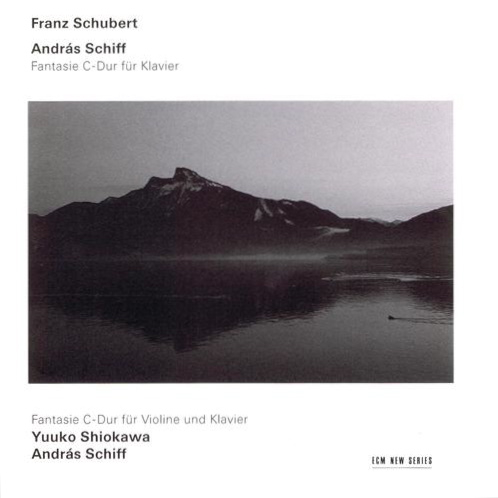
András Schiff: Schubert C-major Fantasies (ECM New Series 1699)

Schubert Fantasien

András Schiff
Franz Schubert C-major Fantasies

András Schiff piano
Yuuko Shiokawa violin
Recorded December 1998, Schloss Mondsee
Engineer: Stephan Schellmann
Produced by Manfred Eicher

It is tempting to say that the music of Franz Schubert (1797-1828) was ahead of its time. In the words of pianist András Schiff, “Schubert has such modernity—perhaps his time has only arrived now.” When encountering the 1822 “Wanderer” Fantasy for the first time, the characterization would seem to fit like a tailored suit. And yet, if we track its subsequent influence on composers as diverse as Liszt and Ligeti, it becomes clear that he was a composer of his moment, and it is this moment to which so many listeners have returned in their own wanderings. It might, then, be more accurate to say, “Modernity has such Schubert.”

In the first half of this recital disc for ECM, Schiff flows through the piece’s technical challenges like a river through a forest. As remarkable as this is, more intriguing are the ways in which he navigates its emotional mazes, for as a Schubert interpreter Schiff prefers poetry to drama. He gives requisite oomph to the magisterial introduction and from it elicits rounded gestures implying acres of pasture at a single touch of key. Yet his most commanding moments are the gentlest. Almost as still as mirrors, they reflect the leaf-patterned light that seeks them. Pulling away the vines, Schiff smells the moss, fecund with mystery. Knowledge of Schubert’s all-too-brief life inflects these passages darkly. From the spectral to the colloquial, the “Wanderer” spans the gamut of responses to landscape, though the Beethovenian desperation in the final fugue is undermined by an intermittent restraint that may sit oddly with fans of benchmark recordings like Richter’s or Pollini’s. Still, a resplendent sign-off gives the piece a total shape that is Schiff’s own.

His wife, violinist Yuuko Shiokawa, joins her partner for Schubert’s Fantasy D934, also in C major. Published posthumously in 1850, its proper score rested dormant beneath the recital stage until the 1930s. Emerging in a ghostly whisper, Shiokawa draws a spider’s thread through the piano’s microscopic tides. This is the dream to the former fantasy’s waking, made manifest through the strains of an inviting dance. Shiokawa brings appropriate balance of airiness and strident romanticism to what is arguably some of Schubert’s most beautiful writing. She partners well with the piano as a parallel voice—neither competing nor unified. Shiokawa also handles the technicalities with grace, particularly during a delightful passage that floats pizzicato in cascading undulations from Schiff’s fingers. Another flowery conclusion, if more succinct than the last, again closes the circle with confidence.

The recording here is noticeably soft in texture, heavy in the lower register. The combination sucks a bit of wind from Schubert’s sails in portions, especially in the finale of the “Wanderer.” Both Fantasies remain purest in their introductions and in their quieter turns. Such issues aside, with these two pieces Schubert shows that perhaps all music is fantasy.

<< Dave Holland Quintet: Prime Directive (ECM 1698)
>> Jan Garbarek/The Hilliard Ensemble: Mnemosyne (ECM 1700/01 NS
)

Bent Sørensen: Birds and Bells (ECM New Series 1665)

Birds and Bells

Bent Sørensen
Birds and Bells

Christian Lindberg trombone
Oslo Sinfonietta and Cikada
Christian Eggen conductor
Recorded October 1997 at NRK Studio, Oslo
Engineer: Audun Strype
Produced by Manfred Eicher

Visual practitioners have experimented with processes of decay for centuries. Their art has even become subject to it over time in varying degrees. Those working with sound, however, face different challenges in evoking the same. Electronic musicians have perhaps been most successful in this regard. Mike Sandison and Marcus Eoin, better known as Boards of Canada, often subject their creations to a sort of virtual oxidation whereby the music loses its sheen and welcomes blemishes and distortions into its fold. William Basinski inadvertently took this one step further when he captured the process live while recording what came to be known as the Disintegration Loops. And now we have Bent Sørensen, whose quasi-spectralist sound-world dons the ECM New Series cloak in this program of instrumental works.

Bent Sørensen

Most of the program places soloists inside an ad hoc group under the moniker Cikada Ensemble. The Lady and the Lark (1997) centers on viola amid a spray of other colors. And yet this series of five miniatures (the longest at three minutes) turns soloist into periphery, dotting a mandala-like framework with textured bodhisattvas. Amid fluttering intentions and water-drip effects, woodblocks touch the night with their toad-throated vibrations. Like paintings subjected to X-ray, they reveal underlying sketches. Such attention to microscopic detail further shapes the Funeral Procession for violin, viola and 6 instruments (1989), which similarly pulls up the carpet from the forest floor and shines a flashlight on all that squirms beneath. Like an astronomer, it focuses on the negative space as much as the stars, each nothing without its limpid backdrop.

By contrast, while The Deserted Churchyards for violin, cello, flute, clarinet, percussion and piano (1990) designates no central instruments, piano and flute act as quasar to its gaseous system. Their transcendent relays render invisible fissions audible. A tubular bell bends to the will of a shifting wind and drowns in a wisp of distance. From the title alone, one might imagine a still and neglected scene. We instead encounter a microbiome of scuttling activity. Desertion does not mean death; it means the freedom of kinesis to run its course unimpeded, except by its own zeal.

The Bells of Vineta for solo trombone (1990) dips freely into the Uncanny Valley. Christian Lindberg is the soloist, and his presence throughout is almost disturbingly vocal. With every muted slur he walks the line between cartoonish mockery and cathartic mourning. He travels with an eerie persistence in the tripartite title composition. Composed in 1995, it drops him into the larger palette of the Oslo Sinfonietta under the baton of Christian Eggen, who elicits a viscous, bleeding mosaic with wounds that sparkle from the touch of a healing ear. Each grows a tiny hand of light, plucking thorns of shadow from its own luminescent skin. Lindberg again animates his playing vocally, closing and separating to the pulse of a larger body. The result is a Doppler effect of the soul, the tinnitus of collected verses that make up any life. The occasional rhythmic passage cuts through the fog, each a tadpole swimming in the piano’s darkened well, a place where reality and childhood intermingle like ink and water, respectively. References to George Crumb, Gideon Lewensohn abound inside these cellular whispers, dreams yet to be dreamt and whose realization flowers with the tide’s recession.

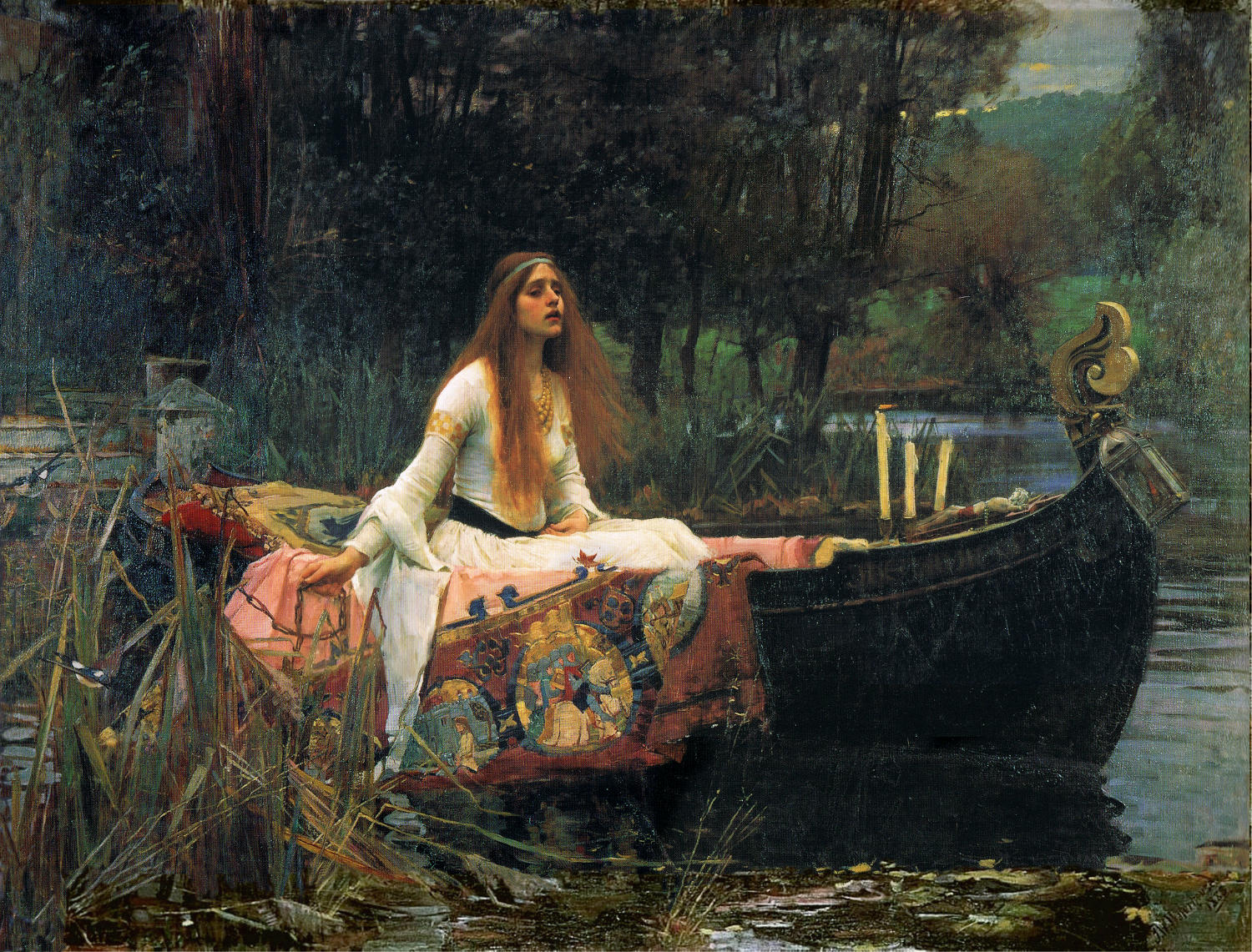
The Cikada Quartet draws a curtain with The Lady of Shalott (1993), which allows us to feel water and glass as if they were the same. Yet the cut of its passage is less like the boat in the famous John William Waterhouse painting…

Waterhouse Lady of Shalott

…and more like the threads in William Holman Hunt’s rendering, spilling from their loom with all the profusion of Christmas yet clipped by cerebral destruction. These are the paths we have taken, and they lead us all to where we began.

WHH Lady of Shalott

And on that note, these pieces, if only by virtue of their programming, exist as part of a phosphorescent whole. They arch their backs along the edge of a crescent moon, feeding off the oscillation of the night. By the humble touch of a fingertip to string and bone, their effect births as much as it dissolves. Though the foliage may change, the branches pulse in synapses of life. There is destiny in these leaves and it quivers with every verdant breath. In this music, sun and moon can touch each other without the slightest hint of destruction, for in that contact they acknowledge having been spun from the same breath.

<< Misha Alperin w/John Surman: First Impression (ECM 1664)
>> Keith Jarrett Trio: Tokyo ’96 (ECM 1666
)

John Surman: Proverbs and Songs (ECM 1639)

Proverbs and Songs

John Surman
Proverbs and Songs

John Surman baritone and soprano saxophones, bass clarinet
John Taylor organ
John Surman
Howard Moody conductor
Recorded live at Salisbury Cathedral, 1 June 1996
Engineer: Mike Walter
Produced by Derek Drescher and Manfred Eicher

Multi-reedist John Surman returns to his chorister roots and lays bare his compositional prowess with this oratorio commissioned by the Salisbury Festival and premiered in June of 1996. The Salisbury Festival Chorus, founded in 1987 by Howard Moody (of whose compositions the Hilliard Ensemble and Trio Mediaeval have been strong proponents) approaches its Old Testament sources as the composer sets them: that is, with panache, a flair for syncopation, and raw intensity. Add to this pianist John Taylor in an unexpected turn on cathedral organ, and you’ve got a recipe for one of Surman’s most intriguing catalogue entries to date.

Despite the forces assembled, it is he who dominates the palette. The “Prelude” immediately places his cantorial baritone amid a wash of organ in a free-flowing Byzantine mode, thereby establishing a rich narrative quality from the start. Our first foray into choral territory comes in the form of “The Sons,” a robust piece that works men’s and women’s voices in an iron forger’s antiphony toward genealogical harmony. At first, the thicketed singing feels more like a shoreline along which reed and pipes crash in pockets of light and bas-relief. Yet as the “The Kings” soon proves, it is capable of the jaunty togetherness at which Surman excels. “Wisdom” has its finger most firmly on this pulse of greater fellowship, for there is a wisdom of Surman’s own in the brushwork of his soprano, which dances for all the world like the world.

This being a live BBC Radio 3 recording that was later mixed down at Oslo’s Rainbow Studio, the quality is rather compressed. Then again, so is the music, the message of which is as dense as its King James texts. The album’s space is left to Taylor, its images to the voices, its method to Surman’s winds. There is a rusticity to the album’s sound that matches the unadulterated emotions of the music. We hear this especially in “Job,” which like its scripture upholds divine reason in the face of hardship. The chanting here is a form of punctuation, the snaking baritone lines its restless grammar.

“No Twilight” continues to unravel the sopranic weave in what amounts to the heart of the album, both in spirit and in execution, and places the voices at the slightest remove to haunting effect. Surman’s streaks of sunlight—here the voices of reason—add depth of field to this vision, so that the whimsical shallows of “Pride” emphasize the frivolity and fragility of their eponym. The truth comes out in the ruminative organ solo that epilogues the piece. “The Proverbs,” with its ominous recitation, is the freest and builds eddies of judgment and self-reflection (note Surman’s brilliant evocation of the dissenter) until the rays of sacrifice blind with “Abraham Arise!”

In light of the stellar body of choral work that ECM has produced, Surman’s forays into the same are not life-changing, if only because they are about unchanging life. True to the lessons at hand, it is more descriptive than it is aesthetic. Its juxtaposition of distinct sonic color schemes is pure Surman, and represents not a detour from but a dive into the kaleidoscope of his discography…and one well worth taking, at that.

<< Dino Saluzzi/Rosamunde Quartett: Kultrum (ECM 1638 NS)
>> Keith Jarrett: La Scala (ECM 1640
)

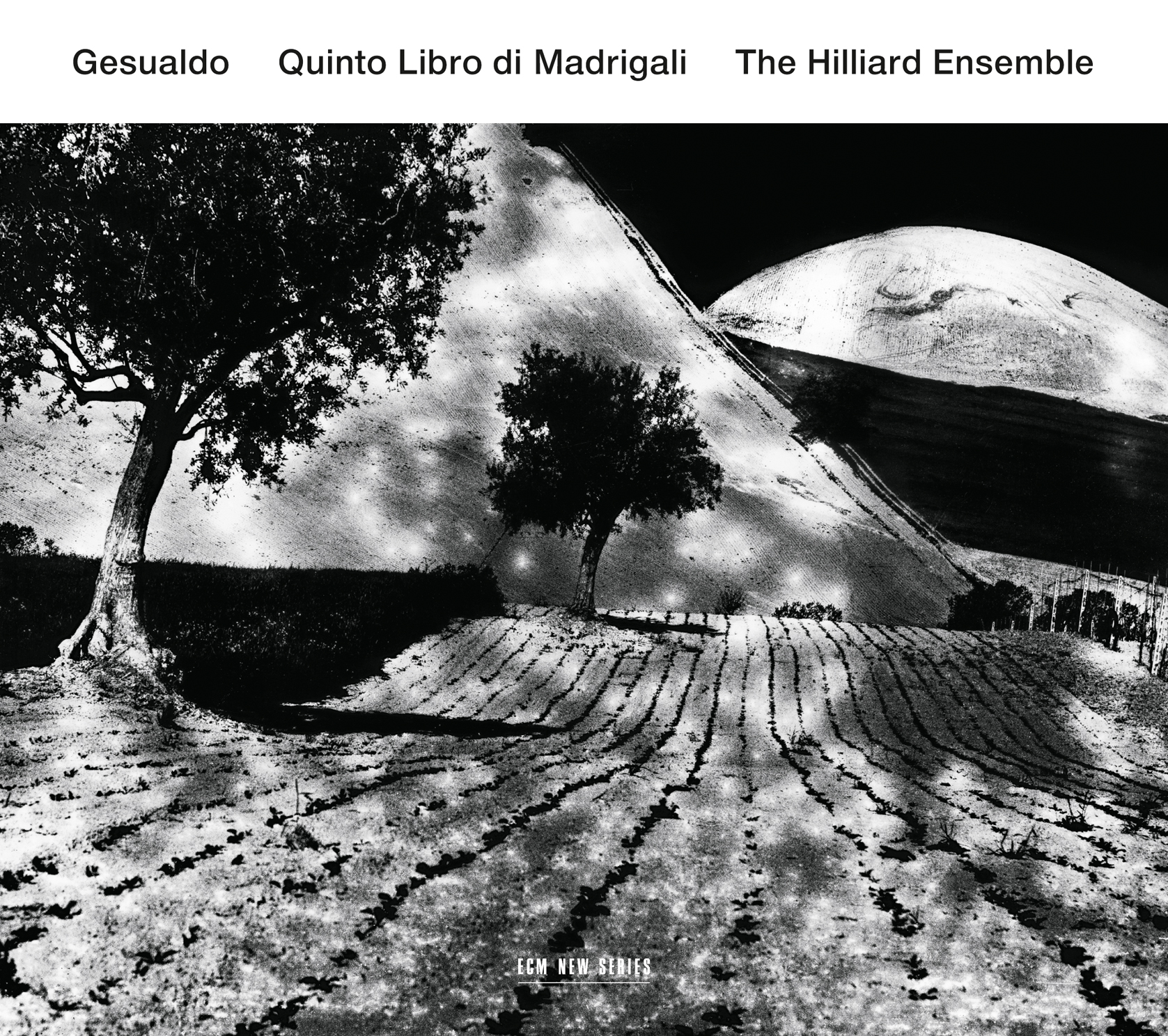
Gesualdo: Quinto Libro di Madrigali (ECM New Series 2175)

Gesualdo Madrigali

Carlo Gesualdo
Quinto Libro di Madrigali

The Hilliard Ensemble
Monika Mauch soprano
David James countertenor
David Gould countertenor
Rogers Covey-Crump tenor
Steven Harrold tenor
Gordon Jones baritone
Recorded November 2009 at Propstei St. Gerold
Engineer: Peter Laenger
Executive producer: Manfred Eicher

If my grief pains you,
only you, my soul,
can turn it all to joy.

On first hearing madrigals by Carlo Gesualdo (1566-1613), English writer Aldous Huxley proclaimed, “These voices—they’re a kind of bridge back to the human world.” In the mouths of the Hilliard Ensemble they certainly are. Baritone Gordon Jones cites the Prince of Venosa as a touchstone of the ensemble’s performing repertoire. And so, it is with practiced appreciation that they return to it as they take on his Fifth Book of Madrigals of 1611 in its entirety. Gesualdo finished his Sixth and final Book (he would leave fragments of an unfinished Seventh) in the same year, penning his first in 1594. Of the Fifth, Jones says, “The whole collection constitutes a gallery of dramatically lit portraits of human emotions with a heavy emphasis on the extremes of joy and despair.” On this note, the addition of soprano Monika Mauch and countertenor David Gould speaks to the range and color required of those extremes, and in this regard the ensemble emotes splendidly.

One can hardly discuss this music without mentioning its bold, mannerist dissonances. Written as it was by a man who had his wife and her lover murdered when he caught them in flagrante delicto and who subsequently receded into his own psycho-sonic cage, this can be no surprise. Even by today’s standards it rattles us. Yet to characterize Gesualdo’s output by so reductive a summation (dissonance, for example, was part and parcel of the madrigal idiom) would be to ignore the textually sensitive traditions of harmonic expansion upon which he built it. Despite being professedly “ahead of his time,” he was no enigma to his aristocratic contemporaries, being a particular favorite of Queen Christina of Sweden. For every gritty texture he loosed, a smoother one was in attendance, and we do well to remember the equal weight in both pans of the scale.

We have the Hilliard/ECM partnership to thank for already having done the composer justice with a sublime and direct rendition of his Tenebrae Responsories for the Christian Holy Week. Here that same trueness to the melodic line remains, and is so magnified by the bareness of its voices, by which the tortuousness we’ve come to expect lives by a more fluid name. If it lives anywhere, it is in the strange tenderness of Gioite voi col canto, which opens the collection with an autobiographical tinge:

Rejoice in song,
while I weep and sigh,
while tears choke my breath.
Alas, wretched heart of mine,
born for grief alone;
weep, but weep so much
that my mistress may be vanquished
by your tears, and then revert to seeing
my grief and pains in her.

The shifting tectonics of tenor lines and dulcet edge of Mauch’s gilding in the words’ weeping evocation is testament both to Gesualdo’s knack for comingling and to the sensitivity of the singers assembled at Propstei St. Gerold, where these works were so lovingly recorded. The charged weight of Itene, o miei sospiri rekindles these considerations, mixing “bitter weeping” with “loving song” in particularly adroit handling from the Hilliards. O dolorosa gioia falls into the same category of “painful joy,” a core theme of Book Five that finds further traction in Se vi duol il mio duolo. In both of these, the pathos of the text comes through tactfully. Death is another trope, as inescapable in the music as it is in us. From the heartfelt appeal of Occhi del mio cor vita (“Eyes, life of my heart”) and the lovesick resignation of Languisce al fin (“He who parts from his life languishes at last”) to the lachrymose accents of O tenebroso giorno (“O darkest day”), the music is practically dripping with it. Yet not all is so morose in this landscape, for there are also the flora of Felicissimo sonno, a heartfelt appeal to dreams as living threads to a love that cannot flourish in waking, and the intoxications of Correte, amanti, a prova (“Vie, lovers, in speed”) to soothe our weary countenances, to say nothing of the optimism that bids us a fond farewell in T’amo, mia vita (“I love you, my life”).

A small handful of these 21 madrigals stands out. The snaking turns of Mercè grido piangendo (“Have pity on me! I cry weeping”) showcase the coolness of the Hilliard’s peerless blend to the utmost, while the prototypically Gesualdan Tu m’uccidi, o crudele (“You are killing me, o cruel woman”) pulls out all the stops in its affective toolkit, achieving moments of sublime light. Finally, Se tu fuggi, io non resto, with its fluttering vowels and tight syncopations breathes with expert realization, even as its narrative voice bids us leave on the wings of cruelty.

Due to the subject matter and sheer variety of invention, and despite the pitch-perfect performances, this is no mere soundtrack for an idle afternoon. It asks us to steep in its brew until we begin to take on a bit of its flavor. Those who find beauty in the Tenebrae may encounter discomfort in these secular woes. But if this discomfort has anything to teach us, it is that the act of living depends on that very thing.