Bent Sørensen: Birds and Bells (ECM New Series 1665)

Birds and Bells

Bent Sørensen
Birds and Bells

Christian Lindberg trombone
Oslo Sinfonietta and Cikada
Christian Eggen conductor
Recorded October 1997 at NRK Studio, Oslo
Engineer: Audun Strype
Produced by Manfred Eicher

Visual practitioners have experimented with processes of decay for centuries. Their art has even become subject to it over time in varying degrees. Those working with sound, however, face different challenges in evoking the same. Electronic musicians have perhaps been most successful in this regard. Mike Sandison and Marcus Eoin, better known as Boards of Canada, often subject their creations to a sort of virtual oxidation whereby the music loses its sheen and welcomes blemishes and distortions into its fold. William Basinski inadvertently took this one step further when he captured the process live while recording what came to be known as the Disintegration Loops. And now we have Bent Sørensen, whose quasi-spectralist sound-world dons the ECM New Series cloak in this program of instrumental works.

Bent Sørensen

Most of the program places soloists inside an ad hoc group under the moniker Cikada Ensemble. The Lady and the Lark (1997) centers on viola amid a spray of other colors. And yet this series of five miniatures (the longest at three minutes) turns soloist into periphery, dotting a mandala-like framework with textured bodhisattvas. Amid fluttering intentions and water-drip effects, woodblocks touch the night with their toad-throated vibrations. Like paintings subjected to X-ray, they reveal underlying sketches. Such attention to microscopic detail further shapes the Funeral Procession for violin, viola and 6 instruments (1989), which similarly pulls up the carpet from the forest floor and shines a flashlight on all that squirms beneath. Like an astronomer, it focuses on the negative space as much as the stars, each nothing without its limpid backdrop.

By contrast, while The Deserted Churchyards for violin, cello, flute, clarinet, percussion and piano (1990) designates no central instruments, piano and flute act as quasar to its gaseous system. Their transcendent relays render invisible fissions audible. A tubular bell bends to the will of a shifting wind and drowns in a wisp of distance. From the title alone, one might imagine a still and neglected scene. We instead encounter a microbiome of scuttling activity. Desertion does not mean death; it means the freedom of kinesis to run its course unimpeded, except by its own zeal.

The Bells of Vineta for solo trombone (1990) dips freely into the Uncanny Valley. Christian Lindberg is the soloist, and his presence throughout is almost disturbingly vocal. With every muted slur he walks the line between cartoonish mockery and cathartic mourning. He travels with an eerie persistence in the tripartite title composition. Composed in 1995, it drops him into the larger palette of the Oslo Sinfonietta under the baton of Christian Eggen, who elicits a viscous, bleeding mosaic with wounds that sparkle from the touch of a healing ear. Each grows a tiny hand of light, plucking thorns of shadow from its own luminescent skin. Lindberg again animates his playing vocally, closing and separating to the pulse of a larger body. The result is a Doppler effect of the soul, the tinnitus of collected verses that make up any life. The occasional rhythmic passage cuts through the fog, each a tadpole swimming in the piano’s darkened well, a place where reality and childhood intermingle like ink and water, respectively. References to George Crumb, Gideon Lewensohn abound inside these cellular whispers, dreams yet to be dreamt and whose realization flowers with the tide’s recession.

The Cikada Quartet draws a curtain with The Lady of Shalott (1993), which allows us to feel water and glass as if they were the same. Yet the cut of its passage is less like the boat in the famous John William Waterhouse painting…
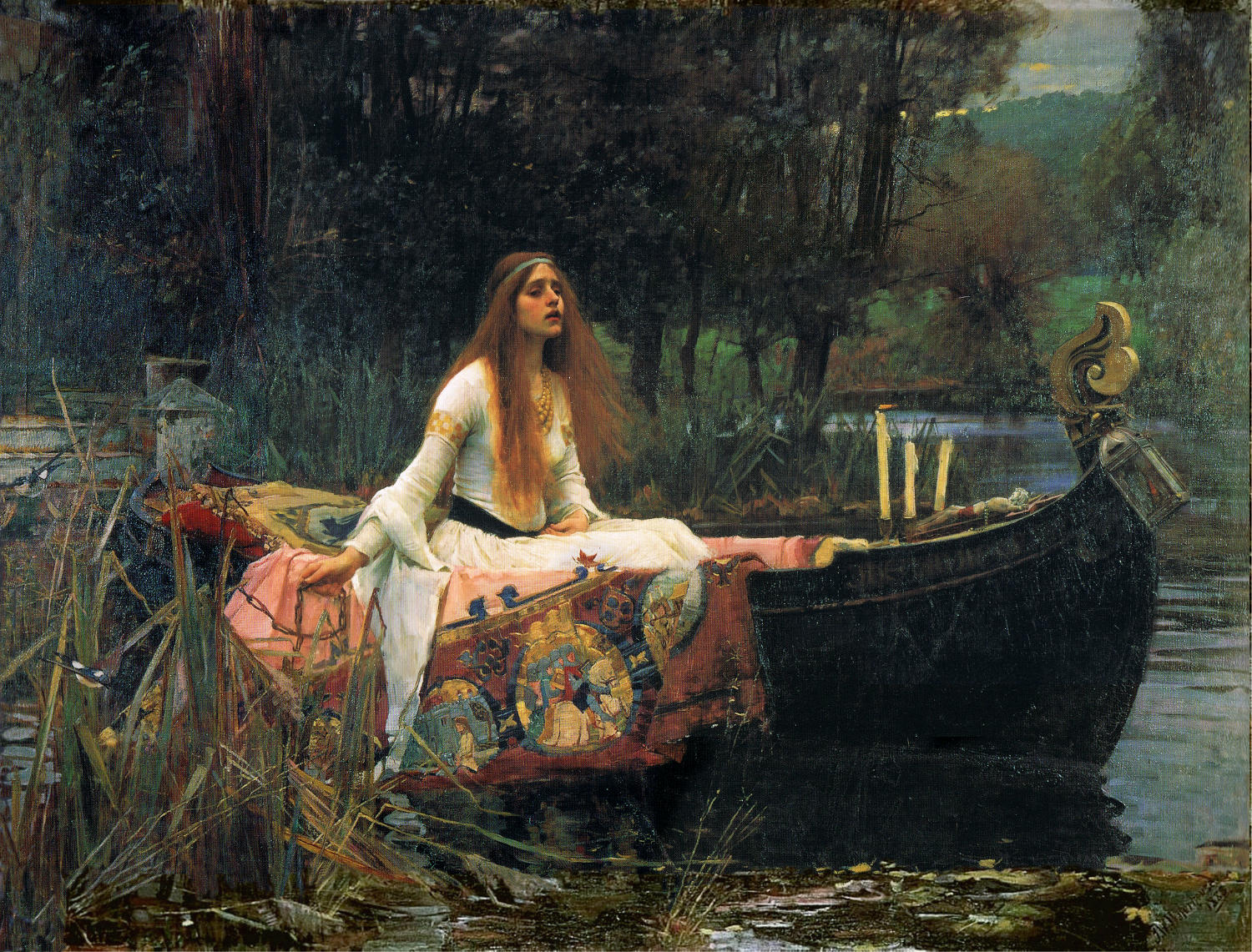
Waterhouse Lady of Shalott

…and more like the threads in William Holman Hunt’s rendering, spilling from their loom with all the profusion of Christmas yet clipped by cerebral destruction. These are the paths we have taken, and they lead us all to where we began.

WHH Lady of Shalott

And on that note, these pieces, if only by virtue of their programming, exist as part of a phosphorescent whole. They arch their backs along the edge of a crescent moon, feeding off the oscillation of the night. By the humble touch of a fingertip to string and bone, their effect births as much as it dissolves. Though the foliage may change, the branches pulse in synapses of life. There is destiny in these leaves and it quivers with every verdant breath. In this music, sun and moon can touch each other without the slightest hint of destruction, for in that contact they acknowledge having been spun from the same breath.

<< Misha Alperin w/John Surman: First Impression (ECM 1664)
>> Keith Jarrett Trio: Tokyo ’96 (ECM 1666
)

John Surman: Proverbs and Songs (ECM 1639)

Proverbs and Songs

John Surman
Proverbs and Songs

John Surman baritone and soprano saxophones, bass clarinet
John Taylor organ
John Surman
Howard Moody conductor
Recorded live at Salisbury Cathedral, 1 June 1996
Engineer: Mike Walter
Produced by Derek Drescher and Manfred Eicher

Multi-reedist John Surman returns to his chorister roots and lays bare his compositional prowess with this oratorio commissioned by the Salisbury Festival and premiered in June of 1996. The Salisbury Festival Chorus, founded in 1987 by Howard Moody (of whose compositions the Hilliard Ensemble and Trio Mediaeval have been strong proponents) approaches its Old Testament sources as the composer sets them: that is, with panache, a flair for syncopation, and raw intensity. Add to this pianist John Taylor in an unexpected turn on cathedral organ, and you’ve got a recipe for one of Surman’s most intriguing catalogue entries to date.

Despite the forces assembled, it is he who dominates the palette. The “Prelude” immediately places his cantorial baritone amid a wash of organ in a free-flowing Byzantine mode, thereby establishing a rich narrative quality from the start. Our first foray into choral territory comes in the form of “The Sons,” a robust piece that works men’s and women’s voices in an iron forger’s antiphony toward genealogical harmony. At first, the thicketed singing feels more like a shoreline along which reed and pipes crash in pockets of light and bas-relief. Yet as the “The Kings” soon proves, it is capable of the jaunty togetherness at which Surman excels. “Wisdom” has its finger most firmly on this pulse of greater fellowship, for there is a wisdom of Surman’s own in the brushwork of his soprano, which dances for all the world like the world.

This being a live BBC Radio 3 recording that was later mixed down at Oslo’s Rainbow Studio, the quality is rather compressed. Then again, so is the music, the message of which is as dense as its King James texts. The album’s space is left to Taylor, its images to the voices, its method to Surman’s winds. There is a rusticity to the album’s sound that matches the unadulterated emotions of the music. We hear this especially in “Job,” which like its scripture upholds divine reason in the face of hardship. The chanting here is a form of punctuation, the snaking baritone lines its restless grammar.

“No Twilight” continues to unravel the sopranic weave in what amounts to the heart of the album, both in spirit and in execution, and places the voices at the slightest remove to haunting effect. Surman’s streaks of sunlight—here the voices of reason—add depth of field to this vision, so that the whimsical shallows of “Pride” emphasize the frivolity and fragility of their eponym. The truth comes out in the ruminative organ solo that epilogues the piece. “The Proverbs,” with its ominous recitation, is the freest and builds eddies of judgment and self-reflection (note Surman’s brilliant evocation of the dissenter) until the rays of sacrifice blind with “Abraham Arise!”

In light of the stellar body of choral work that ECM has produced, Surman’s forays into the same are not life-changing, if only because they are about unchanging life. True to the lessons at hand, it is more descriptive than it is aesthetic. Its juxtaposition of distinct sonic color schemes is pure Surman, and represents not a detour from but a dive into the kaleidoscope of his discography…and one well worth taking, at that.

<< Dino Saluzzi/Rosamunde Quartett: Kultrum (ECM 1638 NS)
>> Keith Jarrett: La Scala (ECM 1640
)

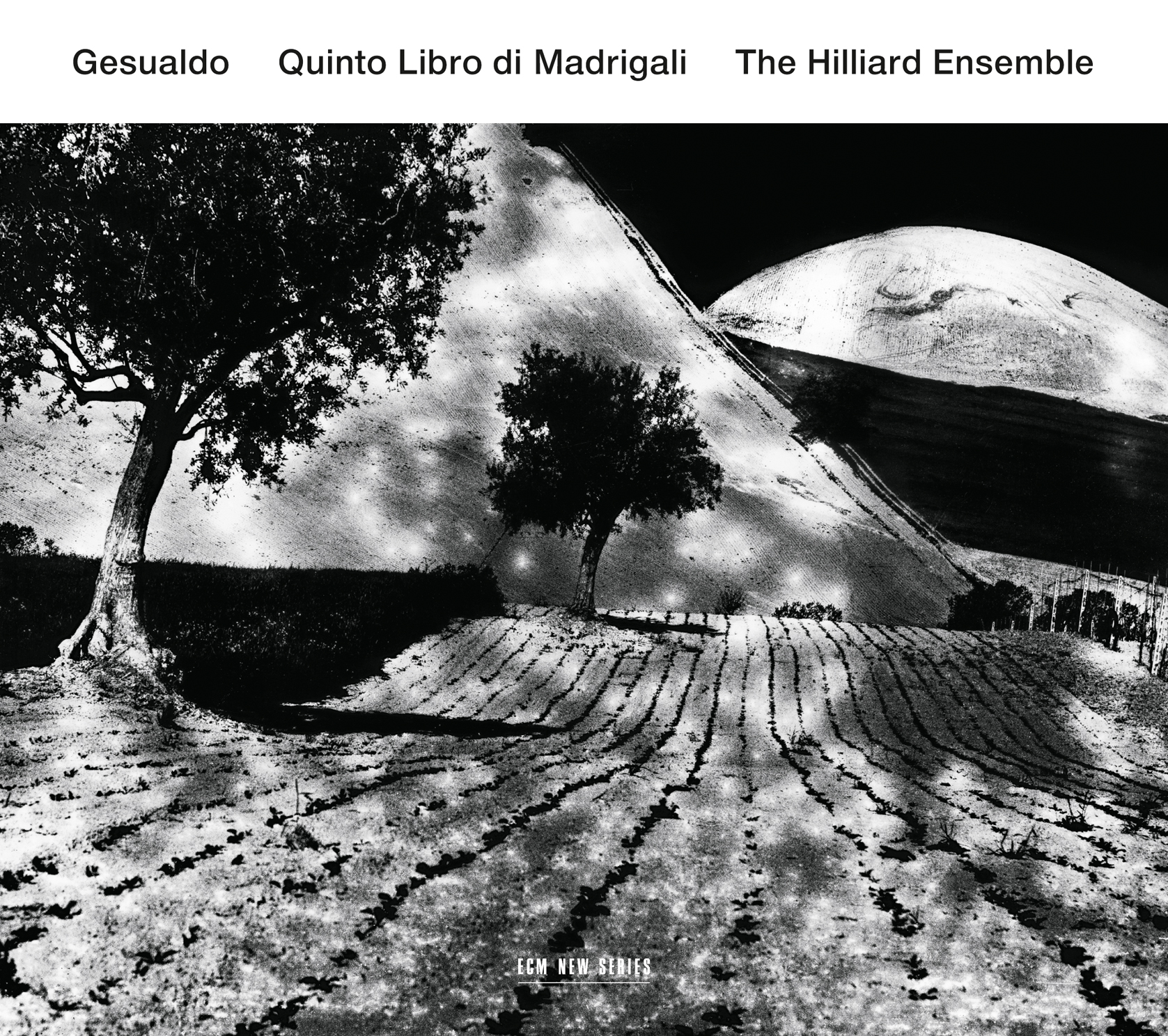
Gesualdo: Quinto Libro di Madrigali (ECM New Series 2175)

Gesualdo Madrigali

Carlo Gesualdo
Quinto Libro di Madrigali

The Hilliard Ensemble
Monika Mauch soprano
David James countertenor
David Gould countertenor
Rogers Covey-Crump tenor
Steven Harrold tenor
Gordon Jones baritone
Recorded November 2009 at Propstei St. Gerold
Engineer: Peter Laenger
Executive producer: Manfred Eicher

If my grief pains you,
only you, my soul,
can turn it all to joy.

On first hearing madrigals by Carlo Gesualdo (1566-1613), English writer Aldous Huxley proclaimed, “These voices—they’re a kind of bridge back to the human world.” In the mouths of the Hilliard Ensemble they certainly are. Baritone Gordon Jones cites the Prince of Venosa as a touchstone of the ensemble’s performing repertoire. And so, it is with practiced appreciation that they return to it as they take on his Fifth Book of Madrigals of 1611 in its entirety. Gesualdo finished his Sixth and final Book (he would leave fragments of an unfinished Seventh) in the same year, penning his first in 1594. Of the Fifth, Jones says, “The whole collection constitutes a gallery of dramatically lit portraits of human emotions with a heavy emphasis on the extremes of joy and despair.” On this note, the addition of soprano Monika Mauch and countertenor David Gould speaks to the range and color required of those extremes, and in this regard the ensemble emotes splendidly.

One can hardly discuss this music without mentioning its bold, mannerist dissonances. Written as it was by a man who had his wife and her lover murdered when he caught them in flagrante delicto and who subsequently receded into his own psycho-sonic cage, this can be no surprise. Even by today’s standards it rattles us. Yet to characterize Gesualdo’s output by so reductive a summation (dissonance, for example, was part and parcel of the madrigal idiom) would be to ignore the textually sensitive traditions of harmonic expansion upon which he built it. Despite being professedly “ahead of his time,” he was no enigma to his aristocratic contemporaries, being a particular favorite of Queen Christina of Sweden. For every gritty texture he loosed, a smoother one was in attendance, and we do well to remember the equal weight in both pans of the scale.

We have the Hilliard/ECM partnership to thank for already having done the composer justice with a sublime and direct rendition of his Tenebrae Responsories for the Christian Holy Week. Here that same trueness to the melodic line remains, and is so magnified by the bareness of its voices, by which the tortuousness we’ve come to expect lives by a more fluid name. If it lives anywhere, it is in the strange tenderness of Gioite voi col canto, which opens the collection with an autobiographical tinge:

Rejoice in song,
while I weep and sigh,
while tears choke my breath.
Alas, wretched heart of mine,
born for grief alone;
weep, but weep so much
that my mistress may be vanquished
by your tears, and then revert to seeing
my grief and pains in her.

The shifting tectonics of tenor lines and dulcet edge of Mauch’s gilding in the words’ weeping evocation is testament both to Gesualdo’s knack for comingling and to the sensitivity of the singers assembled at Propstei St. Gerold, where these works were so lovingly recorded. The charged weight of Itene, o miei sospiri rekindles these considerations, mixing “bitter weeping” with “loving song” in particularly adroit handling from the Hilliards. O dolorosa gioia falls into the same category of “painful joy,” a core theme of Book Five that finds further traction in Se vi duol il mio duolo. In both of these, the pathos of the text comes through tactfully. Death is another trope, as inescapable in the music as it is in us. From the heartfelt appeal of Occhi del mio cor vita (“Eyes, life of my heart”) and the lovesick resignation of Languisce al fin (“He who parts from his life languishes at last”) to the lachrymose accents of O tenebroso giorno (“O darkest day”), the music is practically dripping with it. Yet not all is so morose in this landscape, for there are also the flora of Felicissimo sonno, a heartfelt appeal to dreams as living threads to a love that cannot flourish in waking, and the intoxications of Correte, amanti, a prova (“Vie, lovers, in speed”) to soothe our weary countenances, to say nothing of the optimism that bids us a fond farewell in T’amo, mia vita (“I love you, my life”).

A small handful of these 21 madrigals stands out. The snaking turns of Mercè grido piangendo (“Have pity on me! I cry weeping”) showcase the coolness of the Hilliard’s peerless blend to the utmost, while the prototypically Gesualdan Tu m’uccidi, o crudele (“You are killing me, o cruel woman”) pulls out all the stops in its affective toolkit, achieving moments of sublime light. Finally, Se tu fuggi, io non resto, with its fluttering vowels and tight syncopations breathes with expert realization, even as its narrative voice bids us leave on the wings of cruelty.

Due to the subject matter and sheer variety of invention, and despite the pitch-perfect performances, this is no mere soundtrack for an idle afternoon. It asks us to steep in its brew until we begin to take on a bit of its flavor. Those who find beauty in the Tenebrae may encounter discomfort in these secular woes. But if this discomfort has anything to teach us, it is that the act of living depends on that very thing.

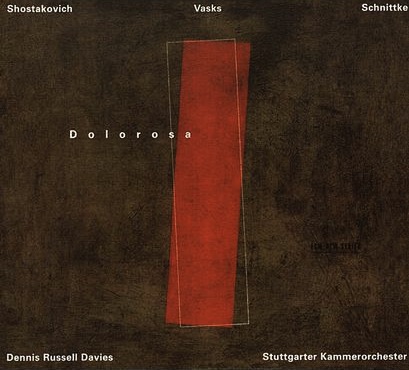
Shostakovich/Vasks/Schnittke: Dolorosa (ECM New Series 1620)

Dmitri Shostakovich
Alfred Schnittke
Peteris Vasks
Dolorosa

Dennis Russell Davies conductor
Stuttgarter Kammerorchester
Recorded June 1996, Mozart-Saal/Liederhalle, Stuttgart
Engineer: Peter Laenger
Produced by Manfred Eicher

Orchestral transcription can be a contentious enterprise, obscuring as it enhances. Yet in rare cases its contours manage to take a shape all their own, living a new life somehow beyond the shadow of the original. Of this transformation we get two fine examples in Dolorosa, a well-conceived program from three distinct compositional minds.

The works are presented in chronological order, with a 1967 orchestration of Dmitri Shostakovich’s String Quartet No. 8 as a “Chamber Symphony” coming first. The arrangement, by conductor and violist Rudolf Barshai (the only one ever approved by the composer), is brilliant in that it avoids masking itself and features a flowing chain of solos. The swell of grief that besets the first movement now feels like a cinematic shift rather than climatic one and leaves a lethargic trace on the second movement. Conductor Dennis Russell Davies takes a conservative tempo on this often-cathartic passage, figuring it as a page manifesting its own ink rather than one furiously scrawled upon. The macabre minuet that follows in the third reaches new dynamic heights in the current version, and allows us perhaps above all to feel what the composer himself read into the energies breathing through it (though, as Richard Taruskin reminds us, the motivations for doing so were questionable, the result of a personal revisionism). The quartet as a whole is an intertextual treasure trove, comprised primarily of snippets of Shostakovich’s own works and those of Wagner and Tchaikovsky, in addition to revolutionary songs such as “Tormented by Grievous Bondage.” Whatever the reason for writing this supposedly autobiographical summary, we can hear in the final two Largos an underlying nonconformity threatening to overtake us with each turn of phrase. But all of it is just so beautiful that one finds it hard to unlock it as a political document.

Those Largos seem to whisper throughout Musica dolorosa. Penned in 1983 by Latvian composer Pēteris Vasks in memory of his sister, it spins from indubitable threads a tapestry to be viewed, experienced, and understood. Though it manifests itself with Shostokovichian pathos, its structures feel relatively smooth to the touch. And when the quietude is at last overtaken by an outpouring of grief, pizzicato accents mark the tempo like an aural tic chipping away at a world that could dispense with life so readily. As the orchestra subsides, violas scrape the edges like tears. This piece does for grief what Erki Sven-Tüür’s Passion does for its eponym.

Alfred Schnittke’s String Trio brings the transcription instinct full circle. Arranged for orchestra in 1987 by Yuri Bashmet as Trio Sonata, it is both the longest piece on the album and the one in least need of commentary. Like Schnittke’s quartets, the trio opens itself up to moments of grandeur, but quickly undermines them with mournful denouements. Proof positive that, despite the expansion that an orchestral arrangement engenders, the music becomes no less introspective and no less intimate, and perhaps delves even deeper into the solitude of its creation.

Shostokovich noted that his eighth quartet, while openly bearing dedication to all victims of fascism, was in fact about himself, about the death of his ideological self after having undergone such intense social pressure to join the Communist party. Yet if we take a quiet walk between the lines of that history, we find a landscape populated with staves and notes like countless others before or since. Our assumptions about Shostakovich as the victim of a sensitive political milieu often color the ways in which we perceive his music, which is perhaps the point: to read is to experience. There is, however, a danger here. One the one hand, hardship in the lives of any of these composers, much less of any others, can hardly be denied. On the other, the music is its own space, which though its attempts to grapple with something in art that cannot be safely engaged in life breathes into our souls without mitigation. In the end, there only the beginning.

<< György Kurtág: Játékok (ECM 1619 NS)
>> Jean Barraqué: Sonate pour piano (ECM 1621 NS
)

ECM New Series Anthology (ECM New Series 1405)

ECM New Series Anthology

Staatsorchester Stuttgart
Dennis Russell Davies
conductor
The Hilliard Ensemble
Gidon Kremer violin
Keith Jarrett piano
Meredith Monk voice, piano
Heinz Holliger oboe
Kim Kashkashian viola
Tamia voice
Pierre Favre percussion
Shankar double violin
Jan Garbarek soprano saxophone, flute
Paul Hillier voice
Stephen Stubbs lute
Erin Headley vielle
Thomas Demenga cello
Paul Giger violin

ECM made history in 1984 with the release of Tabula rasa, the first of the jazz label’s equally influential New Series. Not only did this beloved recording introduce many to the music of Arvo Pärt, but it also clarified producer Manfred Eicher’s classical roots and fed into the likeminded sensibilities Eicher was then bringing with increasing confidence to his groundbreaking approach to jazz. It is therefore appropriate that Pärt, the imprint’s shining star, should be represented here more than any other composer or performer. His Cantus In Memory Of Benjamin Britten, a haunting secular homage to a composer he would never meet, is the disc’s open door. Its quiet sweeps and intoning tubular bell resemble little in all recorded music. Pärt comes to us further through his spiraling Arbos for brass and percussion and through Fratres, a touchstone in his compositional career. Existing in many treatments, here it is given one of its most powerful through the greatness of violinist Gidon Kremer. Accompanied by Keith Jarrett at the piano, his simple yet burrowing progressions capture (and release) the essence of something so physiological that one cannot but help feel it in the veins.

If Pärt is the New Series’ mainstay composer, then the phenomenal singers of the Hilliard Ensemble are its star performers. Since making their label debut with a flavorful rendition of Thomas Tallis’s Lamentations Of Jeremiah, of which the Incipit is given here, they have redefined the art of the chamber vocal ensemble.

Meredith Monk shifts the light considerably in a selection from her Vessel: An Opera Epic. The New York-based composer and performer has established a loyal group of vocal artists, all of whom find in her voice a depth of inspiration all too rarely encountered. One would feel tempted to call her world mysterious, were it not for the fact that it sounds undeniably familiar. “Do You Be” is a representative work in this regard, an aria of sorts that blows her ululations through the branches of a faraway tree.

Swiss oboist Heinz Holliger is another major compositional force in the New Series catalogue, and his Studie Über Mehrklänge for solo oboe is as good a place as any to start for those adventurous enough to wander his musical paths. As the title (A Study in Multiphonics) already informs us, Holliger wrings a wealth of sounds and colors from the single woodwind. Whether unsettling or ethereal, they never fail to enchant and reinvent with every listen.

The peerless Kim Kashkashian gives us the final movement of Paul Hindemith’s fifth Viola Sonata. This 11-minute masterpiece is the first of a smattering of solo pieces on the album, the others being Thomas Demenga’s astonishing Sarabande from the fourth Cello Suite of J. S. Bach and an all-too-short excerpt (only three of its original twenty-two minutes) from “Crossing” by Swiss violinist Paul Giger. The album, Chartres, from which the latter was taken is one of the finest violin recordings ever released and is a must-have for those interested in exploring more of what the New Series has to offer.

Singer, scholar, and early music specialist Paul Hillier gives us “Can Vei La Lauzeta,” a haunting lilt of troubadour stylings by Bernart de Ventadorn (fl. 1145-1180). It is a fitting inclusion in a program that is but a thread in an ongoing tapestry—more than I can say about the album’s filler. Why, for example, do we find not one but two selections from saxophonist Jan Garbarek’s Legend Of The Seven Dreams? A fantastic album, to be sure, but not a New Series release (the same goes for “Adagio” by Carnatic violinist L. Shankar). I realize that this was perhaps an attempt to show that the music of ECM proper can sometimes extend into fuzzier areas of genre, but it still casts an interesting question mark over the proceedings. Case in point is “Ballade” by singer Tamia and percussionist Pierre Favre, a lovely New Series document that straddles borders.

Another addition—that of actor Bruno Ganz’s recitation of “Vom Abgrund Nämlich” by Friedrich Hölderlein—may also seem curious, if only for its politics, but its opening lines at least ring to the tune of the ECM spirit, which has cast its sonic lessons into the widening sea of listening in which we are all embedded:

We began of course at the abyss
And have gone forth like lions

By and large, this is an adequate introduction to a side of ECM that some may feel hesitant to explore. Yet rather than pay for a well-chosen, if sometimes puzzling, collection, I would instead encourage the curious to get their hands on any one of the above recordings in full.

<< Aparis: s/t (ECM 1404)
>> Karlheinz Stockhausen: MICHAELs REISE (ECM 1406 NS)

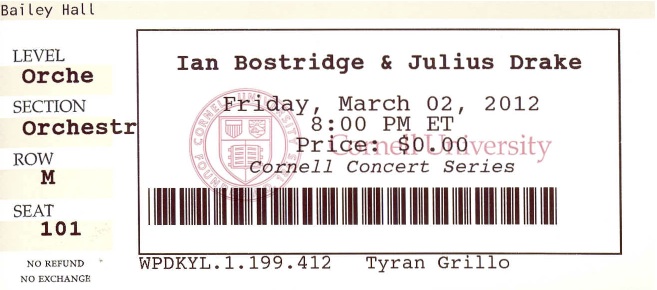
A Walk in the Magic Garden: Bostridge and Drake Bring Lieder to Bailey

Imagine yourself as the protagonist in poet Heinrich Heine’s Ich wandelte unter den Bäumen (“I wandered among the trees”). You’ve been wandering through a forest, your only companion grief over an unrequited love. Suddenly, a “little word” flittering in the trees, a simple utterance that pulls the wool of the past over your eyes. You wonder how the birds know it, why they torment you so. They sing:

“A young woman once passed by,
She sang it again and again,
And we birds snatched it up,
That lovely gold word.”

You feel the sparkle, ironic and stabbing, of every rounded syllable. You are pressed by the weight of their diction. Only then do you realize that you’ve been sitting in a concert hall with a flock very much of your kind. The voice comes not from the trees but from English tenor Ian Bostridge, who looms almost as tall as one, onstage at Cornell’s Bailey Hall.


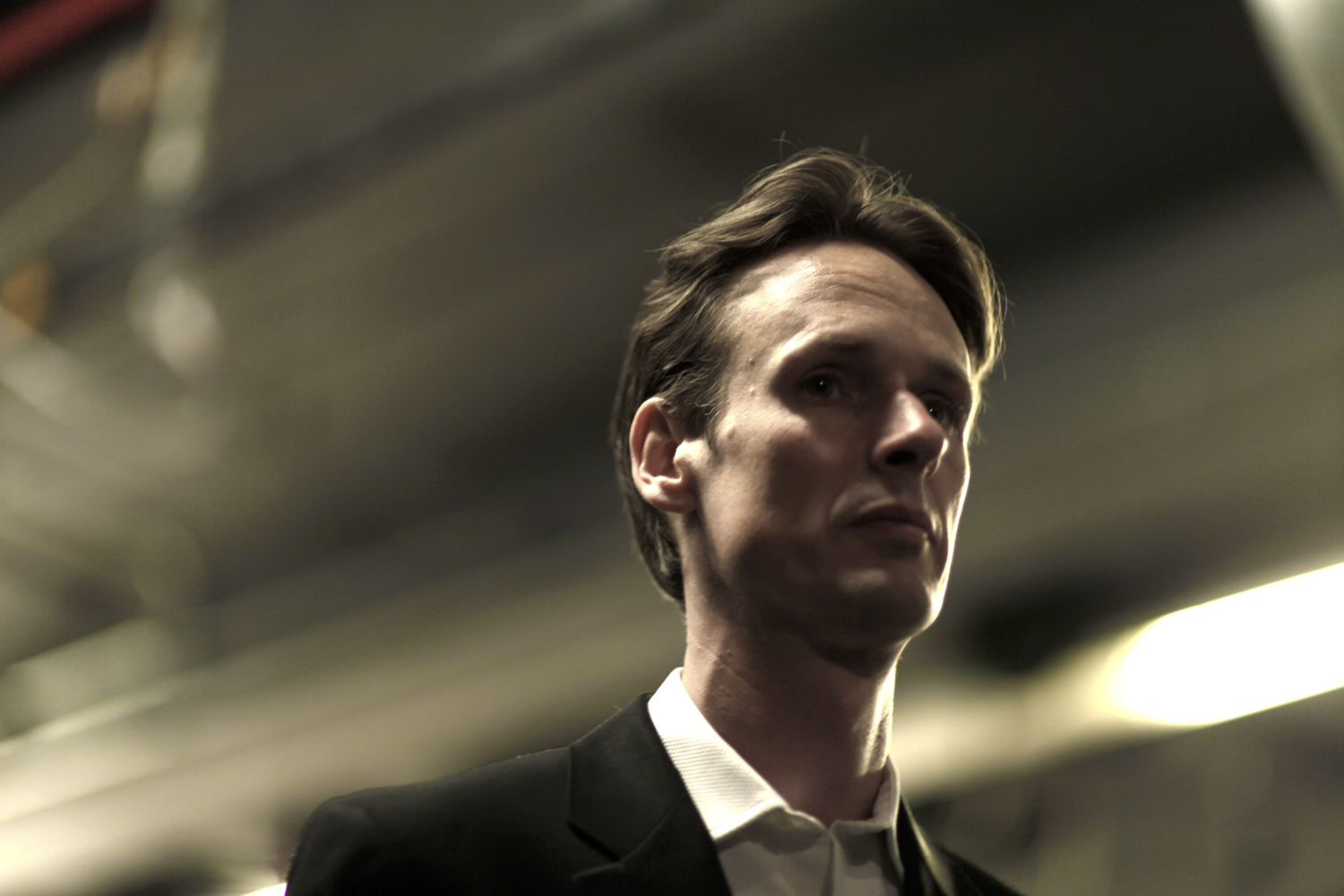
Ian Bostridge

Although Bostridge started out as an aspiring physicist who also wrote a seminal book on witchcraft before devoting his life path to singing in 1993, his audiences would be the last to refute that his command of, and interest in, either physics or witchcraft has waned. To wit, his accompanist of choice for we fortunate Friday few was Julius Drake. An in-demand recitalist and professor at London’s Royal Academy of Music, Drake maintains an alchemical interest in Robert Schumann and in German lieder, or art songs, both of which fuse together via the composer’s setting of the poem above, one of nine by Heine in the op. 24 Liederkreis (Circle of Songs). Written in 1840, a period known as his Year of Song, the cycle bears dedication to his wife, Clara. Despite its passionate origins, the Liederkreis tends to fall by the wayside of Schumann’s monumental Dichterliebe, though one can hardly deny the mastery with which piano and voice share their creative duties in both. Schumann blends folk idioms and a flair for the programmatic, into which Bostridge and Drake pour over twenty years of collaborative experience.


Julius Drake

During this performance it was clear that for Bostridge the sounds of words are as important as their meanings. Throughout the Liederkreis and the quartet of Dichterliebe apocrypha that preceded it he fashioned a living, breathing persona that was as chameleonic as the sentiments he so punctiliously enunciated, while Drake matched his depth gesture for gesture. Both artists found themselves surpassed only by the lyricism of Schumann, whose adorations blossomed before our ears in the passions of Lehn’ deine Wang’ (“Rest your cheek”) and the sweetness of Berg’ und Burgen schaun herunter (“Mountains and castles look down”), the latter contrasting starkly with the morose Es treibt mich hin (“I’m driven this way, driven that”), the fiendish difficulties of which Bostridge navigated with apparent ease. Artistic witchcraft was also in order for Mein Wagen rollet langsam (“Slowly my carriage rolls”), during the middle stanza of which he sang an internal thought as if it were his own. Not to be outdone, Drake’s pianism cast its share of enchanting spells, as in the brightness of Morgens steh’ ich auf und frage (“Every morning I awake and ask”) and the chromatic sweeps swirling like smoke from a breeze-blown candle throughout Mit Myrten und Rosen (“With Myrtle and Roses”).


Robert and Clara Schumann

While Bostridge and Drake were obviously comfortable with Schumann, much of the evening’s treasure was buried in the relatively uncharted maps of Johannes Brahms, in whose poetics they steeped the program’s first half. With a life-affirming, if not transformative, energy Brahms’s songs made for a fitting introduction to anyone not familiar with the lieder tradition from which he is so often excluded, typically dominated as it is by Franz Schubert, Hugo Wolf, and Schumann himself. For one, he favored the words of “minor” poets—a downfall in an art built from the text up. This and his disinterest in grand cycles pegged him as something of an outsider. Yet Brahms saw no necessary correlation between great music and great poetry. Each was its own melody. As with Schumann, whom Brahms much admired, folk motifs were an important touchstone and sometimes led him boldly where his contemporaries dared not tread.


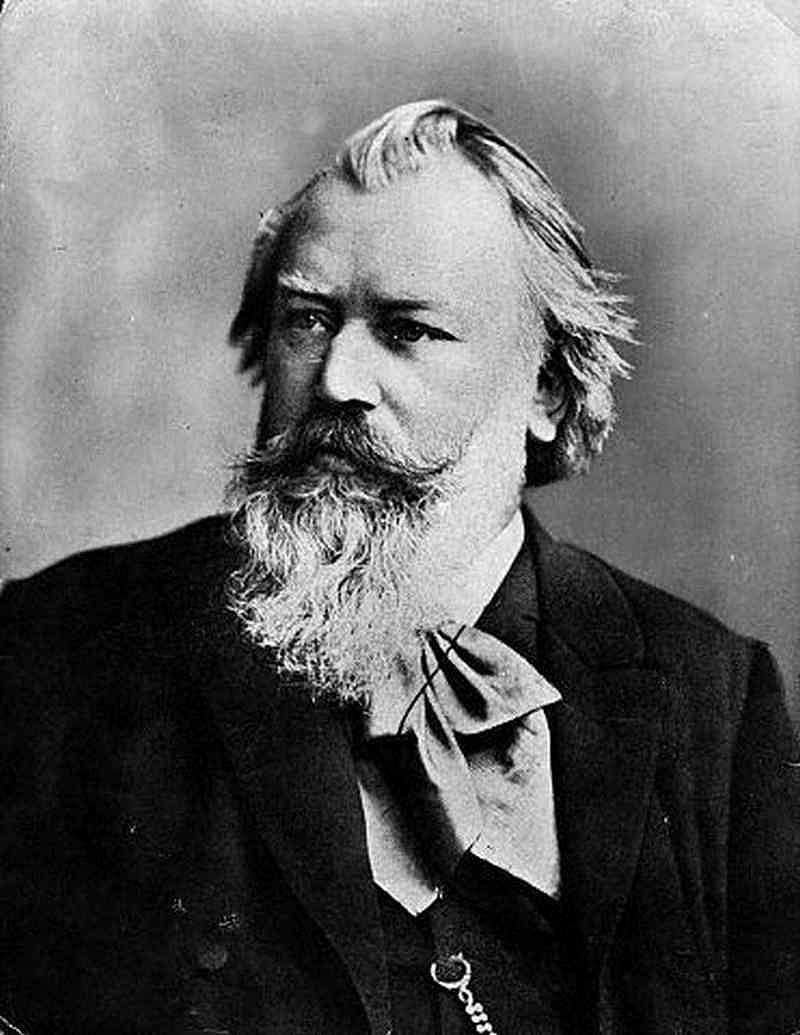
Johannes Brahms

His was, and continues to be, a music filled with worlds that don’t so much collide as pass through one another. From the mighty gales of Auf dem Kirchhofe (“In the churchyard”) and on through the Chopinesque backcloth of Der Gang zum Liebchen (“The way to the beloved”) to the raging seas in Verzagen (“Despair”), the pianism was of a vastly different order, with the result that Bostridge pushed himself to engage every facet of its relief. This resulted in an unexpected hiccup during a high reach in Geheimnis (“Secret”). Yet even this did nothing to detract from what was for this listener the most awe-inspiring song of the program (if anything, it broke a tension that threatened to sweep us away entirely), and may explain the marked determination with which he dove into the set’s most turgid waters—notably, Alte Liebe (“Old Love”) and O kühler Wald (O cool forest).

Due perhaps to Brahms’s rich keyboard writing, Drake’s interpretive nuances were most effulgently realized here. He was at once impressionistic and exacting like a carver’s tool, but always playing the words at hand. The lushness of chording in his right hand atop the rising arpeggios of his left in the concert’s opener, Es träumte mir (“I dreamed”), assured us that the best accompanists also know how to sing. Bostridge was reverently aware of this. One could see it in the way he looked into the distance between verses, as if watching the Steinway’s notes mingling with his own over the horizon. He interacted with the piano, now resting on it like a poet’s tree, now at an intense moment breaking free from its pull.

Oftentimes the more careful one is, the more conservative one becomes. In the case of these two performers, however, care seems to have bred nothing but expressive potential. In this respect Bostridge sings as might a Shakespearean actor surrender to a soliloquy—which is to say, by stepping outside the self and into the landscape of another space and time. His ego flees like the poetry from his lips, even as he shows us the vitality of the body in the singing of lieder, its centering and de-centering, its bows and cringes, and in all the winged commitment required to make every syllable fly. Drake, meanwhile, proves himself supremely attuned to every color change, and stands respectfully poised on the edge of drowning. He listens to the voice just as the voice listens to itself, intoning with the wavering realism of a reflective surface.

We return to Heine, in whose beauties we find ourselves lost:

In the magic garden wander
Two lovers, silent and alone;
The nightingales are singing,
The moon is shimmering.

So sings the now familiar voice, no longer birdlike but nonetheless profoundly arboreal. Bostridge takes us fearlessly into that garden and shapes its flora and fauna, each more magical than the last for the Midas touch of his vocal presence. Said garden is his gift to us, a place to which we can always return when remembering this night.

(See this article in its original form at the Cornell Daily Sun.)