Terje Rypdal: Melodic Warrior (ECM 2006)

2006 X

Terje Rypdal
Melodic Warrior

Terje Rypdal guitar
The Hilliard Ensemble
Bruckner Orchester Linz
Dennis Russell Davies conductor
Wroclaw Philharmonic Orchestra
Sebastian Perloswski conductor
Melodic Warrior recorded December 2003 at Brucknerhaus, Linz (ORF)
Recording engineer: Alice Ertlbauer-Camerer
Engineer: Alois Hummer
And The Sky Was Coloured… recorded November 2009 at Jazztopad Festival, Wrocław
Recording engineer: Maurycy Kin
Mixed at Rainbow Studio, Oslo by Jan Erik Kongshaug, Manfred Eicher and Terje Rypdal
Album produced by Manfred Eicher

…from the house made of mirage…
…the rainbow rose up with me…
…the rainbow returned with me…
…to the entrance of my house…
…from the house made of mirage…
–excerpted from a Navajo Night Chant

How does one review an album for which one has also written liner notes? This is the challenge I set before myself in the instance of Terje Rypdal’s astonishing Melodic Warrior. Pairing the gargantuan title piece with a younger sibling, it reveals yet another facet of the Norwegian guitarist’s compositional profile, one that has given us such wondrous reflective surfaces as Undisonus and his Lux Aeterna. Where those two works examined sonic temperatures across relatively expansive climates, here the lens cracks in an implosion of voices.

Of those voices we get four prominent stewards in the Hilliard Ensemble, who also commissioned Melodic Warrior from the very ether. Their singing burgeons in a selection of Native American poetry chosen by Rypdal, along with a sprinkle of original words. To the touch-and-go listener it may seem an outlying choice for the Hilliards, unless of course one considers their likeminded reworking of Quechua and Passamaquoddy sources with saxophonist Jan Garbarek on, respectively, Mnemosyne and Officium Novum—in which case the fit could hardly be more intuitive. These are poetries rooted in that which roots us, pouring mercury into the primacy of oral over written expression: the lived knowledge that eternal regeneration is impossible without the fleeting rain.

The instrumental makeup alone chains this magnum opus to an immovable classical altar, surrounding the Hilliards with a full orchestra under the ever-erudite guidance of Dennis Russell Davies. It further bears the scars of Rypdal’s many-hued pools of influence, for his electric guitar bleeds through its movements like fire through lit steel wool, cupping a prog-rock relic or two in its satchel. In light of this, Melodic Warrior would seem to bring together many of his earlier threads into unified fruition—from his supergroup The Dream and on through the defining ECM years (Odyssey, Chasers, and especially Skywards) to the large-scale compositions mentioned above. The end effect is a snake coiled and poised to strike. Yet rather than deploy its secrets as weaponry (the melodic warrior sustains injury in place of others), it holds venom in mind and makes it palatable to the tongue and to the ear. Rypdal’s baying leads are unmistakable in this regard, stringing us as they do along a necklace of vocal cells, each writ large within the itinerant body. That we can at last experience the journey of that body on disc (prior to release, it had been maturing in ECM’s vaults for nearly a decade) is a gift for the soul.

Rypdal’s Opus 79 finds company in his Opus 97, And The Sky Was Coloured With Waterfalls And Angels. Whether coincidental or not, the numerical reversal suggests a kinship. And indeed, despite its wordless topography, the second piece would seem to drink from the same ocean, albeit on a different coast. Fronting now another orchestra and without the company of (human) voices, Rypdal paints bruises of a different kind: these the bursting flowers of a fireworks display. Although not overtly programmatic, those eruptions do materialize in periodic squints, carrying us out on a breath of awe.

It was an honor and a dream come true to contribute liner notes to this release. In solidarity with listeners (and because digital downloads deprive us of the pleasure of holding a booklet), I offer said notes in full below, with ECM’s kind permission.

… . …

Contrapunctus naturalis: Rypdal’s Warriors and Angels

The Chippewa tell a form of picture-story in which silence takes the form of two lines, close but never touching. As the asymptote of all existence, they do more than represent. They enshrine. Surrounding them is a need for self-questioning, for acknowledging the power of the beating drum.

River, nature, vision: these are the tools of the warrior whose flesh stands firm against the tide. Like the stag hanging from a tree—last touched by chipped stone and hunter’s eye, now drained by gravity and sun’s transit—it has an illusory stillness. Somewhere, in another time, the warrior’s legs still run. Terje Rypdal’s warrior is consequently melodic. Protagonist of his magnum opus, he activates a landscape by contact of lyric and pen. Its composer is a river; the voices of the Hilliard Ensemble its fauna; the writhing Bruckner Orchestra Linz, under the baton of Dennis Russell Davies, its flora. Davies adds depth through an abiding passion for living works. He gives voice to the margins, here doubly so, guiding Rypdal’s assembly through a 45-minute epic drawn from Chippewa, Navajo, Pima, and Papago sources. The words came to Rypdal by way of stage director and musician Carl Jørgen Kiønig, who lent him a book of Native American poetry. “Its closeness to nature mirrored my own,” he says, and thus the seeds were planted. Since its 2003 Austrian premiere, this Hilliard commission has taken on a soul that consolidates Rypdal’s many paths.

From his early ECM leader dates onward, including the self-titled 1971 debut and 1974’s Whenever I Seem To Be Far Away, Rypdal has had a hand in multiple idioms. He grew up in a classical home (his father was also a composer) and trained formatively in that sphere before taking to the guitar in his teens. If we can paint anything with these biographical colors, it is not the portrait of a fusion artist, but rather one who walks along dissolving borders. Whether in the chamber music aesthetics of Q.E.D. or the wayfaring 5th Symphony, in the droning lyricism of Undisonus or the flowing textures of Lux Aeterna, through it all persists a consistency of vision.

And what of Melodic Warrior? “The title came to me almost as a vision,” Rypdal recalls. “It felt as if I had planned something like this all my life.” Given the strength of this conviction, one might expect a ruder “Awakening” than what transpires in the eponymous prologue. The first of nine movements, it opens its eyes in high-pitched stasis, an abyss where the fray of human awareness hums above the earth’s surface. The ensuing plunge is cinematic to the core, traveling from cosmos to land, from breath to heart. In it we find the glitter of coastal waters, a veritable Bering land bridge rooted in sea floor and spreading its fingers toward wounded sky. To tread here is to embrace daylight, to feast on it, as the crow takes to carrion.

Storm, leaf, soil: the constellations Rypdal’s electric guitar lives by, echoes from a mythic past, garments donned by our four unmistakable voices when twilight falls around them. Their welcome blessing reveals an organic body, splitting and fusing like water’s flow. As one, they fly. In isolation, they soar. During solos their spirits thread disparate needles, sometimes flirting with call and response, but always with unity in sight. A storm is nothing without its droplets.

Rypdal remains the omniscient lurker, resurfacing across the suspenseful pages of “The Secret File” with script aflame. He envisions this dramatic intermezzo—having used it before in a hard-rock context—as a nod to Western film soundtracks, thereby bearing relevance on the contradictions of the Native American theme. Not until “Song Of Thunder” does he ride lightning into the roiling ash. He weaves stealthily, finding in the curve of a whale’s back, in the sweep of a honeybee’s pollen comb, the natural counterpoint that haunts his oeuvre at large.

The strings of Linz mark the face of this music with laugh lines. Profound shifts in light reveal rivulets and isles of possibility. In “Magician Song” countertenor David James evokes a leaf on that water, the tremble of the branch before its descent, the seed from which that tree burgeoned. Ancestors become stories, backgrounds become foregrounds, as they would in dreams, and close the circle by way of opening another in the light of a morning star.

The flair of Melodic Warrior brings to mind another ECM-represented composer, Erkki-Sven Tüür, whose background in progressive rock buoys a mind meld of fortitude and color. And if we can draw further lines of contact to the work of such 20th-century stalwarts as Górecki, Ligeti, Penderecki, and even a hint of Glass, it is only because Rypdal has mixed and baked his clay from the mineral-rich soil of deep listening.

All of this comprises a challenge to purveyors of modern music who rest on atmospheric crutches in lieu of compelling linear themes. Rypdal points to early conversations in this regard with label mate Ketil Bjørnstad: “We used to talk about how melody in contemporary music was looked down upon. I knew right from the start of my composing that I had to bring back melody…and beauty in general.” His forte embodies the uphill battle of this realization, beholds the world as new parents behold themselves, at once without and within. The polarity makes sense, for what is the guitar if not a bringer of visceral melody? It is a fortuitous compositional tool in the hands of one who wields it properly.

Sky, journey, reflection: the shaman’s initiations. As technician of the sacred, the shaman dismantles mortal designs. He abstains from taste of dust for that of haze. He casts bones through skin, passes mind through matter, and returns with timely prophecy. He visualizes decay, the withering of boundaries. He casts one eye down and the other up. Thus undone, the earth overflows.

And The Sky Was Coloured With Waterfalls And Angels is the receptacle of that excess. More than a landscape, it is another link in the chain of being. The live recording presented here opens a curtain on Wrocław, Poland, where the 2009 Jazztopad Festival (artistic director: Piotr Turkiewicz) is about to set forth on this purely instrumental journey. It is under these auspices that, with Sebastian Perłowski leading the Wrocław Philharmonic and Rypdal poised before six foreshortening strings, the music bubbles with the freshness of its premiere.

The piece was inspired by the 2008 International Fireworks Festival in Cannes and assumes a denser structure than its sibling. It brings to evidence the din of human commerce, technology, and construction, even as it links those rosettes high beyond mundane concern. The violin scratches an itch it cannot quell, unfurls banners of melancholia between explosions. Even a surge of harp brings little hope or heavenliness. It is caked with time, unshaken. Somehow all of this finds peace, such that the sky becomes the cell of another body, and that body the cell of another.

Mirror, vessel, silence: the totems of a composer seeking nectar. Once found, it drips from waterskin, emphasizes imperfections. This music holds a mirror to land, turning every arch into a ring. The counterpoint is more than natural. It is the all-encompassing sight of things created and destroyed. Every instrument sheds a skin.

The horns in particular take on a quasi-Wagnerian role throughout the program, signaling themes and atmospheres as they become intertwined with locations and avatars. At one moment the song of bestial life, swaying the next in bowed waters, they cast crimson lines of intention into a darkening sea. This is the trick of Rypdal’s notecraft: he digs into continental influences with an archaeologist’s eye, persevering where many have quit until that single common vessel is revealed, petrified yet singing.

Tyran Grillo
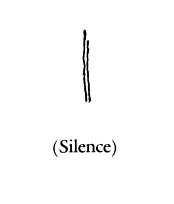
Silence

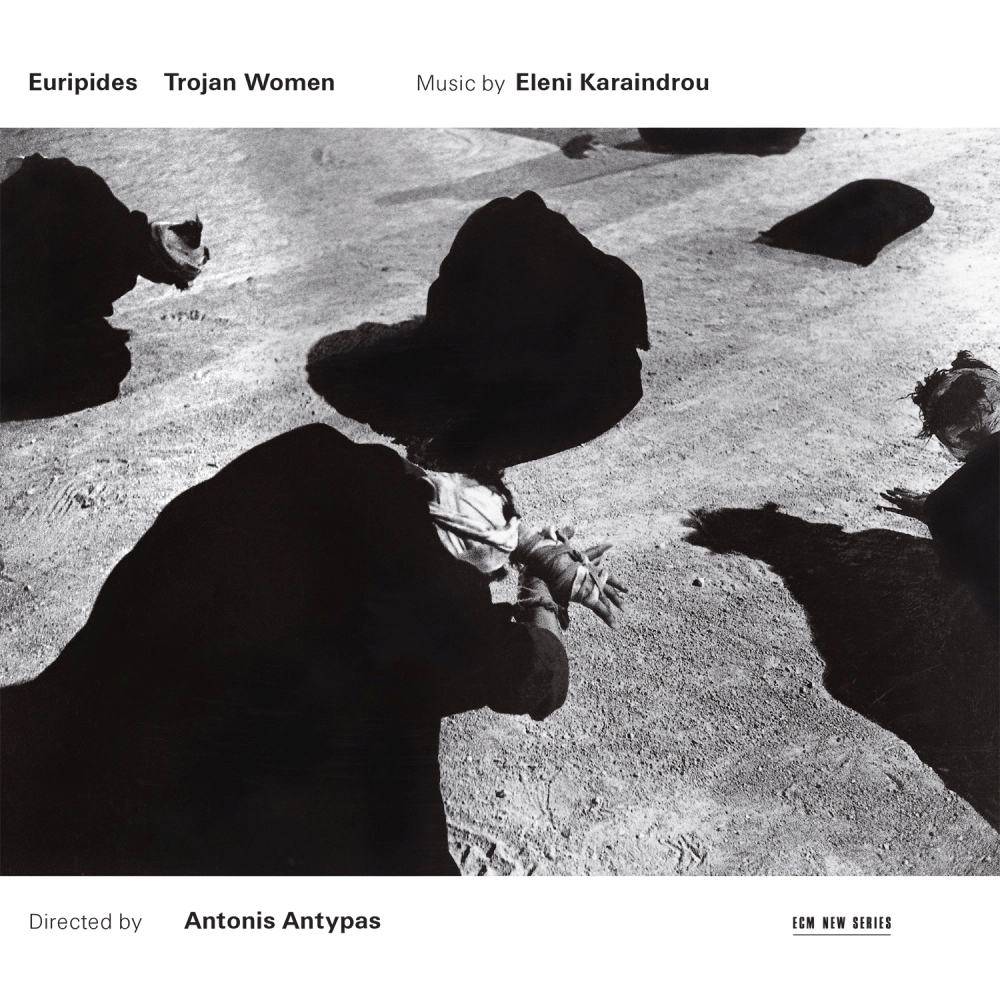
Eleni Karaindrou: Trojan Women (ECM New Series 1810)

Eleni Karaindrou
Trojan Women

Socratis Sinopoulos Constantinople lyra, laouto
Christos Tsiamoulis ney, suling, outi
Panos Dimitrakopoulos kanonaki
Andreas Katsiyiannis santouri
Maria Bildea harp
Andreas Papas bendir, daouli
Veronika Iliopoulou soprano
Eleni Karaindrou
Antonis Kontogeorgiou chorus director
Recorded July 2001 at Studio Polysound, Athens
Engineer: Yiorgos Karyotis
Produced by Manfred Eicher

No human heart is set so hard
that hearing the grave music of your dirge,
your keening, would not bring tears.

The distinct approach of Greek composer Eleni Karaindrou to film sound-tracking, through ECM’s rigorous documentation of her partnership with director Theo Angelopoulos, has imbued her music with a life of its own among international audiences. All the while, Karaindrou had been nurturing an equally prolific association at home with the theatre. Her Angelopoulos in that craft has been director Antonis Antypas, with whom she has collaborated on over 20 productions for the Aplo Theatro. This album documents her incidental music for a new staging of the Euripides tragedy Trojan Women, which received its premiere at the Ancient Theatre of Epidaurus on August 31 and September 1, 2001.

First performed in 415 B.C., the play was a vitriolic critique of the Athenians’ then-recent attack on the island of Melos, where countless violently perished and women were sold into bondage in the name of conquering Sparta (in this the Athenians did not succeed). It is perhaps no coincidence that the word melos also means song, for singing constitutes the very flesh of this album’s limestone skeleton. Karaindrou kneads into these politics the idea that less is more. With the barest use of folk instruments—such as the Constantinople lyra, ney, santouri, and bendir—she implies a battered panorama of immense emotional congruity. Producer Manfred Eicher has lent further sanctity through his arrangement and editing of the material into its present form.

A profoundly comported scenography of touching (which is to say, tangible) melodic beauty finds particular expression through the lyra’s grasshopper song. It is a mournful, unforgettable sound, dry as a reed in summer. The harp also figures notably in the music’s rolling waves, overcoming the barrenness evoked by titles like “Terra Deserta” with oceanic depth. Its vibrations are transformations of landscape itself, silenced by their own resonance.

Much of the material on Trojan Women will sound familiar to regular Karaindrou listeners. The themes, although nominally character-specific, are melodically uniform, changing their instrumental clothing from visage to visage, thereby sounding a fluidity of purpose and choice. Unusual, and perhaps a point of contrast to nevertheless persistent indications of barrenness, is the presence of choir and a soprano soloist who only occasionally poises her lips above the waterline to spout names of the deep. Of central importance in this regard are the three stasimons (choral odes), each a vertebra of both story and music, a refraction of the rest. In them voices grow bolder, reaching epiphany in “An Ode Of Tears” and “In Vain The Sacrifices,” the latter a ring to which the former’s gaping clasp holds true. These voices do more than the traditional Greek chorus. They burgeon at stage center, relegated not to the wings but to the head and body of a flightless bird. Without wings, they think themselves into freedom, casting their minds from horizon to horizon, faster than the sun. They do not create the stars but make them brighter.

As a matter of course, the pieces are generally short (only one surpasses four minutes). In their sublime chemical suspensions of tears, blood, and determination swims a pair of eyes—one directed at us, the other elsewhere. Consequently, there is a feeling of stepping out of time in order to better understand its circumscription. Vast harmonic networks slumber in the underlying empty spaces, never stirring except in the most funerary moments. Despite the mythic sheen, the music of Trojan Women finds deeper mystery in the earth’s living subjects, which in isolation reveal the mystery of creation, both divine and mortal, far more acutely: in order to attain permanence one must be open to the fallacies of agreement.

Karl Amadeus Hartmann: Funèbre (ECM New Series 1720)

Funèbre

Karl Amadeus Hartmann
Funèbre

Isabelle Faust violin
Paul Meyer clarinet
Petersen String Quartet
Münchener Kammerorchester
Christoph Poppen conductor
Recorded July and September 1999, Angelika-Kauffmann-Saal, Schwarzenburg
Engineer: Andreas Neubronner
Produced by Manfred Eicher

Funèbre stands out in the New Series both for its due attention to German composer Karl Amadeus Hartmann (1905-1963) and for welcoming conductor Christoph Poppen and the Munich Chamber Orchestra into the ECM fold. The latter have since gone on to record a number of pivotal records for the label, including the all-Scelsi program Natura Renovatur and the Bach/Webern crossover project Ricercar. Here they are joined by violinist Isabelle Faust, the Petersen String Quartet, and clarinetist Paul Meyer for a shuffling of dark, darker, and darkest. The two main courses—Concerto funebre and the Symphony No. 4—are among Hartmann’s best known and preface the world premiere recording of his Chamber Concerto for clarinet, string quartet, and orchestra.

Hartmann’s fiery personality and strikingly inter-idiomatic style made him an easy target under the Third Reich, during which time he withdrew his music from the public sphere altogether in solidarity with other persecuted composers who chose “internal exile” over excommunication (or worse). It was nevertheless heard abroad, where it took on a life of its own. After the war, his revitalization of the European soundscape through the famed Music Viva concert series further deflected attention away from his own work at home. This, coupled with his penchant for self-criticism, left the world with a minimal published output, a problem rectified only after his passing when all-but-forgotten scores were restored, printed, and performed.

Concerto funebre for solo violin and string orchestra is Hartmann’s only violin concerto. It is meant to navigate the iniquities he saw brewing in 1939, when he began writing it. Hartmann dedicates it to his son, only four at the time. In this spirit, he wrote in retrospect, “The chorales at the beginning and end are intended to offer a sign of hope against the desperate situation of thinking people.” The piece in four tableaux initially bore a different title: Musik der Trauer (Music of mourning)—which naturally recalls Hindemith’s Trauermusik for viola and string orchestra—before changing it upon revising the piece in 1959. It forges a unique alloy of violinist and orchestra, so that the former’s attitude is more traveler than soloist, strings the life-giving land from which it comes together. The end effect is such that high notes and low notes are not markers of altitude, but rather inversions of one another on a horizontal axis of expression. The violin is a full-throated being, a pendulum housed in wrought iron. Neither do typical rules of concerto form apply. The Allegro does not provide catharsis but rather embodies a deepening of grief. Only in the Adagio do we detect a morsel of affirmation. Nevertheless, the Allegro does provide a physical sensation of uplift, a cyclone of leaves in which Faust is the only one determined among them. It is also a stepping-stone for the achingly beautiful corridor of the final Chorale, which strengthens the elasticity of the body’s emotional skin and draws on its palimpsest a broken circle.

The Symphony No. 4 (1947/48) for string orchestra takes a 1938 concerto for strings and soprano as its palette and builds from it a new diorama. Two slower movements sandwich a compact inner core: a sonic flag bearing ugly repression and shaded resistance. The colors are wan at first, rhythmically tethered to a far-off caravan whose footprints have long since been dusted over. Lachrymose and weighted by unspoken fear, the figures that left them are but a flicker on the horizon. Hints of Mahler and Webern dot an otherwise bold, original score. That Hartmann deploys these references so organically is one thing. That he does so with such arresting melodic development is quite another. The free-floating sensations of the symphony’s bookends are especially instructive in this regard, while its heliocentric Allegro reaches downright thrilling peaks of agitation. The broad sweep of its closing Adagio is overwhelmingly dense, leaving us with a heavy bowl of fruit indeed to share with those who will listen.

Although the unusual Chamber Concerto was completed in 1935, it was first performed only posthumously, in 1969. In light of its gypsy flavors, that it bears dedication to Zoltán Kodály should come as no surprise. Two longer outer movements create yet another frame, this one housing six brief dance variations. Across these Hartmann splashes the piece’s most vivid colors. Gorgeous, rustic, and magnetic, the tunes practically leap of their own volition, turning midnight into dawn at Meyer’s fluid inflections. All of this builds to a haunting stretch of ocean, crisp and bright as the moon.

If this sounds like your cup of tea, you’ll not want to miss out on ECM’s worthy account of Sándor Veress, and vice versa. Both composers draw out likeminded freshness from the earthly cares of which they were both injured subjects.

From the ash comes the phoenix.

<< Mat Maneri: Trinity (ECM 1719)
>> Michael Mantler: Songs and One Symphony (
ECM 1721)

Alexander Knaifel: Amicta Sole (ECM New Series 1731)

Amicta Sole

Alexander Knaifel
Amicta Sole

Mstislav Rostropovich cello
Tatiana Melentieva soprano
Soloists of Boy Choir Glinka Choral College
State Hermitage Orchestra
Arkady Steinlukht conductor
Psalm 51 recorded September 2001 at Propstei St. Gerold
Engineer: Stephan Schellmannn
Amicta Sole recorded July 2000 at St. Catherine Lutheran Church, St. Petersburg
Engineer: Semion Shugal
Produced by Manfred Eicher

The text is intoned as if it sounds. These, the simple instructions that composer Alexander Knaifel offers in the score of his Psalm 51 for cello solo. Dedicated to Mstislav Rostropovich, who also performs it in the present recording, the piece is as skeletal as its source: a sounding of spirit made flesh by mortal touch. While listeners may never hear the words, they will feel them in Rostropovich’s bow, poised as it is on a fulcrum of silence. Says Knaifel, “it is the only one and unique experience in my life when not a note was composed—in the fullest and most exact meaning of this word.” By this he admits no fallacy of the creative process, but instead reveals the divinity behind its cause. The internal is renderable only as an idol to itself, so that every dynamic of the cellist’s articulation seems destined to tremble. A climb into higher registers opens a flame’s pathos into vision and leaves one suspended in Heaven’s basement.

Like the burnt offerings of which the psalm concerns itself in its final stanza, the music scatters easily in the wind. That it holds true to form at all is proof of its spiritual integrity. Although the performer is singular, the incantation is sometimes plural. From piercing bridge crawls and vulnerable downward steps to interlocking pizzicati, every motion signals a diacritical reality. Rostropovich achieves all of this through his decades-long path toward mastery. For while the notecraft is almost as bare as the paper it is written on, Knaifel infuses every nodule with a word. Were we to plot each on an axis of pitch and time, they would form a rainbow arc through the firmament from birth to death. Only at the end does light creep in, pulling ever higher into the cello’s very threshold of audibility.

The papery consistency of Psalm 51 provides absorption of the ink in Amicta Sole (Clothed with the Sun) for soloist (female) of soloists. As a follower of the former’s grace, this starkly glassine piece speaks in angel’s tongue and awakens to angel’s ways. It is also performed here by its dedicatee, the inimitable soprano Tatiana Melentieva, who etches with her voice a denser light against a slow waterfall of strings and choral textures. Now that the texts are consciously sung, there is great movement from above to below, from interior to interior’s interior.

Inspired by the “woman clothed with the sun” who appears in Revelations, Amicta Sole sequences the genealogies of Christ as a helix between new prayer and ancient origins. The instruments perform the same role as the cello in Psalm 51, sounding the texts as if singing them, while the voices sing the texts as if sounding them. Melentieva’s art is so rich that she could very well carry these forces without their cushion, for she seems to summon legions of air before her. Despite the above connotations, what we have here is the full spectrum of earthly care, the weight of human conditions pressed upon our ears with the almost there-ness of a molt feather. And although we are invited to bask in the caesural nature of what transpires, stretched into barest triad, we can never be a part of its cathedral, where vibration and darkness dwell. The feeling of renewal is such that no architecture can stand here for so long as a breath (hear this in the flute’s red thread of color). Only in the harp is the promise of good news made manifest, and with it the uniform face of which our own are imperfect copies.

That the pieces here are from the mid-nineties, shaded by a lingering fog of the Soviet era, is only fleetingly significant. In them is a stillness of heart that reflects on troubled pasts. By the same token, their worth lies not in their politics, bleeding as it does through the reddest of paper with its own hues intact. At once reifying and transcending the corporeal waver that is its mirror, they are but two jewels in an eternal crown. 

Have mercy on me, O God, according to Thy great mercy,
and according to the multitude of Thy tender mercies
blot out my iniquity.

<< György Kurtág: Signs, Games and Messages (ECM 1730 NS)
>> Robin Williamson: The Seed-at-zero (
ECM 1732)

Luciano Berio: Voci (ECM New Series 1735)

Luciano Berio
Voci

Kim Kashkashian viola
Vienna Radio Symphony Orchestra
Luciano Berio conductor
Robyn Schulkowsky percussion
Recorded November 1999, ORF Studio, Vienna; May 2000, Teldec Studio, Berlin
Engineers: Josef Schütz and Peter Laenger
Produced by Manfred Eicher

The interest of Italian composer Luciano Berio (1925-2003) in folk music runs as deep as the grooves in his scores—trenches, rather, through which performers have been backpacking their talents since the latter half of the 20th century. In them are remnants of decay and sound intermingling with fantastical re-creations. Much of said interest has flowed through those earthly scars outward into other lands. French, Italian, Armenian, Azerbaijani, and American sources were all fair game in the path of his net, reaching notable culmination in his Folk Songs of 1964. The range of this touchstone composition places unenviable demands on the singer, who must convey respective flourishes and qualities as if they were her own. The brilliance of the piece lies less in Berio’s settings, per se, than in his decoupling of songs from their provenance. This act of displacement lends their motives clarity and reliability (an idea that would surely have been fresh for one who had just relocated to America for a series of teaching appointments). We can therefore assume that the settings were no mere archival gesture (two of the Folk Songs are his own), but rather a vibrant shuffling of idioms. In that world we encounter a roving gallery of maidens, fishermen, even a nightingale, and in each there is a new message. It is something of a comfort to know that, in the midst of this politically charged period, Berio remained true to roots as he saw them, even when they were not his own. The folk song was thus for him a found object. Like his contemporary Italo Calvino (who would write two librettos for the composer), Berio was an interdisciplinary storyteller who meshed experimental and traditional impulses, and in the process saw fit to fit what he saw.

Voci (1984) continues the thread first spun in Folk Songs, but stares deeper into the looking glass. As the center of this exemplary recording from ECM’s New Series, it radiates with warmth and tactile force. Its focus is on the sights, sounds, and smells of Sicily, and in them finds a suitable color palette from which to sketch and paint. Its inaugural gesture of bells and viola is not unlike the solo introduction to Ravel’s Tzigane in its thorough physicality. The analogy stops there, however, for Voci is anything but a showpiece. It rings in the air like the street calls, lullabies, and folk tunes that inspired it, minimally dressed. Violist Kim Kashkashian and the Vienna RSO are ideal and formidable interpreters, bringing renewed variety to the piece’s inherent textures as compared to the reference recording by Aldo Bennici (for whom it was written) fronting the London Sinfonietta. Kashkashian carries full orchestral weight in her bow, keening her way through the piece’s epic travels with confidence. Fragmentary dances and incantations trade hands, carving circuitous paths around an elusive center. The colorful blend of percussion (courtesy of the great Robyn Schulkowsky), winds, and strings surrounding her form a pastiche of rusticity that brims with practically excessive totality. This is not the careful revelry of the attentive archivist, but rather the unrest of the enraptured interpreter, translating, transforming, and deconstructing.

In a fitting stroke of programming panache, producer Manfred Eicher includes five field recordings from the very regions that so entranced Berio. Of these, the lament is especially magnetic. Mournful though it is, it also undergirds a heavy weight of realization: the folk song is no fleeting thing. Rather, it continues to sing itself into existence even in the absence of voices, working its way into the very soil and thrumming among the dead. This makes Kashkashian’s performance all the more worthy of praise, for she does what many singers have done before her with a shaft of hair, rosin, and four strings.

After this dive into “agro-pastoral” authenticity, we return to land in Naturale (1985), which combines the composer’s own song recordings with viola and percussion. Although more than a mere Voci redux, its effects are nearly identical, drawn as they are from the same starting point. The intimacy factor is higher, the mirror more polished, the sun lower in the sky.

As Berio would have been the first to admit, the “cannibalization” process by which these strains made their way into his meticulous constructions remain free from romantic visions of preservation and speak to a process of linear progression in the continued search for new directions through the fusion of disparate paths. We can be thankful that some of those paths lead straight into our ears.

<< Charles Lloyd: The Water Is Wide (ECM 1734)
>> András Schiff: Leoš Janáček – A Recollection (
ECM 1736 NS)

John Surman: Coruscating (ECM 1702)

Coruscating

John Surman
Coruscating

John Surman soprano and baritone saxophones, bass and contrabass clarinets
Chris Laurence double-bass
Rita Manning violin
Keith Pascoe violin
Bill Hawkes viola
Nick Cooper cello
Recorded January 1999 at CTS Studios, London
Engineer: Markus Heiland
Produced by Manfred Eicher

The title of John Surman’s Coruscating means sparkling. Yet with track names like “At Dusk,” “Moonless Midnight,” and “An Illusive Shadow,” we are squarely in a nocturnal realm. The multi-reedist, along with bassist Chris Laurence, puts his touch on this set of eight compositions, which over the album’s course blend into a seamless whole. At their center is an ad hoc string quartet, to which Surman and Laurence act as improvisatory satellites. The two aforementioned sections drop Surman’s oboe-like soprano into pre-written cuts of land, each a ripple in a lake that holds ebony sky in its cup.

Although it will not be surprising to any Surman fan, it is as baritonist—ever the rightful successor to Gerry Mulligan—that he comes closest to bringing the shine. Whether in the softly rolling sentiments of “Dark Corners” or the  muscular stirrings of “Stone Flower” (in memory of another baritone great, Harry Carney), his low reed dots the compass many times over through charcoal travels. “Winding Passages” is the most mature of these breeze-swept soliloquies and provides a solid platform for the composer’s bronzed hieroglyphs. Laurence shakes his most geometric ghosts out in “Crystal Walls,” while “For The Moment” mixes cello tracings into vibraphone, Surman’s restless gestures carrying us all the while into deeper pasture.

Those who weren’t quite feeling Proverbs and Songs might find Coruscating more accessible, if only because there is so much space for listeners to relax and, in spite of all the darkness, feel their way around. It is a dream of quotidian objects sleepwalking for want of a place to have purpose, only to discover that their wandering is that very thing.

<< Jan Garbarek/The Hilliard Ensemble: Mnemosyne (ECM 1700/01 NS)
>> Gianluigi Trovesi/Gianni Coscia: In cerca di cibo (
ECM 1703)

Anna Gourari: Canto Oscuro (ECM New Series 2255)

2255 X

Anna Gourari
Canto Oscuro

Anna Gourari piano
Recorded May 2011, Historischer Reitstadel, Neumarkt
Engineer: Stephan Schellmann
Produced by Manfred Eicher

Born 1972 to a family of musical pedagogues, Russian (and, since 1990, Munich-based) pianist Anna Gourari makes her ECM debut with a characteristically unconventional recital…or so it would seem. Two of J. S. Bach’s chorale preludes, as arranged by Ferruccio Busoni, parenthesize the program’s modern heart. “Ich ruf’ zu Dir, Herr Jesu Christ” and “Nun komm’ der Heiden Heiland” both come from the incomplete Orgelbüchlein, a pedagogical scrapbook compiled in the earthy 18th century. Busoni’s erudite touch burgeons further in Gourari’s, opening a doorway all the grander for being so austere. Yet here is a Bach that, while adorned, breathes with the minimalism of a single voice. The tenderness of these leaves betray nothing of the fragile limb to which they cling.

From light to brokenness, the program tilts its wings eastward to Sofia Gubaidulina’s Chaconne. Composed in 1962, this deconstruction of a b-minor triad represents an key period in the Russian composer’s development. One may be tempted to read grand philosophical statements of suffering into such music, when really it turns itself inside out for all to hear. This is not an evocation of suffering, per se, but an acknowledgment of its necessity. The effect is such that even the overt references to Bach come across as probing, strangely confident, and spiraled like a unicorn’s horn. Its elegiac impulse is foxed by ragged edges, given light in measured doses. Here is a lighthouse without a vessel to guide, a signal without a flare.

Paul Hindemith (1895-1963), a prolific composer yet one whose piano works have only in recent years begun to crop up on CD programs, is given plenty of space in Gourari’s ecstatic take on his Suite “1922.” Although its effect would surely have raised a few eyebrows that same year, as was Hindemith’s intention, today his experiment stands as a fascinating cross-section of early expressionism. Over the course of five parts, this jocular, if rigorous, piece takes us on a wild ride. Titles like “Shimmy,” “Boston,” and “Ragtime” transport the listener to a time when said dances still hit the floor, when financial doom was still some years away. Such historical perspective lends poignancy to the central movement, a “Nachtstück.” Like a fragment of title card found in the wreckage of a silent film warehouse, it tells only part of the story that its context makes abundantly clear. Hindemith’s references are seeds for more complexly developed ideas and beg comparison with contemporary George Antheil, whose own “Shimmy” graces Herbert Henck’s fascinating Piano Music. Gourari’s resolute command of, and passion for, the material makes this a benchmark recording.

Anna Gourari

Busoni resurrects Bach again in his supernal arrangement of the Chaconne from the solo violin Partita No. 2. The mighty Chaconne has always been a keystone in Bach’s solo literature. That it speaks with the same colors is testament both to arranger and performer. From the chord-enhanced arpeggios to the requisite drama throughout, Gourari allows the music to resound not by means of surface but interior. If Busoni has given it an elastic quality, then she has stretched it to the limit in an interpretation that promises to open new doorways with every listen.

Were this program a long day, Bach’s e-minor Prélude (transposed here to b minor) would be its longed-for slumber. In a stained glass arrangement courtesy of composer-conductor Alexander Siloti (1863-1945), this relatively small piece from the Clavier-Büchlein vor Wilhelm Friedemann Bach reminds us that duration has nothing to do with density. There is bounty in this music that one discovers through living it.

(To hear samples of Canto Oscuro, click here.)

Bach: Das Wohltemperierte Clavier – Schiff (ECM New Series 2270-73)

2270-73 X

Johann Sebastian Bach
Das Wohltemperierte Clavier

András Schiff piano
Recorded August 2011, Auditorio Radiotelevisione svizzera, Lugano
Engineer: Stephan Schellmann
Produced by Manfred Eicher

Johann Sebastian Bach’s The Well-tempered Clavier is more than a magnum opus. It’s an origin story. Practically speaking, it houses a prelude-fugue couplet for each of the 24 major and minor keys, twice over. Dated 1722 and 1742 respectively, Books I and II are the subjects of two earlier ECM New Series recordings by Keith Jarrett, while pianist Till Fellner has lent his shadows to Book I. Jarrett made the bold decision to record Book I on piano and Book II on harpsichord, thereby giving discernible substance to the two decades that separate them. Fellner’s poignant rendition is only half completed, and it remains to be seen whether the rest will reach market. Until then, label devotees have another.

In his marvelous liner notes, Paul Griffiths characterizes the WTC as “one of the central thoroughfares of western music.” He goes on to speak of prelude and fugue as gate and path or, another way, “Things in The Well-Tempered Clavier always come in pairs, but pairs that, unlike butterfly wings, display an essential asymmetry, if an asymmetry that will sound inevitable, even natural.” Doubtless, this asymmetry is inevitable, for it is the pollen that keeps Bach’s fields fragrant. As a renowned veteran of the composer, András Schiff dusts decades of return into these flora. For him the question is not whether to approach them as studio recording or as performance, because for him the two are inseparable. “To me, Bach’s music is not black and white; it’s full of colors,” he asserts. As in the cover art by Jan Jedlička, the music crosses lines in a deepening network of variation.

Schiff concludes his portion of the booklet with a note on pedal use—or, in his case, total lack thereof. The music is all the freer for it, the affectation a potent expressive tool. Like a digital photographer reverting to manual, Schiff’s process gives vision to its subject with meticulous care. Whether or not this creates a “purer” sound is entirely subjective, though one can hardly fault the sincerity of his choice, for indeed the pedal is often fantasy’s servant. In its place is a tasteful reverb, lacquered at Lugano’s Auditorio Radiotelevisione svizzera under the watch of engineer Stephan Schellmann.

Eschewment of pedal shortens the distance between attack and delay, making it more akin to human speech. Already, in the C major Prelude of Book I, we feel a linguistic touch speaking through those famous arpeggios as Schiff makes of the piano a syllabic organ, no mere percussive machine. His ability to distinguish palatal colors becomes further apparent in the A-flat major Prelude. Schiff’s hands-only approach lends pop and shine to the faster movements, and to the slower adds emotional weight. It also makes the rhythmic complexities glow. Whether the playful grinds of the C minor and C-sharp minor Fugues or the balance of taste and virtuosity of the D major Prelude, the relationship between medium and message becomes, again, inevitable the more one listens.

Perhaps most illuminating in this regard is the equal partnership of the left and right hands. Listen, for instance, to Schiff’s handling of the C-sharp minor Fugue ground, which folds words into sentences and sentences into stories, or the coalescence achieved in his E minor Prelude. From epic carriage to dulcet tickling, such nuances sweep the landscape free of its weeds. Other moments, like the F-sharp major Prelude, are the espresso in a latte universe. Also noteworthy are the extended trills, which Schiff varies to suit the mood at hand. Twirling like maple propellers at one moment (G minor Prelude) and methodically slow the next (F-sharp minor Fugue), they hold us captive at any speed.

Brilliant execution of the C major Prelude and C-sharp minor Fugue stand out in Book II, sounding at least like three hands. The sheer volume of intimacy in the D-sharp minor Prelude draws a comparable spiral of creative focus, and the famous F minor Prelude enchants, ghostly but tangible. The F-sharp major Prelude is yet another notable. This Schiff manages beautifully, shifting with perfect pacing between the dotted eighth-sixteenth couplets and moving into strings of sixteenths in this 3/4 piece. Likewise, his downward chromatic steps in the A minor Prelude are intuitively realized. The final Prelude and Fugue in B minor scintillate with new beginnings and good tidings. Thus, Schiff has locked us into Bach’s prism (especially in the E minor Prelude of Book II) with the precision of a Spirograph wheel and has held us there until the design can no longer repeat itself.

Happiness theorists believe that we become habituated to surpluses of pleasure or positive stimulation, to the point where even the most meaningful activities lose the value they once held. Bach’s WTC noshes on time with the same measured reflection that the iconic shepherd chews on his wheat stalk. In that idle motion is a world of temperament whose secrets will never be fully disclosed. Listening to this music today, it is easy to imagine how different our world is from the time in which it was written. The beauty of Schiff’s performance and Bach’s insightful writing is that, despite the potential infinitude of performances the score invites, at its heart is a survival instinct that will never falter so long as life walks this earth.

(To hear samples of this album, click here.)

András Schiff: Schubert C-major Fantasies (ECM New Series 1699)

Schubert Fantasien

András Schiff
Franz Schubert C-major Fantasies

András Schiff piano
Yuuko Shiokawa violin
Recorded December 1998, Schloss Mondsee
Engineer: Stephan Schellmann
Produced by Manfred Eicher

It is tempting to say that the music of Franz Schubert (1797-1828) was ahead of its time. In the words of pianist András Schiff, “Schubert has such modernity—perhaps his time has only arrived now.” When encountering the 1822 “Wanderer” Fantasy for the first time, the characterization would seem to fit like a tailored suit. And yet, if we track its subsequent influence on composers as diverse as Liszt and Ligeti, it becomes clear that he was a composer of his moment, and it is this moment to which so many listeners have returned in their own wanderings. It might, then, be more accurate to say, “Modernity has such Schubert.”

In the first half of this recital disc for ECM, Schiff flows through the piece’s technical challenges like a river through a forest. As remarkable as this is, more intriguing are the ways in which he navigates its emotional mazes, for as a Schubert interpreter Schiff prefers poetry to drama. He gives requisite oomph to the magisterial introduction and from it elicits rounded gestures implying acres of pasture at a single touch of key. Yet his most commanding moments are the gentlest. Almost as still as mirrors, they reflect the leaf-patterned light that seeks them. Pulling away the vines, Schiff smells the moss, fecund with mystery. Knowledge of Schubert’s all-too-brief life inflects these passages darkly. From the spectral to the colloquial, the “Wanderer” spans the gamut of responses to landscape, though the Beethovenian desperation in the final fugue is undermined by an intermittent restraint that may sit oddly with fans of benchmark recordings like Richter’s or Pollini’s. Still, a resplendent sign-off gives the piece a total shape that is Schiff’s own.

His wife, violinist Yuuko Shiokawa, joins her partner for Schubert’s Fantasy D934, also in C major. Published posthumously in 1850, its proper score rested dormant beneath the recital stage until the 1930s. Emerging in a ghostly whisper, Shiokawa draws a spider’s thread through the piano’s microscopic tides. This is the dream to the former fantasy’s waking, made manifest through the strains of an inviting dance. Shiokawa brings appropriate balance of airiness and strident romanticism to what is arguably some of Schubert’s most beautiful writing. She partners well with the piano as a parallel voice—neither competing nor unified. Shiokawa also handles the technicalities with grace, particularly during a delightful passage that floats pizzicato in cascading undulations from Schiff’s fingers. Another flowery conclusion, if more succinct than the last, again closes the circle with confidence.

The recording here is noticeably soft in texture, heavy in the lower register. The combination sucks a bit of wind from Schubert’s sails in portions, especially in the finale of the “Wanderer.” Both Fantasies remain purest in their introductions and in their quieter turns. Such issues aside, with these two pieces Schubert shows that perhaps all music is fantasy.

<< Dave Holland Quintet: Prime Directive (ECM 1698)
>> Jan Garbarek/The Hilliard Ensemble: Mnemosyne (ECM 1700/01 NS
)