Carolin Widmann violin Recorded July 2021 Auditorio Stelio Molo RSI, Lugano Engineer: Markus Heiland Cover photo: Wilfried Hösl Produced by Manfred Eicher Release date: June 17, 2022
Although L’Aurore represents violinist Carolin Widmann’s seventh ECM appearance, this is her first solo program for the label, making it the culmination of the many potent strands she has woven to get here. Hearing her breathe through the Spiritus sanctus vivificans vita of Hildegard von Bingen (1098-1179), which opens the program with fundamental monophony, is equivalent to the feeling of recovering from a long illness, taking in mundane details with renewed appreciation. The angular vigor of the Fantaisie concertante by George Enescu (1881-1955) that follows reminds us further of the need to absorb as much of our surroundings as possible if we are to give back more to the world than it has given us. Widmann’s ability to bring verve to the most leaping gestures and quietest rasping of the bow ensconces the motivations of this rarely performed treasure she calls a “sweeping melisma” of improvisational qualities. Contrasts of pulchritude and decay leave us marveling over a gray area where no single impression overwhelms another. Any keen listeners drawing a line from here to the work of Eugène Ysaÿe (1858-1931) are rewarded by his Sonata No. 5 in G major, op. 27, the first movement of which yields this album’s title. Its multivalence drips from Widmann’s fingers like rain from leaves after a storm, her double stops leaving trails of light as she works her way toward the “Danse rustique.” Here, the mood is somehow airier, despite the denser textures and grounded form, though at no expense of emotional savor. Between these giants are the no-less-powerful Three Miniatures of George Benjamin (b. 1960). With an economy of expression that makes every note count, each tells its dedicatory story in lucid terms. In doing so, what otherwise might seem like fleeting shifts in more florid writing take on a stark significance. The central piece, in particular, stirs the soul with its elasticity.
After revisiting Hildegard’s antiphon, Widmann takes us on a journey through the Partita No. 2 in D minor of J. S. Bach (1685-1750), a piece she felt prepared at long last to present in the studio. And while it concludes the disc, it feels more like a renewal. The minutiae of her caring spirit are immediately apparent in the caressing Allemanda, from which a personal ethos of direct communication shines in welcome. Over the next three movements, she turns the mirror to capture flashes of light, fragments of dreams, and memories of better times. All’s well that ends well in the epic Ciaccona, which for Widmann is “an epitome of life” (as is Hildegard, she is quick to add). Without apparent force yet with total conviction, she renders its details with the control required to wield a feather quill. Every mark confirms the need for ink and paper, without which these leaves of the human spirit might fall from the trees of history, leaving its forest bereft of fruit.
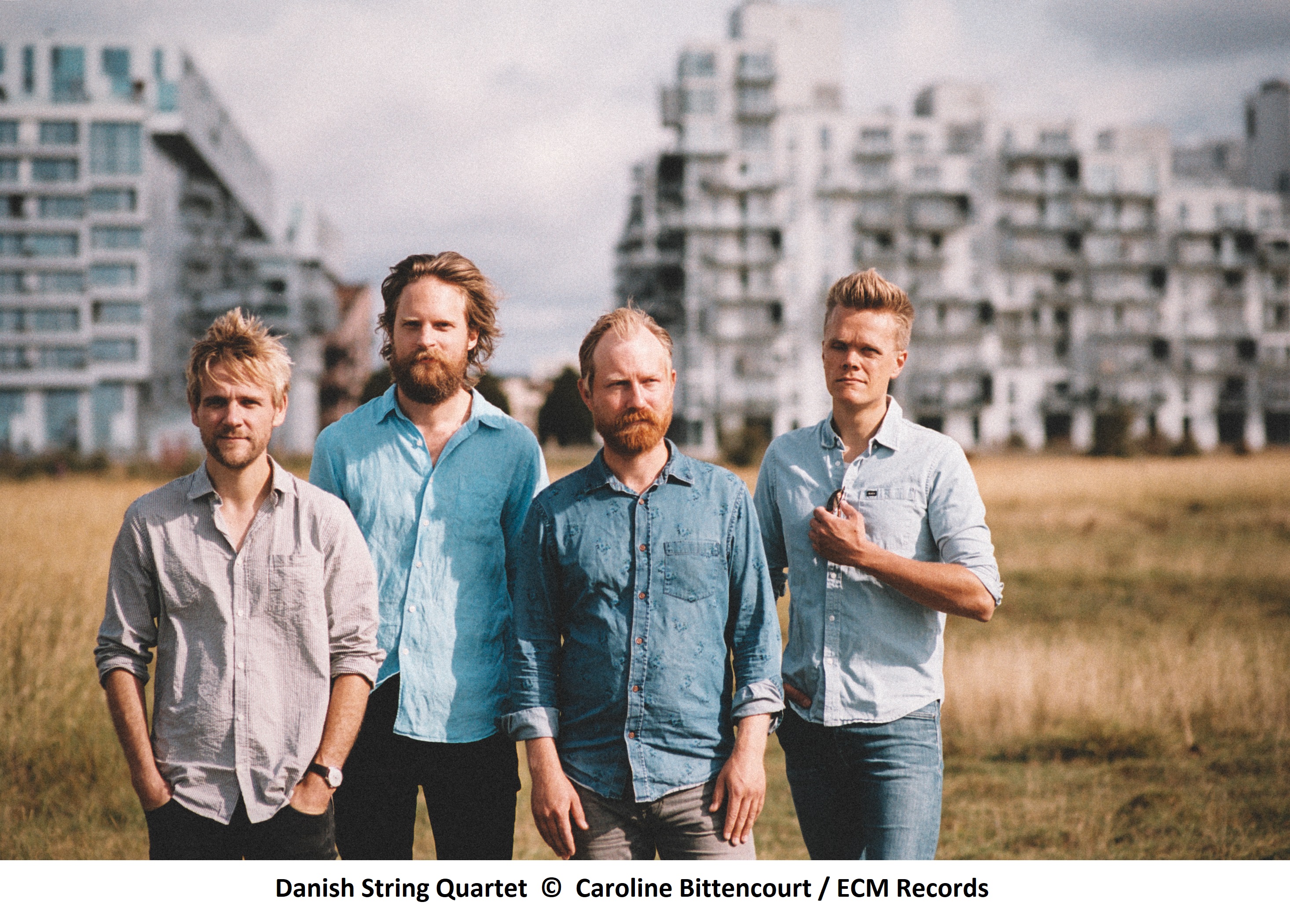
Danish String Quartet Frederik Øland violin Rune Tonsgaard Sørensen violin Asbjørn Nørgaard viola Fredrik Schøyen Sjölin violoncello Recorded September 2018, Reitstadel Neumarkt Engineer: Markus Heiland Cover: Eberhard Ross Produced by Manfred Eicher Release date: June 3, 2022
For this fourth installment of the PRISM series, the Danish String Quartet strikes its boldest combination of light and shadow. By starting with the Fugue in G minor, BWV 861, from Book I of Johann Sebastian Bach’s The Well-Tempered Clavier (as arranged by Emanuel Aloys Förster), it wears on its sleeve the subtle élan that permeates all to follow. Its textures are those of a piece of clothing one has worn for years, every memory connected with it coming to life in déjà vu. Stepping outside of that outfit and into another embroidered with the name “Ludwig van Beethoven,” it’s impossible to think of the String Quartet No. 15 in A minor, op. 132, as anything less than an unpacking of the gift we have just received. The opening forgoes Bach’s expansiveness, tracing ropes all the same but this time in less of a macrame and more of a sailor’s knot. The second movement, marked Allegro ma non tanto (“Fast, but not too much”), gives ample room for the musicians to spread their leaves in a canopy porous enough to nourish the forest floor with sunlight. The balance of urgency and patience is exemplary. A shift halfway through into sustained harmonies pushes hues of glory between the trees. The 18-minute third movement is like a pond in that while its surface appears tranquil, we are aurally edified regarding the undercurrents and other invisible forces keeping its waterline steady. A methodical seesawing between straight tones and vibrato amplifies a voice of literary dimension, circling clockwise from prologue to epilogue. Only then do we get the retrospective excitement of the fourth movement (a brief march), followed by the shifting plates of the fifth. When pizzicato punctuations from the cello signal the final stretch, a feeling of sadness eclipses the ears. Thus, any happiness we might have found must be returned to sender, leaving us to wonder when we will ever meet again.
It’s poignant to consider that Beethoven was just months from leaving this world behind when Felix Mendelssohn, then a tender 18, composed his String Quartet No. 2 in A minor, op. 13. Mendelssohn’s exploratory ethos was ripe for transplanting the influences of Beethoven’s Opus 132, watering them into a piece that overlapped in technical similarities even as it deviated in extroversion. Such is the spirit of the first movement, in which vertical and horizontal motifs favor parallel paths over common ground, so to speak. The Adagio that follows develops with nondescript urgency. The viola is especially robust as the violins circle overhead, high but never out of sight. The third movement is a delectable exercise in playfulness that foreshadows the pastoralism of Antonín Dvořák. Its abrupt ending gives us pause before the drama of the finale opens the quartet’s thickest curtain to reveal a densely populated scene, likewise open-ended in its resolution.
If any of the above reads evocatively, it’s because these Danes make it impossible to experience this program any other way. Their approach to synergy is as carefully planned as it is spontaneous, and with only one more volume to go, we have much to look forward to as this journey reaches its destination. At that point, however, we are likely to realize how much further we have yet to go in our listening.
Danish String Quartet Frederik Øland violin Rune Tonsgaard Sørensen violin Asbjørn Nørgaard viola Fredrik Schøyen Sjölin violoncello Recorded November 2017, Reitstadel Neumarkt Engineer: Markus Heiland Cover: Eberhard Ross Produced by Manfred Eicher Release date: March 12, 2021
Ludwig van Beethoven’s five late quartets must be reckoned with. In the words of the Danish String Quartet, presenting the String Quartet No. 14 in C-sharp minor of 1826, they “changed the game.” In saying as much, we might very well ask ourselves: What was the game to begin with? How far back does it go? With whom did it start? Augmenting the famous profession that “all roads lead back to Bach,” this recording charts as many paths forward as it does retrospectively. As for the game itself, we can say that it involves not only musical idioms but also hints of visual art, literature, religion, war, migration, and, dare I say, hope.
To know Beethoven’s Op. 131 is to take a full view of humanity, with all its triumphs and tragedies. The opening Adagio, the first of seven movements, spins fibers of tenderness into a muscle that flexes in tune with emotional suspensions, thus emphasizing the DSQ’s fitness as much as the composer’s. The Allegro that follows surprises with dance-like energies but may just as easily be interpreted as a coping mechanism against the grief that preceded it. Its extroversions are deeply entwined with introversion. Other movements, like the lively Presto, share their secrets more openly, taking on a litheness of clarity rarely heard in other renditions. The closing Allegro wears its heart on its sleeve just as securely, emboldening (not flaunting) its awareness as a modus operandi of exposition. But it’s in the gargantuan fourth movement, a nearly 15-minute Andante, where most of this vessel’s cargo is tallied in its keep. What begins as a spider’s thread of narrative sweetness morphs, as if in answer to the subtle insistence of the cello’s pizzicato, into a fog of impressions that resolves itself into a dew of urgent memories. All the more fitting that this quartet was never performed in the composer’s lifetime. For while its mixed receptions have morphed into high regard, the music reminds us of the necessarily contrasting organs in its body. As these meticulous musicians remind us, none will function on its own but only when connected to the larger whole.
For his String Quartet No. 1, op. 7, Sz. 40 (1909), Béla Bartók took inspiration from Beethoven’s opus 131. Both open in lament. That said, Bartók evokes a distinct shade of darkness made modern not only by its tonality but also in the interpretation so lovingly given here. The DSQ enhances the piece’s metallic sheen without neglecting the patina it already had when first composed. When the viola announces itself in the opening Lento, it does so not out of desperation but infirmity. At this point, the heart is already so weakened that beating its drum feels like an uphill climb. Somehow, Bartók affords us a view of the valley to show that achievement means nothing without hardship. Even the Allegretto that follows emerges hesitantly, an animal out of hibernation before proclaiming its heritage. The digging cello of the Introduzione that follows sets up the storytelling of an Allegro for the ages. The atmosphere is chiseled in something more durable than stone: an alloy of reinforcement made possible only by the laying of human hands on natural materials. Forgoing any illusion of permanence (everything decays), Bartók recognizes that imperfection is always a reliable receptacle for creative ideas. As the strings move—sometimes in unison, mostly apart—they prove that cohesion isn’t always obvious or visible. Rather, it is born through the message of interpretation. Every gesture of insistence in the violins gives way to glorious resolution, jumping from the edge of a collective inhalation. Is this triumph or just a return to baseline? You decide.
Because Beethoven was deeply inspired by Johann Sebastian Bach’s The Well-Tempered Clavier, it only makes sense to include a fugue (this one in C-sharp minor, the very key signature used in Beethoven’s 14th quartet), as arranged by Emanuel Aloys Förster. Its tessellated configuration is a breath of higher origin, smoothing over the postmodern cracks with a reminder of what makes beauty earn its name: the scars of our destitution.
Ferenc Snétberger guitar András Keller, Zsófia Környei violin Gábor Homoki viola László Fenyő violoncello Gyula Lázár double bass Concert recording, December 2018 Liszt Academy, Grand Hall, Budapest Engineers: Stefano Amerio and Gergely Lakatos Cover photo: Atilla Kleb Produced by Manfred Eicher Release date: February 12, 2021
After making his ECM debut with the live recording In Concert and the jazzier follow-up Titok, guitarist Ferenc Snétberger returns to the label with Hallgató. Recorded live in December of 2018, it positions his strings amid those of the Keller Quartett and Gyula Lázár on double bass. The focus this time is on Snétberger as a composer, with three of his works standing as pillars of the program. His Concerto for Guitar and Orchestra (1994/95; arr. 2008) spans three substantial movements. Subtitled “In Memory of My People” and written for the 50th anniversary of the end of the Holocaust, it balances precise notation with liberating cadenzas. “Hallgató” (a somewhat ambiguous word meaning “listener”) sets the scene with guitar alone before the quintet’s entrance, feeling out the landscape upon which we are about to walk with these fine musicians as our guides. “Emlékek” (memories) is our first waystation. Romantic yet devoid of excess, its nourishment fortifies us for the fancier footwork of “Tánc” (dance), in which the catharsis we have been seeking is realized, reminding us of what vibrancy feels like. Snétberger’s Rhapsody No. 1 for Guitar and Orchestra (2005; arr. 2008) is equally dynamic, if less angular. Like a figure sashaying between historical buildings, it navigates city streets with the nostalgia of experience on its shoulders. In the journey between them, we come across Your Smile for solo guitar, a timely song without words.
Works from other composers fill in the gaps with vital organs. Two songs from John Dowland (1563-1626) are the subject of astonishing arrangements by David Warin Solomons. “I saw my lady weep” and “Flow, my tears,” both from 1600, show the undying spirit of this music, the guitar adding a lute-like touch to the backdrop while strings weave their tapestry in its light. The latter tune, a duet for guitar and cello, speaks in an unmistakable nocturnal tongue. The program takes its deepest breaths in the String Quartet No. 8 in C minor of Dmitri Shostakovich (1906-1975). Written in 1960 for victims of fascism and war, its opening and closing Largos are played crosswise, lending a graceful urgency to their differences. The second movement, by contrast, is delicate without pulling the punches of its traumatic reveals, while the Allegretto dazzles with its rougher qualities. The Adagio for Strings by Samuel Barber (1910-1981), taken from the String Quartet, op. 11, of 1936, is also included, rendered with a vocal quality I’ve rarely heard.
All told, this is a superb program from world-class artists. More than the performances, however, Snétberger’s writing scintillates. Such cinema requires no camera and only the heart as a projection screen. What begins with a yearning for peace opens into dance-like wonder, but only briefly before lowering the head in slumber to chase resolutions behind closed eyes. Because, in the end, memories may be nothing more than dreams we haven’t yet forgotten.
András Schiff piano Jörg Widmann clarinet Recorded May 2018 Historischer Reistadel, Neumarkt Engineer: Stephan Schellmann Cover photo: Jan Jedlička Produced by Manfred Eicher Release date: October 2, 2020
In the opening gestures of the Sonata in E-flat major, op. 120/2 (1894), for clarinet and piano, it’s difficult not to feel the breath of life that moved its composer, Johannes Brahms (1833-1897), to such rapture in the latter years of his life. As the second of two such sonatas and his final chamber work, it is a testimony not only to Richard Mühlfeld, the master clarinetist of his day whom Brahms called “the nightingale of the orchestra,” but also to the self-effacement with which Brahms struggled throughout his creative life. And so, when considering the enduring interpretations here by pianist András Schiff and clarinetist Jörg Widmann, one must understand that without a love for every note, the bars between them would erode. Thus, Widmann gives colorations to the breath at every turn, while Schiff understands the role of the piano in Brahms’s chamber works as more than an accompaniment, giving it the fullness of expression it requires. The second movement, a rousing Allegro appassionato, is quintessential Brahms for its controlled drama and balance of fine motor skills, all tied together with a rustic charm. The final movement works patience into the virtue of exuberance.
The Sonata in f minor, op. 120/1 (1894), is even more dynamic. After a gradual first movement, the second unravels like paint from a brush, finding favor in the final trails of each stroke. The restrained Allegretto that follows sets up a rousing Vivace, the ebullience of which dazzles the senses. Given its symphonic textures, it’s no wonder the piece lent itself so gloriously to Luciano Berio’s orchestral transcription in 1986.
Between these giants of clarinet literature are Widmann’s five Intermezzi (2010) for piano. As tributes to both Schiff (to whom it is dedicated) and Brahms, they show a modern heart in love with the blood of tradition pumping through it. The central intermezzo, at 12 minutes, digs deepest into the spirit of this emotional transference. Throughout, we encounter waking moments in an otherwise dreamlike mise-en-scène. Nevertheless, clarity abounds.
Camerata Zürich Igor Karsko direction, lead violin Maïa Brami speaker Recorded September and November 2017 Radiostudio DRS, Zürich Engineer: Andreas Werner Cover photo: Nadia F. Romanini An ECM Production Release date: November 26, 2021
“When the heart speaks, the mind finds it indecent to object.” –Milan Kundera, The Unbearable Lightness of Being
Czech composer Leoš Janáček (1854-1928) penned his two-volume On an overgrown path between 1901 and 1908. While its significance in the pianistic pantheon is often eclipsed by canonical predecessors, its inventiveness is marked by nonorthodox shifts in harmony, each a full statement without the need to justify what precedes or follows. Given the music’s history and place in time, few would be up to the task of arranging it for string orchestra with equal fervor, but this is precisely what Daniel Rumler did in 2016 to luminous effect, breathing not new but old life into the lungs thereof.
As Thomas Meyer notes in the CD booklet, the title of On an overgrown path references a Moravian wedding song, said path signifying the new bride’s severance from a home to which she can never return. The result is a collection of what the composer called “distant reminiscences” of folk songs and practices. In pieces like “A blown-away leaf,” the underlying connectivity of the notes rises to the surface as treasure from past sediment. Given its basis on the rhythms of the Czech language, we can rightly think of these as “texts” across which editorial marks of prosody and poetry abound, shifting with lyrical abandon from elegy to triumph at the gesture of a bow. Dances (e.g., “Come with us!” and “They chattered like swallows”) testify to the power of memory to reside where it cannot be erased. The spiritual glimpses of “The Madonna of Frydek,” which paints in broad strokes yet with detailed awareness, lean into Janáček’s love for his daughter, Olga, who died in 1903.
Much of this music, however, is divided against itself. For instance, what begins as a frolic in “Words fail!” morphs into uncertain recollections and emotional vulnerabilities. The latter work their way through “Good night!” and “Unutterable anguish” with the wormlike glow of burning steel wool. The strings are especially able to draw out that inner turmoil with maximum acuity. Even the closing Allegro grasps a bouquet of fragmented selves, each a palimpsest of circumstance.
Between the cycle’s two books is a 10-part text by Maïa Brami, dedicated to Thomas Demenga, who was the director of the Camerata Zürich when the orchestral arrangement was being put together (and who suggested the writing of these texts). Brami describes the scene as follows:
“In the evening of his life, Leoš Janáček returns to his native forest. He does know it, but it is the last time. The composer is looking for Otto, the son of his muse, Kamila Stösslova, whom he loves passionately. The boy has wandered off into the woods. After years of passionate correspondence, the young woman finally accepted the first-name as an admission of shared love and came to visit him in his family home. When he met her at a spa in 1917, the artist was at his lowest ebb: he had not recovered from the death of his daughter Olga and his career was not taking off. Kamila, his ‘rose,’ his ‘red flower,’ will resurrect him.”
This panoply of yearnings and recollections (“God how I would love to hold on to the summer,” he cries, “I who waited for it all my life!”) unfolds like a biography in miniature, brilliantly capturing moving images of the composer’s childhood (“Deep down in my suitcase, a pot of honey from my father’s hives, heavy as my grief”), mortal anxieties, and the loves connecting the spaces between. Thus, the composer is able to dip his fingers into the font his creative inspiration. And as the end encroaches on him, he resigns to the fleeting nature of things.
The program is bookended by two kindred pieces. The Meditation on the Old Czech Chorale St. Wenceslas, op. 35a (1914) of Josef Suk (1874-1935) welcomes natural sonorities. Like tall grasses in a windswept landscape, it gives purpose to the elements by making known their otherwise invisible movements. The Notturno in B major, op. 40 (1875) by Antonín Dvořák (1841-1904) closes with grace, folding us into a river’s current in search of an oceanic afterlife.
Parker Quartet Daniel Chong violin Ken Hamao violin Jessica Bodner viola Kee-Hyun Kim violoncello Kim Kashkashian viola Recorded November 2018, Radiostudio DRS, Zürich Engineer: Peter Laenger Cover photo: Woong Chul An Produced by Manfred Eicher Release date: October 22, 2021
If the phenomenality of existence is rooted in its fleetingness, then music cannot be clothed in any raiment other than its mortality. Such is the impetus (and the slip-through-your-fingers brilliance) of György Kurtág’s composing, which never bites off more than it can chew so as to absorb every nutrient of its dialogic vocabularies. In the invocational architectures of his Six moments musicaux, op. 44 (2005), which open this program of ear-opening juxtapositions, there is much to be uncovered by listeners willing to seek the fragmentary in the harmonic and the holistic in the dissonant. Whether dancing with exuberance or wallowing in the eventide of mourning, the strings manifest as much meaning untouched by the bow as humming beneath its pressure. Shades of motifs that came before crack themselves open like eggs to reveal two distinct textures that cook at different temperatures. The Parker Quartet treats these dichotomies as anything but, reveling quietly in their gradations of white and yellow. The icy “Rappel des oiseaux…” (an etude rendered mostly in harmonics) is the clearest example of how sensitive one must be to speak Kurtág’s language. The quieter his grammar, the more robustly it leaps from the score.
The painted side of this mirror is Kurtág’s Officium breve, op. 28 (1988/89). Written in memory of composer Endre Szervánsky (1911-1977) but also paying respects to Anton Webern (1883-1945), its fifteen movements open as if tuning, bleeding into concentrations of light. Like a candle during a power outage, its quotidian purpose is magnified to near-sacred focus. For the most part, however, these pieces are reflections of reflections. From the sonority of the “Sostenuto” to the fragile spirituality of the “Canon a 2,” the Parkers erase the “d” in “breadth” and leave it to exhale into the slow-motion slumber of the final “Larghetto.” It is, as Paul Griffiths best describes it in his liner note, “A homecoming, to a lost home.”
Between these two destinations blossoms the String Quintet No. 3 in E-flat major, op. 97, of Antonín Dvořák (1841-1904). Composed in 1893 during a sojourn in the small Iowa town of Spillville, its rendering here with special guest, violist Kim Kashkashian (a mentor of the musicians), immediately boldfaces the brightness for which the Czech composer was so well known, soaring in search of a place without winter. What begins as a splash of sunlight in the Scherzo shifts into fluid motion, the violin working its way like a bird in slow motion without any other purpose than to mark its path with invisible ink. Heat comes in the slow burn of the Larghetto, which rests its weight on Kashkashian’s shoulders as on a savior in dark times. This is a highlight for the quartet’s ability to mesh with itself and incorporate the extra instrument as if it was always there. Between the light footfalls of the cello’s pizzicato and the dreamlike tremble of its higher cousins, everyone has a chance to make peace with the fullness of their message, finding in the Finale a way to begin again: by inhaling with a prayerful spirit.
Fred Thomas piano Aisha Orazbayeva violin Lucy Railton violoncello Recorded 2012/2018 University of Huddersfield, courtesy of Pierre-Alexandre Tremblay Recording and mixing engineer: Alex Bonney Balance engineers: Pierre-Alexandre Tremblay and Rob Sutherland (trios), Elliott Parkin (solos) Recording producer: Fred Thomas Cover photo: Manos Chatzikonstanzis Mastering: Christoph Stickel Executive producer: Manfred Eicher Release date: October 22, 2021
Three Or One documents the prismatic transcriptions of pianist Fred Thomas, who for this project dips his fingers into the font of Johann Sebastian Bach’s Orgelbüchlein. He adds to that unfinished book of organ chorales and canons a selection of vocal movements and other Bachiana, lovingly sequenced by producer Manfred Eicher. As revealed in a liner note, Thomas sought to “subvert the associations of the piano trio (so remote from Bach) and induce a hushedness that I heard in his compositions.” Bringing said trio to life are violinist Aisha Orazbayeva and cellist Lucy Railton, whose sense of color, space, and time humble the proceedings to a scriptural level.
The opening chorale, “Ach bleib bei uns, Herr Jesu Christ” (BWV 649) gives majesty to the very air as if it were only a medium for melody. Such presence is strong yet yielding throughout, as most apparent in the organ pieces. Of these, “Herr Christ, der ein’ge Gottes Sohn” (BWV 601) is especially touching for its heartfelt composition and centuries-delayed interpretation. “Ich ruf zu dir, Herr Jesu Christ” (BWV 639) is another spiritual well from which is drawn the water of life itself.
The arranging is as sensitive as the playing. Whether in the delicate cello pizzicato of “Durch Adams Fall ist ganz verderbt” (BWV 637) or the sustained violin lines of “Erbarm dich mein, o Herre Gott” (BWV 721), one can feel the close-eyed bliss of the creative process in both directions. The program offers solo piano interpretations as well, including a flight of four cantata arias and a sinfonia. In these are light-footed grace, intensifying passion, geometric wonder, and childlike whimsy all rolled into a holistic package.
Culminations of these signatures are found in the shining beacons of “Liebster Jesu, wir sind heir” (BWV 633), in which the strings blend like siblings while the piano sermonizes as if to a congregation of three, and “O Gott, du frommer Gott” (BWV 767), in which the violin sings as if a choir of one. Perhaps, this is a hidden nuance of the album’s title, referring not only to the number of musicians but also an evangelical diversity. Another doctrinal nugget is “Gott, durch deine Güte” (BWV 600), in which a closely miked violin played sul ponticello fills the left channel with birdlike movements.
We can be sure that everything gained here is the result of something lost. Hence the poignancy of what we are hearing: the cycle of birth and death that allows these beauties to exist in the first place. We can feel history coming together as much as separating, working to define the sounds through equal parts memory and unknowability. Notes Thomas: “Bach set out to discover, not create, the musical rules of the universe.” Indeed, there is much to discover in these hymns, sung before we could ever sing them.
Thomas Zehetmair Baroque violin
Recorded August 2016, Propstei St. Gerold
Engineer: Hannelore Guittet
Mastering: Christoph Stickel
Cover: Fidel Sclavo
Executive producer: Manfred Eicher
Release date: November 15, 2019
The Sonatas and Partitas for Violin Solo, inked by Johann Sebastian Bach under the trim title of Sei Solo (pseudo-Italian for “Six Solos”), are often lumped among his “secular” instrumental works, albeit as the crowning achievement of their kind. Yet they are every bit as spiritual as his cantatas and just as glorious in their ability to activate metaphysical particles in the listener. That said, they are more than illustratively hagiographic, for they are their own acts of transcendence.
We know little of the genesis of the Sei Solo, though Bach was accomplished enough as a violinist that he would have possessed requisite understanding of the instrument’s inner life to write them. And where some violinists—wittingly or not—take to obscuring the bodywork required of the interpreter, Thomas Zehetmair broke new ground in this regard with his recording for Telefunken in 1983. Said recording came to me by way of Teldec’s 1992 reissue (which I purchased on CD after wearing out my vinyl copy) and has been my benchmark ever since. Only later, once I saw that Zehetmair was being featured on an increasing number of ECM productions, including accounts of the solo works of Eugène Ysaÿe and Niccolò Paganini, and especially in light of ECM’s other takes on the Sei Solo by John Holloway and Gidon Kremer, I hoped he might one day think to revisit Bach’s masterworks. Imagine my elation when I saw the press release for this recording in my inbox. It was eminently worth the wait.
Now playing on period instruments that, by sheer coincidence, date from Bach’s birth and death years of 1685 and 1750 (along with two bows from around 1720) and recording in the priory of St. Gerold, a location known well by ECM aficionados as a favorite of the Hilliard Ensemble, Zehetmair brings more than thirty years of bonus experience to these personal interpretations.
Zehetmair’s use of gut strings, combined with the immediacy of playing without a shoulder rest, is palpable. As before, he eschews demonstrative pitfalls, lets endings exhale, and understands the architecture inherent to each movement, but this time brings the wisdom of life itself to bear on music that is, too, life itself. His ornamentation has grown in both detail and control—drawing from within rather than adding from without—and emphasizes the importance of reflective surfaces to give light meaning.
The Sonata No. 1 in G minor moves across his strings with the grandest of gestures, as if in that very sweep he describes the fullness of an entire village with all the histories, triumphs, and tragedies it has seen. Standing in the center of that village is a church where Bach himself can be seen praying for a world that is increasingly turning its ears away from the beauty it was designed to preserve. The initial effect is so inwardly focused that when extroversions like the Allegro emerge, they do so with light in their grasp. Zehetmair’s pacing is as magnificent as it is organic, swimming with the currents of time as a fish fearing neither hook nor net. His dynamics are also noteworthy, holding back with artful righteousness. Even in the briefer Siciliana, he ensures that every note has its say among a congregation of voices lifted high. Even the urgency conveyed in the final Presto is tempered by faith. Its balance of legato and rhythmic scraping is crepuscular.
The Allemanda that opens the Partita No. 1 in B minor is one of the most heroic passages of the entire collection (and, incidentally, where Zehetmair began the first recording). It is rendered here like an erratic brush painting. In moving through its narrative, cycling back to its repeat mark as if to confirm a memory before leaving it behind, Zehetmair allows previously glossed-over double stops to resonate a touch longer, speaking in a voice that can only resonate through hair and string. He plays the Double with such grace as to be its own hymn; the Corrente likewise. The Sarabande and its own double are hauntingly exquisite, as is the Tempo di Borea, which dances its way through the heart as if it were a springboard into doctrinal truth.
As Stanley Ritchie writes in his book on interpretations of the Sei Solo: “There is no such thing as ‘unaccompanied’ Bach.” This statement, I imagine, refers not only to the fact that the violinist must have an intuitive command of multiple strings and arpeggios (the connections of which bleed richly into one another in St. Gerold’s acoustics), but also to the music’s own self-referentiality. The Grave that begins the Sonata No. 2 in A minor, for instance, is certainly a ghost of the Allemanda that began the preceding Partita, and sets up the Fuga as if it were a closing statement from a pulpit. But then the tenderness of the Andante weaves its threads like a shroud for a glorified body and prepares to receive the sacrament of the final Allegro. Played at an initially conservative tempo, it escalates—as the flesh is wont to do—in abandonment of a rhythmic ideal, shifting from one phase to the next as if each were born of its own tempo.
The Allemanda of the Partita No. 2 in D minor breaks the chain of its cousins and forms a more rounded and contemplative sonic sculpture. Jumping over to the Giga, we encounter another wonder of the arpeggio in its ability to converse with itself. All of which brings us to the mighty Ciaccona. Despite taking on a life of its own as a self-contained performance piece, it is best heard in context. Zehetmair’s bowing comes across with sentience, as if compelled to communicate by something far more powerful than words: namely, melody. So, too, must we read carefully the Adagio opening the Sonata No. 3 in C major that follows as a continuation of that restless fatigue, and the organ-like Fuga that follows it as the beginning of a revival taken to fullness of joy in the concluding Allegro assai. What the exuberant Preludio of the Partita No. 3 in E major lacks in duration it makes up for in Zehetmair’s purity of interpretation. His mixture of the royal and the rustic is uniquely his own, as is true also of the Gavotte. And because the two Menuets feel like such snapshots out of time, the final Bourrée and Gigue are surely recreations of the past.
For me, at least, the bar has been set even higher by the one who placed it there to begin with. In so doing, Zehetmair has left us with a document unlike any other. The transformation he has undergone in a matter of decades—the same to which we are granted access over the span of two CDs—puts me in mind of Verses 1-7 from Psalm 102:
Hear my prayer, O LORD, and let my cry come unto thee. Hide not thy face from me in the day when I am in trouble; incline thine ear unto me: in the day when I call answer me speedily. For my days are consumed like smoke, and my bones are burned as an hearth. My heart is smitten, and withered like grass; so that I forget to eat my bread. By reason of the voice of my groaning my bones cleave to my skin. I am like a pelican of the wilderness: I am like an owl of the desert. I watch, and am as a sparrow alone upon the house top.
So, too, does the lone instrument gaze upon the world from its vantage point, waiting for grace to show itself. But one also knows that goodness is never far behind wherever evil treads, and that divine protection is ours for the taking because it is offered freely against enemies whose melodies reign dissonant and unsweet. Bach gives one such set of armor, and here it has been tempered to mirror shine.