Michael Naura: Vanessa (ECM 1053)

ECM 1053

Michael Naura
Vanessa

Michael Naura piano
Wolfgang Schlüter vibraphone, marimba, percussion
Eberhard Weber bass
Joe Nay drums
Klaus Thunemann bassoon
Recorded September 1974 at Windrose Studios, Hamburg
Engineer: Martin Wieland
Produced by Michael Naura

Lithuanian-born Michael Naura is a German pianist, editor, and journalist. Capitalizing on a range of influences, from George Shearing to Horace Silver, his successful self-titled quintet LP of 1963 made him a household name in hard bop. If the benefit concerts arranged after his being diagnosed with polyserositis the following year are any indication, his brief absence caught many in its ripples. Central to Naura’s cadre in his formative years as recording artist was vibraphonist Wolfgang Schlüter, whose presence is keenly felt throughout Vanessa, his first and only album for ECM proper (he did release another, Country Children, as part of the label’s short-lived SP series). Even though last year saw Naura’s efforts recognized with a WDR Jazz Prize lifetime achievement award, this album remains etched in vinyl.

Naura’s set of six opens its eyes in the electric piano and marimba strains of “Salvatore.” The unmistakable electrobass of Eberhard Weber provides just enough ground for Klaus Thunemann’s stellar bassoon improvisations. This gorgeous opener sounds more like John Zorn’s Electric Masada on sleeping pills than anything else. The energy peters out over time and seems to trip on its own intentions, opening up a subtle improvisatory space in the process. From these murky depths arises the track’s thematic beginnings, passionately recapitulated with some superbly realized drumming from Joe Nay, amid a flanged wash of familiarity. “Hills” bustles like lunch hour in Burtonville, though it’s Weber’s nimble fingers that make it the album’s highlight. The next tune lumbers playfully like its titular “Baboon,” all the while emoting an intrinsic self-assurance. Thunemann adopts a vocal quality that is anything but primitive in a three-minute aside that’s sure to bring a smile to your prehensile lips. The title cut reaffirms Schlüter’s reign, billowing through the night like a curtain at an open window, where once wavered the silhouette of a love no longer here, and at which now stands the one left behind. Moments of synchronicity hint at a fleeting union shared under cover of neon and subterranean steam. The serrated contours of “Listen To Me” contrast alluringly with its straight-edged neighbors. Vibes thread the whole, culminating in a sustain-pedaled echo. Ultimately, the bassoon abstractions and soloing of the elegant “Black Pigeon” prove Thunemann to be the star performer of an altogether commendable group of musicians.

A rare video of the group from 1974:

The only downside to the album is its sometimes weak recording mix. One can almost feel the marimba solo in “Salvatore,” for example, being tweaked into the foreground (compare this with the more equitably balanced “Listen To Me”). Should a reissue ever be in the works, as I hope it will be, a remastering will also be in order. Nonetheless, a keeper if you can track down one of these hot pink, fishnet sleeves.

<< Steve Kuhn: Trance (ECM 1052)
>> Richard Beirach: Eon (ECM 1054)

Wolfgang Dauner: Output (ECM 1006)

1006

Wolfgang Dauner
Output

Wolfgang Dauner piano, effects (ring modulator), keyboards (Hohner Electra-clavinet C)
Eberhard Weber bass, cello, guitar
Fred Braceful percussion, voice
Recorded September 15 and October 1, 1970 at Tonstudio Bauer, Ludwigsburg
Engineer: Kurt Rapp
Produced by Manfred Eicher
Release date: December 1, 1970

An early outlier in the ECM catalog, Output convulses with as much originality as it did when it was first released. Wolfgang Dauner, perhaps better known as founder of the United Jazz + Rock Ensemble (which saw ECM greats Eberhard Weber, Kenny Wheeler, and Charlie Mariano pass through its doors), assembles a modest trio of talent for this classic 1970 studio free-for-all. The end result is humor, brilliance, and chaos rolled into one. Most of the album flirts with any number of possible paths, the sole exception being “Nothing To Declare,” a straight-laced tangent into jazzy territory in which Dauner has a field day with his modulator. “Mudations” and “Brazing The High Sky Full” are cryptic bookends, while tracks like “Abraxas” whet our appetite with provocative flavors.

Output

Superb, if jumbled, musicianship and strong attention to detail are the order of the day. Dauner does wonders with limited means, Braceful sheds his skin whenever possible, and this is a far cry from the Weber of languid orchestral suites. Not an easy listen for the faint of heart, but one that will give back what’s put into it and, like the fully opened cover, gathers its power from another dimension.

<< The Music Improvisation Company: s/t (ECM 1005)
>> Jan Garbarek Quartet: Afric Pepperbird (ECM 1007)

Eberhard Weber: The Colours Of Chloë (ECM 1042)

Eberhard Weber
The Colours of Chloë

Eberhard Weber bass, cello, ocarina
Rainer Brüninghaus piano, synthesizer
Peter Giger drums, percussion
Ralf Hübner drums
Ack van Rooyen fluegelhorn
Cellos of the Südfunk Symphony Orchestra Stuttgart
Recorded December 1973 at Tonstudio Bauer, Ludwigsburg
Engineers: K. Rapp and M. Wieland
Produced by Manfred Eicher

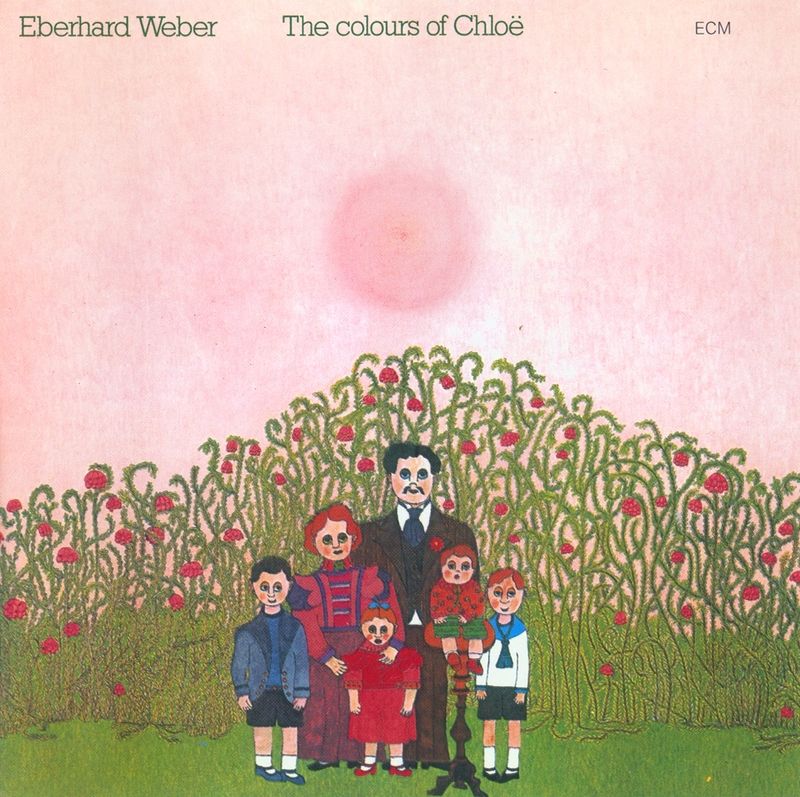
Listening to an Eberhard Weber album, one can always count on an immersive experience. This is especially true in his first as frontman. From its enigmatic title and charming cover to its fine musicianship and well-conceived instrumentation, The Colours of Chloë remains an ECM classic and may just be the perfect introductory album for those looking to know why the label was so influential even in its infancy. In a span of 4 compositions and 10 times as many minutes Weber produces a veritable mélange of flavors, textures, and, of course, colors. On that note, “More Colours” gives us just that as Weber’s bass cuts a slow swath of orchestral goodness. The title track features an ethereal ocarina* that swirls into a resplendent piano solo from longtime Weber collaborator Rainer Brüninghaus. “An Evening With Vincent van Ritz” draws from the same palette as the first track, but soon breaks into a run with some inspired drumming and a stellar fluegelhorn solo by Ack van Rooyen, while “No Motion Picture” reprises the spacey feel of the title track and shows Weber at his most profound. Not to be forgotten, Brüninghaus also has some breathing room here and provides some of the more transcendent moments in this all-too-brief journey.

Although a glance at the cover art or lineup may not exactly cry “Jazz!” Weber knows where he and his instrument stand. The music is firmly rooted in the genre’s orthodox structural standby: i.e., a solid thematic framework with plenty of room for improvisation along the way. While compositionally astute, Weber’s greatest strength is his “eye” for sound. His feel for blending instruments is highly idiosyncratic and backed by an obvious passion for music-making. His distinctive combination of bass, piano, percussion, horns, and strings is such that no one instrument or group is ever dominant for too long. Each musician is only as good as his altruism toward the ensemble as a whole. That being said, one cannot help but marvel at Weber’s signature sound at the heart of it all, or at his uncanny playing that walks the line between affirmation and mourning. This album is not to be missed.

*Thanks to Rasmus Sylvester Bryder for this correction.

<< Jan Garbarek: Witchi-Tai-To (ECM 1041)
>> Bennie Maupin: The Jewel In The Lotus (ECM 1043)

Eberhard Weber: The Following Morning (ECM 1084)

ECM 1084

Eberhard Weber
The Following Morning

Eberhard Weber bass
Rainer Brüninghaus piano
Members of Oslo Philharmonic Orchestra celli, French horns, oboe
Recorded August 1976 at Talent Studio, Oslo
Engineer: Jan Erik Kongshaug
Produced by Manfred Eicher

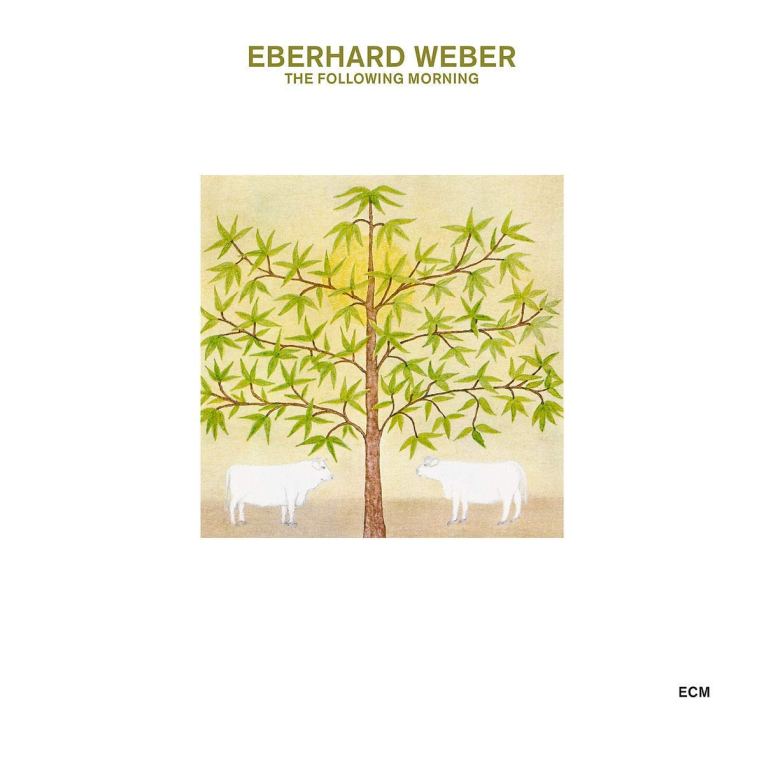
The title of Eberhard Weber’s classic 1977 album is as evocative as they come. At once cryptic and expository, the image calls up a host of associations, plays of light and shadow.

“T. On A White Horse” establishes the album’s solemn mood as Weber’s distinctive electrobass springs to life against an aquatic electric piano. A small orchestral section weaves its way in, painting chromatic oboe lines onto a droning canvas of cellos. As the strings intensify, bass and woodwinds share a plaintive synchronicity. The bass holds its breath, cupping its hands around Brüninghaus’s delicate flame. Oboes carry their lilting harmony across the oceans, fading into the bell-like call of sunrise.

“Moana I” feels less like a journey with a goal and more like a testing ground for confluence. The orchestra sprouts like a forest through which Weber must limp on his way toward dawn. The piano’s melodic charge, however, helps to cut this tension. Once the French horns offer their own desultory commentary, morning light pours in. The electric piano buffs the music to a crystalline sheen while horns and winds work their way back into rest. They find their beds and sleep, having reached the summit of their dreams.

The title track begins with indistinct ambient noises: people rustling in a resonant space, musicians shifting in their seats. This impressionistic cloud splits with a piano chord in reverse, loosing an electronic squall. Strings talk among themselves in the background as bowed harmonics trickle like rain down a window. The piano speaks of midnight to the bass, which emerges with a chorused effect. Weber’s keening tone touches the landscape, scratching glyphs into its fertile surface. The scene shifts and grinds, a hurdy-gurdy whispering in slow motion. The appearance of an acoustic bass in this track creates a dazzling effect, as if rising from some bygone era where the immediacy of live performance was a given and not a luxury, and where the communal experience of music thrived in the ears of every listener. The world unravels like a lullaby, revealing just enough of its heart to give us vast internal comfort. With this rupture mended the electrobass returns, laying out its motif over the pieces left behind. The acoustic bass chants the same note as a French horn plays us out.

“Moana II” puts us into an echoing flock of horns that seems to scorn the earth below. This segues into a brief passage of quiet abstractions before blossoming into a conversation between piano and bass, at which point the horns have flown away. Although the acoustic arrangements are wonderful, in this instance the heavily contrived bass feels just slightly out of place and, I think, clashes with the more organic backdrop. Thankfully, Weber reacclimatizes as he goes along, meshing beautifully with the synth effects at the album’s end.

Weber’s sound is instantly recognizable in its solitary function, marking its mission in stillness. With a liquid technique Weber wrings out as much melodic juice from his instrument as he possibly can. Not to be outdone, the epic piano stylings of Brüninghaus are the perfect foil for Weber’s decidedly intimate approach. Every time his fingers touch the keys, we begin to see where this music can really take us. Weber’s compositions constitute a vast sonic kaleidoscope in which one finds a range of moods all strung by the same nostalgic threads. Every detail is a new feather, stitched into the wings on either side of the space-bound fuselage that is his ever-expanding oeuvre. To listen to his music is to feel the state of things change from light to dark and back to light again.

<< Terje Rypdal: After The Rain (ECM 1083)
>> Keith Jarrett: The Survivors’ Suite (ECM 1085)

The Gary Burton Quintet with Eberhard Weber: Ring (ECM 1051)

1051 X

Gary Burton Quintet
with Eberhard Weber
Ring

Gary Burton vibraharp
Mick Goodrick guitar
Pat Metheny guitars
Steve Swallow bass guitar
Bob Moses percussion
Eberhard Weber bass
Recorded July 23 and 24, 1974 at Tonstudio Bauer, Ludwigsburg
Engineer: Martin Wieland
Produced by Manfred Eicher

Before I get into this review, I’d like to take a moment to share my process:

As a busy grad student, listening to music for pleasure has become an increasingly difficult luxury to sustain with any regularity. In addition to my undying adoration for ECM, one major part of my motivation for starting this blog was a desire to reinvigorate my listening life. To that end, I have taken to giving one album per night my undivided attention as I go to sleep. I keep a digital voice recorder by my bed and speak whatever impressions come to mind. I then transcribe these comments the following morning and pare them down to something coherent. Any of my regular readers will notice that my review production has slowed down as of late. This is due to the fact that I have been preparing for my M.A. thesis defense and am heavily sleep-deprived as a result. Even so, I have attempted to listen when I can and continue with my audio review logs. Due to the aforementioned sleep deprivation, however, fatigue has begun to take its toll on my cognizance. This became especially apparent as I was recording my review for Ring. It began benignly enough with my usual laudatory ramblings, but as I sat down the following morning to transcribe, I realized that I had almost no recollection of the second half of what I had said, having uttered it in a stupor of half-sleep. I have since removed the odder bits, but would like to share a few verbatim examples for your (and my) amusement:

One almost feels or gets the sense of joy, for in that concept of joy there are also children…. There are clouds and unwashed apples and trees floating in the sky…. Next year it will be different, somehow pleased by the authorities while people such as I will be behind bars…

Whether or not these comments impart any deep insight into the music at hand might very well be arbitrary. Still, I cannot imagine having said such things without some sort of provocation. This experience makes me question what kind of background noise I must be filtering out before coming up with anything at all intelligible. Thank you for indulging this tangent and, for what it’s worth, here’s my highly filtered version:

Gary Burton is in a class all his own. On the vibraharp he is pliant yet unbreakable with a certain flair for the understatedly powerful. Among the present company, he is perfectly at ease. No one tries to overpower him, and despite his melodic dominance he never looms for too long, receding into as many shadows as he casts. There’s not a single pretentious note to be heard; the flow between and within tracks barters its way across smooth waters. This is a nocturnal album all the way.

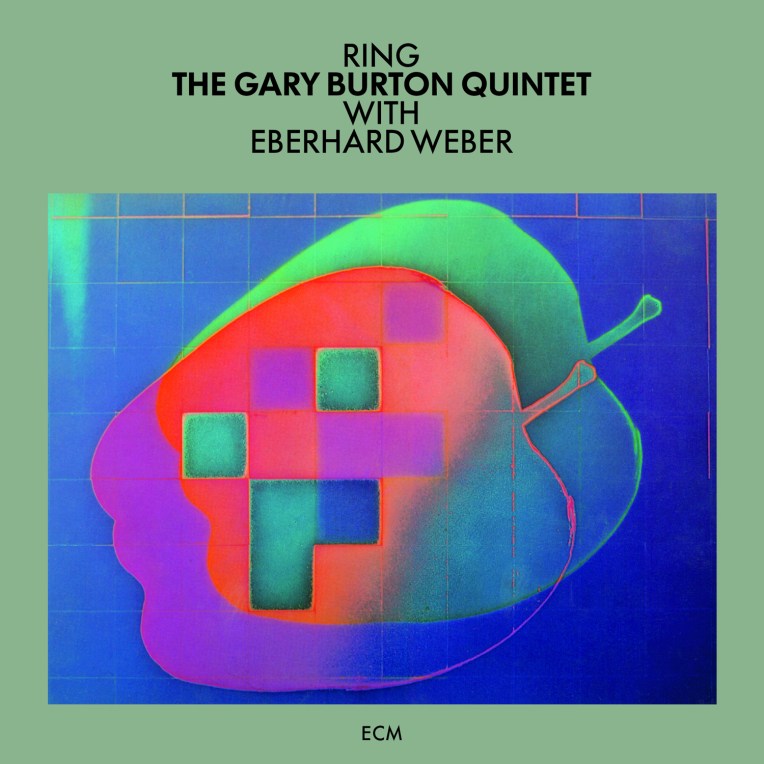
In the opening “Mevlevia,” flanged guitar provides a yielding current of sound upon which Burton and Weber are able to lie back and drift. “Unfinished Sympathy” is more than just a clever play on words, but is also a gorgeous vehicle for Goodrick’s rolling solos. Its structure is built around a recurring guitar motif, which indeed feels unfinished as it circles around a flower it can never pollinate. It is a short and sweet diversion into a vaguely grasped thought. “Tunnel Of Love” is a languid journey toward something that is apprently fated but which is actually uncertain. A warm bass solo arises from the murky surface that surrounds us, threading our path with its own braided thread. A lilting guitar in the background plucks steady notes from the air, balancing them atop slowly rolling spheres. “Intrude” begins with a drum solo that flitters like a dragonfly skirting the edge of its known domain. A certain jouissance works its way from the outside in before petering out into the last few drops of cymbal, at which point the ensemble kicks in with a six-stringed groove tugged along by bass and the now recumbent drums. The delicacy from before is implicitly maintained, even as the static builds in charge, at last defused by a premature spark. “Silent Spring” feels like the most composed piece in this set, and in that sense it refuses to take its own simple pleasures for granted. The bass flickers its way into recognition like a blown-out candle in reverse, telling what it knows to be untrue, a musical fabrication in disguise. “The Colors of Chloë” produces another superb bass solo in the midst of a first-rate groove, which seems to climb up and down stairs before settling on the black and the white of its own private chessboard.

In short: listen to this album and love it.

<< Keith Jarrett: Belonging (ECM 1050)
>> Steve Kuhn: Trance (ECM 1052)

Ralph Towner: Solstice (ECM 1060)

ECM 1060

Ralph Towner
Solstice

Ralph Towner 12-string and classical guitars, piano
Jan Garbarek tenor and soprano saxophones, flute
Eberhard Weber bass, cello
Jon Christensen drums, percussion
Recorded December 1974 at Arne Bendiksen Studio, Oslo
Engineer: Jan Erik Kongshaug
Produced by Manfred Eicher

This is arguably the first recording to fully flesh out the aural expanse for which ECM has come to be known. Although I am well aware of the immense groundswell of musical activity that was the 1970s, certainly an album like this was a refreshing and altogether mind-altering experience for those fortunate enough to be young musical explorers at the time. Featuring a lineup of musicians who would go on to weave ECM’s significance into the fabric of time, Solstice is a tour de force of musicianship, writing, arrangement, and recording.

Each track is brimming with life and features the sensitive application of a variety of instrumental combinations and studio savvy. “Oceanus” showcases Garbarek in his prime, soaring with an unbridled emotional register. As always, Towner’s 12-string speaks in 360 degrees. Superb drumming from Christensen complements lush melodic lines from Weber, who stretches a melodic cello into infinity while his bass arises like the conical aftereffect of a water droplet. “Visitation” clouds this ardor in a nocturnal vision filled with laughing spirits. “Drifting Petals” is a slow progression, a timid look out onto a dusty plain where the promise of freedom looms larger than the possibility of danger. But then an elder’s advice rings in our ears and pushes us onward. Feet move of their volition and pull us into the ever-receding horizon as the first drops of a squall streak across our foreheads. Towner proves again that his piano musings are not to be taken lightly, as they make for one of the most evocative tracks on the album. A transcendental 12-string solo (with gentle dimensional support from Weber) opens “Nimbus,” soon blossoming into a flourish of flutes, drums, and a bowed bass that cries with the grating fluidity of a sarangi. Garbarek’s sax joins in the fray and lets loose its harmonious fire. The deftly overdubbed flutes return, spreading their wings for a few moments before fluttering off into the distance. “Winter Solstice,” “Piscean Dance,” and “Red and Black” comprise a triptych of duets: the first for classical guitar and sax, the second a prime jam for 12-string and drums, and the third for 12-string and bass. “Sand” ends our cosmic journey with one of Garbarek’s deepest meditations for sax set to the strangely compelling ululations of Christensen’s flexatone lolling about in the background.

Melodically robust while structurally yielding, this is an album to be treasured and is a must-listen for anyone desiring to know what ECM is all about. An astounding meeting of musical minds if there ever was one.

<< Arild Andersen: Clouds In My Head (ECM 1059)
>> Abercrombie/Holland/DeJohnnette: Gateway (ECM 1061)