Lucian Ban/Mat Maneri: Transylvanian Dance (ECM 2824)

Lucian Ban
Mat Maneri
Transylvanian Dance

Mat Maneri viola
Lucian Ban piano
Recorded live at CJT Hall in Timișoara, October 29, 2022
Recording engineer: Utu Pascu
Mixing: Steve Lake and Michael Hinreiner (engineer)
at Bavaria Musikstudios, Munich
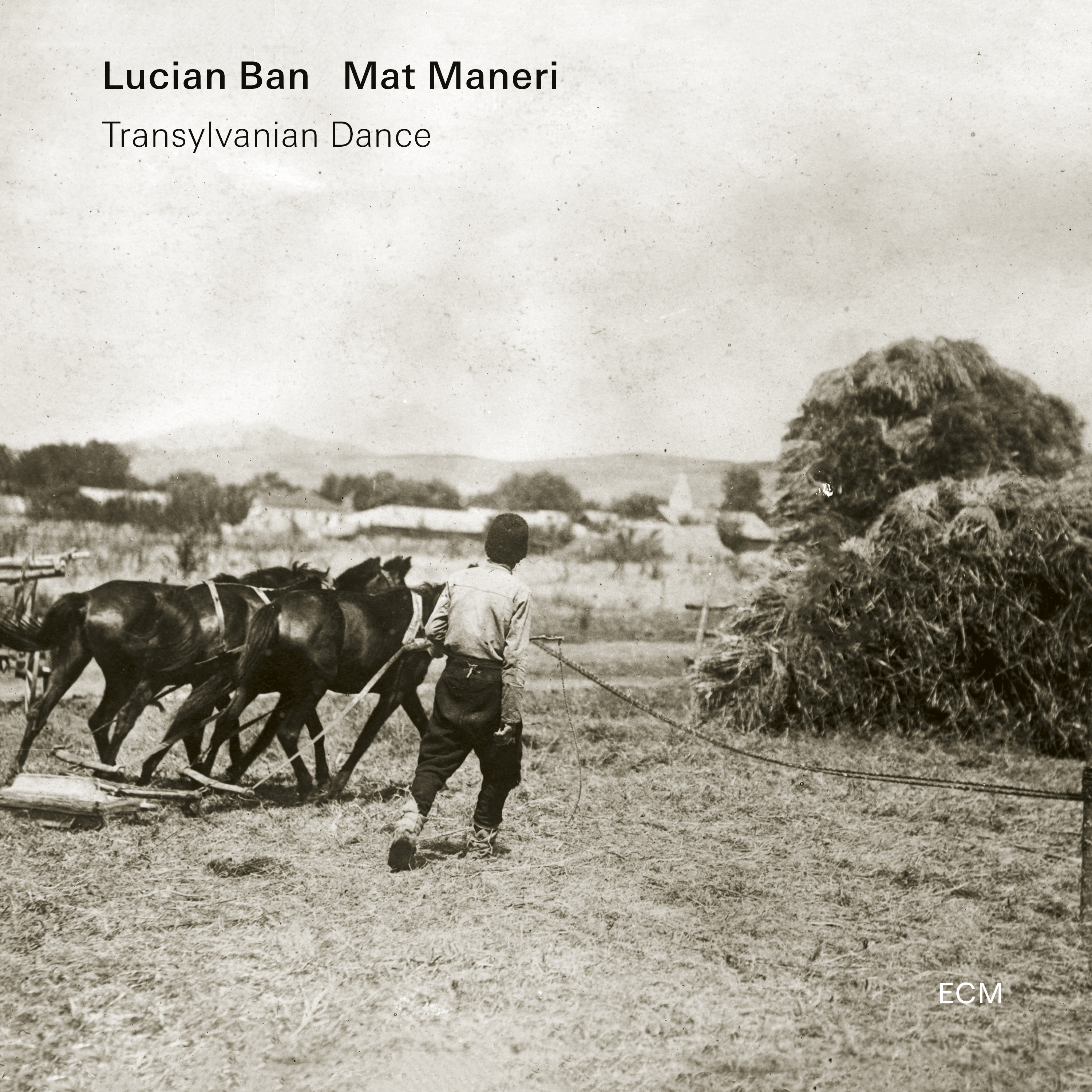
Cover photo: Romania farm scene, 1919 (courtesy Library of Congress, Washington)
Album produced by Steve Lake
Release date: August 30, 2024

Transylvanian Dance is the long-awaited follow-up to 2013’s Transylvanian Concert. The latter ECM debut of pianist Lucian Ban and violist Mat Maneri’s collaboration was a landmark showcasing the duo’s ability to immerse and blend in a partnership written in the stars. The present program, recorded live in October 2022 in the context of the Retracing Bartók project in Timișoara, is based entirely on songs and dances collected by Béla Bartók in Transylvania. And yet, the recapitulation of this music is more than a gesture of preservation; it’s an act of solidarity. If Ban and Maneri are archaeologists, they regard every artifact on its own terms. Rather than dust off the caked sediment, they appreciate it as a part of what the object has become.

In his liner notes for the album, Steve Lake invokes the “treasure-house,” a term used by Bartók and fellow composer Zoltán Kodáldy to describe the folksongs that may have gone lost without their efforts and one that feels duly appropriate to label the container built by these four hands. Drawing from his own experience growing up in Transylvania, Ban stains the wood with an ancestral quality, while Maneri carves adornments patterned after the imprints of far-reaching histories from within.

Open the door and take any interpretation stored a few steps beyond it, and you’re sure to find something to connect to. That being said, “Poor Is My Heart” is about as sparkling an introduction as one could hope for into this archive of still photographs come to life. To be welcomed into this space so freely is more than a privilege; it speaks to the human right of free expression against tyrannies of silence. Appropriately, the pianism is lithe yet strong, while the viola is a pliant voice that speaks of reeds and winds from bygone eras, its harmonics turning shafts of recollection into particles of real-time action. Like the title track later in the program, it keeps no secrets from us. However near or far the musicians feel, their balance of extroversion and introversion is superbly rendered. If Ban is the earth, then Maneri is the tiller of its collective memories. “Romanian Folk Dance” is another ripe harvest. Through disjointed yet natural movements, it breathes with an unsettled (but never unsettling) quality. The instruments circle each other, closing but never tightening the knot past the point of loosening.

What might seem to be a discerning focus on revelry is the oxygen for the darker flames of “Lover Mine Of Long Ago,” which treats its garments as layers of skin to be shed at will. Ban’s exploration of the piano’s inner strings, whether by plucking or muting, polishes a dowry of coins and other trinkets to be left behind with it. Meanwhile, “The Enchanted Stag” is a keening hymn in which bluesy accents bend to the will of the compass’s needle. Both “Harvest Moon Ballad” and “The Boyar’s Doina” turn the concept of the soul into a playing style. Wavering yet never faltering, each is a house creaking in the night, reminding us of the fragility of what we call home. Settling ever deeper into the ground, their candlelit windows beacons for wandering dreamers, they create a breezeway for the final song, “Make Me, Lord, Slim And Tall.” Not a single note feels wasted: percolating, germinating, and fragrant as a forest floor after the rain. With so much fertility, we can only wonder at the gifts it will yield with repeat listens.

András Schiff: J. S. Bach – Clavichord (ECM New Series 2635/36)

András Schiff
J. S. Bach: Clavichord

András Schiff clavichord
Recorded July 2018
Kammermusikssaal H. J. Abs,
Beethoven-Haus, Bonn
Engineer: Stephan Schellmann
Cover photo: Jan Jedlička
Produced by Manfred Eicher
Release date: January 27, 2023

“When I’m at home, my day always begins with Bach. It used to be on the piano, now it’s on the clavichord, even before breakfast. After a few of the Inventions I feel reborn. My ears, my mind, soul and spirit are cleansed.”

Few keyboardic constructions feel as tangible as the clavichord. If only for that reason, it takes getting used to. Yet if you are willing to meet it on its own terms, its internal resonances and breadth of character soon become apparent. As the go-to of Johann Sebastian Bach, it deserves a spotlight in this music—not only for its sound but also for its spirit. For while its intimacy is a given (allowing as it did the luxury of private interpretation for both composers and enthusiasts), and its history and Bach’s relationship to it are well documented, there’s something about letting it sing for itself, and I can think of few hands more capable of doing just that than those of pianist András Schiff, whose humble admission crowns this review.
 
The six-part Capriccio sopra la lontananza del fratello dilettissimo (Capriccio on the departure of a beloved brother) is a delightful inauguration to the instrument’s flavor. Though lesser known than the Inventions and Sinfonias (a.k.a., the Two- and Three-Part Inventions, split between this album’s two discs), they speak nakedly and with the programmatic lucidity required of them. The bigger, canonical collection after them dons new garments (if not sheds old ones) in the present recording. Knowing that Bach likely intended them for the clavichord gives us a renewed understanding of their provenance. The faster movements (cf. Invention No. 4 in d minor, Sinfonia No. 15 in b minor) sparkle, while the slower ones (cf. Invention No. 2 in c minor, Sinfonia No. 4 in d minor) feel more robust than ever. The middle realm (cf. Invention No. 15 in b minor, Sinfonia No. 11 in g minor) gives us the best of both worlds. Such is the magic of the clavichord: Despite its slimmer character and build, it holds its own and then some in a basket woven of lower pitch (a’ = 404 Hz). One highlight in this regard is the lutelike Sinfonia No. 9 in f minor, which walks up a flight of stairs, making the pull of gravity palpable.
 
Between these are the Four Duets (of which No. 3 in G major is especially wholesome) and the Ricercar à 3 from Das Musikalische Opfere, which, along with the concluding Chromatic Fantasia and Fugue, is the biggest revelation herein. Whereas the orchestral sensibilities in one are still very much alive, albeit refracted and distilled, the other shows the subtlety of the “Bebung” technique, whereby the performer adds vibrato with vertical pressure of the fingertip. Thus, these pieces’ complexities become more apparent because they cannot hide within the piano’s cavernous architecture. The fugue is a wonder. Feet to ground, it knows where it stands and how to take joy in the life it has been freely given.

Danish String Quartet: PRISM V (ECM New Series 2565)

Danish String Quartet
PRISM V

Rune Tonsgaard Sørensen violin
Frederik Øland violin
Asbjørn Nørgaard viola
Fredrik Schøyen Sjölin violoncello
Recorded June 2021
Festsal, KFUM/KFUK, Copenhagen
Engineer: Markus Heiland
Cover: Eberhard Ross
Produced by Manfred Eicher
Release date: April 14, 2023

The Danish String Quartet concludes its nearly eight-year journey pairing Ludwig van Beethoven’s five late string quartets with works by Johann Sebastian Bach and later composers. Looking back, I can’t help but smile at how deeply and patiently the DSQ has fertilized the soil of this project to yield the richness of spring harvest.

As the musicians humbly observe, “Micromanagement is rarely a successful strategy when it comes to late Beethoven.” Therefore, if the music feels almost fiercely detailed, it’s because the relationships between the notes speak up for themselves at every turn. Indeed, it’s impossible to encounter the initial stirrings of the String Quartet No. 16 in F major, op. 135, wherein the composer returns not only to the quadripartite form but also to his astonishment of the past, without blushing. And what, you might wonder, is immediately apparent this time around? Nothing less than the undeniable realization that the late Beethoven deviates from other “standard” quartets of the repertoire (including his earlier own) in how inevitable it feels. Whether in the lucidity of the second movement or the dark pastoralism of the third, every sound takes on a physical appearance. The sheer grit the Danes bring to these contrasts is wonderous. Whereas the faster rites of passage would give little room for personal interpretation in less capable hands, in the present context, they are vessels in which the pudding of proof is artfully mixed. In the final stretch, which begins in gentler territory while also expressing great urgency, the call and response between cello and violins opens the door into a run across an open field where life itself becomes the map leading the way to the other side.

Anton Webern’s String Quartet of 1905 (the second of two he wrote that year) brought about a sea change in the genre. Although played in one continuous 18-minute stretch, it takes on a nominal structure in three sections (“Becoming,” “Being,” “Passing Away”) based on the work of painter Giovanni Segantini. Its shifts between darker and lighter keys, between exhalations and holdings of breath, would seem to mirror Beethoven, while its central fugue casts a shadow further back to Bach. The more one immerses oneself in it, the more fragmentary it becomes. As with the canvases that inspired it, one is tempted to isolate a mountain from land and sky, all the while missing out on the benefit of zooming in further on individual plants, puffs of cloud, and rocky imperfections that can only be described as “hymnal” in shape.

The setting for these diamonds consists of Baroque prongs. Whereas Bach’s chorale prelude, Vor deinen Thron tret ich hiermit, opens the program as one would wake up from a coma only to realize how much the world has not changed, the Contrapunctus XIV from The Art of Fuguereleases its pollen by the light of the moon, windswept in evening breezes to places we cannot touch until our bodies wither. Being unfinished, it ends mid-statement, leaving the remainder to toss about in the waves of our unworthy fancy. Sometimes, the best way to answer a question is by posing another.

Avishai Cohen: Ashes to Gold (ECM 2822)

Avishai Cohen
Ashes to Gold

Avishai Cohen trumpet, flugelhorn, flute
Yonathan Avishai piano
Barak Mori double bass
Ziv Ravitz drums
Recorded November 2022 at Studios La Buissonne, Pernes-les-Fontaines
Engineer: Gérard de Haro
Mastering: Nicolas Baillard
Production coordination: Thomas Herr
Cover: Avishai Cohen
Executive producer: Manfred Eicher
Release date: October 11, 2024

Since sewing his ECM leader debut with 2016’s Into The Silence, Avishai Cohen has reaped a unique voice as a trumpeter and composer. But in “Ashes to Gold,” the five-part suite from which his latest gets its name, we are introduced to the sound of his flute, which speaks of more harmonious times than these. Like the opening credits to a war film, it offers the dramatis personae—including pianist Yonathan Avishai, bassist Barak Mori, and drummer Ziv Ratiz—before throwing us into a battle scene from the start. In that vein, the trumpeting jolts us with its raw emotional reportage straight from the trenches.

By no stretch of metaphor, the music’s genesis took place in the aftermath of October 7, 2023, during which the chaos of war at once starved and fed Cohen’s inspiration. One week of intense writing later, the suite was born. While adding to and refining it on tour, he crafted the theme that would become the introspective Part III. Part II before it is its meditative ancestor, featuring a droning arco bass, keening brass, chanting pianism, and a heartbeat giving hope of survival beneath the debris. In the wake of Part IV, an interlude for flute and piano that turns light into shadow, the flowing conclusion finds Cohen soaring as a messenger bird with the sole remaining fragment of truth in its talons. 

Following this is the Adagio assai from Maurice Ravel’s Piano Concerto in G major, a staple in the band’s live repertoire. In this context, it serves as a lost hymn, fusing fragments of the past with the utmost attention to form. “The Seventh” (by Cohen’s daughter Amalia) provides the epilogue. Every flower that sprouts from its dying soil releases spores in the hopes that, at the very least, it might find richer land even as cities and their inhabitants fall.

It’s worth noting that the title Ashes to Gold refers to the kintsugi, the Japanese aesthetic practice of filling cracks in pottery with gold. Thus, he seals the traumatic ruptures of our humanity with music. And is that not what music does in times of unrest? It is a salve of retribution, physically applied to wounded fists closing around life itself.

Jordina Millà/Barry Guy: Live in Munich (ECM 2827)

Jordina Millà
Barry Guy
Live in Munich

Jordina Millà piano
Barry Guy double bass
Recorded live February 2022, Schwere Reiter, Munich
Engineer: Zoro Babel
Mixing: Ferran Conangla at FCM Studio, Barcelona
Mastering: Christoph Stickel
Cover photo: Thomas Wunsch
An ECM Production
Release date: July 5, 2024

Catalan pianist Jordina Millà and British bassist Barry Guy merge creative lanes for this live 2022 performance at the Schwere Reiter hall in Munich. The two first met as participants in Barcelona’s Mixtur Festival in 2017, where Guy was tasked as composer-in-residence to put together an ensemble piece, in which Millà’s participation stood out. Although a new partnership was born, one would never think of it as such from the telepathy they so intuitively inhabit.

This successor to String Fables, their first duo album (released on the Polish label Fundacja Słuchaj in 2021), offers an even deeper sense of lucidity and nursing of detail, enhanced but never overshadowed by the engineering of their sonic kaleidoscope. Their relationship is broken into—if not unified by—six freely improvised parts. Even without familiar melodies and rhythms, the sounds are holistically accessible for their spiritedness and emotional honesty.

One thing that becomes immediate is how each musician unearths elements hidden in the other. Whereas Millà fish-hooks the percussiveness of the double bass into the foreground, Guy inspires a pizzicato sensibility in the piano. The latter’s harp-like articulations in Part I are no mere decorations but a necessarily physical language. Even in the gentlest moments, there is a feeling of total revelation. Extended techniques lend comfort to an otherwise fitful dream. The effect is such that when Millà’s fingers land on keys, they cry out with the urgency of newborns.

Part II refashions much of that restlessness into conviction. Jazzy phrases bleed through postmodern lyricism and touches of prayer, their shadow growing to glorify the sun. Part III is even more melodic and communicates like a Janáček piece for children turned inside out to reveal its darkest fables. The prepared piano of Part IV is magical realism at its finest. With Guy’s skin tracings, it forms a complete organism that steps from thought into form with all the stop-motion haunting of a Brothers Quay film. Part V is the most tense yet also the most powerful in its release, working into a droning brilliance that calms the mind. Part VI is the final exposition, bowing and plucking its way into a humble sort of mastery.

What marks this recording is its sheer presence. Nothing feels hidden or obscured; rather, it is stripped of its protections for naked scrutiny. It speaks in the stirrings of souls, if not in the breathing room between them, until life becomes a mantra unto itself.

Jarrett/Peacock/Motian: The Old Country (ECM 2828)

Keith Jarrett/Gary Peacock/Paul Motian
The Old Country

Keith Jarrett piano
Gary Peacock double bass
Paul Motian drums
Recorded September 16, 1992
at the Deer Head Inn
Engineer: Kent Heckman
Design: Sascha Kleis
Produced by Bill Goodwin
An ECM Production
Release date: November 8, 2024

On September 16, 1992, pianist Keith Jarrett, bassist Gary Peacock, and drummer Paul Motian graced the humble setting of the Deer Head Inn, yielding an eponymous recording that stands as a beacon in the ECM catalog writ large. Nestled in the Pocono Mountains, the venue is one of the oldest for jazz in the US, having served as a stage for live music for over seven decades. As the story goes, Jarrett gave his first performance as trio leader there in 1961 at the age of 16 and returned for this performance to commemorate the ownership’s love for genuine music making. But this was another first, as it was the only time this group was ever billed as such (although Motian had, of course, played in the pianist’s “American Quartet”). Looking back on this landmark achievement, Jarrett and producer Manfred Eicher decided to release the rest of the recording, thus giving us The Old Country.

The title track by Nat Adderley is as good a place as any to begin our walkthrough, though one could start from anywhere and feel immersed in the inimitable vibe of that special evening a third of a century ago. The band never misses a lick, Jarrett treating every improvisatory message as the seed of a new tree. The “Autumn Leaves”-esque chord progressions only underscore that metaphor. “Someday My Prince Will Come” is another head nodder. As the doyenne of sorts in his American Songbook repertoire, one from which he recedes in the present treatment sooner rather than later to give Peacock the floor, it takes on a spirit of revival.

Engaging as such turns are, it’s in the slower numbers, like the Gershwin gem “How Long Has This Been Going On” and the Jule Styne standard “I Fall In Love Too Easily,” where we get glimpses of a particular beauty that might never grace a stage again. (They are also where Motian’s colorations are most vivid.) The latter tune is a heated blanket for the soul and feels custom-built for the musicians. Just as profound as Jarrett’s unfolding of every origami motif are the pauses between them. In each, where he may or may not cry ecstatically, it’s as if he were inhaling the Milky Way before exhaling starlight for all whose paths have gone dark. Peacock’s solo is a silhouette staring through a curtain for a lover who will never appear.

Further delicacies await in Thelonious Monk’s “Straight No Chaser,” the joy of which is so effortless that it might as well be a language with its own dictionary. Jarrett’s vocalizing cuts to the quick of the melody, giving us insight into his precognitive abilities at the keyboard. The dissonant touches are superb, and the rhythm section swings a full 360 degrees from start to spirited finish. Speaking of spirited, the piano intro to Cole Porter’s “All Of You” blossoms with metaphysical detail. The resulting groove is tempered by restraint—likewise in Victor Young’s “Golden Earrings,” which is as delicate as a bubble but strong as iron. Motian carries the bulk of this atmosphere with his brushes, while Jarrett manages to be ever one step ahead yet locked into place.

None of this would feel quite so complete with the album’s opening, “Everything I Love.” This little piece of magic from Cole Porter gives us that familiar blush of establishment such as only Jarrett can render, a chord progression that reminds us of where we belong. The sentiment is as much alive today as it was then. Your heart has already heard it. Now, it’s time for your ears to catch up.

Arild Andersen Group: Affirmation (ECM 2763)

Arild Andersen Group
Affirmation

Marius Neset tenor saxophone
Helge Lien piano
Arild Andersen double bass
Håkon Mjåset Johansen drums
Recorded November 2021 at Rainbow Studio, Oslo
Engineer: Martin Abrahamsen
Cover photo: Thomas Wunsch
Executive producer: Manfred Eicher
Release date: October 28, 2022

At the height of the pandemic, bassist and longtime ECM veteran Arild Andersen convened a new quartet at Rainbow Studio in Oslo. Although he arrived to lay down a predetermined set list alongside tenor saxophonist Marius Neset, pianist Helge Lien, and drummer Håkon Mjåset Johansen, during the second day of recording, he suggested the idea of a group improvisation. The result is Affirmation, presented in its real-time unfolding. Despite being new territory, the feeling is downright familiar from note one, the title indicative of a mutual trust and the need for life during a time of death.

Part I stakes its claim in delicate genesis. Light cymbals resolve into glittering pianism and tender reedwork, Andersen’s quiet strength bounding through it all. In a space enhanced by reverb, otherwise fleeting gestures become entire biographical statements, each the trail of an elder gone to rest. Johansen calls ancestrally, while Neset evokes the ancient ways of Jan Garbarek. Such influences speak of a metaphysical kinship—splashes of color spinning into freer territory before hints of groove can make good on their promises. At the center of their circle is a melodic heart that beats for all.

Part II rows darker waters at first, casts Andersen in more of a listening mode, cradled in a weed-woven basket. A lively middle section finds Lien working up a frenzy, but only briefly, as tenor and bass dialogue for a spell. Everything culminates in a smooth balladic energy, lit just enough to see our way through the night. What we’re left with, then, is a benediction, a prayer, a call to quiet action for the lost and found.

At times, Andersen eerily recalls David Darling’s cello playing and Eberhard Weber’s fluid arpeggiations, but for the most part, he sounds like only he can. And so, it makes sense to finish the album with his “Short Story,” an affirmation all its own. After two hefty doses of freedom, it resonates as a hymn to the future, riding its wave of appreciation straight into the sun.

Jacob Young: Eventually (ECM 2764)

Jacob Young guitar
Mats Eilertsen double bass
Audun Kleive drums
Recorded May 2021 at Klokkereint Studio, Gjøvik
Engineer: Sven Andréen
Mixed by Audun Kleive and Sven Andréen
Design: Sascha Kleis
An ECM Production
Release date: May 12, 2023

Eventually is the fourth leader date from Norwegian guitarist Jacob Young, but his first trio outing. Alongside bassist Mats Eilertsen and drummer Audun Kleive, he traverses a set of nine original tunes that are as varied in dynamic and scope as they are cohesive in temperament. 

The title track opens with arpeggios and impressions, broadening into a shoreline of shifting sands. Even with this precedent in place, one honed by the individual band members’ century of musical cross-examinations between them, there is room for incisive melodizing and fresh runs across familiar terrain. A case in point is “I Told You In October,” which goes down warmly while awaiting whatever surprises the next sunrise has in store. Eilertsen flirts with blues in his solo while keeping things forthright and pure.

Continuing in that spirit, “Moon Over Meno” manages to simultaneously feel like family but also a new acquaintance. Young takes brief yet surprising turns, thinking out loud in an unpretentious display of honesty and vulnerability. Despite his trepidations with the trio format going into this project, he proves himself well-attuned to its challenges, ever buoyed by musicians anticipating his every move. With the gentlest of frictions, he brings forth small flames of beauty in his chord voicings. In that light are rendered shadow plays of quiet intensity (“One For Louis”), urban sprawl (“Schönstedtstraße,” a head-nodding standout for its spacy overdubs), and somber travels (“Northbound”). 

“The Dog Ate My Homework” is a treat not only for its tongue-in-cheek title but also for the interlock of its development. Kleive keeps just enough fuel in the tank to get us where we need to go, while Eilertsen facilitates the combustion to let Young fly. After lovingly schooling us on “The Meaning Of Joy,” we end up “Inside,” where circling motifs knit scarves against the cold from the air so we might survive the winter without fear.

As the band hangs one masterful painting after another in this intimate gallery, the core strength of the proceedings lies in Young’s composing and the depth of expression giving them life. Like a lighthouse revolving in the night, his sound embodies a place to return to and a function to serve, bringing safety to those caught in the fog of dangerous waters.

Anders Jormin/Lena Willemark: Pasado en claro (ECM 2761)

Anders Jormin/Lena Willemark
Pasado en claro

Anders Jormin double bass
Lena Willemark vocals, violin, viola
Karin Nakagawa 25-string koto
Jon Fält drums, percussion
Recorded December 2021 at Studio Epidemin, Gothenburg
Engineer and coproducer: Johannes Lundberg
Cover photo: Fotini Potamia
Executive producer: Manfred Eicher
Release date: January 20, 2023

Since breaking ground on 2004’s In Winds, In Light, bassist Anders Jormin and singer/violinist/violist Lena Willemark have charted old and new territories in an increasingly fertile partnership. Their collaboration reached the next stage of development when they welcomed Japanese koto player Karin Nakagawa into their midst on 2015’s Trees Of Light. To that milieu, they’ve added drummer Jon Fält, whose name will be familiar to Bobo Stenson Trio fans. Although Willemark’s roots in Swedish folk heritage and its preservation are at the core of what’s being articulated here, the improvisational packaging has been deepened. The settings touch down on the landing strips of many times and places, including poetry from ancient China and Japan, contemporary Scandinavia, Mexican luminary Octavio Paz (whose “Pasado en claro” gives us this album’s title), and Renaissance humanist Petrarch.

The latter’s Poem no. 164 from Canzoniere, the eponymous subject of “Petrarca,” flickers like a candle flame. It is one of many musical settings by Jormin, whose loose strata give his bandmates plenty of room to look for fossils and regard their shapes melodically. Long before that, “Mist of the River,” his take on Ouyang Xiu (1007-1072), opens with the gentlest shimmer of koto. The poem paints a picture of a fisherman whose cast is obscured by mist and storm, resolving into groovy textures. With the clarity of a statue, Willemark etches the scene one frame at a time until they mesh into a flowing whole. Brushed drums add jazzy touches: water and silver combined. “Glowworm” looks even further back to the 8th century. The tanka by Yamabe no Akahito, rendered here in an evocative Swedish translation, finds Willemark and Jormin’s instruments in a cloudy slumber while percussion and koto yield just enough light to see the contours of their dreams.

Most of Jormin’s tapestries are woven from more recent material. And yet, despite the brief appearance of artifice—as in Jörgen Lind’s “Blue Lamp,” which contrasts hospital buildings against a starkly natural scene—all the modern verses are steeped in an unbroken respect for the organic. This is especially true in “Kingdom of Coldness,” where the haikus of Tomas Tranströmer seep through liquid gongs and arco bass as Willemark’s voice draws maternal lines across Nakagawa’s constellations, and “Returning Wave,” where Anna Greta Wide’s words accumulate against the barrier of closed eyelids.

The remaining tracks consist of original songs by Willemark, who has her bow and throat on the pulse of something so genuinely folkloric that they seem as weathered by time as the rest. “The black sand bears your footprints / trampled by many, but seen by none,” she sings in “Ramona Elena,” forging a scene of heartache, loss, and sisterly love that demands motionless listening. “The Woman of the Long Ice” brings more of that briny sound through her fiddle as she laughs with joy at the power of music to run beneath even the most frozen waters. (This track is also a highlight for its freer playing.) Between the instrumental “Wedding Polska” and the leaping strains of “Angels,” the quartet never loses sight of its roots, which run deep and wide, sustaining forests older than us all.