Zakir Hussain: Making Music (ECM 1349)

Zakir Hussain
Making Music

Zakir Hussain tabla, percussion, voice
Hariprasad Chaurasia flutes
John McLaughlin acoustic guitar
Jan Garbarek tenor and soprano saxophones
Recorded December 1986 at Rainbow Studio, Oslo
Engineer: Jan Erik Kongshaug
Produced by Manfred Eicher

In March of 2010, I had the great honor of seeing Zakir Hussain and the Masters of Percussion give an unforgettable performance. I had always been a great admirer of him, but to experience that blissful power firsthand was beyond special. This liveness can hardly be replicated on disc, though we can still feel the passion that imbues his every action in the studio and beyond.

The key to Making Music lies in its title. This is not about a fusion of East and West. This is about creation for its own sake. The selfsame track opens our ears to the flute of Hariprasad Chaurasia, who turns breath into gold. Guitarist and Mahavishnu Orchestra guru John McLaughlin is another welcome addition to a quartet rounded out by saxophonist Jan Garbarek. As lines curve their way through subtle changes in temperature, we can feel the rhythm being formed, piece by ephemeral piece, even before Hussain lays hands to drum. Garbarek works some of that same magic that enlivened his earlier recordings with Shankar, while McLaughlin showcases his mastery of classical forms (the duet with Hussain on “You And Me” is one of many highlights), matching the tabla master’s deftness with ease.

Yet Chaurasia is the jewel of this session. His dialogues with McLaughlin (“Zakir” and “Sabah”) in particular reveal a purity of tone all his own. Sometimes, he lowers the threads from which the music hangs, pulling us along with them into a verdant sky. Others, he bends like an outstretched leaf hit by the first raindrop of spring (“Toni”). The album’s remainder is filled with rainbows. The most verdant of these is “Water Girl,” a mosaic spread with saffron and rosewater, willed into life by that generative flute. Garbarek makes his voice clearest in “Anisa,” which first pairs him with McLaughlin in an exchange at once forlorn and sweet before Hussain regales with such grace that one has to wonder if his fingers aren’t pure energy. After this saga of tribulation and triumph, Garbarek’s skyward incantation in “Sunjog”—incidentally, another standout for McLaughlin, who shares a winged exchange with everyone in turn—proves well suited to this musical nexus, for he, like the others, plays not in unison but in tandem, and in so doing binds the overall unity toward which they strive together. And so, when they do join in the occasional doubling, the sound becomes gentler, each voice restraining itself so as not to overpower.

Hussain is a carpenter who delicately hammers the edges of every project he touches into perfect alignment. Yet after listening to Making Music, one has the feeling this project had only just begun.

<< Gidon Kremer: Edition Lockenhaus Vols. 4 & 5 (ECM 1347/48 NS)
>> The Bill Frisell Band: Lookout For Hope (ECM 1350)
Keith Jarrett: Book Of Ways (ECM 1344/45)

Keith Jarrett
Book Of Ways

Keith Jarrett clavichord
Recorded July 1986 at Tonstudio Bauer, Ludwigsburg
Engineer: Martin Wieland
Produced by Manfred Eicher

Trying to describe Keith Jarrett’s alchemical explorations of the clavichord is like trying to describe love: if you’ve never fallen into it, the words of others mean little. All I can do is share and hope my impressions might speak, for the album promises something so ineffable that it can only be expressed in music.

Over the course of nineteen improvisations, Jarrett transcends both the medium and the message in search of something untouched for centuries. He burrows into the heart of this nearly forgotten instrument, seeming to make music as if only after centuries of slumber. By the time he awakes, his body has fused with every molecule of metal and wood, so that he needs only step into a latter-day age, where the magic of technology allows us a glimpse of that anatomy, wavering and fair.

1
Like some vast lute, curled into a withering plant of dedicatory power, it wishes itself clean of all earthly things, finding balance in song where there can be no troubadours to sing.

2
It is a self-sustaining lantern, whose oil is memory and whose flame is the flick of a maiden’s tongue along the edges of speech.

3
It is a scribe in a dimly lit cave, where every note is the scrawl of a quill on cracked parchment, sipping nourishment from an inkwell.

4
It is a taste of birth on the mind’s palette. A tearful wish discarded like so many handkerchiefs along garden paths. A joyful reunion reflected in her broach. A portrait in miniature, forgotten in a decaying drawer next to her brittle volume of poetry. She hums, her throat wound like a string.

5
It is a dream, wistful yet morose, putting a stopper into the night’s hidden vial. There it holds us, ever thoughtful, winded like an errant pageboy cursed with an undeliverable charge.

6
It is a child of time who speaks through dance, our feet its only partners. It looks to itself for guidance, only to touch an anxious moth who hopes the window will melt away, as if its millennia of grime will somehow afford a view of the impossible horizon.

7
It tickles the feet of our childhood, making us laugh in ways we have since denied.

8
It trembles like a plucked string that, once slowed to show every nuance of its warbling activation, finds much to fear in its own echo.

9
It turns to every Baroque master who sat alone at a keyboard and painted the room with novel sounds.

10
It is a percussive message that knocks on every castle door and rattles the bones in its crypt.

11
It is a love letter, a heart unfolded into the map of another heart. A dewy pasture that remembers lovelier days when the torturous end of an age was not upon us.

12
It strums an unmade bed in the hopes of recreating the music that once rustled there, but alas, there is only the lingering scent of a love that can never be washed away.

13
It is a necklace of memories, each bead more translucent than the last.

14
It opens our eyes to the clouds and to the trembling Tree of Life that hangs the wash of history from its boughs.

15
It carries us down an eroded stairway, even as it lifts us to the top of the tower.

16
It is a forlorn carnation, every petal the leaf of a story whose only tether is its maternal stem.

17
It upholds a chivalrous decorum, tilting its hat to the unbroken gait of a faithful horse. Through thick and thin, it has batted neither tail nor eye at knighthood’s unstoppable demise.

18
It is a funereal ode, a pyre burning to its glowing orange roots.

19
It brings us full circle to the avenues from which that first shadow extended before a dying sun.

Not only does this recording show us a book of ways, but it also shows us the way of books, for it teaches us that the written word, like music, is but a stepping-stone to silent understanding.

<< Enrico Rava/Dino Saluzzi Quintet: Volver (ECM 1343)
>> Terje Rypdal & The Chasers: Blue (ECM 1346)

Edward Vesala: Lumi (ECM 1339)

Edward Vesala
Lumi

Esko Heikkinen trumpet, piccolo trumpet
Pentti Lahti alto and baritone saxophones, flutes
Jorma Tapio alto saxophone, clarinet, bass clarinet, flute
Tapani Rinne tenor, soprano saxophones, clarinets
Kari Heinilä tenor, soprano saxophone, flute
Tom Bildo trombone, tuba
Iro Haarla piano, harp
Raoul Björkenheim guitar
Taito Vainio accordion
Häkä bass
Edward Vesala drums, percussion
Recorded June 1986 at Finnvox Studios, Helsinki
Engineer: Risto Hemmi
Produced by Manfred Eicher and Edward Vesala

Take a moment to wander the art of Morten Haug, whose cover photograph (one of ECM’s best) is a gateway into what’s to come. Like Edvard Munch’s The Scream mummified, it silences that which is already silent, and in so doing unleashes a slow torrent of organic music. As the rain of Iro Haarla’s harp trickles through the branches of “The Wind,” picking away the last crumbs of our disbelief, we are able to ease into the careful telepathy this ensemble braids together. Thus blown of our dust, we meditate in “Frozen Melody,” which, though it may begin in stillness, melts with every rendered note. “Calypso Bulbosa” is a rougher diamond, freshly unearthed, the grunge of an electric guitar still clinging to every clouded knurl. Birdcalls and flightless reeds share the same forest, twisting into all manner of distorted reflections. After sailing through the elliptical orbits of the “Third Moon,” we reach the title track, which indeed brings light to bear, cloud-shafted and wavering. The saxophone work here, and in the “Camel Walk” (Vesala’s own “Donkey Jamboree”) that follows, is gorgeous, watery, silted. “Fingo,” no dissimilarly, sounds like a Bill Frisell tune blended in a sonic food processor with Dino Saluzzi spice and a dash of late-night cabaret. A brilliant inclusion. The album’s briefest spit comes in “Early Messenger,” and brings us “Together” in the full-circle closer, interlacing creative fingers in the full dark of finality.

Another puzzling masterpiece from Vesala. Savor it as you will.

<< Mark Isham/Art Lande: We Begin (ECM 1338)
>> Thomas Demenga: Bach/Holliger (ECM 1340 NS)

Doran/Studer/Wittwer: Red Twist & Tuned Arrow (ECM 1342)

Red Twist & Tuned Arrow

Christy Doran electric and acoustic guitars
Fredy Studer drums, percussion
Stephan Wittwer electric guitar, synthesizer, sequencer programming
Recorded November 1986 at Soundville Recording Studios, Luzern
Engineer: Rene J. Zingg
Produced by RT&TA and Manfred Eicher

Guitarist Christy Doran, who nowadays divides his time between teaching in Switzerland and recording, is another in a line of unique guitarists on the ECM roster. For those new to this intriguing musician as I am, this seems as good a place as any to start, though one may also encounter swatches of his art flapping in the wind of the OM collective. For the Red Twist & Tuned Arrow project, he joins improviser extraordinaire Stephan Wittwer and OM founder Fredy Studer on drums and percussion. The product of this chemical reaction is a record of great ingenuity that has worn well. What first impresses about Doran and Wittwer is their delicacy. We find out right away in the Derek Bailey-esque vibes of “Canon Cannon” that both musicians are far less interested in powering their way through material than they are in uncorking a fine vintage of fermented logic. Moving from the synth ground lines here to the perpetuity of “1374,” again we are awash in the microscopy, which is only enhanced by Studer’s evocative colors. Like something out of a sci-fi film, it pulses with alien energy. On that note, “Quasar” might as well be called “Quaver,” for that it does in abundance, moving through a gallery of playing that is nocturnal yet blinding. Doran does much to admire here in the date’s crowning achievement, which is not without its more forthright moments in the oh-so-satisfying grunge of “Belluard.” Along with “D.T.E.T.,” “Backtalk” casts a jazzier, if more abstract, reflection onto the mix. The trio ends smashingly with “Messing,” a quintessential track for Doran, who takes his signature seizures to their greatest height yet. An acoustic breaks from its cage and runs rampant with its freedom cries, leaving the piece’s latter half to fend for itself electronically. Awesome.

Doran grists a pliable sound that never stays in one place or genre for very long. His quick costume changes ensure that we remain on our toes. Perhaps an acquired taste for some, but satisfying and ultimately joyful, with nary a pessimistic puddle to step in.

<< Thomas Tallis: The Lamentations Of Jeremiah (ECM 1341 NS)
>> Enrico Rava/Dino Saluzzi Quintet: Volver (ECM 1343)

Terje Rypdal & The Chasers: Blue (ECM 1346)

Terje Rypdal & The Chasers
Blue

Terje Rypdal electric guitar, keyboards
Bjørn Kjellemyr electric and acoustic bass
Audun Kleive drums, percussion
Recorded November 1986 at Rainbow Studio, Oslo
Engineer: Jan Erik Kongshaug
Produced by Manfred Eicher

Terje Rypdal, Bjørn Kjellemyr, and Audun Kleive continue where they left off on Chaser with this equally memorable set. Blue is not a companion album, however. It is the yin to the other’s yang: on the surface they are solid teardrops of color, but closer listening reveals an eye of one in the other. Swiveling in at a mere 90 seconds, “The Curse” provides an alluring introduction that fades all too quickly into the bass-driven groove of “Kompet Går.” Rypdal may run like a melodic rat with his tail on fire at first, but soon paints the sky with cool winds in a free anthem of strings and rhythms. These last are ever an audible undercurrent to what’s going on above the surface. Their analog warmth lends particular comfort to “I Disremember Quite Well,” where it is enhanced by a hum of bass. Rypdal’s inescapable lyricism is the calm before a quiet storm that rains liquid flame into the cauldron of “Og Hva Synes Vi Om Det.” Every utterance of the bass is like a bubble of lava popping, every echo a dying bird going down in smoke. Even the drum machine in “Last Nite” somehow enchants us, holding on to Rypdal’s feathered back as he peaks above the clouds in denial of the deserts below. The title track lowers us slowly on the bass’s thickly wound strings, Rypdal the melodic bait on this hook, twirled like a ribbon around the finger of a forgetful deity. “Tanga” gets us back into the swing of things with a catchy vamp, even as Rypdal works a magical mood far away. This excursion grinds to a halt in a crunchy solo before “Om Bare,” a solo punctuated by outbursts from synth, casts us into the sea.

Essential for the Rypdal fan.

<< Keith Jarrett: Book Of Ways (ECM 1344/45)
>> Gidon Kremer: Edition Lockenhaus Vols. 4 & 5 (ECM 1347/48 NS)

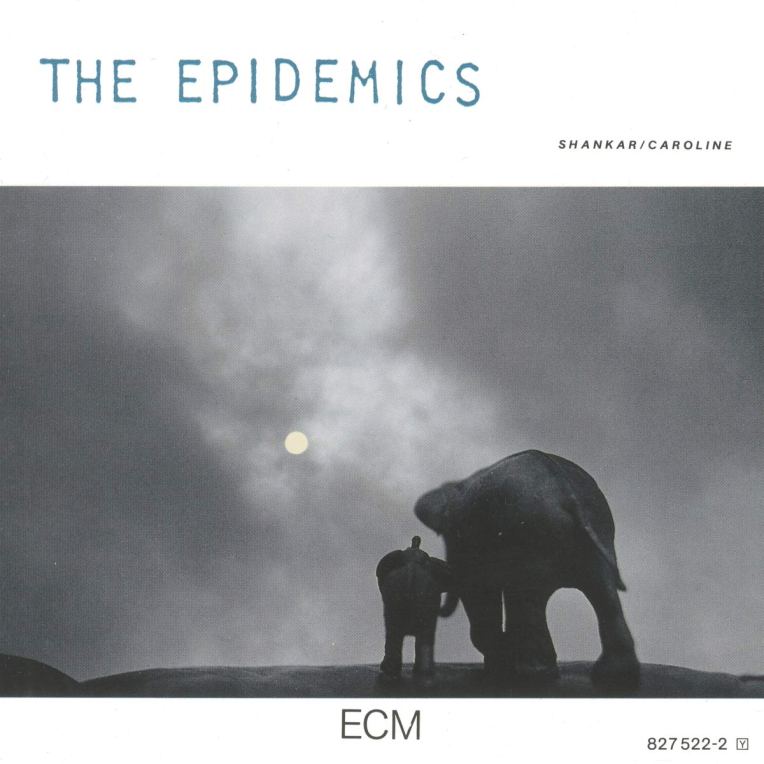
Shankar/Caroline: The Epidemics (ECM 1308)

The Epidemics

Shankar/Caroline
The Epidemics

Shankar vocals, violin, synthesizer, drum machine
Caroline vocals, synthesizer, tamboura
Steve Vai guitar
Gilbert Kaufman synthesizer
Percy Jones bass
Recorded February 1985 at Stickwork Studios, New York
Engineer: Chris Richards
Produced by Shankar/Caroline

Full moon on Friday
watch out for the werewolf

Who’s next – who’s next
who’s next
Close the windows – pull the curtains
who knows – what may happen

When I first slid this CD into my computer, the Gracenote Media Database upped my anticipation by filling in its genre as “Traditional.” Which is exactly what this album is not. But if you’re looking for a quirky lollipop that has baffled ECM and Shankar enthusiasts for decades, by all means lick away. With endearing vocals by Caroline, not to mention the collaborative edge of having guitar legend Steve Vai and bassist Percy Jones (of Brand X fame) in the same studio, one can only imagine the possibilities of throwing Shankar’s astounding virtuosity into such a milieu.

On that note, the musicianship is healthy and the record not without its charm, which may or may not convince you by the third track, “Situations.” I just find myself yearning for Shankar’s violin, which only makes a few lilting, if fiery, appearances on tracks like “Don’t I Know You.” Vai also has his moments in the sun (check his solo in “You Don’t Love Me Anymore”). I imagine this music may have nostalgic value for some, and far be it from me to criticize what might for them be a very real attachment. All I can say is that I’m jealous they can see what I cannot. With inane lyrics like those from the last song (“Full Moon”) quoted above and a lackluster mix that all but drowns Jones’s snaking lines, it’s difficult to gauge the artists’ intentions. Tongue-in-cheek experiment? Worldly statement? Either way, I feel lost, and welcome anyone who knows better to help me find my way.

Although the album is quite beyond me, I surmise that the artists were jumping at what was then an exciting opportunity for musical crossovers. Yet not even the crossover potential is there, as Jones himself notes in a 2004 interview:

It’s very different from most other things you’ve played on. I was expecting something maybe a little Eastern sounding.

Well that’s what I was expecting. He kept saying that he was going to be doing some Indian music, and maybe doing some gigs in India, and I was really up for that, because I love Indian music and it would’ve been a good chance to learn. But it never happened, it just continued in this sort of Western pop format, and that never went anywhere.

Interesting musicians on that record, he had Steve Vai….

Steve Vai played on the record but another guy did all the gigs. It was an unusual record for ECM I thought. I haven’t heard anything else on ECM even approaching that. I was disappointed that I never got to do any Indian stuff with him.

I don’t see myself returning to this one anytime soon, if ever. It’s simply not for me. An intriguing detour on the label’s path through a sonic territory as vast as it is varied, it is the only ECM album I would never recommend. And out of a catalogue of well over 1000 releases, that’s saying a lot more about the quality of the label than about the substandard cumulations of this single outlier.

Endearing cover, though.

Incidentally, a rare promotional single of “Give An Inch” released that same year (1986) includes a remix of the song. Heavier on the drum machine and electronic framing than its album mix, this iteration has the quality of background music to some lost 80s film about teenagers on the run. For extra frustration, we get some phenomenal violin playing from Shankar, but only during the fadeout, leaving us to wonder what might have been had his bow been the point of an album otherwise without one. Listening to it again now, I can’t help approaching it like an alien encountering our planet for the first time and wondering what it is about our own creations that holds our attention.

<< First House: Eréndira (ECM 1307)
>> Dino Saluzzi: Once upon a time – Far away in the south (ECM 1309)

Norma Winstone: Somewhere Called Home (ECM 1337)

Norma Winstone
Somewhere Called Home

Norma Winstone voice
John Taylor piano
Tony Coe clarinet, tenor saxophone
Recorded July 1986 at Rainbow Studio, Oslo
Engineer: Jan Erik Kongshaug
Produced by Manfred Eicher

After her stunning contributions to ECM via the enigmatic outfit known as Azimuth, jazz vocalist Norma Winstone broke out, or should I say broke in, her solo career with Somewhere Called Home. Joined by pianist John Taylor and Tony Coe on clarinet and tenor saxophone, she lends her sympathetic draw to the canonic tree while also hanging it with her own lyric adornments to the music of Egberto Gismonti, Ralph Towner, and Kenny Wheeler. The finished session is burnished to a dim reflection of yesteryear.

From the first measured steps of “Café,” Taylor’s gentle snowflakes and Coe’s fluted reeds are perfect companions. This is a song, like so many, of people and places intersecting in romances as fleeting as the words they’re built upon. The title track is a geodesic shape of ebony and ivory, splashed with the prismatic light of Winstone’s lilting phrasings. Patterns of loneliness emerge, seeking in the human voice the solace from which our pain also arises, and through which we purge the very same. Taylor and Coe run off, hand in harmonic hand, rushing through the wilds of memory, leaving Winstone to paint the veil of winter in “Sea Lady” with a translucent river of spring, where love flows into an ocean of forgetfulness. “Some Time Ago” opens with a mournful cry from Coe, dropping us talon-first into a sky of childhoods. Every chord from Taylor is a wisp of cloud, gone too soon in a dragon’s breath. Winstone spins the mythology of love into a jewel of hope that shines only in the sunlight of the future. She waits, breathing in the world so that she might exhale the promise of another morning, of another kiss, of another embrace. The delicate impressionisms of “Prologue” and “Out Of This World” recall at once the French symbolists and Manuel de Falla’s Psyche. Coe enchants with every flap of his virtuosic wings, lending his ethereal tenor to “Celeste.” This bittersweet exploration of songcraft catches up to us like an ancestral figure. Every breath of the sax is like that figure’s movements, by turns flesh and shadow, and brought to active life by the erosion of the high note, which chips away like a welding torch at the resolve of our solitude. “Hi Lili Hi Lo” takes comfort in the fact that in order to fall in love, one must jump, blindfolded, from a great height indeed. With “Tea For Two,” we at last get the assurance of a lover’s arms cradling not just our bodies, but also our souls. That gorgeous tenor returns for a final heave, ending where it all began, folded in the origami of time.

Winstone washes away the clothing of every sentiment, exposing the naked flesh of words. Her melodies swim in life’s tormented sea, compressing the universe into a salty teardrop of pure expression. While this date may not be for everyone, it is for me another candidate for inclusion in ECM’s Top 10. A profound, meditative masterpiece that will grow as you do.

<< Meredith Monk: Do You Be (ECM 1336 NS)
>> Mark Isham/Art Lande: We Begin (ECM 1338)

Keith Jarrett Trio: Standards Live (ECM 1317)

Keith Jarrett Trio
Standards Live

Keith Jarrett piano
Gary Peacock bass
Jack DeJohnette drums
Recorded July 2, 1985 at the Palais dis Congrès Studios de la Grand Armée
Engineer: Martin Wieland
Produced by Manfred Eicher

Take one look at the thoughtful cover art of this seminal Keith Jarrett release, and you’ll gain immediate insight into what makes his trio click. Each curvaceous line brings a lifetime of movement, of study, and of passion to bear on the music at hand. And with these six standards resurrected to such profound levels, there’s nothing not to like.

Just let the groove of “Falling In Love With Love” have its way, and the quicksand of the trio’s genius has you by the heart. Jarrett is in his element, crying his way through sibilant improvisatory arcs. Peacock surfaces for an engaging solo, Jarrett watching from the sidelines with duly attentive chording before sharing an intuitive stichomythia with DeJohnette. Peacock grabs the spotlight again in “The Old Country,” in which piano and drums spread a subtle launching pad for his low yet adroit flights. Jarrett builds on these, dancing on air through every motivic change before putting the starlight back into “Stella By Starlight.” Ever the sonic chameleon in a world of primary colors, he achieves the musical equivalent of alchemy once his ever-faithful rhythm section dashes in its own mysterious elements. A magnetic bass solo draws DeJohnette’s cymbals like iron filings before ending in a forgiving embrace. “Too Young To Go Steady” receives an absorbing treatment, the band whipping up a soft peak that melts smoothly into resolution. Next is a spirited version of “The Way You Look Tonight,” which unpacks oodles of bliss and shows the trio form at its finest. A whoop-worthy solo from DeJohnette forms an enlivening bridge to the vamp, playing us out into “The Wrong Blues,” which does everything oh so right.

While all the tunes on this album are classic, the untouchable performances make them doubly so.

Beyond recommended.

<< Kim Kashkashian/Robert Levin: Elegies (ECM 1316 NS)
>> Stephan Micus: Ocean (ECM 1318)

First House: Eréndira (ECM 1307)


First House
Eréndira

Ken Stubbs alto and soprano saxophones
Django Bates piano
Mick Hutton bass
Martin France drums, percussion
Recorded July 1985 at Rainbow Studio, Oslo
Engineer: Jan Erik Kongshaug
Produced by Manfred Eicher

A session like the one documented on Eréndira can easily made or broken by a saxophonist, and I’m happy to say that Ken Stubbs succeeds with plenty of inspiration to spare. His soloing is at once ponderous and restless, constantly moving in and out of shadow, adding just the right amount of cursive to his flowing script. With the help of Bill Bruford’s Earthworks double agents Django Bates and Mick Hutton on keyboards and bass, along with drummer Martin France, he leads this young fusion outfit’s debut with stylish, mature writing and deft exchanges all around.

“A Day Away” starts as if awakening, those first rustlings of the morning flittering across France’s kit, Bates opening his eyes as butterfly’s wings to sunlight, while Hutton takes our first steps, breathing in the saxophone’s crisp air. Stubbs carries a gentle tune in “Innocent Eréndira,” lilting over bass and a gentle tat of cymbals. Like an airborne serpent falling to the ground with that final breath, he slithers into a dark hole before opening the thematic radar of his cobra fan for “The Journeyers To The East.” This touch-and-go excursion finds the album’s surest traction, and seems to wink at us, knowingly. The rhythm section excels, launching Stubbs into a backflip that allows the soles of his feet to graze the underbellies of the clouds. Pay particular attention to Bates here, and you’ll know why he was already one of the hottest jazz pianists of the 1980s. “Bracondale” and “Grammenos” lull us into surrender with promises that Hutton and Stubbs fulfill with grace. The latter tune swirls with wondrous enervation, Stubbs scaling a mountain of tight hooks and crashing improv before sliding back into a forlorn back (v)alley. The brief wave that follows in “Stranger Than Paradise” washes us onto the shores of “Bridge Call,” a lonesome dove spreading its melodic feathers over rivers and islands. Another brief teardrop falls in “Doubt, Further Away,” trickling down the face of one who is about to smile for the first time in ages.

Thus ends a beautiful, seemingly forgotten album from a quartet of musicians who tended to involve themselves in more progressive acts. Here, they take it back home. Don’t pass this one by.

<< Ralph Towner/Gary Burton: Slide Show (ECM 1306)
>> Shankar/Caroline: The Epidemics (ECM 1308)