Steve Tibbetts: Yr (ECM 1355)


Steve Tibbetts
Yr

Steve Tibbetts guitars, kalimba, synthesizer
Marc Anderson congas, drums, percussion
Bob Hughes bass
Steve Cochrane tabla
Marcus Wise tabla
Tim Weinhold bongos, vase, bells
Recorded ca. 1980 at Atma-Sphere and Oxit Roxon, St. Paul
Engineer: Steve Tibbetts
Produced by Steve Tibbetts

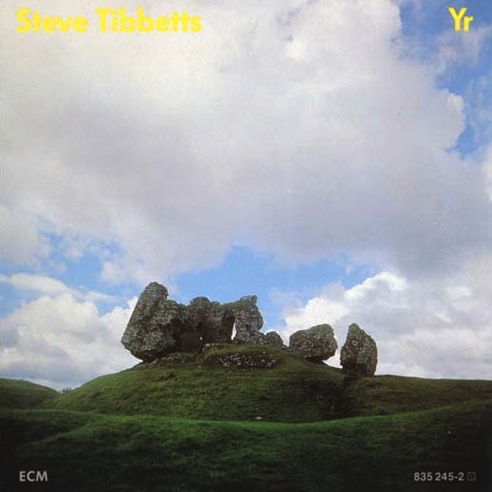
Yr is yet another fascinating peek into the Steve Tibbetts sound-verse. The feeling of open plains that so characterized his previous efforts remains, only now the production is more immediate, such that the 12-string intimations unlocking the doors of “Ur” set us adrift in our own mysteries. Percussionist Marc Anderson soars, seeming to grow out of Tibbetts’s hollow-bodied heart before the heavy thrum of the latter’s electric curls itself into a ball and rolls down a hill of unrelenting melody. After an explosion of beats and guitars settles us into the soothing reverie of “Sphexes,” we find our expectations blotted by an interlude of kalimbas before Tibbetts spreads his buttery axe over this acoustic toast with sweetness in “Ten Years.” Fantastic. “One Day,” much like the opener, rises from the ashes of a campfire, but not without leaving an aftertaste of the prairie. “Three Primates” is a pocket of sunshine that shifts masterfully between tones and timbres. Now darkened by shadow, now blinded by noon, it dives headfirst to a tabla-infused conclusion. “You And It” is another shimmering slice of life. Backed by strings and icy sleigh bells, it breathes life into a new day. This opens the doors even wider, letting in the dawn’s early electric and unleashing a torrent of dreams made real. “The Alien Lounge” traipses through tall grasses, weaving past abandoned foxholes and memories of warm nights toward the starlight of “Ten Yr Dance,” spun like a home movie rewound to one’s first days on earth.

This is by far Tibbetts’s most uplifting date and one sure to win you over with its no-frills charm, emoting as it does with an artistry at which we can only shake our heads in wonder. It also shows just how deftly and appropriately he takes advantage of the studio, flipping prerecorded bits on end and adding just the right touch of electronics for depth. The spaces therein are constantly morphing, content to move on once they have achieved a certain kind of beauty while always looking forward to the next.

Timeless, as all Tibbetts releases are.

<< Oregon: Ecotopia (ECM 1354)
>> Pepl/Joos/Christensen: Cracked Mirrors (ECM 1356)

Mark Isham/Art Lande: We Begin (ECM 1338)

Mark Isham
Art Lande
We Begin

Mark Isham fluegelhorn, trumpets, synthesizer, percussion
Art Lande piano, synthesizer, percussion
Recorded January 1987 at Rainbow Studio, Oslo
Engineer: Jan Erik Kongshaug
Produced by Manfred Eicher

“All art is at once surface and symbol.”
–Oscar Wilde

This brooding session from Rubisa Patrol alumni Mark Isham and Art Lande is an odd one. Odd, because with the immensity of acoustic talents to be found in both musicians, the results tend toward a saccharine blend of electronics that detracts from the heavenly beauties being painted before them. Take, for instance, Isham’s swaths of trumpeted gorgeousness in “The Melancholy Of Departure,” which are at pains to harmonize with the drum machine that is the piece’s frail backbone. Neither does Lande have reason to augment his resonant pianism with the synthetic gamelan that deadens “Ceremony In Starlight” when he might have further explored the inside of the piano for similar effect. And are not Isham’s muted calls here far more cosmic than a few patching of wire ever could be? The same goes for the title piece and for the closing “Fanfare,” in which Isham might easily have multi-tracked himself (as he does later on) in lieu of the thin choir that we get.

Lande’s piano becomes more prominent as the album progresses, most effectively so in his tender solo piece, “Sweet Circle.” All the more ironic, then, that the live feel of “Lord Ananea” never quite gets off the ground. “Surface And Symbol,” on the other hand, is as transcendent as transcendent gets. One only wishes this veritable flower of layered horns, echoing like voices of ages past, and veiled pianism were more representative of the whole.

In spite of this album’s shortcomings, the melodic pictures it paints are so downright beautiful that one can forgive its cheap gilded frame. And far be it from me to criticize what was then an exciting new tool of the moment. Neither a must-have nor one to ignore. I’ll leave it for you to decide where it falls.

<< Norma Winstone: Somewhere Called Home (ECM 1337)
>> Edward Vesala: Lumi (ECM 1339)

Jon Hassell: Power Spot (ECM 1327)

Jon Hassell
Power Spot

Jon Hassell trumpet
J. A. Deane percussion, alto flute
Jean-Philippe Rykiel keyboards
Michael Brook guitar
Richard Horowitz keyboards
Brian Eno bass
Richard and Paul Armin RAAD electro-acoustic strings
Miguel Frasconi flute
Recorded October 1983 and December 1984, Grant Avenue Studio, Ontario
Assistant  engineering: David Bottrill and Roman Zack
Produced and engineered by Brian Eno and Daniel Lanois

American composer and trumpeter Jon Hassell is best known for his music of the Fourth World, which he describes as “coffee-colored classical.” The definition becomes clearer once you immerse yourself in the sounds of Power Spot. Hassell’s career is as varied as his education. A student of both Karlheinz Stockhausen and Pandit Pran Nath, he is known for overlooking idiomatic barriers in favor of something far broader. Nath left an indelible mark in Hassell, who turned to the master’s voice for guidance in his own playing. His unmistakable tones are achieved by singing into the instrument, thereby drawing clusters of sounds from a single exhalation. This recording is significant for a number of reasons, not least for indicating a moment in sonic history in which the electro-acoustic universe was beginning to spin some of its richer, more majestic galaxies. The music on Power Spot radiates like a supernova waiting patiently for the traction of celestial bodies to fan its clouds away, revealing softly spinning globes of breath and vapor. With such evocative titles as “Wing Melodies” and “The Elephant And The Orchid,” one feels almost overwhelmed by the range of possible imagery. And yet, like any question of mode or genre thereof, these words disappear behind the music’s waterfall.

At first listen the album may seem to blend into a broad wash of sound, but lean in closer and you begin to hear the details emerge. The title track is perhaps the most potent, opening this portal to a wellspring of beats and train whistles. Brian Eno’s amphibian bass slithers through a pond of liquid mercury, fading into the gaseous darkness from which it sprang. Otherworldly connotations are bound to reveal themselves, and nowhere more so than in “Passage D.E.,” which sounds like the soundtrack to a documentary of some undiscovered planet. Notable also is “Miracle Steps,” where live percussion provides marked contrast to the synthetic overlay, drawing in the process the album’s most beautiful cartography.

Power Spot is one protracted aerial view, a bubbling primordial soup of circuits and blips, funneled through such progressive sense of direction and atmosphere as only Hassell can activate. Unlike much of the knob-turning to grace the many electronic albums of the 80s, its sound is strikingly effusive and organic. In this ocean, one finds that the light of life shines brightest on the inside. It is a light that no clouds can obscure, a light that no darkness can close its eyes around. It is a journey of transience, of transport, of futurism and antiquity, of none of these things. Influential? More than words can say. Just listen to Paul Schütze’s Stateless, or the works of countless others who’ve clearly drunk from the Hassell font.

A perfect specimen.

<< Lester Bowie’s Brass Fantasy: Avant Pop (ECM 1326)
>> Gary Burton Quintet: Whiz Kids (ECM 1329)

Lester Bowie’s Brass Fantasy: Avant Pop (ECM 1326)

Lester Bowie´s Brass Fantasy
Avant Pop

Lester Bowie trumpet
Stanton Davis trumpet
Malachi Thompson trumpet
Rasul Siddik trumpet
Steve Turre trombone
Frank Lacy trombone
Vincent Chancey French horn
Bob Stewart tuba
Phillip Wilson drums
Recorded March 1986, Tonstudio Bauer, Ludwigsburg
Engineer: Martin Wieland
Produced by Manfred Eicher

Lester Bowie’s Brass Fantasy is all about joy. The joy of making music, the joy of turning the popular inside out, revealing the beating heart of that which makes sound accessible. In this respect, the title of Avant Pop might as well mark the genre that this most talented trumpeter forged. And the sound? Aromatic, clean as a whistle, and affirmative. What with the heaping portions of brass sandwiched between Bob Stewart’s gorgeous tuba bass lines and Phillip Wilson’s otherworldly percussive colors, something’s bound to move you, sparking a dormant memory into animation.

Bowie pulls out all the stops on this album, blatting with ease through the opening waves of “The Emperor” and on into a lyrical rendition of “Saving All My Love For You.” The latter’s big band sound hits you right in the gut of your denial. Like a swing you never want to jump out of, it builds to a swooning climax. The vocal colors of “B Funk” add another spice to the stew and leave us spinning on “Blueberry Hill.” Stewart digs deep here and follows Bowie wherever he leads. Things get a little swanky in “Crazy,” while homage is the name of the game in “Macho (Dedicated To Machito),” which spins from a prayerful bell an infectious montuno vamp that would have made the Afro-Cuban jazz master proud. This is followed by “No Shit,” which besides having the honor of boasting the only curse word in the ECM lexicon (?) also gives us the album’s catchiest motif—a cross between “Pride and Joy” and a distorted C jam blues. “Oh What A Night” provides an irresistible and punchy conclusion.

Never has Bowie sounded so tonally corpulent, a feat only underlined by the superb engineering. And while he may blow shooting stars across a universe of familiar tunes, in this context we cannot help but hear them anew. The album is indeed a fantasy, not only in its backward glance but also in its very revival of popular song, which speaks to the sometimes-magical escapism of the form. Rather than enhance it, Bowie seems intent on bringing it down to earth in a crash landing of goodness. The breadth of idioms represented on Avant Pop is inspiring and barely scratches the surface of his legacy of wit and good cheer.

As epic as it is intimate, this is a sonic child that could only have been nurtured by a mind like his.

<< Arvo Pärt: Arbos (ECM 1325 NS)
>> Jon Hassell: Power Spot (ECM 1327)

Jan Garbarek: All Those Born With Wings (ECM 1324)

Jan Garbarek
All Those Born With Wings

Jan Garbarek solo
Recorded August 1986 at Rainbow Studio, Oslo
Engineer: Jan Erik Kongshaug
Produced by Manfred Eicher

As one of ECM’s most passionate and prolific contributors, Jan Garbarek has left us with a varicolored, sometimes watery, archive. For All Those Born With Wings, the Norwegian saxophonist went solo, painting an evocative album of relic-laden vistas. The result is a six-part session filled with a variety of instruments and tastes. The hammered dulcimer is a welcome sound to the Garbarek palette, and is used tastefully in the 1st Part, where Garbarek’s saxophone refracts into a flock of large-winged birds. An army of chants floods the 2nd Part, as martial drums resound like the introductory sequence of a classic martial arts film.

While such dramatic flourishes make for a powerful start, the album’s hold begins to wane in the 3rd part, which comes across as tentative and in need of deeper thought. By the same token, such moments reveal an endearing vulnerability, one of which I like to think Garbarek was conscious when drawing this album from his psyche. Another drawback, though likely not at the time of recording, are the electronics, which don’t hold up as well as the melodies they articulate. Note, for example, the visceral edge Garbarek gets using only piano and saxophone in the 4th Part. This combination is so effective (cf. Stella Malu), one wishes it comprised the entire album. Its permeable lullaby haunts, as do the strains of the next part. This time, Garbarek pairs himself with a shoddy synthesized guitar, which makes me wonder why an acoustic couldn’t have been brought in. The subtle live percussion, however, adds flavor and sparkle to both of these pieces. I also find the multi-tracking to be an unnecessary diversion. Garbarek’s tone is already so full that additional voices seem superfluous. The final part brings together the album’s quiet logic at last and breeds its greatest clarity for the lack of contrivance.

There is something delicate, almost childlike, in these pockets of stars that makes them worth exploring. Still, those new to Garbarek may want to look elsewhere in his evening sky before connecting the dots of this particular constellation.

<< Gavin Bryars: Three Viennese Dancers (ECM 1323 NS)
>> Arvo Pärt: Arbos (ECM 1325 NS)

David Torn: cloud about mercury (ECM 1322)

David Torn
cloud about mercury

David Torn guitars
Mark Isham trumpets, synthesizer
Tony Levin bass
Bill Bruford drums, percussion
Recorded March 1986 at Audio International, London
Engineer: Andy Jackson
Produced by Manfred Eicher

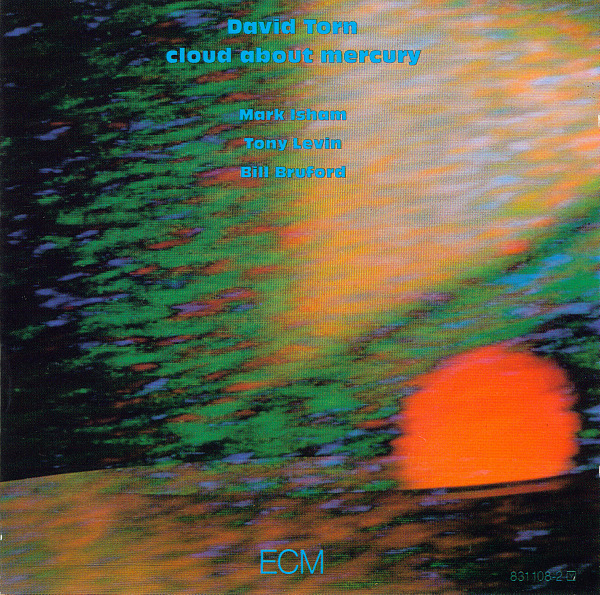
Guitarist David Torn defines jazz fusion, proving that the genre is more than add and stir. With cloud about mercury he made his most personal statement to date. The album sounds like many things: a sweep of Steve Tibbetts dimensions, a Jon Hassell think piece, a tree with many cultural branches, a spider’s web in sound. Torn roams freely throughout these territories, shouldering a vast load of thematic material. The opening wash of heaven that is “Suyafhu Skin…Snapping The Hollow Reed” condenses much of that material, letting fall a quiet storm of continental activity. Detuned guitars and a bubbling synthesizer part the way for Tony Levin’s grounded bass lines and trumpeter Mark Isham’s sustained flights, while drummer Bill Bruford chases after, somehow keeping pace. Next is “The Mercury Grid,” another engaging rhythm piece that boasts Isham in a Molværian mode. Torn flexes acrobatically here, swinging from every branch of this sonic corridor. The curiously titled “3 Minutes Of Pure Entertainment” is a mid-tempo groove that again features soaring guitar. Torn’s fractal precision speckles “Previous Man,” which begins with two guitars before engaging drums and synth bass in staggered syncopations. The likeminded “Network Of Sparks: The Delicate Code” sets off an intriguing chain of electric events, all the more enigmatic for their brevity. Which brings us to “Network Of Sparks: Egg Learns To Walk…Suyafhu Seal,” a warm, gelatinous mosaic that slices the night into ribbons like light through a window blind, rendering empty space into a virtual stairway by curls of cigarette smoke.

cloud about mercury represents a pinnacle of Torn’s craft and is must-have for the adventurous.

<< John Abercrombie: Getting There (ECM 1321)
>> Gavin Bryars: Three Viennese Dancers (ECM 1323 NS)

John Abercrombie: Getting There (ECM 1321)


John Abercrombie
Getting There

John Abercrombie electric and acoustic guitars, guitar synthesizer
Marc Johnson bass
Peter Erskine drums
Michael Brecker tenor saxophone
Recorded April 1987 at Power Station, New York
Engineer: James Farber
Produced by Lee Townsend

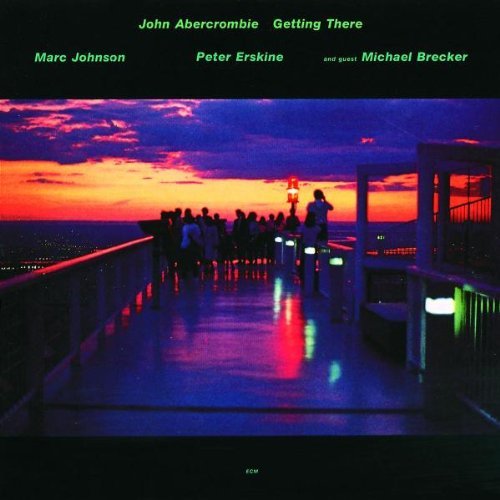
This trio—consisting of John Abercrombie on guitars (still favoring synth treatments at this point), Marc Johnson on bass, and Peter Erskine on drums—was one to be reckoned with in the 80s. Getting There seems, like many of ECM’s dates from the decade, to have been overlooked by many, but its rewards are plentiful. All the more so for the presence of saxophonist Mike Brecker, whose buttery tenor graces a smattering of its tracks. First and foremost among these is “Sidekicks.” This fishhook of a tune reels us into the album’s sweep, sped along by Erskine’s anthemic drumming and Johnson’s springy lines before ending on a classic fadeout as Brecker careens into outer space. “Remember Hymn” is another Brecker-heavy capsule of nocturnal medicine. With wondrous lyricism, the group constantly reforms itself here in one of the frontman’s finest. Marc Johnson spikes the compositional punch with “Furs On Ice”—one of only two non-Abercrombie tunes on this set (the other being Vince Mendoza’s “Thalia,” which finds Abercrombie in a Metheny mode)—lays down a smooth groove for Hammond organ-like chording and Brecker’s smooth emotive pinwheels. Abercrombie glows in his solo, drawing his electric sound like a dull razor across the stubble of time. Speaking of which, “Upon A Time” gives us plenty, taking the trio form down memory lane as Abercrombie’s fingers squeak along the fret board like birds.

This album is also marked by thoughtful choices in distortion and amplification, as exemplified in the title track, in which Abercrombie lets fly his laser-honed melodies, burning like a welding torch in a silent film. Erskine is epic on this cut. “Chance” brings a more delicate body language to that same immortal circle, while “Labour Day” gives Johnson a turn at the helm over Erskine’s precise brushes before Abercrombie returns for his most spirited solo yet.

Abercrombie has a tendency to catapult his notes, sending listeners on clean, high lobs. These are some of his brightest, not least because of Lee Townsend’s sparkling production. And in the company of such comparably strong wings, this flock can do no wrong. This is captivating music-making that welcomes us into the joy of musicians at the peak of their expressive powers.

<< Paul Bley: Fragments (ECM 1320)
>> David Torn: cloud about mercury (ECM 1322)

Paul Bley: Fragments (ECM 1320)

Paul Bley
Fragments

Paul Bley piano
John Surman soprano and baritone saxophones, bass clarinet
Bill Frisell guitar
Paul Motian drums
Recorded January 1986 at Rainbow Studio, Oslo
Engineer: Jan Erik Kongshaug
Produced by Manfred Eicher

Of all the chamber jazz experiments perfected by Paul Bley over the years, Fragments is arguably his most profound. This fascinating date finds Bley in the studio with reedman John Surman, guitarist Bill Frisell, and drummer Paul Motian. The pianist pens two pieces here. First is “Memories,” which opens the set and features the burnished sound of Surman’s bass clarinet against Bley’s spindly keys and Frisell’s insectile drones. A soothing and get-under-your-skin kind of track, it breeds a unique power, one that creaks into the bones of the album’s remainder like an oncoming winter. On the flipside is “Hand Dance,” which sounds more like a Motian piece and holds tight to its thematic cliff, never looking down. “Monica Jane” (Frisell) is like the rings of Saturn: separate yet one. Motian’s slow tumble carries us over into every new phrase with delicacy. The composer finally comes out of the woodwork with this one, varnishing his own brand of knotted grain.

“Line Down” (Surman), aside from sporting a pun of Wheelerian proportions, is an even freer tracing of incendiary threads, roped across vast differences yet never breaking. Surman proves yet again why his baritone is unmatched, twisting in and out of all manner of pretzels before sailing into Frisell’s ports of call. Two ballads by Carla Bley lower us into those same nocturnal waters. The bass clarinet swims like a beluga whale through “Seven,” Frisell spiraling around it like dolphin song. “Closer” crawls at its own pace, touched by the guiding hand of history. What else can it be closer to but closeness itself, in which music breathes like fragrance in spring’s last gasp?

Paul Motian counters with two numbers. “Once Around The Park” focuses the lens a little further. Dipped again in the bronze of Surman’s baritone, it sings darkly while Bley’s fingers press the keys like footprints into sand. The conversation continues in “For The Love Of Sarah,” a harmonic duet for baritone and guitar. Combined, these two otherworldly energies make something touching and familiar.

Last is Annette Peacock’s “Nothing Ever Was, Anyway,” a breeze through dying leaves that carries with it the voices of memory with which the album began. It ends on a dark and quiet chord, dropped like a feather on the surface of our slumber.

While it may not be to everyone’s liking, for me Fragments is a pinnacle of ECM production, musical language, and sheer depth of commitment to every moment it documents. Another personal Top 10 candidate and perhaps the most haunting album on the label. I encourage you to let it speak to you.

<< Masqualero: Bande À Part (ECM 1319)
>> John Abercrombie: Getting There (ECM 1321)

Masqualero: Bande À Part (ECM 1319)


Masqualero
Bande À Part

Arild Andersen basses
Nils Petter Molvær trumpet
Tore Brunborg saxophones
Jon Balke piano, synthesizer
Jon Christensen drums, percussion
Recorded August and December 1985 at Rainbow Studio, Oslo
Engineer: Jan Erik Kongshaug
Produced by Manfred Eicher and Masqualero

Masqualero was the Arild Andersen Quintet by another name, a name that both tipped its hat to Wayne Shorter while casting its gaze toward a future that was decidedly Andersen’s. Note the formidable cast of up-and-comers: Nils Petter Molvær on trumpet, Tore Brunborg on saxophones, and Jon Balke on keys. Add to that Jon Christensen on drums, and one can hardly go wrong. Andersen himself flexes his compositional muscles on three cuts, filling each with his depth of tone. Yet his presence is, as ever, non-invasive, and allows a porous democracy to seep through. The skipping snare and soaring trumpet of “3 For 5” throw a lacy net over Balke’s gorgeous strains, leaving us buffed for the varnish of “Natt.” In this we find one spiral after another, sliding down the throat of the freely improvised “Sort Of” before cresting on the wave of “Vanilje.” Andersen digs deep for this one, excavating cloudy jewels of wisdom. Balke’s “Bali” is especially moving and finds unity in Brunborg’s horn. A rolling drum solo closes this frenetic weave. Christensen throws his compositional hat into the ring with “Tutte,” a stretch of arco strains and slow tumbles. Molvær does likewise with “No Soap (A Jitterbug Jamboree),” another stunner that glows at the edges. “Nyl,” Balke’s other offering, draws a protracted groove, indicated by bass and then set free into an expanse of vocal energy.

The strength of Bande À Part lies in the writing, ever rooted in the soil of reflection. Andersen’s is a sound-space where we may float or lie prone as we see fit, laughing and crying in the same breath. An essential release for Andersen enthusiasts that speaks to the heart of his craft.

<< Stephan Micus: Ocean (ECM 1318)
>> Paul Bley: Fragments (ECM 1320)