John Clark: Faces (ECM 1176)

John Clark
Faces

John Clark french horn
David Friedman vibraharp, marimba
David Darling cello
Jon Christensen drums
Recorded April 1980 at Talent Studio, Oslo
Engineer: Jan Erik Kongshaug
Produced by Manfred Eicher

Faces documents the only appearance of versatile French hornist John Clark on ECM proper (he does, however, appear on a trio of WATT releases) and is one from a modest overall output as leader. Having performed with musicians as diverse as Paul Winter, LL Cool J, and Gil Evans, his tender considerations fit snugly with the Eicherian touch in this out-of-print session. Joined by David Friedman’s mallets, the particularly welcome presence of David Darling’s electric cello, and Jon Christensen on drums, Clark paints for us a rain-slicked character study of a life lived in slow motion.

Side A charts the album’s deepest waters in “The Abhà Kingdom.” Its understated flow of vibes, overdubbed horns, and cello courses in and out of sonar range, diving ever deeper with every muted clench, so that even Christensen’s accentuations seem to move at the speed of honey behind Friedman’s subdued yet strangely exuberant cartwheels. The afterimages of “Lament” would make the perfect backdrop for a Terje Rypdal excursion. Instead of that grinding song, we get the rounded icicles of Darling’s bow and the sustained arpeggio from vibes that leaves us hanging before dropping us onto Side B. Our guide on this descent is “Silver Rain.” The marimba vamp evokes an African thumb piano and affectionately embraces Clark’s processed horn. Friedman also shares a notable dialogue with Christensen here. Darling’s fluid threads are the binding force of “Faces In The Fire.” A comforting feeling of perpetuity abounds in that cello’s voice and brings out otherwise inaudible whispers. “Faces In The Sky” would feel right at home as the soundtrack for a road picture. Christensen beguiles with his delicacy, in which he cradles a delicate implication that never breaks, even under Darling’s far-reaching pizzicato. After all of this soul-searching, the carnivalesque “You Did It, You Did It!” ends the album in resolute jubilance.

Faces has a semi-porous quality and shimmers like the surface of an out-of-focus pool. It sits comfortably just below the rim of our consciousness, like a half-dream that one holds dear in the face of inevitable wakefulness.

<< Keith Jarrett: The Celestial Hawk (ECM 1175)
>> Walcott/Cherry/Vasconcelos: CODONA 2 (ECM 1177)

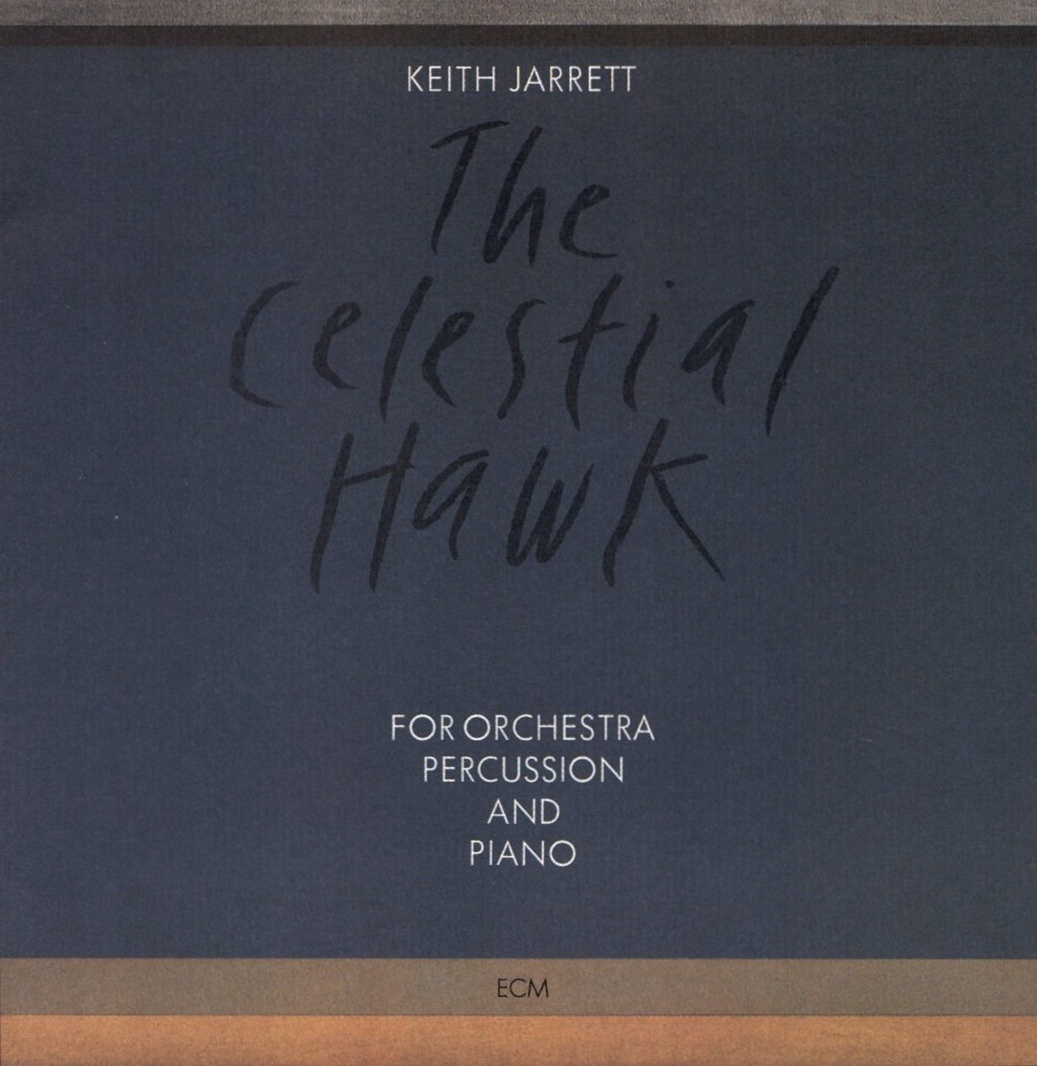
Keith Jarrett: The Celestial Hawk (ECM 1175)

Keith Jarrett
The Celestial Hawk

Keith Jarrett piano
Syracuse Symphony
Christopher Keene conductor
Recorded March 1980, Carnegie Hall, New York
Engineer: Stan Tonkel
Produced by Manfred Eicher and Keith Jarrett

Keith Jarrett’s classical modality often comes across to me as a dark pastoral, a variegated tapestry of intensity and withdrawal. And while The Celestial Hawk may be no different in this regard, it promises some brighter discoveries upon deeper listening. Against a gentle backdrop of percussion that includes timpani, snare, and triangle, Jarrett deploys his tiny fleets of high notes in the First Movement, out of which arises a delicate harp ostinato, doubled by piano and accentuated by woodwinds and strings, as a crystalline glockenspiel slowly clouds into less translucent ores. After a deep surge, Jarrett rows us into calmer waters alone at the piano, where dolphins in the forms of harp and mallet percussion soon join him. The Second Movement offers up the most cinematic passage of this piece. One can feel its images running, skipping, and emoting through lives unseen. We never stay in one thread for too long, for each is picked up by another into which the previous one has looped itself. The martial snare and cavalrous brass of the Third Movement glisten with the patriotism of an undiscovered country, bound to a manifest destiny in which walking is like flight. From behind the uplifted curtain, horns dance for us a message to prosperity. And yet even as the twilight descends, the oboe threads a ray of moonlight through the waters, bringing with it all sense of time for which beauty is but an afterthought to the truer beauties of slumber, where life ends in a crashing gong.

Despite being very programmatic, this music is far more than incidental to the narrative it describes. At times tumbling in billowy romance, at others even jarringly uncomfortable, Jarrett’s piano embraces itself, following the orchestral advice that surrounds it to the letter. It is an honest music, a painful truth, a call for peace in a violent world.

<< Keith Jarrett: Sacred Hymns of G. I. Gurdjieff (ECM 1174)
>> John Clark: Faces (ECM 1176)

Keith Jarrett: Sacred Hymns of G. I. Gurdjieff (ECM 1174)

ECM 1174

Keith Jarrett
Sacred Hymns of G. I. Gurdjieff

Keith Jarrett piano
Recorded March 1980, Tonstudio Bauer, Ludwigsburg
Engineer: Martin Wieland
Produced by Manfred Eicher

The exact date on which George Ivanovich Gurdjieff was born into this world is unknown. This is fitting, for to one who spent his life trying to unravel it, such mundane details would have been unnecessary in the grander scheme of things. Born in Armenia to a Greek father and Armenian mother, Gurdjieff traveled the world in search of fabled monasteries and the secrets they contained. Unlike many before and since, he succeeded. Yet more unlike many before and since, he packed that knowledge into his somatic consciousness until it burst like a supernova. Biographer John Shirley likens the Gurdjieff encounter to a cold shower, “a welcome shock of wakefulness” that leaves its deep, indelible traces in body and soul. Music was the dark matter of his cosmology and operated at the whim of an inarticulable law by which the listener felt compelled to turn oneself inside out, loosing previously bottled emotions into the open stars. Music was vibration, and vibration was life itself. In the hands of an artist like Keith Jarrett, I daresay it becomes something more.

Composed during Gurdjieff’s so-called “second period,” the music on this album arose from a fruitful block of the 1920s, which saw him and Russian composer Thomas de Hartmann together producing a treasure trove of melodies drawn from various folk music traditions and Russian Orthodoxy. The resulting selections are understatedly suited to Jarrett, spun as they seem to be from the kindred methodology behind his own solo improvisations, which construct from the ground down glorious caverns of sound, melody, and spirit. The strains of “Reading Of Sacred Books,” for example, unfold ever so gently, and yet rather than unveiling new territory simply open more and more doors within, each the mirror to a different face of our psyche. Ceremony and despair share the same sky; exaltations and poverty, the same ground. Each of these living moments winds itself like a string around the finger of spiritual forgetting. Jarrett negotiates these stark contrasts, and the connective tissue between them, with unwavering attention. Just listening to the brilliance with which he dialogues the punctuations of “Hymn To The Endless Creator” with the Debussean meditations of “Hymn From A Great Temple” and “The Story Of The Resurrection Of Christ” is wonder in and of itself. “Holy Affirming—Holy Denying—Holy Reconciling” perfectly describes the tripartite process of becoming that Jarrett enacts throughout, leaving us suspended in the final “Meditation.”

From the titles alone, one might think of these pieces as incidental music, when in fact the music is its own ritual, a collection of hymns to itself in a mise-en-abyme of faith. It is a multifaceted jewel of loosely bound energy that finds joy in emptiness. With due assurance and temerity, Jarrett proves it’s not music that is its own religion, but religion that is its own music.

<< Ralph Towner: Solo Concert (ECM 1173)
>> Keith Jarrett: The Celestial Hawk (ECM 1175)

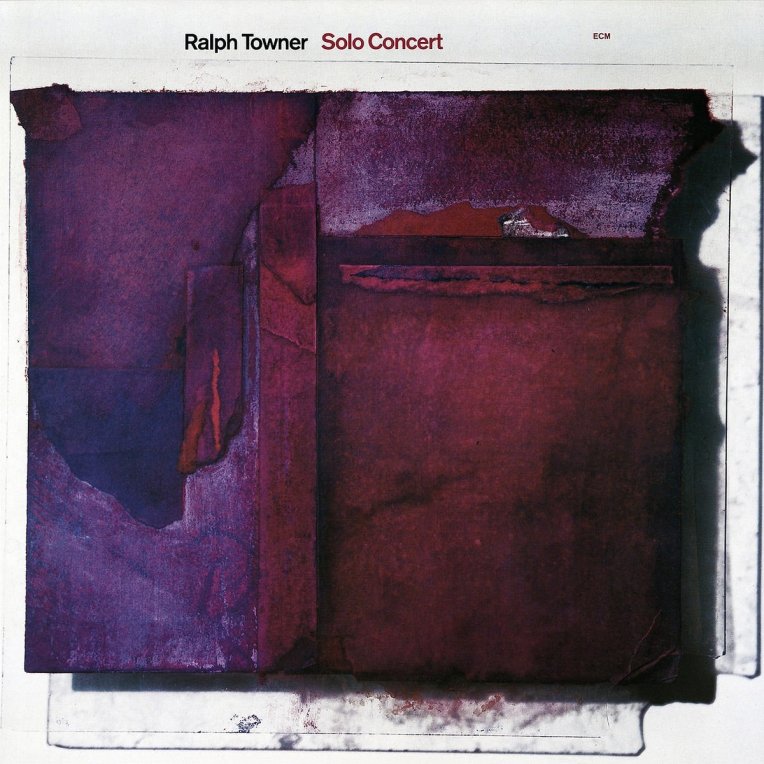
Ralph Towner: Solo Concert (ECM 1173)

ECM 1173

Ralph Towner
Solo Concert

Ralph Towner 12-string and classical guitars
Recorded October 1979, Amerika Haus, München and Limmathaus, Zürich
Engineer: Martin Wieland
Produced by Manfred Eicher

Ralph Towner’s Solo Concert holds a special place in my ECM-adoring heart, for it was my introduction to a guitarist whose skills have since become staples of my listening life. Lovingly recorded in the open concert spaces of Munich and Zürich, Solo Concert is to the guitar what Keith Jarrett’s The Köln Concert is to the piano. It’s that good.

Towner’s own compositions make up the bulk of the album. The opening “Spirit Lake” is the most transcendent of these and exemplifies Towner’s craft as both technician and melodic wellspring. Notes drip from his 12-string with shimmering lucidity, dipping below every motif it can swing from as it blossoms into a brilliant flourish of an ending. What at first seems an abstract improvisational exercise in “Train Of Thought” reveals the instrument’s hidden voices, in which a pulsing bass lingers and harmonic clusters soar. The staggered melodies and banjo-like articulations of “Zoetrope” contrast superbly with “Chelsea Courtyard,” in which dissonant arpeggios lie in the grass, above which the clouds are so thin they’re barely visible, and motivations even more so. Still, the music offers more than enough provocation as nostalgias flit by the windows of our attention, the curtains of which Towner opens to let in the light of a half-remembered day.

Towner also lays his hands on a pocketful of sparkling covers. Of these, the two by John Abercrombie—“Ralph’s Piano Waltz” and “Timeless”—are notable for their use of thumbed anchors, which provide a ghostly counterpoint to wider runs in the upper registers. Lilting syncopations trade places with jazzier throwbacks, packing melodic energy into increasingly compact cells. Yet it is with “Nardis” (Davis/Evans) that Towner truly enthralls. Played on classical guitar, it is a vivid standout that jumps headfirst into its themes before unraveling them in a blissful wave. Towner’s deft harmonies and prowess at the fingerboard leap with the precision of synchronized swimmers about to clinch a gold.

This is an intelligently assembled program of complementary music that shows the depth and breadth of Towner’s abilities more than any single disc. My only complaint is the applause that breaks the spell of every piece when it ends. Then again, I’d have done the same had I been there.

If you’ve ever wondered just how high a guitar can fly, then here’s your plane ticket.

<< Keith Jarrett: Nude Ants (ECM 1171/72)
>> Keith Jarrett: Sacred Hymns of G. I. Gurdjieff (ECM 1174)

Keith Jarrett: Nude Ants (ECM 1171/72)

ECM 1171_72

Keith Jarrett
Nude Ants

Keith Jarrett piano, timbales, percussion
Jan Garbarek saxophones
Palle Danielsson bass
Jon Christensen drums, percussion
Recorded May 1979 at the Village Vanguard, New York
Engineer: Tom McKenney
Produced by Manfred Eicher

Something about Keith Jarrett’s very presence seems to draw out from even the most highly regarded musicians unexpected levels of performance, commitment, and above all faith in the musical moment. Nude Ants, easily one of his most uplifting live dates (this time at the Village Vanguard) on record and the pinnacle of his quartet activities, exemplifies this to the nth degree.

In its European incarnation, Jarrett’s menagerie of yesteryear opens its gates quietly and smoothly with “Chant Of The Soil.” Jarrett digs in alongside one of the most engaging rhythm sections one could ask for (Palle Danielsson and Jon Christensen). The liveness of the performance comes across early in “Innocence.” Amid clinking glasses and the even more cacophonous spirits of appreciation of those drinking from them, an enthralling intro from keys tosses Jan Garbarek’s exposition like a salad of bright energies. The moonlit “Processional” burrows beyond the trappings of a ballad and into a cavernous subconscious. Jarrett’s singing teases out a vivid pedal point as he punches chords like ecstasy’s time clock before floating off in reverie.

The second half of this heavy loaf slices much like the first: in slabs of wing-beats and half-words. Garbarek shines in “Oasis,” his reed shawm-like and opaque, as he wrenches out some of his most ecstatic high notes on record. Out of this measured catharsis Jarrett waters his colors in a solo tour de force. After the upbeat “New Dance,” the drawl that begins “Sunshine Song” is hardly enough to keep the band from pulling back a slingshot of dynamism and hurtling its contents skyward. Mounting intensities from Christensen underscore a fluttering resolution. And yet, as with everything in this set, it is tempered by an intense feeling of perpetuity that renders every potential end into a pathway of renewal.

In spite—if not because—of the idiosyncratic strengths of its performers, this is ensemble jazz at its freshest. Jarrett’s vocal leaps are nearly as adventurous as his fingers, proving once again that such passion cannot be contained in a vessel so modest as the human lung. Garbarek lets loose in ways seldom heard outside of Sart, while Danielsson and Christensen are so good together that I would be nearly as content listening to just the two of them for the entire set. Everyone here is aflame. Together, they light the world.

An indispensable classic.

<< Haden/Garbarek/Gismonti: Folk Songs (ECM 1170)
>> Ralph Towner: Solo Concert (ECM 1173)

Haden/Garbarek/Gismonti: Folk Songs (ECM 1170)

ECM 1170

Folk Songs

Charlie Haden bass
Jan Garbarek saxophones
Egberto Gismonti guitars, piano
Recorded November 1979 at Talent Studio, Oslo
Engineer: Jan Erik Kongshaug
Produced by Manfred Eicher

This scintillating follow-up album to Magico is yet another fine example of ECM’s progressive comings together. Uniting multi-instrumentalist Egberto Gismonti with the instantly recognizable stylings of saxophonist Jan Garbarek and bassist Charlie Haden seems at once a stroke of genius and an inevitable configuration. A blue “Folk Song” sets the tone for all tender considerations that follow, slowly working its motions into a helix of atmospheres. Gismonti stretches out a gorgeous drawl in “Bôdas De Prata.” Within the open bowl of Garbarek’s cupped tenor, he glows like a firefly. The rhythmic acuity of “Cego Aderaldo” is enough to sustain an otherwise languid album. There is something special about the 12-string/sax combination here that recalls the label’s Solstice days and pairs beautifully with “Veien,” which gives us the album’s most reactive moments. Gismonti’s perpetuity, Garbarek’s crystalline phrasings, and Haden’s heartening geometries unify, appropriately enough, in “Equilibrista.” This cradle of rolling piano and melodic overlays falls from its bough in a melodious tumble, landing on its feet for the final word, which comes in the form of “For Turiya,” another ballad-like seesaw of piano and bass resting on the fulcrum of Garbarek’s nocturnal whispers.

Each of these precious musicians has the ability to paint the grandest pictures with the subtlest gestures. This tension of method and effect is at the heart of ECM’s ethos. In such projects, one feels producer Manfred Eicher’s conversational presence and guiding hand, both of which can only illuminate the joys of creation and the sharing thereof.

<< Jan Garbarek/Kjell Johnsen: Aftenland (ECM 1169)
>> Keith Jarrett: Nude Ants (ECM 1171/72)

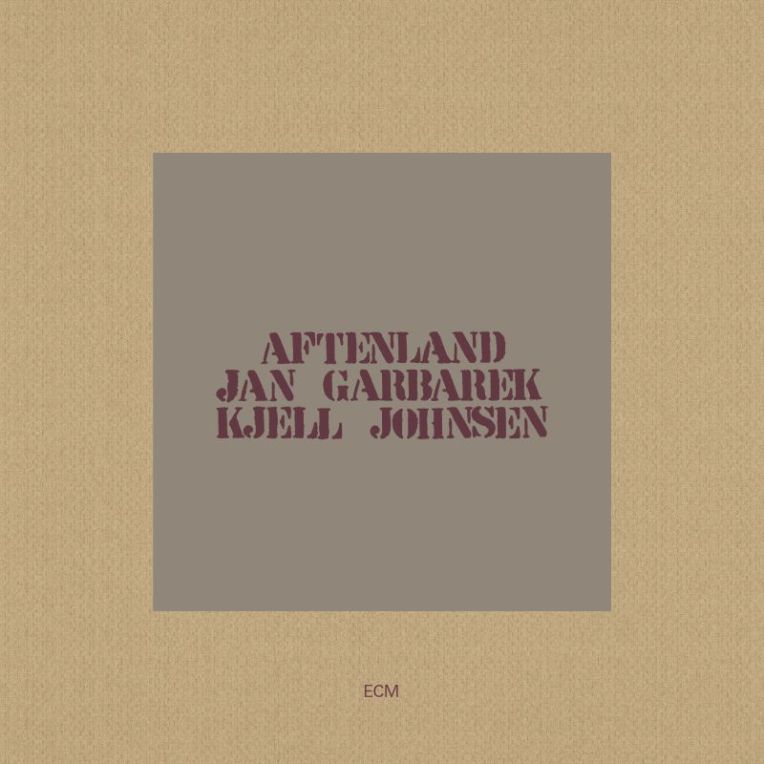
Jan Garbarek & Kjell Johnsen: Aftenland (ECM 1169)

ECM 1169 2

Aftenland

Jan Garbarek tenor and soprano saxophones, wood flute
Kjell Johnsen pipe organ
Recorded December 1979 at Engelbrektskyrkan, Stockholm
Engineer: Jan Erik Kongshaug
Produced by Manfred Eicher

If improvisation is a form of meditation, then meditation is also a form of improvisation. In being at peace with what one plays, one lives it.

Jan Garbarek is, of course, one of ECM’s longest standing composers and saxophonists, yet he is first and foremost a spectacular improviser who often manages to reach farther than (I imagine) even his own expectations in touching new melodic concepts. Paired with the Spheres-like church organ of Kjell Johnsen, he plumbs the depths of spiritual and physical awareness in a way that few of his albums have since. Here more than anywhere else, he shapes reverberation into its own spiritualism, exploring every curve of his surrounding architecture, every carved piece of wood and masonry.

The title track opens with a viscous solemnity, ever in shadow, while “Syn” reaps even more intense crops from the ethereal harvest it has sown. A trio of miniatures clustered around the session’s center reaches even more intimately into its heartbeat. “Kilden” seems to drip from the chapel ceiling like a weeping fresco. Garbarek unveils the rare recorders for a more playful exchange in “Spill.” “Iskirken” grips the heart with its piercing keen, dividing cloud and rain with the light of grief that shines like no other in times of greatest darkness. Lastly, the hurdy-gurdy drone of “Tegn” strings a delicate safety net for Garbarek’s robust defenestration.

This album predates his later Officium project by fourteen years, but is in parts just as effective in its vaulted evocations of hidden chants and invisible voices. At times, it also reminds me of the Licht/Haino/Hamilton/MLW one-off, Gerry Miles, only with less turbulent folds.

This is a pensive album, an unsung classic in the Garbarek oeuvre, filled with more than enough revelations to lodge a place in your musical heart.

<< Reich: Octet / Music for a Large Ensemble / Violin Phase (ECM 1168 NS)
>> Haden/Garbarek/Gismonti: Folk Songs (ECM 1170)

Art Ensemble of Chicago: Full Force (ECM 1167)

Art Ensemble of Chicago
Full Force

Lester Bowie trumpet
Joseph Jarman reeds, flute, gongs
Roscoe Mitchell reeds, percussion
Malachi Favors Maghostus bass, percussion, melodica, vocal
Famoudou Don Moye sun percussion
Recorded January 1980 at Columbia Recording Studios, New York
Engineer: David Baker
Produced by Manfred Eicher

Full Force begins in cool breath and ends in scalding heat, the inhalation and exhalation of its own mission. As one comes to expect from any AEC outing, tonal colors are on a mission to envelop us. Despite what the title would have you believe, this is an album of staggering subtlety and finesse. That being said, it is also an intense experience. The first such intimations appear early in “Magg Zelma,” which amid a delectable gamut of percussive signatures begins like an iteration of John Zorn’s Cobra—duck calls share the air with gongs, brass, and mysterious whistles—before the muddy bass of Malachi Favors is cross-hatched more regularly by cymbals and winds. Rhythmatist Don Moye keeps us in the loop as our reedmen crack a freedom egg. Big band horns carry us along through tight harmonies in “Care Free,” which lasts all of 51 seconds, prelude to the Mingus tribute “Charlie M.” Here, the mood and melody recall “A Sentimental Journey,” if through raunchier diction. An unhinged bass solo and some swanky sax from Roscoe Mitchell underline its narrative flow. “Old Time Southside Street Dance” christens itself with a bottle of fire. Laced with an incredible alto solo sustained by circular breathing and equally inexhaustible energy, this tune is perfectly programmed as the penultimate catharsis. A string of solos from trumpet, soprano, and bass skid into the finish line by the skin of their teeth.

These vagabond musicians prove their inventiveness at every turn, and nowhere more so than in via the Baroque chamber instruments woven into the prismatic title track. They hurtle forth with all the potential of a tornado compressed into a dot—a sweeping yet brief gesture, a calling out, a fluttering drum, a distorted voice, a bout of laughter, and a resolute twang running its fingernail around the edge of an enormous sonorous quarter.

Now occupying a well-earned place among ECM’s carefully chosen Touchstones series, this may just be the best entry point into the AEC’s fantastic ride.

<< Enrico Rava Quartet <<Ah>> (ECM 1166)
>> Reich: Octet / Music for a Large Ensemble / Violin Phase (ECM 1168 NS)

Enrico Rava and Thomas Stöwsand (ECM 1166 & 1224)

On October 5, 2006, the audible world lost a tireless champion. Thomas Stöwsand was a musician and journalist by trade when he joined forces with Manfred Eicher in 1970. Over the next decade he helped lay earth for the secluded pantheon that the label would soon become. From early on he believed that the best way to promote ECM’s quickly growing scene was to bring it directly to the consumer. The crowning achievement of his efforts was the booking agency Saudades Tourneen, which he founded in 1983. Consequently, Keith Jarrett, Chick Corea, and Pat Metheny found themselves touring for the first time before European audiences. A healthy chunk of Stöwsand’s complete roster reads like an ECM hall of fame: John Abercrombie, Bill Frisell, Egberto Gismonti, Ralph Towner, Paul Motian, Dave Holland and many others all had the great fortune of being sucked into his whirlwind of passion. “I know he loved their music,” observes Nonesuch’s Bob Hurwitz, “but I think Thomas loved them as people even more.” This was, as Hurwitz goes on to say, a part of his legacy. I imagine it is also part of the legacies of every musician he represented. These were the people he surrounded himself with, the ones who fanned a flame much too extroverted to contain. Stöwsand lived fast, drove fast, and seems to have made connections as easily as one might breathe. His personal touch was felt, and still is felt, worldwide, as Saudades carries on his mission through the pioneering forces of John Zorn, the Kronos Quartet, Fred Frith, and the many others who funnel decades of close working relationships with the man into their unquenchable creative thirsts.

Yet behind his acute business acumen, infectious personality, and resounding laugh, Stöwsand was also quietly producing a fascinating catalogue of albums. Nearly all of these were available only on JAPO, though thankfully a gleaming handful of Manfred Schoof material has since been reissued on CD. There were two albums, however, that dropped needles directly to flagship vinyl. Both were recorded with Italian trumpeter Enrico Rava’s fledgling quartet at the famed Tonstudio Bauer and were the only two Rava albums not produced by Eicher. The first of these, the curiously titled >>Ah<< (released 1980), featured bassist Giovanni Tommaso and drummer Bruce Ditmas, while 1982’s Opening Night placed Rava alongside bassist Furio Di Castri and the great Aldo Romano on drums. Both feature Franco D’Adrea, whose pianism lights up even the darkest corners. Bafflingly, neither album has felt the touch of a laser, and so, for what it’s worth, here’s a play-by-play.
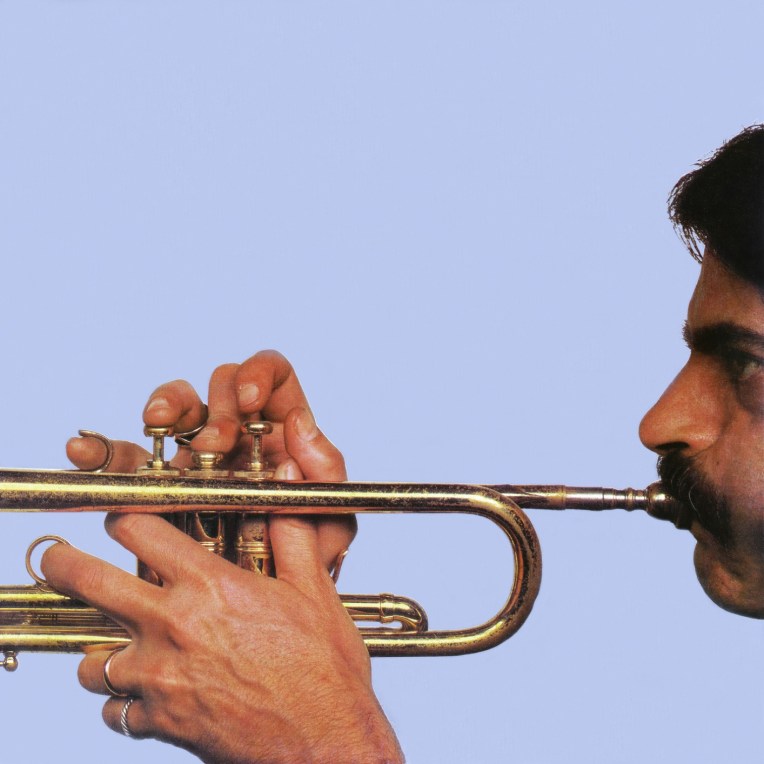
ECM 1166

Enrico Rava Quartet
>>Ah<< (ECM 1166)

Enrico Rava trumpet
Franco D’Andrea piano
Giovanni Tommaso bass
Bruce Ditmas drums
Recorded December 1979 at Tonstudio Bauer, Ludwigsburg
Engineer: Martin Wieland
Produced by Thomas Stöwsand

Feeling a little under the weather? Then open up and say Ah, because Doctor Rava is in! This warm rainy day session is the perfect sonic elixir for what ails you. The sumptuous diagnostics of “Lulu” lay their pianistic hands upon us first, and with them the album’s leitmotif. Rava and D’Andrea are in fine conversational form here, as they ever are, cracking open a Pandora’s Box of free improv before re-attuning to a smoldering vamp. Rava starts us off strongly in “Outsider,” in which he swings his rhythm section around and around like children holding hands in a field. A swift kick from Ditmas brings us solid thematic closure. “Small Talk” allows Tommaso his just airtime in what is by far the highlight of the examination. Rava checks our pulse in the groovier “Rose Selavy,” breezes wistfully through the title track, and gives way to “Trombonauta,” the album’s brief yet impactful ballad, before ending “At The Movies.” This eclectic ode breathes with the magic of Cinema Paradiso while threatening to topple from the weight of its own remembrance.

<< Gary Peacock: Shift In The Wind (ECM 1165)
>> Art Ensemble of Chicago: Full Force (ECM 1167)

… . …
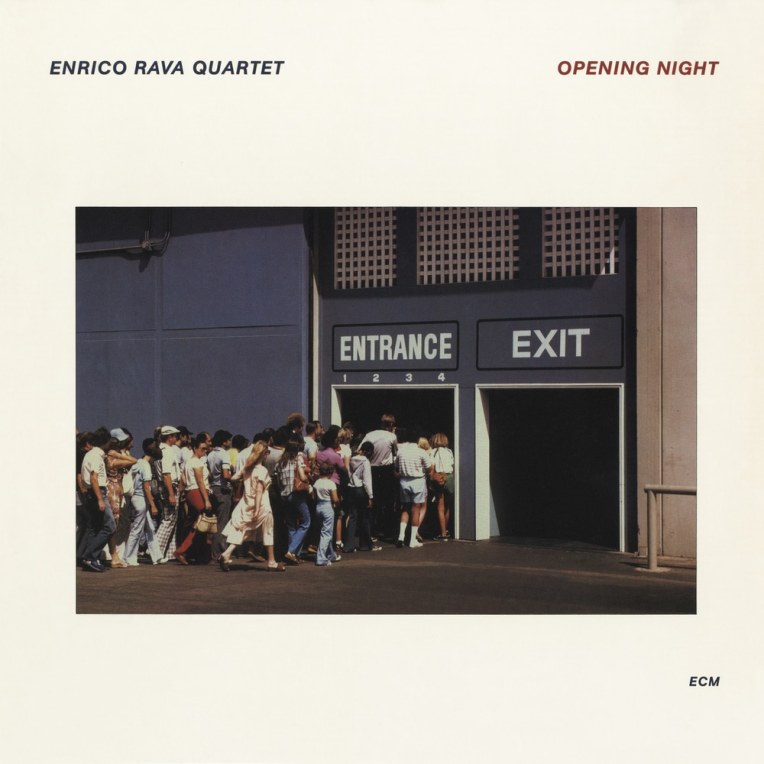
ECM 1224

Enrico Rava Quartet
Opening Night

Enrico Rava trumpet, fluegelhorn
Franco D’Andrea piano
Furio Di Castri double bass
Aldo Romano drums, guitar
Recorded December 1981 at Tonstudio Bauer, Ludwigsburg
Engineer: Martin Wieland
Produced by Thomas Stöwsand

“I’m Getting Sentimental Over You” welcomes us with open arms as Rava skips, keens, wails, and laughs his way along this journey filled with nostalgia and multilingual communication. D’Andrea is downright ecstatic as he stumbles into a teaser of an ending. The title track is the album’s showpiece, unraveling from its languorous intro into an urgent stretch of virtuosity. Rava brings unwavering life to his playing, always playful, always present. “Diva,” on the other hand, is far mellower and arches its back across dusky skies.

Side B kicks off with a “Grrr.” Aside from being perhaps the greatest title in the Rava catalogue, it also ignites D’Andrea as he runs through prickly fields with supremely targeted chording. “F. Express” brings some pop to the album’s snap and crackle, further accentuated by unstoppable antics at the piano, while “Venise” again turns down the lights to a comforting level of solitude. “Thank You, Come Again” brings some rat-a-tat-tat platitudes to bear upon one of Rava’s catchiest tunes. Replete with cascading pianism and downright transportive trumpeting, this is as good as it gets.

This diptych shows off Rava at his liveliest and hones noticeable edges in the freer passages. For this listener, however, D’Andrea nails the spotlight every time he puts his fingers to those black-and-whites, leaving us with two exciting dates that are beyond ripe for reissue, and which are a vibrant testament to a producer, promoter, and friend whose indelible fingerprints continue to glow in even the darkest ignorance.

<< Jan Garbarek: Paths, Prints (ECM 1223)
>> Dewey Redman Quartet: The Struggle Continues (ECM 1225)