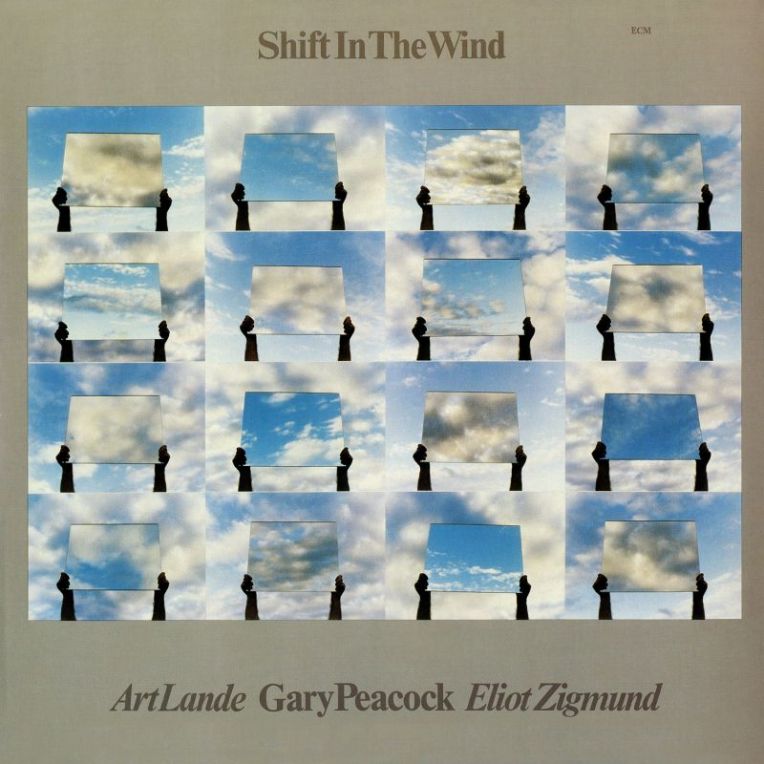
Gary Peacock: Shift In The Wind (ECM 1165)

ECM 1165

Gary Peacock
Shift In The Wind

Gary Peacock bass
Art Lande piano
Eliot Zigmund drums
Recorded February 1980 at Columbia Recording Studios, New York
Engineer: David Baker
Produced by Manfred Eicher

Though cataloged as a Gary Peacock joint, Shift In The Wind has Art Lande written all over it. It shows a different side of Peacock as he is taken in unforeseen directions by the grace of that delicate Lande touch. The latter’s pianism is majestic yet intimate in the opener, “So Green,” and sets the stage for an album in which he and Peacock share most of the compositional credit. The two consistently turn fleeting moments into epic sentiments, and vice versa, all the while thrown skyward by Eliot Zigmund’s hip sensibilities at the kit. With completion of these exercises, “Last First” comes as a fresh sunrise. With its solid arpeggios and bright rolls in the piano’s upper register, it teeters between reverie and jubilation, brought to fullest equilibrium in Peacock’s solo turn. The title track soars between whistles through detached mouthpieces, whispering piano, and percussion. So begins an abstract free-for-all which, like an ephemeral tornado of blown leaves, makes recognizable shapes out of stillness. This, along with “Fractions” and “Centers,” takes a divisional approach to the cumulative. “Caverns Beneath The Zoth,” on the other hand, funnels into a steady counterpoint. The trio lays the icing on the cake with “Valentine,” a precious ballad that exposes the magic of which Lande is capable at his best.

This is a vital session in the archives of everyone concerned, bringing home as it does a focused sense of craft, performance, and, above all, sensitivity. Lande, it bears repeating, dominates as much as one of his delicate sensibilities can, while Peacock carries his characteristically somber brand of exuberance to new depths.

<< John Abercrombie Quartet: Abercrombie Quartet (ECM 1164)
>> Enrico Rava Quartet <<Ah>> (ECM 1166)

Sam Rivers: Contrasts (ECM 1162)

1162 X

Sam Rivers
Contrasts

Sam Rivers soprano and tenor saxophones, flute
George Lewis trombone
Dave Holland bass
Thurman Barker drums, marimba
Recorded December 1979 at Tonstudio Bauer, Ludwigsburg
Engineer: Martin Wieland
Produced by Manfred Eicher

It’s a funny thing about getting lost: the more one tries to do it consciously, the more one discovers new pieces to fit into the jigsaw puzzle of familiar things. Jazz legend Sam Rivers, who made his only other ECM appearance on the classic Conference of the Birds, proved this sonically when he brought his patented “inside-out” technique to bear alongside Dave Holland, George Lewis, and Thurman Barker upon this free jazz date from 1979. Now in his 88th year, Rivers’s legacy continues to yield new nuggets of audio wisdom through such albums as Contrasts.

The album opens in “Circles” with some chewy improv. Thick horns and brittle drumming provide plenty of interplay to keep our wits on a tight leash. Lewis seems the most at home here, providing a bubbling cauldron of likeminded flights. It is the first in a smattering of freer tracks, the others being the slowly building “Solace” and perhaps the most abstract aside, “Images.” This leaves us with a hefty set of rhythm-driven powerhouses. “Zip” tightens the purse strings with an ever-moving tenor for some wholesome, head-nodding goodness. This joint also serves up a heaping drum solo on the side. Our frontman opts for flute in the swinging “Verve” with a renewed spring in his step. Convincing monologues from Holland and Lewis ease into a slow and timid end. “Lines” reprises that contagious soprano sax against an omniscient rhythm section before bowing out for some quality bass time. “Dazzle” brings exactly that, freeing our minds with a Braxton-esque tenor and tap-dancing bass work. Lewis is more than up to the task, scurrying in with Rivers in their joint commitment to going deeper.

As one of ECM’s bolder sessions, Contrasts deserves shelf space right next to George Adams’s Sound Suggestions. It is nothing if not about contrasts: the cohesive and the fractured, uprightness and vertigo. Colorful, straightforward, stirring.

<< David Darling: Journal October (ECM 1161)
>> Azimuth: Départ (ECM 1163)

David Darling: Journal October (ECM 1161)

ECM 1161

David Darling
Journal October

David Darling acoustic and electric cello, voice, percussion
Recorded October 1979 at Tonstudio Bauer, Ludwigsburg
Engineer: Martin Wieland
Produced by Manfred Eicher

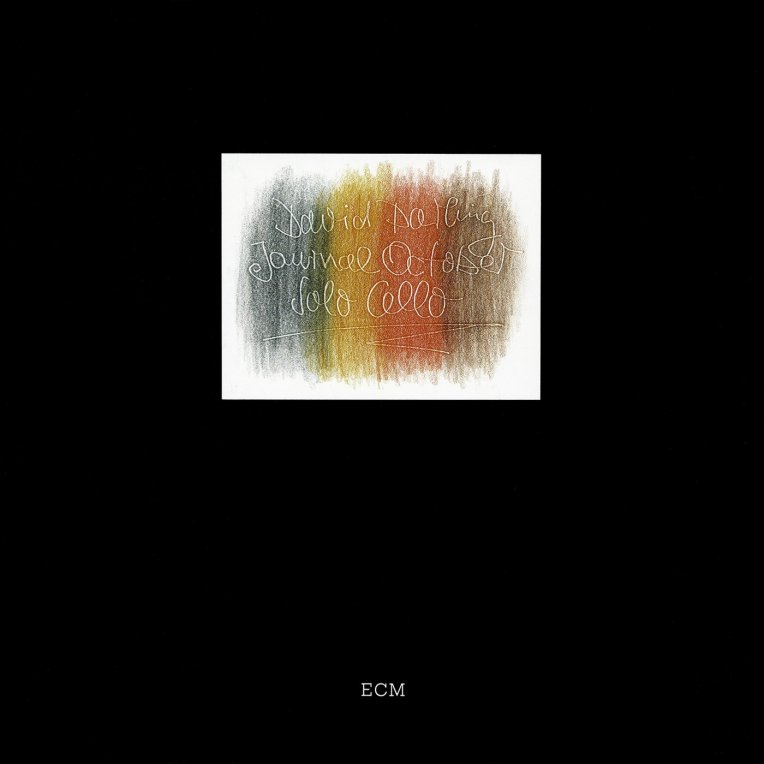
Having recently seen the film adaptation of James Redfield’s The Celestine Prophecy, which cycles through the book’s eight manifold insights on the path to another, the number nine is fresh in my mind. And so, as I pore through the sonic pages of David Darling’s Journal October on this fallen winter night, I inevitably see each of its nine tracks as an insight in and of itself. Darling’s music is one of ECM’s most invaluable treasures, and one could hardly find anything more beautiful than what he has left behind in its archive. His electric cello bays like a resurrected voice, an insight in and of itself into the lucidity of “Slow Return.” This introductory track is also the longest, drawing every jagged line like the echo of a mountainous horizon. From this potent doorway issues a host of transient forms.

Darling shifts the chronology of his recollections, grafting each to the new experiences of these studio performances. Their breath fills the album’s two solo cello improvisations, each of which cycles through grief’s most harrowing stages toward an inner peace. Rapture comes through in his involuntary vocalizations, in the dissonances that feed them. Darling foregrounds his body in “Solo Cello And Voice,” a self-division of high reaches and archaeological digs, while “Far Away Lights” gives us a taste of his pizzicato technique, which on his electric cello resounds like a tambura undone.

Two Darling touchstones—“Minor Blue” and “Clouds”—also make their first appearance in Journal October, both revisited in his masterful 8-String Religion. The former comes across with more impactful effect, less obscured by gossamer veils of reverb. The latter’s rocking ostinato buoys atmospheric vocals with vulnerable clarity, amplified harmonics ringing out with all the power of a waterfall compressed into a single string. The closing piece sails like an entire biography gathered into one vessel. Notes ascend into birdcalls, circling a teetering falsetto that reshapes the drone dynamic as one suspended rather than suspending.

This album began a walkabout of sorts that has borne some of ECM’s most humbling revelations. Such sounds still the heart and lure our inner eyes with their slow-motion lobs. Darling clears out the detritus of arrangement, the ornaments of song, and the obligations of tradition, forging an improvisatory path that is all his own. It may be trimmer than his later treks along more fluid paths, but his subtle intensities are all there, waiting to embrace the next aching spirit that comes along.

<< Steve Swallow: Home (ECM 1160)
>> Sam Rivers: Contrasts (ECM 1162)

Steve Swallow: Home (ECM 1160)

ECM 1160 2

Steve Swallow
Home

Sheila Jordan voice
Steve Kuhn piano
David Liebman saxophones
Lyle Mays synthesizer
Bob Moses drums
Steve Swallow bass
Recorded September 1979 at Columbia Recording Studios, New York
Engineer: David Baker
Produced by Manfred Eicher

Quiet as is proper for such places;
The street, subdued, half-snow, half-rain,
Endless, but ending in the darkened doors.
Inside, they who will be there always,
Quiet as is proper for such people—
Enough for now to be here, and
To know my door is one of these.
–Robert Creeley, “Return”

Home is a title, and an album, of many masks. Though by the time of this recording, bassist Steve Swallow had been involved in a string of projects with Gary Burton and Carla Bley, here his creative sediments sifted into their comfort zone on a label that was to become a home in and of itself. A kindred home may be found in the poetry of Robert Creeley, whose tender colloquialism is Swallow’s sounding board throughout. With the unmistakable smolder of Sheila Jordan’s vocal warmth, its meaning is never lost. Recorded just two months after Playground and featuring three from that Steven Kuhn-led quartet (Swallow being the only substitution), Home betrays yet another of its valences through the sympathetic approach of its musicians.

Lilting and lovely are the names of the game in “Some Echoes.” The verdant synth work of Lyle Mays draws us immediately into Dave Liebman’s soprano leaps. The rasp of each inflected phrase wafts like a breeze through the open doors of the album’s cover, bringing with it the scents of a long-dead memory gradually reanimated with every freshly raked word. These Jordan plants carefully and from a safe distance, allowing Kuhn’s busy fingers to prance across the ivories in her afterglow (“She was young…” and “Colors”). During the slow-motion somersault that is “Nowhere one…,” a sumptuous horn pulls out any lingering threads from Jordan’s introductory call to melodic arms. Rather than see the battlefield as a place of violence, however, the music embraces it as a place of adoration; a landscape replete with fading lives and their instant renewals. In all of these, we feel the nostalgia that enlivens such lyrical swathes as the title track and the engaging “In the Fall.”

The album saves its most indelible marks for those moments where whimsy and mysticism entwine. The pinnacle thereof is reached in “Ice Cream.” From Swallow’s sublime opening to Jordan’s varicolored sprinkles, not to mention a cosmic turn from Kuhn, this one caramelizes to perfection. The playfulness continues in “Echo,” which not only sports Liebman’s best solo in the set, but also practices what it preaches with some didactic volleys between Kuhn’s right and left hands. The band plays us out in the throes of “Midnight,” where quotations of “Three Blind Mice” rub shoulders with a haunting drone before falling into a stream of nocturnal consciousness. The moonlight of Jordan’s voice at last cuts a soft figure from the clouds, becoming one with the dawn.

Swallow is a joy. He is always on the move, bringing a range of moods to the table. From the swagger of youthful ignorance to the pensive affair between the self and regret, it’s all here in one slick package. Jordan’s involvement makes it all the more so. In contrast to her extended poetics in Playground, here she is the keystone to the music at hand, setting the stage for every scene. One need only listen to the way she infuses “You didn’t think…” with such guttural optimism using only a couplet to gain insight into her brilliance.

This is simply infectious music, smooth and tessellated, with not a single false step to be noted.

<< Steve Kuhn/Sheila Jordan Band: Playground (ECM 1159)
>> David Darling: Journal October (ECM 1161)

Bill Connors: Swimming With A Hole In My Body (ECM 1158)

ECM 1158

Bill Connors
Swimming With A Hole In My Body

Bill Connors guitars
Recorded August 1979 at Talent Studio, Oslo
Engineer: Jan Erik Kongshaug
Produced by Manfred Eicher

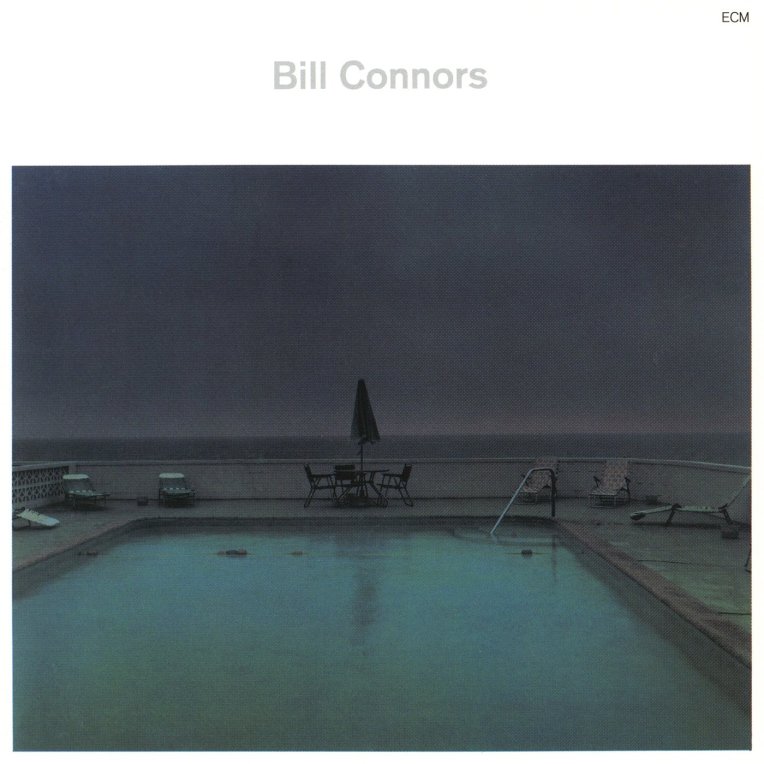
Bill Connors’s follow-up to his solo debut, Theme To The Guardian, is more than the latter’s other half; it is a deeper look inward. From the moment we step “Feet First” into this veritable sonic field, there is moonlight to be savored. It is a place where shadows open their arms to embrace other shadows. From the playful (“Frog Stroke”) to the plaintive (“Wade”), the inspirational (“Sing And Swim”) to the romantic (“Surrender To The Water”), Connors covers a travel diary’s worth of temporal terrain in 43 minutes. These qualities crumble like spring snow, each a reflection upon slightly disturbed surfaces. Other pieces, like “Survive” and “With Strings Attached,” lie somewhere between a wing’s beat and a song. All the more the appropriate, then, that we should end with “Breath,” expelling the very air that will condense into the lifeblood of the earth.

Every cell of Swimming… throbs with aquatic humility throughout its gallery of miniatures. Connors’s fingers are always in motion, transporting us to a place where rain never comes but where the sun is almost always hidden. Despite what the title might have you believe, there is no diving to be experienced in this album until you, fair listener, take the plunge.

<< Jack DeJohnette New Directions: In Europe (ECM 1157)
>> Steve Kuhn/Sheila Jordan Band: Playground (ECM 1159)

Jack DeJohnette New Directions: In Europe (ECM 1157)

ECM 1157

Jack DeJohnette New Directions
In Europe

Jack DeJohnette drums, piano
Lester Bowie trumpet
John Abercrombie guitar, mandolin guitar
Eddie Gomez bass
Recorded June 1979, Willisau, Switzerland
Engineer: Martin Wieland
Produced by Manfred Eicher

There is a moment in “Bayou Fever” when Jack DeJohnette, showing his adeptness at the keyboard, lapses into “America the Beautiful.” This brief quotation anchors the piece, making it all the more poignant for having appeared in this historic live set. This eighteen-and-a-half-minute juggernaut is as gentle as it is lengthy, and embodies well the lively spirit that infused the drummer’s New Directions project. With the introduction of Eddie Gomez on bass, we hear the call of vocation, the instinct that allows us to persevere through even the most trying circumstances, if only to taste the beauties of creation one more time. Six-stringer John Abercrombie weaves his fingers through the loom of reflection, adjusting the microscope until the dividing cells of Lester Bowie’s trumpet come clearly into focus. This quintessential chunk of tactile birth cycles through a chain of experiences, each the sum of another life before. Once DeJohnette reverts to his forte, he nurtures an inward-looking fluttering of sticks. Abercrombie matches with a fluttering of his own as his nimble hands leap across the fingerboard with an energy that seems to draw audible gasps of expectation from the audience, but which never quite materializes into the full rupture we might expect. One hears in this not hesitation, but rather a more subdued commitment to melodic integrity that praises the living effect of performance over its virtuosity.

It’s a far cry from the album’s opener, “Salsa For Eddie G.,” which begins in the mountains before sliding down their sunlit faces amid scintillating articulations from Abercrombie. With prime support on all sides, DeJohnette is free to move forward without ever looking back. No matter how exploratory he becomes at the skins, his foot keeps the hi-hat going steady, leaving crumbs of light on a dark and winding trail. “Where Or Wayne” begins quietly enough, but then strains a terse improvisatory energy through a fine mesh. The palpable charm throughout provokes laughter from musicians and audience alike. During this portion of the show, DeJohnette introduces the musicians, after which Bowie returns to the foreground and blows out the candle with a flourish of finality.

While the music on In Europe does stretch its very skin to the limits, especially in the trumpet, it manages never to injure itself irreparably. The closest we get to pure abandon is “Multo Spiliagio,” a free-for-fall which contorts its body through many acrobatic challenges. Yet even the most explosive moments are somehow delicately circumscribed. It is an exercise in maturity and critical thinking that ends in sheer delicacy.

This altogether respectable outing gives us a concerted taste of an unrepeatable period in musical history, a time in which the music world’s progress was being most clearly charted on the jazz stage. The concert is miked in such a way that the listener feels situated right between audience and band. We can almost imagine Bowie—this recording’s brightest star—roaming about the stage, projecting his cackling brilliance into every corner of the venue, and hopefully further onto the shelf of any lover of marvelous music.

<< Kenny Wheeler: around 6 (ECM 1156)
>> Bill Connors: Swimming With A Hole In My Body (ECM 1158)

Kenny Wheeler: around 6 (ECM 1156)

ECM 1156

Kenny Wheeler
around 6

Kenny Wheeler trumpet, fluegelhorn
Evan Parker soprano and tenor saxophones
Eje Thelin trombone
Tom van der Geld vibraharp
Jean-François Jenny-Clark double-bass
Edward Vesala drums
Recorded August 1979 at Tonstudio Bauer, Ludwigsburg
Engineer: Martin Wieland
Produced by Manfred Eicher

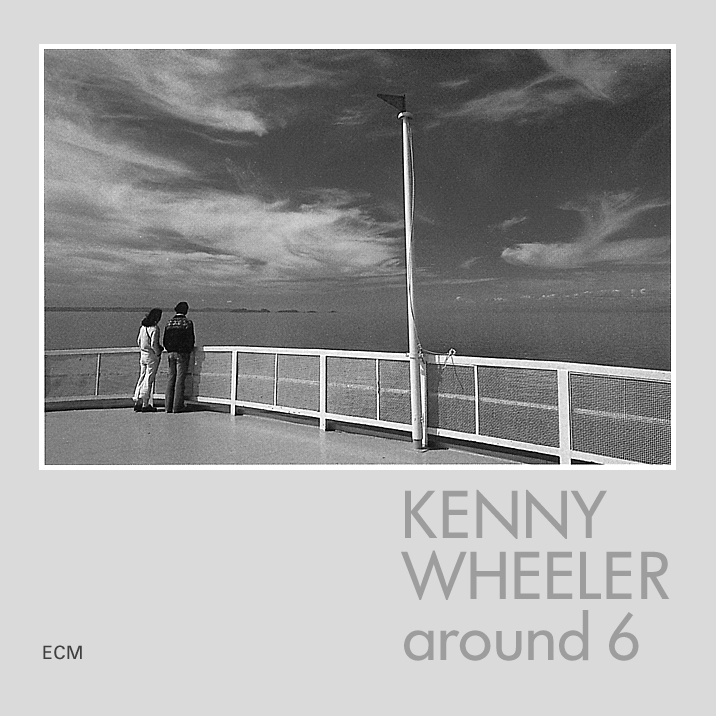
For his third ECM outing as leader, Kenny Wheeler offers up this set of six originals among some of the finest support ECM had to offer at recording time. The reed-work of Evan Parker in particular proves to be a prophetic addition to Wheeler’s rounded edges.

Like the wordplay of first cut (“Mai We Go Round”) the album as a whole is twice removed: once from the immediate expectations born of past projects, and once more from the often earthly shapes of those projects. This time around, Wheeler is happy to tiptoe over the clouds, reaching for the sun that illuminates their cauliflower topsides. A pliant intro urges us down the rhythmic paths of Jean-François Jenny-Clark (bass) and Tom van der Geld (vibes), along which Wheeler crafts the tenderest of songs. At heart a lullaby, it is lively on the surface, so that we always remain half awake, our eyes glazed by an interest in the musical moment. All of this stretches a diffuse canvas across which Parker splashes the enchanting wisdom of an aurora borealis in fast forward. After this dip into limpid waters, Wheeler breaks out the gorgeous ”Solo One.” Floating on a studio echo with great care, his tone is tender yet immovable, and moves like a human body after an epic recovery. “May Ride” lays another solid foundation between bass and vibes and the subterranean patter of Edward Vesala on drums. Wheeler stays fairly centered, letting out the occasional squeal, and sets up a fantastic solo—one of the album’s best—from trombonist Eje Thelin. After a few doodles from the horns, “Follow Down” unfolds in a parabolic blade, thereby tilling a nutrient-rich soil for Parker’s brilliance. Vibes curl their reverberant fingers alluringly along the edge of our attention before horns and arco bass fall into line. A splash of water dispels our reveries in the propulsive “Riverrun.” Wheeler and Thelin swing from every branch with an unwavering sense of play, granting Vesala a few moments in the spotlight before ending tenderly, conservatively, with the ballad “Lost Woltz.”

A lush and consistent album, around 6 takes on a life of its own with every listen, and deserves a place in any self-respecting jazz collection.

<< Pat Metheny Group: American Garage (ECM 1155)
>> Jack DeJohnette New Directions: In Europe (ECM 1157)

Old And New Dreams: s/t (ECM 1154)

ECM 1154

Old And New Dreams

Don Cherry trumpet, piano
Dewey Redman tenor saxophone, musette
Charlie Haden bass
Ed Blackwell drums
Recorded August 1979 at Talent Studio, Oslo
Engineer: Jan Erik Kongshaug
Produced by Manfred Eicher

Hot on the heels of Old Friends, New Friends comes Old And New Dreams, an operation meant as a new flagship for Ornette Coleman, whose lack of enthusiasm for the project left a gap duly filled by Dewey Redman. The result is this delightful excursion into post-bop outlands that sounds as alive as ever. Two Coleman pieces comprise nearly half of its duration—which is saying much, for like many of ECM’s joints of the 70s, this one breezes by in under 50 minutes. The first Coleman piece, “Lonely Woman,” walks the tightrope stretched by Haden, who hugs the solo spotlight after a string of progressive fadeouts in this otherwise drum- and horn-heavy opener. Redman and Cherry elicit a peculiar distance in their playing, speaking in tongues from beyond a wall of silence. The second is the more upbeat “Open Or Close.” Its buoyant drumming and unhinged horn soloing do nothing to obscure Haden’s brilliance as he kick-starts his usual pensiveness into overdrive. Not to be outdone, Blackwell whips his snare into a froth before the group reconvenes.

With these territories covered, each band member completes the experience with one tune apiece. Blackwell’s “Togo” is a prime vehicle for Cherry, as is the latter’s own “Guinea.” The music here is reflective of the long journey that had led Cherry from the limelight into political protest and back into ECM’s fold. We hear this in his biting themes and pianistic wanderlust. Redman breaks out the musette (or suona, a Chinese shawm) for his “Orbit Of La-Ba,” a mystical detour into sere grooves. “Song For The Whales,” courtesy of Haden, is the last piece of the puzzle, and shows the bassist in a more experimental mode. Even as he glides along his harmonic slides like some large creaking vessel that is part cosmic ship and part bird, we are held firmly into place. Drums and horns tremble like the very gut of the earth letting its voice be known.

This is a superb album, and regardless of whether these dreams are old or new, they never seem to fade. What makes it so strong is its careful balance of sidewinding monologues and the sense of direction that a full band sound brings. One craves that sound throughout and the expectation it manifests, so that when it comes in such thick doses, it heightens our involvement in the listening. It acknowledges us.

<< Ralph Towner: Old Friends, New Friends (ECM 1153)
>> Pat Metheny Group: American Garage (ECM 1155)

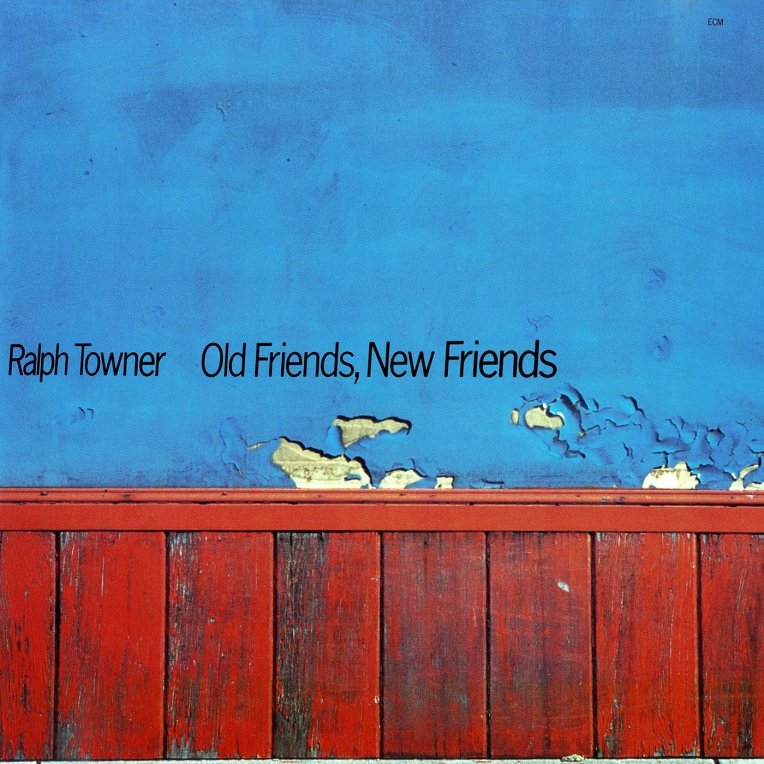
Ralph Towner: Old Friends, New Friends (ECM 1153)

ECM 1153

Ralph Towner
Old Friends, New Friends

Ralph Towner 12-string and classical guitars, piano, French horn
Kenny Wheeler trumpet, fluegelhorn
Eddie Gomez bass
Michael DiPasqua drums, percussion
David Darling cello
Recorded July 1979 at Talent Studio, Oslo
Engineer: Jan Erik Kongshaug
Produced by Manfred Eicher

This set of six extended pieces—each penned by Ralph Towner—is like the flipside of his classic Solstice. From the moment we step into its sound-world with the resplendent 12-string of “New Moon,” we know this will be a path from which we may never wish to stray. Towner’s unexpected French horn adds shading and depth to his already gossamer billows, leaving the fluegelhorn of Kenny Wheeler to snake through Michael DiPasqua’s lucid drumming as the unmistakable cello stylings of David Darling arise from the depths of our expectations. Darling, a personal favorite among ECM-represented artists, proves to be a welcome, if nearly ineffable, presence. One hears shades of his classic Darkwood unfolding like a meandering dream in “Yesterday And Long Ago,” while “Beneath An Evening Sky” weaves twelve strings through six over his ornamental crosshatchings.

Not unlike the album as a whole, “Celeste” forges an uplifting sort of melancholy, heard in Towner’s heartwarming pianism and in Wheeler’s boldly sketched lines. Moments of sheer majesty quickly succumb to underlying reveries, awaiting the “Special Delivery” of Eddie Gomez’s vocally infused commentary. This leaves only “Kupala,” which shows off Towner’s fine muting technique, brushed drums adding a touch of age. Running his fingernails along the edge of this sonic quarter, Towner opens the floor to a magic that only the listener can supply.

I know it’s nothing new to say, but albums like this always put me in awe of jazz, an art form in which a musician can surrender oneself so freely to the musical moment and yet just as easily anchor oneself in explicitly composed material. Likewise, Towner’s music, and especially that collected here, is something into which one can read experiences that are at once rooted in the physical world and firmly bound to a realm where physicality is a myth. Like its own mythology, it is creation and dissolution made one. It ends in a slow fall, laying itself down like a flower upon its own grave.

<< Jack DeJohnette: Special Edition (ECM 1152)
>> Old And New Dreams: s/t (ECM 1154)