Hans Otte: Das Buch der Klänge (ECM New Series 1659)

Hans Otte
Das Buch der Klänge

Herbert Henck piano
Recorded September 1997, Festeburgkirche, Frankfurt am Main
Engineer: Markus Heiland
Produced by Manfred Eicher

“It is an old dream of mine that the nature of sounds is discovered and that they are not used in order to express something else.”
–Hans Otte

Hans Otte (1926-2007) was a German composer, pianist, and sound installation artist. A student of Paul Hindemith, he came to see the role of sound as a phenomenon in its own right, and seems to have treated his piano music as a crucible in which musical lexicons might be boiled down to their essential vocabularies.

Herbert Henck offers up this sweeping interpretation of Otte’s twelve-part masterwork, Das Buch der Klänge (The Book of Sounds), as a stunning example of what piano music can grow into when loosed from its binds and allowed to breathe of its own volition. The cycle was three years in the making, and exudes gentle and attentive care. Part I is remarkably consonant, seesawing between the same two chords while alternating with more quickly syncopated passages. From these first moments we get the sense of travel that comes to characterize the trajectory to follow. There is also a nostalgic air that one finds in many of John Adams’s earlier compositions (and especially in Phrygian Gates). Part II undulates in cascades, from which single notes call out with assurance and clarity. Part III returns us to the journey, its slowly applied chords pressing like footsteps into the soil. Part IV erupts in dramatic cloudbursts, bleeding into Part V, in which the same chords are deployed with more urgency. The piano sings here, knitting between its open strings the makings of a vocal tract. Part VI is a linear melody, each note dotting the darkness with a distant galaxy. Part VII is one of the most spiritual sections of the piece, and is like the ostinato of a more expansive composition that never develops into a lead line, but rather looks inward via more pinpointed notes within arpeggiated clusters. In dispensing with the imagined right hand, the music speaks for itself, as if to untie the binds of its inner heart so that each note may flow freely through its ventricles. Part VIII marks the return of cautious footsteps. This is the frustration of travel, the annoyances, delays, and logistic disconnects that are inevitable when experiencing any new culture, however adored. Part IX at last offers some reprieve, giving itself over into rest. It is the time of reflection, when the return seems all too imminent and the lessons learned have hardly had time to take root, and we come to realize that those moments of misunderstanding are the ones we cherish the most. Part X shines like the dawn. Only now do we realize this landscape may be forever lost to us, so we glory in every flaw and perfection alike while we still can, in the hopes of carrying it inside us when we leave. Throughout Part XII, one hears a little Satie peeking through in the finality of its playful departure. It is the quiet checkered landscape below on the return flight, the silent coastline receding behind the ship, the cloud of dust churning behind the bus, the slowly waving hand left behind at the train station. All such moments are brought to bear in Otte’s Buch, so that all we have left is this audible postcard on the back of which Henck has inscribed as much as could possibly fit in such a limited space. But the real beauty of this recording is that, as a tangible object, it can be held, turned in the hands, admired for its cover art, intellectually fed upon through its liner notes, and the journey repeated at any moment one wishes. It is music like this that reminds us of the pleasurable luxury of recordings and their didactic effect. They transport us to unseen locations, or conversely reconstruct those locations stone by stone in our very minds without us having to lift a finger. Most importantly, they allow us to appreciate the very real experiences we have in our own travels, and in doing so give us the gift of hindsight, reminding us of how memory shapes who we are.

Considering Henck’s often-eclectic approach, I was both surprised and reassured by his championing of Otte. Although Henck has always chosen fascinating material, the reductive power of this music is nothing short of revelatory. These sounds speak directly to the heart and feel as if they grew out of solitary nocturnal improvisations. Notions of minimalism are easily vanquished with a careful listen, which reveals a wealth of subtle details and variations peppered throughout. Through the infliction of its uneven terrain, the joys of arrival and the memories that linger once the destination has been found become one and the same. Henck plays with grace and fortitude, making explicit use of the sustain pedal and the instrument’s own internal space. This is music that looks simple on paper, but requires personal commitment to articulation, speed, timing, and volume. Thus, it becomes a magnifying glass into the musician’s, and the listener’s, sense of being. By far one of ECM’s finest achievements.

<< The Hilliard Ensemble: Lassus (ECM 1658 NS)
>> Mats Edén: Milvus (ECM 1660
)

Barry Guy: Folio (ECM New Series 1931)


Barry Guy
Folio

Maya Homburger baroque violin
Muriel Cantoreggi violin
Barry Guy double-bass
Münchener Kammerorchester
Christoph Poppen conductor
Recorded February 2005, Himmelfahrtskirche, München
Engineer: Peter Laenger
Produced by Manfred Eicher

Over the years, ECM New Series listeners will have variously encountered Barry Guy as composer, performer, and improviser. In Folio, we get to experience all three. I have always found his improvisatory role to be the most compelling, for it stirs my heart with communicative possibilities. And so, in the spirit of living in the moment, I share this review verbatim, as I dictated it while listening:

“Barry Guy is very much concerned with the internal, the biological nature of music. The seemingly sourceless energy it evokes through human contact enables us to question our own energy: whether it is divinely given or naturally ordained. While his epic explorations of thematic material by Diego Ortiz betray a more honed compositional reach, Guy still inhales the oxygen of indeterminacy. This music functions very much like memory: when one focuses on one memory, others try to creep in, sometimes courting unwanted associations, secrets we would rather not acknowledge…. Even at its most dynamic moments, this music is all about gentility and caution—not as a sign of fear…but as a way of life, a philosophy. The improvised ‘commentaries’ peppered throughout add a rich sense of bulk to the album’s presence…but one shouldn’t think they are any less substantial, for they wouldn’t be what they are without their source texts. They give the musicians a crisp field in which to ponder the emotional implications of what they have just played…to share those feelings with the listener rather than covet them unceremoniously. The ‘Folio’ pieces are richer in orchestral texture. They tap into a broader sensibility of the music’s own potential while also burying the possible egotism of the solo artist…in a lush balance of restraint and emotional surrender. Guy uses gimmicks briefly and wisely, and is never afraid to stutter. This is music that never edits itself. The commentaries are immediate responses. They do not simply act as arbitrary filler material, but rather speak to the lingering effects…grasping on to those effects before they fade out of sight and out of mind. And so, I think this is why Track 13 is called ‘Memory,’ for what is commentary but solidified memory shared with others…? And similarly, what is a review but a memory…a conscious chronicling of an experience that can never be recaptured, but only inadequately preserved in one person’s thought. For rather than a simple memory, I should like to share a record of my experience. This track also speaks to me in the same way we often search through our memories for an originating thought. Oftentimes, especially as we are going to sleep, we let our minds wander, only to backtrack, looking for that one sound or image or word or impression that launched our mental exploration…and this is perhaps what we stumble into in ‘Ortiz II,’ which in some way charts the frustration of our psychological imperfections, while also exploiting those imperfections to audible effect. This is an altogether intriguing album, which is always greater than the some of its parts, as it allows for the listener’s own reflection and for the compositional nature of personality to run amok, or slumber as it may, in pockets of empty space.”

Food: Quiet Inlet (ECM 2163)

Food
Quiet Inlet

Thomas Strønen drums, live-electronics
Iain Ballamy tenor and soprano saxophones
Nils Petter Molvær trumpet, electronics
Christian Fennesz guitar, electronics
Recorded live in Norway, 2007/08
Produced by Food and Manfred Eicher

The earth is very still, like an infant asleep. Into a quiet inlet, a streamlet is falling. It is singing to the sleeping earth, telling it of the days to come when the great silence shall be broken by the voice of man, and life shall fill alike the darkling wave and the sunlit field.
–T. A. Rickard, “A Story in Stone”

Considering the distinct lyrical path Food has been forging since 1998, it was perhaps only a matter of time before the group would migrate into ECM territory. The guest appearance of Nils Petter Molvær is therefore a no-brainer. Fans of Molvær’s work will feel like they are slowly falling into the Norwegian trumpeter’s waking dreams. The results are an undeniably unique blend of nu jazz sensibilities and ritual melodic power.

“Tobiko” opens with metallic percussion against a cascade of synths and muted beats. A radio dial is tuned, reaching through the airwaves as if for a familiar voice to latch onto. Only then does Ballamy’s sax rise to the surface of this oceanic passage: if our ears are vessels, then here is the dolphin swimming silently alongside them. Before long, live drums make their presence known and lead us out of the fog. Having shown us the way, our guides then recede into the darkness, where light and sonar dare not venture. “Chimaera” is a gentler number. Sax lines continue their passage as percussion and electronics cocoon them with deep thematic threads, free-flowing and heavenly. “Mictyris” is distinguished by Strønen’s intense rhythmic drive, over which we encounter some fantastic electronics that sound as if a sax were being torn apart and rebuilt as a train whistle. Tight drumming, combined with the protracted ambient wash in the background, meshes wonderfully with Ballamy’s constellate reed work. “Becalmed” builds itself around a repetitive leads motif, its aftereffects ever ghostly and omnipresent. Whether intentional or not, this track also contains oblique references to Eleni Karaindrou’s “Parade” from the film Happy Homecoming, Comrade. “Cirrina” and “Dweller” both flow with Molvaer’s distinct sound, seeming to revel in their grace and liberation from formulaic constraints, while “Fathom” ends the album bittersweetly, as if the music were looking into a mirror, unsure of what it sees.

The electro-acoustic sound honed on Quiet Inlet works wonders at every turn. And on that note, it’s inspiring to see a wonderful artist like Fennesz crossing over into the ECM circuit. Let’s hope this is a sign of things to come.

(To hear samples of Quiet Inlet, click here.)

Werner Bärtschi: W.A. Mozart/G. Scelsi/A. Pärt/F. Busoni/W. Bärtschi (ECM New Series 1377)


W.A. Mozart/G. Scelsi/A. Pärt/F. Busoni/W. Bärtschi

Werner Bärtschi piano
Recorded July 1988 at Kirche Blumenstein, Switzerland
Engineer: Andreas Neubronner
Produced by Manfred Eicher

In this ECM debut, Swiss pianist Werner Bärtschi offers up an intriguing and carefully conceived program. Having studied with Klaus Huber and Rudolf Kelterborn, Bärtschi brings a decidedly compositional attention to his playing that lends itself well to the material at hand. He begins with Mozart’s C minor Fantasie (1785), which, as the longest piece, reads like a single human life. It is not a simple reimagining of the past but a reliving of it, for to play the piano is to articulate a biography in sound, using the body in imitation of what bore those same feelings in “real time.” After such a piece, the Four Illustrations on the Metamorphoses of Vishnu (1953) by Scelsi may seem like a startling transition. Yet humble quartet presents us with a rare programmatic gesture from the Italian, whose microscopic approach actually balances out Mozart’s broader strokes and veils the turmoil of mortality behind the surface of the spirit made flesh. Bärtshi surprises us yet again with Arvo Pärt’s Für Alina. This early 1976 version is like a dream we question upon waking: Did we really hear it, or did the music rise in our minds out of an unspoken memory? And so, when we next encounter Mozart in the 1788 B minor Adagio, we hear him with fresh ears and open hearts. Rather that scoping out the Mozartean influence in the surrounding works, we see the latter funneling into the former. Bärtschi follows with a piece of his own, Frühmorgens am Daubensee (1986/88), realized during an early morning hike in the mountains surrounding the eponymous lake. In it we hear snatches of something upon the wind, distant conversations, activities, worldly movements, the beginning of an avalanche that never quite forms. This salves us nicely for the relative onslaught of Busoni’s 1921 Toccata, a masterful yet demanding unfolding of theme and counterpoint. After such a towering cascade of notes, Mozart’s B major Sonata (1783) is like a gentle return, a pair of hands lowering us slowly to the earth, leaving us to slumber in a blanket of solid ground.

Hans-Klaus Jungheinrich provides a beautifully conceived essay which, despite risking an overuse of the word “oriental” (it appears no less than five times in the liner notes), makes a viable case for Bärtschi’s musical choices as being firmly rooted in the spirit of magic and fantasy that engenders the program as a whole. Where Jungheinrich characterizes this as a piano recital of “Mozart and…,” I would go a step further and say it is equal parts “…and Mozart.” yet although Mozart bookends the recital and inhabits its fulcrum, his infrastructural presence is no more significant than the validation of the superstructure. As such, the continuity between these pieces is a narrative rather than formal concern—not a linear continuity, but one in which the potential for speech is equally present at every stage.

<< Dino Saluzzi: Andina (ECM 1375)
>> Heinz Reber: MNAOMAI, MNOMAI (ECM 1378 NS)

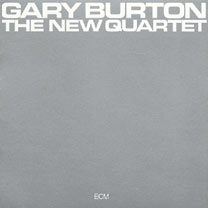
Gary Burton: The New Quartet (ECM 1030)

1030 X

Gary Burton
The New Quartet

Gary Burton vibraphone
Mick Goodrick guitar
Abraham Laboriel bass
Harry Blazer drums
Recorded March 5/6, 1973 at Aengus Studios, Fayville, Massachusetts
Engineer: John Nagy
Produced by Manfred Eicher

One needs only to catch the first few licks of “Open Your Eyes, You Can Fly” to know this album represents an era that can never be recaptured. Burton does wonders with the Chick Corea tune, lifting its upbeat soul to the greatest heights of creative pleasure. One can almost taste the freshness of his sound, the sheer newness of vision and synergy of musicianship ingrained into every moment of this phenomenal record. This was another early disc that managed to fall under my radar until I sought to review it. Burton is always a supreme joy to listen to, and with this, his second ECM appearance, he certainly made a profound statement. Burton himself contributes one composition, the enchanting “Brownout,” which takes full advantage of the rhythmic precision of his backing trio for a deft volley of restraint and abandon. Two Gordon Beck tunes provide the most robust flavors in this thickening stew, balancing the smooth full-ensemble nosh of “Tying Up Loose Ends” with the infectious full course of blistering key changes and nimble flair that is “Mallet Man,” the album’s centerpiece. The ballads are haunting and moody. “Coral” (Keith Jarrett) proves just how soulful vibes can be, while “Olhos De Gato” (Carla Bley), with its seedy undercurrent and humid climate, slinks like its namesake, stalking the edges of the night. Two Mike Gibbs tunes, “Four Or Less” and “Nonsequence,” round out the set on a more playful note, making dramatic use of pauses and a wider variety of textures.

Gary Burton is synonymous with the vibes. And while I had long been one of countless admirers of his technical and melodic acuity, this album was nothing short of a revelation for me. The technique is flawless all around and glistens with Burton’s Midas touch. He contacts his instrument like fingers walking up a spine, never missing a single nerve along the way. Yet one cannot commend this album without also praising Goodrick’s phenomenal guitar work, Laboriel’s quick-witted ornaments, Blazer’s unrelenting dedication to the moment, and the astounding unity the ensemble as a whole manages to uphold. The overall balance comes across as joyously democratic, and all with a fresh-off-the-boat sound that surprises at every turn. There isn’t a single errant note, gesture, or idea to be found on The New Quartet. From start to finish, an inimitable achievement.

<< Garbarek/Andersen/Vesala: Triptykon (ECM 1029)
>> Terje Rypdal: What Comes After (ECM 1031)

Marilyn Crispell/David Rothenberg: One Dark Night I Left My Silent House (ECM 2089)


One Dark Night I Left My Silent House

Marilyn Crispell piano, soundboard, percussion
David Rothenberg bass clarinet, clarinet
Recorded March 2008 by Chris Andersen at Nevessa Production, Woodstock
Produced by Marilyn Crispell and David Rothenberg

In the dark I the bird can pretend, in light I am overdoing it,
pretending to be what I’m not, like art, like imagination.
–David Rothenberg, Always the Mountains

Having only been familiar with David Rothenberg through my own interest in animal studies, which had already led me to his unique book Why Birds Sing, imagine my delight when his name showed up on the latest release from my favorite label—and alongside one of its most singular talents, no less. His meditative improvisations with Marilyn Crispell have produced one of the most delightful surprises of 2010.

This album is fluid yet abstract, often devoid of melodic traction, but is bound by a certain poignancy that I find utterly engaging. Take, for example, “Stay, Stray,” which begins with airy chords but quickly turns introspective, even regretful, but is nevertheless boldly committed to its indeterminate purpose. Goal-oriented is what this music most certainly is not. Rather, it surrenders to the dynamics of the moment, to the gravity of performance, and to the possibilities of material interaction. In the latter vein, a number of tracks feature Crispell playing an old upright piano soundboard, from which she elicits a playful metallic accompaniment. It is part of her attempt, in Rothenberg’s words, to “get away from the keyboard, more into the realm of pure sound.” In tracks like “Still Life With Woodpeckers,” these sounds are blatantly foregrounded, while in others they linger like ghosts. “The Way Of The Pure Sound (for Joe Maneri)” begins with low-blown notes, sounding almost like a didgeridoo, and walks its line faithfully over Crispell’s exploratory ruminations on the very innards of her chosen instrument. “Tsering” lies somewhere between the two, featuring strings plucked with the fingertips and a few carefully placed notes on the keyboard proper. The unspoken communication between the two musicians is always clear, especially in “What Birds Sing,” “Companion: Silence,” and “Owl Moon.” Even in the more adventurous moments found in “The Hawk And The Mouse,” “Motmot,” “Grosbeak,” and “Snow Suddenly Stopping Without Notice” maintain a mutual delicacy that binds them as a whole. And it’s hard not to be won over by the frailty of “Evocation,” which sets the album adrift on a most dreamlike reverie.

Despite the nocturnal imagery implied by its title and cover art, One Dark Night fills my imagination with summer. The opening “Invocation” in particular drips like molasses in sunlight, evoking a hot and humid environment, somewhere rich in agriculture. The piano is like a planted seed, resting quietly in the soil, and the clarinet its first shoots, caressed by the wind, fed by the rain, and pulled from silence by the unblinking eye of the sun. Rothenberg always seems to be putting on a severe frown, like that of a tragedy mask—which is to say his sound is carefully sculpted and symbolic of a long dramatic history. His approach is rooted in nature and survival and rests comfortably on the organic foundation Crispell so lovingly provides. Both of them seem to grasp every ribbon of sound and to blindly follow wherever it might lead. If anywhere, this is where the darkness comes in, forging through that blindness a light of one’s own making, a certain sense of being that is internally of the night, even as it basks in the nourishing glare of its harvest. This may not be the most versatile music, but I think for the right mood and occasion it captures something that cannot be expressed any other way.

Ensemble Belcanto: Come un’ombra di luna (ECM New Series 1739)

Come un’ombra di luna

Ensemble Belcanto
Dietburg Spohr mezzosoprano, director
Birgitta Zehetner mezzosoprano
Andrea Baader soprano
Rita Huber soprano
Dzuna Kalnina alto
Rica Rauch alto
Recorded January 2000 at Festeburgkirche, Frankfurt am Main
Engineer: Markus Heiland
Produced by Manfred Eicher

I have at home a blue piano
and yet know no note.
–Else Lasker-Schüler

My first encounter with Ensemble Belcanto was on an extraordinary recording of Klaus Hinrich Stahmer’s Hommage à Daidalos on the ProViva label, which combined Belcanto’s rich voices with the sound sculptures of Elmar Daucher (whose resonating stones also found their way into ECM via Stephan Micus’s The Music Of Stones). The ensemble was formed in 1986 by mezzo-soprano Dietburg Spohr as a springboard for new music activity and has since honed its skills in a variety of percussion instruments. The ensemble’s depth of performance is clearly seen in Haim Alexander’s Mein Blaues Klavier (1989-90), a setting of four poems by Else Lasker-Schüler. Although the piece inhabits a tight chromatic range that steps just beyond one octave, the singers manage to expand its borders through a wealth of gingerly applied drums, gongs, triangles, and other accentuating paraphernalia. The ritualistic arrangements lend the voices a flavor of incantation, each word seeming to bring about a discernible change in the music’s countenance. Mein Blaues Klavier is severely analytical without being clinical, especially in its final section, in which repetitive clangs probe deeper into self-inflicted wounds.

This is followed by two a cappella settings. The first, Konrad Boehmer’s Un Monde Abandonné Des Facteurs (1996), is a wavering slog through its text. The composer’s Darmstadt School roots are on full display, voices bristling with his teacher Stockhausen’s same penchant for the instability of the utterance. The 1997 title composition comes from Fabrizio Casti. His is a haunting weave of darkness and light that burns like the calls of sirens in one’s head.

We close with Wolfgang Rihm’s Séraphin – Stimmen (1996), a magnificent cartographical exploration of wordless territories. It is the most minimal piece on the album, and all the deeper for it. Rihm’s use of percussion is most adept, and seems to be directly influenced by Noh theatre, where a single wood clap can accentuate an emphatic syllable, and where the beat of a drum can synchronize an action or gesture, infusing it with intense programmatic effect. Also like Noh, the piece makes the most of silence and its implied sense of movement. And in fact, the entire album has the feeling of something staged, inhaling and exhaling through its dramaturgy.

While every voice here is superb, Spohr’s stands out for its technical breadth and for possessing one of the most engaging vibratos I have ever heard. The ensemble as a whole shapes every syllable with strict attention, elongating certain syllables and severely shortening others. Such textual detail is always such a pleasure to hear, for rather than trying to fit a text into a predetermined musical structure, Spohr and her companions adapt their sound to emergent vocal surroundings. Again, this speaks to an explicit root in drama, for ultimately these pieces are like plays of the mind, populated by characters of one’s own making.

<< Michael Mantler: Hide and Seek (ECM 1738)
>> Bobo Stenson Trio: Serenity (
ECM 1740/41)

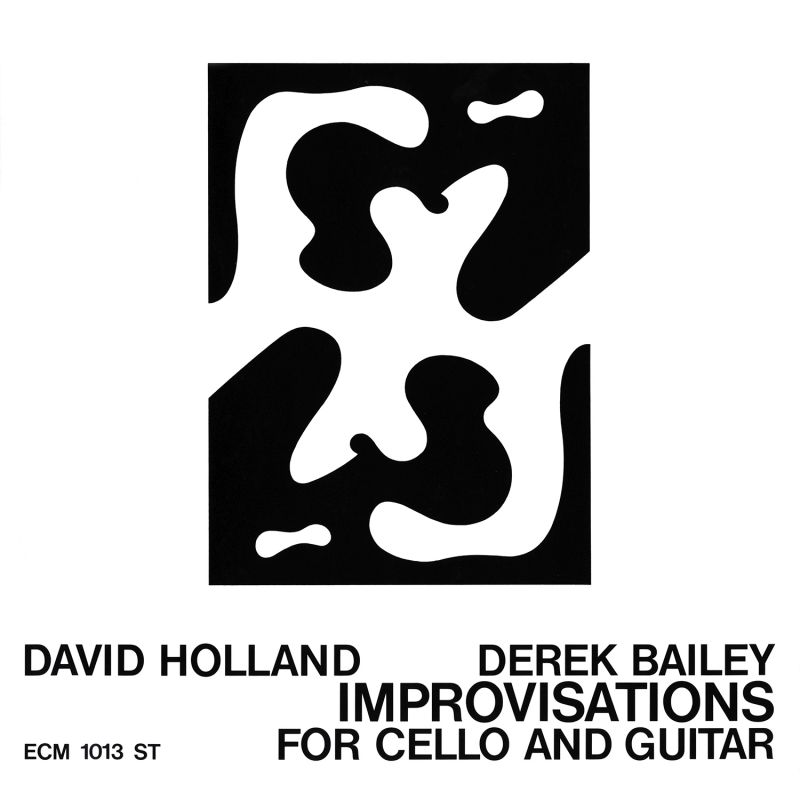
Dave Holland/Derek Bailey: Improvisations for Cello and Guitar (ECM 1013)

1013

Improvisations for Cello and Guitar

Dave Holland cello
Derek Bailey guitar
Recorded live at the Little Theater Club, London, January 1971
Release date: October 15, 1971

One’s not half two. Its two are halves of one… All lose, whole find.
–e. e. cummings

If you’ve ever picked up a guitar and played those short strings between the end of the neck and the pegs and wondered if one could make viable music with that kind of sound, then look no further, for that is precisely the pinpoint aesthetic captured on this rare recording. These improvisations are miniscule and entomological, whispering with the nocturnal regularity of a cricket. Holland and Bailey shift from pops and plucks to more sustained tones at the drop of a hat, but always with an ear keenly tuned to the other player. The two take full advantage of extended techniques to create a wide palette of sounds. These are delicate pieces, but no less full of verve and character for their utter precision. Sometimes the music is incredibly expansive. Other times it seems to implode, by turns galactic and subterranean. Because both musicians are so skillful at what they do, one can truly appreciate the spontaneous dynamics of their playing, the ways in which they react and prompt each other into action. They are never afraid to take separate paths, for they always seem to rejoin, and in doing so they add seemingly endless variety as the energy flows and ebbs. It’s always fascinating to hear Dave Holland’s earlier work, and this meeting with Bailey is certainly an archival treat.

<< Stenson/Anderson/Christensen: Underwear (ECM 1012)
>> Chick Corea: Piano Improvisations Vol. 1 (ECM 1014)

Adelhard Roidinger: Schattseite (ECM 1221)

ECM 1221

Adelhard Roidinger
Schattseite

Adelhard Roidinger bass
Heinz Sauer tenor saxophone
Bob Degen piano
Harry Pepl guitar
Werner Pirchner vibraharp, marimba
Aina Kemanis voice
Michael DiPasqua drums, percussion
Recorded November 1981 at Tonstudio Bauer, Ludwigsburg
Engineer: Martin Wieland
Produced by Manfred Eicher

It’s unfortunate that Adelhard Roidinger only cut this one record for ECM. The Austrian-born Renaissance man seems to have been a perfect fit for the label, which by the time of this release (1982) had firmly established its aesthetic hold on the jazz market. Schattseite has a lush, airy sound that is always appealing, and what better way to draw us in than with the slow-moving “Fü Pfü.” The soloing is crisp all around: gorgeous vibe work from Pirchner, Pepl’s soft guitar licks, DiPasqua’s tender drumming, a fluid run from Sauer on tenor sax, and an alluringly pianistic turn from Degen all make for a crystalline opener, and Roidinger’s plaintive accompaniment pulls it all together with humility. There is much stopping and starting, as if the music were afraid to latch on to a memory it knows could be self-destructive. Next is “Lufti,” a delightfully overdubbed bass duet, interrupted by occasional glissandi for a playful effect. “Loveland” fades in on a sweet piano riff doubled by Aina Kemanis’s brassy vocals, evoking the distinctive sound originally forged on Return to Forever. Roidinger harmonizes with the lead motif, blending into another mercurial leap from Pirchner, this time on marimba, supported by a delicate repeat of the same progression sans voice. The fantastic sax solo and Metheny-esque picking lend even more elegance to the track’s progressive sound. “Stress” begins with a bowed electric bass, caressing the air like whale songs. Sauer introduces the main line, again doubled by Kemanis, before Roidinger steps in to offer some regularity, thereby allowing Deger more room to flex his fingers. “Ania” starts with laughter, or something like it. Out of this abstract pointillism comes an engaging chant, throughout which Pepl jauntily strums his way along. The album closes with its longest track, “When Earth Becomes Desert,” which steadily moves from haunting drones to an all-out improv-fest. The marimba is unusually present here, and I wouldn’t be surprised if it was miked differently, if not added in postproduction. The final minute brings us slowly back down with a gorgeous melody in tutti.

Although Schattseite does take a while to find its groove, whatever it may lack in drive it makes up for in atmosphere and melodic robustness. This is an album of exceptional sound and quality, and is like the audio equivalent of a scenic route: it may get you to the same destination, maybe even less efficiently, but its allure is such that by the time you near the end, you no longer care where you were going. In dire need of a reissue.

<< Mike Nock: Ondas (ECM 1220)
>> Paul Motian Band: Psalm (ECM 1222)