Arvo Pärt: Arbos (ECM New Series 1325)

Arvo Pärt
Arbos

The Hilliard Ensemble
David James countertenor
Rogers Covey-Crump tenor
John Potter tenor
Gordon Jones baritone
Christopher Bowers-Broadbent organ
Gidon Kremer violin
Vladimir Mendelssohn viola
Thomas Demenga cello
Brass Ensemble Staatsorchester Stuttgart
Dennis Russell Davies conductor
Arbos, An den Wassern zu Babel, Pari Intervallo, De Profundis, and Summa recorded March/August 1986, Karlshöhe, Ludwigsburg
Engineer: Martin Wieland (Tonstudio Bauer, Ludwigsburg)
Stabat MaterEs sang vor langen Jahren recorded January 1987 at St. John’s Church, London
Engineers: Peter Laenger and Andreas Neubronner (Südwest Tonstudio, Stuttgart)
Produced by Manfred Eicher

The music of Arvo Pärt, says Wilfred Mellers in his liner notes, is “concerned with the numinous”; as direct a statement as one can make about the sounds contained in this relatively neglected disc, overshadowed as it often is by the popularity of Te Deum and Tabula Rasa. For those new to Pärt, the wide selection represented in Arbos makes a solid primer. From the succinct to the majestic, the listener is treated to a carefully programmed process of transformation, culminating in one of the great masterpieces of modern choral literature.

The journey begins with the title piece, a terse blast of energy scored for brass and percussion. While cacophonous and chromatic, it is also perpetual and dark, providing the core for the “Dies irae” of Pärt’s later Miserere. On its own, it swirls into a self-sustaining galaxy that becomes more ordered with distance.

An den Wassern zu Babel saßen wir und weinten renders the well-known “By the rivers of Babylon” passage from Psalm 137 in a series of lilting triads, alternating between men’s and women’s voices. Here and elsewhere throughout the album one encounters the essence of the composer’s “tintinnabuli” style. Sustained tones from organ thread a line of subdued vocal beads, reaching ever higher, only to fall like kites whose strings are cut.

Pari Intervallo provides respite from denser surroundings. Comprised of gravid lead tones resting on a blanket of softer commentary, it is a funereal postlude, waiting and watching as the end draws near, promising not cessation but new life in its reverberant heart. It is a sublime meditation on the meaning of divinity and the divinity of meaning, a soul left unscripted by the wayside, where it can be captured neither on paper nor in sound. And yet, here we find an attempt to sketch its contours against our better judgment, against our feelings of inadequacy, against our assumptions of complexity in all things spiritual. In this piece we find the fibers that bound the garments of Christ on the cross, the creaking of knees of those who knelt at his feet. Pari Intervallo shimmers like heat distortion, moving with the force of a slow tide before receding into a still sea.

This is followed by Pärt’s stunning De Profundis, which also makes an appearance in the Miserere, if augmented by a broader choral palette. Different also here is the recording, which is less spacious (the bass drum, for one, is far more present). The voices are allowed to luxuriate in their own fallibility, in that beauty of impermanence that makes them human. In exposing its fragility so readily, the music becomes resilient. An organ provides the waters upon which this vessel of music floats, while a gong adds a dual note of ceremony. Whereas this piece brings us to the end in Miserere, as a standalone composition it seems to suggest a beginning.

Es sang vor langen Jahren sets a German poem (text and translation available here) by Clemens Brentano (1778-1842) for alto, violin, and viola. Alto Susan Bickley weaves a delicate song in this bare setting. Her tone is rich, as if residing somewhere in the back of her throat, heard before it is seen. The strings are like a lectern upon which the poetry rests, its pages bronzed with age.

Next is Summa in its original choral version. It is the quintessential Pärt composition: balanced, lush with triadic splendor, and concise. Along with Fratres in its many guises, Summa is a red thread in Pärt’s oeuvre and shines in this heartfelt performance.

This is followed by a curious reprise of Arbos that may divide listeners. Either way, it startles us from our reverie before pushing us into another.

At last we come to the highlight of an already fine disc: the 1985 Stabat Mater for 3 voices and string trio. The downward movement of its opening strings presents us with a unique metaphorical inversion. Where many a Stabat Mater works toward transcendence in its mourning, here we are brought from Heaven to Earth, even as we know that we must look from the latter to the former. The voices are the Trinity in a single open Ah, as if to spin their grief beyond the confines of language. Only then, after a brief comment from strings, does the text reveal itself. David James is the standout performer here, leading the way to a more rhythmic passage, echoed sul ponticello. Soprano Lynne Dawson enters like light through a window, bringing a maternal edge as she joins with James in duet, dotting the frosted glass of eternity with her warm fingertips. From Mount Zion they overlook the valleys—as green as they are brown—until everything that we have known is washed away in sound.

On the whole, Arbos goes down like a potion brewed in a vast melodic crucible. This is music that revels in its own exiguousness, for it is within those empty spaces that the greatest discoveries await us.

<< Jan Garbarek: All Those Born With Wings (ECM 1324)
>> Lester Bowie’s Brass Fantasy: Avant Pop (ECM 1326)

Kim Kashkashian/Robert Levin: Elegies (ECM New Series 1316)

Elegies

Kim Kashkashian viola
Robert Levin piano
Recorded 1984 in New York
Engineers: Marc Aubort and Joanna Nickrenz
Produced by Manfred Eicher

Kim Kashkashian is easily one of the finest violists to ever place her bow on the instrument. She shines just as effervescently in the company of an orchestra as she does solo or here alongside Robert Levin, a trusty accompanist with whom she shares a palpable musical bond, and puts the range of her talents on full display in this fine chamber program of mostly rarities.

Benjamin Britten: Lachrymae: reflections on a song of Dowland (1950)
As the title suggests, Lachrymae is built around the merest skeleton of quotations. One doesn’t go into this piece expecting a recognizable motif. Rather, one wanders a dense exegesis of thematic material that splits the narrative into unspoken “reflections.” The only way in which these voices are renderable is through a music born in obscurity, like a film transitioning from blur to discernible image. This emergence from a darker history does little to foreshadow the drama that follows. An early pizzicato passage glitters with poignant resonance and the occasional touch of vibrato. At moments, Kashkashian and Levin fall into unison, only to scamper off again into the shadows. Kashkashian draws out a mosaic of double stops as Levin sprinkles her playing with suitable adornments. This leads to an eruption of emotion that seeks resolution through the sharpening of its own agitation. In its quieter passages, the music evokes a mouse running skittishly through hollow walls. At 14 minutes, Lachrymae is much to absorb in a single movement. Still, the fervor of the performance of this finely nuanced masterpiece is a revelation. In the hands of these competent musicians it is given its fullest possible breadth, so that the end leaves us wanting more.

Ralph Vaughan Williams: Romance
A rarely heard work that blossoms in a gorgeous, almost cathartic outpouring of emotion, Romance is neo-romanticism at its finest. One thinks perhaps of summer, of those youthful infatuations that seemed so utterly consuming, only to be replaced by those even stronger and unimaginably overpowering. Whereas Vaughan Williams’s orchestral arrangements often evoke the pastoral landscape in all its vastness, Romance skirts the edges like a wayfarer who, during an unseasonable cold snap, stumbles upon a half-buried skull: remnants of a forgotten hunt. As the sun rises, the animal’s spirit animates the dawn with promise and leaves us feeling light as air.

Carter: Elegy (1943)
If the Vaughan Williams is inhalation, then Carter’s attractive miniature is exhalation, a windy sigh across nostalgic waters. Each note lilts with careful equality. Even as the energy increases, the music remains constant in its message. This is a solitary world where only composers can open their eyes, and only listeners can close them.

Glazunov: Elegie (1892)
This is perhaps the most evenly structured statement on the program, a crystalline rivulet that knows exactly where it is headed. Kashkashian’s vibrato is particularly resplendent here and one can almost imagine the comportment of her playing, the arches of fingers and tilts of body that produce such sounds from this neglected instrument. Her tone is rich and inviting, if a touch regretful. Elegie is melodically succinct, rhythmically consistent, and symmetrical in approach, closing with a lovely phrase amid an ivory cluster.

Liszt: Romance Oubliée (1881)
Liszt’s dedication on the original manuscript reads: “To Herr Professor Herman Ritter, the inventor of the viola alta.” Ritter (1849-1926) was responsible for designing the instrument in question, a 5-string affair with a larger body for a higher range combined with deeper tone. And certainly, one can hear the expansive reach Liszt has wrought into this piece, weaving as it does like a needle and thread. Our musicians here work in studied synergy, building to a carillon-like crescendo. Listening to this piece is like body surfing: you just have to let its undulations take you where they will. The viola goes down to its lowest note, never venturing much higher as it washes ashore in a mournful end.

Kodály: Adagio (1905)
Composed just before Kodály would launch his monumental gathering of Hungarian folksongs, this quaint Adagio shines with a Brahmsian lacquer. The music is plaintive, even timid. It gives the piano a few asides in which to speak with minimal interjection. These segue into a gorgeous series of fast arpeggios over which the viola glides with an ice skater’s ease. This breaks down into a dirge that turns slowly toward a more uplifting song. The viola seems almost to weep; whether with joy or sadness is never clear.

Vieuxtemps: Elegie (1854)
This closing piece feels choral and almost militaristic, as if it were an anthem or war song meant to inspire troops down on hard times. The nostalgia with which it is painted attests to its arousing qualities as it marches through silent trenches in a flurry of confusion. This dark mood leaves the listener with much to ponder after the CD ends.

On the whole, this album is very warmly recorded. Levin pulls from the piano an almost gamelan-like quality, while Kashkashian luxuriates in the plurivocity afforded to her. She interacts with her instrument as would fingers upon a spine and her tonal depth often breaches cello territory. For anyone who is curious to discover what her playing is all about but who is wary of her penchant for the contemporary, this is an ideal place to start.

<< Werner Pirchner: EU (ECM 1314/15 NS)
>> Keith Jarrett Trio: Standards Live (ECM 1317)

Meredith Monk: Do You Be (ECM New Series 1336)

Meredith Monk
Do You Be

Meredith Monk voice, piano, synthesizer
Robert Een voice
Ching Gonzalez voice
Andrea Goodman voice
Wayne Hankin voice, keyboards, bagpipes
Naaz Hosseini voice, violin
Nicky Paraiso voice
Nurit Tilles piano, voice, keyboards
Johanna Arnold voice
John Eppler voice
Edmund Niemann piano
Recorded June 1986 and January 1987, Tonstudio Bauer, Ludwigsburg and Clinton Sounds, New York
Engineers: Martin Wieland and James Farber
Produced by Manfred Eicher

The appearance of words in Meredith Monk’s work can be rather jolting, as it is so easy for one to get used to the lack of semantic footholds. Like few other vocalists (Elizabeth Fraser comes to mind), Monk grinds the surface of what is being conveyed to such a fine patina that quantifiable meaning is often no longer necessary. Her vocal ramblings are mimetic, purposeful. Monk ably switches between registers and modes with lightning precision, creating a veritable conversation in and through a single body, gazing in multiple directions in the same breath.

Do You Be is a Meredith Monk hodgepodge culled from an assortment of operas and theater pieces. As such, it contains more in the way of quantifiable semantics.

We open with four selections from Acts From Under And Above. A synth ruptures the silence that precedes “Scared Song,” in which Monk’s immediately recognizable voice furls and unfurls itself across a text that blurs the line between confession and innocent recollection. And just when we have been primed to embark on yet another wordless journey, we recognize the emergence of narrative from its constituent parts as she sings:

And a runnin’ and a skatin’
and a runnin’ and a skatin’
A runnin’ and a skatin’    A runnin’ and a skatin’
A runnin’ and a skatin’    A runnin’ and a skatin’    A run, oh I’m scared
Oh I’m scared, oh she’s scared, oh she’s scared
Scared, oh he’s scared, scared    Oh, oh, oh, oh

This rondele of sorts is self-contained, and as such bars its own interpretive cycle from completion. Enter piano, coloring the sound with a somewhat harsh and underlying urgency, and a series of fragmentary commentaries. “I Don’t Know” continues pianistically, now in quieter accompaniment. Against this faded backdrop, Monk squeals and dips, sounding veritably bird-like as she hops among the branches of her scant libretto:

So what, what do you know?
What, what do you know?
I don’t know, I don’t know

and variations thereof. She seems to inhabit the edges of these words, picking at their scabbed edges until those membranes join the dust of countless expelled breaths. “Window In 7’s” comprises a brief interlude, a linear narrative upon a road that is freshly paved, yet which also retains all the old potholes and cracks that its travelers remember so well, and along which we proceed with the regularity of a printing press. “Double Fiesta” abounds with sublime vocal reflections. A second piano joins the first, playing a staccato note that becomes almost indistinguishable from Monk’s voice as it punctuates the audio landscape like a Morse code signal. Monk laughs, but musically—that is, in accordance with a predetermined time signature. She lowers herself, only to rise higher with each recapitulation. Amid a series of motives, she leans back and laughs. And with this the pianos build to a crescendo and release.

The next piece is our title track and is excerpted from Vessel: An Opera Epic. “Do You Be” ululates and runs around in frantic circles. As with much of her earlier work, Monk plumbs the depths of communication.

This is followed by a representative selection from The Games. “Panda Chant I” works in a round, tracing its center with the throat and coloring it in with air. Unpretentiously built around the syllables “PAN-DA,” an a cappella ensemble provides its own rhythm and direction. “Memory Song” lays down a delicate Casio ostinato, over which women’s voices skip like stones across water, jumping octaves with beautiful ease. They narrate from a space in between German and English:

Ich vergesse, Ich vergesse, vergesse, vergesse
Ich vergesse, vergesse, vergesse
(I forget)
Ich vergesse, vergesse, vergesse
Ich vergesse

Trees, trees
Oh trees, birds
Oh trees, birds, coffee, coffee, coffee
Do you remember, do you remember, do you remember…

as a violin comes and goes, arising in solo at last as if to mourn while also paving the way to resurrection. The voices speak through their song:

Trees, birds
Champagne, champagne, champagne
Football, football, football
Cherries, cherries, cherries

After a sylvan cacophony, there is a litany of memories:

I remember mushrooms
I remember candlelight
I remember early morning coffee
I remember fish
I remember newspapers
(Ich erinnere mich an altes Großsteinpflaster)
I remember a black Suzuki
(Ich erinnere das Tischgebet)
I remember aspirin
I’m thinking about Shakespeare’s garden

As Monk so brilliantly demonstrates time and time again, after the rather startling aphasia that lulls us into this unusual sense of communion, when hearing language in its more standard form, even the most innocuous asides take on fresh meaning. “Panda Chant II” is another a cappella round. Perhaps a distant cousin of the Ramayana Monkey Chant, it similarly recreates the chattering of lush forestland.

“Quarry Lullaby” is our only selection from Quarry, and opens with a plaintive male voice, joined in unison by a female one, and still by others in counterpoint. The piece builds to a fine display of extended vocal techniques. As the dirge ends, it lays itself bare to a strange animal rhythm, the complexity of which lies in the open spaces that it leaves unbreathed upon.

We close with two more selections from The Games. “Astronaut Anthem” inhabits, as its title would imply, the depths of outer space, reaching us only through a sort of dynamic motionlessness, like that of a comet in the sky. It unfolds with the resonance of medieval polyphony and is certainly the most “atmospheric” piece on the album. Its resplendent harmonic twists and soaring sensibility; its confluence of title and musical expression; its closing sirens that hurtle themselves into the ether with the force of rocket propulsion—all of these elements make for a mystical experience. For the final “Wheel,” the listener is fed on bagpipes and a linear vocal line. It is a fitting closing that proceeds like end credits rolling over characters’ faces in freeze-frame. Memories still move among us, but we know the story must end. Accepting this end, we find great beauty in the solace it promises. The bagpipes summon shrill breath, even as the vocal after-effects linger with the assurance of something that will outlive us all.

Listening to this music we might swear we’ve heard it before, for it may very well tap into something familiar but hidden, something intimately touched by the promise of singing and sealed by the taste of mortality.

<< Steve Tibbetts: Exploded View (ECM 1335)
>> Norma Winstone: Somewhere Called Home (ECM 1337)

Fraying the Thread: Dave Holland Quintet Live Report

Dave Holland Quintet

April 18, 2010
Buckley Recital Hall @ Amherst College

Dave Holland bass
Robin Eubanks trombone
Steve Nelson vibraphone, marimba
Chris Potter alto and soprano saxophones
Nate Smith drums

As a graduate student with limited time and financial resources (a redundant statement, if ever there was one), I find that going to live shows has become all too rare a luxury. Lack of a car further constrains my options, and so I am deeply appreciative of the musical opportunities that a college community brings to the hermetic academic. Where else could I have experienced the wonders of Zakir Hussain, stumble upon a free performance of Dvořák’s New World Symphony, and bask in the sounds of the Dave Holland Quintet for less than the price of a good dinner, all within a three-week period?

The venue for the latter was a packed Buckley Recital Hall at Amherst College. And while the space didn’t seem at first particularly suited for a quintet of such explosive caliber, a few knob-turnings from the sound technician worked out the kinks soon enough. After a brief introduction, Holland and his crew took the stage. The man himself offered a quip or two to an eager audience before jumping right in.

“The Balance”
The opening bass line was pure Holland: a mixture of delicate highs and thrumming lows that set the tone with unmistakable immediacy. Through this freshly strung loom, vibes, soprano sax, and trombone strung their own vivid threads. The group began by scaling up the improvisatory ladder with practiced precision, holding fast to a tight core of unity while venturing just close enough to the edge to gauge a drop to certain doom. A trio of drums, vibes, and bass provided solid ground for the horns, with ample room to roam. This led into an artfully performed passage of more staid harmonies before Eubanks broke free, jumping nimbly through invisible hoops as he dyed this mosaic with a guttural ferocity that was as viscous as it was effervescent. Just as the tension rose, Smith brought his drumming to a halt, stopping and starting playfully, paring down the music to a variant trio. With full support from bass and drums, Nelson loosed a barrage of half notes that shimmered like a hailstorm in sunlight. The horns returned on the heels of a violent drum kick, which soon relaxed into a head-nodding interplay of rim shots and hi-hat, bringing the ensemble down for a slow and easy landing.

Next up was a tune from the latest Octet CD, Pathways. An extended and soulful bass solo lulled the crowed into an intimate silence. Holland’s fingers made the lows sing, milking the amp for all it was worth, while his highs fluttered like wings. Just then, our rapt attention was broken by a cell phone, which Holland simply smiled away as Eubanks placed a hand on his chest and mouthed, “It’s not me.” Before long, Smith picked up the beat, ushering the others into more distinctly composed material as alto sax and trombone leaped across rim shots and cymbal rides. Potter’s first major solo of the evening began tentatively, as if he were putting out his feelers before releasing a modest joy. Bass and drums kept pace like a fast-moving train. Suddenly, the mood changed, and I felt like I was in a dingy nightclub rather than an immaculately kept concert hall. Smoke billowed in the darkness with every turn of phrase. Potter let out the occasional impassioned screech, each strategically placed amid clusters of glistening notes, then moved into a series of sustained tones over a spate of superb drumming. This paved the way for a ferocious solo from Smith, who elicited nothing short of gunshots from his snare. Yet Smith also proved his finesse with a delicate splash of cymbals, to which Holland added a few lobbing glissandi, before locking into a full-fledged groove. Holland eased his way in, ushering the theme’s return, which was then picked up by Potter. The group ended with a staccato burst in triplicate.

“Souls Harbor”
Holland broke out his bow for the opening lines of this Potter number before Nelson and Eubanks began hanging a series of triads from the composer’s smooth lead. Vibes asserted themselves with a bass-like steadiness. Holland swapped bow for fingertips and plucked his way out of a fluid intro. Potter and Eubanks laid out the main theme in perfect unison. After splitting into two-part harmonies, they rejoined as a single voice against Nelson’s ostinato. Eubanks’s emergent solo was one of the evening’s most idiosyncratic, sounding like a foghorn yearning to sing its woes across the waters. As the music gathered speed and energy, laced with incredibly dexterous runs, vibes crept along the cove with their slow return. Potter’s reappearance made for some subtle harmonization before Smith cracked open a livelier beat. At this point, Potter and Holland wandered off into an abstract, but strangely lyrical duet. To this question, Smith and Nelson had an expansive answer, fraying the thread of their overall sound into its determinate strands. Potter’s sax screamed, making its voice known above the din even as it parsed itself. And before we knew it, everyone was back into thematic material, closing in solid agreement.

“Walking the Walk”
This newer composition began in a solid triangle of bass, drums, and vibes. With the entrance of the horns, we were treated to a mélange of moods before settling into an arid sound, opened even wider by Nelson’s gorgeous four-mallet stylings. This was the vibraphonist’s time to shine. With the barest shades of the opening proclamation, he tread confidently in familiar territory and receded as Holland took the cue. The shuddering high notes, resplendent vibrato, and rumbling lows of Holland’s solo filled the space with the instrument’s deepest possibilities. All the while, Smith relegated his playing to the rims. Sax and trombone once again took center stage and ended in a paroxysm of beauty.

Holland’s quiet count kicked off “Secret Garden.” Hot off Critical Mass, this tune continued the dune-laden dynamics. It was at this point that Nelson finally turned to the massive marimba at stage left, lending a certain organic flair to the overall sound. With the theme dispensed, Holland and Smith rode easy to let the light of Eubanks break from behind the clouds. Eubanks stretched his breath to its limits, occasionally singing into the trombone for a chorused effect. Smith, meanwhile, tore a page from the Joey Baron handbook and drummed with his hands. Soon, it was just Smith and Holland for the latter’s brief solo turn, singing upward as the horns and vibes reinstated the path upon which they first led us in this taxing yet scenic journey. A flickering strand of bass and marimba brought us to our destination.

Last on the menu was “Step Tunes,” another new piece that showcased the quintet at its most blistering. After a brief blast from the horns, Nelson took over with some incendiary support from Holland and Smith. The brass returned, and presaged the most stellar solo of the evening from Potter, which brought thunderous applause from the crowd. Nelson was left to pick through the aftermath and find still more to salvage. His notes ran up and down with the abandon of a child at play, letting the occasional sustained note ring through the body. The return of Eubanks and Potter was almost anticlimactic after such inspired displays of joy. After a concise drum solo, the musicians converged and, with a glance from Holland, fell back into the center.

The audience wasn’t about to leave it at that, and cheered for more. Thankfully, dessert came in the form of “Easy Did It,” a short but sweet encore dedicated to the city of New Orleans. And indeed, it was like mashing five jazz clubs from The Big Easy into one delectably harmonious confection. The quintet blossomed with a soulful theme, punctuated by a couple of low blasts from Eubanks and painted with broad strokes from Potter, whose penultimate cries on soprano signaled the winding down of the evening’s song.

In its current incarnation, the Dave Holland Quintet is an unstoppable force. Seeing them live deepened my understanding of their relationship and their process. Holland’s bass lines are like supremely fashioned entities whose entire physical makeup is as taut as the strings that tell their life stories. He smiles, eyes slightly squinted, and leans into his bass with the lilt of a conductor’s baton. Eubanks plays with closed eyes, his entire body rocking into the balance of every piece. Smith is constantly looking up, as if to let his drum kit whisper and shout of its own accord. Nelson dances left and right, navigating the broad terrain of his instrument with the deftness of a boxer. Potter’s approach is rather different, as nonchalant as it is utterly embodied. It’s as if he refuses to lock himself into any motif for too long, more interested as he is in finding out what awaits just around the corner. He is always turning and weaving through the crowd of his musical ideas, pickpocketing whatever interesting tidbits he can along the way and exhibiting them with minimal mitigation. I also enjoyed seeing how the musicians performed as a group, sometimes leaving the stage or standing off to the side when they weren’t needed, coming back at just the right moment to an unspoken signal. Their synergy was complex without being complicated.

The quintet’s compositional astuteness was also clearly evident. These were far from the concise ditties that characterize so much of what constitutes jazz in the mainstream. Rather, they were (with the sole exception of the encore) 10- to 15-minute epics of form, freedom, and style. Theirs is beautiful, heart-wrenching music that stands firmly in tradition even as it thinks over the horizon. Their sound is rich, evolved, and never content to type itself. Although Holland has, with the founding of Dare2 Records, deviated from his 34-year stint with ECM, he nevertheless carries with him that same communal spirit instilled in him through his seminal work with the label. He is always about dialogue, even when playing alone, for jazz is nothing without response.

Gavin Bryars: Three Viennese Dancers (ECM New Series 1323)

Gavin Bryars
Three Viennese Dancers

Pascal Pongy French horn
Charles Fullbrook percussion
Gavin Bryars percussion
Arditti String Quartet
Recorded February 1986, Tonstudio Bauer, Ludwigsburg
Engineer: Martin Wieland
Produced by Manfred Eicher

The opening moments of this seminal disc encapsulate Bryars in a nutshell: restrained yet so full of life. A murky prologue drags us through reverberant waters, never quite breaking the waves of percussion above. Like the tides, sustained tones caress the coasts of our attention with invisible rhythm. If one were to record a wind chime, slow it down to a languid crawl, and submerge it in a tank, and if we were outside that tank with our ears pressed against the glass, straining to feel the vibrations with every inch our bodies, we might approach an analogous sound. Despite the lack of discernable melody, the mood is thick, fading into the silence whence it came.

String Quartet No. 1 (“Between the National and the Bristol”)
The result of a 1985 Vienna Festival commission, this quartet allowed Bryars to look beyond the insular world of his main instrument (the double bass) and into new territory. Having never written for string quartet, Bryars was faced with the task of both expanding upon the intricacies of his instrument while being faithful to the dynamics of this new medium. On the title, Bryars says:

During the time that I was working with Robert Wilson on The CIVIL WarS I undertook research into the life of Mata Hari in order to find text for an aria. One night in 1906, unknown to each of them, the three most famous dancers of the period were staying in Vienna. Maud Allan was at the National, Mata Hari was at the Hotel Bristol, and Isadora Duncan, another reference within the quartet, was staying in a hotel “somewhere between the National and the Bristol”.

While one might easily dismiss the anecdotal underpinnings of the quartet, they do add a splash of color to its monochromatic canvas. The instruments seem to enter in procession, with the violins in the lead. Each layer of the quartet is clearly introduced, as if each were its own string in a larger instrument, speaking as one story between worlds. The music here is fairly minimal and at moments puts me in mind of Michael Galasso’s wonderful album Scenes, also available on ECM. With the same grace that embodies so much of his work, Bryars traces his path in arcs. The quartet evokes a European city in pastiche. Violins raise a call to arms and, with one foot firmly planted in the arid terrain of imperialism, sound an alarm of imminent histories. We become privy to the sentiments of a young girl who has grown up in an oppressive regime and who must now choose between life and death, between family and freedom. She wanders the lamp-lit streets, glistening with a fresh spate of rain, and she despairs because she has lost something more than her grounding: her identity. The state does not beat her with its fists, but oppresses her with its presence of mind, even as her not-so-distant memories haunt her with promises of a better life. But then, we are suddenly lifted away from this scene in a swish from cello to violins, whereupon the narrative slips into a bizarre sort of dance—one that sways and tilts in conversation with gravity. It is the twirl of slippered feet dotting the landscape with steps as yet undiagrammed. The passage of time becomes contested as strings ascend once more into new harmonic possibilities.

First Viennese Dance
This third piece nears the 20-minute length of its predecessor and is scored for French horn and percussion. Again, we get a broad swell of gongs and liquid tones. Tubular bells resound in our ears as metallic clusters glitter like handfuls of coins dropped into a fountain. Like the prologue, this music is murky—so much so that even the trebly glockenspiel is diffused in a haze of post-production. Unlike the first string quartet, the structure of this first dance is so amorphous that all potential themes are stretched to the point of misrecognition. By the time we get to the end of any melodic line, we are so far from the beginning that we forget it. This music is more atmosphere than motive, flickering somewhere between an unknown future and nostalgia. Bryars is able to elicit from these acoustic ingredients a sound that is almost electronic in taste. In contrast to Bryars’s earlier The Sinking of the Titanic, however, the music represented on this album seems to have no specific vessel. It is, rather, the aura of a war-ravaged city yet to be built, much less destroyed.

The album ends where it began, plumbing the depths of clouded waters, leaving us to recede ever downward into a heavy darkness. This is an album to be experienced with closed eyes.

<< David Torn: cloud about mercury (ECM 1322)
>> Jan Garbarek: All Those Born With Wings (ECM 1324)

Meredith Monk: Turtle Dreams (ECM New Series 1240)

ECM 1240

Meredith Monk
Turtle Dreams

Meredith Monk voice, piano, organ, mini-moog, casio
Andrea Goodman voice
Paul Langland voice
Robert Een voice
Julius Eastman organ
Steve Lockwood organ
Collin Walcott organ, didjeridoo
Recorded June/July 1982 and January 1983 in New York and Ludwigsburg
Engineers: John Kilgore, Thomas Lazarus / Howard Kaufman, Phil Lee, M. Monk, M. Wieland
Produced by Manfred Eicher and Collin Walcott

The shell of Meredith Monk’s Turtle Dreams is, like that of its eponymous animal, of cellular design and impenetrable strength while also housing a fragile heart within. This turtle’s heart is the album’s rhythmic center, represented through the regularity of the organ that opens the title track. The instrument is stripped of effects, direct and without pretension. We meet a voice that might be described as eerie, yet which with a few deep listens reveals its sobering honesty. A second vocalist mimics these incantations. Their combined syllables feel precisely notated and yet free, as if passed down orally rather than through the written page. Eventually the voices rise into mechanical sirens, becoming protracted and devoid of the regularity that has spawned them, until they bubble and froth. The organ stops suddenly, leaving vocal trails to flash and fade like shooting stars. Notes ululate and dance, congregating like insects—dispersed with the wave of a hand, only to return in greater chorus. The first movement ends with return of the two voices, only now slightly askew and in freefall, as other voices rise in countermeasure before fading against the organ, which continues its commentary before deciding on a contentious chord.

The second movement, “View 1,” introduces a sharper pianistic sound. The music is so precise and so cyclical that it almost resembles that of video games, which must also be open-ended so that it can be looped seamlessly (and potentially endlessly) to match the imagery for which it was composed. A single voice comes in, post-processed with a shallow echo, presaging a similarly processed keyboard that slathers the music with nostalgia. Against Monk’s private songs, two voices interject like teasing children. The electric piano then signals a shift in narrative. No longer is the human voice responsible for telling us the tale, but is instead co-opted by silence, reminding us that the same realm which guards our cherished past is the same realm from which arises the most hurtful things. A modulated synthesizer shows its face before bringing the movement to a close.

Next is “Engine Steps,” in which timed silence breeds an unusual industrial rhythm, like a conveyor belt carrying things to be stamped and shipped out into the universe.

A diminutive voice laces the following “Ester’s Song,” a brief peek into the mind of a child at play.

“View 2” signals the organ’s final return, carrying upon its back the same choral cargo. The single voice, the narrative voice, becomes divided, speaking of ancestors, each of whom casts a single lure into Ester’s mind. Her hair grows, but her face stays the same.

The title of the album as a whole, aside from being rather evocative, also might just be the most accurate description of the mood contained therein. For what is a turtle, if not a living being whose body is its home, whose life is lived in and near water, and whose dreams must also be liquid, submerged, and full of the sounds of the marsh. As with much of Monk’s compositional work, what we get on this CD is only half the journey, complimented as it is by dance and imagery. The brief clips available online don’t seem to do justice to the overall shape and feel of what I am sure is a far more inclusive live experience. Nevertheless, the descriptive power of Monk’s wordlessness is staggering, and albums like this one continue to enlarge the scope of linguistic possibility. I can only hope it might do the same for all who listen.

<< Denny Zeitlin/Charlie Haden: Time Remembers One Time Once (ECM 1239)
>> Bill Frisell: In Line (ECM 1241)

Meredith Monk: Dolmen Music (ECM New Series 1197)

ECM 1197

Meredith Monk
Dolmen Music

Meredith Monk voice, piano
Collin Walcott percussion, violin
Steve Lockwood piano
Andrea Goodman voice
Monika Solem voice
Paul Langland voice
Robert Een voice, cello
Julius Eastman percussion, voice
Recorded March 1980 and January 1981 at Tonstudio Bauer, Ludwigsburg
Engineer: Martin Wieland
Produced by Manfred Eicher and Collin Walcott

Like much of Meredith Monk’s work, the atmospheres on this album are as foreign as they are familiar and comprise a vivid testament to the staying power of her compositional talents. When I first heard Dolmen Music as a teenager, I thought of it as folk music from lands that had yet to be discovered (admittedly, this interpretation was shaped by an oft-cited description to the same effect). Listening to it anew, I prefer to think of it as music that comes from a place so deep within, so familiar, that we tremble to hear it blatantly exposed. Monk’s music is all about the voice: it extends from the voice, begins and ends in the throat, reveling in its elasticity, its pliancy, its fragility.

Gotham Lullaby
Over a sparse layer of four-note arpeggios, Monk sings and squeals, tracing her swan song in the dust. Sustained tones hover in the background just out of reach as her voice ebbs and flows along a wordless coast. This is a lullaby of trees, if not for trees; a dream of darkness between branches and the decay of leaves falling past the city’s edge; a place where the wind can still be felt…

Travelling
This little journey springs to life with a rollicking piano laced with ritualistic drumbeats. Monk carries full weight in her confident ululations. The emergence of a rain stick adds an air of ceremony, where the piano becomes our circle and Monk the medium who channels voices of the dead in a semblance of life. Words dissolve, wetted by the trickling of monosyllables, grunts, and cries. Monk converses with her self, as if the piano were not another voice but a landscape in which the voice has found purchase. She casts her lot into the chasm at her feet as one other voice takes up the call, floating like a severed head in the ether, its mouth agape to expel the song of its birth and its death.

The Tale
A thread of piano and mouth organ supports a series of vocal beads in which we get our first and only discernible words. Over this conformist backdrop, she proclaims:

I still have my hands.
I still have my mind.
I still have my money.
I still have my telephone…hello, hellooo, hellooooo?

And between these seemingly innocuous interjections, she riddles our attention with rhythmic laughter against the sound of breaking glass, the detritus of the living.

I still have my memory.
I still have my gold ring…beautiful, I love it, I love it!
I still have my allergies.
I still have my philosophy.

This is not the voice of the insane, despite what its many disjunctions might have us believe. It is the voice of a larger social body gone awry rather than that of a single individual corrupted by its oppressive infrastructure.

Biography
This is the most emotional composition on the album and makes me stop what I’m doing every time it comes on. It is a keen in reverse that scrapes the interiors of our lungs. Peeking out from the deepest recesses of articulation, Monk sings as if in mourning. Her utter abandon allows her access to divine control through the very lack of her desire to control. In doing so, she looses the strictures of emotional conduct, shedding the outer walls of her physical makeup. She cries as she sings, intoning and droning. Her register strays into animal territory, as if intent on communicating to any and all creatures that might be listening. She runs through this vocal catalog, as it were, as a way of rearticulating the nature of her supposed loss and the comportment of its breathing remnants. This piece in particular rests on a razor’s edge, seemingly content on lying back and letting the world press down until it is cleaved in two. She wakes and walks, a divided self, into the night.

Dolmen Music
The last 24 minutes of the album are dedicated to its title piece, and what an epic journey it is. Dolmen Music unfolds liturgically, as delicate as it is persistent. A cello breathes into our ears with soft harmonics: introit. Women’s voices evoke the fundamental phonemic underpinnings of language. This language is not primitive so much as formative, spreading its vocabulary across space and time. Male voices process, lilting with “Ahs” that degenerate into a sort of ritualistic aphasia constrained only by time signatures. The cello returns: communion. The congregation partakes of a musical host and drinks vocal wine. And in the ecstatic peace that follows, Monk’s voices gather energy and speed with evangelical fervor. The voices work in canon, floating even as they crash into the limits of meaning.

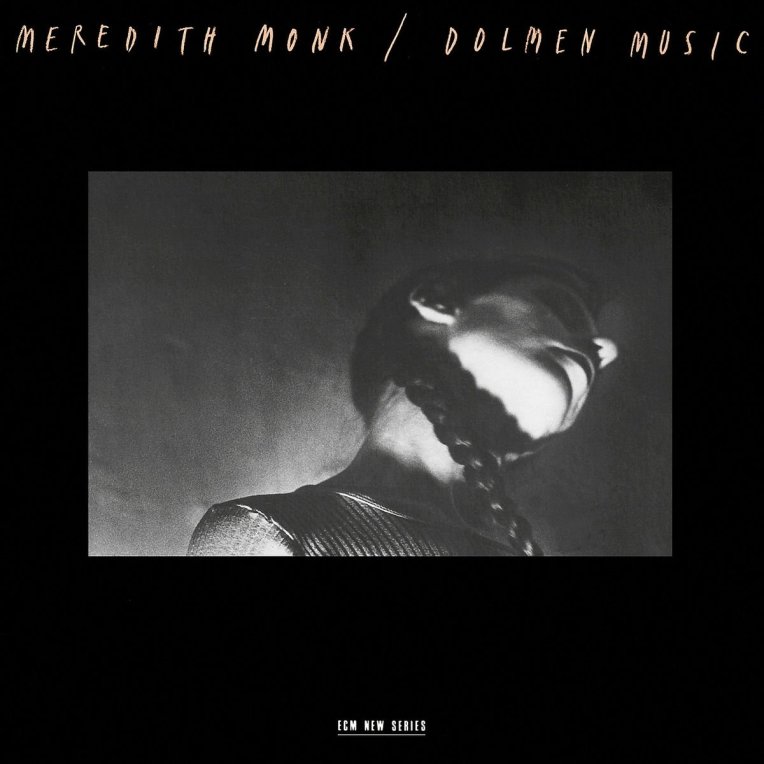
With this album Monk reinvigorated the linear song, the sole/soul singer, the monophonic performer. With the barest resources, she and her highly trained ensemble gave us an eternity of sounds. Dolmen Music makes a stunning addition to any music collection not only for its audible dimensions, but also as an art object, for it boasts one of the most perfectly suited covers in the entire ECM catalog.

<< Thomas Demenga/Heinz Reber: Cellorganics (ECM 1196 NS)
>> Steve Eliovson: Dawn Dance (ECM 1198)

Gateway (ECM 1061)

ECM 1061

Gateway

John Abercrombie guitar
Dave Holland bass
Jack DeJohnette drums
Recorded March 1975 at Tonstudio Bauer, Ludwigsburg
Engineer: Martin Wieland
Produced by Manfred Eicher

With this record, John Abercrombie both repaved and detoured from his staid path. He could hardly have been in finer company, and the combination seems to have fanned all sorts of flames within him. DeJohnette and Holland string an array of tightropes across which Abercrombie balances his way into previously uncharted territory.

“Back-Woods Song” evokes a mood that would come to define some of the later work of Bill Frisell. To be sure, the sound lives up to its name here as it awakens like an alligator poking its head above some swampy surface. Holland solos wonderfully here, after what some have rightly remarked to be a rather “creepy” turn from Abercrombie, ricocheting delightfully off the cymbals. This is very muddy jazz: viscous, opaque, and teeming with unseen life. “Waiting” is essentially a slow trek for bass that ushers us into “May Dance,” in which Abercrombie’s fingers frolic across the fretboard. Thus he brings a clear sense of continuity and of dynamic energy, scraping away at the surface of possibility and peering into its inner depths without fear of censure. The ensuing frenzy of activity resolves into a delicate bass solo, during which Abercrombie takes a much-needed breather. Holland cleverly mimics Abercrombie’s style, underscoring that same cluster concept of note value and melodic ascendency. “Unshielded Desire” is exactly what it claims to be. It starts with a percussive bang like the finale of a fireworks display and Abercrombie runs with all his might to capture every dying spark as it trails in the sky. The music goes around in spirals, flirting with a center it can never reach no matter how far down it goes, until it is like a compass gone haywire in the Bermuda Triangle. Next is “Jamala,” the most downtempo cut on the album. This is a moody masterpiece and a fine lead-in to the magical, epic, and incendiary “Sorcery I,” which rounds out the set.

I actually fell asleep the first three times I tried listening to this record. For whatever reason, its quirky energy seems to have had a soothing effect on me. Odd, seeing as I cannot imagine a more invigorating guitar trio. Abercrombie has such a distinctive sound and it has to do not only with the amplification and choice of instrument (or pairing thereof), but more importantly with the fragmented aesthetic he brings to his playing. Abercrombie is a “sensual” musician—that is, a musician of the senses. He seems to rattle his own bones, bringing to his improvisation a sense of detached wonder. Those looking for the laid-back Abercrombie may find this an unexpected outing. I do think it’s worth taking a chance on, however, as the freer moments herein might very well surprise and inspire. Despite a seemingly haphazard approach, Abercrombie remains tightly knit to the music’s immediacy. His is an electric sound that stays close to its acoustic roots, while Holland’s solos rise and fall, never straying from the core beat, as if strung to DeJohnette’s limbs.

It’s difficult to explain this kind of jazz to someone who has never heard it, and almost as difficult to describe it as someone hearing it for the first time. It is chameleonic music of the highest order. The wealth of possibility represented here in the art of improvisation expands the ear, the mind, and the heart of the listener, cracking the window of one’s worldview open just that much more to reveal the joys of lived experience. And maybe that’s what jazz is all about: experiencing the human spirit and the infinite ways in which it contorts itself to the tune of some intangible creativity.

<< Ralph Towner: Solstice (ECM 1060)
>> Collin Walcott: Cloud Dance (ECM 1062)

Pat Metheny: Bright Size Life (ECM 1073)

ECM 1073

Pat Metheny
Bright Size Life

Pat Metheny guitars
Jaco Pastorius bass
Bob Moses drums
Recorded December 1975, Tonstudio Bauer, Ludwigsburg
Engineer: Martin Wieland
Produced by Manfred Eicher

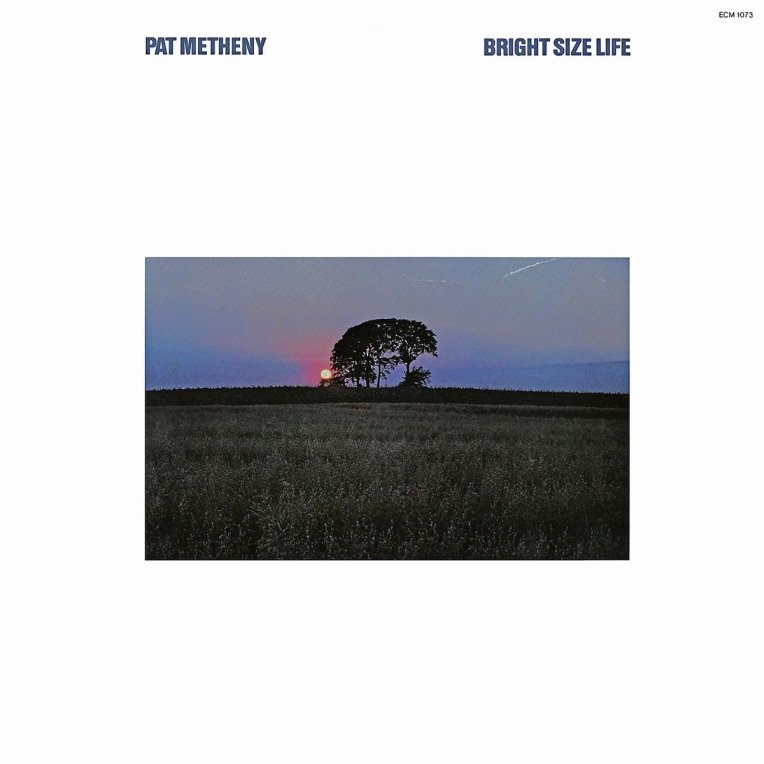
The tunes on Bright Size Life, Pat Metheny’s first studio album as frontman, tell a story that begins at the outskirts of Jim Hall, traverses the vast plains of the American Midwest, and ends smack dab in the middle of Ornette Coleman. From the moment fingers hit strings, we are launched into the luscious warmth that would come to characterize an ECM era. Flanked by the late Jaco Pastorius on bass and a cymbal-happy Bob Moses on drums, Metheny carries the brunt of the record’s melodic thrust. Positively overflowing with gorgeous circuitousness, organic inversions, and unwavering execution, Metheny and his sidemen make it sound as if it were harder not to produce such flawless synergy. With the obvious exception of his solo efforts, this is Metheny at his barest. And while his larger group projects tend to stray into more fusion-oriented territory, here we get a trio of musicians whose sensibilities, no less intertwined, arrange themselves into a more consistent rural flavor. There is something unmistakably outdoorsy about Bright Size Life. One can’t help but want to pop this music in the stereo during a long drive or cross-country trip, and maybe even have it in one’s ears during a hike (assuming that such digital trappings aren’t antithetical to the activity). An utter delicacy of phrasing and controlled abandon is what makes Metheny such a joy to listen to as he weaves his monochromatic web. Even during those moments in “Missouri Uncompromised” and “Omaha Celebration,” which swell into ecstatic fervor, Metheny exercises stylish restraint, as if pushing too far might break an already fine thread of articulation. Slower numbers like “Midwestern Night Dream” put Metheny in a more supportive mood, spinning a web of chords in equity with his fellow musicians. The bass adopts a more chorused presence, hopping over Metheny like a frog on lily pads. “Unquity Road,” along with the title track, foregrounds a composed doorway into an improvisatory wonderland, looking back regularly to its origins, as a child would its mother. Metheny closes out the set with “Round Trip/Broadway Blues,” an Ornette Coleman medley that seems to write its script as it goes along, until the vanishing point swallows and spits us out whole.

Bright Size Life is suitably recorded, with drums given the widest berth beneath the evenly spaced leads. Pastorius has plenty of opportunities to strut his stuff on center stage, and it is astounding to hear how he manages to thread every needle that Metheny fashions from the ether. At times, guitar and bass walk hand-in-hand, while at others one trails the other. Listening to this album is like tracing a map in sound. As followers, we may not know the next phase of our journey and can only trust that our guides will come through in the end. Metheny and company deliver above and beyond in this respect, with plenty of unexplored terrain left over to do it all over again.

Many consider the 1970s to be jazz’s deadest era. With records like this, ECM sufficiently laid that myth to rest. Listen and find out why.

<< Gary Burton Quintet: Dreams So Real (ECM 1072)
>> Jack DeJohnette’s Directions: Untitled (ECM 1074)