As part of a recent feature on the new ECM album by the Gurdjieff Ensemble, featuring the music of Komitas, for RootsWorld online magazine, I had the fortune of interviewing the ensemble’s director, Levon Eskenian. The article also includes a review of the album by Erik Keilholtz. My own review of the album, soon to appear on this site, will feature others parts of that same interview not included for being more specifically related to ECM. In the meantime, click the cover below to read on.
ECM Records
An interview with engineer Stefano Amerio by Stefano Bertoncello
Those who pay attention to album credits will notice that in recent years ECM has been employing the services of genius engineer Stefano Amerio. One of my dedicated readers, Stefano Bertoncello, visited Amerio in his ArteSuono studio near Udine, Italy for a lively interview and portrait of the artist in his element. Click the photo below to read on…
Tigran Hamasyan: Luys i Luso (ECM 2447)
Tigran Hamasyan
Luys i Luso
Tigran Hamasyan piano, prepared piano
Yerevan State Chamber Choir
Harutyun Topikyan conductor
Recorded October 2014 at Argo Recording Studio, Yerevan
Engineer: Markus Heiland
Assistant engineer: Armen Paremuzyan
Mixed March 2015 at RSI Studio Lugano by Markus Heiland, Manfred Eicher, and Tigran Hamasyan
Produced by Manfred Eicher
U.S. release date: October 2, 2015
Luys i Luso realizes the dream of Tigran Hamasyan to build an entire album around the sacred music of Armenia. Now based in Los Angeles, the prodigious jazz pianist has held on to the melodies of his homeland with solemnity and patience for this project. The antiquity of much of the repertoire—hymns, sharakans (chants), and cantos, some of which date back to the fifth century—leaves room for improvisation, which evidence suggests has been a part of its living tradition for centuries. Hamasyan takes to this freedom like a wing to wind, using his polyphonic arrangements of monophonic melodies as runways for spontaneous flights. He has intentionally left the piano parts unwritten, so that by following only skeletal structures he is free to move about the score.

(Photo credit: Vahan Stepanyan)
The album’s title (Light from Light) is primarily descriptive, revealing the process of pulling out an interpretive glow from contemporary compositions, and from the older ones embers of bygone devotions. It also signals themes of variation in a program built around multiple incarnations of the core melodies. The preludinal “Ov Zarmanali” (Oh this Amazing and Great Mystery) by 12th-century catholicos and composer Grigor G. Pahlavuni, for example, illuminates the listener’s ears first through a solo piano treatment, like snow falling from the branches of a godly tree, and later in the album in a veritable river of voices. The Yerevan State Chamber Choir’s balance of raw technique and rhythmic precision indicates a vulnerability diminished by numbers. Hamasyan’s pianism takes on a regular role here, sounding its arpeggios with veracity. The modal changes speak to something deeper than beauty, to the heart within it darkened by neglect. Midway through the singers fade and leave the piano to move jazzily through their afterimages, only to return like objects of worship polished smooth over centuries of devotion. “Sirt im Sasani” (My Heart is Trembling!), a canticle by 13th-century canonical writer Mkhitar Ayrivanetsi (c. 1230-1297) also reveals its mercies through two iterations, the second of which is a piano variation of Trinitarian dimension, while the first professes faith through the distant mechanisms of exile. Bass soloist Seiran Avagyan renders a flower of textual identity shedding petals in favor of bodiless light.

(Photo credit: Vahan Stepanyan)
No such project would be complete without Komitas (1869-1935), because of whose efforts much of Armenia’s sacred music has been preserved. His “Hayrapetakan Maghterg” (Patriarchal Ode), a hymnal request to be heard and absolved, takes three forms. In two Hamasyan-only versions, the pianist attends to the words between notes. He is keenly aware of these spaces and gathers strength through their collective presence. Like the pages of a thumb-worn Bible, its gilding has faded through absorption, finding in its choral life a treasure of grace and, in soprano soloist Jenni Nazaryan, a dove clutching sprigs of gratitude. From Komitas’s Armenian Holy Mass we encounter two sections, “Surb Astvats” (Holy God) and “Orhnyal e Astvats” (Blessed is God), each based on melodies from the seventh century. Where the former is driven by forward-thinking improvisation, the latter looks backward by sampling tenor Armenak Shahmuradyan. This 1912 archival recording, made in Paris in the presence of Komitas, defines the palette from which the choir draws its colors over a century later.
Medieval theologian and hymnologist Mesrop Mashtots (c. 362-440) is represented in two chants and a canticle for Fasting Days. The first of these, “Ankanim araji Qo” (I Kneel Before You), is where the choir makes its album entrance—or should I say “in-trance,” for such is its state of being. Therein, singers descend to the bottoms of their linguistic wells, making dervish circles until the shadows are cleansed. Each is a powerful statement of redemption, of the will to drown in transgression so that one might be reborn into sobriety.
For the singly rendered, Hamasyan offers two cantos of the Resurrection, both chanted during Divine Liturgy. “Nor Tsaghik” (New Flower) by Nerses Shnorhali (c. 1102-1173) strikes difference through its use of prepared piano, at which Hamasyan uncovers hidden voices behind the voices, while “Havoun Havoun” (The Bird, the Bird was Awake) by Grigor Narekatsi (c. 951-1003) pairs soprano and piano in the name of faith. Nazaryan’s lone singing barely grazes the belly of the nearest cloud until the nourishment of Heaven comes raining forth, leaving us to drink in what we can.
Those who would write off this recording on the sole basis of its description—Do we really, they might say, need another jazz musician improvising over a vocal ensemble?—may be pleasantly surprised at the level of integration achieved on Luys i Luso. Like Misha Alperin, Hamasyan recognizes the dedication of knowledge required to mesh with equally disciplined singers. Whether broken or healed, each of his selections embodies the fragmentary nature of things as a path to wholeness. The sheer love pouring from that wholeness is proof of concept.
An unexpected masterpiece, and one of ECM’s most astonishing in years.
(To hear samples of Luys i Luso, please click here. Further information about the project is available here.)
ECM @ Winter Jazzfest: Full Live Report
ECM @ Winter Jazzfest
For those of you in or near the New York City area, don’t miss an unprecedented two nights of American ECM artists at the New School’s Tishman Auditorium (63 5th Avenue, between 14th and 13th Streets) this Friday and Saturday, January 15 and 16. I’ll be there to review the entire event for All About Jazz. Below is the full schedule, along with a video statement from Manfred Eicher about ECM’s historical connections to the American milieu.
Friday January 15:
6:00 – David Torn (solo)
7:00 – Mark Turner Quartet (w/Avishai Cohen, Joe Martin & Marcus Gilmore)
8:00 – Craig Taborn (solo)
9:00 – Avishai Cohen Quartet (w/Jason Lindner, Tal Mashiach & Nasheet Waits)
10:00 – Ches Smith / Craig Taborn / Mat Maneri
11:20 – Vijay Iyer Trio (w/Stephan Crump & Marcus Gilmore)
12:40 – David Virelles’ Mbókò (w/Román Díaz, Eric McPherson & Matt Brewer)
Saturday January 16:
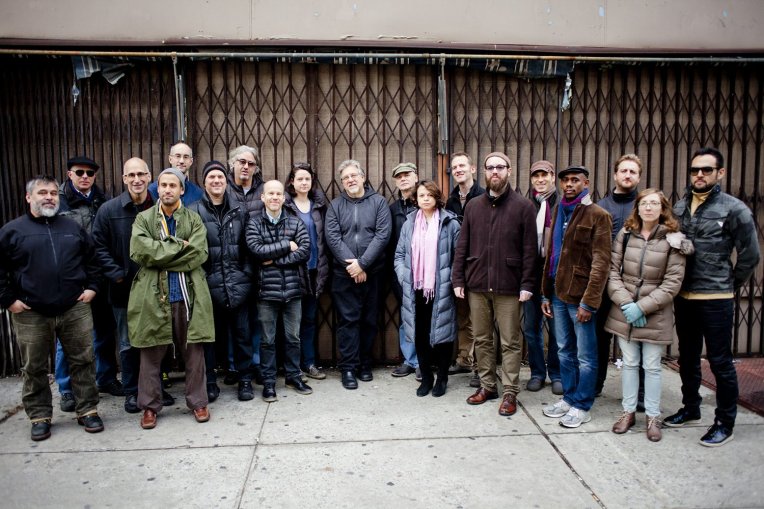
6:00 – Michael Formanek’s Ensemble Kolossus
7:20 – Theo Bleckmann’s Elegy (w/Shai Maestro, Ben Monder, Chris Tordini & John Hollenbeck)
8:40 – Chris Potter Quartet (w/David Virelles, Joe Martin & Marcus Gilmore)
10:00 – Tim Berne’s Sideshow (w/Ralph Alessi, Matt Mitchell, John Hébert & Dan Weiss)
11:20 – Ralph Alessi Quartet (w/David Virelles, Drew Gress & Nasheet Waits)
12:40 – Ethan Iverson-Mark Turner Duo
Giya Kancheli: Chiaroscuro (ECM New Series 2442)
Giya Kancheli
Chiaroscuro
Gidon Kremer violin
Patricia Kopatchinskaja violin
Kremerata Baltica
Recorded December 2014 at Lithuanian National Radio and Television, Vilnius
Engineers: Vilius Keras and Aleksandra Suchova
Mixing and mastering at Emil Berliner Studios, Berlin by Rainer Maillard, Manfred Eicher, and Vilius Keras
Produced by Manfred Eicher
U.S. release date: November 6, 2015
“Despite the world’s obvious achievement, our planet is still torn by bloody contradictions. And no progress in artistic activity can withstand the destructive force that easily cancels the fragile process of construction. (…) I write for myself, without having any illusions that ‘beauty will save the world.’”
–Giya Kancheli
The words of a composer-in-exile who lives so deeply inside time that he creates outside of it. Kancheli speaks them not in the interest of putting forth a mission statement, but to assess the measure of his art against the metric of history, the last century of which has birthed some of its brightest galaxies and darkest nebulae. In the context of his personal astronomy, Kancheli seeks out vestiges of indifference in a world built on denial of the same. On this disc you will find no healing but the honesty of a mixed spirit. Surely, the music not only abides by such sentiments but also thrives on their shadows.
The 2010 title composition, first in a program of two, is scored for violin and chamber orchestra. Despite its perennial format, it reads neither like a concerto nor a tone poem, but rather a procession led by one who follows his own invisible nature. The feeling of inseparability is strong as these figures—nodes in a pathway of nerves—bond and separate. The bass drum rumble that opens their 23 prosaic minutes of communication signals the subterranean heart of it all, which by virtue of the shimmering strings that follow sews its raiment anew. As in the music of Valentin Silvestrov, the piano here adopts a commentary role. Its very involvement reveals an internal expanse rivaled in scope among his previous works perhaps only by Trauerfarbenes Land.
Violinist Gidon Kremer and his Kremerata Baltica handle every note with the admiration of a curator. Kancheli opines humbly about the musicians’ contributions and recognizes that the simplicity of his thematic moon shines by the light of many suns. In this recording, he dubs Kremer the “true author” of Chiaroscuro and he himself its “co-author.” The level of integration and respect achieved from both is something to behold with awe. Likewise, the distance and birdlike liquidity of Kremer’s high notes in the final phase.
At a slightly longer duration of 25 minutes, Twilight (2004) is scored for two violins and chamber orchestra. Kremer is joined by protégé Patricia Kopatchinskaja, last heard on ECM playing the music of Galina Ustvolskaya. Although it is Kancheli’s first piece for this instrumentation, and written at Kremer’s behest, it will feel familiar to the Kancheli initiate. Inspired by a row of poplar trees outside his Antwerp studio, whose significance became clear to him after a brush with death, it treats life as a gift twice given. The addition of a second leading voice emphasizes this metaphor and changes the landscape considerably, collapsing the former procession into a molecule of new rotations. Merest hints of Kancheli’s past thematic staples whisper through the overgrowth, speaking through the photosynthesis of the present. Interrelationships of soloists and orchestra are gnarled and rooted, each pouring out from the last in the manner of a divided cell. Melodies and atmospheric changes occur with such aching force that it is all one can do to keep the skeleton from trembling.
Twilight abounds in prismatic effects. Like an enhanced chamber music, it magnifies the immediacy of smaller forces with implications of unwritten futures. A direct emotional line takes shape from motif to motif until a naked mystery prevails. Kancheli is therefore correct in his self-assessment: This is not an album in which to seek sanctuary. That being said, one may discern a ray or two in the bleakness of its canvas, for to the interpreters’ authorship must be added the listener’s own.
As is always the case with the Kancheli experience, moments of apparent eruption are in fact the opposite. Nowhere truer than in this program, where the occasional outburst is, if anything, an “inburst,” pushing the focal point ever farther toward forgetting. Cavernous engineering thus allows the orchestra’s solitude to come spilling out in consumption of tension. We do well to see these dynamic affordances, like album’s title, as variations on a grander theme—in this case of mortality, and the parentheses that are its beginning and end.
Kancheli’s most important recording since Exil.
(To hear samples of Chiaroscuro, please click here.)
Food: This is not a miracle (ECM 2417)
Thomas Strønen drums, electronics, percussion, moog, fender rhodes
Iain Ballamy saxophones, electronics
with
Christian Fennesz guitar, electronics
Recorded June 2013 at Holand Sound, Oslo
Recording producer: Thomas Striven
Engineer: Ulf Holland
Mixed February 2015 at Holand Sound, Oslo by Ulf Holand, Manfred Eicher, and Thomas Striven
Mastered at MSM Studio, Munich by Christoph Stickel and Manfred Eicher
An ECM Production
U.S. release date: November 20, 2015
For its third ECM course, the duo of Thomas Strønen (drums, electronics, percussion, Moog, Fender Rhodes) and Iaian Ballamy (saxophones, electronics), known together as Food, serves up its most introspective chunk of nourishment yet. With assistance from Christian Fennesz (guitar, electronics), who last guested on Mercurial Balm, the project burrows even deeper into its lyrical universe with atmospheric phasers set to stun.
Under the creative disclosure of This is not a miracle, Strønen has taken to crafting every piece using elements culled from hours of studio improvisation with the musicians and producer Ulf Holand, whose hand was so gorgeously evident in Nils Petter Molvær’s Khmer. Strønen admits to starting more often with a structural rather than melodic idea before cutting the music, in his words, “to the bone.” Cutting is precisely the word, as linear utterances became spliced, looped, and restructured into fully fledged, standalone grooves.
It would be tempting, once the distorted guitar and muffled bass beats of “First Sorrow” pulse their way into the mind’s ear, to place the origins of this music at a far remove from Earth, when really it is torn from the book of an internal cosmos. Brushed with fire and written in ashes, its pages glow with the allure of a sere orthography in “Where Dry Desert Ends,” making even this unforgiving territory feel like cashmere on winter skin. Drums add their skipping traction to the dunes, while synthesizer and saxophone cut the sky with their cloudless scissors. A marked shift in viewpoint flushes heat as if through an emotional exhaust system of continental proportions, turning the emptiness of sunset inside out as a gift for the coming dawn.
Much of what awakens thereafter draws its nutrients from somewhere between this planet’s surface and its core, a comfort zone of difference and sculpted time. Whether whirling in the title track’s dervish circles or overlapping reeds in “Death Of Niger,” crunching through the detritus of “Sinking Gardens Of Babylon” or drifting over “The Concept Of Density,” just high enough to traverse the highest mountains yet low enough to ingest the detail of every village below, genetics bleed through every joining of head and tail with the power of unifying color.
Whatever the means at hand, lineage remains at the forefront of Strønen’s sound-world. Khmer kinship is strongest in “Exposed To Frost,” of which Fennesz’s biwa-like twangs imply another world within, while the drumming of “Earthly Carriage” and “Without The Laws” has the tuneful attention of label mate Manu Katché. His simple guidance is as shifting as the sand of an hourglass, pulling notes by gravity into mountainous ends. Similarly, “The Grain Mill” seeks the chicken in the egg. This glitch-laden lullaby enables a searing emergence from Fennesz, who tears through the veil of dreams into waking reality, where coronas whip themselves in place of lovers drowning in self-regard.
Whatever poetry This is not a miracle might inspire, it is, as the title implies, a practically molded object. The band has since taken these constructions as cohesive compositions, performing them as such in live concerts. But their democratic foundation remains audibly intact, and is perhaps the greatest force keeping them from being sucked into the black hole of countless other albums vying for your attention. This one tugs as the moon does the ocean, leaving shores refreshed and glistening beneath its light.
(To hear samples of This is not a miracle, please click here.)
Dino Saluzzi & Anja Lechner: El Encuentro (ECM 5051)
Dino Saluzzi
Anja Lechner
El Encuentro: A film for bandoneon and violoncello
Directors: Norbert Wiedmer and Enrique Ros
Camera: Norbert Wiedmer and Peter Guyer
Editing: Katharina Bhend
Sound, sound editing, and sound mix: Balthasar Jucker
Production: PS Film, Biograph Film
Co-produced by SRF
Post-production: Recycled TV
In Sounds and Silence, Norbert Wiedmer produced a rather fleeting portrait of ECM Records and its head Manfred Eicher, leaving viewers with, at best, vague sketches by trying to do too much in one go. But with El Encuentro, glimpses of which one might remember seeing in the former documentary, he has given us the film that should have been. Along with co-director Enrique Ros, Wiedmer touches more of the label’s ethos by following only two of its major artists than Sounds and Silence does in profiling many more besides. Despite being from opposite sides of the Atlantic, gentle giant of the bandoneón Dino Saluzzi and cellist Anja Lechner have bridged waters of their own making since 1998, when they first collaborated in the Kultrum project that featured the Rosamunde Quartett, of which the cellist was founder.
What makes El Enceuntro such an insightful window is the relative clarity of its narrative glass. At its core is a trip taken by Dino and Anja—so one feels compelled to call them after getting to know them so well by the end credits—to Salta, Argentina, where the bandoneonista absorbed the tango that would become central to his life. It’s an art form that would become increasingly important for Anja, who cites her own deep knowledge of, and respect, for the tango as a motivation for forging this intergenerational partnership with Dino. She recalls learning these rhythms for the first time in Argentina, where signatures rendered cut and dry through classical training now blossomed at her fingertips, reinvigorated.
Dino meanwhile looks back on memories of his father, who after working a long day at the factory would sing for their village. Dino took to his father’s love of song like a sunset to ocean and, as the film makes clear, has passed that spirit on to Anja in kind. Indeed, the cellist says that even though Dino is always more comfortable playing with his family, she feels she has become a part of it. Whether dancing with the locals or navigating a recording session with Dino and his brother Felix, she adapts with chameleonic precision—which is to say: unthinkingly.
But Dino’s story is as much about leaving home as finding it. He regales us with stories of putting his home country behind him to support his family, and of finding an unexpected brother in the late George Gruntz, who in 1982, as president of the Berlin Jazz Festival, traveled to Latin America in search of musicians and recruited Dino on the spot. No one in Gruntz’s band had ever seen or heard a bandoneón before, and this opportunity would prove career-defining.
The past, however, is never too far behind. As Dino admits, “I compose with memories and hopes,” and in so doing kneads the passage of time into desired shapes. In this respect, the film is as much a meeting of lives as of minds. Anja lets us in on her own past: playing with rock bands at age 12, among whom she learned to improvise in the heat of the moment; hearing Dino’s music for the first time in Munich, where she’d so dutifully immersed herself in classical music of the European masters, even while surrounding herself with the melodies and forms of other places. And for her that’s the key. You have to go to these places to experience the emotional core of their music. Location is vocation. It’s something that cannot be substituted or recreated.
None of this is meant to suggest that Lechner has abandoned her classical foundations. Far from it, as evidenced in her interactions with composer Tigran Mansurian in Armenia, the country dearest to her after Argentina.
The cameras are there again for conversations with Levon Eskenian, who explains to her the sacred music of Armenia, and how when playing folksongs on the duduk one must always convey a sense of improvisation. Anja thus characterizes life in Armenia as more immediate, whereas in Argentina people truly engage and look into you. Such is the balance of her traveling life.
On Dino’s own travels, no companion has been more constant than his trusted bandoneón. “I can’t conceive of life without the bandoneón,” he says. “The instrument has spoken with modesty since its conception. It doesn’t raise its voice, it only speaks with calmness, simplicity, and directness. All of the words are written here. All of the thoughts are here. All of the difficult equations are here. You only have to serve to bandoneón and understand that you’re letting the human experience pass through other channels.” But he also believes that bandoneonists should explore beyond the tango and create new forms of music. As if his recordings weren’t already ample proof of this advice in action, excerpts from concerts with drummer U.T. Gandhi and singer Alessandra Franco, and with the Metropole Orchestra in Amsterdam’s Musiekgebouw under the baton of Jules Buckley, show just how catalytic the instrument can be.
But it is in combination with the cello where channels of communication open their hearts to the vastest possibilities. Just as Anja says, “Music is a world in which all emotions exist,” so are emotions a world in which all music exists. And at their center, we can feel these two souls creating a third for the listener to inhabit at will.
Early on in the film, Dino wonders how people can connect at all to his melancholic music, even as he recognizes something that meets the listener halfway. “For me,” he goes on, “doubt is driving force. It’s like gasoline. You use gasoline to run a car. And for us to work, we need doubt. Because if doubt is a driving force, then it can’t become a paralyzing problem. On the contrary, it’s a generator of ideas and desires, of searches and answers to the great questions we have.” And if we must be the electricity that powers this generator, how fortunate we are to be swept up in its current.
Keith Jarrett Trio: Live In Japan 93/96 (ECM 5504/05)
Keith Jarrett Trio
Live In Japan 93/96
Keith Jarrett piano
Gary Peacock bass
Jack DeJohnette drums
DVD 1
Recorded live in Tokyo, July 25, 1993 at Open Theater East
Director: Kaname Kawachi
Recorded by Toshio Yamanaka
Produced by Yasuhiko Sato
Executive producers: Hisao Ebine and Toshinari Koinuma
DVD 2
Recorded live in Tokyo, March 30, 1996 at Hitomi Memorial Hall
Director: Kaname Kawachi
Recorded by Toshio Yamanaka
Produced by Yasuhiko Sato
Executive producers: Hisao Ebine and Toshinari Koinuma
Concerts produced by Koinuma Music
It’s one thing to hear, but quite another to see, the Keith Jarrett Trio in action. For those unable to do so in a live setting, this two-DVD release is the next best thing. Like the Standards I/II set that precedes it, this one was recorded in Tokyo, but puts about a decade between those first Japan performances.
A 1993 gig at Open Theater East takes place in the heart of a sweltering summer. The air shines both with the music and with the rain that forces a large and dedicated audience to listen from beneath ponchos, and the musicians to play from beneath a clear canopy. The video quality is much finer this time around, and despite a rocky start born of technical issues and the weather, captures one of the trio’s finest sets available on any medium.
What separates this concert from the others available on DVD is the openness of the band’s aura. Jarrett more than ever plays for his appreciative listeners because he understands the bond into which nature has pushed them. Perhaps it’s no coincidence that Jarrett’s The Köln Concert also famously began in the least ideal of conditions. Clearly, the pressure set him on an unprecedented creative path. And so, even as the trio struggles to feel out the climate in Dave Brubeck’s “In Your Own Sweet Way” (throughout which Jarrett must often wipe down the keyboard with a towel), all while latecomers snake to their seats, we can feel the groove emerging one muscle at a time. After the worldly touches of “Butch And Butch” and “Basin Street Blues,” we know that things have been set right.
Whereas in the previous Japan documents Peacock proved himself the man of the hour (although, to be sure, the breadth of his architectures in “If I Were A Bell” and “I Fall In Love Too Easily” are as masterful as they come), it’s DeJohnette who produces the deepest hues of this rainbow. His sticks make evergreens like Sonny Rollins’s “Oleo” that much greener, and turn a 26-minute rendition of Miles Davis’s “Solar,” combined with Jarrett’s “Extension,” into a downright sacred space.
As with the 1986 concert on Standards I/II, the trio ends on three encores: “Bye Bye Blackbird,” Jarrett’s “The Cure,” and “I Thought About You.” In all of this one can sense a quiet storm of commitment to the music that flows from within. Melodies breathe, reborn, requiring open hearts to know their graces.
The year 1996 brings us to Hitomi Memorial Hall, where Jarrett and friends jump fully refreshed into “It Could Happen To You.” As always, Jarrett’s lyrical intro reveals little about the mosaics soon to follow. He takes the theme and its surrounding chords as a starting point down densely textured corridors. Which is, of course, what improvisation is all about: dungeon crawling without a map yet knowing that a destination will wrap its arms around you eventually. Jarrett seems to unravel every possible path into its fullest and on through the ballad “Never Let Me Go,” in which the pianist transcends the status of storyteller to that of myth keeper.
“Billie’s Bounce” is a staple not only for its composer, Charlie Parker, but also for Jarrett. As one of his prime expressive spaces, it layers all the bread and butter that make his art so nourishing. But we mustn’t forget that each member of this unit is equally important. In “Summer Night,” Peacock’s gentility is Jarrett’s flame, shining like the moon with a song to sing, and DeJohnette’s opening to “I’ll Remember April” shows a drummer with just as much to say from the bedrock, even as Jarrett evolves in real time through every change in the rapids above.
Other standbys such as “Mona Lisa” and crowd favorite “Autumn Leaves” open as many new avenues as they retread. With a crispness of feeling, Jarrett grabs the spotlight, while lively soloing from Peacock and fancy brushwork from DeJohnette make the picture whole. Even the familiar strains of “Last Night When We Were Young” become something new when they melt into Jarrett’s groovier “Carribean Sky.” It’s what one can always count on with this trio: playing as if for the first time.
The Bud Powell tune “John’s Abbey” commands from the sidelines as Peacock and DeJohnette go from canter to gallop and sets off a rapid-fire succession of closing tunes. A touching rendition of “My Funny Valentine” falls like a tear of quiet joy into Jarrett’s “Song,” in which the musicians open a book you always meant, and at last have the chance, to read again. “All The Things You Are” and Ray Bryant’s lesser-heard “Tonk” end the set with a satiating balance of delights. Nothing added, nothing taken away.