Marilyn Crispell Trio: Storyteller (ECM 1847)

Storyteller

Marilyn Crispell Trio
Storyteller

Marilyn Crispell piano
Mark Helias double-bass
Paul Motian drums
Recorded February 2003 at Avatar Studios, New York
Engineer: James Farber
Produced by Manfred Eicher

Although the distinction of Marilyn Crispell’s free-flowing approach to the keyboard has been evident at least since her 1983 solo album Rhythms Hung in Undrawn Sky, her sporadic ECM tenure has shown an artist coming into her own. For Storyteller, she is joined by bassist Mark Helias (filling the formidable shoes of Gary Peacock) and drummer Paul Motian. One hesitates to call them “bandmates,” for the symbiosis between the three is such that parsing them into any hierarchy of leader and followers would upset the balance of their artistry. Motian and Helias are indeed more than a rhythm section: rather, they section rhythm into its base components, fragmenting and rebuilding in real time, like Crispell herself, to suit the needs of the tune at hand.

On the subject of tunes, the set list affords fair consideration to each musician’s pen, beginning and ending with Crispell’s contributions, and through them loosely framing the trio’s open approach. In the first moments of “Wild Rose,” as Motian’s rasp breezes through Crispell’s transcendence, and they in tandem through Helias’s pockets of air, there is a sense that what we are hearing is available only to the ears. This is, in certain terms, invisible music. Dynamics are constantly flipping and shifting, so that in “Alone” Crispell billows like a curtain in the foreground, while in “So Far, So Near” she becomes now the page across which the texts of bass and drums take form. Despite being over nine minutes long, the album’s closer passes like a windblown leaf among countless others, even so yielding unforgettable color.

Motian offers five tracks, including his classic “Flight of the Bluejay,” which in this rendition flits about with descriptive perfection. Like its namesake, it cycles between lyrical glides and punctuations of caution. “The Storyteller” is notable for its sustained arpeggios and for the archaeological precision of its composer. So, too, “The Sunflower,” a brief yet sparkling ode to photosynthesis. But the two tracks marked “Cosmology” show the trio at its interlocking best, as does “Limbo,” one of two tunes by Helias; the other being “Harmonic Line,” which is the album’s most melodic and contains the first proper solo of the set, accompanied only by drums, painting the ripples of Crispell’s pebble dropping.

In the purview of these masters, each the side to a pliant yet unbreakable triangle, the title of Motian’s “Play” is as much a noun as a verb. There is, accordingly, a stark awareness of the stage, of the performance, of the importance of every set piece and backdrop. Every gesture gives off a constellation, each star a seed for countless more. Crispell is that rare pianist who can erase a picture in the same gesture that paints it. With a single wave of her hand across the water’s surface, she resets every reflection before it can pull us in like Narcissus. She is the storyteller, recording her fleeting narratives so that listeners might forever experience of the poetry of their immediacy, if not vice versa.

Manu Katché: Playground (ECM 2016)

Playground

Manu Katché
Playground

Mathias Eick trumpet
Trygve Seim tenor and soprano saxophones
Marcin Wasilewski piano
Slawomir Kurkiewicz double-bass
Manu Katché drums
David Torn guitar on “Lo” and “Song For Her (var.)”
Recorded January 2007 at Avatar Studios, New York
Engineer: James A. Farber
Produced by Manfred Eicher

Playground is the spiritual successor to drummer Manu Katché’s auspicious ECM leader debut: Neighbourhood. Auspicious, because said debut practiced just the communal sort of sharing it preached. The lineup here replaces saxophonist Jan Garbarek with the multi-talented Trygve Seim and adds to its ranks trumpeter Mathias Eick—neither strangers to one another since their appearance on Iro Haarla’s Northbound. Rounding out the cast are two thirds of the Marcin Wasilewski Trio (bassist Slawomir Kurkiewicz and Wasilewski himself at the keys), as well as guitarist David Torn. Aside from the latter’s ambient contributions to its bookends, the album luxuriates in the all-acoustic interplay of Katché’s simple yet potent tunes.

Of those tunes, we get 11 artfully crafted gems, gradated from sunrise to sunset. From the first, there is a sort of lush Americana that pervades each smooth turn of phrase, swaying like poplars in anonymous urban landscapes—a result, perhaps, of these European jazzmen soaking in the spell of New York City, where Playground was recorded. Either way, one can hear the pulse of the city’s history in the underlying beat textures. In this regard, Wasilewski’s pianism is striking for both its sink and swim. In the album’s opener it acts as an intermediate force between Katché’s supporting brushes and Eick’s leading stare, while in “Song For Her” (and its variation, which ends the set) it enables reflective bassing, pinging like pachinko balls in slow motion. Here, as elsewhere, the horns build to the non-invasive sort of head at which Katché’s writing excels.

Tracks are designated by names that are as descriptive as they are simple. Most are relatively obvious. “Motion,” for example, moves flexibly. Noteworthy is Wasilewski, given free reign in one of the session’s strongest improvisational showings, of which there are a strategic few (others being Seim’s chromatic solo in “Inside Game” and Eick’s skyward lob in “Project 58”). Despite the groundedness of Katche’s drumming, there is always something airborne about the melodic front line, so that tracks like “So Groovy” showcase Katché’s multidirectional awareness. What distinguishes his grooves, then, is less their sense of push than of pull. Here, as in “Snapshot,” the music draws ocean waters like the moon. Whether piecing together the cymbal-happy backbone of “Clubbing” or paving the smooth runway of “Morning Joy,” Katché finds strength in his attractions to kindred spirits. They clearly take inspiration from him in kind, for by the end one feels the cycle ready to repeat for a third round.

The title of the second track, “Pieces Of Emotion,” describes it best: each fragment builds a larger mental whole, a place built on togetherness, listening, and, above all, synchronicity.

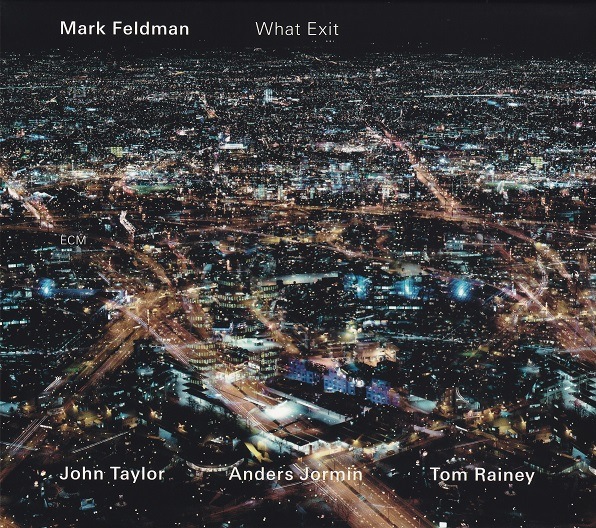
Mark Feldman: What Exit (ECM 1928)

What Exit

Mark Feldman
What Exit

Mark Feldman violin
John Taylor piano
Anders Jormin double-bass
Tom Rainey drums
Recorded June 2005 at Avatar Studios, New York
Engineer: James A. Farber
Produced by Manfred Eicher

Mark Feldman belongs to that selective cadre of jazz violinists ruled by such greats as Noel Pointer and Stéphane Grappelli, all while honing a storyteller’s edge so much his own that he might one day be seen as the pioneer of a new tradition. Should that ever be the case, then the 23-minute “Arcade” which begins What Exit—Feldman’s first leader date for ECM—will certainly comprise a central chapter of his scripture. It is a quintessential statement for both album and artists in kind. One first notices the delicate tracings of drummer Tom Rainey, who throughout the album shows the spectrum of his touch. Into that soil bassist Anders Jormin presses his feet like an archaeologist about to embark on a vast improvisational survey. Only when pianist John Taylor fills those footprints with plaster does Feldman whisper into being. The band almost comes together, part by part, like some parthenogenetic steam train, coalescing from metal and gristle and steam, alighting upon a track fully formed and ready to chug. But just as the ride is about to begin, Feldman and Taylor pause to take stock of things. The latter fades for Jormin’s arco dovetailing, haunting the sub-terrain as Feldman beguiles with Bach-like arpeggios before, ever the feline, slinking into a trio with Jormin and Taylor, interjected with popping duet statements with Rainey. Such eruptive flip-flopping becomes more complex and fragmentary as the train moves forward, engaging the quartet in various combinations of resolve and dissolve. “Arcade” is therefore appropriately titled, filled as it is with spontaneous sounds, which after a while take on a cadence of their own in the interest of play.

The cerebral challenges of this behemoth introduction are rewarded by “Father Demo Square,” second of the album’s eight Feldman originals. This one more smoothly and expectedly tallies the invigoration of the violinist’s characteristic grammar. Jormin takes an early solo, swinging in the loose netting woven by Taylor and Rainey, but it is Feldman’s restless beauties that overtake the foreground, courting implosion at every turn. From foreground to underground, the memorial tune “Everafter” balances cinematic foreboding with understated grandeur. The branches of Taylor’s encroaching pianism hang ripe with fruit, their scent lingering like the double stop that ends with its swan breath. As in the later “Elegy,” Feldman cuts a bitter shadow, slaloming through his backing trio’s loosely upholstered interplay along the way.

There is, however, a brighter side to this moon. Brightest in “Ink Pin,” a rousing throwback that trades licks freely toward swift-footed unity. This brilliant track boasts the special combinatory force of Jormin and Feldman, gilding the frame from start to finish. The Brazilian flavor of “Maria Nuñes” adds spice to the night, trading strings for strands in jagged, sparkly development. The tenderness of “Cadence” tips the scales yet again toward shadow, giving way at last to the light of the title track. Between its fragile liveliness and the album’s confident serenity as a whole, there is much to absorb and re-absorb. And all from a quartet of which only ECM could dream and make reality—proof of the label’s unflagging creative spirit in pursuit of jazz perfection.

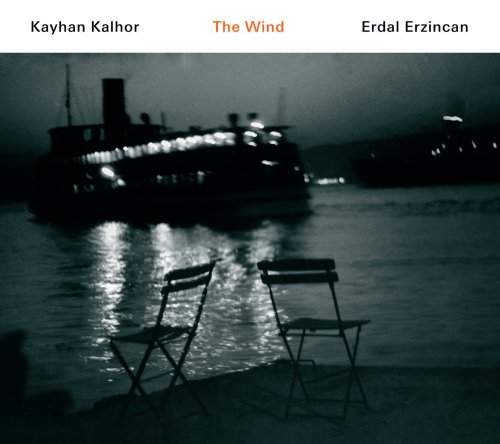
Kayhan Kalhor/Erdal Erzincan: The Wind (ECM 1981)

The Wind

The Wind

Kayhan Kalhor kamancheh
Erdal Erzincan baglama
Ulaş Özdemir divan baglama
Recorded November 2004 at Itü Miam Dr. Erol Üçer Studio, Istanbul
Engineer: Mustafa Kemal Öztürk
Produced by Kayhan Kalhor and Manfred Eicher

The Wind is a significant way station in the travels of kamancheh (Iranian spike fiddle) virtuoso Kayhan Kalhor and baglama (an oud-like Turkish instrument, also known as the saz) master Erdal Erzincan, who under its name are captured on record together for the first time. Ghosting them is Ulaş Özdemir, the musicologist who aided Kalhor in his search for musical material during research trips to Istanbul, and who plays the divan baglama (bass saz) almost like a tambura, stretching a droning sky across which the duo may fly.

Improvisation is of primary importance in Kalhor and Erzincan’s world of sound—so much so that the performance documented here feels like one long freeform variation, divided though it is into 12 parts.The baglama has a haunting insistence about it, which tills soil until Kalhor’s bow comes sprouting through. The latter seems at first like a trick of the ear, for its verbs conjugate by way of a most understated grammar. As it becomes more faithfully inscribed, gathering minnows and courage from every limpid pool, Kalhor’s spirit billows like parachute silk between elements, of which the album’s titular wind is but one of many. Every gust of air keeps him afloat, but also reminds us of the importance of rootedness. And all of this in the album’s first six minutes.

Part II moves in swaying patterns and, like much of what follows, practices the wisdom of restraint even at its most eruptive moments. From here, the album turns fragmentary, dialogic corners, ping-ponging motifs across a divine net according to subtler rules of play. Strum-heavy passages (Part IV) are balanced by holy unions (Part V), marking slow escalation into clouds near to bursting with melody. As territories expand, so too does the capacity for these musicians to breathe. An open circuit in search of a conductor, they unleash electrical charge from the friction of their dance. Erzincan’s fingerwork in Part X inspires Kalhor to just such a lightning bolt of expression, the overtones of which are almost deafening in their affect. Kalhor’s pizzicato action in Part XI spins a different cyclone before the bittersweetness of farewell sets us on our way.

Kalhor and Erzincan inhabit everything they play as bees inhabit a hive, wagging to invisible rhythms and joining the almighty hum that activates every soul to buzz its wings. What we have, then, is the honey.

John Holloway: Veracini Sonatas (ECM New Series 1889)

Veracini Sonatas

Veracini Sonatas

John Holloway violin
Jaap ter Linden cello
Lars Ulrik Mortensen cembalo
Recorded September 2003, Propstei St. Gerold
Engineer: Stephan Schellmann
Executive Producer: Manfred Eicher

Francesco Maria Veracini (1690-1768) is the subject of John Holloway’s fourth ECM traversal of Baroque violin repertoire. Joined now by cellist Jaap ter Linden and harpsichordist Lars Ulrik Mortensen, who together comprise a formidable continuo, Holloway mines the ore of yet another underrepresented violinist-composer, this one an iconoclast to the last: showman, itinerant solo artist, and experimenter. The variety of his contributions to the sonata canon of the time—in both its four- and five-movement incarnations—is expertly represented on this disc. Through them all runs a deep mineral vein of melodic and atmospheric sensitivity.

The Sonata No. 1 in g minor, composed in 1721, comes from the composer’s Opus 1. Its pentagonal structure flies effortlessly from Holloway’s bow, by which he elicits a tone so organic that one hardly notices the trills and mordents of his interpretive genius—some of the most artful to be found in the world of Baroque violining. Whether by the leaping Allegros or the darker, quasi-operatic turns, Holloway and friends mark the passage of this music with instruments as cartographic as they are sonorous.

One quickly notices an airiness to this music that, while charming, is never paltry. This is due equally to the writing and to the playing, both of which work in lively, scintillating congruence. And even though Holloway occupies the spotlight, the interactions between cello and harpsichord are so integral—the former weaving comets through the latter’s pinpointed stars—that to imagine the music without them is to imagine a sky without clouds. The result is a sense of open space, whereby each sonata lends grandeur to even the airiest movements—to wit: the Largo that begins the Sonata No. 5 in C Major. Taken from the Sonate a violino, o flauto solo, e basso, a collection that predates the Opus 1 by five years yet which was published only posthumously, it sketches canvas with bolder ground lines. This renders the exuberant movements all the more emphatic, enacting balance between the violin’s flight paths and the bass lines entrenched below. The concluding Allegro emotes with bravado in a blush of call and response.

The date of composition of the Sonata No. 1 in D Major, from Veracini’s “dissertation” on Corelli’s Opus 5, is uncertain. Considering its programmatic brilliance, youth dominates the possibilities. The dual voicing in particular invokes the antennae of a butterfly fresh from the cocoon. The contrast of this sonata’s shadows and lights presage the maturity of narrative voice achieved in the Sonata No. 6 in A Major, from Veracini’s Opus 2, the Sonate accademiche. Written in 1744, its sweep and drama are on par with Vivaldi’s The Four Seasons. The brief Siciliana that opens betrays nothing of the variety about to ensue. This one has it all: tearful beauty and folk-like revelry in equal measure. At its center is a memorable Andante, in which we are treated to a lute-registered harpsichord, while pizzicato cello and muted strings from the violin touch hands in a most delicate choreography before funneling into a spirited Allegro assai to superb closure.

Where some composers have left only breadcrumbs for future listeners to follow in the wake of paltry imitations, this benchmark recording offers loaves of sonic goodness that are as warm and nourishing as the days they were first baked. The mastery of their realization is matched only by the engineering, which captures details from a respectable distance. Yet another essential document of 18th-century repertoire from those who know its secrets best.

Leonidas Kavakos/Péter Nagy: Stravinsky/Bach (ECM New Series 1855)

Stravinsky:Bach

Stravinsky/Bach

Leonidas Kavakos violin
Péter Nagy piano
Recorded October 2002, Radio Studio DRS, Zurich
Engineer: Stephan Schellmann
Produced by Manfred Eicher

Igor Stravinsky (1882-1971) and Johann Sebastian Bach (1685-1750). Mirrors or two sides of the same coin? This electrifying album by Greek violinist Leonidas Kavakos and Hungarian pianist Péter Nagy answers the question: neither. Stravinsky was indebted to Bach, as so many who put pen to staves ever will be, and explored the Baroque master’s architectures to the very end—even working, the story goes, on Bach transcriptions on his death bed. Yet the Russian iconoclast accomplished a remarkable something that set him apart. Unlike so many before him, he did not shine his light through Bach’s prism but rather shined Bach’s through his own.

Stravinsky’s crucible in this regard was at its hottest in the Duo concertant (1931/32). One of two pieces written for violinist Samuel Dushkin (this for violin and piano, the other his 1931 Violin Concerto), it was not in a format the composer favored at the time but one he nonetheless reconciled through neoclassical rigor. Oscillating between the earthly and the mythological, the piece its composer called a “musical versification” finds unity in gradually joining the two. The first and last of its five movements—the Cantilène and the Dithyrambe—bear mysterious nomenclature. The one blossoms from a pianistic blush to an overpowering charge from the bow. The other drips with lachrymose quality, suspended high above Olympus casting threads to mortal hearts down below. Between them is another dyad, this of two “Epilogues” of friction and protraction in turn. And with them is the sprightly Gigue, one of Stravinsky’s finest moments, played here with integrity.

What sets Kavakos’s playing apart is his ability to be at once fluid and sharp, a quality that lends itself well to the above but also to the below, for in the Partita No. 1 in B minor that follows we hear exactly this contradiction at play. Although two centuries separate these works, Bach’s solo violin masterpiece feels remarkably present in this rendering. Kavakos gives the almighty Allemande a stately treatment, beginning with it a series of four movements and their faster “Doubles.” The first of the latter reveals barest tuning issues in Kavakos’s instrument, but these are quickly brushed away by the Corrente, which he plays with especial care, in the process exploiting the record’s engineering at full potential. The Sarabande likewise unfolds in its dance of blade and water toward the final Tempo di Borea and its Double, by which the music reaches a cavernous interior filled with stalagmites pontific.

The program returns to Stravinsky with the 1933 Suite Italienne for violin and piano. Based on his ballet Pulcinella, it proves the glistening counterpart to the Duo concertant, the spring to its thaw. The affirmation of its introductory motives barely hints at the fiery Tarantella which is the piece’s prime turn—a ball of yarn expertly unraveled. Kavakos’s hefty double stops nourish their flames on Nagy’s pointillist sparks. The folk-like Scherzino is another highlight and sets up the Minuet and Finale with authorial flourish.

From these concentrations we return once more to Bach, whose Sonata No. 1 in G minor reveals further affinity. From the cautious first half to the dawn-like awakening of the third movement and into the forward thinking of the final Presto, it develops itself like one long proclamation—slowed here and sped up there—until it glows.

Those thinking of buying this album for ECM’s treatment of the Bach will want to check out Holloway and Kremer’s versions first. In any event, the Sonatas and Partitas will always overshadow their interpreter. For the Stravinsky? Look no further.

Ghazal: The Rain (ECM 1840)

The Rain

Ghazal
The Rain

Kayhan Kalhor kamancheh
Shujaat Husain Khan sitar, vocals
Sandeep Das tabla
Concert recording, May 28, 2001, Radio Studio DRS, Bern
Recording engineer: Andy Mettler
Recording producer: Kjell Keller
Edited, remixed, and mastered at Rainbow Studio, Oslo by Kayhan Kalhor, Manfred Eicher, and Jan Erik Kongshaug
Album produced by Manfred Eicher

One cannot become full without first being empty.

In the presence of Ghazal, vicarious though it may be through the medium of a single album, things drain away. There is no excuse for distraction, no reason to hear this music as anything but a portal between states of mind and body. Kayhan Kalhor plays the kamancheh, an Iranian spike fiddle with a sound like the Byzantine lyra, and with it cinches horizons in a cosmic string game. Shujaat Khan plays sitar and sings. Khan comes from a long line of raga masters and has been featured on over 60 albums, though western listeners are most likely to have encountered him via Waiting for Love, released 1998 on India Archive Music. It is his deepest recording yet and one I was lucky enough to discover after buying it at a concert given by its tabla player, Samir Chatterjee. On the subject of tabla, one must acknowledge Sandeep Das, who since debuting at the age of 15 with Ravi Shankar has become one of the greatest living proponents of the instrument and who joins Kalhor and Khan in a timeless performance. Thus, Ghazal’s three sides blend two musical traditions (North Indian and Persian) with one purpose: to send you.

Recorded live in Berne, Switzerland, The Rain is divided into three long-form improvisations on traditional motifs, averaging 18 minutes each. “Fire” opens with a blush of sitar, a splash of sun on the well-worn path of the kamancheh’s tearful song. The expectation in Khan’s singing, indistinguishably potent through throat and string, marks that path with a mapmaker’s intuition. Khan’s voice is almost startling, providing that moment of satori on which everything hinges. Vocal cues are left intact, loosing the birds of Kalhor’s flights from their cages: signals born of moments yet predestined beyond all sense of time. In contrast, the tabla arises from the very earth, its skins mineral-rough against a backdrop of unforced biorhythms.

“Dawn” is a prayer for Kalhor, who awakens, stirring like the forest in early light and coaxing buds from their stems to broaden the promise of spring. His branches survive by means of their own photosynthesis, taking what they need from below to express themselves skyward. Khan’s singing spins air into filament, a thread without a needle unraveling from that seam where sky meets settlement. Such is the pond into which the stone of “Eternity” is dropped. Its ripples manifest a dialogue between heaven (Kalhor) and earth (Khan). The presence of tabla only makes the melodies freer, absolving words from their social sins. The fulcrum of this balancing act comes in the form of a chromatic undulation in the sitar that like a mountain is grounded yet untouchable, pointing toward the gaping mouth of silence from which it was born.

One cannot become empty without first being full.

Sylvie Courvoisier: Abaton (ECM 1838/39)

Abaton

Sylvie Courvoisier
Abaton

Sylvie Courvoisier piano
Mark Feldman violin
Erik Friedlander cello
Recorded September 2002 at Rainbow Studio, Oslo
Engineer: Jan Erik Kongshaug
Produced by Manfred Eicher

The ancient Greek title of Abaton denotes, abstractly, an “inaccessible place” and, practically, a space believed to have curative properties when used for ritual sleep by those deemed worthy of its seclusion. It also names the trio performing here under its auspices. Born in Switzerland, pianist Courvoisier has lived and worked in New York City since 1998. This is her only ECM appearance thus far, but with it she makes a far-reaching splash. Violinist Mark Feldman, who after a string of successful releases with the John Abercrombie Quartet explores his classical foundations through the pianist’s evocative writing, and cellist Erik Friedlander, another New Yorker whose penchant for edges finds him in comfortably eclectic tenure, accompany her. Together they have forged something so realistic that it can only be enchanting. Indeed, what began as a recording exclusively of Courvoisier’s compositions, four of which comprise the first disc, turned into a double album at the behest of producer Manfred Eicher, who encouraged the musicians to improvise another disc’s worth of material once the initial recording was complete.

SC

“Ianicum,” with which the album begins, is also its postmodern statement par excellence. Courvoisier daubs the canvas with barest ash, producing an audible equivalent of the album’s cover art, while Feldman and Friedlander draw a winter moon’s halo around her. From these introductions coalesces a mirror structure: strings on one side, keyboard on the other. Direct plucking of piano strings signals tectonic movements, a breaking of surface that flirts with indecipherability even as it speaks clear as day to our mental sanctums. Courvoisier’s internalism is echoed by pizzicati, prompting Friedlander to own the shadows of interpretive duty for a spell. Into this dynamic context wanders Feldman, who leaves a trail of breadcrumbs both familiar and newly inspired. The pianism of “Orodruin,” by contrast lights the cello’s fuses in an asymptotic dance between the macabre and material reality. Unisons somehow make it through, angelic and suspended in the glow of afterlife. The title composition is also for the trio. In it, linguistic affinities abound, dialecting over time as voices become protracted and distinct.

Courvoisier is absent for “Poco a poco,” making for a slicker, more chameleonic experience. The effect is celebratory at heart and delineates a realm where nostalgia for 20th-century chamber music blends motifs with assurance. Feldman and Friedlander are an intuitive pair in a tertiary drama.

Each of the 19 improvisations that follow is a vignette of eclectic power. Confronted with titles such as “Icaria” (of which there are three versions) and “Clio” (Greek muse of history), one can’t help but read mythological impulses behind these ad hoc constructions. Words and images fall short of their affective spectrum, dancing among the shadows across the wall of Plato’s allegorical cave. These figures haunt themselves, stepping into their own dreams as if through water.

As fascinating as the trio’s full-on interactivity can be (cf. “Archaos”), it is in the program’s solo portions where brilliance truly crystallizes. Feldman draws the most mournful bow through “Imke’s,” a candle flame in sound that holds on to wick like life itself and draws melody from oxygen. Friedlander is not far behind in “Turoine” and “Ava’s,” walking a tightrope between regret and resolve. Yet it is Courvoisier, tracing an arc from “The Scar of Lotte” through the organic preparations of “Brobdingnag” and lastly to “Narnia,” who houses the album’s spirit with most of its wing fibers intact. Her notes become indistinguishable from the snowflakes beyond the wardrobe, reminding us that quietude sits on the throne of this castle.

The relationship between these two halves—the predetermined and indeterminate—is hardly conversational. It instead forms a palindrome of intention, meeting in the silent middle between disc changes: the album’s very own abaton, waiting to make divided listeners whole again.

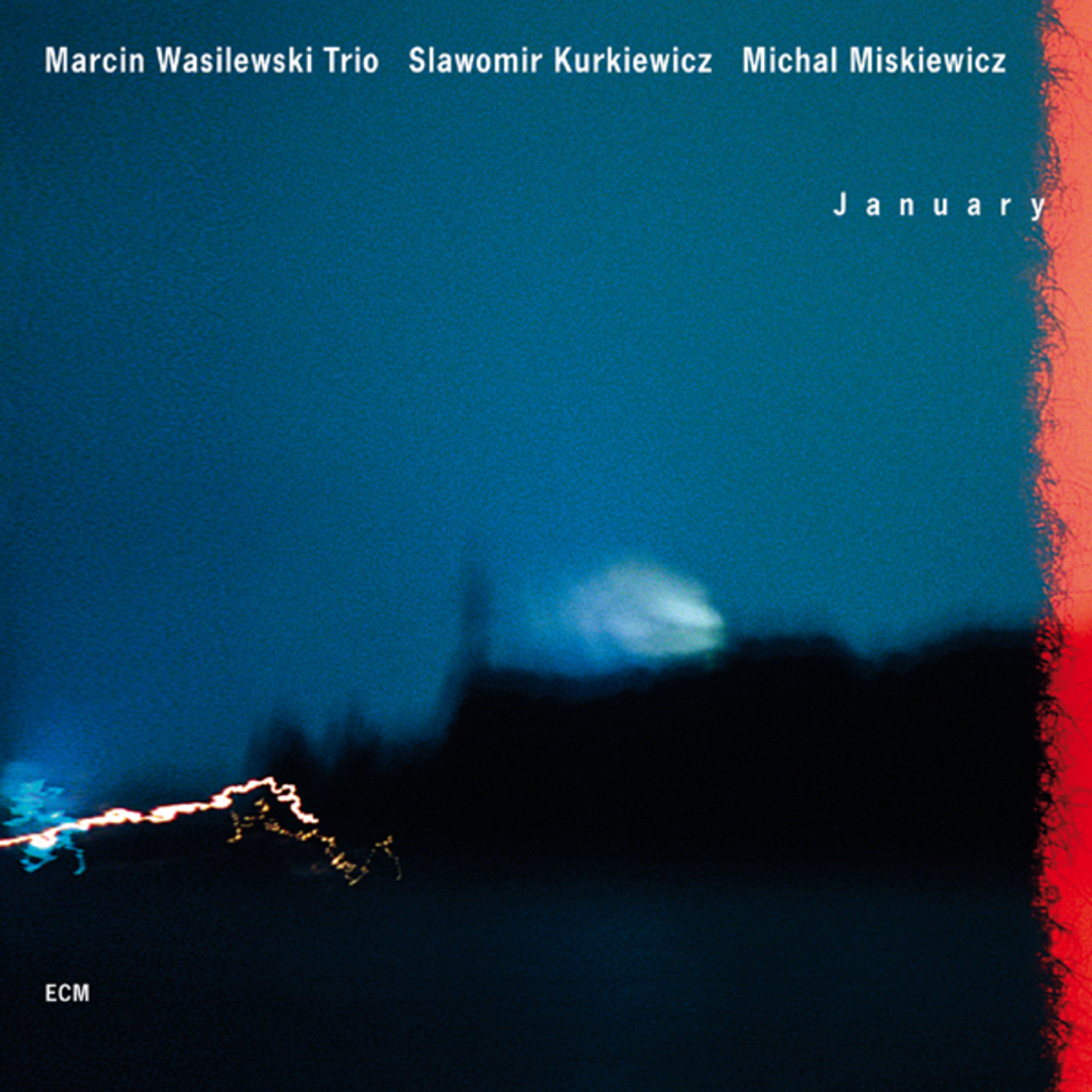
Marcin Wasilewski Trio: January (ECM 2019)

January

Marcin Wasilewski Trio
January

Marcin Wasilewski piano
Slawomir Kurkiewicz double-bass
Michal Miskiewicz drums
Recorded February 2007, Avatar Studios, New York
Engineer: James A. Farber
Produced by Manfred Eicher

Pianist Marcin Wasilewski is a seeker of themes. As nominal leader of one of the most assured trios in recent jazz history, he throws together a variety of sources, moods, and songs into one pot, stirring until every ingredient takes on something of the rest. Bassist Slawomir Kurkiewicz and drummer Michal Miskiewicz are therefore no mere sidemen. Their flavors permeate every morsel of this sonic stew, the group’s sophomore disc for ECM. With well over a decade of steady experience going into this record, it would be harder not to enjoy the synergy at play.

As per usual, the set list is grab bag of delights. Wasilewski leads off “The First Touch,” one of four original tunes, on a tender foot. The rhythm section here marks time by beats irregular and less discernible: kisses of raindrops before the album’s quiet storm. The title track, another penned by the pianist, is as somber as its season and finds Miskiewicz in a decorative mode. Balancing these are “The Cat” and “The Young and Cinema,” both decidedly hipper affairs replete with flourish and sparkle. Drums and bass crosstalk beautifully in both, the latter miked in such a way as to capture every inflection with immediate clarity.

Brightening the music’s silver screen pulse is Ennio Morricone’s “Cinema Paradiso,” of which the pianism is so delicate that it nearly floats away of its own volition. Gentle, yes, but patterned by the razor edge of nostalgia. Such blurring between image and sound is paramount at ECM, and fans of the label will encounter much to admire between two cuts suggested by producer Manfred Eicher. The trio’s loving attention to detail is especially poignant in “Vignette,” which casts a backward glance to Gary Peacock’s seminal yet often-neglected Tales Of Another. The bassing here is magnetic, independent yet resolving by a gradual return to fold. By contrast, jocularity abounds in Carla Bley’s “King Korn,” which gets a treatment to be reckoned with. There is, further, a poignant nod to Tomasz Stanko—with whom the trio first gained international notoriety—by way of “Balladyna,” an enduring swirl of leaves fallen from the tree of Stanko’s label debut.

The group’s tradition of pop do-overs continues with Prince’s “Diamonds and Pearls,” bringing to light the album’s most soaring passage and providing an aerial view of the trio’s melodic landscape. All of this ties together in “New York 2007.” This improvised blip completes the radar sweep by which this album navigates. January belongs on any jazz lover’s shelf right next to Changing Places as yet another groundbreaking statement of trio-ism from ECM. Its sounds are hollow-boned and ready to fly.