Thomas Larcher: Naunz (ECM New Series 1747)

Naunz

Thomas Larcher
Naunz

Thomas Larcher piano
Thomas Demenga cello
Erich Höbarth violin
Recorded November 1999, Europahaus Mayrhofen, Austria
Engineer: Stephan Schellmann
Executive producer: Manfred Eicher

Austrian pianist Thomas Larcher, previously known to ECM New Series aficionados as a tactful interpreter of contemporary music, with Naunz shows his colors as a composer of the same. That Larcher is a close associate of Heinz Holliger, another musician-composer of immense talent, should come as no surprise: both compose as if through a microscope. Yet while Holliger tends to languish in protracted gazes at what lies beneath his cover slides, Larcher is more interested in compressions and calms before storms—in the message of the medium. The laser-precise title piece, written 1989 for piano, evokes a particular brain chemistry and cellular dysfunction…yet also a fractured, spatial sort of harmony. Its thirteen-and-a-half-minute duration holds a broad technical spectrum on the tongue: metallurgical hammerings, bright pops, and bluesy accents trade places in carousel fashion. Every note drips like a love-sworn face, open-mouthed, a scabbard without a sword.

Thomas Demenga pushes these images deeper into the fire in Vier Seiten (1998), throwing himself into jaggedly brushed scenery. Larcher’s trust in Demenga is obvious, for even the most challenging passages flow effortlessly at the cellist’s virtuosic touch. Ley lines crack in a symphony of such intimate proportions that the piece stabilizes, settling into meditative fog curls, a muscle torn to infinity. Further bowings are put on hold for the duration of two more piano pieces. The fractured yet resonant Noodivihik (1992) works at an even more cellular level. With scientific attention, Larcher expounds its polyphony in monosyllables while moments of clarity rub up against those of murky discomfort. Not every piece, however, is so overtly disjointed, for in such a piece as Klavierstück 1986 (the collection’s earliest composition) there is overt color-bleeding, punctuated by moments of insistence that fade into bodiless reflections.

Larcher

The autobiographically inflected Kraken (1994-1997), a fascinating trio, revives Demenga and adds the violin of Erich Höbarth. In the latter’s playing is an Ysaÿe-like exuberance told yet in a language Larcher’s own, distinct for its obsessions. The entrance of piano after Höbarth’s pliant introduction lends a morose, titanic feeling of sunkenness. Violin lines evoke ghostly strangers from the wreckage, cleaving water and sky in kind. As a unit the trio forms a methodical braid, ponytail of a slumbering warrior. Larcher brings a percussive sound to his part, treading water in a marriage of staccato and legato impulses. The Holliger connection deepens as Demenga and Höbarth embark on a journey eerily reminiscent of his Duo for Violin and Cello before fragility and gnarled woodwork bring closure. Also bringing closure is the concluding Antennen-Requiem für H. (1999), an elusive piano piece that flirts with audibility by way of various extended techniques. Hands on the strings turn the instrument into a fast-forwarded film. It is a diegesis, an awakening, a genetic table setting loosed from its horizontal plane.

Larcher’s music is the equivalent of a postmortem. With a meticulousness that can only come out of self-discipline, he scours every body for clues of its demise. In so doing, he creates new life. Every helix begins a story.

<< Charlie Haden/Egberto Gismonti: In Montreal (ECM 1746)
>> Eberhard Weber: Endless Days (
ECM 1748)

Anouar Brahem: Le Voyage de Sahar (ECM 1915)

Le Voyage de Sahar

Anouar Brahem
Le Voyage de Sahar

Anouar Brahem oud
François Couturier piano
Jean-Louis Matinier accordion
Recorded February 2005, Auditorio Radio Svizzera, Lugano
Engineer: Stefano Amerio
Produced by Manfred Eicher

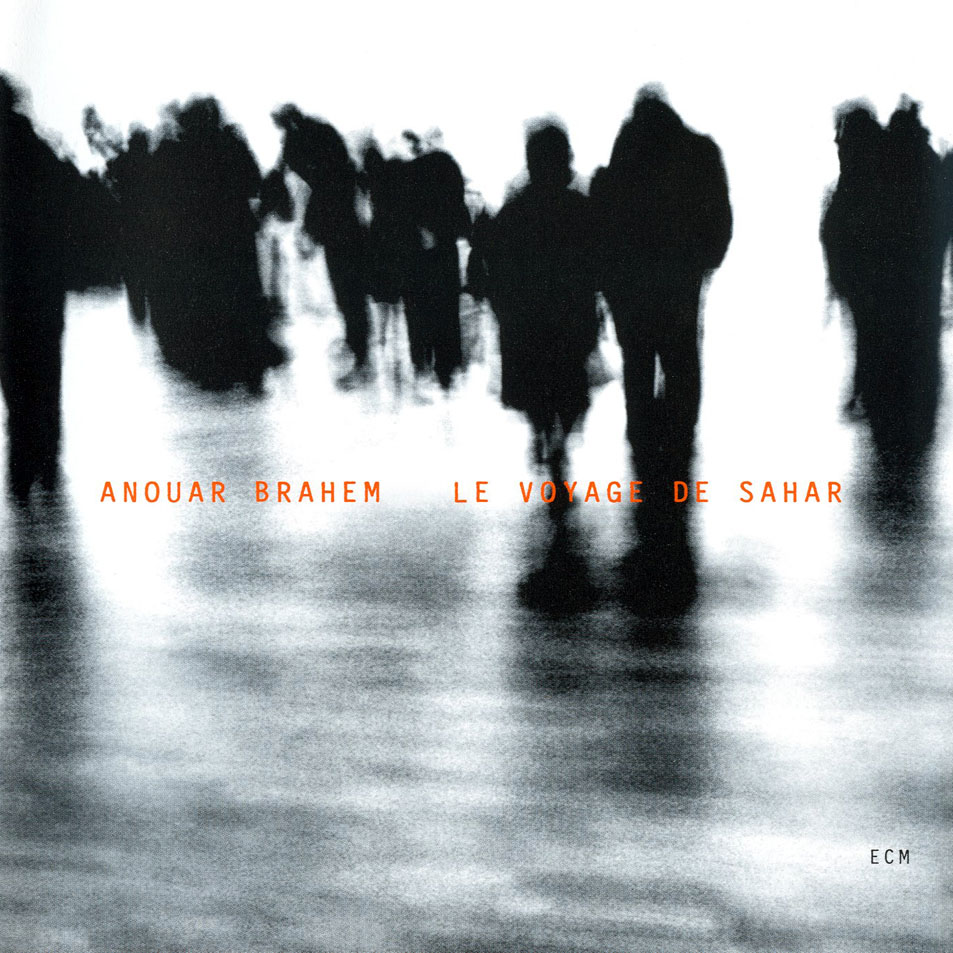
The music of Tunisian oud virtuoso Anouar Brahem and his trio with pianist François Couturier and accordionist Jean-Louis Matinier is like a magical box of movable type in which the letters form alluring, coherent stories no matter how one arranges them. The printing press this time around may be of similar make to the preceding Le pas du chat noir, but the themes are even more narratively inflected by virtue of the trio’s evolving magnetism. The strength of Brahem’s visual imagination comes strongly to the fore whenever he sings. Although wordless, his voicings on “Les jardins de Ziryab” and “Zarabanda” fold water into sand, painting cycles of intervallic bliss. The chant-like quality of his melodizing buoys Matinier’s soaring exegeses, thus providing an aerial view of the album’s intimate topography. Further whispers abound in the album’s opener, “Sur le fleuve,” which establishes a signature sound of lilting pulse and unseverable braid. As in the gentle persuasions of the title track, Brahem’s suspended steps give his associates just the shade they need to unravel their filmstrips without fear of overexposure. Each of the oudist’s wistful solos is a message in a bottle, Couturier’s chording the foamy currents it rides, and Matinier’s cries those of the recipient standing on a distant shore.

Ensuing atmospheres range in density: from the enigmatic “L’Aube,” as fragile as a mirage, to the restless abandon of “Cordoba,” each samples a different time and space in a sepia-tinted world of streets and blurred visages. Sometimes, the directions are clearer, as in “Eté andalous,” which begins in the mountains and flows down to the mainland. Other times, the music’s robust heartbeat finds balance in meditative poses and parabolic expression. Whether running across the plains of “Nuba”—each dig into the oud’s lower register a puff of kicked-up clay—or drowning in the insomnia of “La chambre,” these are ever-thoughtful alternate realities.

Rounding out the disc are three of Brahem’s most requested tunes, freshly realized. “Vague” and “E la nave va” form a diptych (the former revived from its appearance on Khomsa). With the regularity of a train warning sign, two red eyes alternating winks in the night, it crosses hands until one body is indistinguishable from the other. “Halfaouine” (cf. Astrakan café) is a brief yet luminescent passage of cascading beauty, the swirl of grounds at the bottom of a coffee cup.

The Anouar Brahem Trio wears a skin of gold, sings with a tongue of silver, and moves in gestures invisible. And whatever it chooses to communicate, one can always be sure its language needs no translation.

Charlie Haden/Egberto Gismonti: In Montreal (ECM 1746)

In Montreal

Charlie Haden
Egberto Gismonti
In Montreal

Charlie Haden double-bass
Egberto Gismonti guitar, piano
Recorded July 6, 1989, Festival International de Jazz de Montréal, Salle Marie-Gérin-Lajoie, Université du Québec
Recorded by La Chaîne culturelle de Radio-Canada
Recording and mixing engineers: Alain Chénier and Michel Larivière
Editing and mastering: Denis Leclerc
Recording and mixing producer: Daniel Vachon
Executive producer: Manfred Eicher

Twelve years after it was recorded at the Festival International de Jazz de Montréal, this landmark performance by legendary American bassist Charlie Haden and Brazilian guitarist-pianist Egberto Gismonti at last saw the light of day in 2001. The concert marks the sixth of eight organized by the festival in celebration of Haden’s ongoing legacy. Haden had plenty of experience playing with Gismonti as part of their Magico trio with Norwegian saxophonist Jan Garbarek, yet the distillations offered here are entirely of another plane.

From the Magico songbook the duo plays “Palhaço” (a trio staple by Gismonti), as well as the Haden-penned “Silence.” Both feature Gismonti’s astonishing pianism, balancing florid biospheres with ponderous asides, Haden all the while drafting the terms of endearment by which every page turns. Haden the composer also reveals the set’s deepest piece: “First Song.” Featuring Gismonti on acoustic guitar, its intuition soars for all its quietude. A pleasant street scene, a childhood memory, a favorite scent in the air…exchanging glances in a melodic triangle. Such trade-offs mark the session for its selfless ingenuity. So, too, the jangly undercurrents of opener “Salvador” and “Em Familia,” both of which reference Gismonti’s work with Academia de Danças and, as such, reflect a bold unity of purpose. The latter’s invigoration grabs scruffs and throws us skyward, even as it gives us wings to fly. And fly we do into quiet pockets of cloud, each the eye of a storm where the leaves barely tremble to the tune of Gismonti’s masterful harmonics. Also notably from the Academia repertoire are “Maracatú,” a study in contrasts, and “Frevo,” in which pointillism at the piano inspires dramatic, resonant depths from Gismonti’s partner. “Don Quixote” (previously featured on Duas Vozes with percussionist Nana Vasconcelos) closes with an elegy-turned-anthem, a shifting ocean of temperate love.

Although there is much to admire in Gismonti’s prodigious guitar playing, it’s at the piano where his musicality truly shines. How wonderful to get so much of it here. And no bassist crafts melodies quite like Haden. He keeps the earth in mind, even when there is nothing but sky ahead of us, scaling the ladder from light to dark and back to light while Gismonti filigrees his playing like a frame around a picture. In Montreal is a must-have for fans of these unique talents, who together forge a distinctly “global” sound: not world music, but music for the world.

<< Heino Eller: Neenia (ECM 1745 NS)
>> Thomas Larcher: Naunz (
ECM 1747 NS)

Heino Eller: Neenia (ECM New Series 1745)

Neenia

Heino Eller
Neenia

Tallinn Chamber Orchestra
Tõnu Kaljuste conductor
Recorded August 1999, Estonia Concert Hall, Tallinn
Engineer: Teije van Geest
Produced by Manfred Eicher

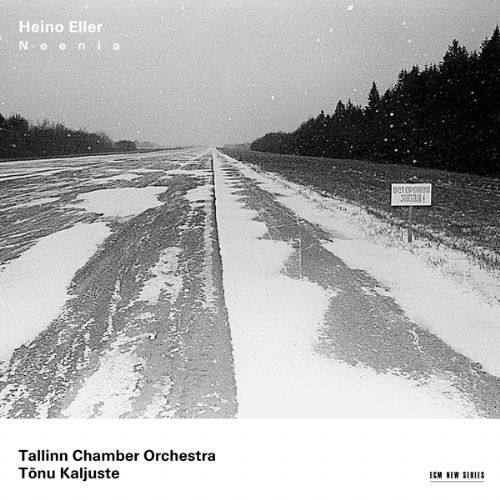
The word “trauma” comes from the Greek, meaning “wound.” The derivation seems apt: a wound leaves one prone to infection from invisible forces, while from it exudes the very stuff that keeps us alive. According to classical Freudian psychoanalysis, a healthy Ego redirects traumatic influence, thereby protecting us from overstimulation. Otherwise, the trauma festers within. Either way, the subject is spared the pain of being consciously aware of the affliction in question. Music, however, inflects this view somewhat differently. In that of Estonian composer Heino Eller (1887-1970), a distinctly autobiographical impulse floods us neither with catharsis nor with a working-through. It is, rather, a fullness of life that sees death not as non-existence but as one of many equal facets.

Eller’s stamp on Estonian concert music cannot be overstated: his was the spark that set a revolution aflame. His influence pulses on in the work of his many students. Arvo Pärt, for one, fondly remembers his composition teacher as a noble human being who nurtured an open and personal approach, as the founder of Estonia’s professional music scene, and above all as a musician of “strict logic.” Yet Eller’s personal life was also indelibly marked by a strictly illogical act: the murder of his wife, Anna, at the hands of occupying Nazis. It was during this period that his Lüüriline Süit (Lyric Suite, 1945), originally composed for piano but heard here in an orchestral reworking, came to fruition. The heartrending physicality of its mortal undercurrents breathes with the ache of living—a sound as only the Tallinn Chamber Orchestra under Tõnu Kaljuste’s direction could elicit without need for the background sketched above. Each of its six movements is corporeally minded, a ballet of actors on a sociopolitical stage. In the final movement especially one notices the rhythmic sensibilities inherited by such progenitors as Erkki-Sven Tüür, only here they pick at a scab that will never heal. The depth of landscape is masterful, its contrasts of texture and time, of heaven and hell, indicative of all that follows.

The 1928 title composition is a memorial to friend Johannes Arro (1865-1928). A tone poem of majestic emotional depth, it undergoes constant color changes, each continuing the gloomy dramaturgy of the opening suite. The Five Pieces for String Orchestra (1953)—of which “Homeland Song,” says Pärt, is the Estonian equivalent of Sibelius’s Finlandia—unfolds in a more fragmentary, though no less organic, sense of architecture. Like that of Antonio Gaudi, straight lines are rare and there is a beginning at every end. Densities also vary: a solo violin draws a silver thread through the occasional needle, pocking the clouds with patches of sky. From lively dances to saturnine dips, the overall effect is stirring and reminds us that home is never far away, so long as one can find a song to share.

The concluding works of the program embrace the spectrum of Eller’s craft. The Sümfonietta (Sinfonietta, 1965-67), his last major composition, speaks in a language of catch and release. Every time it seems to tip, something swoops in to steady it. Agitations in the lower strings draw a screen as translucent as rice paper yet as impenetrable as an iron fortress as we are moved through a vast unraveling into the final dance, the spirit alive and forthcoming with its light. The promise of that light is realized in Eleegia (Elegy, 1931) for string orchestra and harp. Written in memory of another musical friend, Peeter Ramul (1881-1931), its lachrymose reflections turn into titanic hope, drifting through joyful memories to get there. All of which brings us full circle to the knowledge with which we began: namely, that something of our lives, whether given or taken away, persists beyond the measure of all the grief in the world.

The listener will be hard-pressed to locate a single abrasive maneuver in Eller’s compositions. Each is a coherent entity. There is feeling that the music will go on without ever resolving itself, but that in that lack of closure time becomes its own mirror. We may never understand the persistence of violence, but at least it may be temporarily diluted by the draw of a bow.

<< Trygve Seim: Different Rivers (ECM 1744)
>> Charlie Haden/Egberto Gismonti: In Montreal (
ECM 1746)

Iva Bittová: s/t (ECM 2275)

Iva Bittová

Iva Bittová

Iva Bittová voilin, voice, kalimba
Recorded February 2012, Auditorio Radiotelevisione svizzera, Lugano
Engineer: Stefano Amerio
Produced by Manfred Eicher

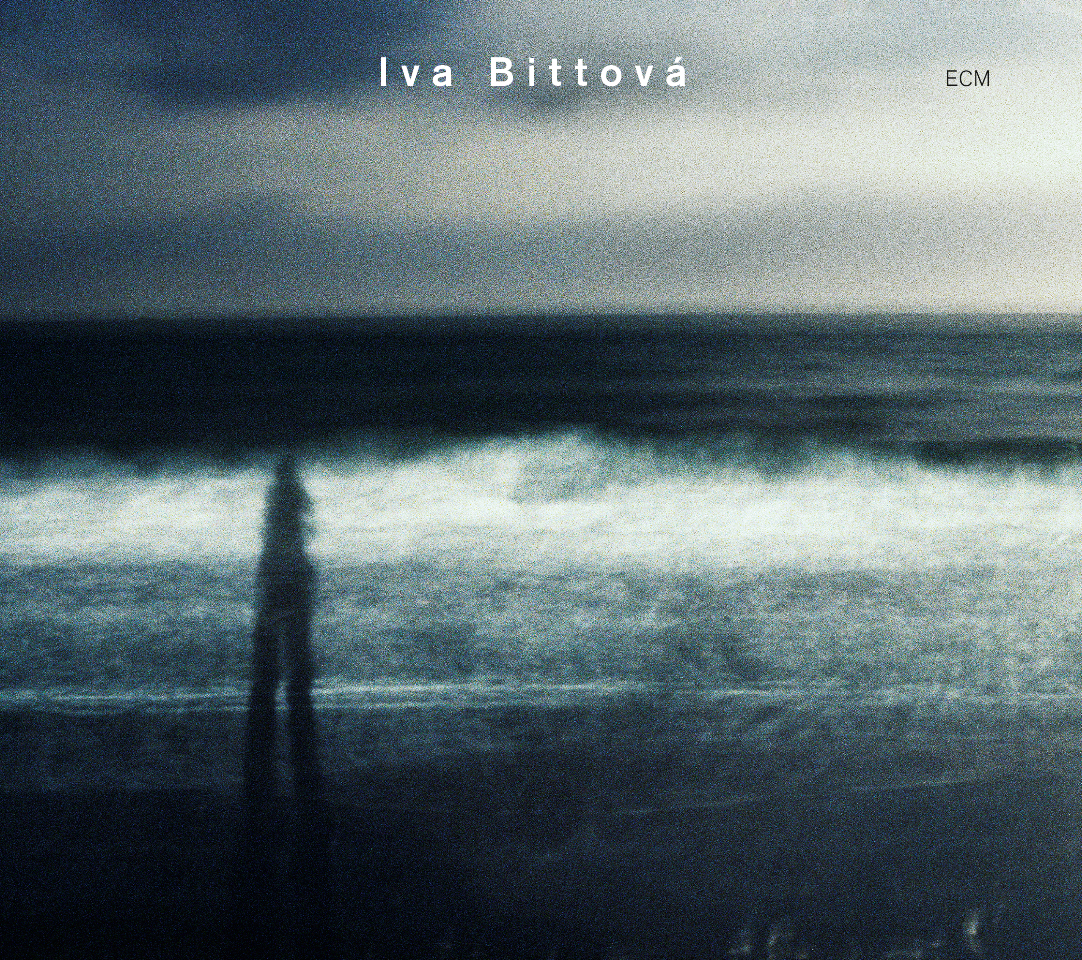
Characterizing the music of Iva Bittová as resistant to definition both describes it perfectly and does it a disservice. The former, because her minimal tools of violin and voice elicit a museum’s worth of colors, moods, and brushstrokes. The latter, because every listener will emerge from that museum with a unique image in mind that is anything but indefinable. Despite her many creative personalities—which encompass acting, performing, and composing—she has achieved notoriety by no small feats of expression. Still, don’t be mistaken: this is no “avant-garde” artist. She’s not upsetting paradigms, but deepening their self-awareness.

“The violin accompanies me all the time,” says Bittová of an instrument that has centered her musical life since the early 1980s. “It is a mirror reflecting my dreams and imagination.” Yet she is, above all, a singer. Whether through vocal folds, bow, or physical gesture, her voice strikes flint to stone and blows a tangle of weed until it glows. So potent is said voice that it inspired fellow Czech composer Vladimír Godár’s Mater (documented most recently in a 2007 release for ECM New Series), a multilayered cantata on women-centered texts of which Bittová is both sun and satellite.

Iva

This self-titled solo album finds Bittová in her element in a series of 12 numbered “Fragments,” and because fragments imply a whole, it makes sense to speak of the album as such. Like a work of masterful anamorphosis, its image emerges only by submitting oneself to its perspective. Twelve is, of course, a mystical number. It defines the modern clock, marks the end of childhood, numbers the Bibical apostles, and zodiacally divides the heavens. Here it is a riddle that harbors many more.

The album begins and ends with her voice slaloming through the delicate signposts of a kalimba. Here and throughout there is harmony and tension, starlight and soil. At one moment, her voice and bow may unify. At another, her feet go their separate ways, divorced from body and destination. Pizzicato gestures seem to pluck hairs from the scalp of the night, while arco gestures get lost in mazes even as Bittová draws them. Sometimes: her voice alone, spoken and then sung, so that incantation becomes chant becomes lullaby in one fluid swing. Sometimes: the violin alone, crossing every bridge without ever touching feet to plank. Sometimes: a river’s flow through black forest, hints of love and travel.

To be sure, ghosts of a Slovakian heritage breach the fabric of time that veils her, but the freshness of her storytelling makes it all feel uncharted. For while she does adapt the music of Joaquín Rodrigo in Fragment VI and sings texts by Gertrude Stein and, notably, Chris Cutler in others (III and VII, respectively), she renders these sources personal and organic through her crafting. Words like “gypsy,” “folk,” and “tradition,” then, might as well be gusts of air, so intangible are they in her sound-world. That being said, her art is certainly rooted in a worldly sense of time and plays with that notion as would a hummingbird flirt with a backyard feeder. Her sound is resilient to climatic damage, for it has already absorbed so much of the oxidation that gives it character, and her tone is never brittle, even at its thinnest. In fact, the album’s strongest moments are to be found in her unaccompanied singing. From gentle cuckoo to shaman’s possession, her voice cycles through many (after)lives and makes this world of social details begin to feel other-cultural.

Here is an artist whose sense of architecture is wholly translucent, whose persona is her crucible, and whose music is an embodied practice, a mimesis personified to the point of healing.

(To hear samples of Iva Bittová, click here. See this review as it originally appeared in RootsWorld magazine.)

Trygve Seim: Different Rivers (ECM 1744)

Different Rivers

Trygve Seim
Different Rivers

Trygve Seim tenor and soprano saxophones
Arve Henriksen trumpet, trumpophone, vocals
Håvard Lund clarinet, bass clarinet
Nils Jansen bass and sopranino saxophones, contrabass clarinet
Hild Sofie Tafjord french horn
David Gald tuba
Stian Carstensen accordion
Bernt Simen Lund cello
Morten Hannisdal cello
Per Oddvar Johansen drums
Paal Nilssen-Love drums
Øyvind Brække trombone
Sidsel Endresen recitation
Recorded December 1998, January and December 1999 at Rainbow Studio, Oslo
Engineer: Jan Erik Kongshaug
Produced by Trygve Seim, Christian Wallumrød, and Øyvind Brække
Executive producer: Manfred Eicher

Breathe, and you know that you are the world.

Different Rivers marks Norwegian saxophonist Trygve Seim’s emergence from the ECM wings as a leader in his own right. Well versed in the label’s vital documentation of European improvising (not least of all through his life-changing tenure with Finnish drummer Edward Vesala), Seim draws upon those influences to pool his talents for the present disc, which deepens the free spirit of his so-called Trondheim Kunstorkester. Trumpeter Arve Henriksen—notably, a close associate of Christian Wallumrød—and a host of Scandinavian talents round out an ensemble of remarkable depth and poise.

Seim’s three duets with Henriksen are the album’s acupuncture points, each a vitalization of the whole. The breathy meditations of “Bhavana” and the flutter-tongued percussiveness of “Between” both spin on fluid axes, but it is “For Edward” that breaks its gravitational ties and flows outward into the universe. Seim’s shakuhachi tone reveals superb control of his reed, a sound honed by oneness with its source. Like two cranes calling to one another in the night, never able to find a way across the Milky Way between them, he and Henriksen paint bridges of artful listening in lieu of earthly travel. Even when they are surrounded, as in the title track, they are ever swimming toward something galactic.

The trumpeter reveals his vocal skills in opener “Sorrows.” In wispy arpeggios he lurks, stranger among a crowd of consenting instruments. The effect is ghostly, sirened by keening higher reeds. With the exception of “Search Silence” (a curious little flicker of geometry), the album’s remainder samples a likeminded palette. The subconscious beats of “Ulrikas Dans” brush on a light gesso for bolder horn strokes. Seim’s piercing harmonics lend an angelic touch, and his tenoring on “The Aftermath” spins a charm bracelet of wispy melodic cells. This life further into the sun-swept plains of “African Sunrise,” giving name to the aching land. Drummer Per Oddvar Johansen’s flint-strikes incite a conflagration in Seim’s playing, ending on scream. I daresay this and “Breathe” are two of the finest tracks in the ECM catalogue. The latter is a mission statement, a parable on the profundity of simplicity. Amid the band’s resonant atmospheres, vocalist Sidsel Endresen recites a powerful wakeup call. She finds a process in every wing-flap, every sprout and blossom, as blurry horn textures translate word into life.

The strengths of Seim’s compositions, and of those interpreting them, lie in their control and dynamic range. Their roots are as deep as their branches are tall, softly aflame with autumnal themes. Case in point: “Intangible Waltz,” which follows Henriksen’s patterns through thick forest and barren field alike. Its central whisperings between drums, accordion, and trumpet work wonders under the microscope. No matter how calm and thin its layers become, it allows visions of a dancing light to seep through.

Seim’s is a viscous music; don’t expect to swing. Meditative and ashen, every track of Different Rivers feels as if it was recovered from the archives of a lost culture, of which only this music remains to represent it. Let the rebuilding begin.

<< Ralph Towner: Anthem (ECM 1743)
>> Heino Eller: Neenia (
ECM 1745 NS)

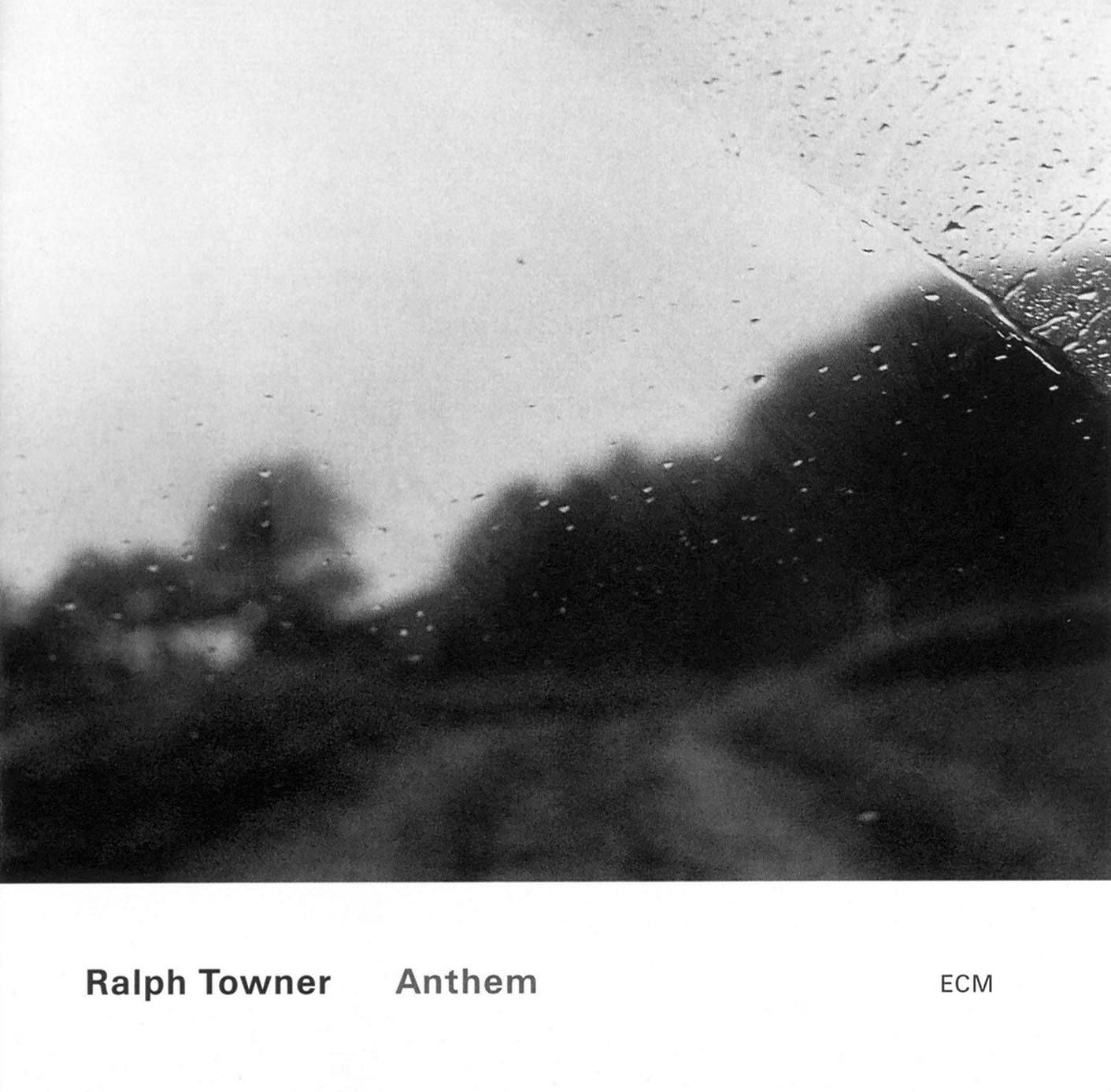
Ralph Towner: Anthem (ECM 1743)

Anthem

Ralph Towner
Anthem

Ralph Towner classical and 12-string guitars
Recorded February 2000 at Rainbow Studio, Oslo
Engineer: Jan Erik Kongshaug
Produced by Manfred Eicher

Once the luminescent 12-string of Ralph Towner opens the ears to the thoughts of “Solitary Woman” (aka “Alia’s Theme,” composed for the 1992 film Un’altra vita), there’s no turning away from the guitarist’s captivation. Towner’s ability to tell a story is uncanny: we know his characters as if they were ourselves but are at pains to describe them in retrospect. His is a music that must be lived, and relived, to be known. The modal approach of the album’s opening gambit proves revelatory in its percussive and emotive variety and compresses so much of what marks Towner’s mastery into one piece. Like nearly the rest of the album, it looks back also to an adroit compositional mind, one that recognizes the equal value of improvisation as a tool of expression.

Most the album features classical guitar. The title track gives solemn praise to the musical act itself. The sweep of Towner’s evocative sensibility is compass-like. Down the helical twirl of love and loss that is “Haunted,” he slides into “The Lutemaker.” Something of a sonic equivalent to James Cowan’s novel A Mapmaker’s Dream, it is a concise yet somehow beautifully varicose embodiment of its subject matter. It feels so real one can almost smell the workspace, hear the luthier’s plane singing. “Simone” is another of the album’s mysterious figures, her face familial yet also obscured by the ripple of shadow that she wears like the night. “Gloria’s Step,” by the tragically short-lived Scott LaFaro, is yet another and links Towner back to the Bill Evans circle in which he trained. It receives a studious and impassioned rendering at Towner’s fingertips and leads into the gallery of “Four Comets,” which along with “Three Comments” comprises one of two handfuls of sparkling miniatures. The former’s six-stringed sky becomes the latter’s 12-stringed loom, both spaces through which creative shuttles weave their constellations for others to decipher.

“Raffish” is a perfect example of Towner’s crystalline brand of jazz, at once deferential to past masters (hence the album’s title) and overtly countercultural in its sometimes-overwhelming optimism. The angularity here is refreshing. “Very Late” is another architecturally sound track. Its title bleeds from the music and reaches a steadying hand toward “The Prowler,” a programmatic gem. “Goodbye, Pork-Pie Hat” reprises the 12-string one last time, bringing the album back to its resonant beginnings in an especially intimate rendering of this classic Charles Mingus tune.

There is a depth of refrain in Towner’s music, and on Anthem it is alive with a direct philosophy that feeds also into the engineering. It is, quite simply, one of the finest solo guitar recordings to come out of ECM’s studios. Its balance of distance, finger action, and breath control is as erudite as that of the artist it documents. When medium and message are so well unified, who could ask for more?

<< Crispell/Peacock/Motian: Amaryllis (ECM 1742)
>> Trygve Seim: Different Rivers (
ECM 1744)

Crispell/Peacock/Motian: Amaryllis (ECM 1742)

Amaryllis

Amaryllis

Marilyn Crispell piano
Gary Peacock bass
Paul Motian drums
Recorded February 2000 at Avatar Studios, New York
Engineer: James Farber
Produced by Manfred Eicher

With Nothing ever way, anyway, the trio of pianist Marilyn Crispell, bassist Gary Peacock, and drummer Paul Motian degaussed the sonic landscape. With this, its follow-up, the trio redefines itself. If in that debut Crispell proved the sonority of her craft as an improviser, here she proves the craft of her sonority. Whether evoking river’s flow or faucet’s drip, there is such palpable structure to her playing that one can almost live in it.

“Voice from the Past” gazes back to Gary Peacock’s 1982 album of the same name while also trudging forward in anticipation of what sigils it might inscribe by virtue of its fresh passage. Even the composer seems compelled to drown in his own creation, allowing Crispell’s porpoises to shake their bottlenoses in slow motion to the rhythm of Motian’s tide. Conversely, Peacock stands out in the pianist’s title track, which for all its prettiness cages a lonesome heart. There is a feeling of nature as entity, as if it were somehow able to brush away the veneer of our sadness and flow resolutely into its cause. “Requiem” is another dip into classic Peacock, this off his 1987 effort Guamba, again played here as if for the first time. Peacock takes the foreground as an artist grabs a paintbrush: which is to say, swiftly but respectfully. Yet even when composer and process sync with expectation, as they do also in “December Greenwings” (referencing 1979’s December Poems), Crispell is not to be overshadowed, for she brings a tree’s worth of blossoms into full view. As a melodic first responder, she unpacks Peacock’s compact phrases with obvious delight, and in her own “Rounds”—which connects the dots back to her 1983 album for Cadence, Spirit Music—she blankets our vision with flurries of brilliance. Strong as his drumming is in this track, Motian’s own compositional voice grabs even more attention in the trio’s slippery rendition of “Conception Vessel” (which titles his 1973 album) in conjunction with “Circle Dance.” The latter in particular elicits some of Crispell’s profoundest atmospheres, channeling Keith Jarrett at his most sacred. Motian’s “Morpion” solidifies the triangle by muscling its wide mane down connecting avenues of shine.

During sessions, producer Manfred Eicher further bid the musicians to improvise in the spirit of seeing what might take shape. Striking is how distinct the results are from their surroundings. “Voices” lays out a bed of bass and drums, one resonating and the other in a state of decay, and gives the piano an amorphous tree up which to climb. “Silence” is an album highlight, a real stunner that leaves us hanging from a branch of Zen-like irresolution. “M.E.” naturally pays tribute to Eicher, without whom it would not have taken shape and whose miraculous influence echoes through every touch of finger and brush, here and beyond. Another flask of inspiration drained and refilled to the last drop. “Avatar” is similarly gauze, fecund, and free. Pure magic, but with the bonus of “Prayer” (by clarinetist Mitchell Weiss) providing the final kiss to ensure the spell’s completion.

The most significant revelation of Amaryllis for ECM devotees is Crispell, who underscores the fortuitousness of having “crisp” in her surname with a string of performances that are exactly that. She is an expert at deep listening, and can provoke only the same in we who listen in turn.

<< Bobo Stenson Trio: Serenity (ECM 1740/41)
>> Ralph Towner: Anthem (
ECM 1743)

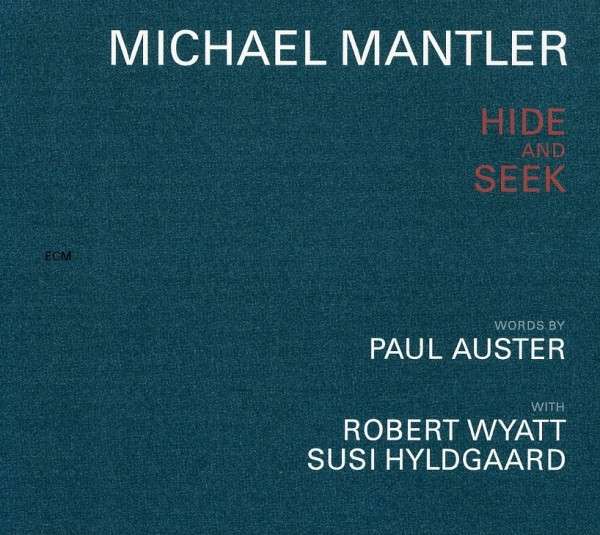
Michael Mantler: Hide and Seek (ECM 1738)

Hide and Seek

Michael Mantler
Hide and Seek

Robert Wyatt voice
Susi Hyldgaard voice, accordion
Roger Jannotta flute, oboe, clarinets
Michael Mantler trumpets
Martin Cholewa French horn
Vincent Nilsson trombone
Bjarne Roupé guitars
Tineke Noordhoek vibraphone, marimba
Per Salo piano
Marianne Sørensen violins
Mette Winther violas
Helle Sørensen cellos
Recorded and mixed February-Septemer 2000 at Danish Radio Studios, Copenhagen
Engineer: Lars Palsig
Vocals recorded April 2000 at Gallery Studios, London
Engineer: Jamie Johnson
Electronic percussion programmed by Michael Mantler, sounds realized at Subzonique
Produced by Michael Mantler

Michael Mantler is a force: not to be reckoned with, per se, but of reckoning itself. He is an artist of voices, one who, as the title of this operatic jewel attests, seeks them out from hiding. One of those, Robert Wyatt (long since found), is a singer with whom this album furthers a 25-year collaboration. Another is Susi Hyldgaard (also an accomplished accordionist), who first rose from within the Mantler fold in his masterwork The School of Understanding. Accompanying them is an expanded version of the composer’s loosely termed Chamber Music and Songs Ensemble, which opens its wings to include, on winds, Roger Jannotta (of Tom van der Geld’s elusive Children At Play) and Danish pianist Per Salo. Also (omni)present is Bjarne Roupé, a guitarist who has become an integral player in Mantler’s soundings. The most vital instrument of all, however, is the text by Paul Auster, an author on Mantler’s mind for years and whose eponymous short play lends itself starkly to the composer’s unmistakable brand of telepathy. The result is no mere setting, as Mantler takes his scissors (with the author’s approval) to its language with surgical care.

Holograms are constructed in such a way that if you cut them into pieces, each retains the entire image on a smaller scale. Such is the dynamic of Hide and Seek’s seventeen miniatures. Not one is fragmentary but rather contains elements of the whole. The purely instrumental “Unsaid” dots the program in six parts, the first of which opens. In them one encounters swarms of commentary, some more modest than others, around the guitar’s queen bee. In them are the agitations into which the play’s two characters are so reluctant to give. The balance is meticulous. It allows Wyatt and Hyldgaard to dance in their circles of comfort, breaking even in their seesawing between resignation and martyrdom even as the strings paint cracks in the glass above. Unsaid, yes, but not un-voiced.

“What did you say?”

These words introduce us to a drama of elliptical conversational elements. They cradle in their hands steaming plates of indecision, miscommunication, and vulnerability, which take the piece’s full duration to consume. Voices get caught up in their own vices, and in that process also take advantage of a few loopholes. Statements become facing mirrors lost in a mise-en-abyme of their own making. In their net the accordion occupies stage center, emotes without semantic limitations, while Mantler’s trumpet drips with guidance.

“What do you see?”
“Absolutely nothing”

Question and answer. Cloud and rain. Strings and footsteps. These comprise the core of Hide and Seek, their refrain a powerful marker of identity, or lack thereof, in which all traction is gilded, amplified. The tangled web of “What can we do?” features Mantler’s electronically programmed drums in a whirl of self-realization. It also poses the album’s most pertinent question, for which it has no answer but the melody of its asking.

“It all has to end sometime”

Closure by conjuring. An impending doom, so dark it is beautiful. In its shadows Wyatt and Hyldgaard make an emotionally foiled pair, especially in the final leg. They braid acceptance, parrying and thrusting their way toward the simple resolution of “I’m glad you’re glad.”

All of which culminates in two of Mantler’s most perfect shapes. The circling electric guitar of “Do you think we’ll ever find it?” marks a standout denouement, while “It makes no difference to me” sets speech atop a fulcrum of rocking strings. A return to the game, the accordion’s song passes through the door and on to the next chapter, as yet unwritten.

<< Vassilis Tsabropoulos: Akroasis (ECM 1737)
>> Ensemble Belcanto: Come un’ombra di luna (
ECM 1739 NS)