
Bach: Sonatas and Partitas (ECM New Series 1909/10 & 1926/27)

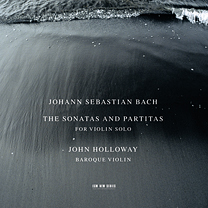
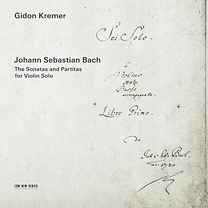
Johann Sebastian Bach
The Sonatas and Partitas for Violin Solo
as played by John Holloway and Gidon Kremer

Recorded July and September 2004, Propstei St. Gerold (Holloway)
25-29 September 2001, Lockenhaus, Pfarrkirche St. Nikolaus, and 10-15 March 2002, Riga (Kremer)
Engineers: Stephan Schellmann (Holloway) and Niels Foelster (Kremer)
Produced by Manfred Eicher (Holloway) and Helmut Mühle (Kremer)

I first heard Bach’s Sonatas and Partitas for solo violin on vinyl under the bow of Thomas Zehetmair in his awe-inspiring Teldec recording, which remains my interpretation (and format) of choice. Ever since Zehetmair signed with ECM, I have constantly wondered what untold pleasures a repeat performance for the label might bring. Sadly, this has yet to be realized. Thankfully, however, ECM listeners have two complementary representations to choose from, and for this reason I review them side by side.

Looking Back
As one of the world’s foremost Baroque violinists, John Holloway brings four decades of intimate engagement with these masterworks to the proverbial table. Working from the original autograph score, Holloway takes meticulous care in observing every detail of articulation as a means of arguing for the composer’s own deeply informed knowledge of the instrument. His supple playing and humble approach make for one of those rare “historically informed” performances that actually dusts off the ravages of time and breathes cleanly rather than calling attention to its antiquity. Not only does he bring a visceral robustness to the Adagios and a refreshing regularity to the Prestos, but he also makes sure that every tempo in between is given its own dynamic quality.

I have always cherished the Allemanda of the B minor Partita over all, as it is the last piece I learned to play on the violin before I abandoned the instrument to focus on training my voice. It is typically the standard I go by when encountering a new version for the first time and I am proud to report that Holloway draws from it a wealth of seductive material for our auditory perusal. He adopts a similar posture in the Fuga of the A minor Sonata and in the Siciliana of the G minor sonata, both of which scintillate like dark pools in moonlight. But the true gem of this collection is the D minor Partita, where we encounter one of the most heartrending Sarabandes imaginable, an absolutely resplendent Giga, and as finely executed a Ciaccona as one could hope for. The C major Sonata brings out another exemplary performance, especially in the haunting vulnerability injected into the Allegro assai. The E major Partita is pitch-perfect. Its immediately recognizable Preludio shines with renewed verve in Holloway’s hands.

Looking Ahead
What can one say about Gidon Kremer? He is one of the leading innovators among contemporary classical performers, having inspired a wealth of commissioned music and a somewhat controversial discography of variable projects. Kremer first recorded these pieces for Philips in 1980 and returns to them here in a self-professed “final statement” on Bach. As any avid Kremer listener can expect, this interpretation is at once fiercely idiosyncratic and deeply aware of its roots. His G minor Sonata is appropriately subdued and sets an introspective tone for the entire performance. Kremer truly stands out in the fast movements, such as in the Double Presto of the B minor Partita and the delicately executed Allegro assai of C major Sonata, where he is able to put his dynamic energy on full display. He also puts his “GK” stamp on the more dance-like movements, such as his ravishing Tempo di Borea from the B minor Partita and the Gavotte en Rondeau of the E major Partita. This is not meant to imply, of course, that he is without sensitivity. Under Kremer’s agile fingers the Andante of the A minor Sonata weeps with unrivaled ardor, the Sarabanda of the D minor Partita stumbles with an unusually supplicatory air, and his C major Sonata Adagio brings a whole new sense of tortured emotion to a movement so often played with reserve. Kremer revels in the rhythmic possibilities afforded to him by the score, stretching out as many moth-eaten holes in its musical fabric as he can, so as to emphasize its polyphonic structure and harmonic integrity. He also shows a predilection for sharp attacks. Witness, for example, his crisp Ciaccona, which punctures the ether with the power of a thunderclap. And what of my beloved B minor Allemanda? It has taken some getting used to, but I can now appreciate Kremer’s halted style and flawless tuning, and the liveliness he brings to this somber dance is uniquely his own.

I would never venture to say which of these performances is “better” than the other. Holloway plays at period pitch, while Kremer opts for a modern tuning, resulting in two entirely different experiences. Holloway’s opaque sonorities become Kremer’s airy glitter. These are both recordings to be savored and revisited. The reverberant acoustics and attentive microphone placement put Holloway’s a head above the rest in sound quality, while its somber undertones speak to the violinist’s humility in the face of Bach’s complex symmetries. Then again, Kremer’s staggering attention to detail and variation prove once again why he is one of the instrument’s sharpest proponents. I can only recommend both for their technical spread and complementary attitudes. Not to mention that the pieces themselves belong on any music lover’s shelf.

Arvo Pärt: Arbos (ECM New Series 1325)

Arvo Pärt
Arbos

The Hilliard Ensemble
David James countertenor
Rogers Covey-Crump tenor
John Potter tenor
Gordon Jones baritone
Christopher Bowers-Broadbent organ
Gidon Kremer violin
Vladimir Mendelssohn viola
Thomas Demenga cello
Brass Ensemble Staatsorchester Stuttgart
Dennis Russell Davies conductor
Arbos, An den Wassern zu Babel, Pari Intervallo, De Profundis, and Summa recorded March/August 1986, Karlshöhe, Ludwigsburg
Engineer: Martin Wieland (Tonstudio Bauer, Ludwigsburg)
Stabat Mater, Es sang vor langen Jahren recorded January 1987 at St. John’s Church, London
Engineers: Peter Laenger and Andreas Neubronner (Südwest Tonstudio, Stuttgart)
Produced by Manfred Eicher

The music of Arvo Pärt, says Wilfred Mellers in his liner notes, is “concerned with the numinous”; as direct a statement as one can make about the sounds contained in this relatively neglected disc, overshadowed as it often is by the popularity of Te Deum and Tabula Rasa. For those new to Pärt, the wide selection represented in Arbos makes a solid primer. From the succinct to the majestic, the listener is treated to a carefully programmed process of transformation, culminating in one of the great masterpieces of modern choral literature.

The journey begins with the title piece, a terse blast of energy scored for brass and percussion. While cacophonous and chromatic, it is also perpetual and dark, providing the core for the “Dies irae” of Pärt’s later Miserere. On its own, it swirls into a self-sustaining galaxy that becomes more ordered with distance.

An den Wassern zu Babel saßen wir und weinten renders the well-known “By the rivers of Babylon” passage from Psalm 137 in a series of lilting triads, alternating between men’s and women’s voices. Here and elsewhere throughout the album one encounters the essence of the composer’s “tintinnabuli” style. Sustained tones from organ thread a line of subdued vocal beads, reaching ever higher, only to fall like kites whose strings are cut.

Pari Intervallo provides respite from denser surroundings. Comprised of gravid lead tones resting on a blanket of softer commentary, it is a funereal postlude, waiting and watching as the end draws near, promising not cessation but new life in its reverberant heart. It is a sublime meditation on the meaning of divinity and the divinity of meaning, a soul left unscripted by the wayside, where it can be captured neither on paper nor in sound. And yet, here we find an attempt to sketch its contours against our better judgment, against our feelings of inadequacy, against our assumptions of complexity in all things spiritual. In this piece we find the fibers that bound the garments of Christ on the cross, the creaking of knees of those who knelt at his feet. Pari Intervallo shimmers like heat distortion, moving with the force of a slow tide before receding into a still sea.

This is followed by Pärt’s stunning De Profundis, which also makes an appearance in the Miserere, if augmented by a broader choral palette. Different also here is the recording, which is less spacious (the bass drum, for one, is far more present). The voices are allowed to luxuriate in their own fallibility, in that beauty of impermanence that makes them human. In exposing its fragility so readily, the music becomes resilient. An organ provides the waters upon which this vessel of music floats, while a gong adds a dual note of ceremony. Whereas this piece brings us to the end in Miserere, as a standalone composition it seems to suggest a beginning.

Es sang vor langen Jahren sets a German poem (text and translation available here) by Clemens Brentano (1778-1842) for alto, violin, and viola. Alto Susan Bickley weaves a delicate song in this bare setting. Her tone is rich, as if residing somewhere in the back of her throat, heard before it is seen. The strings are like a lectern upon which the poetry rests, its pages bronzed with age.

Next is Summa in its original choral version. It is the quintessential Pärt composition: balanced, lush with triadic splendor, and concise. Along with Fratres in its many guises, Summa is a red thread in Pärt’s oeuvre and shines in this heartfelt performance.

This is followed by a curious reprise of Arbos that may divide listeners. Either way, it startles us from our reverie before pushing us into another.

At last we come to the highlight of an already fine disc: the 1985 Stabat Mater for 3 voices and string trio. The downward movement of its opening strings presents us with a unique metaphorical inversion. Where many a Stabat Mater works toward transcendence in its mourning, here we are brought from Heaven to Earth, even as we know that we must look from the latter to the former. The voices are the Trinity in a single open Ah, as if to spin their grief beyond the confines of language. Only then, after a brief comment from strings, does the text reveal itself. David James is the standout performer here, leading the way to a more rhythmic passage, echoed sul ponticello. Soprano Lynne Dawson enters like light through a window, bringing a maternal edge as she joins with James in duet, dotting the frosted glass of eternity with her warm fingertips. From Mount Zion they overlook the valleys—as green as they are brown—until everything that we have known is washed away in sound.

On the whole, Arbos goes down like a potion brewed in a vast melodic crucible. This is music that revels in its own exiguousness, for it is within those empty spaces that the greatest discoveries await us.

<< Jan Garbarek: All Those Born With Wings (ECM 1324)
>> Lester Bowie’s Brass Fantasy: Avant Pop (ECM 1326)