

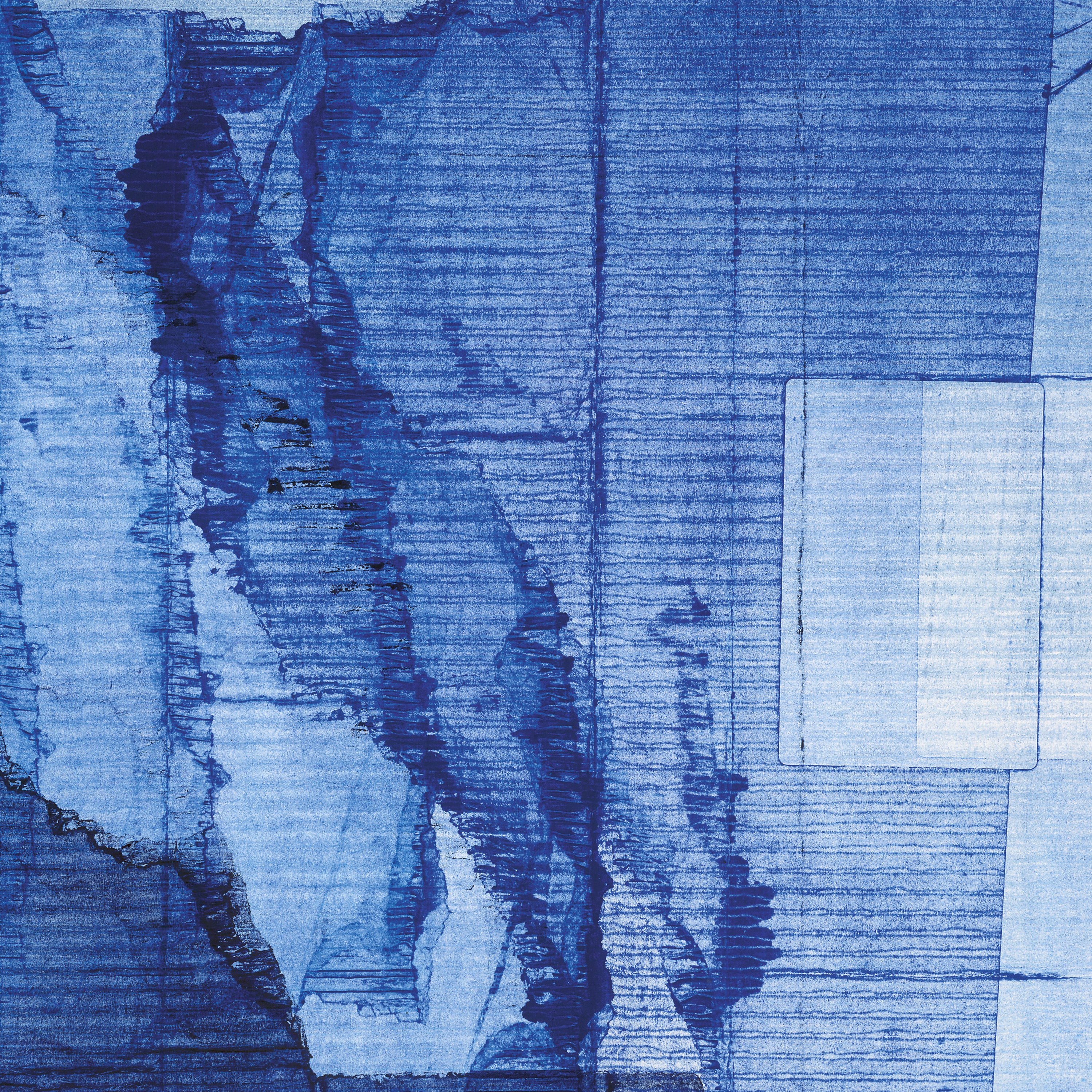
On Refract, electronic musician Tyler Gilmore (a.k.a. BlankFor.ms), pianist Jason Moran, and drummer Marcus Gilmore refuse the idea of a simple collaboration. Instead, they open their triad like a prism, splitting, bending, and rejoining light in ways that illuminate what music becomes when it learns to question its own edges. Their real-time explorations shatter the familiar, producing new angles of incidence and escape, each honed like a digital blade against the raw stone of acoustic touch. Tyler captures sounds as they appear, then manipulates and redeploys them as new organisms, refractions that remember their origins only in the way a rainbow remembers rain. It’s sound becoming itself by passing through itself. Using an inimitable array of degraded cassette tapes, analog synthesizers, and the tactile wisdom of his training at the New England Conservatory (where he studied with Jason), he brings physical materials to heel in service of apparitional textures. When producer Sun Chung first encountered these experiments, he discovered an irrepressible tension between fragility and force. The idea of being in a room with hard-hitting improvisers struck Tyler as both thrilling and terrifying. Jason and Marcus were invited, and suddenly the studio became a chamber of mirrored possibilities.
Before a single note was recorded, Sun and Tyler lingered in the long dawn of preparation, an apprenticeship to undetermined futures. Tyler laid out multiple pathways for the trio but held his expectations lightly, as gardeners do with unripe branches that might bear fruit or vanish into thin air. He offered fully formed pieces with melodic husks and harmonic marrow, skeletal sketches designed for wandering, and, above all, the spinning oracles of his tapes, each a prophecy split into new wavelengths.
The first sounds we hear come in “Onset I,” a beautiful wash of ambience, comforting and luminous, that meets the listener not with answers but with an invitation to dream without judgment. In this opening, where the glitch becomes the norm and coherence dissolves like a mirage, Jason’s pianism is pointillist and exploratory, fitful yet unguarded, as if tapping along the walls of an invisible room. Is the titular onset that of a seizure, a psychotic break, or a moment of long-awaited healing? The music refracts every interpretation, scattering our expectations into sympathetic fragments. Swirls of digital murmurations settle into sustained, lyrical pianism, hopeful despite the tremors, and without noticing, we find ourselves in “Onset II,” where subterranean beauty rises like musical lava. Tyler adds cryptic messages in plain earshot, flickering codes awaiting the translation of a dialogue that seems to recognize us even before we have learned how to listen.
The tender disorientation of this opening gives way to the warm, contoured intimacy of “Affectionate, Painful,” a track that feels like a kiss traded between piano and distorted inner hiccups. So much beauty and hope lie nestled in these woods, their branches bending with emotional weight. It pairs organically with “Inward, Curve,” a blossoming that moves into a fluent, jazzy ride of piano and drums, recalling the sheen of 1980s ECM while remaining unmistakably its own creature. These pieces feel more sculpted, guided by harmonic intention, though the electronic threading makes them seem strangely more organic—ironically so, given the circuitry at their core. Other pieces, however, arise from structures left intentionally open, vessels designed not to hold sound but to parse whatever light finds them.
Most of the album’s 16 tracks stem from the completely improvised tape loops—those fragile, flickering seeds in which the trio’s instincts seem most clearly aligned. From sputtering, almost vocal textures to interlaced patterns of tender repetition and meticulous drumming, each carves out a linguistic territory all its own. These passages examine surface texture across backward speech acts, elongated sustains, and distant echoes of time. They refract the notion of forward motion, making memory and immediacy exchange masks. At the album’s conclusion, “Tape Loop D” offers a particularly poignant elegy, polished just enough to shimmer. Its lyricism rises from the din of the city, swirling once more before sliding into an open manhole.
Amid these atmospheric passages comes the urban stride of “Eighth Pose,” the album’s most rhythmically grounded passage. Its pulse lays down a stretch of imaginary sidewalk, giving piano and drums room to catch their feet as they navigate back streets of unfamiliar harmony. Each swirl is another crack in the glass of the matrix. The music is phenomenal, not because it aims for spectacle but because it continually demonstrates how easily light can be fractured—and how beautiful the fracture becomes when treated with such care.
From here, the album breathes outward. “Stir” stretches a heartbeat into eternal song, a strip of empty road dissolving into the horizon. “Release” blossoms in suspended time, a long exhale after the chest has forgotten how to loosen. And “Little Known” closes this inner arc by turning a child’s secret thoughts inside out, shading them in charcoal and silver, a reminder that innocence contains shadows as complex as any adult confession.
And while echoes of Jon Hassell, Tim Hecker, Takagi Masakatsu, William Basinski, Aerovane, or Kettel may drift through the trees, these touchpoints evaporate almost as soon as they form. They are ephemeral reflections along a deeper pool, quickly lost in the forest of granulations that surrounds us. For Refract is not merely an album but an experience, one that holds us in its open palms and recalibrates the ears until they find their way.






 Between Sound and Space: ECM Records and Beyond