Mal Waldron: Spanish Bitch

SMJX 10113-LP-front

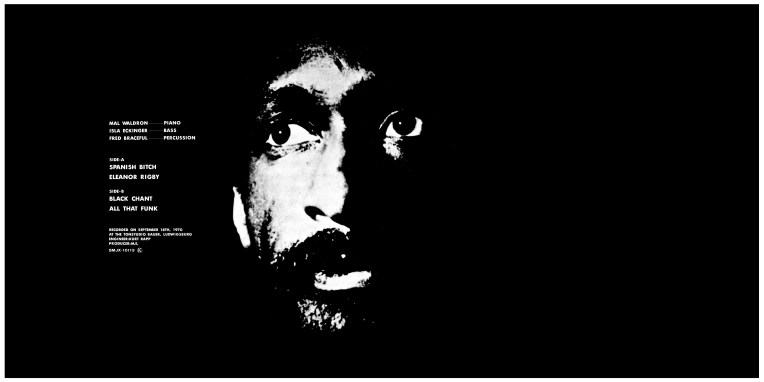
Mal Waldron
Spanish Bitch

Mal Waldron piano
Isla Eckinger bass
Fred Braceful percussion
Recorded September 18, 1970 at Tonstudio Bauer, Ludwigsburg
Engineer: Kurt Rapp
Produced by Manfred Eicher

Post-bop master Mal Waldron may just be the most important musician in ECM history, if only because his Free At Last was the label’s first bona fide release, opening a doorway to a paramount catalog of music. And while that seminal album, recorded in 1969, has recaptured the spotlight in a recent vinyl reissue, listeners may not be aware that Waldron stepped into the studio a year later to lay down a sequel of sorts. Recorded at Tonstudio Bauer, with Kurt Rapp engineering and Manfred Eicher producing, the curiously titled Spanish Bitch never made it to ECM proper and was released instead in Japan on the Globe label. Like its predecessor, Spanish finds the pianist in a trio setting, once again with go-to bassist Isla Eckinger but now, in place of Clarence Becton, welcoming Fred Braceful on drums.
SMJX 10113-LP-inside

SIDE A opens with the eponymous tune, and through its modal affiliations nods in the direction of Miles Davis and John Coltrane, who also appropriated Spanish scales for effect. In his hands, however, such motifs take on an almost ritualistic quality as scaffolding for an idiosyncratic reverie. From a web of bass and plucked piano strings emerges a vibrant block of chords. Waldron sets aside the theme almost as soon as he develops it, using it as a springboard for his laser-focused energy. Eckinger’s unusual solo sets up Waldron’s phenomenal own, building to steadfast density and playing off Braceful with glorious aplomb. This is followed by Waldron’s audacious take on “Eleanor Rigby.” A somewhat warped version of this evergreen, it boasts a robustness of architecture such as only Waldron could blueprint. He owns the song from start to finish, turning it into something of a macabre lullaby.

SIDE B pulls us back into original territory with the laddering effect of “Black Chant.” Initial restraint waters a muscular flower of high tone clusters over a plowing left hand. Though the aesthetic is Waldron’s own, it incorporates the voices, movements, and hardships of many who came before him. But don’t mistake this for catharsis. It is, rather, a link in a humble chain. Another original, “All That Funk,” saves the strongest for last. Here Waldron swings hard like a ton of rocks, leaving plenty of room for Eckinger’s forthright exposition before punctuating a groovy dialogue with Braceful. Here most of all, Waldron’s playing comports itself as a force to reckon with in three dimensions. Thus, his willingness to go deep into the darkest parts of his musical soul yields blinding light.

SMJX 10113-LP-back

As a service to completists, below I have translated the original Japanese liner notes by jazz critic and producer Masahiko Yuh (悠雅彦):

The first thing to catch my eye is this album’s title, Spanish Bitch. It brings me back to one late May evening, when Mal was listening to Miles’s widely lauded Bitches Brew in an apartment not too far from the center of Munich. Mal just sat there without a word, casting his gaze in my direction from time to time to show me how much he admired the extraordinary beauty of Miles’s music. I can still see that gentle smile.

“Anyone would be captivated by this music on the surface. But the real beauty of Miles is on the inside. It’s amazing, don’t you think?”

I’ll never forget the way Mal’s eyes sparkled as he said this. There’s no reason to think he would be married to his choice of album title here. This music, painted as it was on his canvas, clearly differs from the world of sorcery and black magic that so enamored Miles (Bitch = Witch), who had incorporated a representative mode of Spanish folk music for little more than exotic effect. That said, remembering Mal’s expressions of enthusiasm, I like to think that perhaps in using the word “Bitch” he had Bitches Brew somewhere in mind. And as the light percussion of Ina’s knife from the dimly lit kitchen mingled pleasantly with Miles’s trumpet, it may be that the concept behind Spanish Bitch was already starting to take shape. As I made to leave, Mal handed me a copy of the ECM label’s first release, his own Free At Last (Japanese catalog number SMJX-10098). About four months later, on September 18, 1970, Mal would head into Tonstudio Bauer in the city of Ludwigsburg with bassist Isla Eckinger and drummer Fred Braceful to record his second album for ECM, Spanish Bitch.

… . … . … . …

Mal Waldron vanished from the American jazz scene in 1965, when he moved across the pond to Europe. It would be fair to say, however, that he had already been primed to do so since ’62, when his singular career as a jazz pianist came to a halt. In ’63, a long bout with illness left him virtually unable to perform. Moreover, life in America had hijacked his creative ambition. And so, as had happened over the past few years when playing with Mingus and Dolphy, among others, there was no longer anything to ignite his passion.

In ’64, Mal wrote his first film score for Cool World. “Not even that lit a fire under me to perform,” he recalls. At the time, Mal was shut in with his parents, who lived in Jamaica, Queens. But then, another composing gig: this for a French film called Three Rooms in Manhattan. Gleefully, he flew to France and, after a month of taking in the freer air of Paris, completed his score.

A brief return home found him hurriedly putting the finishing touches on scoring and recording for the film Sweet Love, Bitter, by then already intent on putting America behind him. This was how Mal, once separated from performing in earnest, ended his film composing career as quickly as it began. He also knew that a host of new creative endeavors awaited him in Europe.

And that was how, in the fall of 1965, he settled down in Paris at last. That same year and the next, Mal took part in the Bologna Jazz Festival. It was during that time that he recorded his well-known tune “All Alone” and moved to Germany by way of Italy at the end of ’66.

He landed in Munich in ’67 and never left, and since then has become a fixture of this city.

Munich was love at first sight. Here he discovered Swiss bassist Isla Eckinger and American-born drummer Clarence Becton, the talented jazzmen with whom he would play on Free At Last. He was able to take short trips to European capitals and make a living by performing jazz. It’s easy to imagine how much contentment it brought him. Above all, however, it was the superlative atmosphere of the Domicile jazz club, where he enjoyed performing every night, and where the ancient and the modern comingled in perfect accord, that kept him there. The atmosphere in Munich was the freshest and most alive in all of Germany.

Nearly every jazz fan and musician who set foot inside the country paid a visit to Munich, where they were sure to drop by Domicile. Dusko Goykovich led his big band there, bringing verve to a packed house amid uproarious applause. Recently, bassist Jimmy Woode sat in with Mal’s trio, and, much in contrast to Mal’s deadpan demeanor, coaxed smiles from the crowd like a circus clown. Pony Poindexter, stopping over on his way to Belgium, was also welcomed onstage. With alto in hand, he gave a laid-back performance. One night it would be Benny Bailey, the next it might be the Clarke-Boland Big Band delighting audiences to overflowing. Such was the energy Domicile was known for. Only when Mal sat down at the piano did an apparently miraculous silence take over the room. His profound reverberations and faint tone colors coiled about the feet of everyone squatting next to all those great black musicians whose portraits hung on every wall. It was most unbefitting of this city’s nondescript lights and the hammering of Olympic construction outside. I dare say, his own hammering thundered more eternally. Still, Mal’s acute sensibilities already had a whiff of German folklore to them, combining with his ancestral blood to produce an even deeper, heavier reverberation. We both remember that time, when he recorded “All Alone” during his brief Italian sojourn, a tune replete with the sun of the south country in all its warped beauty, laden with transparent pathos…. I don’t know anyone who so intuitively grasps the plight of ethnic peoples and who struggles so earnestly with his own music as Mal.

Keith Jarrett: Salle Pleyel Paris 1992

KJ INEDITS

Recorded at Salle Pleyel in Paris on October 25, 1992 and produced by Manfred Eicher, this was a limited promotional item offered by the French retail chain Fnac to customers who purchased two qualifying ECM or ECM New Series CDs. Consisting of two exclusive tracks, it’s a poignant snapshot of Jarrett atop a mountain no one else is likely ever to scale.

His perennial encore, “Over The Rainbow,” glistens with lyrical suppleness. Looking back as we can through the lens of retrospection, we find in it the story of an entire career, if not also the life it defines: from the initial stirrings of talent that surely twitched in the young pianist’s fingers, through the chronic fatigue syndrome that would all but hijack his gifts four years later (incidentally, when this disc was offered), and beyond a recovery whose afterglow continues to illuminate ears in the darkest hours. No matter how sweeping, dramatic, and turbulent the experiences that came before, we can hold vigil in these fleeting moments of intimacy before they turn away from us to seek the hand of an ether we have yet to touch.

In the wake of this inward glance, the exuberance of Jarrett’s own “C The Blues” feels like a splash of water on the face. Romping through memories as if they were a muddy riverbank along which the dead and the living dance in celebration of kinship, Jarrett gives every mouth a voice. The colorful ornaments of his right hand are the nurture to his left’s nature, each note a word spoken, a relationship formed, a spirit harnessed, only to fade as quickly as it forms. Like the fog of a window about to be defrosted, it resolves into a clarity of vision such as only he can provide.

These same two tracks also appeared on a CD included with issue No. 672 of the French magazine Jazz in May of 2015:

Jazz Magazine

Jazz Magazine CD

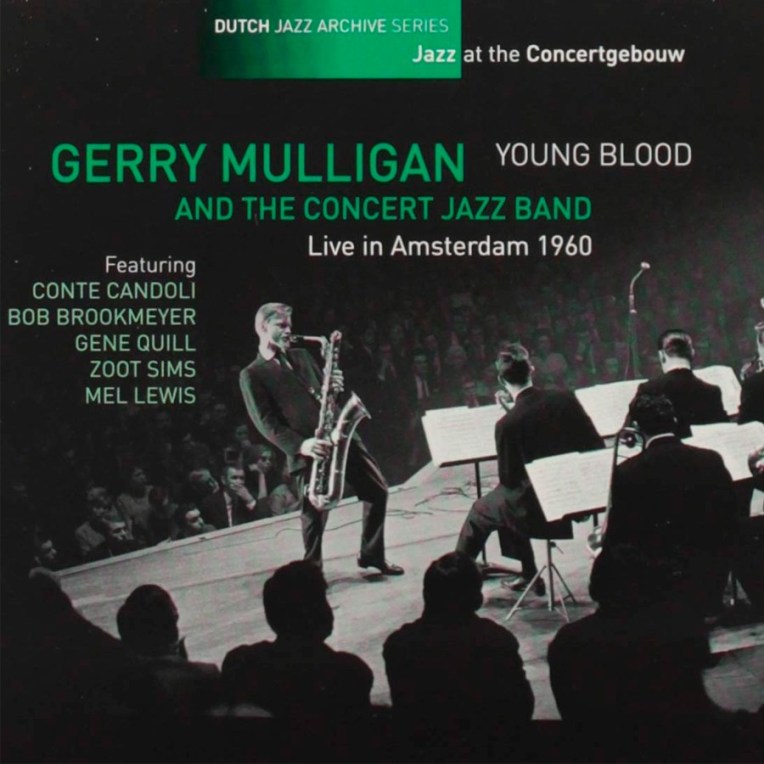
Gerry Mulligan and The Concert Jazz Band: Young Blood (Jazz at the Concertgebouw)

Live Mulligan

The document presented here for our consideration by the Dutch Jazz Archive is important not only as a gem for fans of Gerry Mulligan, but also for reasserting the baritone saxophonist’s first love of the large ensemble. His self-styled Concert Jazz Band was indeed a return to form. Recorded on November 5th, 1960 at Amsterdam’s Concertgebouw, this performance finds Mulligan commanding his instrument in such a way that only the vessel of a big band would have been large enough to contain it.

Mulligan and friends chew on a wide-ranging repertoire, but especially seem to savor the iconic Johnny Mandel, represented in three tunes from his soundtrack to the 1958 Susan Hayward vehicle I Want to Live! (the theme, “Black Nightgown” and “Barbara’s Theme”).

Alongside these cinematic turns, each a noir-ish sashay through smoke-filled rooms and even smokier intentions, we find a smattering of standards and showtunes, including the swinging Richard Rodgers- Lorenz Hart’s “You Took Advantage Of Me” (Rodgers/Hart) and slower drawl of “Come Rain Or Come Shine” (Arlen/Mercer).

Though Mulligan never treated this band as a showcase for his own writing, his are some of the highest points in the set. Of those, “Apple Core” provides a towering stage for guest soloist tenor saxophonist Zoot Sims who, despite being in less-than-stellar condition, brings a lithe kinesis to the fore. The title track is another standout swing. In the latter vein, the rhythm section of bassist Buddy Clark and drummer Mel Lewis is on point throughout, but especially in “As Catch Can,” in which they anticipate every turn of the wheel.

Fiery solos abound, including alto saxophonist Gene Quill’s in “18 Carrots For Rabbit” and trumpeter Conte Candoli’s in the title track. Mulligan himself goes for quality over quantity, adding grit wherever he treads, especially in a spotlight rendition of “My Funny Valentine,” and with that characteristic dark edge only he could hone.

(This review originally appeared in the April 2020 issue of The New York City Jazz Record, a full PDF of which is available here.)

(This review originally appeared in the April 2020 issue of The New York City Jazz Record, a full PDF of which is available here.)

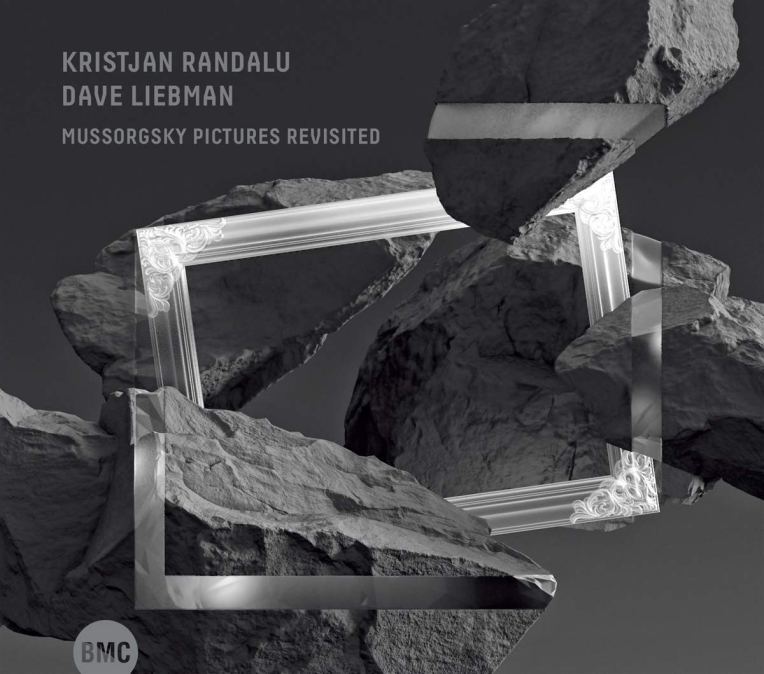
Kristjan Randalu/Dave Liebman: Mussorgsky Pictures Revisited

MPR

Although Russian composer Modest Mussorgsky (1839-81) is best remembered for Night on Bald Mountain and Pictures at an Exhibition, the latter has had the more interesting afterlife, inspiring arrangements from such wide-ranging artists as prog-rockers Emerson, Lake & Palmer, German metal band Mekong Delta and Japanese electronic pioneer Tomita. Yet this duo of soprano saxophonist Dave Liebman and pianist Kristjan Randalu presents more than a recasting of the Mussorgsky mold, instead a fresh landscape irrigated by channeling water from the source material. Case in point is the jaunting “Promenade,” which opens in straightforward territory but which in subsequent iterations (five in all) draws out hidden messages.

Liebman understands how to turn even the most familiar melodies inside out without losing their skin in the process. His tone is as flexible and colorful as ever, navigating every twist of “Les Tuileries” and “The Market” with characteristic attention to detail. The physicality of his artistry is most obvious in “Ballet of the Unhatched Chickens,” as also in his bluesy handling of “Samuel Goldenberg and Schmuyle,” the latter a veiled stand-alone among extroverted peers. Randalu, for his part, is as comfortable laying foundations as he is building on top of them. Whether orienting his compass to the lodestar of “Bydło” or jazzing up “Baba Yaga” with exuberance, he makes sure that every wisp of proverbial smoke fulfills its promise of fire. As a unit, he and Liebman find profoundest coherence in “Il Vecchio Castello,” of which they make an understated dirge.

And so, by the time we reach the farewell of “The Heroic Gate,” we are confident in having been somewhere. This is, of course, the whole point of Mussorgsky’s greatest hit: to place us in that gallery so that we may feel the colors of every scene as if they were our own.

(This review originally appeared in the April 2020 issue of The New York City Jazz Record, a full PDF of which is available here.)

Jøkleba: Outland (ECM 2413)

Outland

Jøkleba
Outland

Per Jørgensen trumpet, vocals, kalimba, flute
Jon Balke electronics, piano
Audun Kleive electronics, drums, percussion
Recorded May 2014 at Madstun, Fall and Rainbow Studio, Oslo
Engineers: Audun Kleive and Jan Erik Kongshaug
Mixed by Audun Kleive
Mastered by Bob Katz
Produced by Jøkleba
Release date: October 24, 2014

Is it the sea you hear in me,
Its dissatisfactions?
Or the voice of nothing, that was your madness?
–Sylvia Plath, “Elm”

Although Per Jørgensen (trumpet, vocals, kalimba, flute), Jon Balke (electronics, piano), and Audun Kleive (electronics, drums, percussion) had already made four albums as Jøkleba before debuting on ECM under that same name, each musician had been involved in numerous other productions for the label. That said, this set of literarily themed improvisations leaves its own set of fingerprints, the whorls of which are spectral in range. By the second track, “Bell Jar,” itself a saline flush of digital impulses and organic trumpeting, the listener will know whether leaving or staying feels like the right thing to do.

To be sure, there’s much to admire here. From the visceral mountain calls in “Blind Owl” and “Horla” to the moonlit twinges of “The Nightwood” and “Below The Vulcano,” this trio knows how to craft a mood from scratch with cinematic lucidity. And while each musician contributes a personal energy throughout, for me it’s Jørgensen as vocalist who links the most creative chains. He plays the trumpet as if it were his own voice and sings as if his throat were honed in brass. The album’s most intriguing passages are his to carry. “Brighton,” for example, unfolds with the cadence of a Butoh dance, rich with meaning in the subtlest of movements.

Amid these abstractions, the appearance of piano and drums in “Rodion” feels like an oasis in the desert. “One Flew Over” gives further traction to the keyboard, and by that deference hints at something more pre than post. By the end, we’re left with a slipstream narrative that neither fulfills a promise nor answers a question. And perhaps that’s the way they prefer it.

Avishai Cohen: Big Vicious (ECM 2680)

2680 X

Avishai Cohen
Big Vicious

Avishai Cohen trumpet, effects, synthesizer
Uzi Ramirez guitar
Jonathan Albalak guitar, bass
Aviv Cohen drums
Ziv Ravitz drums, live sampling
Recorded August 2019, Studios La Buissonne, Pernes-les-Fontaines
Engineers: Gérard de Haro and Romain Castéra
Mastering: Nicolas Baillard
Produced by Manfred Eicher
Release date: March 27, 2020

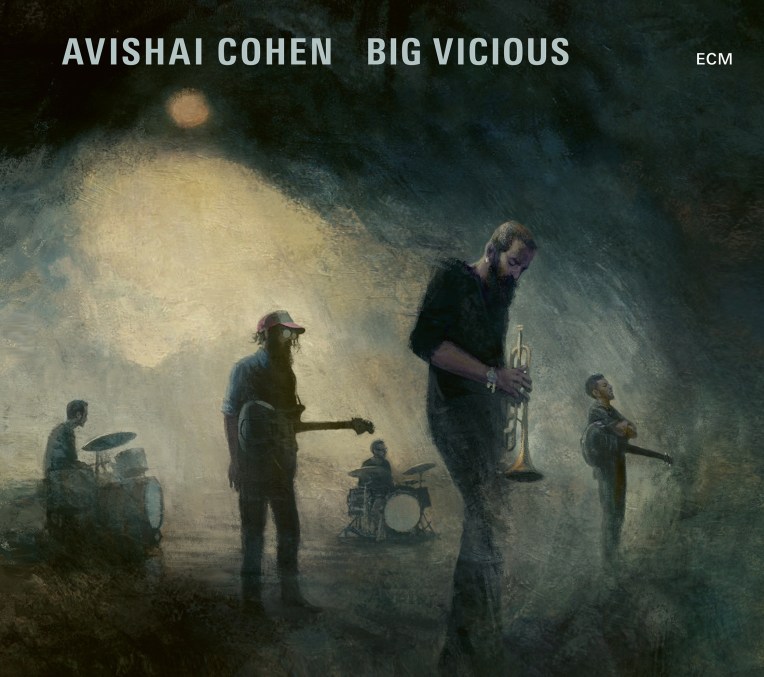
Big Vicious marks the studio debut of trumpeter Avishai Cohen’s eponymous band. Already six years old, this assembly with Uzi Ramirez (guitar), Jonathan Albalak (guitar, bass), Aviv Cohen (drums), and Ziv Ravitz (drums, live sampling) embodies the canyon-wide leap of evolution Cohen has taken across ECM’s terrain since Into The Silence in 2016. This album is distinguished by its digital sheen, which through a web of guitars and live sampling shines the light of a distant future on the darker here and now. It’s a sensation amplified by the project’s silent partner, Tel Aviv musician-producer Yuvi Havkin (a.k.a. Rejoicer), who served as Cohen’s cowriter (another new direction for the frontman) on such tracks as “Honey Fountain” and “Teno Neno.” Where the former lifts the spirit by chains of echoing sentiment, even as it redraws boundaries of the flesh from which it stretches a hand toward hope, the latter tune speaks of moonlight in the language of a star.

From start to finish, Cohen fulfills the role of a storyteller gathering characters, dialogue, and settings, and in his combinations of those elements forges history. Throughout “Hidden Chamber,” his trumpet is a warrior of light, a reminder that politics forces us into places where tongues of strife lose their sense of taste. Cohen’s composing paves us a viable detour. From the propulsive bassing of “King Kutner” to the regressive groove of “This Time It’s Different,” every melody oils our skin through the thorny bramble of adversity.

The brightest heavenly bodies are the band’s arrangements. Beethoven’s “Moonlight Sonata,” for one, is reborn. Shedding every possible shade of cliché, it lives in a space only ECM can provide. Massive Attack’s “Teardrop” gets an equally postlapsarian treatment and harks to the earliest days of Big Vicious, when Cohen and friends mainly played 90s covers. The original lyrics of this song are appropriate in describing the present sound:

Water is my eye
Most faithful mirror
Fearless on my breath
Teardrop on the fire
Of a confession

Likewise, messages ooze from the ground as if during a spring thaw. Each is artfully crafted, traveling upward in a vortex of self-regard.

Of especial note is the album’s cover, a painting by David Polonsky, perhaps best known for Waltz with Bashir. Like the image itself, this is music that eschews photorealism in favor of something touched by hands, materials, and movement. It is also the visual equivalent of the album’s closer, “Intent,” which is so smooth that you might just find yourself blending in with your surroundings, wherever you happen to be.

Wolfgang Muthspiel: Angular Blues (ECM 2655)

2655 X

Wolfgang Muthspiel
Angular Blues

Wolfgang Muthspiel guitar
Scott Colley double bass
Brian Blade drums
Recorded August 2018 at Studio Dede, Tokyo
Engineer: Shinya Matsushita
Assistants: Yuki Ito and Akihito Yoshikawa
Mixed at Studios La Buissonne by Manfred Eicher, Wolfgang Muthspiel, and Gérard de Haro (engineer)
Mastering: Nicolas Baillard
Album produced by Manfred Eicher
Release date: March 20, 2020

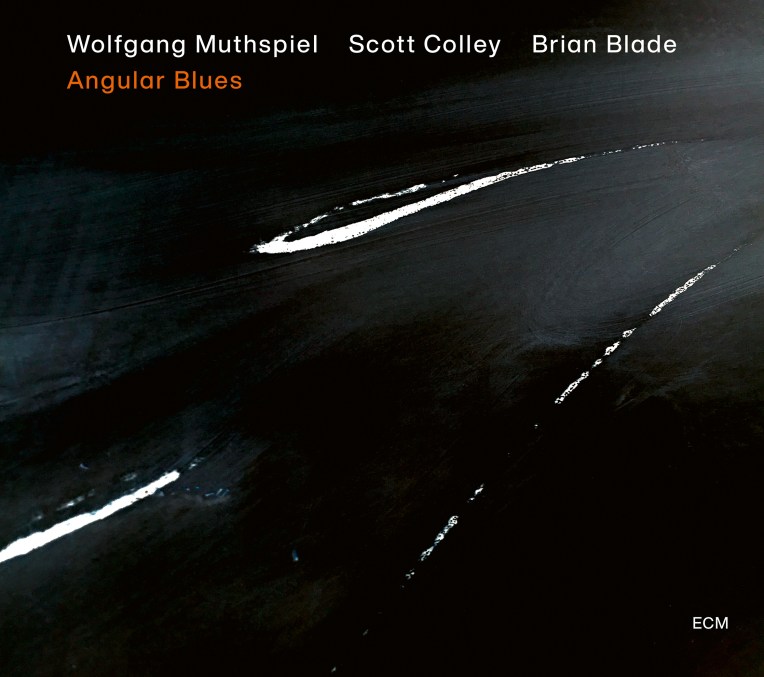
On Angular Blues, Wolfgang Muthspiel revives the format of his 2016 ECM leader debut. Rejoined by drummer Brian Blade yet inviting bassist Scott Colley in place of Larry Grenadier, the Austrian guitarist serves a full course of originals with a couple of surprises added to taste. The members of this trio share what Muthspiel calls a “love of song” and perhaps no more succinct a term could so accurately describe their rapport. Longtime listeners won’t be surprised that Muthspiel has brought together players who understand the value of space: how to shape it, to be sure, but more importantly how to let oneself be shaped by it in kind.

The narrative impulses of the opener, “Wondering,” harness the flexibility of Muthspiel’s acoustic playing, which in this context meshes with bass while kissed cymbals draw the z-axis of a three-dimensional sound. Moods cycle between gentility and insistence and shades between. The title track is aptly named for revealing a delicately virtuosic side to the energies at hand. “Hüttengriffe” follows with a soft-hewn anthem.

The remaining tunes find Muthspiel plugged-in, jumping into the amorphous body of his electric guitar. In “Camino” he is equally at home, his fingers free to engage in metaphysical play. As a thinly veiled tribute to the late John Abercrombie—not only in style but also in the way Muthspiel drafts his solo—it’s a highlight that deserves close listening. Others include “Kanon in 6/8,” which shows the trio at its deepest level of synergy (it’s also offset by the digitally enhanced “Solo Kanon in 5/4”), and bebop-influenced “Ride.” Two standards fill in the gaps. Where Cole Porter’s “Everything I Love” moves vertically, “I’ll Remember April” ends this worthy set on a horizontal plane.

(This review originally appeared in the April 2020 issue of The New York City Jazz Record, a full PDF of which is available here.)

James Ilgenfritz: You Scream A Rapid Language

YSARL

Bassist/composer James Ilgenfritz is rare for running lines of transfusion between jazz and classical bodies while keeping them equally alive. In that spirit, he presents this chamber program of formidable subtlety and feeling that travels comfortably between (and beyond) genres.

The combinations of instruments provide constant fascination, starting with the pairing of violin (Pauline Kim Harris) and double-pedal bass drum (Alex Cohen) in Terminal Affirmative. By turns primal and futuristic, this music frays the edges of such contradictions to the point of unity. It’s worth noting that this piece is based on observations of Ovid, who emphasized the power of water droplets to erode stone over time as an organic illustration of persistence. This philosophy seeps into everything that follows, but especially in Apophenia III: The Index. This trio for piano (Kathleen Supové), guitar (James Moore) and violin (Jennifer Choi), based on a short story by J. G. Ballard, asks the musicians to build a grander narrative out of through-composed fragments. Thus, what first seem to be aphorisms take on a coherence all their own.

Apophenia IV: A Bell In Every Finger sets poetry by the late Steve Dalachinsky (on Muhal Richard Abrams and Cecil Taylor, no less) for baritone (Thomas Buckner), piano (Joseph Kubera), percussion (William Winant) and Ilgenfritz himself. Buckner lends his falsetto to this garden of delights and darkness, contrasting hauntingly with the album’s masterstroke: How To Talk To Your Children About Not Looking At The Eclipse. Here flutist Margaret Lancaster breaks down breath to its most linguistically pure elements and makes them sing.

Tempting as it is to call this album intermittently assaultive, it is perhaps better described as possessed of a fierce intimacy. As in the concluding Fanfares For Modest Accomplishments for two violins (Pauline Kim Harris and Conrad Harris), it uses brevity to bring our attention to expanse. Such dichotomies are difficult to maintain, but these musicians do just that with unwavering strength.

(This review originally appeared in the April 2020 issue of The New York City Jazz Record, a full PDF of which is available here.)

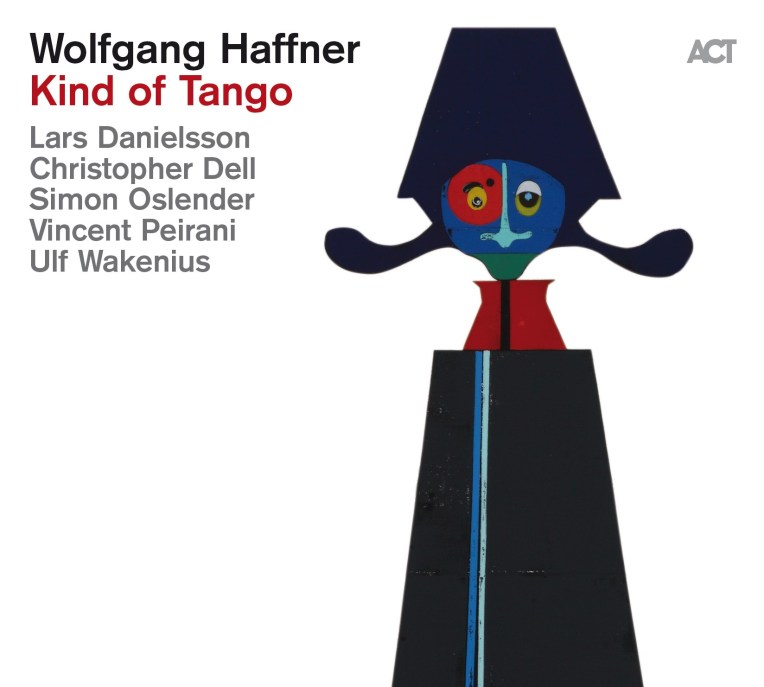
Wolfgang Haffner: Kind of Tango

Kind of Tango

This album expands composer and drummer Wolfgang Haffner’s Kind of… series with its best-integrated offering. Not only because the rapport he shares with bassist Lars Danielsson and pianist Simon Oslender is as involuntary as breathing, but also because the music spinning out from that core trio is reflective of a bandleader who understands that comfort is born of experience.

Whether in the understated groove of “La Cumparsita,” the inward glance of “Respiro” or the somber farewell of “Recuerdos,” Haffner figures that every dance doesn’t need to be a competition. And he’s not afraid to let melodies awaken slowly, as on “El Gato.” But the tango is best drawn between a leap and a crawl, and the brilliance of Haffner’s tempi lie in that balance. Quintessential in both concept and execution is his handling of Astor Piazzolla. By wrapping the familiar strains of “Libertango” in mystery and the lesser-known neorealism of “Chiquilín de Bachín” in the warmth of an open fire, he brings out a blush of sanctity from the secular. What we end up with, then, is a welcoming examination of tango: something personal, fresh and unforced.

(This review originally appeared in the May 2020 issue of DownBeat magazine.)