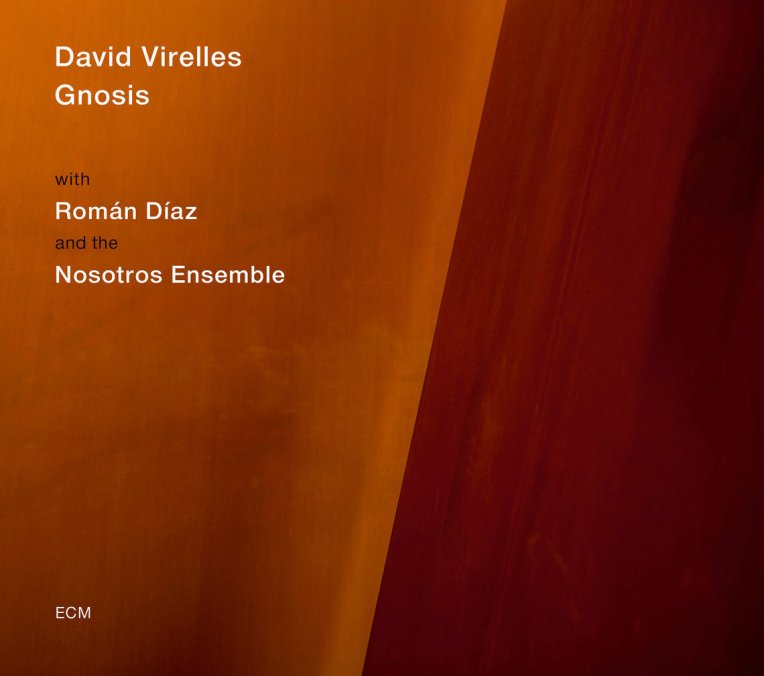
David Virelles: Gnosis (ECM 2526)

Gnosis

David Virelles
Gnosis

David Virelles understands that to make music of the future, one must delve into the past. Somewhere in the middle we find Gnosis. On his third album as leader for ECM, Virelles polishes the mirror of his Cuban roots, also as a prism of the chamber music sensibilities that informed his training under such composition teachers as Henry Threadgill. One couldn’t dream of a better assembly of musicians than the brotherhood of rhythm makers and guiding voice of poet/percussionist Román Díaz to bring these wonders to fruition. Bassist Thomas Morgan, flutist Allison Loggins-Hull and a modest string section complete the puzzle.

Each of the album’s 18 originals could be the start of another album. In this context, they work as one body. Whether in Virelles’ six solo piano pieces—including lyrical “De Ida y Vuelta I” and delicate “Dos” (arranged by Threadgill)—or in ensemble forays such as “Del Tabaco y el Azúcar” and “Tierra,” Virelles renders every dissonance an initiation into life. His pianism, especially in “Fitití Ñongo,” is ecstatic yet ponderous and speaks of an artist who understands the preciousness of time.

Morgan and Loggins-Hull are key players, balancing the pull and push of anchor and sail. Like a ship, Gnosis indeed needs water to give it purpose, even as those same oceans pose the constant threat of drowning. Virelles’ awareness of this tension sets his music apart by way of an organic postcolonial philosophy. Through it all, Díaz is the voice of land when sky is all we’ve ever known. His call and response in the ambient “Erume Kondó” is one of the profoundest things to grace these ears in a long time and speaks to what Díaz himself calls the “reciprocal language” of secrecy. According to Virelles, the album’s title “in this context refers to an ancient collective reservoir of knowledge.” Here, then, is the light of a star that died long ago but whose patterns are still perceptible, rewoven under a new name as an offering to the unborn.

(This review originally appeared in the January 2018 issue of The New York City Jazz Record, a full PDF of which is available here.)

Mette Henriette: s/t (ECM 2460/61)

2460|61 X

Mette Henriette

Mette Henriette saxophone
Johan Lindvall piano
Katrine Schiøtt violoncello
Henrik Nørstebø trombone
Eivind Lønning trumpet
Sara Övinge violin
Karin Hellqvist violin
Odd Hannisdal violin
Bendik Bjørnstad Foss viola
Ingvild Nesdal Sandnes violoncello
Andreas Rokseth bandoneón
Per Zanussi double bass
Per Oddvar Johansen drums, saw
Recorded 2013-2014 at Rainbow Studio, Oslo
Engineer: Jan Erik Kongshaug
Mixed November 2014 in Oslo by Manfred Eicher, Mette Henriette and Jan Erik Kongshaug
Produced by Manfred Eicher
U.S. release date: November 20, 2015

Norwegian saxophonist and composer Mette Henriette Martedatter Rølvåg enters the ECM universe with a self-titled album of doublings. First, as a two-disc affair, it is among the most formidable debuts for the label in recent years. Second, it is a union of contrasts, balancing composition and improvisation, declaration and whisper, with a straightforwardness that is Mette’s métier. Moreover, the album is a chain of coupled voices, as instruments converge and diverge in an alternating chain of what she calls “elongations” and “miniaturizations.”

Although the trumpet was Mette’s first instrument, in an interview for this album’s press release, she waxes fatefully about her switch to saxophone: “I knew that this was what I’m meant to do. […] I have to tell my stories, and early on I had a feeling of how I was going to do that. […] Soon I would also enjoy disappearing into the theoretical aspects of music but at the beginning it was something more primitive, a response to an inner urge.” For demonstration of this autobiographical concept, we need listen no further than the first disc, simply titled o. Featuring a trio comprised of Mette on saxophone, Johan Lindvall on piano (and who also contributes original compositions), and Katrine Schiøtt on cello, it is a veritable chess board of thematic impulses.

Mette

Immediately noticeable is the crackle of Mette’s saliva across the reed, which gives the saxophone textural authenticity as an apparatus of musical translations. In that technique is proven not only Mette’s patience in letting notes awaken, but also the personal associations imbuing those notes with meaning. The nocturnal calls of “.oOo.,” for instance, are meant to evoke the call of an owl (one of the first sounds she remembers hearing), while the breathiness of “3 – 4 – 5” conveys a menagerie of emotions so tender they cannot be broken. By the time we encounter the first full-throated notes of “all ears,” the listener has been primed with a fullness of register and physicality comparable to Mette’s own.

The logic of her sound is that such shorter pieces feel the most expansive while the longer ones feel compressed and circular. In either case, one feels this music growing in real time, as if every cell of its body were genetically acquired.

Despite knee-jerk comparisons to other free jazz greats such as Evan Parker, Mette had no such musicians in mind when developing her musical language. Her primary inspirations are more nature than nurture, as made clear in the second disc, given the enigmatic title Ø. Here we have a “sinfonietta” for which the trio is absorbed into a 13-piece band that includes drummer Per Oddvar Johansen (of the Christian Wallumrød Ensemble) and the Cikada String Quartet. Individual track titles are even more suggestive of their composer’s inner life, a storybook dusted off from attic storage and rebound through interpretation.

The addition of musicians enhances intimacy tenfold. The wind-through-leaves snare of “passé” makes for a fitting introduction, and bassist Per Zanussi adds a deeper element to this chemical mixture as strings produce a crispier layer of shine. All of this elicits a grittier side in Mette’s playing. The Cikadas lend a cinematic touch to occasional interludes, as painterly as their titles (“veils ever after” being a quintessential example). The build of “wildheart” from whisper to shout is a highlight of this disc, as are the relatively aggressive turns of “late à la carte.” As with the first, however, some of the most compelling tracks are the shortest, like the one-minute blush of piano and strings that is “this will pass too.” And if “off the beat” is the most urban tune, then “wind on rocks” is an atmospheric free dive into the wilderness.

Mette Henriette is a story written in lowercase, whose genesis is one for the pages of ECM lore: “One Saturday night in Oslo I saw a poster for Dino Saluzzi at the Cosmopolite. I thought: I should hear this, especially because I’m also writing for bandoneon in my ensemble. When is the gig? Oh, it’s today. When does it start? In twenty minutes! OK! So it was a very quick walk to Cosmopolite. It was packed, but I found a place on the stairs, and by chance I was next to where Manfred Eicher was sitting. We spoke in the interval and I told him about my project. He had been recording at Rainbow, and listened to some of my music.”

And now, we too can join hands with fate in listening to this constellation appear from first star to last.

Miroslav Vitous: Ziljabu Nights

Ziljabu Nights

Ziljabu Nights is an emotional black box recovered from the wreckage of a bygone era and brought intact into ours. Recorded live in June of 2016 at Germany’s Theater Gütersloh, it features saxophonists Gary Campbell and Robert Bonisolo, keyboardist Aydin Esen and drummer Roberto Gatto. Leading them all in a program of mostly original compositions is legendary bassist Miroslav Vitous, whose experiential integrities shine among those of like-minded maestros.

The performance documented here is at once nostalgic and spontaneous. Vitous, who turns 70 this month, and his musicians inhabit their respective continents, yet on stage forge a veritable Pangea of sound. “Ziljabu” eases us into the album’s tender awakenings with a mélange of keyboards and flanged bassing. Its fusion-leaning tendencies recall certain landmark ECM albums from the 1980s, not least of all the bassist’s own for the label. A one-letter difference in the title of “Ziljabe” yields an equally subtle shift in tone. A subtle maturity percolates throughout the 17-minute “Morning Lake.” It unfolds with patient respect, under cover of which Bonisolo’s sopranism provides the aerial view to Campbell’s terrestrial excavations, while in “Miro Bop” the reeds play out a dancing exchange of tenors, both feet on the ground.

Vitous pays homage to late fellow bassist Scott LaFaro in an unaccompanied rendition of “Gloria’s Step Variations.” What seems relatively straightforward on the surface, however, reveals a depth-charge of interpretation, with equal parts muscularity and flexibility woven into its fuse. The same holds true of “Stella By Starlight Variations,” wherein the band sends love to the periphery as Esen takes solo flight at the center of it all.

The album finishes off with an interview, in which Vitous speaks a little to his history as an artist, his growth out of the initial iteration of fusion giants Weather Report and the blessedness of his musical life. “It’s not so much searching,” he says of his rapport with this band. “Basically, we hear it.” And it’s all we can do in return to appreciate that which has been heard.

(This article originally appeared in the December 2017 issue of The New York City Jazz Record, a full PDF of which is available here.)

Vijay Iyer Sextet: Far From Over (ECM 2581)

Far From Over

Vijay Iyer Sextet
Far From Over

Graham Haynes cornet, flugelhorn, electronics
Steve Lehman alto saxophone
Mark Shim tenor saxophone
Vijay Iyer piano, Fender Rhodes
Stephan Crump double bass
Tyshawn Sorey drums
Recorded April 2017 at Avatar Studios, New York
Engineer: James A. Farber
Assistant: Nate Odden
Mixed May 2017 by Farber, Eicher, and Iyer
Produced by Manfred Eicher

Vijay Iyer’s fifth record for ECM is the pianist’s most engaging yet. Over ten scenes, Iyer directs an original storyline with his freshly-cut diamond of a sextet. Graham Haynes (cornet, flugelhorn, electronics), Steve Lehman (alto), Mark Shim (tenor), Stephan Crump (bass) and Tyshawn Sorey (drums) are not only actors playing multiple roles; they’re also real-time producers, editors and sound designers.

“Poles” and “Threnody” provide opening and closing credits. Both nurture storms of activity from raindrops, as if celebrating the end of a draught. They also balance the mutual extremes of locking and unlocking. In the latter vein, the leading horns take turns in “Down To The Wire” and in the title track, revealing the underlying irregularities that make this music so exciting. Like oranges, Haynes, Lehman and Shim’s solos are at the peak of flavor when juiced. No wonder, when their bandleader has given them so much soil and sunshine in which to ripen.

Iyer’s clairvoyance smiles across the delightful “Nope,” breathes to fullest capacity throughout “Into Action” and expands on South Indian beats in “Good On The Ground.” The latter two are masterstrokes—thematically and in execution. The rhythm section understands that being sportive can be serious and Sorey digs especially deep. Haynes also has his monologues in “End Of The Tunnel” and “Wake,” both of which work in the cerebral tendrils of his electronics.

Far From Over is a call to listening. More importantly, it’s listening to a call, as most evident in “For Amiri Baraka.” Here the core trio of Iyer, Crump and Sorey teaches the hard lesson shrouded by all this enjoyment. Baraka himself said it best: “There cannot be any apprenticeship for freedom.” Jazz may be heard as a genre of emancipation, but Iyer understands that freedom is illusory until actualized, that communal action is the embodiment of humanity’s reach for its flame and that music is one way to keep us from getting burned in the process.

(This review originally appeared in the October 2017 issue of The New York City Jazz Record, a full PDF of which is available here.)

DeJohnette/Grenadier/Medeski/Scofield: Hudson

Hudson

Although Hudson derives its title from the valley of the same name, don’t expect the swaths of greenery shuffled across the album’s cover. Its influences are less environmental than musical, the 1969 Woodstock Festival being a central theme.

Of all the greatness at play, most organic is the balance of backward and forward glances. Jack DeJohnette’s drumming references Tony Williams— honored by John Scofield’s original “Tony then Jack”— even as it ignites fresh hearths with that same torch. Larry Grenadier draws on the electric bassists who inspired him through his acoustic wonders, building an anticipatory language distinctly his own. John Medeski on Rhodes hints at electric Miles Davis even as he maps uncharted atmospheres at the piano. And guitarist Scofield, who recorded with Davis, brings that classic vibe into the 21st century, pulsing with abiding love for rock and blues. His other contribution, “El Swing,” is a modal gem frontlining his restrained fire. DeJohnette pens three: “Song for World Forgiveness” aches with beauty, not least of all through Scofield’s lyricism; “Dirty Ground” (written with Bruce Hornsby) features him singing with gritty sincerity; and in the final “Great Spirit Peace Chant,” wooden flutes, percussion and voices leave us holding a feather of ancient ways.

Much of this album, though, polishes gems of folk-rock until they glisten anew. Bob Dylan’s “Lay Lady Lay” and “A Hard Rain’s A-Gonna Fall” are replete with masterful exchanges. Joni Mitchell’s “Woodstock” moves in seamless retrograde while a reimagined “Wait Until Tomorrow” (Jimi Hendrix) emotes with bluesy abandon. On the same level is Robbie Robertson’s “Up on Cripple Creek,” which mixes its ingredients in all the right ways.

Like-minded gravity attracts us first, however, to the opening title track, an 11-minute improvisation that puffs up like four dinner rolls baking in fast- forward. This is musical comfort food, the abstractions of which are butter on the nooks and crannies.

(This article originally appeared in the October 2017 issue of The New York City Jazz Record, a full PDF of which is available here.)

Avishai Cohen: Cross My Palm With Silver (ECM 2548)

Cross My Palm With Silver

Avishai Cohen
Cross My Palm With Silver

Avishai Cohen trumpet
Yonathan Avishai piano
Barak Mori double bass
Nasheet Waits drums
Recorded September 2016 at Studios La Buissonne, Pernes-les-Fontaines
Engineers: Gérard de Haro and Nicolas Baillard
Produced by Manfred Eicher
U.S. release date: May 5, 2017

One can always count on being in the moment when experiencing an Avishai Cohen record. The Israeli trumpeter proved as much when he made his ECM debut with 2016’s Into The Silence, from which he now journeys forth with this set of five originals in tow. Cohen calls the quartet assembled here—with pianist Yonathan Avishai, bassist Barak Mori and drummer Nasheet Waits—his “dream team” and the distribution of energies throughout Cross My Palm With Silver confirms it.

Although politically engaged, Cohen’s style of personal reflection takes two inward glances for each outward. The result is that he and his bandmates invariably end up in vastly different places from where they began. They carry impressions to lucid ends, all the while achieving delicate infusions of seeking and finding. “‘Will I Die, Miss? Will I Die?’” epitomizes this philosophy in an intimacy deepened by engineers Gérard de Haro and Nicolas Baillard. One may choose to focus on the melodic convergence of trumpet and piano, but greater subtleties are found beneath: bass is the heartbeat of this musical organism, drums its neural pathways.

The declamatory tenderness of “Theme For Jimmy Greene” feels all the more heartfelt for setting up the piano-less “340 Down.” The latter stumbles but never falls, balancing its tray of motivic possibilities all the way to its destination. “Shoot Me In The Leg” bleeds with Cohen’s most dynamic playing on the record. He moves through changes as fluidly as fast-forwarded footage of clouds. Waits works off Cohen’s fluttering calls, as bass and piano move with varying degrees of angle. The backing trio has a gorgeous aside before Cohen’s final word. “50 Years And Counting” finishes the album with invigorating openness, giving Cohen all the space he needs to work out his expressive alchemy. All of which makes the album’s title that much more enigmatic, for his tone, if anything, is golden.

(This review originally appeared in the September 2017 issue of The New York City Jazz Record, a full PDF of which is available here.)

Tim Berne’s Snakeoil: Incidentals (ECM 2579)

Incidentals

Tim Berne’s Snakeoil
Incidentals

Tim Berne alto saxophone
Oscar Noriega clarinet, bass clarinet
Ryan Ferreira electric guitar
Matt Mitchell piano, electronics
Ches Smith drums, vibes, percussion, timpani
David Torn guitar (tracks 1 & 5)
Recorded December 2014 at “The Clubhouse” in Rhinebeck, NY
Engineer: D. James Goodwin
Assistant: Bella Blasko
Mastering at MSM Studios, München by Christoph Stickel
Produced by David Torn
U.S. release date: September 8, 2017

French philosopher Roland Barthes once faulted music criticism for relying on adjectives. The music of Snakeoil is such that adjectives do leave much to be desired. In that spirit, purged at the outset are choice adjectives that could be used to describe it: slipstream, epic, implosive, chameleonic.

For this ECM leader date, number four for Berne, the alto saxophonist reteams with clarinetist Oscar Noriega, pianist Matt Mitchell, guitarist Ryan Ferreira and drummer/percussionist Ches Smith. In the fray is producer David Torn, contributing his guitar to two tracks. “Hora Feliz” showcases the craftsmanship of everyone involved, through which electronics nestle against acoustics as mountains meet sky. Torn sets the scene before the theme jumps into frame. Such awakening, a Berne staple, keeps listeners in check. As the interconnectedness and independence alike of these musicians develop, one comes to see shadow and light in Snakeoil not as opposites but as twins.

Smith is a wonder. He lends no credence to grooves, taking his time, as in “Incidentals Contact,” to mark a beat, thereby furnishing Noriega with a fulcrum. He extemporizes at the margins while Noriega flaps his wings with abandon. “Stingray Shuffle” is another metropolis of sound, which, like “Prelude One/Sequel Too” (the album’s closer), keeps Ferreira’s fire in play around a reverie of higher notes before Berne commands his way to the finish line. But it’s “Sideshow” that gives us the goods and then some. Being the conclusion to a piece that began with “Small World In A Small Town” on this album’s predecessor, You’ve Been Watching Me, it has a past from which to draw. Mitchell does most of the lifting throughout its 26 minutes, responding as much as anticipating. Poetry shares breath with prose at every turn. Whether in Noriega’s sensitivity or Berne’s physicality, Smith’s blast of timpani or Ferreira’s finesse, the band demonstrates the ability of jazz to open doors you never knew existed. The truth of mastery lives on.

(This review originally appeared in the September 2017 issue of The New York City Jazz Record, a full PDF of which is available here.)