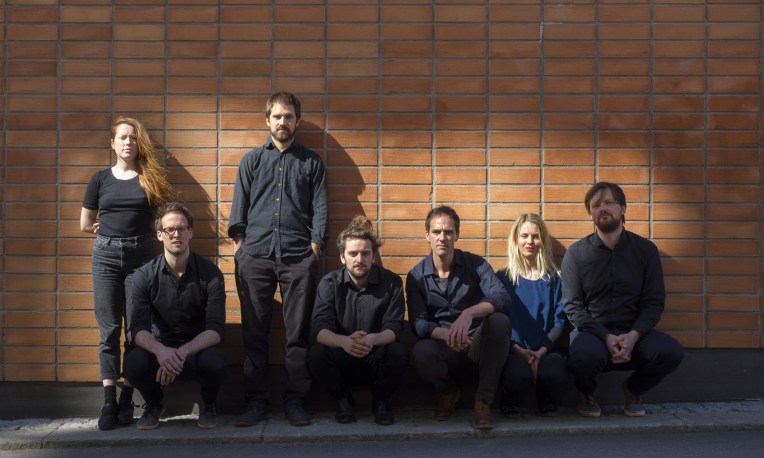
Nils Økland viola d’amore, Hardanger fiddle, violin, Rolf-Erik Nystrøm alto and baritone saxophones Sigbjørn Apeland harmonium Mats Eilertsen double bass Håkon Mørch Stene percussion, vibraphone
Recorded June 2012, Hoff Church Østre Toten, Norway
Engineer: Audun Strype
Executive producer: Manfred Eicher
U.S. release date: April 8, 2016
Since his 1996 solo debut, Blå Harding, Norwegian Hardanger fiddler Nils Økland has charted a range of melodic waters, always docking at the intersection of traditional and contemporary music. His relationship with ECM has produced a series of artistic statements, each more cohesive than the last. His first for the label was 2009’s Monograph, a solo album of great scope that led to 2011’s Lysøen, in duet with Sigbjørn Apeland. And now we have Kjølvatn, for which he has assembled a full band under his own name. Apeland rejoins the fray, here playing harmonium, along with saxophonist Rolf-Erik Nystrøm, bassist Mats Eilertsen, and percussionist Håkon Mørch Stene. Each has lived in that gray area between folk, jazz, and classical, and funnels his unique experiences into Økland’s sound-world like grains of sand through an hourglass.
Having worked with these musicians for years in some configuration or another (all except Nystrøm played on Bris, released in 2004 on Rune Grammofon), Økland revisits a trove of older material with special familiarity. A look at even a few of the tunes shows the breadth of his network. He wrote “Mali,” for instance, after attending a concert by Swedish rapper Timbuktu. The band’s profiles cohere evocatively in this opening piece, as in the album’s title track, a retroactive score for the 1933 Scottish silent film The Rugged Island. “Undergrunn” (Underground), too, feels quite integrated, arising as it did from a collaboration with the London Sinfonietta around folk motifs. Such diversity of origins suggests that Økland’s influences are as complex and fragmentary as life itself.
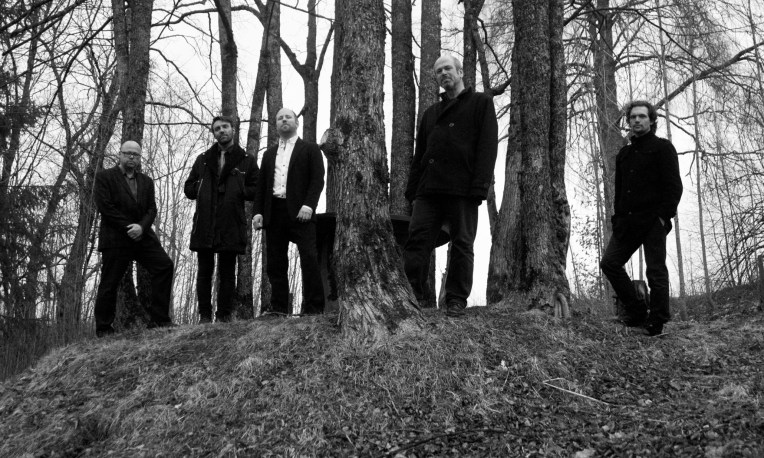
(Photo credit: Ellen Ane Eggen)
Økland employs a variety of open tunings on the album, each of which has its own special name. The “dark blue” tuning (D-D-A-D) is heard on the processional “Drev” (Drifted), wherein are bolded Stene’s percussive colors, and “Start” the so-called “troll tuning” (B-E-B-D#). In the latter, Økland combines ancient structures and modern minimalism, both of which he sees as relying on short motifs multiplied to form larger structures.
Økland has been increasingly inspired by the viola d’amore, which like his mainstay instrument has extra strings that vibrate sympathetically beneath the main four, and on tracks “Puls” and “Skugge” (Shadow) he draws a darker soul from this cousin. In the former piece, the heartbeat is evoked by Stene on kettledrum, while Eilertsen explores kindred frequencies. Over this, a flight from Økland’s bow touches the ocean with a wingtip in search of nesting territory.
Location matters a lot in Kjølvatn, which was recorded at the Hoff stone church in the countryside of Norway’s Oppland county. Økland’s go-to engineer, Audun Strype, captures the church’s resonant bounce, allowing the rougher, more organic aspects of the performance to exude clarity. One may hear this especially in “Fivreld” (Butterfly), an alluring piece of ambience in which the harmonium breathes like sunlight through foliage. Made for a ballet performance at Haugesund Theater in Økland’s hometown, it veritably dances.
Other references to Økland’s past are found in “Blå harding” and “Amstel.” Earlier versions of both appeared on the aforementioned debut. The first is something of a blues dedicated to his Hardanger fiddle teacher Sigbjørn Bernhoft Osa, while the second, which closes out the album, is greener, its organ-like harmonium reminding us of where we are.
Kjølvatn rarely bubbles beyond a simmer, but its flavors are all the purer for it. It’s a significant move in Økland’s career, and exemplifies an artist who, despite denying any underlying message, understands the value of careful construction. And in a way, that is its practice: to create art for its own sake, devoid of political baggage and free to roam in search of new and welcoming ears.
(See this review as it originally appeared in RootsWorld online magazine here.)
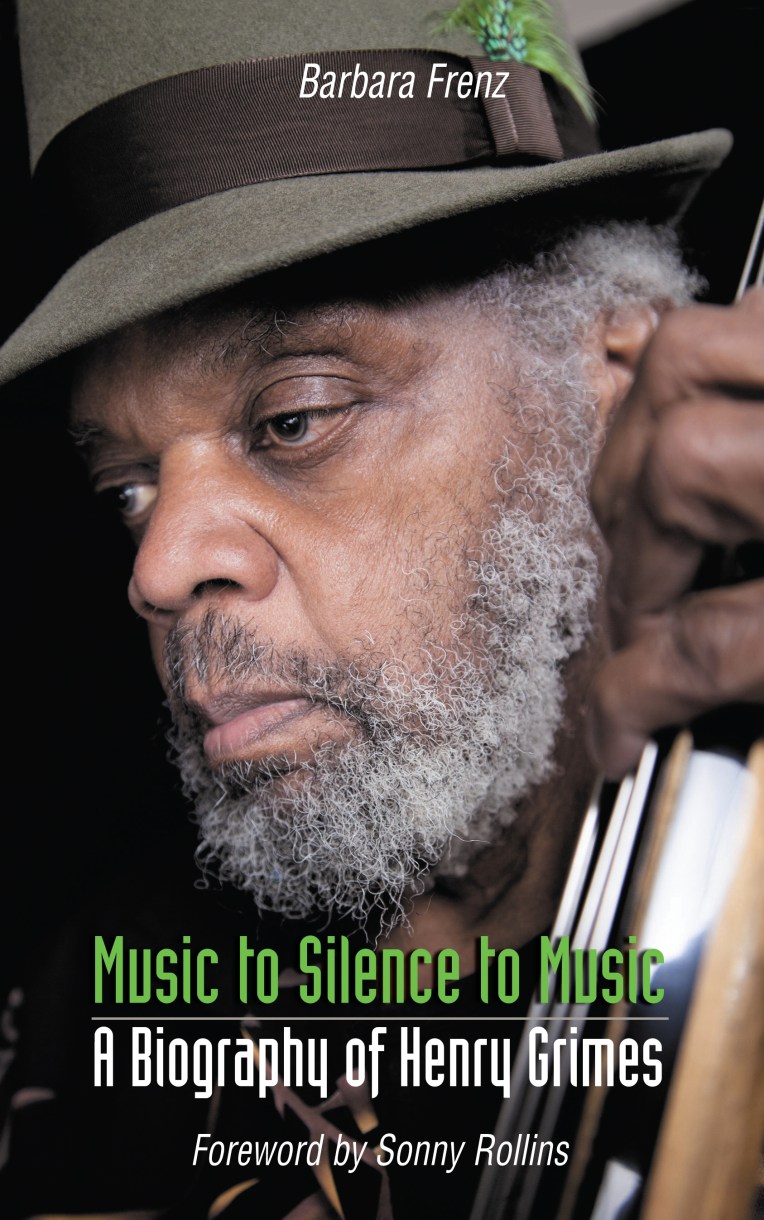
In his foreword to Music to Silence to Music: A Biography of Henry Grimes, Sonny Rollins recalls his first encounter with the young bassist in Philadelphia: “He seemed to hear and immediately respond…in an unbroken circuit between muse and man.” Likewise, German historian Barbara Frenz’s lovingly penned biography wires an unbroken circuit between reader and subject.
Frenz jumps improvisationally from reportage to interview. The resulting portrait is as multifaceted as the man himself. Grimes may not be interested in the anecdotal, but his memories yield a veritable résumé of iconic associations. By the early ’60s he was swimming in the deep end of New York City’s jazz scene, where collaborations with the likes of Albert Ayler unlocked his evolutionary potential. In 1967, just two years after his first leader date, he left the East Coast for the west and wasn’t heard from for nearly four decades. Grimes was forced to sell his bass in Los Angeles, where he sustained himself through odd jobs until he was rediscovered in 2002. He has been playing ever since, much to the glee of listeners and journalists alike, playing hundreds of concerts and surpassing even his own exalted reputation in the process. During the silence, he didn’t so much as touch an instrument. And yet, as Frenz makes clear, the music was always germinating inside him, along with a literary worldview that would feed back into his reprisal endeavors. His poetry is dark yet insightful and, like his soloing, focuses its attention on human interaction.
With this biography, Frenz has undone the misconception of Grimes as reticent ghost, arguing instead for his bold expressiveness while further emphasizing his versatility, go-with-the-flow attitude, and inner growth. His past contributions are obvious, but, as Frenz is quick to point out, his importance to the future of jazz even more so. Rather than an introvert who almost faded into obscurity, she wants us to see him as someone uninterested in attachments, living as he has—and always will—in the immaterial.
(This article originally appeared in the June 2016 The New York City Jazz Record, of which a PDF of the full issue is available here.)
Eight tunes from The Book of Angels make up Flaga, the 27th installment in a series exploring the parallel opus to John Zorn’s popular Masada series. His interpreters this time are pianist Craig Taborn, bassist Christian McBride, and drummer Tyshawn Sorey. “Machnia” puts listeners into the thick of things, highlighting the playing as much as Zorn’s prolific gift for melody.
What would appear to be a triangular relationship in theory turns into a pyramidal one in practice. The atmosphere is joyful and exciting and finds each musician grabbing the wheel in succession with idiosyncratic vigor. It’s a formula that leads to consistent piquancy in the remaining tunes, if at times dulled by the compactness of the engineering, which suffocates tunes like “Peliel” and “Katzfiel.” Other places it works beautifully, however, as in “Shiftier.” Here Taborn balances sacred and secular impressions, launching into his solos with territorial wanderlust. But not even a few misfires at the mixing board can reign in a double take on “Talmai,” of which the landscape is vast and the rhythm sectioning robust.
As may be expected in anything branded Zorn, abstractions are never too far away. Their wonders enliven “Katzfiel” and “Rogziel,” the latter recalling its composer’s fascination with the cartoon music of Carl Stalling. In this respect, the trio allows the spirit at hand to take the music where it needs to go, even if, like sand in an hourglass, every particle of improvisation eventually funnels into a steady passage of time. Which is not to say that reveries are absent: “Agbas” and “Harbonah” show sensitivity in kind, the latter an atmospheric gem that draws an arco bass thread through a stormy patchwork of piano and cymbals, teasing out the indestructible heart of the whole enterprise.
The way these veterans ease into and out of such eclectic themes is masterful, yielding a fresh take on Zorn that may just be the standout disc of the series and one that reasserts his position in the modern jazz canon.
(This article originally appeared in the June 2016 The New York City Jazz Record, of which a PDF of the full issue is available here.)
NIK BÄRTSCH’S MOBILE
Nik Bärtsch piano Sha bass clarinet, contrabass clarinet Kaspar Rast drums, percussion Nicolas Stocker drums, tuned percussion EXTENDED Etienne Abelin violin Ola Sendecki violin David Schnee viola Solme Hong cello Ambrosius Huber cello
Recorded March 2015, Auditorio Stelio Molo RSI, Lugano
Engineer: Stefano Amerio
Produced by Manfred Eicher
U.S. release date: April 22, 2016
Swiss pianist and bandleader Nik Bärtsch makes no distinction between the old and the new, thriving instead on constant transformation. Freed of evocative titles, he writes in so-called “modules,” each of which combines through-composed and improvised material. This approach has yielded a series of albums for ECM under the name Ronin, but on Continuum he debuts his parallel ensemble, Mobile. Drummer Kaspar Rast and mononymous clarinetist Sha are familiar standbys, while percussionist Nicolas Stocker and a string section are the new recruits. Those familiar with Ronin will recognize certain tics in Mobile’s larger body. I ask Bärtsch to elaborate on their differences.
“Mobile is acoustic and Ronin amplified, resulting in different consequences concerning power, pressure, volume, and listening behavior (for musicians and audience alike). We recorded Continuum in close proximity with each other while the Ronin sessions had us in different rooms. Mobile is also a music ritual group and often plays long concerts of several hours or even days. In Mobile we include rhythmic strategies of contemporary classical music, for example in ‘Modul 5.’ The band’s name refers to a ‘perpetuum mobile,’ while Ronin is a ‘groove generator.’ Mobile creates groove equilibriums and orchestral maneuvers while Ronin attacks with a paradoxical mix of empty meditative roughness and strong rhythmic energy: Zen-funk.”
The ritual foundations of said “Modul 5” reveal the virtuosity of their execution with patience. The same holds true for “Modul 60,” in which strings interlock with their surroundings like stairways in an Escher lithograph.
On Continuum, Bärtsch has taken his craft one step closer to an ideal that, while perhaps unreachable, is more audible than ever. Beyond my own idiosyncratic impressions, however, the music of Mobile is rooted in the presence of its musicians, as anyone who has seen them live can attest. Movement would seem to be central to “Modul 29_14” in particular, a force of suggestion made by its pairing with martial arts in a promotional video:
The binary relationship between Rast and Stocker in this piece unpacks bits of code into full-blown programs. High notes in the glockenspiel, doubling those of the keyboard, activate those programs in one artful sequence after another. Bärtsch, for his part, is careful to keep his own perceptions grounded the physical body. “A musical pattern, rhythm, or resonating structure is a sensual movement,” he says. “Sometimes, when I am practicing intensively, I dream of becoming such a musical being: a pure resonating energy of movement. We are all dancers in the universe.”
And is this dancing indicative of the project’s classical leanings?
“The music might seem more ‘classical,’ since we give the impression of a chamber ensemble. In principle we work the same way as with Ronin: I compose a piece, which in the context of the group develops its own instrumentation and dynamics. But in one respect your reception is probably correct: there is less obvious improvisation than in Ronin, although ‘Modul 12’ is completely improvised, if on the basis of a modular, coherent structure.”
That latter module is remarkable for Rast’s brushwork, by which he smooths out a layer of gravel over Sha’s tunneling contrabass clarinet.
While most comfortable on the live stage, in this instance Mobile is uniquely bound to studio parameters. This does not, clarifies Bärtsch, equate to a reduction. “An album is a different genre altogether,” he notes. “It has and creates its own rules. But the group profits from the long-playing rituals, which leave us open to the situation of the recording: a new space-time continuum to be explored and created.”
To my ears, “Modul 18” is a well-rounded example of this brand of creationism. Its elements—metal, wood, air—come to life in a vibrational field of bowed strings against a repeating bass drum, Stocker shining like a constellation in its darker sky. Throughout “Modul 4,” too, the two drummers act as one as a high overlay of notes from Bärtsch foreshadows closure. Listening to such older modules, I can’t help but wonder how they’ve changed. Are they seeds for cultivation or do they become unique entities with every iteration?
“The modular way of composing allows a piece to evolve, while also retaining compositional coherence. The triangle of composition, improvisation, and interpretation should be connected and alive. Usually a pattern, piece, or musical strategy has more potential than you first recognize. You have to explore it for years through playing and observation. I see this as a natural, spiraling development forward into roots.”
Such is the modus operandi of “Modul 44,” in which Rast’s skins serve as palimpsests for musical poetry. The subtlety of his drumming is unexpected from such a robust figure. As in the gradual progressions of “Modul 8_11,” his interaction with the others results in so many orbits that the after-images of their playing form one glowing sphere. Despite the utter precision required to pull off this effect, a free-flowing, interdimensional quality prevails. If any message stays behind, it is Bärtsch’s own: “Trust your ears. They are the most sensitive antennas for the resonating inner and outer world.”
Thomas Strønen drums, percussion Kit Downes piano Håkon Aase violin Lucy Railton cello Ole Morten Vågan double bass Siv Øyunn Kjenstad percussion Steinar Mossige percussion
Recorded June 2015 at Rainbow Studio, Oslo
Engineer: Jan Erik Kongshaug
Mixed July 2015 in Oslo by Jan Erik Kongshaug, Sun Chung, and Thomas Strønen
Mastering: Christoph Stickel, MSM Studios, München
Produced by Thomas Strønen and Sun Chung
U.S. release date: November 15, 2015
At night, a few lights marked port and starboard of these gargantuan industrial forms, and I filled them with loneliness. I listened to these dark shapes as if they were black spaces in music, a musician learning the silences of a piece. I felt this was my truth. That my life could not be stored in any language but only silence; the moment I looked into the room and took in only what was visible, not vanished.
–Anne Michaels, Fugitive Pieces
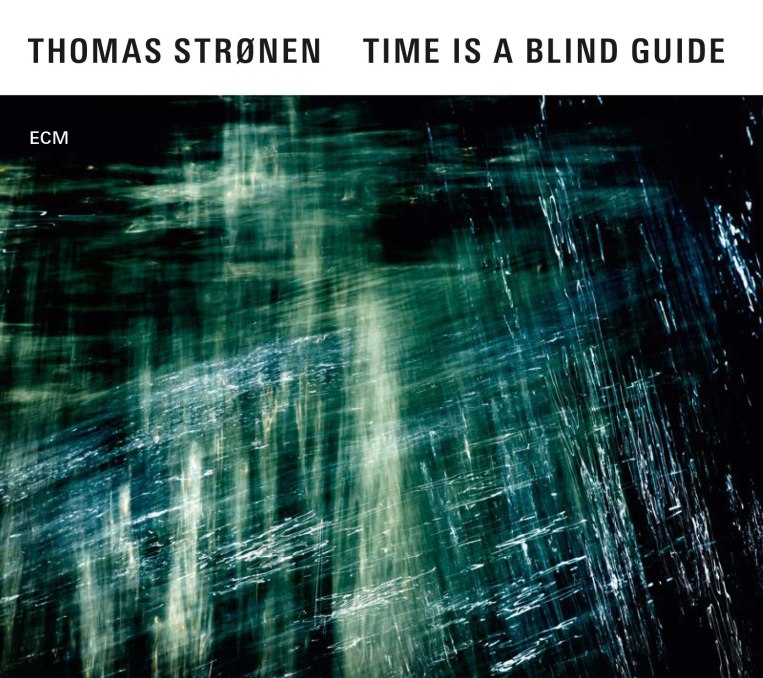
Thomas Strønen follows in the ECM tradition of path-defining artists. Even if that means straying from the path one has already defined. Such is the modus operandi of the Norwegian drummer and composer, whose neural wanderings speak in soft bursts of ideas and creative directions. His relationship with the label began on 2005’s Parish, a leader debut whose acoustics stand apart from the electronic flights of his next three albums—Quiet Inlet, Mercurial Balm, and This is not a miracle—as part of the roving collective that is Food. In a recent interview, I asked Strønen to elaborate on how the band came together for this particular recording.
“The ensemble started when I was commissioned to compose a concert by Fiona Talkington (BBC Radio 3), who at the time was curating a concert series called Conexions. The concept was to bring UK musicians to Norway to collaborate with Norwegian musicians. While brainstorming with Fiona, I landed on these particular musicians. Some of them I knew from before and some of them I had never played with. The plan was always to only play this one concert, but it ended up being something musically new to me, as well as a lovely combination of people, so I decided to continue the adventure.”
Connections indeed nourish the lifeblood of this music, which in the network of its composer’s venation flows through human experiences, and beyond them into experiences of the human. Such flexible dichotomies are fully operational on Time Is A Blind Guide, yet another turn of the Strønen prism that reveals fresh hues of collaboration. Beyond departure, it is also integration, as the bandleader explains to me when I ask about its distinctions:
“This particular ensemble combines three constellations in one: it’s a piano trio, a string trio, and a drum trio. It’s an all-acoustic setting with more through-composed material than any other band I’ve ever played in. It’s a cross between a chamber ensemble and a jazz group, and the music was specially written with these musicians in mind. In a record industry struggling to survive and adjust to new ways of treating music (technically and economically), ECM still manages to be an important voice. To me, the release of Food’s latest record and this one shows how open-minded Manfred Eicher and his label are (and always have been).”
Strønen’s characterization of ECM is no small one to consider when approaching Blind Guide as an historical experience. For while it mines some igneous influences, it also draws light from aboveground into its balances. One might, in fact, say it’s his most cosmic record to date—all the more impressive when you consider the acoustic matrix in which it is based. As “The Stone Carriers” breaks the five seconds of silence that begin every ECM album, the sensation is of a comet reversing its trajectory to interstellar origins. From this diffuse texture coalesces a steady bass line, and with it the promise of a full groove going forward. Violinist Håkon Aase is an obvious defining presence from the start, one to listen for as the album progresses.
As one track break sets me up for the next, I can’t help but feel the album’s literary nature. Did Strønen have any particular stories, books, or narratives in mind while making it?
“While writing most of the music for this album I was (re)reading Canadian author Anne Michaels’s novel Fugitive Pieces. It’s a poetically written book in which language is as important as the actual storytelling. I’m not sure how much this affected my actual composing, but it set me in a state of mind and inspired me to use some words and sentences as titles for the pieces. The band name is the book’s first sentence.”
Alternatively, one might call this music cinematic in character, as if it were a soundtrack in search of images. Strønen, in his fashion, is amenable to the idea but also has his own:
“I tend to think less abstractly about my own music, as it is the result of a longer process from drawing board to recording session. The term ‘cinematic’ is versatile, and if the music brings associations to other art forms, I appreciate it. But it means something different to me. When I listen to my own music (something I seldom do), I seek ways to develop and improve. I enjoy working with various media and have been composing for theatre, film, and dance. These are areas I would like to explore more and I would be happy to see this music used in a movie score.”
Beyond associations with extra-musical art forms without context, I am further tempted to place this album in the grander realm of its ECM associations. In particular, I am tempted to draw threads of continuity back to the works of Jon Balke’s Batagraf (cf. the percussive interlude “Tide”) and Christian Wallumrød (“Everything Disappears”). I ask Strønen if these similarities are coincidental:
“My writing carries the weight of my experiences in my (musical) life. ‘Tide’ is a baka, a drum signal like the ones used in West African Wolof music. The difference is that ‘Tide’ compositionally goes through a special combination of time signatures and rhythmic modulations, while the original bakas are less metrical. I got introduced to Wolof music while traveling to Gambia together with Jon Balke and other musicians. I like Batagraf and worked with them in my own drum ensemble, Extended Ground. We have different approaches to drum music compositionally, but share some of the same aesthetics. I grew up listening a lot to European jazz and improvised music in my early years as a player. But I’ve also discovered treasures in the American jazz tradition, Japanese classical music, West African music, electronic music, and European and American minimalism. All of these have inspired me in many ways.”
Despite any lack of overall genre affiliation, artistic intent is the constant glue of Blind Guide. The extreme tactility of tracks such as “Pipa” and “I Don’t Wait For Anyone” invites the listener to be a piece of the puzzle. Melodic currents held by pianist Kit Downes are remarkable, complementing Strønen’s palette with comforting ease. At times, a silver-tongued violin regales with stories of long ago, moving in tandem with bass and percussion toward the attainment of conversational magic. In concert, these instruments move like a Rubik’s cube until colors begin to orient themselves along uniform sides.
Whether activated by chance or circumstance, the motivic gestures of “The Drowned City” feel as inevitable as the progression of time, thus intuiting the project’s title. Watery gongs and other submarine percussion give visuality to a lost civilization, while cascading pianism is the only indication of the grandeur that once thronged its avenues. “Lost Souls” treads a fraternal archaeology, matching the thread of a bowed string with the thicker rope of drums.
In light of these impressions, one may feel like this music is rooted in the ancient past even as it looks to the future. Strønen’s view is humbler:
“The music simply reflects my interests and my ideas of music. If I manage to create something some define as new, that’s great, but I’m not very concerned about having to create something that hasn’t been made before. There’s so much good music being made all the time and the last thing we probably need is more music. Still, we discover new elements or perspectives and many of us have a need to pen them down and try them out. So I guess it’s not a conscious choice, but more of a natural process.”
The title track demonstrates this organic quality in spades. Anchored by percussion, persuasion, and persistence, its steadiness is dotted with details in relief: a flower for every stem. “As We Wait For Time” further engages the subconscious with its thoughtfulness, violin and piano phasing like two reflections in search of the same radiance.
That being said, conscious connections to material lives do matter, as in “Everything Disappears (Pt. 2),” a quiet drum circle that bears dedication to pianist John Taylor, with whom a project was in works at the time of his death. But in the end, it’s the droplets of notecraft in “Simples” that belie the album’s oceanic casting, and unravel its hidden fortress of dreams.
As one immediately involved in both the recording and production of this album, Strønen has touched nearly every aspect of its growth from idea to digital reality. Blind Guide is a Polaroid snapshot of the serendipity that pulses through his musical universe, shaken to the beat of an unseen heart for want of an image that can only be your own.
Now up for viewing over at RootsWorld online magazine is my review of Nils Økland’s latest ECM project, Kjølvatn. This album takes an evolutionary leap from his first two for the label, Monograph and Lysøen, by surrounding the Norwegian fiddler with a full band. A beautiful expansion of folkish atoms into forward-thinking molecules. Click the cover to read the full review and hear a sample track.
My latest review for All About Jazz should be of special interest to ECM fans. The compilation Magic Peterson Sunshine chronicles the history of the German MPS label, a vitally important predecessor to ECM Records on which many familiar artists (including John Taylor, Eberhard Weber, and John Surman) made key appearances. This album is a vital cross-section of music history and belongs on the shelf of anyone who cares about the history of jazz in Europe and beyond. Click the cover to read on!








 Between Sound and Space: ECM Records and Beyond