My latest review for All About Jazz is of pianist Tuomo Uusitalo’s second leader date, Love Song. Click the cover to discover!



My latest review for All About Jazz is of pianist Tuomo Uusitalo’s second leader date, Love Song. Click the cover to discover!

Avishai Cohen
Into The Silence
Avishai Cohen trumpet
Bill McHenry tenor saxophone
Yonathan Avishai piano
Eric Revis double-bass
Nasheet Waits drums
Recorded July 2015, Studios La Buissonne, Pernes-les-Fontaines
Engineers: Gérard de Haro and Nicolas Baillard
Produced by Manfred Eicher
U.S. release date: February 12, 2016
Following his appearance as sideman on Mark Turner’s Lathe of Heaven, Avishai Cohen makes his leader debut for ECM Records. Bearing dedication to his late father, Into The Silence teams the trumpeter with a fantastic band of his own that includes tenor saxophonist Bill McHenry, pianist Yonathan Avishai, bassist Eric Revis, and drummer Nasheet Waits. This effort marks the first time the band had, as such, stepped foot inside a studio, and the results hark back to the golden age of ECM in both texture and mood. From its spacious arranging and freely realized originals to its classical roots (the solo piano music of Rachmaninoff was a conscious inspiration) and cross-pollination of styles, Cohen’s musical identity speaks at once from without and within.
Through the six-sided prism of as many tunes, Cohen shines a light as only the darkness of mourning could yield. The muted lines of “Life And Death” feel as much celebratory as elegiac. Cohen thus asserts himself as more than a voice among the voiceless, as if the album’s titular silence were not the absence of sound but a personal choice to protect one’s dreams. Here, however, we are bathed in dreamlike qualities with such melodiousness that it’s all we can do to not imagine the many fates that must have convened to produce this patient bit of magic. Avishai’s pianism is another ripe fruit in the band’s gift basket. Morphing from barest comping to bluesy climatic shifts and sparkling tails, he is a comet in an already starry sky. The end of this opener, though a postludinal afterthought, is just as substantial as what comes before it.
“Dream Like A Child” only deepens the spell craft of its predecessor. Unmuted yet just as vulnerable, Cohen undoes the ribbon of this offering to reveal a melodic ocean just aching to crash on the listener’s shore. The pianism is majestic yet aptly proportioned, mirroring the underlying respectful altitude at every turn: just when you think it has gathered enough momentum to soar, it touches its feet to the earth. Though things do cohere in more groove-oriented ways as the rhythm section builds a higher and higher wall from which Cohen and McHenry must jump, there’s no doubt that the ground will hold its foundation through Waits’s textural reinforcements.
The title track expands on ECM’s evolving ethos of ritualistic jazz, as drums and microtonal harmonies in the piano interlock with downright spiritual patience. Again, the band flirts with groove but foregoes that sweetness for a cerebral savory. These strategies become more evident with repeat listens (for this is, indeed, an album you’ll want to return to time and again). Waits is an organic force here, moving from tumbling abstractions to tight snare rolls at the flick of a wrist, his plumage fully outstretched.
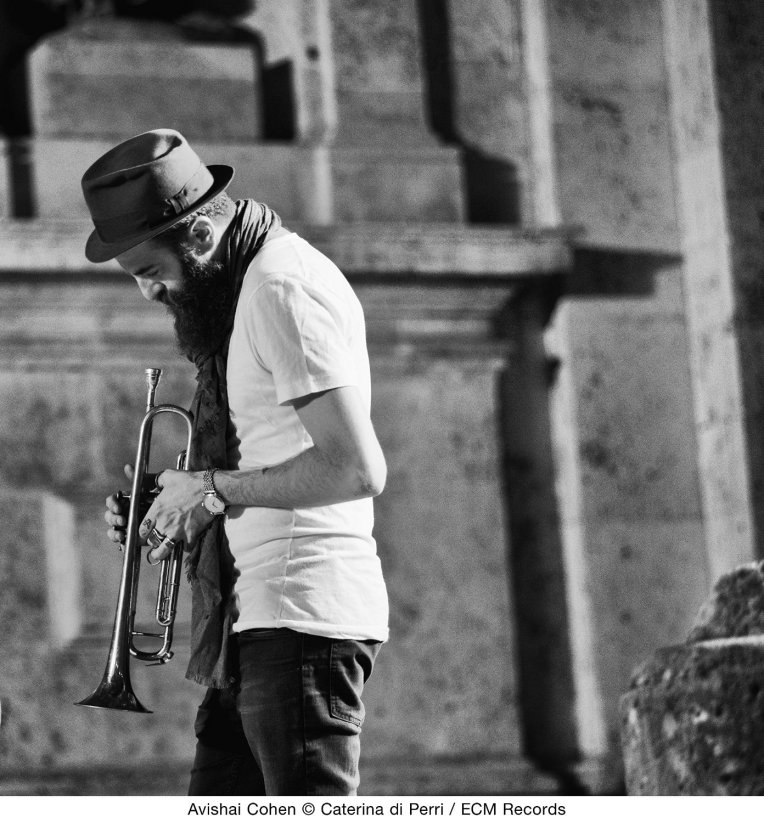
Somberness, however, is never far behind, and “Quiescence” bottles its fragrance like a master perfumer. Cohen’s trumpeting is the center of a vocal solar system, shining through planets forged in thematic space dust. Lengths of days and seasonal changes are determined by the gravitational pull of nostalgia, so that by the next track, “Behind The Broken Glass,” one knows that fragmentation is a universal law. Cohen proves that, in the wake of any emotional shattering, no effort of putting the pieces back together will produce a clean reflection, for it will always bear the scars of its undoing. The breadth of his inspirations has brought him to this humble (and humbling) realization in his career, and finds empathetic amplification in his bandmates that funnels in the solo piano reprise of “Life And Death” that ends the album’s journey.
Having seen this project with a different roster at the 2016 New York City Winter Jazzfest, I can attest to the raw, living power of its music. So much so that, following that experience, this studio date feels somewhat tame by comparison. So: see them in person if you can, but revel in the wonders of this “second best” all the same, for in them is a pilot light that ECM lit nearly five decades ago, and which continues to burn pure and warm despite the winds of change.

Pat Metheny guitars
Jan Garbarek soprano saxophone
Gary Burton vibraphone
Scott Colley double bass
Danny Gottlieb drums
Paul McCandless English horn, soprano saxophone
Klaus Graf alto saxophone
Ernst Hutter euphonium
Eberhard Weber bass (from tapes)
Michael Gibbs arranger, conductor
Ralf Schmid arranger
Rainer Tempel arranger
Libor Šíma arranger
SWR Big Band
Helge Sunde conductor
Concert organized and produced by Martin Mühleis, sagas productions
Recorded by SWR, January 2015, at Theaterhaus Stuttgart by Doris Hauser, Volker Neumann, and Boris Kellenbenz (technician)
Mixed at SWR Studio, Stuttgart, by Volker Neumann (engineer), Manfred Eicher, Eberhard Weber
Pat Metheny’s “Hommage” mixed in New York by Pete Karam
Mastering: Christoph Stickel at MSM Studios, Munich
An ECM Production in collaboration with SWR
Redaktion: Günther Huesmann
SWR Big Band Manager: Hans-Peter Zachary
U.S. release date: September 11, 2015
Bassist Eberhard Weber two-handedly defined a generation of sounds, resulting in some of the most iconic albums the ECM catalog has to offer. In recognition of his contributions to the arts of performance and recording, Weber received the Jazzpreis Baden-Württemberg lifetime achievement award on his 75th birthday, and was guest of honor at jubilee concerts held in January of 2015—proving that, despite the stroke that rendered him unable to play since 2007, Weber’s fire blazes on.
Among his illustrious torchbearers is guitarist Pat Metheny, who in a liner note for the album describes lasting indebtedness, having joined Weber on the classic Ring and Passengers (Weber also appeared on Metheny’s Watercolors). As one who has always made the most of technology to harmonious advantage, Metheny acknowledges the inspiration manifest “in the instruments that [Weber] had built to bring that sound into the air, crystallizing a sonic fingerprint that even all these years later remains as uniquely identifiable and fresh as it was on first hearing back then.” All of which makes it doubly celebration-worthy to see Metheny swimming again in ECM waters. His “Hommage” is, in fact, this disc’s centerpiece. A sprawling world unto itself, it includes its dedicatee as performer in the form of video footage of the improvising bassist projected onto a screen at stage rear, creating what the composer calls “my imagined virtual Eberhard.” The idea somewhat recalls the speech-to-melody experiments of composer Steve Reich, with whom Metheny has worked and whose influence can be felt here in certain passages throughout the half-hour-plus suite.
Germany’s SWR Big Band, backing a chain of venerable soloists, brings this and the other works on the program to a resurrected state, here supporting solos from the formidable Gary Burton (vibes), Scott Colley (bass), Danny Gottlieb (drums), and Metheny himself. The opening is everything that Weber’s music ever was and will be: verdant, atmospheric, and fully developed right out of the box. The videographic Weber is almost ghostly, but over time feels less like an avatar and more a viable player whose creativity shines with unquenchable force. Metheny navigates their virtual interactions deferentially at first before easing into fuller integration, while the band handles this transformation with grace at director Helge Sunde’s exacting touch. The latter’s consistency ensures that Burton’s soloing is both the vessel and the water keeping it afloat; that Colley’s bassing, while distinctly Weberian, also adds its own shades to the spectrum; that Gottlieb’s adornments feel like more than just that; that Metheny’s flights always have their shadow in full view; and that Weber’s archival reveries transcend the limits of space and time they’ve been allotted.
Before this, listeners are treated to a far more intimate introduction in Jan Garbarek’s “Résumé Variations.” Based on the album of the same name, this piece finds the saxophonist improvising in his cinematic, clarion way around prerecorded bass lines. The two instruments intertwine in a way that only years of collaboration could produce, as if two massive continents of time were coming together in the least destructive abduction imaginable.
On the other side of Metheny’s juggernaut is a string of artfully pruned evergreens. “Touch” evokes the golden age of Yellow Fields. Featuring solos by Burton and Ernst Hutter on euphonium, and arranged by Ralf Schmid, this timeless jewel floats on a bed of vibraphone, moving in breezy fashion across its landscapes with the redolence of an old film magically restored. Its reach is matched by “Maurizius,” here arranged by Michael Gibbs and breathing with all the power, and more, of the original. Sharing solo duties with Burton is Paul McCandless, who carries his soprano saxophone to distant shores in this quintessential turn from Later That Evening. The same soloists carry over into an arrangement of “Tübingen” by Rainer Tempel, whose sense of flow meshes sympathetically with Weber’s. McCandless and Burton weave a carpet of textures through a stirring and complex sound that is equal parts somberness and joy.
Two reimagined songs from Pendulum close out the program: “Notes After An Evening” and, available as an exclusive bonus track via digital download, “Street Scenes.” Both are masterfully arranged by Libor Šíma, who gives them a certain heft. Burton and McCandless reappear, with alto saxophonist Klaus Graf adding his nocturnal lines to “Notes.” McCandless’s English horn, by contrast, burns like the sun in “Scenes,” balancing out cooler blasts from the band at large with energetic forecasting.
Given that Weber will never play again, one can’t help but find something bittersweet about these performances, built as they are on a legacy that, while nominally retired, lives on, their poignancy like a pair of lips pursed to a candle flame—yet which, instead of puffing it out, contributes to its glow.

(Photo courtesy of ECM)
Be sure to check out the DVD of these performances, available from Jazzhaus, which I have reviewed here.
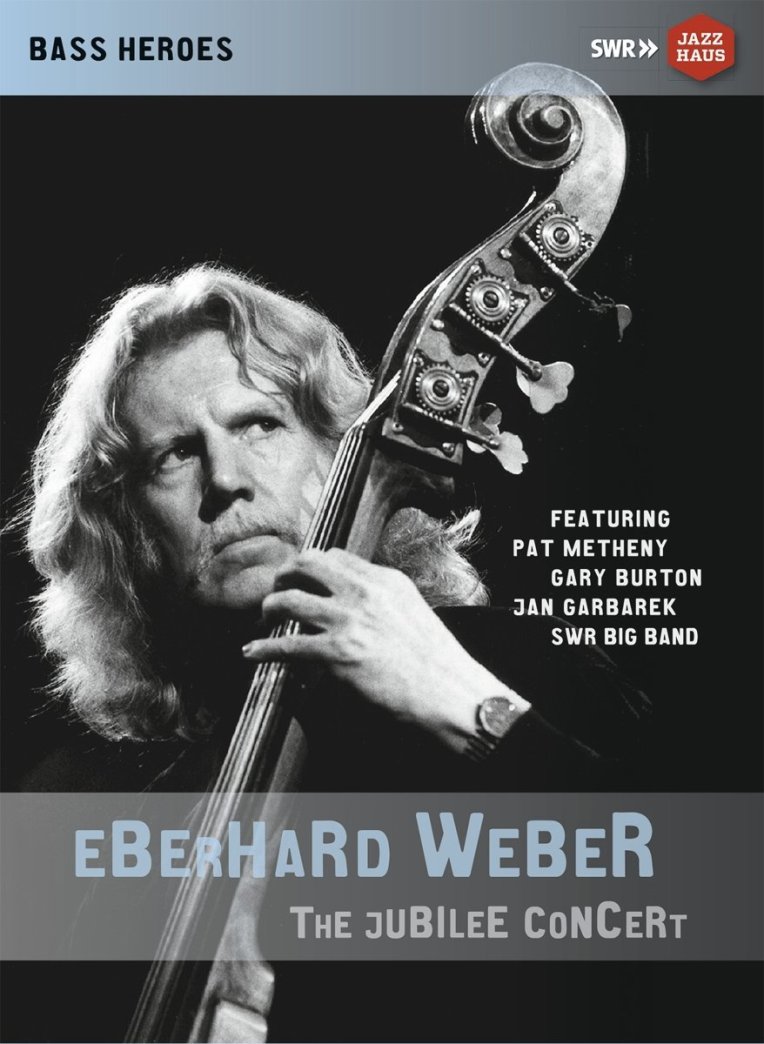
At the summit of a prosperous career on stage and, following a decades-long stint with ECM Records, German bassist Eberhard Weber suffered a stroke and has not played since 2007. In October of 2015 (a year in which he also received the Landesjazzpreis Baden-Württemberg, a lifetime achievement award), jubilee concerts were held at the Theaterhaus in Weber’s hometown of Stuttgart to honor his 75th birthday and contributions to jazz.
This DVD of that same event features the SWR Big Band conducted in turns by Helge Sunde and Michael Gibbs, along with guests Jan Garbarek (saxophone), Gary Burton (vibraphone), Paul McCandless (reeds) and, returning to the fold, Pat Metheny (guitar). The latter’s “Hommage” is the centerpiece—a sprawling 30-minute composition built around archival video footage of Weber from the 1980s. More than any other musician on the roster, Metheny bottles the Weber-ian spirit like the lightning that it is.
In contrast to the sprightly figure on screen, the first image of the concert is of an aged Weber hobbling to his seat of honor by aid of a cane. Following this, his “Résumé” finds Garbarek improvising over a more recent audio recording. It’s a fitting way to start, given that Weber was such a fixture of Garbarek’s quartet. Much of what follows reflects almost somberly on a touching career. Arrangements by Ralf Schmid and Rainer Tempel of classic tunes from Weber’s golden age are showcases for Burton and McCandless while those by Gibbs rejuvenate “Maurizius” (from the 1982 album Later that Evening) and Benny Golson’s “Killer Joe.” But it’s the jovial energies of Libor Šíma, who reimagines “Street Scenes” and “Notes After An Evening” (both from 1993’s Pendulum), which win the day.
In the liner notes for Hommage à Eberhard Weber, the 2016 ECM album culled from this same event, Metheny waxes indebtedly about Weber’s “sonic fingerprint that even all these years later remains as uniquely identifiable and fresh as it was on first hearing back then.” As this landmark performance shows, Weber continues to innovate, even without strings at his fingertips.
(This article originally appeared in the September 2016 issue of The New York City Jazz Record, of which a full PDF is available here.)

This live album from HGBS Blue Records documents the final performance of a two-week tour in 2014 by the ensemble known as Lines for Ladies. Special guest Sheila Jordan acts, in her words, as the band’s “spiritual mother,” shepherding in a younger generation of voices spreading their cohesive harmonies across canvases both familiar and new. To be sure, Kirstin Korb (bass/vocals), Anne Czichowsky (vocals), Sabine Kürlich (vocals/alto sax), and Laia Genc (piano/vocals) share more than the stage with Jordan. They carry on her alluring—or, as one song here would put it, “Delicious and Lovely”—tradition of jazz song as storytelling. Jordan has spent a lifetime and more perfecting her fashion of delivery, and among these women she is as a sun to the stars. Whether paying tribute to her Native American roots in the chant with which she opens “The Moon’s a Harsh Mistress” or unfolding a 13-minute mission statement in the largely adlibbed “Sheila’s Blues,” she churns emotion until it becomes soft as butter. “I sing the blues ’cause I paid my dues,” she croons, humbly failing to mention the profits she has reaped from subsequent dividends.
Likewise, the depths and breadths of Jordan’s spiritual children are not to be taken lightly. Czichowsky appends fresh, self-penned lyrics to standards “Killer Joe” and “Idle Moments” to delightful effect. The former song, suitably rebranded as “Ladies’ Show,” asserts its femme power in a male-dominated genre, while the latter highlights Czichowsky’s vocal trumpeting against Genc’s smooth pianism. Czichowsky relays with Kürlich’s French in a bilingual rendition of “I Wish You Love (Que reste-t-il de nos amours).” The two singers harmonize even more deeply in the above-mentioned “Delicious and Lovely,” a Kürlich original that boasts slick time changes and instrumental qualities all around.
Korb is ever the anchor of this set, and provides some of the strongest philosophies the performance has to offer. Between the Chet Baker-inspired vocalese of “But not for Me” and her duet with Jordan in “Dat Dere,” she brings audible smiles to everything she touches. Nowhere more so than in her original “Something to Celebrate,” which honors her fateful move to Denmark—where she has, since 2011, become a force of nature in the local jazz scene. Genc unravels many of the tune’s finer implications at the keys, reveling (as she does throughout the album) in every twist and turn.
Most wonderful (and unforgettable) about the record is the level of joy brought to every upbeat groove and downtempo swing alike. These are human beings who truly love what they do. Their passion is multifaceted, practiced as preached. And couldn’t we use a little more of that in today’s world?
My latest review for All About Jazz is of pianist Anat Fort’s superb performance at the Rubin Museum of Art in New York City, where her trio, along with Italian reedman Gianluigi Trovesi, celebrated the release of her third ECM album, Birdwatching. Click the photo below to read on.

(Photo credit: Glen DiCrocco)
In the summer of 2014, Aaron Parks held a ten-week DIVA (Danish International Visiting Artists program) residency in Denmark. By then, at the age of 30, the American pianist had already achieved an independent sound, but on these two albums arising from his Danish tenure he thrives on the unsolvable riddle of collaboration.
When Parks released his 2013 disc of solo improvisations (Arborescence, ECM), he earned knee-jerk comparisons to fellow pianist and ECM stalwart Keith Jarrett. Yet while their styles could hardly be more different, they do have one thing in common: a genuine respect for melody. It’s this sense of song and structure that balances Parks’ youthful optimism with patience.
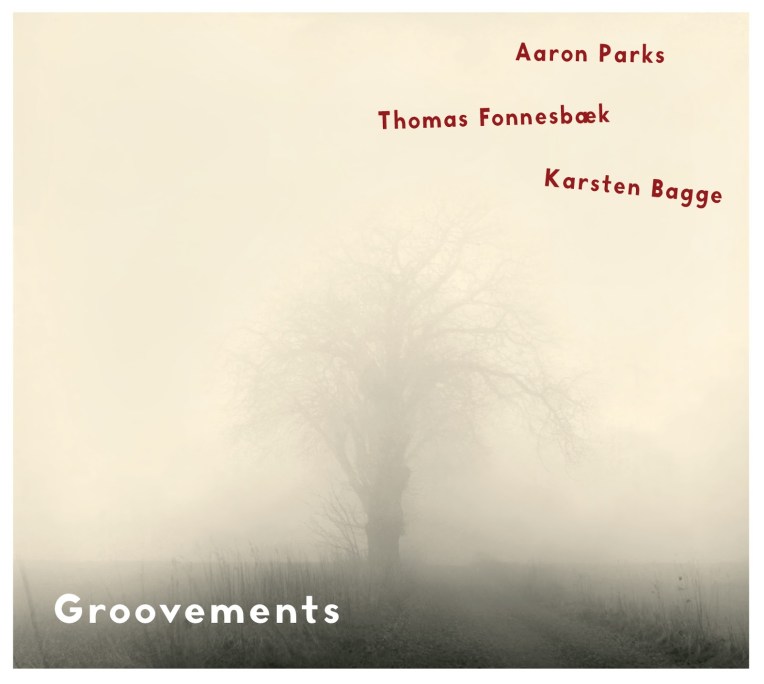
On Groovements, he shares a studio with bassist Thomas Fonnesbæk and drummer Karsten Bagge. Despite being the first time this trio had recorded together—playing tunes written especially for this session, no less—these virtual strangers make for a cohesive mesh.
As if in service of that point, the group improvisation “Shapes ‘n’ Colors” is among the more seamless tracks. No less groovy than its satellites, the tune hits all the right pressure points and is every bit as flexible as Parks’ distinctly New York-ian “Elutheria.” Fonnesbæk and Bagge contribute two originals apiece, the former’s “Winter Waltz” and “Forever This Moment” being special vehicles for the composer’s artistry while the latter’s “Alcubierre’s Law” and “A Rabbit’s Tale,” not surprisingly, capitalize on the rhythmic core. The trio does bare its traditional chops, however, when handling the swing of Cedar Walton’s “Bolivia” and evergreen “You And The Night And The Music” with tact. Even the two surprises, Bruce Springsteen’s “I’m On Fire” and Danish classical composer Carl Nielsen’s “Tit Er Jeg Glad,” proceed with confident logic.
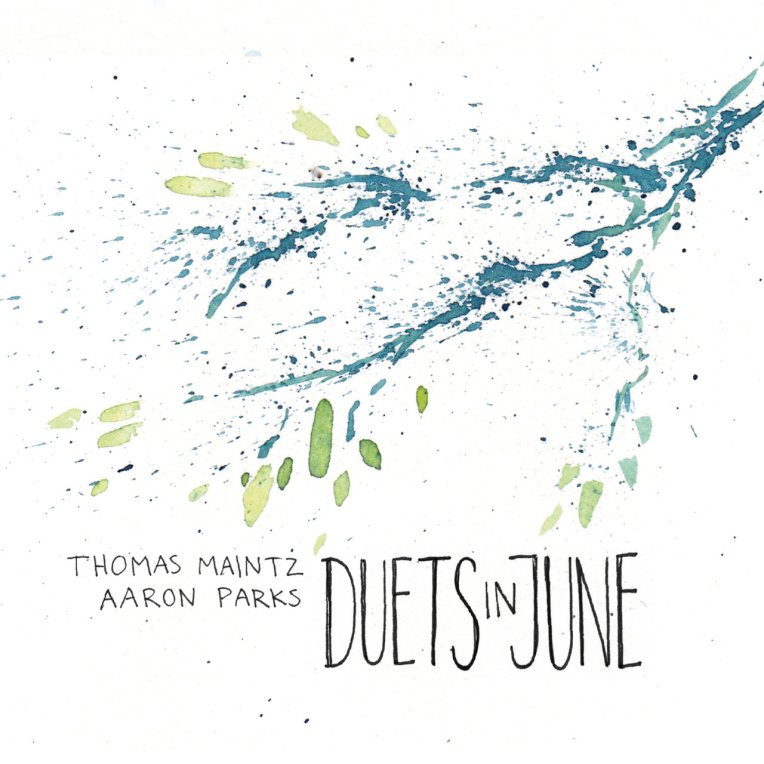
Duets in June would seem to be the more intimate project on paper, but its unusual combination of guitar and piano reaches more broadly and adventurously, the pepper to Groovements’ salt.
Much credit goes to guitarist Thomas Maintz, who wrote all the music except for three improvisations. The latter are the highpoints of this date—exercises in unforced seeking from two musicians who don’t just react to, but converse with each other. Where the drunken “Absinthe” and photorealistic “East Village Waltz” are tongue-in-cheekily illustrative, “Six String Levitation” (featuring Parks on melodica) and ambient “Please Hum (A Hymn)” offer more cerebral delights. Maintz speaks most lucidly through his acoustic baritone guitar, as on “Nude in Red Armchair,” in which his adaptability comes to the fore. All that said, it is Parks whose underlying feel for mood and message rings truest. Whether singing at the keys in “Secret Hallway” or going solo for “Riddles Dressed in White,” he understands that tenderness in music is more than a pantomime. It’s a way of life.
(This article originally appeared in the July 2016 issue of The New York City Jazz Record, of which a full PDF is available here.)
My latest non-ECM reviews are of two vastly different albums, both worthy of your attention. The first is Julian Julien’s Terre II, which has something of a Debussy-meets-jazz-in-a-dark-alley vibe, while the other is by the extraordinary young jazz pianist Megumi Yonezawa, who rides a wave of praise from Jason Moran into her leader debut, A Result of the Colors. Click the covers below to read on…


Nils Økland Band
Kjølvatn
Nils Økland viola d’amore, Hardanger fiddle, violin,
Rolf-Erik Nystrøm alto and baritone saxophones
Sigbjørn Apeland harmonium
Mats Eilertsen double bass
Håkon Mørch Stene percussion, vibraphone
Recorded June 2012, Hoff Church Østre Toten, Norway
Engineer: Audun Strype
Executive producer: Manfred Eicher
U.S. release date: April 8, 2016
Since his 1996 solo debut, Blå Harding, Norwegian Hardanger fiddler Nils Økland has charted a range of melodic waters, always docking at the intersection of traditional and contemporary music. His relationship with ECM has produced a series of artistic statements, each more cohesive than the last. His first for the label was 2009’s Monograph, a solo album of great scope that led to 2011’s Lysøen, in duet with Sigbjørn Apeland. And now we have Kjølvatn, for which he has assembled a full band under his own name. Apeland rejoins the fray, here playing harmonium, along with saxophonist Rolf-Erik Nystrøm, bassist Mats Eilertsen, and percussionist Håkon Mørch Stene. Each has lived in that gray area between folk, jazz, and classical, and funnels his unique experiences into Økland’s sound-world like grains of sand through an hourglass.
Having worked with these musicians for years in some configuration or another (all except Nystrøm played on Bris, released in 2004 on Rune Grammofon), Økland revisits a trove of older material with special familiarity. A look at even a few of the tunes shows the breadth of his network. He wrote “Mali,” for instance, after attending a concert by Swedish rapper Timbuktu. The band’s profiles cohere evocatively in this opening piece, as in the album’s title track, a retroactive score for the 1933 Scottish silent film The Rugged Island. “Undergrunn” (Underground), too, feels quite integrated, arising as it did from a collaboration with the London Sinfonietta around folk motifs. Such diversity of origins suggests that Økland’s influences are as complex and fragmentary as life itself.
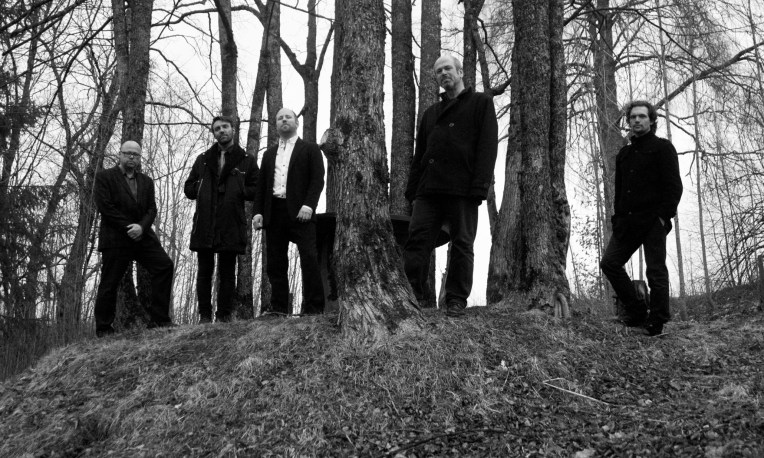
(Photo credit: Ellen Ane Eggen)
Økland employs a variety of open tunings on the album, each of which has its own special name. The “dark blue” tuning (D-D-A-D) is heard on the processional “Drev” (Drifted), wherein are bolded Stene’s percussive colors, and “Start” the so-called “troll tuning” (B-E-B-D#). In the latter, Økland combines ancient structures and modern minimalism, both of which he sees as relying on short motifs multiplied to form larger structures.
Økland has been increasingly inspired by the viola d’amore, which like his mainstay instrument has extra strings that vibrate sympathetically beneath the main four, and on tracks “Puls” and “Skugge” (Shadow) he draws a darker soul from this cousin. In the former piece, the heartbeat is evoked by Stene on kettledrum, while Eilertsen explores kindred frequencies. Over this, a flight from Økland’s bow touches the ocean with a wingtip in search of nesting territory.
Location matters a lot in Kjølvatn, which was recorded at the Hoff stone church in the countryside of Norway’s Oppland county. Økland’s go-to engineer, Audun Strype, captures the church’s resonant bounce, allowing the rougher, more organic aspects of the performance to exude clarity. One may hear this especially in “Fivreld” (Butterfly), an alluring piece of ambience in which the harmonium breathes like sunlight through foliage. Made for a ballet performance at Haugesund Theater in Økland’s hometown, it veritably dances.
Other references to Økland’s past are found in “Blå harding” and “Amstel.” Earlier versions of both appeared on the aforementioned debut. The first is something of a blues dedicated to his Hardanger fiddle teacher Sigbjørn Bernhoft Osa, while the second, which closes out the album, is greener, its organ-like harmonium reminding us of where we are.
Kjølvatn rarely bubbles beyond a simmer, but its flavors are all the purer for it. It’s a significant move in Økland’s career, and exemplifies an artist who, despite denying any underlying message, understands the value of careful construction. And in a way, that is its practice: to create art for its own sake, devoid of political baggage and free to roam in search of new and welcoming ears.
(See this review as it originally appeared in RootsWorld online magazine here.)

