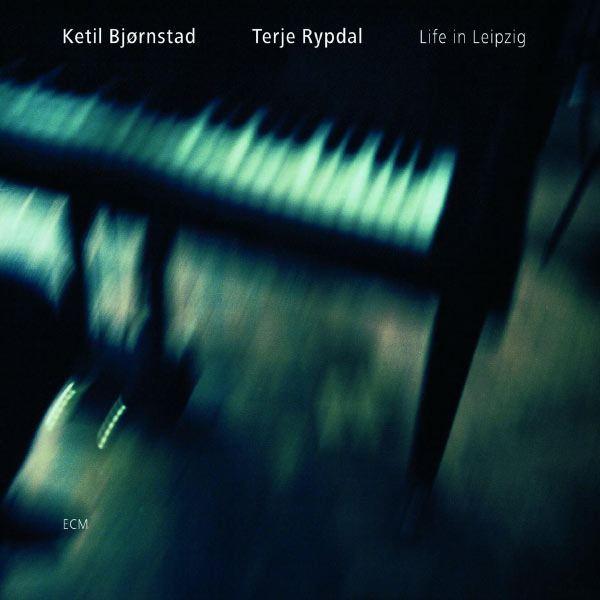
Ketil Bjørnstad/Terje Rypdal: Life in Leipzig (ECM 2052)

Life in Leipzig

Life in Leipzig

Ketil Bjørnstad piano
Terje Rypdal guitar
Recorded live by MDR, October 14, 2005 during the Leipziger Jazztage
Engineer: Matthias Sachers
Produced by Christian Cerny

Pianist Ketil Bjørnstad and guitarist Terje Rypdal present a parallel universe to the former’s duo recordings with cellist David Darling. Despite having performed with Rypdal more than any other musician, Bjørnstad makes here his album debut with Rypdal as a duo. Recorded live at Leipzig’s Opera House in 2005, this document finds both musicians unmasked and in prime lyric form. They are also more focused and impactful in their playing, needing only to listen to each other and to the muses guiding them to sing.

With a Bösendorfer piano at his fingertips, Bjørnstad elicits a heavier sound not heard on previous projects. “The Sea V” thus begins the set in rather dark territory for Bjørnstad, whose lyricism tends to skim the waterline. Only now it scours the ocean floor, a ghost from some ancient wreckage clawing silt and coral into musical rebirth. The pianism gradually turns into sparkle, while Rypdal’s fire remains untainted by the waves—if anything, enlivened by them. Thus the album offers its first of a handful of reprises from The Sea, including also Nos. II and IX. Both overflow with aching nostalgia, the mode of speech between the duo so heartwarming that you’d swear you’ve heard it before, even if for the first time. The latter tune treats us to some rare strumming from Rypdal for a webbed, Bill Frisell-like effect.

Other tracks link back to further group collaborations. From Bjørnstad’s Water Stories we get the utterly fragile “Flotation And Surroundings,” for which Rypdal’s subdued, mid-heavy whispers bob like petals on water, while Bjørnstad dips into some crisp, jazzy playing that takes a page out of Keith Jarrett’s vast book. This in turn elicits from Rypdal a crispness of his own as he carves out a fiercely melodic solo. “By The Fjord” comes by way of The Light. Originally written for voice, it gains even truer vocal quality by virtue of Rypdal’s introspection. His is a physiological bed made up in sheets of gold.

The guitarist’s own Skywards gets props with “The Pleasure Is Mine, I’m Sure.” There or here, it is a luscious and soaring thing, equal parts muscle and fragrant breeze. Two references to If Mountains Could Sing also put Rypdal in the spotlight. The overlapping guitars of “Le Manfred / Foran Peisen” whip up a fiery solo replete with grungy delays. This is a profound moment in the program, and a bursting foray into Rypdal’s cosmology. Fan favorite “The Return Of Per Ulv” closes out the concert in a spirited version. This has a different quality with only a piano to back it. One can almost see it relegated to the corner of a nondescript tavern, even as it blasts its message across tundra and sand. Rypdal’s soloing takes this one to new heights…and depths.

Three standalones round out the set. “Easy Now,” excerpted from Rypdal’s Melodic Warrior, receives an astonishing treatment. Rypdal navigates its chordal landscape with his eyes closed and his pick telepathically attuned to every change in wind. And a fragment of Edvard Grieg’s “Notturno,” a short piano solo with slightest shadows, shifts into a short piece by Bjørnstad entitled “Alai’s Room,” another solo so pretty that might have upset the balance had it been any longer. It offers just enough reprieve.

Even at its most sensitive, the duo maintains an epic quality to its playing. About as good as it gets from either man, and a sheer joy to have them—and no one else—together at last.

Ketil Bjørnstad: The Light (ECM 2056)

The Light

The Light

Randi Stene mezzo-sopran
Lars Anders Tomter viola
Ketil Bjørnstad piano
Recorded February/March 2007 at Rainbow Studio, Oslo
Engineer: Jan Erik Kongshaug
Mixed by Jan Erik Kongshaug, Ketil Bjørnstad, and Manfred Eicher
Produced by Manfred Eicher

“Longing itself is a pledge that what we long for exists.”
–Karen Blixen

Ketil Bjørnstad has left a nuanced yet indelible trail through ECM’s forest, leading to the beacon that is The Light. The more he creates, the less ornamental his music becomes, so that here we have distilled melodies and grander human themes that can breathe. Subtitled “Songs Of Love And Fear,” this album is essentially his second for the label as nominal leader, following 1993’s Water Stories. And while many subsequent collaborations, including his classic sessions among the “Sea” quartet (with David Darling, Terje Rypdal, and Jon Christensen), have rendered water his theme par excellence, now he treads the currents of an equally fundamental force of life.

As any Bjørnstad listener knows, the Norwegian pianist and composer has always had a flair for clear and evocative melodies, and fans will surely find their expectations well met in this album’s two song cycles. The strength of this record, then, lies in its personnel. Bringing new depth to the Bjørnstad aesthetic are singer Randi Stene’s and violinst Lars Anders Tomter, the second of whom adds a dash of reality to the dreamlike qualities of the piano-voice telos. Indeed, these songs would seem to reference the great lieder of European art music in spirit, albeit by means of a more translucent architecture.

Bjørnstad’s Fire Nordiske Sanger (Four Nordic Songs) represent three decades of writing, performing, and refinement. It is, perhaps, no coincidence that the Norwegian word for “four” should mimic the English “fire,” for that is indeed the type of inner glow brought to every verse. The personal feel of “Grensen” (The Border) sets the tone. Written for his wife’s 50th birthday in 2006, it is the most recent of the four songs and reads like a love letter. “Sommernatt Ved Fjorden” (By The Fjord), on the other hand, was written in 1978 and has since become, much to the composer’s surprise, a favorite on the Norwegian pop charts. Imagistic contrasts also abound, as between the rustically inflected “Natten” (The Night), in which the viola takes on a narrative role, and the cinematic “Sommersang” (Summer Song), which follows the emotions of its protagonist—the song was, in fact, written for Stene—with the precision of a tracking shot.

The album’s remainder and title piece sets eleven poems by John Donne (1572-1631). While the vagueness of Donne’s poetry has always been key to its appeal, here it is leveled by the music’s even keel, balancing absence with substance and stillness with life.

In songs like “A Valediction: Of Weeping,” “The Dream,” and “The Prohibition,” the words teeter between surrender and command, while in “Air And Angels,” “Love’s Alchemy,” and “Break Of Day,” love assaults the eyes like two transparencies of the same image bumped slightly askew. Nevertheless, the connective spirit of Bjørnstad and Tomter holds on to a vision of unity in the shadow of Stene’s voice, especially in their instrumental interlude, “Lamentoso.”

Moments of unity abound elsewhere. “The Flea” is both one of Donne’s most intriguing poems and receives here an equally vivid melodic treatment. “A Nocturnal Upon St. Lucy’s Day, Being The Shortest Day” is a morsel of comparable skill, weighted by the pall of a long winter, that finds its renunciations answered in “The Sun Rising,” in which rooted pianism evokes the grip of Donne’s passions. Finally, “A Hymn To God The Father” points to the poet’s devout core, where faith in heavenly blessing wraps his fears of death until they dissolve. This is where the album’s light truly shines through, exploring through prayer a love secluded from a world that would pick it clean if given the chance.

Norma Winstone Trio: Distances (ECM 2028)

Norma Winstone Trio
Distances

Norma Winstone voice
Glauco Venier piano
Klaus Gesing bass clarinet, soprano saxophone
Recorded April 2007 Artesuono Recording Studios, Udine
Engineer: Stefano Amerio
Supervision: Guido Gorna
Editing and mixing: Stefano Amerio and Manfred Eicher
Produced by Manfred Eicher

German reedist Klaus Gesing and Italian pianist Glauco Venier join the ECM roster for the first time in an astonishing trio album with veteran singer and lyricist Norma Winstone. Whereas in her past efforts for the label Winstone used her voice as much as a melodic tool as an agent of song, here she steeps the listener in a richly textured feeling not experienced since her 1987 masterpiece, Somewhere Called Home.

“Distance” sets the stage not only thematically, but also musically. The tune is by Venier, whose gentle ostinato exudes an atmosphere that is as weightless as Winstone’s lyrics are gravid. The whispers of Gesing’s bass clarinet complete this portrait of a subterranean world run dry. A prologue to an album of prologues.

Venier further pens “Gorizia” and “The Mermaid.” The former is a halting and wordless waltz that dissolves like ink in water, while the latter is another lyrical bird’s nest. Winstone and Gesing respectively provide words and music for “Drifter” and “Giant’s Gentle Stride,” both adaptive verses that sweep through the composer’s gorgeous reed work with ease. Winstone deepens the circle in “Remembering The Start Of A Never Ending Story,” set to the music of pianist Hubert Nuss. What begins as a play of light and glass finds solace through the soprano’s wide-flung window. In the haunting “Ciant,” Winstone sings words by Italian director Pier Paolo Pasolini to the tune of Erik Satie’s Petite Ouverture à danser, the peaks and valleys of which become interchangeable, each the yin to the other’s yang.

Winstone and her telepathic trio also reverse-engineer popular songs to an elemental sort of understanding. The Cole Porter chestnut “Every Time We Say Goodbye,” for one, pairs her and Gesing’s soprano to stunning effect. Moving like wings in concert, the duo reads the wind as Venier follows their birdlike shadow. Their version of Peter Gabriel’s “Here Comes The Flood” shines even brighter. Against a backdrop of palpable color, its celestial interpretations and earthly ruminations combine with the precision of a chamber music ensemble.

Finishing off the album’s eclectic stride is “A Song for England,” which finds the trio improvising on a Caribbean calypso, with words by Jamaican-born writer Andrew Salkey. The bass clarinet’s rhythmic support buoys a purely melodic Winstone before switching over to discernible lyric amid a shower of whimsy.

Distances is an album one wishes could go on and on. That said, its compactness offers plenty to rediscover on repeat listening. Combinations like this happen only rarely, and Winstone’s puzzle comes out of the box completed, glued together, and glowing with atmosphere. Hers is a voice that sings not because it must be heard by the world, but because it must itself hear the world. It speaks only of what it has known.

Terje Rypdal: Crime Scene (ECM 2041)

Crime Scene

Terje Rypdal
Crime Scene

Terje Rypdal electric guitar
Palle Mikkelborg trumpet
Ståle Storløkken Hammond B-3 organ
Paolo Vinaccia drums, sampling
Bergen Big Band
Olav Dale conductor
Recorded May 2009 at Nattjazz, Bergen by Norsk Rikskringkasting
Engineer: Per Ravnaas
Produced by Erling Wicklund

A line from The Good, the Bad and the Ugly plunges us into the world of Terje Rypdal’s Crime Scene: “Since we’re all going in the same direction, we might as well go together.” The fruit of a commission for the 2009 Nattjazz Festival in Bergen, Norway, the album is both a departure and a homecoming. In the former sense, it puts the Norwegian guitarist-composer’s pen to the 17-piece Bergen Big Band; latterly it deploys the rawness of his electric guitar into a mounting energy field. Joining him on the main stage are trumpeter Palle Mikkelborg, drummer Paolo Vinaccia, and Ståle Storløkken on Hammond B-3 organ, all under the baton of Olav Dale. The cinematic charge of such forces is brought home by Vinaccia’s tasteful, if unabashed, sampling of classic Hollywood westerns, gangster pictures, and films noirs.

Rypdal’s long-range suite erects a ghost town of familiar voices: Clint Eastwood’s Blondie, Marlon Brando’s Don Corleone, and even (surprisingly?) Christopher Lloyd’s Doc Brown add their own grit and wit to an appropriately gravelly undercurrent. Much has been made about the use of samples in this otherwise muscled sonic experience, but these popular sound bites provide anchorage for the music’s spiraling outcomes. In regard to those outcomes Rypdal gives us tantalizing clues by way of tongue-in-cheek track titles like “Prime Suspects,” “The Criminals,” and “Investigation.” Throughout this course in aural detection we encounter dueling tenors (both instrumental and emotional) and a trio of bass clarinets, the undercurrent of Storløkken’s Hammond stoking the furnace all the while. Mikkelborg often echoes Miles Davis (a major influence on Rypdal’s earliest fusional stirrings) as the rhythm section’s grungy airlock holds its own against a tide of brass. Through this Rypdal’s guitar cuts—not a knife but a siren, breaking the seal on a bag of forensic evidence with sheer force of thought.

As referential as Crime Scene is to its thematic bon mots, it is even more so to Rypdal’s own career and inspirations. Head-nodding bass lines recall What Comes After and Odyssey, scalding the night with their nostalgia. The ambient collage of “Parli con me?!” and hard-hitting funk of “Action” (a prime vehicle for Rypdal the acrobat) rest comfortably between composite sketches of horns. And the darker “It’s Not Been Written Yet” leads to the even darker conclusion of “Crime Solved,” the low drone of which burrows into the skull in a way not heard since Q.E.D.

Crime Scene belongs to that sparsely populated league of such montage procedurals as John Zorn’s masterful Spillane. Although it may not puff as many cigarettes as Zorn’s exemplar, it nevertheless swims in its fair share of smoke.

(To hear samples of Crime Scene, click here.)

Ralph Towner/Paolo Fresu: Chiaroscuro (ECM 2085)

Chiaroscuro

Chiaroscuro

Ralph Towner classical, 12-string and baritone guitars
Paolo Fresu trumpet, flugelhorn
Recorded October 2008 at Artesuono Recording Studio, Udine
Engineer: Stefano Amerio
Produced by Manfred Eicher

Ralph Towner describes his first encounter with Paolo Fresu at a festival in Sardinia: “I didn’t know him at all then, but from the very first phrase that he played, I thought: This guy really understands melodies!” Surely, we can say the same about both musicians once the first bars of “Wistful Thinking” lay the corner pieces of the ensuing puzzle, establishing with them a language of tasteful ornament. If the overall effect feels nostalgic, it’s because the track reprises material from Open Letter, an even more unusual pairing that found Towner in the company of drummer Peter Erskine. Another, “Zephyr,” was last heard on Oregon’s Ecotopia and shows in this duo version an even barer creative process at work.

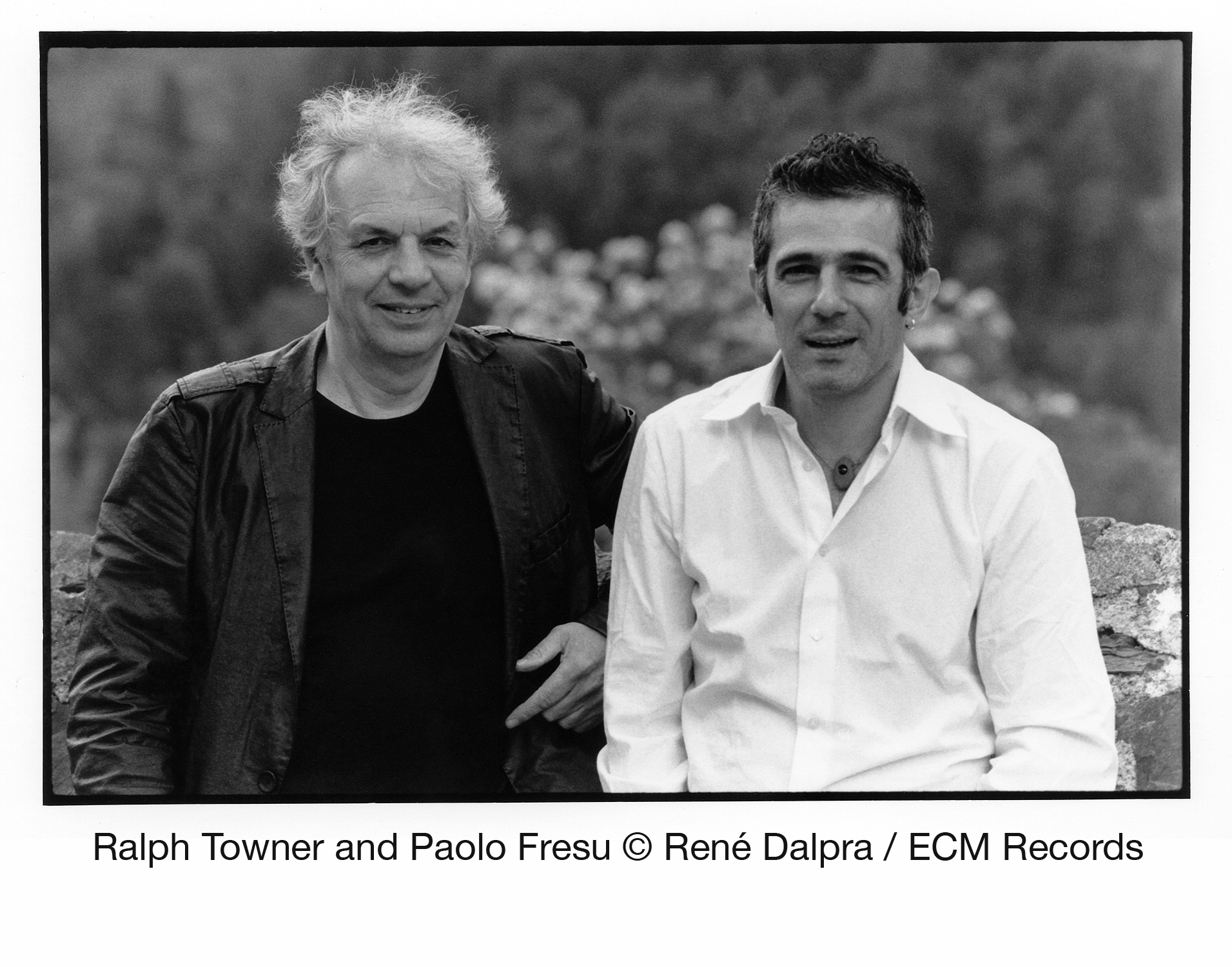
Towner and Fresu

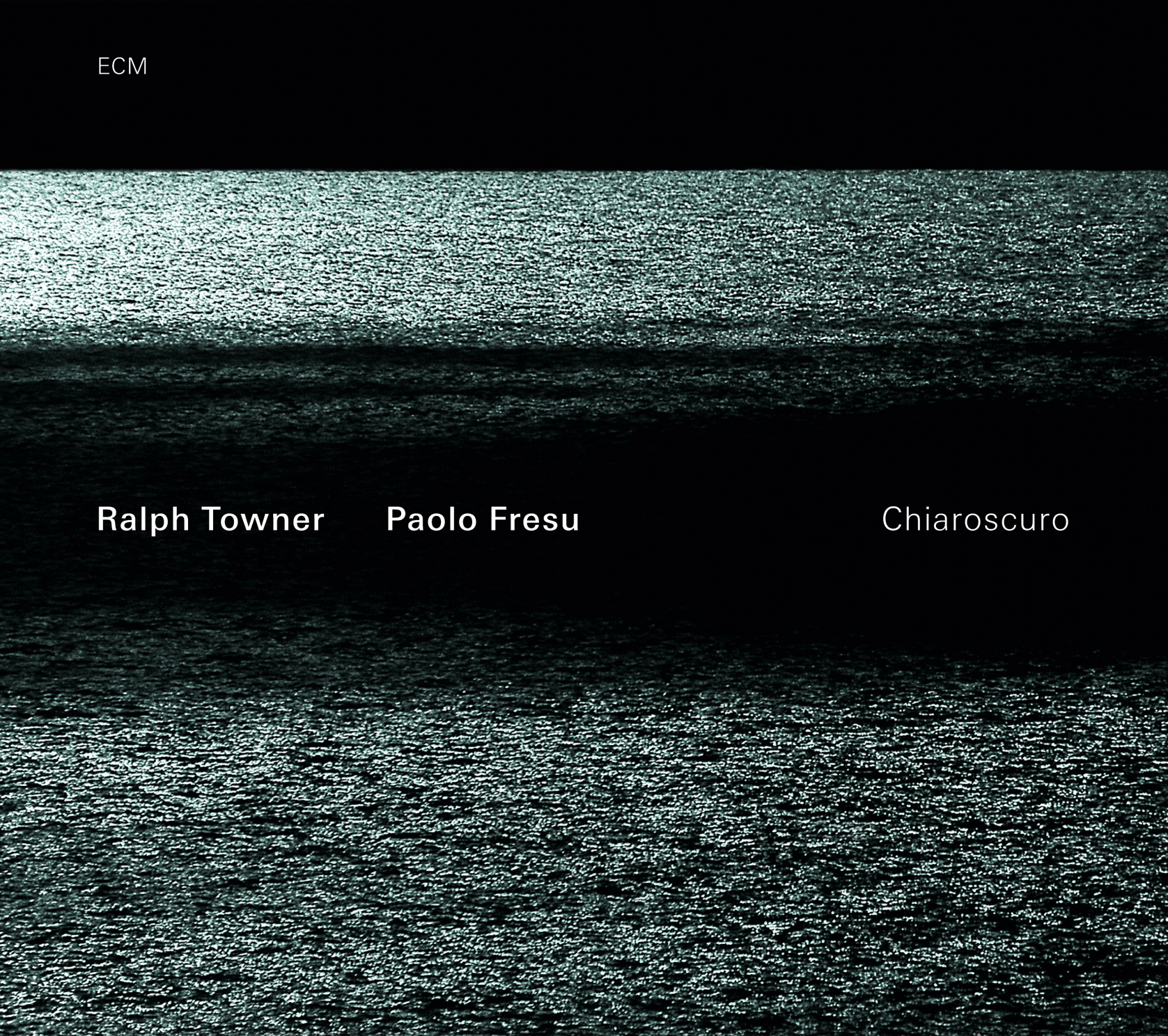
More to the point, Chiaroscuro is an album of balanced architecture, each tune an archway held strong by a melodic keystone. The title track, for one, turns like a windmill in April, sprouting with fractal energy that integrates the musicians in the same way that light and shadow dance in the cover photograph. There is always something of one in the other, even in the solo passages. Whether navigating Miles Davis’s undying “Blue In Green” (the only non-Towner piece of the program) or the propulsive “Punta Giara,” the dance of Towner’s earth tones and Fresu’s hints of sunrise maintains a robust meridian.

The guitarist’s rhythms are so compact that it’s refreshing to hear a partner drawing melodic threads through them without getting buried. In “Doubled Up” especially, Towner’s busy fingerwork would seem to shelter no room for interpretation, yet finds harmony in the trumpeter’s muted approach. Deeper still are the contrasts of “Sacred Place,” a chromatic solo piece from Towner that finds haunting reprise with Fresu’s unforced elaborations. These three tracks also make use of the baritone guitar, a low-tuned instrument new to Towner’s toolkit.

For balance (in both content and form), a dash of improvisations rounds out the session, slinging Fresu high above Towner’s incandescent 12-string. Pliant yet unflinching in its integrity, this is music that is organic by design.

Quercus: s/t (ECM 2276)

2276 X

Quercus

June Tabor voice
Huw Warren piano
Iain Ballamy saxophones
Recorded live March 2006 by Paul Sparrow
Edited by Mike Mower
Mixed at Rainbow Studio, Oslo by Jan Erik Kongshaug and Manfred Eicher
Produced by Manfred Eicher, Iain Ballamy, and Huw Warren

Quercus names both the debut album and trio composed of folksinger June Tabor, pianist Huw Warren, and saxophonist Iain Ballamy. The word is Latin for “oak,” but the image implies more than rootedness, embodying the full arboreal essence of this somber collection. Indeed, Tabor’s voice is the very wood of the forest, and invites the instrumentalists along its democratic path of music making.

Quercus Photo

All that I have endured
Lassie my dearie
Here in thine arms is cured
Lassie lie near me

These words, by Scotland’s national poet Robert Burns, ease us into a running theme: love as a salve for all ills. From the last line comes the title of the song, which Tabor sings with little affectation, save the emotional veracity of her diction, while Ballamy harmonizes, doubles, and cradles her by turns. He and Warren carry on the melody, unraveling finer implications behind the text with understated precision. This formula proves effective hereafter and works especially well in the iambic pentameter of Shakespeare’s “Twelfth Night,” from which is excerpted the lyrics of “Come Away Death,” in Ballamy’s own arrangement, and for which Tabor digs into her chest voice to tease out the Bard of Avon’s gravelly truths. It is a quality she employs selectively, as in her unaccompanied version of “Brigg Fair,” turning a normally airy song into ash. Ballamy further provides music for “Near But Far Away,” in which he seems to channel jazz legend Charles Lloyd in this melodious, if cautionary, tale that is one of the album’s finest. “As I Roved Out” completes the selection of traditional songs. Like a fantasy made actual and turned back into fantasy, its scrim bears the scars of transformation:

And at night when I go to my bed of slumber
The thoughts of my true love run in my mind
When I turn around to embrace my darling
Instead of gold sure it’s brass I find

“The Lads In Their Hundreds” couches the WWI poem by A. E. Housman in music of English composer George Butterworth. With the austerity of a Ken Loach film, it draws black where only green once thrived. The musicianship brings an eerie sense of calm and offsets morose imagery of young soldiers going off to war, only to die as anonymous placeholders of unwritten glory. To this elegy Warren responds with “Teares.” The John Dowland-inspired piano solo blends pointillism and sustain, for all a windswept pasture. Subsequent vignettes evoke faraway deserts (“Who Wants The Evening Rose”), the naïveté of love’s first kiss (“This Is Always”) and, in “A Tale From History (The Shooting),” the drama of remembrance. The latter, a true song of songs, features words and music by Irish singer-songwriter David Ballantine. Tales from history line our breath, goes the rhyme. Start with passion, end in death. The promise of retribution lingering in these mor(t)al variations finds fulfillment in the closing “All I Ask Of You,” by American spiritual leader and hymnist Gregory Norbet. Here Ballamy’s introductory soliloquy strikes a balance of prosody and poetry, and holds on to its melody as one in prayer might grasp a rosary. The flowing changes in instrumental color unexpectedly come together with Tabor in the final moments, oneness above all.

Like the three Robin Williamson discs before it, Quercus expands ECM’s unique interpretive folk niche. Although recorded live at The Anvil in Basingstoke in conclusion of a 2006 UK tour, it wasn’t released until 2013. The seven-year lag seems appropriate, for the trio had been together seven years before turning the microphones on. It’s as if the songs were doubly aged so that they might reach our ears at peak flavor and consistency, pushing us along the way into the darkest crannies of the human experience even as they lift us from those depths in want of light. Each is the shadow within the shadow, a space where dreams and realities intermingle until one cannot be pulled apart from the other.

(See this article as it originally appeared in RootsWorld online magazine, where you may also hear a sample track.)

Sinikka Langeland: Starflowers (ECM 1996)

Starflowers

Sinikka Langeland
Starflowers

Sinikka Langeland vocal, kantele
Arve Henriksen trumpet
Trygve Seim tenor and soprano saxophones
Anders Jormin double-bass
Markku Ounaskari percussion
Recorded May 2006 at Rainbow Studio, Oslo
Engineer: Jan Erik Kongshaug
Produced by Manfred Eicher

It is one of those nights
when loneliness stands with its back turned to everything
and its face frozen fast in the western sky.

“Starflowers” is both an apt name for Sinikka Langeland’s ECM debut and for the cast assembled beneath its canopy. The Norwegian vocalist and kantele (Finnish table harp) player welcomes trumpeter Arve Henriksen, saxophonist Trygve Seim, bassist Anders Jormin, and percussionist Markku Ounaskari for her original settings of verses by lumberjack-poet Hans Børli (1918-1989). Although classically trained, Langeland has nurtured a longstanding interest in folk music. This disc takes that interest into crucible, concentrating it into a melodic cosmology all her own. That Jan Garbarek was an early influence should come as no surprise, for the same mystical undercurrents that inform his own music are undeniably present in hers (refer especially to Mari Boine’s appearances with the saxophonist’s eponymous Group).

Sinikka
(Photo by Dag Alveng)

That said, Langeland is possessed of a voice and touch like no other. The latter, as fed through her five-octave concert kantele (different from the one pictured above) is striking enough to preclude the need for voice. Like the Japanese shō or Constantinople lyra, it’s one of those instruments that seems handed down from on high, left to sing of a homeland to which it can never return. It spins an earthy web as well, shimmering with the pliancy of water but the strength of trees. So preaches the album’s first song, “Høstnatt på Fjellskogen” (Autumn Night in the Mountain Woods), in which Langeland paints entire scenes with a caress of the strings, warping their sound to suit a dreamlike cast. It’s as if the words pull at her, and we hear their pull in every pitch-bent note. The forest is palpable.

Although Børli may rightly be considered a naturalist poet, he was not entirely unaware of the workaday world:

The earth seems to climb and climb,
Lifting into the sky.
Then suddenly there’s calm.
As when the elevator halts
Somewhere on the higher floors and
you take instinctively a backward step
to keep your balance.

Such analogizing only serves his commitment to the outdoors, where his imagery finds common home. Whether chipped away in “Saltstein” (Rock Salt) or emerging from the brushed snare and ghostly bassing of “Sus i myrull” (Whispers in the Cotton Grass) in Meredith Monk-like song-speech, a feeling of rootedness reigns. And in “Langt innpå skoga” (Deep in the Woods), a scrim of frost clings to Langeland’s raw voice, reflecting jazzier denouements from Seim and Ounaskari that speak of urban climes far in the distance.

“Stjernestund” (A Moment of Stars) and “Treet som vekser opp-ned” (The Tree That Grows Upside Down) take on a decidedly mystical air. Cosmic percussion in the one gives life through primal contact, while the other indulges in the power of progression. Both grow in tangled vines, fanciful yet sure as sun and sky. The scintillating quality never weakens. Like the titular instrument of “Den lille fløyten” (The Little Flute), its potential waits for the right person to come along and share it. Even stronger album highlights include “Det er ei slik natt” (It Is One of Those Nights), which features Langeland’s lone voice against the aurora borealis of Jormin’s harmonics, and “Elghjertet” (The Moose Heart), which tells of the same thrown steaming into the snow after a hunt. The heart is covered before the cutting of the carcass is done, left forgotten, cooling to crimson ice.

The album’s three instrumentals are sacred in their own light. “Sølv” (Silver) and “Støv” (Dust) explore likeminded ostinatos, glistening and true. The jazzier “Vindtreet” finds Langeland contributing wordless vocals as the band ventures into its freest territories settling into the quiet sheen and shimmer of strings. All roads, then, lead to “Har du lyttet til elvene om natta?” (Have You Listened to the Rivers in the Night?), where Seim’s soprano and Jormin’s bass embrace a rift of kantele in the rock. The river between them is at once artery and vein. The music builds with urgency, but looses every fish caught back into current. In the wake of their sudden departure, a heat distortion breathes like a church organ fading into sleep.

If you listen long to the rivers in the night,
listen long,
it is at last as if your soul
is mysteriously remembering its future.

François Couturier: Nostalghia – Song for Tarkovsky (ECM 1979)

Nostalghia

François Couturier
Nostalghia – Song for Tarkovsky

François Couturier piano
Anja Lechner violoncello
Jean-Marc Larché soprano saxophone
Jean-Louis Matinier accordion
Recorded December 2005, Auditorium Radio Svizzera, Lugano
Engineer: Markus Heiland
Produced by Manfred Eicher

“What kind of world is this if a madman tells you you must be ashamed of yourselves? Music now!”

So espouses Erland Josephson as Domenico in Andrei Tarkovsky’s 1983 masterpiece Nostalghia, of which this album by pianist François Couturier takes the name. Domenico is, in many ways, himself a musical figure. As the very madman he admonishes, one who shackled his family in their own home for seven years as protection against an imperfect world, he is constantly refolding his own psyche in a leitmotif of fixation, building reality from blocks of fanciful impulses, each more poetic than the last. Yet as Tarkovsky himself once averred, art exists only because the world is imperfect. Music thrives on insanity.

That said, the even keel of Nostalghia presents the listener with such an expressive compass that even the most elemental sound becomes a northward tug. Anyone who has followed Couturier’s ECM travels will know that he is a musician of many directions. From the taut classical forays of Poros to the border-crossing trio recordings with Anouar Brahem (see Le pas du chat noir and Le voyage de sahar), he is anything but predictable. Counting cellist Anja Lechner, accordionist Jean-Louis Matinier, and saxophonist Jean-Marc Larché among the present company, he darkens Tarkovsky’s blueprints with the press of every key until they are ashen with wayfaring.

The album’s outer circle is inscribed by way of “Erbarme Dich” from Bach’s St Matthew Passion, which seeds the opening and closing tracks by way of profound lament. In the absence of words, “Le Sacrifice” (Bach’s aria appears in the Tarkovsky film of the same name) holds on to the text of the moment. In the absence of the cross, one feels the intersection of piano and accordion as a sacrifice in and of itself. The feeling of decay is palpable—surely, if imperceptibly, approaching disappearance—as was Tarkovsky’s play of color and shadow. The concluding “L’éternel retour” unravels by way of piano alone. Like a lost entry from Vassilis Tsabropoulos’s The Promise, its hand closes the lid of a box that houses creative spirit. That the song bears dedication to Erland Josephson indicates Couturier’s attention to detail in paying tribute not only to the artist of interest, but also his brilliant actors and collaborators.

“Crépusculaire,” for instance, honors Sven Nykvist, Ingmar Bergman’s right-hand cinematographer (who also filmed The Sacrifice) and moves accordingly by the touch of Lechner’s picturesque bowing. Her feel for notecraft and harmony is matched only by her attention to atmosphere. Couturier blends pigments with charcoal-stained fingers, each a pontiff reduced to a smudge across gray sky as the accordion finds its peace in the waters below. The combination aches with dew, trembling on grass stems when the three instruments at last share the same breath in focus.

“Nostalghia” is for screenwriter Tonino Guerra, with whom Tarkovsky co-wrote the screenplay for that very film. It opens us to the affectations of the full quartet and takes its inspiration from Schnittke’s Sonata No. 1 for violoncello and piano. This gentle music is a wish turned into stone and laid in stagnant water. The most obvious dedication, “Andreï,” also incorporates the Schnittke. A steady pulse in the left hand frees the right to orbit the keyboard, while the accordion fits like wind to wing over barren plains of consciousness.

“Stalker” gives proper attention to Eduard Artemyev, who wrote the soundtracks for that film and Solaris, and meshes bucolic and hypermodern impulses in kind. Its impactful pianism gives up many relics, each more sacred than the last. Anatoly Solonitsyn, lead actor of Andrei Rublev, is the final dedicatee. With its allusions to the “Amen” from Pergolesi’s Stabat Mater, “Toliu” multiplies shades of night.

Although Couturier consciously avoided the evocation of specific Tarkovsky scenery (this is more than a concept album), the feeling of pathos is so visual that one might as well be watching a film by the great director. The pianism shines like the water so prevalent in Tarkovsky’s cinema, if not swimming among many artifacts strewn below the surface. And in any sense, Couturier is very much the director of all that one hears throughout the program, as borne out most directly in the freely improvised “Solaris I” and “Solaris II.” In these the soprano saxophone turns the sun into a pilot light, and the world its oven, even as the rest of the ensemble hangs icicles from the eaves. Still, the overall effect is more literary than filmic, picking up words and turning them into actions that grow with listening.

“Ivan” references Ivan’s Childhood, Tarkovsky’s first feature. Its declamatory beginning spawns an almost theatrical feeling in distorted fairytale gestures before the quartet rejoins to finish off strong. In the wake of such confluence, Couturier’s solo “Miroir” wipes the slate clean, leaving superbly engineered ambience as the only evidence of an inner world to be discovered. Each step taken on this Escherian staircase walks a path of light.

Perfection may be an impossible ideal, but this album almost touches it. It’s a sheet of paper curling into its own insecurity for want of inscription. Don’t let it slip through your fingers, no matter what kind of quill you wield.

Ralph Towner: Time Line (ECM 1968)

Time Line

Ralph Towner
Time Line

Ralph Towner guitar
Recorded September 2005 at Propstei St. Gerold, Austria
Engineer: Markus Heiland
Produced by Manfred Eicher

Ralph Towner has left many indelible fingerprints along his trail of solo guitar albums, yet none so transcendent as by the acoustics of St. Gerold. The Austrian monastery has long served as recording venue of choice for the Hilliard Ensemble and other ECM New Series acts. The magnification engendered by its architecture serves only to bring out the expanse of Towner’s jazzier vocabulary, which somehow comes across all the more intimately. Exhibit A: “The Pendant.” Its lilting chromatism patterns itself like breathing, dripping just as involuntarily from Towner’s hands. Its reflective classical guitar evokes a veritable photo album of places and faces. Towner traces the flurry of sunlit arpeggios that make up his “Oleander Etude,” for instance, back to memories of Sicily, where oleanders grow in plenitude by the roadside, recreated here by the piece’s traveling speed. Other Sicily-inspired pieces are “Anniversary Song” (written for his wife, actress Mariella Lo Sardo), “Turning Of The Leaves” (written in collaboration with singer Maria Pia De Vito), and “The Lizards Of Eraclea,” which despite its evocative title has little at all to do with lizards. In contrast, “Always By Your Side” takes direct inspiration from Shakespeare’s The Tempest, for a production of which Towner once wrote it as incidental music—although, as he recalls, it feels more like Broadway than Elizabethan theatre. Like so much of the disc, it takes on its own life, dripping sweetness into the ear even as the heart proclaims it within. Whatever the original associations might have been, the truth of these pieces begins here.

Whereas Towner often allows for improvisation, “The Hollows” is through-composed. Its warped harmonies cohere by a strange geometry, which by the end reveals itself to be balanced and assured. “Five Glimpses,” on the other hand, is a collection of entirely improvised vignettes that arose during the recording process. Each is a window into Towner’s mind at work and switches from diaristic meditation to tense poetry at the drop of a pin. The final glimpse is all of 25 seconds of finger tapping, as magical as it is fleeting. Somewhere between the two is “If.” Towner interprets it as a self-contained call and response, whereby the language of the piece emerges through melodic parthenogenesis. Indeed, its shape is almost helical, a strand of DNA floating through its own dream on a cloud. Even as one of the busier pieces of the set, it wants not for breathing room.

“Come Rain Or Come Shine” is one of two standards on the album once favored by Bill Evans, an early influence on Towner. This one, by Harold Arlen (most famous for “Over the Rainbow”), is another nimble turn from Towner, who carves through it a maze with many solutions. The other standard is George Gershwin’s “My Man’s Gone Now,” which, like Towner’s chromatic “Freeze Frame” that precedes it, is played on the 12-string guitar. Both pieces employ a nonstandard tuning that inks the waters. From the Gershwin especially, it teases out a shade of blue hitherto absent.

With his usual solitary, tactile quality, Towner has created a real artifact in sound. Meticulously designed and played, its arching motifs and rhythms come across with photographic assurance, so that one may return to them time and again, knowing they will never change.