
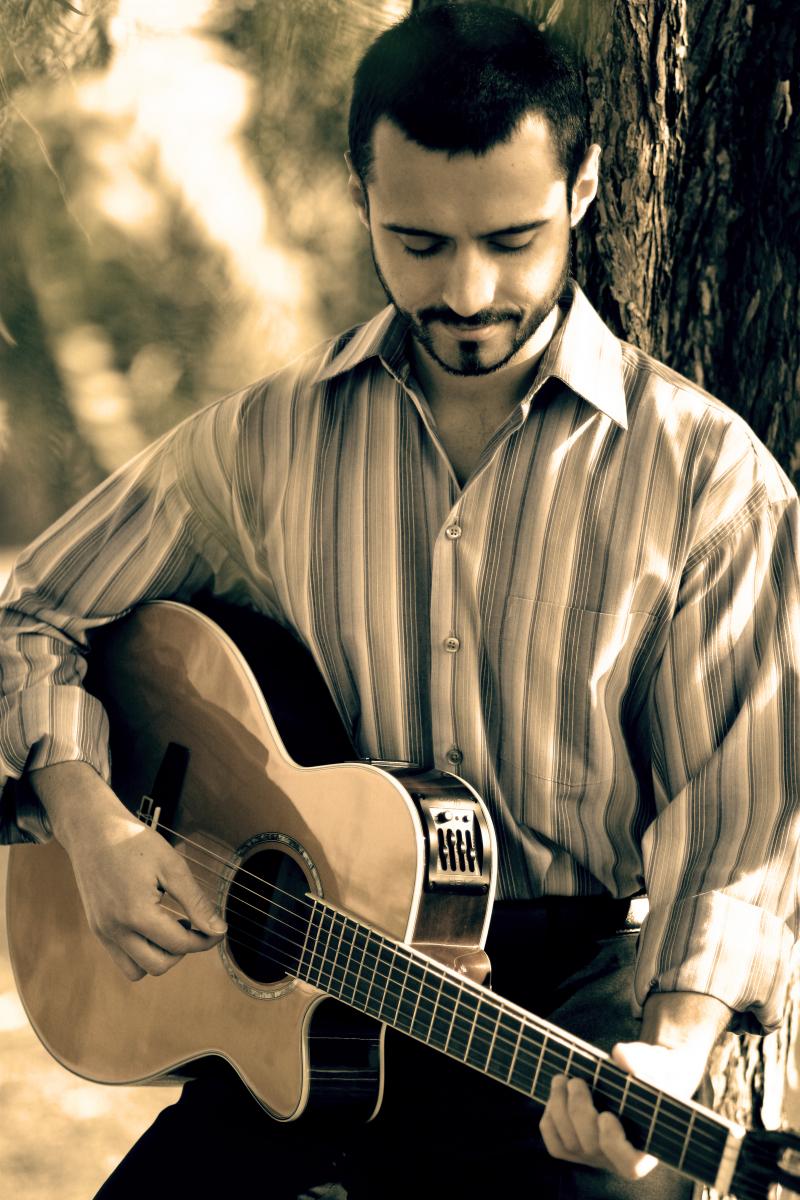
Hristo Vitchev is a gem among jewels. Born in Sofia, Bulgaria and now based in San Francisco, the jazz guitarist-composer has nearly 300 original compositions, various articles on improvisation, and even a book on jazz chord theory to his credit. His 2009 quartet debut, Song for Messambria (2009), was released to wide critical acclaim and firmly established Vitchev as an artist to keep an ear on. For indeed, keeping an ear on things is what his music is all about. Thus attuned to the pulse of his path, his is a spiritually focused craft that welcomes all without judgment. Like many independent artists working today, he has achieved this state of mind through no small measure of sweat and determination, but you might never know it from the effortless fluidity of his playing and the accommodating vitality that animates it.
Of that playing, comparisons to Pat Metheny seem inevitable. Vitchev’s penchant for smooth geometries and quick key changes certainly falls in line with the former’s graceful sound. And so, it only made sense to pose this question during a recent interview. Vitchev’s response:
He is definitely one of my heroes. I was first exposed to Metheny’s music around 1999, and the first record I heard was Imaginary Day. I still remember how mesmerized I was by the tonal colors and textures of that album. At the time, however, I was still into rock music and had yet to discover jazz. In a way, the mystery and curiosity that Pat’s music planted in me was one of the forces behind deciding to study and understand this great American art form. Of course, one cannot escape the conscious and subconscious influences of his/her idols, but if I had to compare my style with his, I would say I’m more of an impressionist, blending harmonic and tonal planes to a more finite degree and playing with the smallest nuances. Pianists are among my biggest influences: Tord Gustavsen, Esbjörn Svensson, Brad Mehldau, not to mention Ravel, Debussy, and all the great composer impressionists.
The impressionist angle is an important one to unpack, for it distinguishes Vitchev from others on the scene, who may forego such interest in what he terms “harmonic tapestries” in favor of a less mitigated approach. Yet the patterns with which he concerns himself are truly integral to the sound he has worked to establish. It is a freedom of expression born of unquantifiable practice, performance and, above all, sharing:
There seems to be a lot of travel implied in your songs. The track titles of Song for Messambria in particular contain references to clouds, sky, etc. Is there any conscious geographical or spatial relationship in your music and how do the recording and improvising processes construct or react to that space?
Over the years, I have traveled to many different places and spent a considerable amount of time living on three different continents. Traveling to me is the ultimate way to learn, internalize, and comprehend all the uniqueness of different cultures, traditions, and human diversity. I can affirm that I’m very inspired by geographical places, and by the actual act of traveling. Song for Messambria was inspired by the enchanting city of Messambria (now Nesebar), located on the Black Sea coast of Bulgaria and also one of the oldest cities in Europe. My quintet record The Perperikon Suite was also inspired by a geographical location—the city of Perperikon, also known as the capital of the great Thracian civilization dating back to 5000 B.C. My latest record, Familiar Fields, is inspired by the many emotions I felt returning to Bulgaria many years later (as an adult) to see the homeland of my childhood. Translating this into my music and my sound seems to be a very natural process. When the band gets together and plays the first note of a chart, it is really the beginning of a sonic journey that is responsive and reactive to what each member notices on the way. It is very hard to explain, but in reality playing and improvising music is the same as taking a road trip with your friends and constantly relating to each other’s feelings about the environment around us.
What attracts you to jazz and how has it enriched your life?
My attraction to jazz came rather late in life, but when it arrived it was more intense than any other interest I have ever known. There is something so freeing about its spontaneity. This music is contagious for all its vivid aliveness and constant evolution. Of course, my take on jazz differs quite substantially from the classic definition of the word. For me it is more of a procedure than a style. It is that special and magical element that everyone can embrace and make it his/her own. This music really helped me define who I am as a person, as a musician, as an element of this world and as a spiritual molecule. It is immense.
Overall, is your music consciously autobiographical in any way?
I guess the constant goal of any musician, especially those in the improvisatory arts, is to grow into attaining the ultimate level of emotional expression, one that loses nothing in translation. Straight from the heart and soul. This is also my goal. I work very hard day after day, and hopefully that comes across to the listener. There is nothing more beautiful to me than sincerity and honesty expressed through art.
What kind of music did you listen to growing up?
When I was growing up I first started listening to 80s rock bands. I then transitioned into heavy metal, then progressive rock, fusion, and finally landed in the jazz world in 2000. Of course, being Bulgarian I always had traditional Bulgarian folk music around me as well.

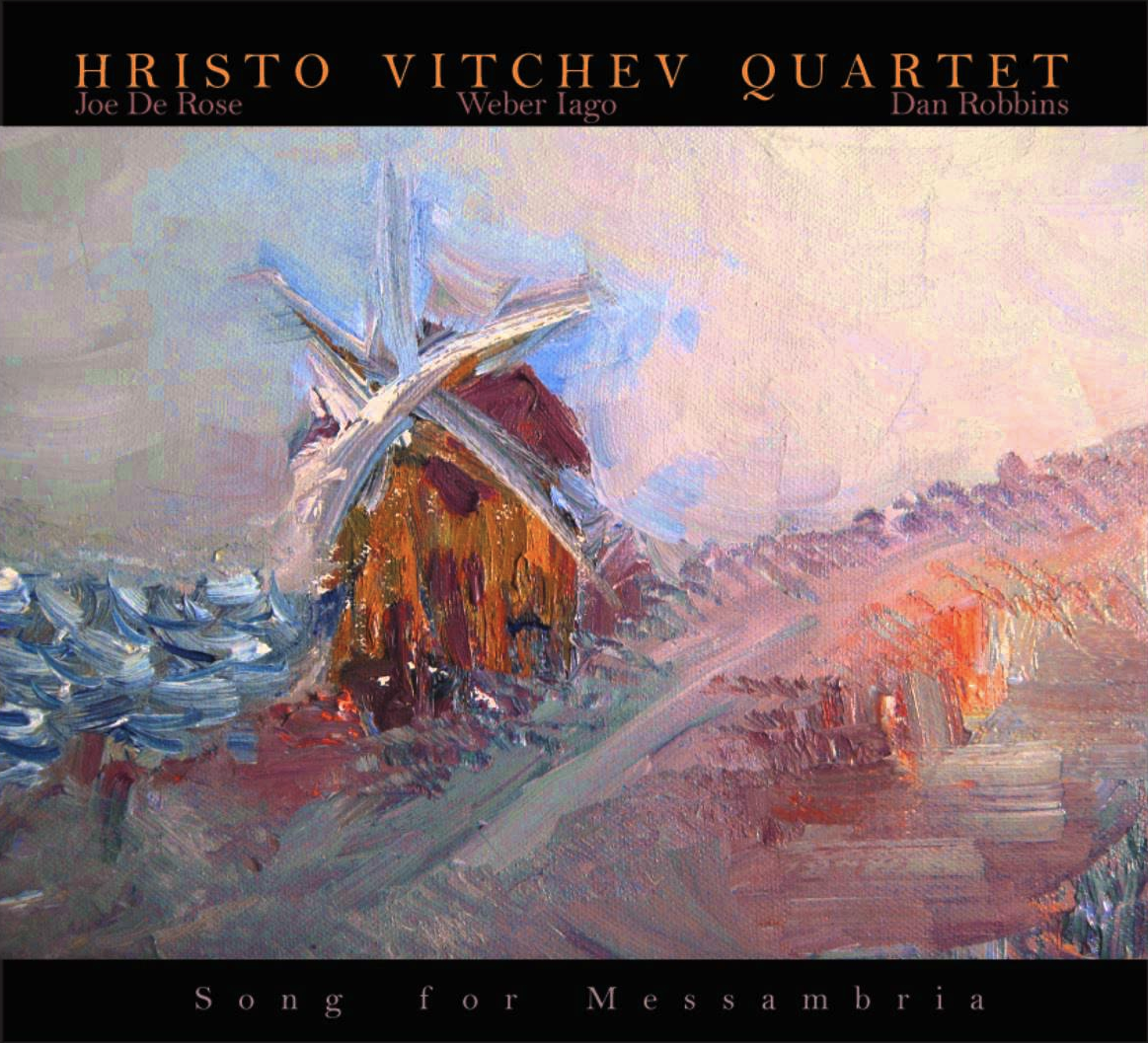
To be sure, Vitchev’s autobiographical impulses are clearly felt on Song for Messambria, which for a debut feels like a step into an already boldly flowing stream. From the first licks of “Waltz for Iago,” the album maps a decidedly itinerant mind, jumping straight into the melodic heart of things. Messambria gets brownie points for featuring acoustic guitar throughout, as well as for its palpable group telepathy. Tracks like “Sad Cloud” and “The Road to Naklabeht” show a quartet in peak form, speaking also to Vitchev’s ability to surround himself with likeminded talent. Bassist Dan Robbins rocks the boat in the whimsically titled “Dali in Bali,” while drummer Joe DeRose keeps us locked into every development with ease. Vitchev clicks most beautifully in the closer, “It Follows.” An emblematic track, it pairs guitar and piano in seeming anticipation of The Secrets of an Angel, his first full duet album with longtime collaborator Weber Iago.

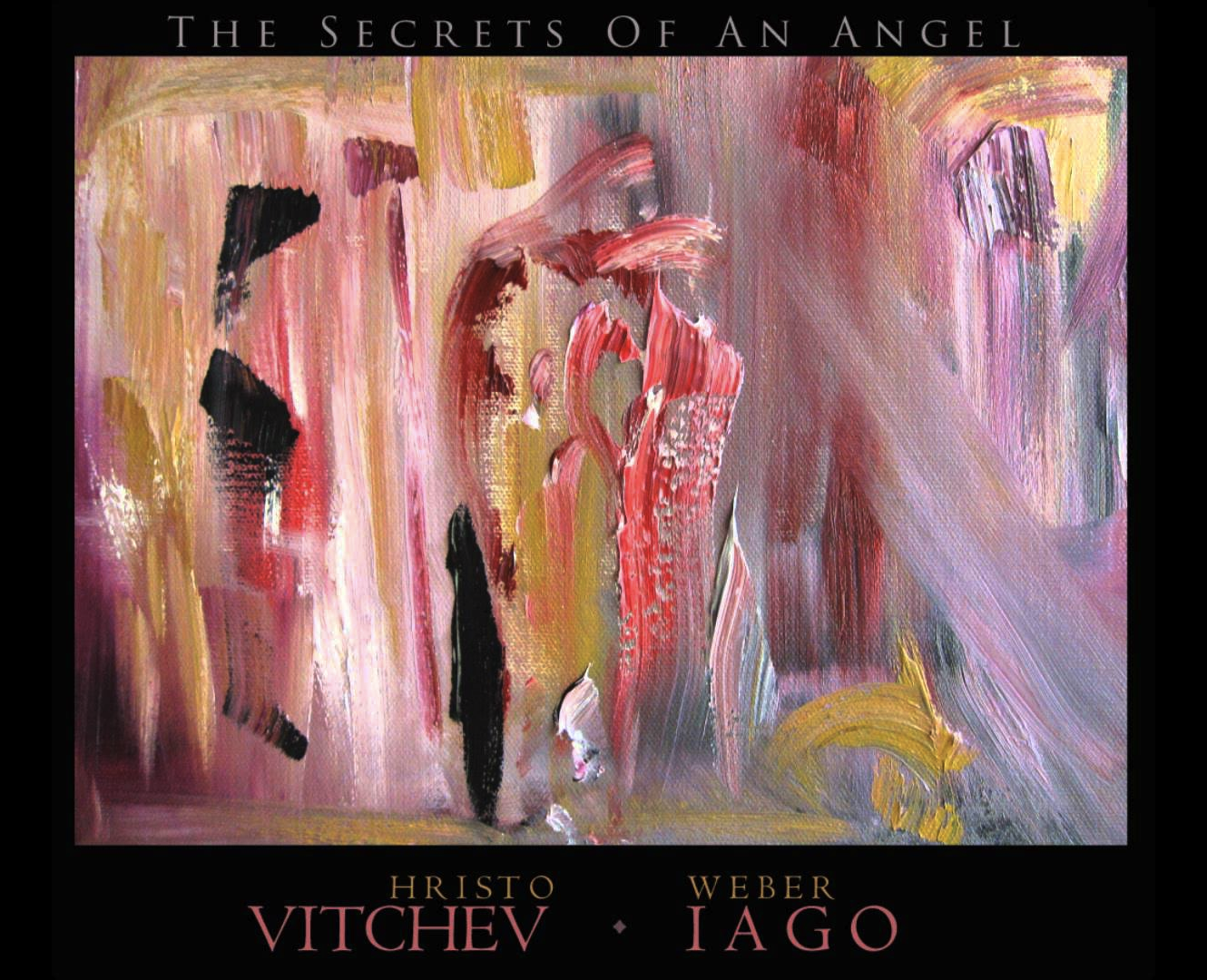
Of that second album, the opening “Waltz by Chance Alone” starts us down a highway to supreme insight. From the intimate and sublime (“Zima’s Poem”) and the delightfully programmatic (“When It Rains” and “Haiuri’s Dance”) to the storytelling vibe of the two-part “The Last Pirate,” there is a continuity of purpose and consistency of color. The final “Leka Nosht (Good Night)” ends like the previous album, closing its eyes on a dream, as if what has just transpired were but a waking memory, a fantasy too beautiful to exist for more than a breath’s duration in this world.
“Waltz by Chance Alone” speaks to unpredictability, to the beauties that can come out of unforeseen encounters. Is your music ultimately your way of reflecting upon the wonder of life’s mysteries?
As an artist, I always thrive to represent my life experiences in sounds without any filters or colorations. As they say: straight from the heart. I’m in love with life and admire and value every single breath, every single day on this planet, and every single emotion felt. I also find the mystery and unpredictability of our human condition to be the most important driving force and reason to move forward and wake up each day. Capturing such emotions in my work is the ultimate goal since there is nothing more beautiful that the sincerity and innocence of living. If the listeners can hear such sensations and qualities in my work and music, then my mission is accomplished.
What made you decide on going acoustic for the first quartet and duet albums? What sparked the shift to electric in the later?
For my first two albums I really wanted to capture the textures and colors of whispering, relating a story in the most delicate and relaxed way possible. In contrast, the material I needed to express on the next three records was a bit more edgy and multidimensional and required the ability to cover a wider dynamic range with my instrument. I’m a true believer that as a composer one has to let the music dictate what it requires to come alive.
How do you approach the duet differently from the larger ensembles?
From the composing to the recording to the playing, the duet records with Weber Iago are so much fun in all aspects of conception. There is something very special about a duo setting. There is this elasticity and immense space for expression for both instruments that is almost impossible to capture in any other format. It also allows for a much deeper and more intense improvisatory experience. I actually love the duet format so much that as we speak I’m finalizing the mixing of my next record: another duo session with Bulgarian master clarinetist Liubomir Krastev. The record’s name is Rhodopa and it covers very old Bulgarian traditional songs which I have arranged in a modern jazz fashion as well as a few original pieces I wrote for the album.
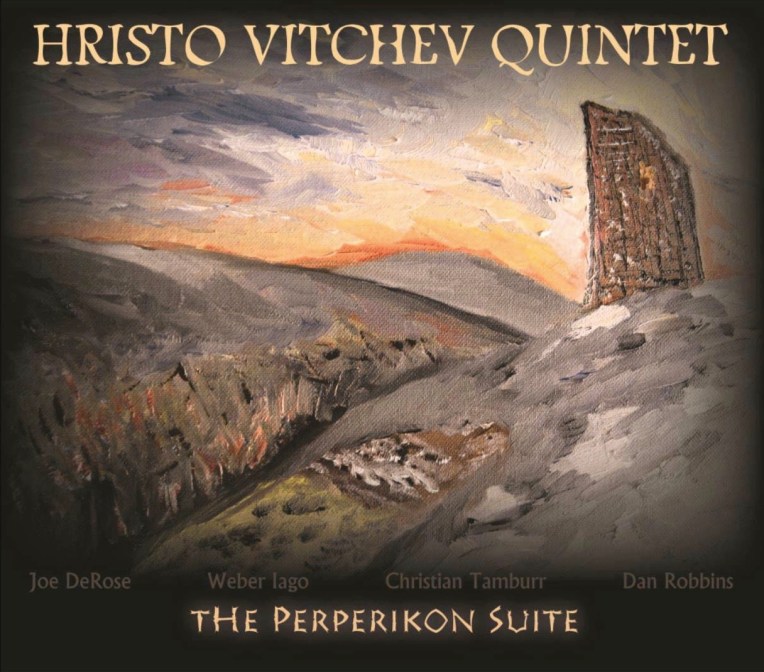
Vitchev’s next major project, The Perperikon Suite, fleshes his sound out to a quintet with the multitalented Christian Tamburr on vibes. The album feels orchestral, almost cinematic in scope, and establishes with “The Stone Passage” a sprawling, living scenery that brings us to “The Palace” by the light of flickering torch. The thematic shapes here are vivid, the music as descriptive as the titles. Tamburr adds reverence to the proceedings, as in tracks like “The Shrine of Dionysus.” All of this comes to a head in the virtuosic ride that is “The Acropolis” before easing us back into the mountains via the backstreets of “The Northern City” and “The Southern City,” through which we float on a bed of string and brush into the sunset.
Conceptually speaking, The Perperikon Suite is your most complex project. But in this day and age of radio airplay, what do you hope the listener will get out of it when s/he encounters it without knowledge of that concept?
That particular record is really a concept album. In a way it is one composition divided into seven different movements that capture the complex sensations and emotions that I felt as I explored the ruins of the ancient city of Perperikon, located in the Eastern Rhodopa mountains. It is definitely hard to grasp and experience the concept, meaning, and intention of the music if one is to hear only one isolated movement from the album, but what can you do. We live in an age and time where instant gratification and short attention spans are the norm.
What is the importance of mythology in your music?
I love history and mythology very much and it is a great source of inspiration to me. Coming from a land where mythology and history interweave, a land of such rich cultural heritage, I almost feel it is my duty to express as much of it through my music as I can.

For his second duo album with Iago, Heartmony, Vitchev builds a mythology of his own. The album is also a stunning showcase for Iago’s lush pianism, offset as it is by both acoustic and electric guitars, often in overdub. This combination is most effective in “Musica Humana,” which aside from being a gorgeous piece of music is also a good descriptor of his craft on the whole. The deeper sound of Heartmony looks outward, as if from a great height, as one can hear in “The Last Leaves Which Fell in the Fall.” Between the poetry of “Crepuscular Rays” and the surprisingly uplifting “The Melancholic Heart,” there is much to soak in and savor.
Heartmony seems to be more extroverted than your first duo album with Iago. Would you agree with this?
Yes, I completely agree with that statement. Out of all my records, Heartmony has the most different style of composing. Usually I use a good combination of ear, theory, and arrangements when I pick the up the pen to write a new composition. For Heartmony I decided to only use my heart in the true essence of the word. I sat down at the piano and just played with no conception for form, harmonic progressions or melody. When I finally reached the point where I felt the story had been completely told, I looked back and there were 11 very interesting compositions already finalized. The rest of the magic was simply playing together with my great friend and musical brother Weber.
You clearly have a deep musical relationship with Weber. How did you meet and what did it feel like to play with him for the first time?
I met Weber in 2007 when we both played in the pop-opera band of a great Italian tenor. From the very first time I heard Weber warm up before a gig and listened to his take on harmony and melody I knew that if I ever could be a pianist I would want to sound just like him. We connected instantly and ever since that date we have worked on every musical endeavor together. His voice on the instrument is truly unique and as a composer he is second to none.
Your albums tend to end on a somber, reflective note, but despite its title, “The Melancholic Heart” ends Heartmony with optimism. Were you trying to show the positivity that can come from sadness?
Yes, a lot of people are surprised when we play that song live. They expect something sad and reflective and in a way it is a very bouncy and uplifting song. I can definitely say that I’m a melancholic person, but when I reflect on the past I often do so in the most uplifting and grateful way. I’m also a true believer that there is something very romantic and beautiful in sadness. It reflects the fragility and innocence of the human condition.
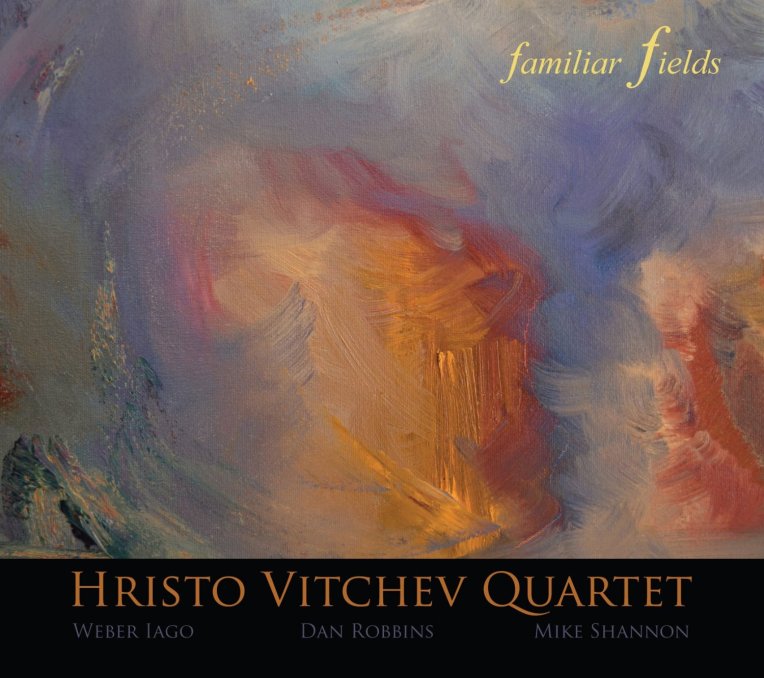
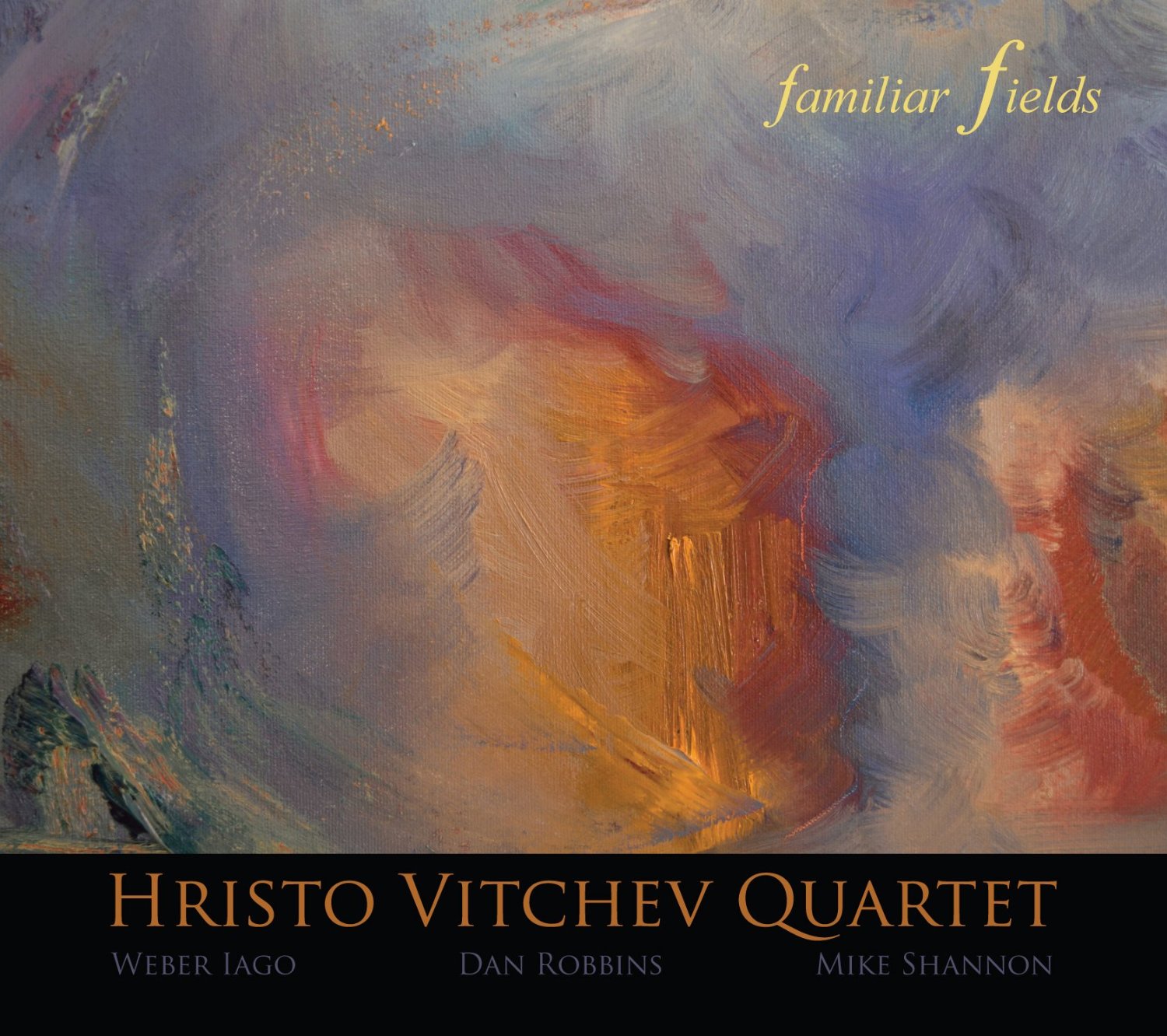
All of these tender sentiments and more seem to have gone into Familiar Fields, Vitchev’s latest effort that lands him again in the trusted company of his quartet, with Mike Shannon replacing DeRose on drums. If any Metheny comparisons are warranted, then let them point to “Ballad for the Fallen.” This groovy, flowing snapshot travels similarly well-worn avenues through a lovely pattern of tension and release. The quartet moves forward with a confidence that is as breezy as it is robust. In spite of his democratic approach, however, Vitchev lures plenty of spotlight his way in “Wounded by a Poisoned Arrow” and “The Prophet’s Daughter,” each a dialogue with the self. Fields feels most familiar when the band lies back, building autumnal susurrations to sparkling summer in “They Are No More” and mortaring galactic staircases in the two-part title tune. Recalls of previous albums also make an appearance. “The Mask of Agamemnon,” for example, harks back to Perperikon, while “The Fifth Season” seems to pick up where Heartmony left off, holding the rhythm section’s wings into the open vistas of “Willing to Live,” whereby this sandy carpet of illusion closes on a philosophical note.
The quartet you have assembled on Familiar Fields is a special one. What does it mean to you to play with these intuitive musicians?
All my musical brothers in the group bring so much to the table. They are simply incredible musicians and improvisers, but most importantly they are my best friends. It is the love and friendship we have for each other and for the music that makes this band so special to me. From the very first note we play, there is only camaraderie and respect in the air. No egos, no barriers. Just the unifying love for exploration and sincere expression. Some people wait an entire lifetime to find a team like that.
What is the concept behind Familiar Fields?
The concept of Familiar Fields actually started a few years ago when I traveled back home to Bulgaria for the first time in 14 years. As the years went by, I kept wondering just how much of my memories was real and how much was imagined. When I finally went back, everything was so different, but in the most fascinating way my memories were more alive than ever. It was the strangest thing. Here I was in a place that I knew close to nothing about, yet everything seemed as if it had been a part of me all these years. It was like I was walking through the most familiar fields yet also discovering new frontiers among them. This was the beginning of the writing process for the record. The music evolved in a very similar way. I had to wait a few years before I knew the music was ready to be put on tape.
Thankfully, you need only wait for the blink of a cosmic eye before the music is your hands…









 Between Sound and Space: ECM Records and Beyond