John Surman: Adventure Playground (ECM 1463)

John Surman
Adventure Playground

John Surman baritone and soprano saxophones, bass clarinet
Paul Bley piano
Gary Peacock bass
Tony Oxley drums
Recorded September 1991 at Rainbow Studio, Oslo
Engineer: Jan Erik Kongshaug
Produced by Manfred Eicher

John Surman’s Adventure Playground is an appendix to Paul Bley’s previous quartet efforts, only now we find them in the company of bassist Gary Peacock and drummer Tony Oxley. And while the session does drip with the same brooding viscosity one would come to expect, the added colors of Oxley enhance the music’s inner states with endless novelty. Take, for instance, the anthemic frenzy he builds in his sole compositional contribution, “Just For Now,” by which he holds smelling salts under the nose of the listener’s attention. And again in Surman’s “Quadraphonic Question,” a lumbering yet somehow airy thing to which the rules of interpretation can only bow in appreciation of their own dismantling, his talents are especially brilliant, describing a host of people and places in bursts of expansive inquiries while managing to give those delicate soprano lines all the room they need to weep.

Not to be outdone, Surman rustles up a fine set of tunes from his own wellspring. Between the utterly gorgeous strains of “As If We Knew” and the nocturnal visions of “Twisted Roots” there is plenty to return to for future listening, while the baritone of “Duet For One” wanders up a long and teetering ladder until it can see above the clouds and, with a hand over the eyes, pinpoint a new destination on the horizon.

The unfathomable smoothness of that baritone is also a defining voice in “Figfoot,” the first of three tunes from Bley, who casts his own two cents with Oxley into an off-kilter bass line. Its rhythmic way thus shown, the music seems regard us with slogging humor. This is a dark swing of a piece with a characteristic tarnish, weathered like the patina of a familiar instrument. Bley hones his focus in “Twice Said Once,” yet another veil of intense and careful spontaneity through which the opaque visions of Surman’s bass clarinet leave us primed for the bluesy slice of gorgeousness that is “Seven.”

Peacock’s “Only Yesterday” may be the album’s plaintive opener, but it feels just as much like its conclusion. From a pianistic shower and tender reeds, it channels a flowing rivulet stained by the pigment of an unknown land. Peacock and Oxley dance somewhere upstream, bringing to their frolic an abiding sense of melancholy. In this percolating world of dreams and mythologies one finds an ever-visible thread running through it all. From this filament one can gather neither beginning nor end, but only the points one may grasp and allow it to lead one where it may. As with the album as a whole, it is a fully formed sphere even before the first note is played, waiting only for the light of our ears to reveal its more surprising topographies.

<< Ralph Towner: Open Letter (ECM 1462)
>> David Darling: Cello (ECM 1464)

John Surman: Private City (ECM 1366)

John Surman
Private City

John Surman bass clarinet, recorders, soprano and baritone saxophones, synthesizer
Recorded December 1987 at Rainbow Studio, Oslo
Engineer: Jan Erik Kongshaug
Produced by Manfred Eicher and John Surman

If the title of Private City comes about as close as one can get to describing the sound-world of John Surman, then that of its first piece, “Portrait Of A Romantic,” does the same for the man behind it. Its quivering recorder blankets us in warmth, fully realized by an electric piano and bubbling as the waters in a forgotten loch. A bass clarinet swims, a creature of myth remembering a time when its kind were plentiful. Thus begins this widely regarded album of incidental ballet music that remains one of Surman’s most personal. The recorder returns, an elusive and mythic voice, “On Hubbard’s Hill,” calling forth steady electronics from the depths of its own dreaming, leaving us to look out on all we’ve done. The familiar sequencer shows its face in “Not Love Perhaps,” climbing itself like a self-generating ladder and carrying with it a sacred form of déjà vu, in which time is but a loop within the heart of learning. Surman’s soprano moves with the grace of a traditional melody that has only now come to the surface of our audible history. “Levitation” is exactly what he accomplishes with an unwieldy instrument like the bass clarinet. As it splinters into myriad offerings beneath a pregnant moon, an “Undernote” bobs on a current of its own regret. “The Wanderer” is another watery piece, that beautiful soprano melting over a wavering ground of synth lines and bass clarinet, and ending on a distant fanfare. The swaying “Roundelay” exemplifies Surman’s limitless talents, as well as the purity of his notecraft. Led by a fairy-like soprano, it feels like ice-skating along an infinity sign set to music. Last is “The Wizard’s Song,” the album’s crowning jewel, showing us again the inimitable delicacy with which its composer approaches the lower, neglected reeds. Like the ending credits to a movie that lives on even after it is done, the effects keep scrolling in our heads, wandering the darkness until they have reached the private cities inside all of us.

<< The Paul Bley Quartet: s/t (ECM 1365)
>> Masqualero: Aero (ECM 1367)

John Surman: Withholding Pattern (ECM 1295)


John Surman
Withholding Pattern

John Surman baritone and soprano saxophones, bass clarinet, recorder, piano, synthesizer
Recorded December 1984 at Rainbow Studio, Oslo
Engineer: Jan Erik Kongshaug
Produced by Manfred Eicher

As one of the most skilled saxophonists alive, John Surman has gone beyond carving a niche, for he has also redefined the medium into which he carves. And while the breadth of his proficiency is certainly staggering, to these ears it is what he does with the baritone (normally not my favorite reed) that sets him a world apart. One need only listen to its poetry in “Doxology” to find out for oneself. In this multi-tracked chorus, Surman plows the melodic field with taste and care, while his favored sequencer provides a glittering edge to the ashen interior, as also in “Changes Of Season,” where now the heavenly cored tone of a soprano links the stars into an all-encompassing constellation. But listen again to the baritone’s solo flights in “All Cat’s Whiskers And Bee’s Knees” and “The Snooper,” each buoyed by the after-images of a tasteful studio echo, and you will find new delights to savor. Two “Holding Patterns” bookend the album’s remainder with broader electronic wingspans. In these one sees neither people nor their relics in the landscapes below, but hears only the music they’ve left behind. Surman is a one-man saxophone quartet in “Skating On Thin Ice,” through which he brings his at once overcast and sunlit visions to life. “Wild Cat Blues” features the deepest sequence of all, pairing beautifully with Surman’s echoed soprano.

These sonic activities are deeply internal, personal excursions into a territory of forgotten histories. Surman’s music always seems to tell a story that would through words be forever obscured by the uncertainty of memory, yet which in their musical retelling is strangely immediate and unmitigated.

<< Jan Garbarek Group: It’s OK to listen to the gray voice (ECM 1294)
>> Lester Bowie’s Brass Fantasy: I Only Have Eyes For You (ECM 1296)

John Surman: Such Winters of Memory (ECM 1254)

John Surman
Such Winters of Memory

John Surman baritone and soprano saxophones, bass clarinet, recorder, piano, synthesizer, voice
Karin Krog voice, Oberheim ring modulator, tamboura
Pierre Favre drums
Recorded December 1982 at Talent Studio, Oslo
Engineer: Jan Erik Kongshaug
Produced by Manfred Eicher

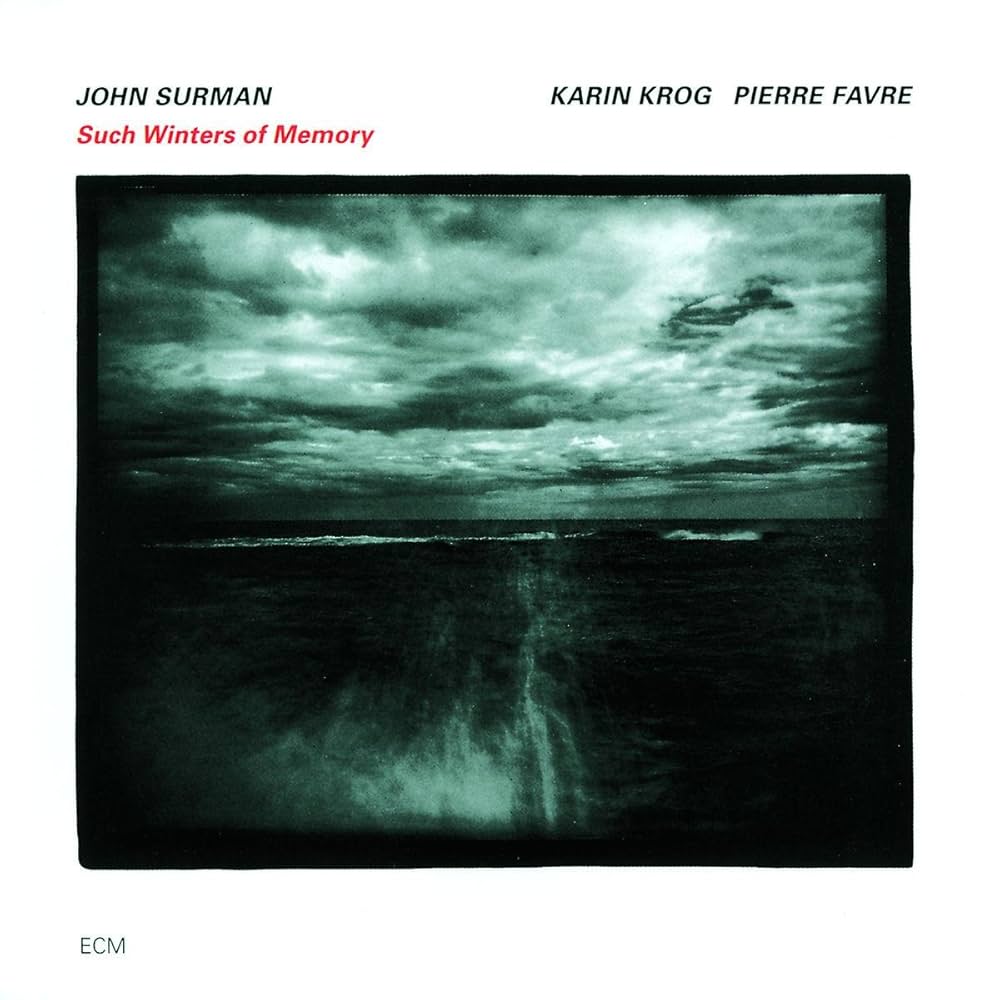
Walking into a John Surman album is like wearing a blindfold. The remarkable reedman provides just enough sensory information to orient us. At times claustrophobic, at others airy and spatial, each composition and improvisation alike seem knitted by the same needle. On Such Winters of Memory, he is joined by percussionist Pierre Favre and vocalist Karin Krog for a calm and collected session sure to please admirers of his solo work. The drones of “Saturday Night” are like a chain of limpid pools from which Surman draws mercury lines. Out of these dreams comes “Sunday Morning,” which reprises the sequencer of “Nestor’s Saga” that would play such a key role in albums to come. Where the electronics were cold and windy at the start, here they are warm, still, and brimming with daybreak. Surman makes the baritone saxophone sing here like no other, and with it he renders even the most contrived surroundings into a strangely organic whole. Decidedly jazzier contours await us in “My Friend,” a loosely woven braid of voice and bass clarinet. Thus uplifted, we float through “Seaside Postcard 1951” on a jet stream of soprano whispers and glittering cymbals, content to be “On The Wing Again” through the approaching dusk. There we linger in monochrome, like the album’s cover, somewhere between steam and cloud. After the solo piano sweetness of “Expressions,” we are left to ponder the adhesive raga of “Mother Of Light / Persepolis,” following an echoing recorder across piped horizons.

Surman is a musician of gentle persuasion and even gentler philosophy. One can always count on an immersive experience, Such Winters of Memory being but one carefully brushed example. And while one may be hard-pressed to see into the autobiographical details of these titles, at least in their articulation one gets an immediate sense of the environments they so meticulously render into graspable sound.

<< Pat Metheny Group: Travels (ECM 1252/53)
>> Keith Jarrett Trio: Standards, Vol. 1 (ECM 1255)

John Surman/Jack DeJohnette: The Amazing Adventures Of Simon Simon (ECM 1193)

ECM 1193

John Surman
The Amazing Adventures Of Simon Simon

John Surman soprano and baritone saxophones, bass clarinet, synthesizer
Jack DeJohnette drums, congas, electric piano
Recorded January 1981 at Talent Studio, Oslo
Engineer: Jan Erik Kongshaug
Produced by Manfred Eicher

When reviewing jazz albums, I tend to abbreviate the word “saxophone” as “sax.” Yet somehow, when describing the music of John Surman, only the full spelling seems appropriate, for he as well as anyone fleshes out the inner architecture of the instrument in whatever form it may assume in his proficient hands. One might say likewise about drummer Jack DeJohnette, whose array of talents fully arches the backbone of the eight originals and one folk tune (the arboreal “Kentish Hunting”) on this curiously titled album. A delicate sequencer washes over us first in “Nestor’s Saga (The Tale of the Ancient)” along with bass clarinet amid awakening drums. Such tonal contrasts are a running thread through “Merry Pranks (The Jester’s Song),” “The Pilgrim’s Way (To The Seventeen Walls),” and the lumbering “Within The Halls Of Neptune.” Like some lost klezmer dream, floating on illumined clouds, these tunes step over vast plains before setting foot upon mountaintops. The finest moments are to be found in the soprano work, featured to varicolored effect in “The Buccaneers” and most engagingly in “Phoenix And The Fire.” DeJohnette holds his hands to the pianistic fire in “Fide Et Amore (By Faith And Love),” each chord a glowing ember beneath the bare feet of Surman’s baritone. “A Fitting Epitaph” mixes two drops of clarity for every one of forlornness and leaves an airy aftertaste in the sequencer’s final rest. This first in a continuing collaboration between two of ECM’s finest has aged well and is a good place to start on this intriguing duo.

<< Rypdal/Vitous/DeJohnette: To Be Continued (ECM 1192)
>> Goodhew/Jensen/Knapp: First Avenue (ECM 1194)

Barre Phillips: Music By… (ECM 1178)

ECM 1178

Barre Phillips
Music By…

Barre Phillips bass
Aina Kemanis voice
John Surman soprano and baritone saxophones, bass clarinet
Herve Bourde alto and tenor saxophones, flutes
Claudia Phillips voice
Pierre Favre drums, percussion
Recorded May 1980 at Tonstudio Bauer, Ludwigsburg
Engineer: Martin Wieland
Produced by Manfred Eicher

Long before Twitter was a microblogging phenomenon, it was the name of the first cut on this out-of-print gem from Barre Phillips. Thankfully, there is nothing micro about it. Driven by train-like syncopation from drums and bass clarinet, this attention-grabbing burst of virtuosity introduces us to the bubbling acrobatics of daughter Claudia Phillips, a vocalist whose career as chanteuse found a niche in France in the 80s. Her sometimes-manic instincts are swept down the stream of Aina Kemanis, the voice of Journal Violone II. Together they form a magic triangle with John Surman’s own sinewy lines. With such exuberance and glottal depth as Claudia displays here, one can hardly keep one’s ears focused on anything but her brilliance. Her siren-like spindles prove to be a guiding force in the more freely improvised “Angleswaite” and, with Kemanis, trace fluid arcs in “Elvid Kursong” and drop like spores in “Pirthrite.” The latter is a bizarrely martial excursion that is at once march and requiem, made all the more so through the liquid alto of Herve Bourde. These facets contract into a single plane in “Longview.” Here, Claudia comes to life in a bubbling stutter, soon overtaken by Bourde’s tenor, left of center. “Entai” and “Double Treble” sound like an ice-skating bass and clarinet struggling for balance over a warping record, compressing the album into more rudimentary ciphers.

This is yet another fascinating cell in the stained glass window that is Barre Phillips, capturing both the thrill and pain of modernism and those quiet moments, few and far between, where the soul kisses the brow of alienation. The content is brought to fervent life by an impassioned participation that frolics at the intersection of speech and song. As a longtime fan of the Cocteau Twins and Elizabeth Fraser’s voice that drives it, I have sometimes wondered what she might have sounded like had she made an ECM album. With Music By… we begin to approach one possible answer.

<< Walcott/Cherry/Vasconcelos: CODONA 2 (ECM 1177)
>> Bengt Berger: Bitter Funeral Beer (ECM 1179)

John Surman: Upon Reflection (ECM 1148)

ECM 1148

John Surman
Upon Reflection

John Surman soprano and baritone saxophones, bass clarinet, synthesizers
Recorded May 1979 at Talent Studio, Oslo
Engineer: Jan Erik Kongshaug
Produced by Manfred Eicher

I imagine that John Surman’s first solo album for ECM was something of a revelation when first released. Having already provided his sequined elegance to a handful of productions, the English reedman shows us the breadth of his wingspan in this remorsefully out-of-print pool of limpid brilliance. The sequencer of “Edges of Illusion,” recalling the title cut off Azimuth’s debut album, immediately carries us into a uniquely melodic sound-world. Where some might exploit such a transcendent ostinato as mere atmospheric backdrop, Surman engages with it as an equal partner, experiential in dimension, existential in effect. He adds welcome traction via a gravelly baritone, even as he bores out a winding melodic core with soprano.

Other passages show Surman’s penchant for drawing with folk pigments. Of this, the jig “Caithness To Kerry” and the Nyman-esque geometry of “Prelude And Rustic Dance” and “Filigree” are the clearest examples. More somber moments abound in “Beyond A Shadow” and “The Lamplighter,” both of which feature synths and bass clarinet. Each pulls a distinct string of floss through cosmic teeth. At times delicate, at others cathartic, its sonic plaque streaks like shooting stars into silence. A brief aside of whimsy finds us in “Following Behind.” This lovely fling between baritone and echo chamber wipes the slate clean for the arpeggiated “Constellation” with which the album closes.

From soulful solos to one-man ensembles, Surman does it all with the signature intonation and robotic syncopations that make him one of the finest at the reed. One of the most elegant saxophonists represented on ECM, or on any other label for that matter, he brims with information to be pored through and deciphered with each renewal.

<< Nana Vasconcelos: Saudades (ECM 1147)
>> Barre Phillips: Journal Violone II (ECM 1149)

Mick Goodrick: In Pas(s)ing (ECM 1139)

1139 X

Mick Goodrick
In Pas(s)ing

Mick Goodrick guitar
John Surman soprano and baritone saxophones, bass clarinet
Eddie Gomez bass
Jack DeJohnette drums
Recorded November 1978 at Talent Studio, Oslo
Engineer: Jan Erik Kongshaug
Produced by Manfred Eicher

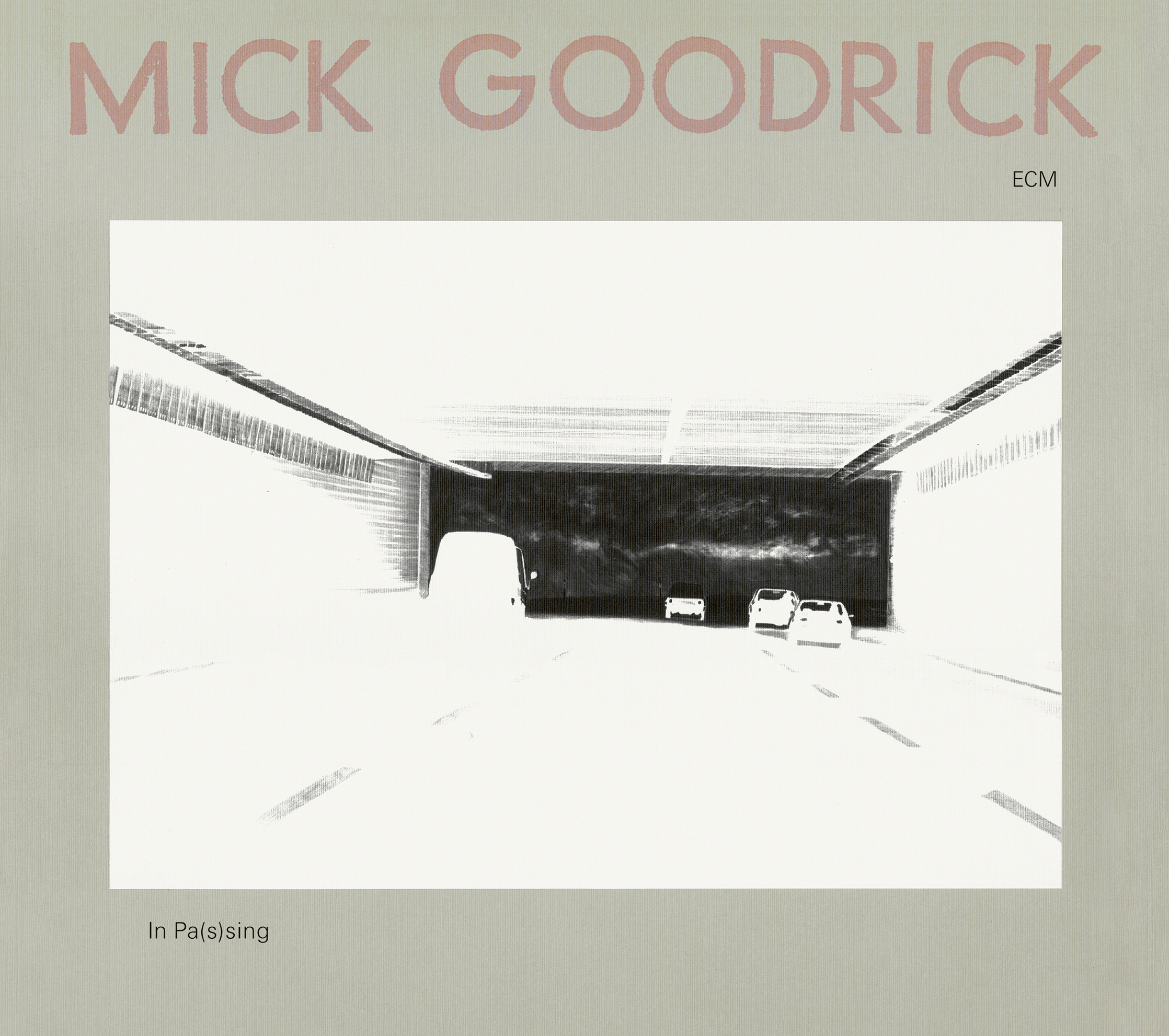
After guesting on three Gary Burton collaborations (The New Quartet, Ring, and Dreams So Real), guitarist Mick Goodrick broke out with his first album as leader—and what better place than ECM to open his art to its fullest, for this would be his last recording for the label. In Pas(s)ing consists entirely of Goodrick originals, save for the collectively improvised title cut, giving us an unassuming view of the thoroughly sanded figures that are his themes.

“Feebles, Fables And Ferns” is morning and dusk, a crepuscular confection wrapped in drums (DeJohnette), bass (Gomez), and tenor sax (Surman), and all tied with Goodrick’s sonic filaments. The latter’s airy, John Abercrombie-like tone is pensive and glows like embers. The bass is shallowly miked, making it seem an extension of the guitar. Its player often vocally anticipates his supporting lines, as in the lovely solo granted passage here. Surman’s equally mellifluous sound rolls off the tongue like a poem. “In The Tavern Of Ruin” continues the lush quartet sound, only this time with a brittle edge. Surman leads a slow procession of hooded figures before his soprano trails into Goodrick’s darkening clouds. Distant cries seize us as Surman again wraps his cosmic fabric around our ears. This makes “Summer Band Camp,” the album’s shortest track, all the brighter in its nostalgia. Surman smiles through his sound, as do all gathered, gently kissing the art into which they have grown. Gomez’s doublings add a chorused, rhythmic aphasia that foreshadows an ecstatic close. A tender bass clarinet lacquers “Pedalpusher” with molasses, sealing in an array of tactful changes which do nothing to obscure the phenomenal bass work therein. In closing, we find ourselves “In Passing,” which throbs with yielding yet intense sentiment. DeJohnette stitches a fine seam here, even as Surman cuts his thematic restraints in favor of more visceral forms of communication.

Goodrick’s elasticity throughout is a comforting presence, while Surman shines in what amounts to a starring role. These energies, buoyed by a plastic rhythm section, coalesce into what is easily one of my favorite ECM releases.

<< Paul Motian Trio: Le Voyage (ECM 1138)
>> Gary Burton/Chick Corea: Duet (ECM 1140)