

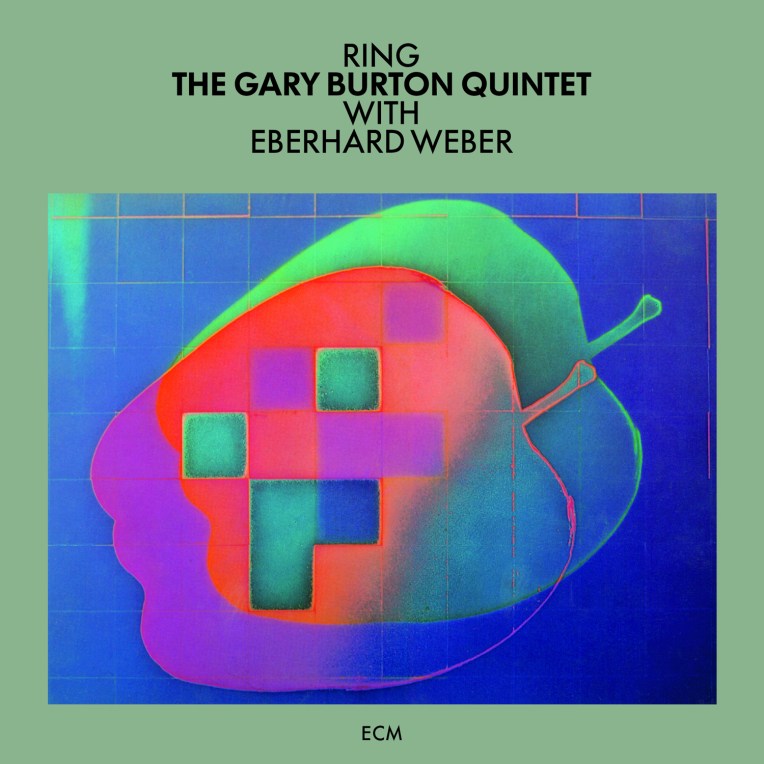
The Gary Burton Quintet with Eberhard Weber: Ring (ECM 1051)

1051 X

Gary Burton Quintet
with Eberhard Weber
Ring

Gary Burton vibraharp
Mick Goodrick guitar
Pat Metheny guitars
Steve Swallow bass guitar
Bob Moses percussion
Eberhard Weber bass
Recorded July 23 and 24, 1974 at Tonstudio Bauer, Ludwigsburg
Engineer: Martin Wieland
Produced by Manfred Eicher

Before I get into this review, I’d like to take a moment to share my process:

As a busy grad student, listening to music for pleasure has become an increasingly difficult luxury to sustain with any regularity. In addition to my undying adoration for ECM, one major part of my motivation for starting this blog was a desire to reinvigorate my listening life. To that end, I have taken to giving one album per night my undivided attention as I go to sleep. I keep a digital voice recorder by my bed and speak whatever impressions come to mind. I then transcribe these comments the following morning and pare them down to something coherent. Any of my regular readers will notice that my review production has slowed down as of late. This is due to the fact that I have been preparing for my M.A. thesis defense and am heavily sleep-deprived as a result. Even so, I have attempted to listen when I can and continue with my audio review logs. Due to the aforementioned sleep deprivation, however, fatigue has begun to take its toll on my cognizance. This became especially apparent as I was recording my review for Ring. It began benignly enough with my usual laudatory ramblings, but as I sat down the following morning to transcribe, I realized that I had almost no recollection of the second half of what I had said, having uttered it in a stupor of half-sleep. I have since removed the odder bits, but would like to share a few verbatim examples for your (and my) amusement:

One almost feels or gets the sense of joy, for in that concept of joy there are also children…. There are clouds and unwashed apples and trees floating in the sky…. Next year it will be different, somehow pleased by the authorities while people such as I will be behind bars…

Whether or not these comments impart any deep insight into the music at hand might very well be arbitrary. Still, I cannot imagine having said such things without some sort of provocation. This experience makes me question what kind of background noise I must be filtering out before coming up with anything at all intelligible. Thank you for indulging this tangent and, for what it’s worth, here’s my highly filtered version:

Gary Burton is in a class all his own. On the vibraharp he is pliant yet unbreakable with a certain flair for the understatedly powerful. Among the present company, he is perfectly at ease. No one tries to overpower him, and despite his melodic dominance he never looms for too long, receding into as many shadows as he casts. There’s not a single pretentious note to be heard; the flow between and within tracks barters its way across smooth waters. This is a nocturnal album all the way.

In the opening “Mevlevia,” flanged guitar provides a yielding current of sound upon which Burton and Weber are able to lie back and drift. “Unfinished Sympathy” is more than just a clever play on words, but is also a gorgeous vehicle for Goodrick’s rolling solos. Its structure is built around a recurring guitar motif, which indeed feels unfinished as it circles around a flower it can never pollinate. It is a short and sweet diversion into a vaguely grasped thought. “Tunnel Of Love” is a languid journey toward something that is apprently fated but which is actually uncertain. A warm bass solo arises from the murky surface that surrounds us, threading our path with its own braided thread. A lilting guitar in the background plucks steady notes from the air, balancing them atop slowly rolling spheres. “Intrude” begins with a drum solo that flitters like a dragonfly skirting the edge of its known domain. A certain jouissance works its way from the outside in before petering out into the last few drops of cymbal, at which point the ensemble kicks in with a six-stringed groove tugged along by bass and the now recumbent drums. The delicacy from before is implicitly maintained, even as the static builds in charge, at last defused by a premature spark. “Silent Spring” feels like the most composed piece in this set, and in that sense it refuses to take its own simple pleasures for granted. The bass flickers its way into recognition like a blown-out candle in reverse, telling what it knows to be untrue, a musical fabrication in disguise. “The Colors of Chloë” produces another superb bass solo in the midst of a first-rate groove, which seems to climb up and down stairs before settling on the black and the white of its own private chessboard.

In short: listen to this album and love it.

<< Keith Jarrett: Belonging (ECM 1050)
>> Steve Kuhn: Trance (ECM 1052)
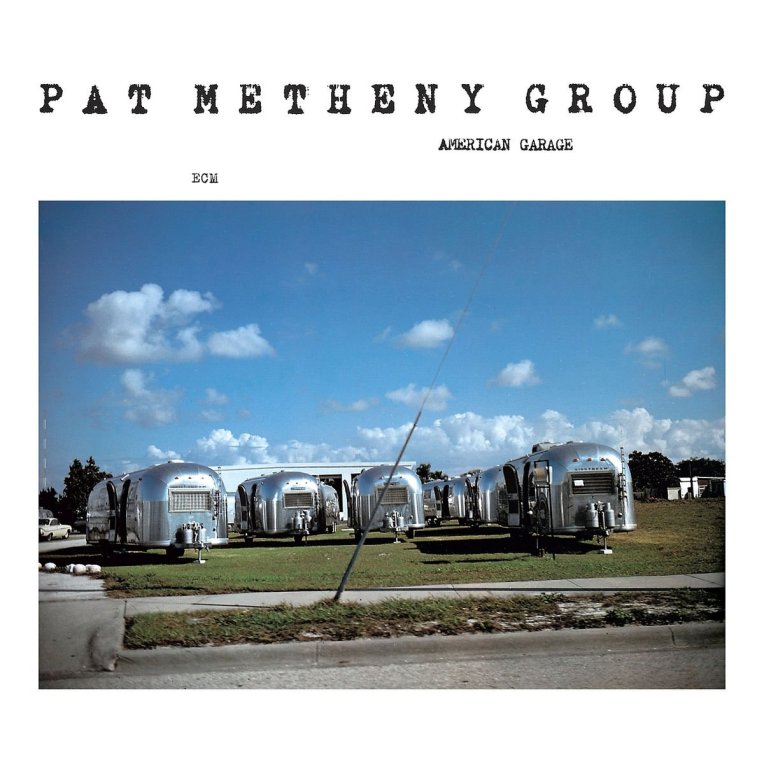
Pat Metheny: American Garage (ECM 1155)

ECM 1155

Pat Metheny Group
American Garage

Pat Metheny guitars
Lyle Mays piano, oberheim, autoharp, organ
Mark Egan bass
Dan Gottlieb drums
Recorded June 1979 at Longview Farm, North Brookfield, Massachusetts
Engineer: Kent Nebergall
Produced by Pat Metheny

With American Garage, the Pat Metheny Group solidified its signature sound. This album, the group’s second, took the Number 1 spot on the 1980 Billboard Jazz chart and spawned a legion of followers. Its virtuosic blend of jazz and roots rock evokes the heartland like no other and has withstood its own commercial success relatively unscathed.

The album opens with a wide view of the open road, and we are in the passenger seat. Metheny’s glistening guitar licks take the wheel, relishing the roar of Lyle Mays’s lively keyboard support under the hood. With Dan Gottlieb’s proclamatory drums and Mark Egan’s sinuous bass in the back seat, we’re good to go. Together, this quartet of talented musicians creates the ultimate musical road trip. There is a beautiful interplay between guitar and bass in the first track, swelling into a verdant wash of backwater splendor. The tone here is almost painfully nostalgic (all the more so for the album’s historicity), as if yearning for something that is only as real as its remembrance. As the car speeds along its journey, we see our collective past just beyond the windshield, somehow within reach. But we also know that as soon as we pull over and step out of the car, there will be nothing to grasp, to hold close, to stow in the trunk or in the glove compartment of our desires. There is only the empty air, the cloudless sky, and the sun beating down upon our backs, as if to say: “You’ve still got miles to go.” But neither do we care, because there is an unbridled joy to the process of travel.

“Airstream” feels undoubtedly like summer, a time of year when obligations melt in the heat along with our inhibitions. The only thing that seems real is the lack of definitive answers, the endless possibility that such freedom entails and which brings us closer to self-realization. It is our most formative season; one in which we observe, live, and learn at our own pace. Metheny captures this free spirit so clearly in his playing. Chord progressions roll off his fingers like change into eager hands at a lemonade stand, and we are reminded of those little moments of independence and security in which, from the merest clinking of coins, we came to assert our agency in a growing awareness of economy. We think also of young love that, while unrequited, also gave us a brief taste of a life lived without obligation. As the track fades out, it leaves behind a trace of itself, a memento of years never forgotten.

“The Search” is the soundtrack for a movie of the mind, a flashback that looks only forward. Alluring piano work lifts the spirits, ruffling the edges of our attention like linen flapping on a clothesline. We bask in the humid air, even as squalls threaten to break upon the horizon. Lusciously harmonized guitar lines blossom in the morning sun with the promise of a new journey.

The title track sounds like a theme song for a show that can never materialize, for its images are supplied by memories. We begin to recognize the value of those times when the self had yet to be formed but during which the future seemed so bright. And no matter how jaded we have become in our lowest points of adulthood, Metheny is here to remind us that it is precisely in these artifacts of sound that we can preserve our tired hopes.

The last track of this all-too-short album is called “The Epic,” and like its title it has an extensive tale to tell. Metheny and Mays both deliver with the most inspired improvisations on the album, drifting across the plains like steel-stringed tumbleweeds. We are driven through an entire day and night of travel. We find ourselves in vast stretches of daylight, but also experience nocturnal visions, wrapped in a sleeping bag under a canopy of stars in the dying embers of a campfire exhaling hot orange into the darkness. Their crackling fills our ears with a cacophony of sound, easing us into the lull of dreams. And in those dreams we relive the entire journey that got us to where we are now. We are drifters, alone and free of earthly bonds, loving every second of life’s uncertainty.

In spite of the album’s title, we always seem to be far from home. Metheny’s compositional talents are given ample breathing room as he crafts rustic yet elegant evocations of a lost America. There’s a small-town feel to the proceedings, a backwater purity that beckons throughout. It is the innocence of a bygone era, which remains here and there in small pockets. And it is through these musical lineages that we string those pockets together with shimmering synchronicity. Like a conceptual jukebox, each leg of the journey that is American Garage spindles a new record into our attentions. The precision of Metheny and his group is extraordinarily clean, shaken dry and stripped of all excess.

Some people say that in every journey half the fun is in getting there. American Garage says all the fun is in knowing that there is no “there” to get to.

Listen to this album on vinyl if you can (ECM has announced a new 180g pressing for 2010). For the technologically unable, the CD will have to suffice. And while the CD may not replicate the experience in quite the same way, at the very least one can get a slightly clouded view through this classic side-door window.

<< Old And New Dreams: s/t (ECM 1154)
>> Kenny Wheeler: around 6 (ECM 1156)