Stephan Micus: The Garden Of Mirrors (ECM 1632)

Stephan Micus
The Garden Of Mirrors

Stephan Micus voice, steeldrums, sinding, shakuhachi, suling, nay, tin whistles, percussion
Recorded 1995-96 at MCM Studios

Just as one look at the many instruments Stephan Micus plays is sure to impress, so too does one experience of what he produces with them dispel arbitrary interest in those means. Music flows from his fingertips in such an organic way that the source catches light in all of us. Nothing feels out of place. It’s worth noting, however, that The Garden Of Mirrors makes especial use of that most intuitive instrument of all: the human voice. Like water in sunset, Micus’s wordless songs collect light-years of travel along the glittering surface of their multiplication. Twenty such voices manifest themselves first in “Earth.” Accompanied by the bolombatto, an African gut-stringed harp, this world traveler speaks to the very marrow of life. A binary star leaves his lips, the being to our nonbeing. These twins become triplets, and so forth, until the galaxy is alive in a choir whose rhythms are the stuff that binds. “Violeta” and “Night Circles” exchange the bolombatto for its hemp-stringed cousin, the sinding, melting into a future where hope may breathe like an autumnal wind through leaves. Dry and crackling fields shape syllables with the ferocity of a linguist. Vocal flocks outline the sky in chalk, coloring it in like the white of a giant eye. Veins become songs. These become the world. “Passing Cloud” bands steel drums, two sinding, and shakuhachi for a sound at once vapor-like and heavy as soil. Those who are content see in it animals, trees, and faces, while others see sighs, depressions, and hardships. For “Flowers In Chaos” we get a coterie of 22 suling (Indonesian bamboo ring flutes), dispelling that very cloud with tales of earthly things. “In The High Valleys” is the album’s most insightful contemplation. In its intimate pairing of sinding and voice, it moves, to reference an album title of the Alial Straa, in a lumbering intransitive dream, and would seem to invoke the origin myth of the jazz bass. “Gates Of Fire” marks its passage with ashen footprints, bringing atonement in circular motions, each a brand on the side of a mountain. “Mad Bird” is a living solo for Irish tin whistle that traverses its own boundaries in search of landing, for life on the wing desires stillness. This singles out the final “Words Of Truth,” where the breath of life courses through six shakuhachi in self-reflective bliss. It is the sailor and his reflection, the storm and its rainbow, caressing the shores of a fading continent, of which we are the only inhabitants left standing.


Alternate cover

Stephan Micus: Athos (ECM 1551)

Stephan Micus
Athos: A Journey To The Holy Mountain

Stephan Micus Bavarian zither, sattar, shakuhachi, suling, ney, flowerpots, voice
Recorded November 1993–February 1994 at MCM Studios

If true meditation is not a centering but a shedding of the self into a plane where the ego no longer speaks under the illusion of a proper name, then Stephan Micus has walked some of the most meditative paths on disc. Inspired by a visit to the holy Greek mountain of Athos, his album of the same name bears traces of just such a traveler, one whose artistry sees medium and message as one. Those looking for anything close to the Byzantine chant that surely nourished his ears during this pilgrimage may feel disappointed. Then again, the Micus experience has never been about total re-creation, but rather about the ways in which the lens of his soul refracts all it comes in contact with during its itinerancy.

Athos takes a diurnal structure, with days marked by flutes of varying origins and nights woven in 22-part choruses, all sung by a multi-tracked Micus. The latter serve as touchstones in the fullness of his narrative, which takes its histrionic steps in voices mineral, unaffected, spun from the wood, clay, and strings of another time and place. In these drones is where the true indeterminacy of life takes shape, shifting from circle to ellipse and back again like a full moon stared at for too long. “The First Day,” a shakuhachi solo, rests on a sibilant edge and awakens like an animal from winter slumber, even as it cranes its neck, heron-like, back toward memory, now hazed by the passage of the seasons. “The Second Day” hangs a suling (Indonesian bamboo flute) above a garden of flowerpots. And in “The Third Day” Micus offers a ney solo, wavering like a reflection across molten rock and shaped by the lips of a divine glassblower who fashions from it a teardrop in the cosmos, forever crystalline and unshattered. Such music turns the sun inside out and shows us that its heart is nothing but shadow, for otherwise it would never know the generative power of fire.

This cosmic passage is bookended by a prologue and epilogue. “On The Way” pairs cascades of Bavarian zither with the tinny laments of sattar (long-necked bowed instrument of the Uyghur people). In its depths we weep at the fallacy of what we have created, but know that within the distorted memories of those tears lies something far more meaningful: constant change. This and more we hear in these moments, in the total dedication that engenders them. “On The Way Back” pulls those evening voices from the clothing of their afterlife, vibrating like a reed in the core of something devoid of song.

Athos is the diary of a sacred space whose pages are born in the siren that calls everyone into the stillness of eternity. It tugs your heart until it merges with Micus’s own, so attuned is his playing to the spirit of all that moves us to listen. He reaches through the veil of distance holding a broken watch, asking us to breathe time back into its silent circle.

<< hr-Jazzensemble: Atmospheric Conditions Permitting (ECM 1549/50)
>> Heiner Goebbels: Ou bien le débarquement désastreux (ECM 1552)

Stephan Micus: To The Evening Child (ECM 1486)

Stephan Micus
To The Evening Child

Stephan Micus steel drums, voice, dilruba, suling, kortholt, ney, sinding
Recorded January and Feburary 1992 at MCM Studios
Digital mastering: Tonstudio Mahne, Dießen

Stephan Micus’s fifth album for ECM is a lullaby. I know nothing of its origins, but I would be surprised if he hadn’t just become a father before recording it, so freshly paternal are its meditations. This time, Micus turns the kaleidoscope of his endless talent to reveal steel drums as the sound color of the moment. These provide a resonant, gamelan-like undercurrent throughout and become more biologically attuned as they sing beneath his mallets. Yet it is his actual voice that awakens the heart in “Nomad Song,” scooping earth in such a way that all life falls through its fingers unharmed, leaving only a heap of unconditional love. The newness of creation abounds in “Yuko’s Eyes,” in which Micus sings now through a bowed dilruba, turning infancy inside out to reveal a future of hope and dreams fulfilled. “Young Moon” pairs that constant steel drum with suling (an Indonesian bamboo flute) and kortholt (a capped reed instrument popular during the Renaissance) for a softly glittering wave of light, given corporeal shape through open-throated calls. The title track welcomes ney, through it gilding the album’s aquatic themes with moonlight. It grows a feather for every breath that falls, as if reaching out to any and all children who slumber in fear and security alike. From these Micus spins a wealth of comfort, trembling to the tune of his heartbeat. There is perpetuity in this dream, from which one is born and to which one returns when circadian rhythms have become a thread of silence. “Morgenstern” stretches a sky bridge from cloud to cloud with steel-drummed steps, while “Equinox” lives in penumbral shadow, crowning a procession of closed-mouthed reverence. Each pair of hands offers a flower to “Desert Poem.” Eyes shielded by sleep, Micus dips his toes in the Milky Way’s waters and dries himself against a tree that grows alone, save for the fallen seed who awaits for the light of dawn to bless it with the kiss of tomorrow.

This music sounds in those hushed spaces where the universe inhales, the sound that keeps all celestial bodies spinning. Like the language in which Micus sings, its words convey meaning to a part of us deep and out of grasp. But for the duration of an album, at least, we can feel it as presently as the rain on our faces.

<< Michael Mantler: Folly Seeing All This (ECM 1485)
>> Paul Giger: Schattenwelt (ECM 1487 NS)

Stephan Micus: Darkness And Light (ECM 1427)

Stephan Micus
Darkness And Light

Stephan Micus dilruba, guitar, kortholt, suling, ki un ki, ballast-strings, tin whistle, balinese gong, sho
Recorded January/February 1990 at MCM Studios and Studio Giesing, München
Engineer: Tom Batoy

Listening to a Stephan Micus album is always like taking a journey through darkness and light, and so it is no wonder that his fourth album for ECM should bear that very title. The sarangi-like tones of the dilrubi of Part 1 open up a pathway that is indeed by turns bright and shaded. The path is circular, leading forever back to where it began, as if to say, “Birth and death issue from the same step.” From this mouth agape we get the insular sutras of guitar. Its chain of arpeggios carries in its arms a bouquet of memories and rests it in the crook of a tree, where it plays for the sake of Nature. From that whispered cove arises a mermaid holding a bow at the edge of a string. With every splitting of voice we are veiled in deeper solitude. Mournful songs shape a still heart, hanging on to certain threads longer than others. The guitar helps us to nourish ourselves with what remains in its chamber, stenciling the periphery with every pluck and unearthing in the afterlife all that is yet to come. Even in the absence of a bow, we feel our voices continuing to spin novel draws in the ether.

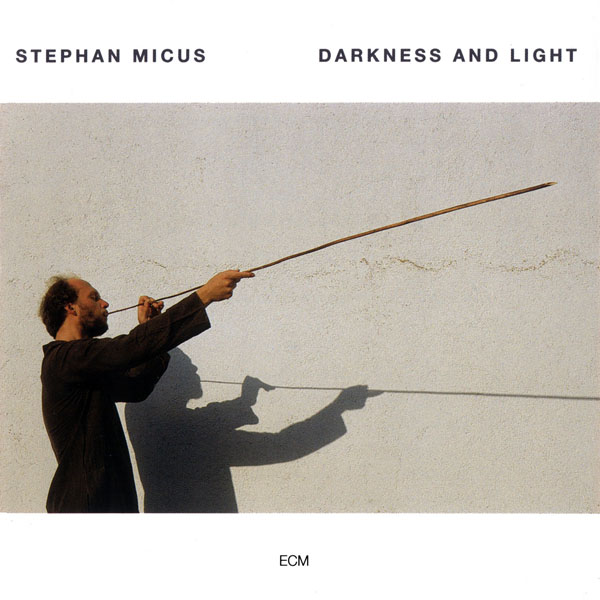
Part 2 takes a rawer approach to the dilrubi, giving rise to the call of the ki un ki, the Siberian cane trumpet pictured on the album’s cover. Played by inhaling, it sounds like a combination between a Theremin, a split and blown grass blade, and an elephant calling out to the cosmos. Part 3 scrapes the edge of darkness on its climb toward a trembling song. A flute cries as if in dialogue, two lovers parted on either side of the Milky Way unifying at last in a hopeful vein, tracing light back to the nebula that birthed them both.

Darkness And Light is as fleeting as its message, transparent as water and betraying its presence only through reflections. Still, its elemental forces sweep us away in the depth of Micus’s human touch, such that when they stop, one feels they might linger forever.

<< Paul Giger: Alpstein (ECM 1426)
>> Egberto Gismonti Group: Infância (ECM 1428)

Stephan Micus: The Music Of Stones (ECM 1384)


Stephan Micus
The Music Of Stones

Stephan Micus shakuhachi, tin whistle, stone chimes, resonating stones, voice
Elmar Daucher resonating stones
Günther Federer resonating stones
Nobuko Micus resonating stones
Recorded 1986 at Ulm Cathedral
Engineer: Martin Wieland

Elmar Daucher’s resonating stones have haunted me since I first heard them on Klangsteine-Steinklänge (released 1990 on ProViva). While not conceptually unique (stone instruments, notes Micus, have at least a 2500-year history), Daucher’s playable sculptures nevertheless speak with voices all their own. They are, as anyone familiar will tell you, enchanting enough on their own terms, but to hear them in the context of Stephen Micus’s visceral melodies is to hear them as the source of some nameless creation. For the most part Micus has had free reign in recording for and submitting his work to ECM producer Manfred Eicher, who commits the material to disc as an acolyte might transcribe a master’s words. But for this project he took a rare dip into the pool of collaboration along with his wife Nobuko, Günther Federer, and Daucher himself all playing resonating stones. Add to these Micus’s unique instrumental prowess in the reverberant embrace of Germany’s Ulm Cathedral, and the results are as profound as they are extraordinary.


Micus and Daucher at Ulm Cathedral

The stones come alive in Part 1. Their voices hum through the listener’s bones. A shakuhachi begins its bird-like dip from the heavens, touching its wings to freedom. In its song one finds a cave, never knowing what will be heard, for under the cover of that night there is but a single voice calling (or is it weeping?) for someone. Two hands hold a song of water, turning it like a teacup held high in the absence of ceremony for the gods to drink. The shakuhachi then becomes a woodland creature who knows the trees well enough to skip through the branches blindfolded. The striking of the stones in Part 2 therefore startles with a blast of light. With the delicate force of a prepared piano or gamelan it is at once metal and flesh. One feels within it a sense of coming together through falling apart, a slow dissolve into unity at a molecular level. Part 3 introduces a penetrating tin whistle, and with it a feeling of windswept plains and distant shorelines, the continued gonging of the stones like cow bells in the pastures. Underlying rhythms carry over into Part 4, embracing an elemental sound in their tectonic heart, in which every seismic shift carves a new glyph of experience. Part 5 is a shakuhachi solo, tremulous and breaking. Spun of cloud and snow, it is a crane’s inner life unfolding before the dawn. Micus lets his throat unspool at last in Part 6, making music out of the very air around him. Which brings our attention to the one uncredited stone sculpture in all of this: the very cathedral itself, which has collected and preserved the footprint of every note played and which imparts its histories to us in an everlasting whisper.

<< Terje Rypdal: The Singles Collection (ECM 1383)
>> The Hilliard Ensemble: Perotin (ECM 1385 NS)

Stephan Micus: Twilight Fields (ECM 1358)


Stephan Micus
Twilight Fields

Stephan Micus flowerpots, hammered dulcimer, Bavarian zither, shakuhachi, nay
Recorded November 1987 at Tonstudio Bauer, Ludwigsburg
Engineer: Martin Wieland

Instrumentation is ever at the heart of the Stephan Micus experience. Never a gimmick, it imparts to listeners a sense of organic care that is palpable in every gesture. Of those gestures we get a plethora in Twilight Fields, his second album for ECM proper. In this close-eyed experience, the crowning elements come from a set of tuned flowerpots which, when struck with hand or mallet, produce a xylophonic texture that borders on gamelan. Part 1 spreads its vision like a walk through rice fields, lush and crepuscular. Hammered dulcimers dance above your head like a thousand memories, through which the rasp of a shakuhachi carries a pregnant song. Myriad footsteps walk alongside as you traipse through the otherwise unpopulated expanse of a nubile life, one to which you have strung all manner of concerns and loves and which now unites in a cord of simple possibility. The thrumming energy of that shakuhachi dissipates into Part 2, in which one hears only contact in lieu of movement, sound stepping in for dance with the gentle persuasion of a lullaby. The song returns, this time not a memory but a harbinger of things to come, an oracle bone hollowed out and given vocal shape. It dries and cracks with age yet maintains its splendor. Its golden light leaks between leaves and breathes in their veins. Out of these gonging interiors Part 3 enacts a rite of flowerpotted passage into the strains of Part 4, one of the most beautiful creations Micus has ever recorded. Here it is the nay that sings, at once moonlight and its reflection, the singer and the sung. Its surroundings open up in a hammered flower, lotus-like and iridescent. The shakuhachi’s mournful stag cry in the fifth and final part drops its dipper into a font of forgotten wisdom, scooping out the moon to drink down its cratered light. The wind refracts into a zither’s hum, leading us to the shaded glens of introspection that sustain all art and through which one must pass in order to arrive at the self.

No matter what instrument Micus plays, one can always hear breath running through it. Like the flutes that figure so prominently here, it rests crisply at the edge of some aquatic abyss, every careful step touched by the blade of a forgiving biography.

<< Koch/Schütz/Käppeli: Accélération (ECM 1357)
>> Rabih Abou-Khalil: Nafas (ECM 1359)

Stephan Micus: Bold As Light (ECM 2173)


Stephan Micus
Bold As Light

Stephan Micus raj nplaim, bass zither, chord zither, bavarian zither, nohkan, sho, voice, kalimba, shakuhachi, sinding
Recorded 2007-10 at MCM Studios

All these ideas, striving towards one goal, thronged whirling through his head, blinding him with their light.
–Leo Tolstoy

Here it is, the dead of winter, and I am listening to Bold As Light, the nineteenth ECM release from renaissance man Stephan Micus. After a few days of heavy snow, the temperatures have risen and let slip a warmer precipitation. Ice melts in the downpour, and I find solace in this music, which works in similar intra-seasonal contrasts. Two transverse bamboo instruments form the audible crux of the sanctuaries therein: the Laotian raj naplaim and the Japanese nohkan. When multiplied, the former coalesces into a proto-harmonium of twirling skies, while the latter skates its wingtips along the clouds.

Like much of Micus’s later work, titles to individual pieces have again crept from the creative woodwork. Yet the music is so rich that one might just as well forego these sentimental tags and experience what they have to offer firsthand. And so, while the opening “Rain” might be a harbinger for the “Spring Dance” that follows, it is only through Micus’s profound playing that our spirits come into focus. “Flying Swans,” for instance, has not a feather in sight. Rather, Micus sings a different style of flight, the forest looming as high around us as the lake is deep, shielding a copse where voices gather to pay their respects to the wind. “Wide River” is barely distinguishable from what has come before, flutes winding themselves around a droning core like fibers to a tether that attaches every listener to a star. The clearest shadows come in the form of “Autumn Dance,” a beautiful and lilting shakuhachi solo falling like a leaf from the “Golden Ginkgo Tree” that follows. Dedicated to master teacher and maker Kono Gyokusui (1930-2008), that latter is easily one of the most enchanting improvisations Micus has ever recorded, and all the more so for being accompanied by the percussive rattle of a sinding (African harp).

Wood and flesh come together in “The Shrine.” Animated by a solemn congregation, it is a prayer unto itself. “Winter Dance” highlights the negative spaces in every snowflake, gaping like a mouth in a plant of infinite soliloquies, of which this is but one leaf. “The Child” would seem to be the recipient of every preceding color shift. Another awe-inspiring track, this one comes across as especially personal. We end in a bed of “Seven Roses,” blooming as if in the forgotten summer, and rocking on a seesaw of meditation and soaring dreams.

You can read more about the fascinating background to and instrumentation of Bold As Light here, but ultimately such explanations are, like the words you’ve just been reading, empty in the face of a music so full of life.

Stephan Micus: Ocean (ECM 1318)


Stephan Micus
Ocean

Stephan Micus voice, sho, nay, shakuhachi, Bavarian zither, hammered dulcimer
Recorded January 1986
Engineer: Martin Wieland

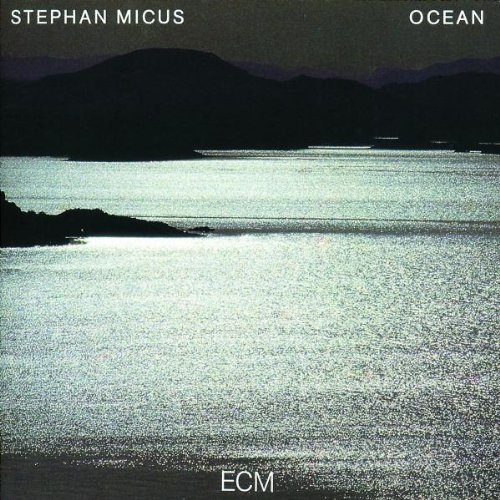
Stephan Micus is more than the sum of his parts. The German-born multi-instrumentalist has done that rare thing: absorbed rather than pilfered a wealth of musical traditions and means and molded from them an entity all its own. As one of his earlier recordings for ECM, Ocean is a tinted window into an artistry of full-blown brilliance. Part I opens with his unaffected, wordless incantation before opening into a flower of hammered dulcimers. As the mournful cries of the nay replace his voice, it is as if the bodily has become breath incarnate, airing out its gentle patchwork of sound in a breezy sky, while meditations rise like pedestals beneath souls. The shō (Japanese mouth organ) opens Part II, treading its feet upon cloud, every step forward an exhalation, every step backward an inhalation, such that one remains poised on the brink of falling. From this congregation of threads arises a shakuhachi, unspooling in reverse, its fatigued song but a dream on a wistful day. Zithers enter in with their skittering rhythms, fluttering like the wings of some vast diurnal insect whose wing covers are its feet, and for whom landing is but a memory of a past in which humans never spoke. In the opening dulcimer meditation of Part III, we feel the kinship into which Micus so profoundly invites us, a promise of stillness in its embrace. The shakuhachi whispers its secrets across the waters, ending in a delicate waterfall, a lifetime’s worth of tears compressed into a single fade and pooled in the cupped hands of silence. Part IV ends (or does it begin?) with a moving shō solo, which turns like a crystal spun from Philip Glass-like filaments and melted by body heat into a fluted garden, churning with the song of every earthworm below.

Micus lets unfold a territory so personal that it becomes selfless, somehow unmarked the human elements of its creation. In his playing, names, labels, and covers, even personages and politics, cease to matter. The only restriction is its very lack. Such music goes beyond the pathos of meditational action, looking into the soul of stillness, where only music can express that which all the languages of the world, lost and extant alike, never could. Their cage is not one that surrounds us but one we surround with the promise of creation, waiting with closed eyes and open hearts.

<< Keith Jarrett Trio: Standards Live (ECM 1317)
>> Masqualero: Bande À Part (ECM 1319)