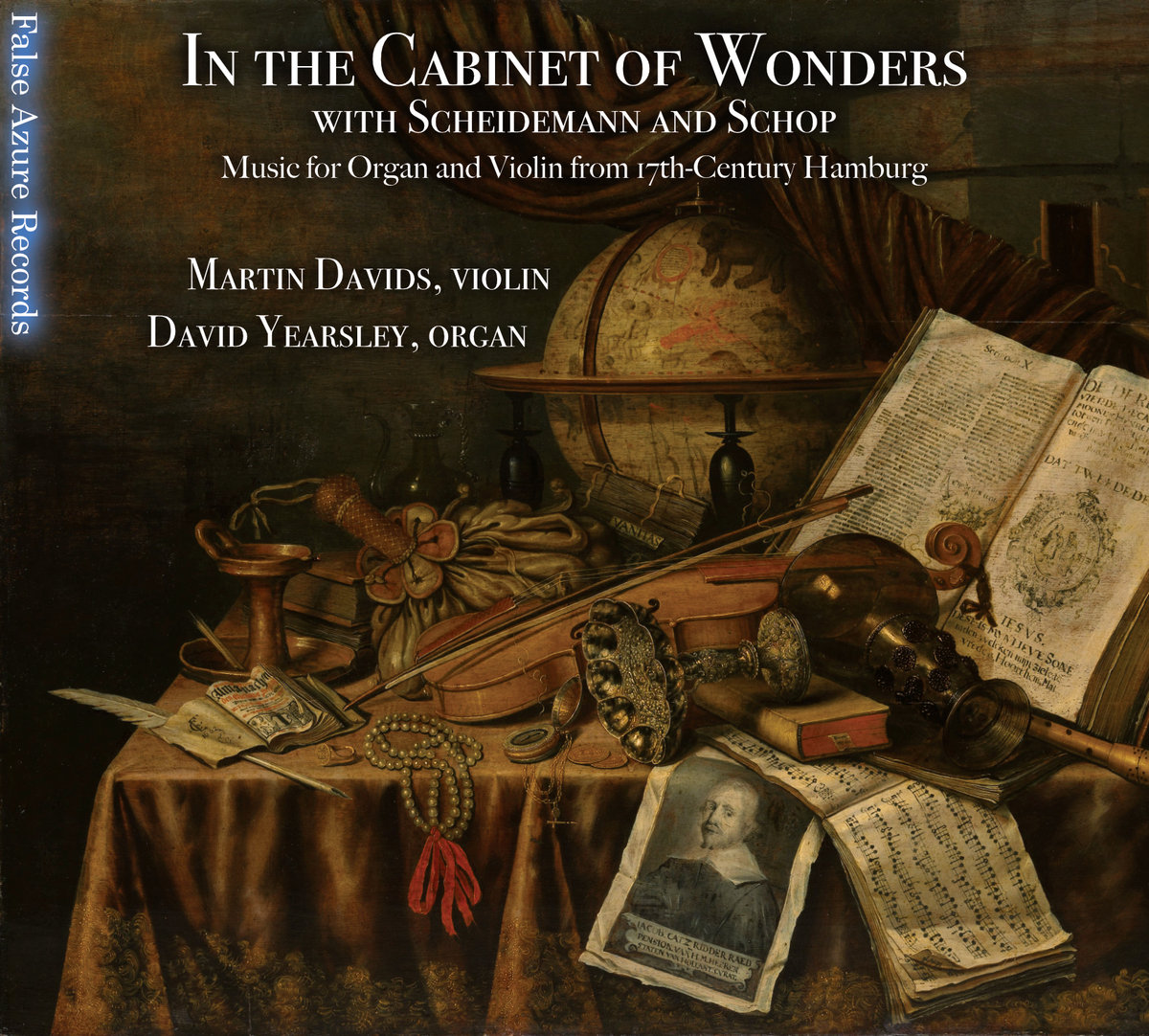
Martin Davids/David Yearsley: In the Cabinet of Wonders

The organ is a colossus, the violin a slender voice. By sheer mass and volume, they seem destined never to agree. One threatens to drown the air in thunder, the other to disappear beneath it. And yet, in 17th-century Hamburg, they discovered a shared breath. High in the gallery of St. Catherine’s church, they spoke not as rivals but as companions, drawing crowds who came to hear scale converse with fragility. What could have been a contest was a study in equilibrium, like a skeleton learning, haltingly, how to stand upright.

It was in this bustling hub that Heinrich Scheidemann (c. 1595-1663) and Johann Schop (c. 1590–1667) met across air and string. Their sounds descended like thought itself, Scheidemann’s pipes carrying the gravity of heaven, Schop’s bow and strings tracing the precarious outline of the human voice. What emerged was more than music. It was a convergence of opposites: cleric and townsman, traveler and citizen, the enduring and the fleeting. In that reverberant space, the city heard itself briefly whole, briefly hushed, before motion returned and the pulse of everyday life resumed.

Under Scheidemann’s quick, laughing hands, sound sprang outward, ricocheting through stone and space with wit and momentum. The organ became less a monument than a body with many lungs, capable of sudden whispers as well as exuberant exhalations. Alongside this abundance, Schop’s violin did not retreat. It danced. Its lines flashed with surprise, then slipped without warning into shadow, like muscles tightening and releasing beneath the skin. Between them unfolded a living exchange, in which the church itself became a resonant demonstration that opposites, when truly listening, can cohere into a single organism.

This album invites the listener into a corporeal experience, one that breathes, sweats, remembers, and occasionally stumbles forward in exhilaration. The music of Schop and Scheidemann, as reimagined by 21st-century analogues Martin Davids and David Yearsley, circulates like blood through civic arteries, passing between church lofts, dance floors, and private chambers, rarely holding one posture for long. What binds the recording is neither style nor chronology, but a shared faith in music as something handled, inhabited, and exchanged socially. Sound is treated as anatomy rather than abstraction. What we hear are the bones of it all, flexing, testing their reach, discovering what they can bear.

Schop’s Intrada à 5 from Erster Theil newer Paduanen opens the album by wrapping the senses in gauze. The interwoven voices refuse hierarchy, relying instead on mutual dependence. Each line anticipates the others’ weight and direction, like ribs designed both to protect and expand. This is consort music already aware of its future disassembly and reconfiguration, carrying that latent plasticity within it. The partnership feels so complete that separation seems almost injurious. From the outset, beauty is not the goal but the consequence. Expression rests on marrow and sinew, and imagination requires a listener willing to inhabit the charged space between intention and realization.

Much of the album’s gravitational pull lies within the orbit of ’t Uitnemend Kabinet of 1646, where Schop’s violin resurrects itself as heir and provocateur. His reworking of Alessandro Striggio’s Nasce la pena mia unfolds like a slow-motion game of double dutch, the ropes of austerity and playfulness turning with deliberate care, demanding full coordination to avoid collapse.

The Lachrime Pavaen after John Dowland presses further inward. The soul twists into a Möbius strip of emotional transference, sorrow folding endlessly back upon itself without settling. Chromatic figures reach deep into the gut to retrieve a half-digested grief and hold it up for inspection. Yet nothing here feels morbid; instead, it suggests that emotion without physicality would simply cave in, that even pain needs a skull in which to resonate.

Scheidemann answers this inwardness with motion and propulsion. His Galliarda ex D sets fire beneath the feet, insisting on the intelligence of movement. Rarely do both touch the ground at once. The sound remains perpetually mid-step, angled toward what follows. Dance here is a matter of orientation, a way of thinking forward with the entire frame. That energy carries seamlessly into the Canzon in G, whose relaxed atmosphere allows light and shadow to exchange places with quiet charm, the organ responsive rather than domineering.

At several moments, the album reveals its improvisatory foundations. The performers’ Intonatiofunctions as connective tissue, recalling a time when much of this repertoire lived between the notes, sustained by trust, familiarity, and shared risk. This ethos extends into Scheidemann’s setting of Christ lag in Todesbanden. Told in two verses, the first establishes the firm outline of a torso, while the second pencils in the extremities.

The relationship between instruments grows aerodynamic in Scheidemann’s intabulation of Giovanni Bassani’s Dic nobis Maria. The cadence is measured yet generous, giving the violin space to breathe while the organ subtly lifts and supports. Imagined as wind and wing, the pairing becomes a lesson in controlled flight, with ornamentation serving as lift. This play of disguise reaches its height in the Englische Mascarada, where the organ steps forward alone. It imitates viols, recorders, and cornetts, its movements almost tactile. The backdrop assumes the foreground, and scale itself learns to play, shedding weight without surrendering substance.

Schop’s sine titulo from ’t Uitnemend Kabinet may be the album’s quietest act of defiance. Tone, transition, and spirit nourish one another organically, as if the piece were activating its own nervous system mid-flight. The violin’s occasional double stops flare like shooting stars across an otherwise stable sky, fleeting, unnecessary, and wholly persuasive.

As the program draws toward its close, its communal heart comes fully into view. Schop’s Præludium, the first work ever published for solo violin, clears the air with intent, a measured breath before speaking plainly. What follows, an improvisatory fantasy on his chorale tune Werde munter, mein Gemüte, unfolds as a conversation restored. The organ answers phrase by phrase, until the violin can no longer remain apart and joins the coda. Harmonies shimmer. What emerges is gratitude, rooted in shared labor. The album concludes with the Pavaen de Spanje, whose stark colors and abrupt shifts return us to orbit.

By its end, the recording has quietly redrawn the boundaries of historical performance. This is no reconstruction, but a living metabolism, a system dependent on circulation, exchange, and constant adjustment. The music does not ask to be preserved so much as inhabited. It leaves the listener with the sense of having moved through a body rather than examined an object, of having felt joints flex, lungs fill, and organs hum in sympathetic response. The final sounds do not conclude so much as release, sending us back into the world more aware of our own inner architecture, and perhaps more willing to trust it when it makes overtures to leap.

In the Cabinet of Wonders is available from False Azure Records here.

Paul Giger: ars moriendi (ECM New Series 2756)

Paul Giger
ars moriendi

Paul Giger violin, violino d’amore
Marie-Louise Dähler harpsichord, chest organ
Pudi Lehmann gongs, percussion
Franz Vitzthum alto
Carmina Quartett
Matthias Enderle violin
Susanne Frank violin
Wendy Champney viola
Stephan Goerner violoncello
Recorded January 2015
Chiesa Bianca, Maloja
Engineer: Peter Laenger
Guggisberglied was recorded 2021 in Walenstadt
Cover photo: Jan Kricke
An ECM Production
Release date: August 26, 2022

The music of Paul Giger became a part of my blood when I first encountered 1989’s Chartres. Not since J. S. Bach’s Sonatas and Partitas had I understood just how architecturally robust the violin could be, to say little of 1993’s Schattenwelt, which introduced his violino d’amore, a custom instrument with five main and six sympathetic strings. If those early albums were temples of the spirit, then ars moriendi is a waystation of the flesh—if not vice versa. The ambiguity of such distinctions gives the album a timeless charge. Across the pages of its cavernous imaginings, Giger writes a real-time scripture of inspiration, building on echoes of lives before and since.

His mythologically tinged Guggisberglied, reinterpreting a popular Swiss folk song of unrequited love and the life one gives up in its name, follows a tracking shot of the human form, shifting in varying degrees of inevitability between innocence and decay. Cradled by the hush of flowing water, what we once saw as shadows are now the shadows of shadows. Such subtlety of framing and placement of subjects is possible only in one whose mind works as a camera. Giger looks within from without, the tones of other cultures beating his drum. The violin body is a percussive force, a multitracked orchestra of emotional instruments. Giger also plucks the lower strings in qanun fashion. Currents of molecular awareness caress the riverbank, praying for a peaceful transition into lifelessness.

The latter sentiment connects to the overarching title. “In the late Middle Ages,” explains Giger in a liner note, “a literary genre of devotional books illustrated with woodcuts flourished under the name ‘ars moriendi.’ They gave instructions on how to ‘die well.’ The purpose of this tradition was to attune the soul to the ‘art of dying’ in order to save it for eternity. Music is also an ars moriendi, an exercise in the ‘becoming’ of a note, of ‘being’ in sound and of ‘passing’ into silence—or into an inner reverberation.” These concepts refer to a triptych of Tyrolean painter Giovanni Segantini, subject of the eponymous documentary by Christian Labhart, for which Giger wrote the music. Selections from that soundtrack take up much of the present album, including three stages of Agony. In the company of percussionist Pudi Lehmann (gongs, singing bowls, frame drum, and conch shell), keyboardist Marie-Louise Dähler (harpsichord and chest organ), and the Carmina Quartett, he builds a tower of wonder one layer of stone at a time until time itself is suspended. As ice dissolves into water and further into steam, the violino d’amore opens light to reveal its individual colors, loosening the bonds of the material within the immaterial through the inherent art of refraction. Zäuerli mit Migrationshintergrund is rooted in the Swiss yodel, harking to 1991’s Alpstein, albeit in far subtler clothing.

Transcriptions of Bach carry over from the film, including two for violin and harpsichord (the choral prelude “Ich ruf’ zu dir, Herr Jesu Christ” and the Largo from the Sonata No. 4 in c minor), angling the mirror of our lives into a cell of collective memory where melodies play on repeat. There is also “Erbarme dich” from the St. Matthew Passion, as sung by alto Franz Vitzthum in a breathtaking arrangement for violin, chest organ, and strings. Vitzthum’s beauties culminate in Giger’s Altus solo II, stitching ground to sky with threads of silver. In the harpsichord’s tactile light, a mournful catharsis takes shape. Like M. C. Escher’s Rind, it suggests a face. Whether forming, unraveling, or holding its own against a patchwork of clouds, its eyes remain fixed on memory.

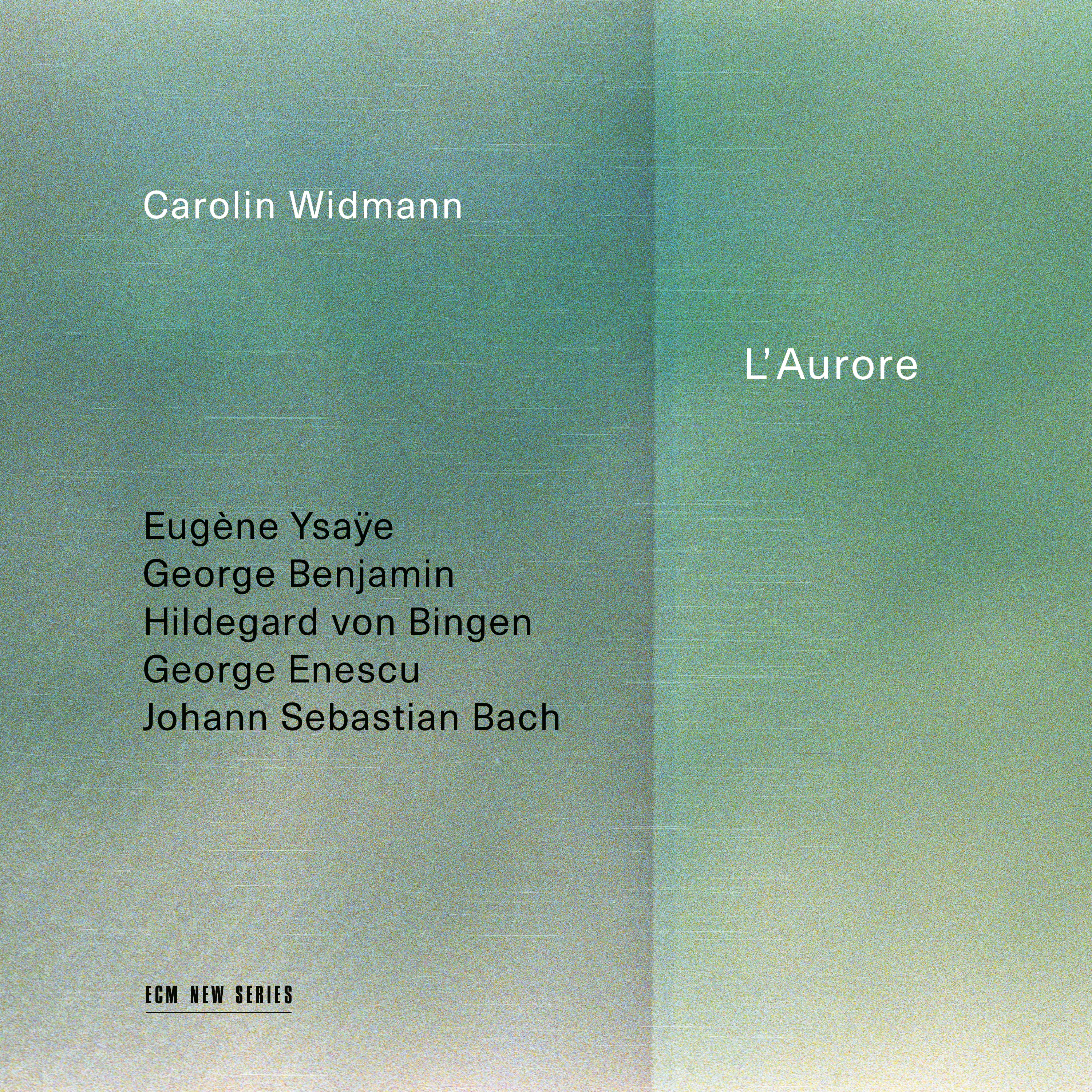
Carolin Widmann: L’Aurore (ECM New Series 2709)

Carolin Widmann
L’Aurore

Carolin Widmann violin
Recorded July 2021
Auditorio Stelio Molo RSI, Lugano
Engineer: Markus Heiland
Cover photo: Wilfried Hösl
Produced by Manfred Eicher
Release date: June 17, 2022

Although L’Aurore represents violinist Carolin Widmann’s seventh ECM appearance, this is her first solo program for the label, making it the culmination of the many potent strands she has woven to get here. Hearing her breathe through the Spiritus sanctus vivificans vita of Hildegard von Bingen (1098-1179), which opens the program with fundamental monophony, is equivalent to the feeling of recovering from a long illness, taking in mundane details with renewed appreciation. The angular vigor of the Fantaisie concertante by George Enescu (1881-1955) that follows reminds us further of the need to absorb as much of our surroundings as possible if we are to give back more to the world than it has given us. Widmann’s ability to bring verve to the most leaping gestures and quietest rasping of the bow ensconces the motivations of this rarely performed treasure she calls a “sweeping melisma” of improvisational qualities. Contrasts of pulchritude and decay leave us marveling over a gray area where no single impression overwhelms another. Any keen listeners drawing a line from here to the work of Eugène Ysaÿe (1858-1931) are rewarded by his Sonata No. 5 in G major, op. 27, the first movement of which yields this album’s title. Its multivalence drips from Widmann’s fingers like rain from leaves after a storm, her double stops leaving trails of light as she works her way toward the “Danse rustique.” Here, the mood is somehow airier, despite the denser textures and grounded form, though at no expense of emotional savor. Between these giants are the no-less-powerful Three Miniatures of George Benjamin (b. 1960). With an economy of expression that makes every note count, each tells its dedicatory story in lucid terms. In doing so, what otherwise might seem like fleeting shifts in more florid writing take on a stark significance. The central piece, in particular, stirs the soul with its elasticity.

After revisiting Hildegard’s antiphon, Widmann takes us on a journey through the Partita No. 2 in D minor of J. S. Bach (1685-1750), a piece she felt prepared at long last to present in the studio. And while it concludes the disc, it feels more like a renewal. The minutiae of her caring spirit are immediately apparent in the caressing Allemanda, from which a personal ethos of direct communication shines in welcome. Over the next three movements, she turns the mirror to capture flashes of light, fragments of dreams, and memories of better times. All’s well that ends well in the epic Ciaccona, which for Widmann is “an epitome of life” (as is Hildegard, she is quick to add). Without apparent force yet with total conviction, she renders its details with the control required to wield a feather quill. Every mark confirms the need for ink and paper, without which these leaves of the human spirit might fall from the trees of history, leaving its forest bereft of fruit.

Of Sound Faith: An Interview with Violinist and Educator Ruth Tumpalan

Sing unto him a new song; play skilfully with a loud noise.
For the word of the LORD is right; and all his works are done in truth.
Psalm 33:3-4

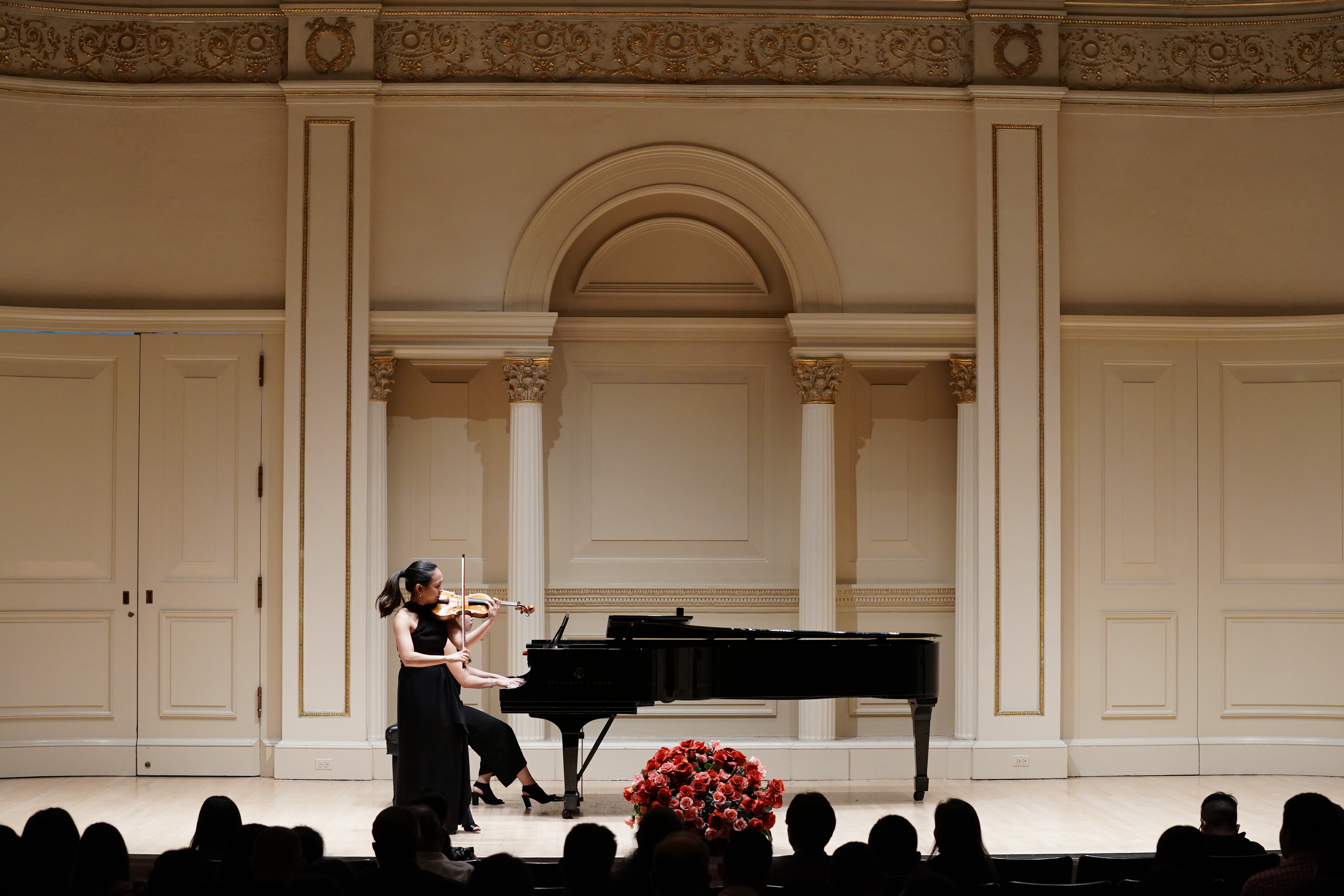
Born and raised in Manila, Philippines, violinist Ruth Tumpalan is a dedicated musician and educator. She is currently a faculty member at the Lindeblad School of Music, where her pedagogical zeal has earned her a place of distinction in the hearts of students. She has studied with such renowned classical artists as violinist Christoph Poppen and pianist Gilles Vonsattel, and has performed with a range of others across genres, from Jaime Laredo to Michael Bublé. Most recently, she won first place in the American Protégé International Piano and Strings Composition, and as a result of that honor was a featured soloist at Carnegie’s Weill Recital Hall in New York City. Her focus on cultural diversity is paramount and drives her to constantly improve her technique in all areas.

DSC_1615 2mb

Yet behind the glamour of performing on some of the world’s most hallowed stages, Tumpalan has found special fulfillment as part of the music ministry at Heritage Baptist Church in Manhattan. Her love of God and music have been intertwined since childhood, and manifest with especial depth in her work with the church’s choir as part of a vibrant ministry.

I recently sat down with Tumpalan via Skype to discuss the role of faith in her personal and professional life, asking first about her musical foundations.

“My father is a pastor, so we were all homeschooled, but when I was 10 he enrolled me and my siblings in an extension program at the University of the Philippines to study music. Two weeks later, I was playing in a Christian wedding officiated by my father. Since then, I’ve always played in church, both as a violinist and choir pianist.”

At the age of 12, Tumpalan got the chance to visit the United States with her father while he was touring churches. Upon returning home, she immersed herself in recordings and live performances, all the while cultivating a desire to pursue music as a profession. She went on to earn her Bachelor of Music degree at the University of the Philippines, with a focus on violin, graduating cum laude in 2009.

“After college, I played with the Philippine Philharmonic Orchestra, but after five years decided I wanted to develop myself even further through study. I had been praying since high school for an opportunity to study abroad, ideally in the U.S., in pursuit of new perspectives and higher standards. In 2014, God led me to a full scholarship to earn a Master’s degree at the University of Massachusetts.”

Tumpalan doesn’t take such blessings lightly and has always seen her gifts as God-given. While at UMass, however, she found herself at an impasse.

“There I was, halfway through my two-year program, contemplating what the Lord’s real will was for me. Did he want me to go back to the Philippines or did he have something bigger in store? It was a long journey, filled with prayer. But God provided, one step at a time, lining me up with a job before I even finished my degree. Although music had originally led me here to the U.S., I know in hindsight that it was actually God’s provision all along, working through all the little things to get me where I am now.”

Although Tumpalan’s husband was in Hong Kong at the time, he also earned a scholarship to study percussion at UMass, bringing them closer under an unseen but ever-felt guiding hand. They were further led to Heritage Baptist Church, where Tumpalan became immediately involved in the music ministry.

“Playing at Heritage is my priority. My job is important, but I like the need of going to church and being with brethren. It also enhances my career, leading me with strength through daily life and its many decisions. When I don’t go to church, even for just a week, I feel that my well-being is lowered.”

DSC_6088
(Tumpalan performs at Heritage Baptist Church)

And what, I asked, of her experience playing at Carnegie?

“I never thought I would get to play there as a soloist. I’d played there before with the Philippine Philharmonic, and thought that was going to be a once-in-a-lifetime experience. But then, last year, I was working with an excellent pianist named Jongsun Lee, who suggested we try out for the competition. With my full studio schedule, it wasn’t easy to manage practice time and teaching, but my teaching actually helped me to prepare. Certain things my own teachers had taught me before suddenly made sense. I never expected to get first place, but God made it possible.”

AmericanProtege-06-09-2019b-1652

For that performance, she chose Henryk Wieniawski’s formidable Scherzo Tarantelle Op. 16, a work brimming with the very excitement that stokes her appreciation for music as a means of communication.

AmericanProtege-06-09-2019b-1719

“The best feedback I’ve ever gotten as a musician is being told that I moved someone to tears. In that respect, in my playing I aim to be more of an inspiration, to connect with people at a level beyond words.”

This approach is integral to Tumpalan’s teaching, which builds upon the renowned methods of Shinichi Suzuki.

“I always make sure to explain to parents that the Suzuki method was designed to create better human beings through music, and that the most important things to learn from the experience are discipline, empathy, and cooperation. These are more than musical skills; they’re life skills. Without them, playing well and achieving success in music mean nothing. Whenever someone makes a mistake in my group classes, no one is allowed to point. They must respect themselves, first and foremost.”

As for the future, Tumpalan sees herself becoming even more involved in the church, and has been considering putting together a book of Christian music arranged for various instruments. Whatever may come, her faith will only continue to grow.

Praise ye the LORD. Praise God in his sanctuary:
praise him in the firmament of his power.

Praise him for his mighty acts:
praise him according to his excellent greatness.

Praise him with the sound of the trumpet:
praise him with the psaltery and harp.

Praise him with the timbrel and dance:
praise him with stringed instruments and organs.

Praise him upon the loud cymbals:
praise him upon the high sounding cymbals.

Let every thing that hath breath praise the LORD.
Praise ye the LORD.

Psalm 150

Dominique Pifarély: Time Before And Time After (ECM 2411)

2411 X

Dominique Pifarély
Time Before And Time After

Dominique Pifarély violin
Recorded in concerts in September 2012
at Auditorium Saint-Germain, Poitiers (France)
and in February 2013
at Cave Dimière, Argenteuil (France)
Engineer: Gérard de Haro
Produced by Manfred Eicher
Release date: August 28, 2015

Here is a place of disaffection
Time before and time after
In a dim light: neither daylight
Investing form with lucid stillness
Turning shadow into transient beauty…
–T. S. Eliot, “Burnt Norton”

After leading a string of caravans across the sands of ECM, Dominique Pifarély enchants on this set of solo recordings taken from French concerts in 2012 and 2013 at Auditorium Saint-Germain (Poitiers) and Cave Dimière (Argenteuil). Although nearly everything is improvised, the violinist dedicated each piece in retrospect to a certain poet, from whose verses he also chose a title. More than highlighting personal connections between literature and music, this artistic decision reveals an agency of spontaneous creation.

The Near Eastern quality of “Sur terre” (for Mahmoud Darwich) makes for a poignant introduction to this border zone where motifs converse for want of being equally heard. Every color and texture is like the seed of a new community, touched by horizons yet to be unfolded, and in this respect shares kindship with “L’air soudain” (for André du Bouchet). The latter’s robust yet plaintive cry yearns to be acknowledged in a place uninhabited except by its own singing. Arid climates are evoked in the rasp of a bow: a gargantuan tongue scraping along the earth in search of nourishment but finding only dust and ruins.

“Meu ser elástico” (for Fernando Pessoa) and “D’une main distraite” (for Henri Michaux) are both jagged wonders, wherein leaping suggestions of dance are constantly pulled back to origins, while the masterful“Gegenlicht” (for Paul Celan) shows us thefull scope of Pifarély’s technical and artistic capabilities. Like a prisoner who succeeds in digging his way through a wall with bare hands, he peels away the barrier to freedom one granule at a time. But before he inhales fresh air again, he must pass through “Violin y otras cuestiones” (for Juan Gelman). A struggle that is as political as it is personal, it finds temperance only in the sul ponticellosalvations of “Avant le regard” (for Jacques Dupin) and “L’oubli” (for Bernard Noël).

If shades of the Baroque are present, they’re no illusion, as even Pifarély admits: “[O]f course Bach is in the air because Bach is polyphonic, and the violin is polyphonic.” Bach also informs his decision to close his solo performances with a standard—in this instance Victor Young’s “My Foolish Heart”—to assert the violin’s autonomy. His interpretation thereof looks in the proverbial mirror, hoping to recognize itself but instead finding awe in what it has become.