

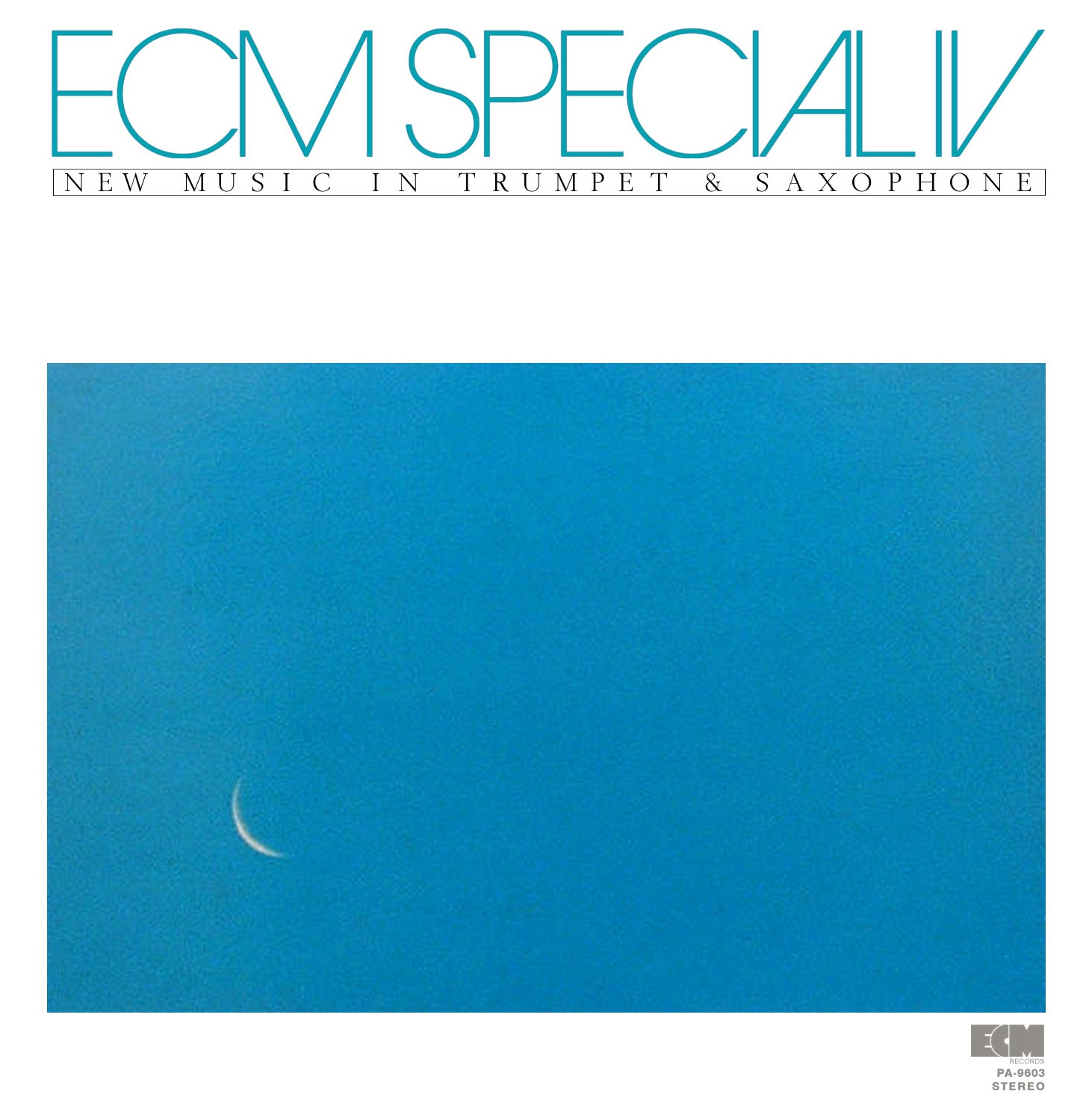
For the fourth volume in the Japan-only ECM Special series, we turn to a selection of tracks devoted to trumpet and saxophone, though the premise soon feels less taxonomic than metaphysical. Across the album, horn and reed serve as emissaries of the instant once melody slips free of intention. “Viddene” opens that passage with a descent into the font of Dis, the legendary duo album between saxophonist Jan Garbarek and guitarist Ralph Towner. Beneath them, a field recording of a wind harp stretches its drone into an almost mineral patience. Garbarek’s soprano, piercing yet hospitable, does not merely climb above the mountaintops but renders altitude a place where yearning can thin itself into radiance. Towner’s 12-string answers with wholesome grain and resonant wood, giving the saxophone’s aerial hunger a body to return to. The result is a soundscape of deep order, moving from abstraction toward groove.
In the wake of this dense conversation, “Tale” enters from Tomasz Stanko’s Balladyna, where the trumpeter speaks into the tensile architecture built by Dave Holland and Edward Vesala. The piece has a robust sense of motion, lumbering forward without losing balance, its gait full of alleyway intelligence and nocturnal cartilage. Stanko’s horn seems to carry a private flame cupped inside brass, illuminating only what it needs to continue. Nothing here explains itself, which is precisely why it convinces. The music fades while still in possession of secrets, leaving the listener with the sensation of having overheard a confession through a wall of smoke. “Svevende” returns us to Garbarek’s sound-world by way of Dansere, where his throaty reed cries with genuine emotional register in a setting only this band could have conjured. Bobo Stenson gathers the harmonic field around him, while Palle Danielsson and Jon Christensen give the rhythm a nervous, breathing intelligence. What begins in fragmentation gradually gathers into a more progressive pulse, around which Stenson and Danielsson inscribe their own Fibonacci sequence of lore.
Enrico Rava’s “By the Sea,” despite retaining the same rhythm section, changes the mood considerably, smoothing the surface until the music seems to stretch horizontally across an enormous inner screen. Taken from one of the trumpeter’s finest albums, The Pilgrim And The Stars, it sparkles all the more through John Abercrombie’s electric guitar, whose presence adds a filament of electricity to the surrounding calm. Rava’s melody moves with slick assurance, skating forward without needing to open its eyes, trusting the contours beneath it with almost dangerous grace. For listeners in 1977, the sound must have felt newly minted, a silver organism arriving from some studio out of time. Rava also closes the album in identical company with “Tribe,” from The Plot, and there the body returns with more visible muscle. A propulsive bass line is doubled by guitar, the cymbals flicker with chromatic wit, and Rava’s tone stays rounded yet incisive, peaking without snapping even the smallest twig in its surroundings. The groove has earth under its nails, but its mind is elsewhere, busy drawing constellations on the inside of the skull.
Between those two Rava signposts, Dave Liebman’s “The Call,” from Drum Ode, widens the album’s ritual dimension. One of only two ECM albums Liebman made as leader, Drum Ode remains a singular document, and this excerpt distills an ecstatic logic. His echoing tenor leaps joyfully amid a gathering of percussionists, a figure absorbed into a larger ceremony of impact and resonance. The title feels exact. This is a call, though not a summons, toward any ordinary destination. It is a signal sent backward through the body, toward the ancient percussive alphabet beating beneath thought. The energy is enormous, yet the recording never collapses into mere heat. ECM’s characteristic spaciousness gives even the densest passages a lucid edge, making the performance feel both historic and strangely unborn, a document whose ink has not yet dried in time.
Garbarek returns once again in “Belonging,” from Keith Jarrett’s timeless record of the same name. The duet opens in pianistic reverie before Garbarek’s soulful tenor walks into frame. Such seamless balladry grows rarer in an age increasingly trained to mistake synthesis for soul, yet here it stands, towering and alive, carrying its vulnerability without theatrical varnish. Then comes “’Smatter,” a gem among gems from Kenny Wheeler’s inimitable Gnu High. The bandleader’s flugelhorn converses with Jarrett’s unstable radiance while Holland and Jack DeJohnette keep the ground elastic beneath them. The piece lifts the spirits without sacrificing complexity, and Wheeler’s richness seems to come from a chamber deeper than technique. To hear this music now is to recognize that joy, when properly documented, becomes a difficult proof.
ECM Special IV is an evergreen meditation on breath under pressure, and its performances preserve the sensation of musicians listening so intensely that sound appears to enter the world through them rather than from them. The album’s profundity lies in its refusal to treat music as expression alone. This music suggests something stranger: that the self may be an instrument briefly borrowed by breath, a rented room through which larger silences pass on their way to becoming audible.
 Between Sound and Space: ECM Records and Beyond