

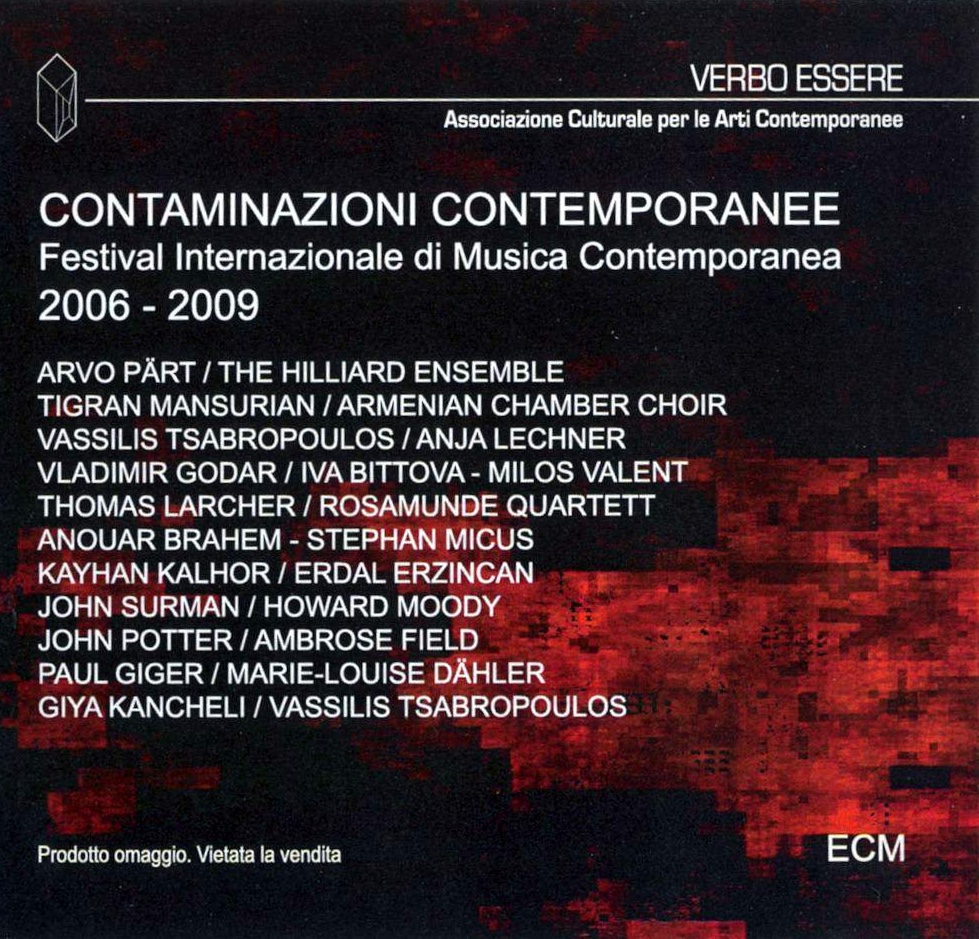
The Contaminazioni Contemporanee, or Contemporary Contaminations, series emerged in Bergamo, Italy, as a multi-year festival devoted to ECM Records’ eclectic sound world. Its title treats contamination as a creative principle: one tradition entering another and subtly rearranging its inner architecture.
Its scope embraces sacred music alongside Mediterranean traditions, with Eastern and Western vocabularies meeting throughout. It is also a rare New Series-dominant ECM sampler. Appropriately, it opens with Arvo Pärt, whose music inaugurated that very imprint. Da pacem Domine, heard as it first appeared on Lamentate (ECM New Series 1930), was composed in 2004 from a ninth-century Gregorian antiphon and recorded the following year at St. Gerold monastery near the Austrian Alps. The Hilliard Ensemble and soprano Sarah Leonard deliver a performance of extraordinary inwardness. Pärt’s apparent simplicity demands absolute discipline, since every sustained tone contains microscopic tension. The antiphon is stretched until time gathers vertically, each line another translucent page in a book whose binding remains unseen.
“Chant,” by pianist Vassilis Tsabropoulos and inspired by the music of G. I. Gurdjieff, continues that inward motion in a duet with cellist Anja Lechner. Each phrase seems to return what it has received. “Night,” from Ars Poetica (ECM New Series 1895), turns to the choral music of Tigran Mansurian. The first of the Armenian composer’s Three Night Songs knits shadow from wordless breathing. That atmosphere flows naturally into Maykomashmalon, from Vladimír Godár’s Mater (ECM New Series 1985). Scored for female voice accompanied by viola and violoncello, it draws on Godár’s experience as a film composer. Iva Bittová’s superb diction gives each syllable physical weight, while the strings seem to rise from somewhere already planted in the listener. Lullaby and lament become indistinguishable, consolation darkened by grief.
Thomas Larcher’s Ixxu (ECM New Series 1967), represented by a selection from his string quartet Cold Farmer, introduces a more volatile intelligence. Written in 1990, it recalls Stephen Hartke, while Alfred Schnittke and Terry Riley flicker at its edges. The Rosamunde Quartett brings out its whimsy and magical realism, treating the score as a mobile architecture whose corridors keep shifting.
A broader geography opens with Anouar Brahem’s “Sur le fleuve,” from Le Voyage de Sahar (ECM 1915). Brahem’s suspended oud phrases give pianist François Couturier and accordionist Jean-Louis Matinier room to unfold their own interior films. No instrument dominates, yet each alters the gravitational field around the others. Stephan Micus extends this cartography in “Madre,” from Snow (ECM 2063). His duduk speaks through strings and mallets, projecting itself outward so that the center may become audible. Origin here feels less a place than an unresolved verb.
The next selection comes from The Wind (ECM 1981) by Kayhan Kalhor and Erdal Erzincan, pairing kamancheh and baglama in improvisational brilliance. Erzincan’s instrument tills the ground with haunting insistence until Kalhor’s bow begins to sprout through it. The kamancheh first appears almost illusory, governed by an understated grammar, then gains tensile force. Motion and rootedness become mutually sustaining. Next, saxophonist John Surman and organist Howard Moody approach the title track of Rain on the Window (ECM 1986) with playful gravity. Surman’s soprano saxophone carries childhood joy, while Moody’s organ grants ordinary memory a chapel of its own.
For “Ma belle dame souveraine,” tenor John Potter and electronic artist Ambrose Field radically reimagine Guillaume Dufay. As part of Being Dufay (ECM New Series 2071), one of ECM’s most daring releases of the present century, the arrangement lets melody and electronic aura arrive from an uncertain distance. Potter preserves the clean contour of early music performance while Field loosens the architecture around it. The 15th century becomes acoustically unstable, less an archive than a question about how identity survives transmission.
Violinist Paul Giger and keyboardist Marie-Louise Dähler sustain that spirit in the fully improvised “From Silence to Silence,” from Towards Silence (ECM New Series 2014). A low harpsichord note opens with subterranean force before Giger’s violin moves above it. The harpsichord, usually confined to continuo, soon becomes a geological event, while the violin traces filaments of light across its fissures. Silence emerges as the destination concealed inside every note.
Giya Kancheli’s title composition from In l’istesso tempo (ECM New Series 1767) brings the collection’s theological implications into focus. A movement from this piano quartet advances across terrain that seems to form beneath it. Strings waver through soft glides and terse spirals, inhabiting a dimension where incomplete statements carry more authority than conclusions. Kancheli approaches revelation, then turns aside before certainty can possess it.
Tsabropoulos returns with the title track of The Promise (ECM 2081), a richly flowing melody that gathers the album’s sacred inheritance into improvisational freedom. Its promise may reside in the willingness of one sound to be changed by another.
That may be the compilation’s deepest proposition. Listening subjects the boundaries of the self to revision. Each work enters consciousness as a foreign structure, then alters the syntax by which consciousness recognizes itself. The listener becomes neither container nor mirror, but a provisional equation whose variables exchange names. Somewhere between antiphon and improvisation, identity appears as the residue left when perception folds back upon its source. What remains is a geometry without stable dimensions, lucid precisely because no final angle can contain it.
 Between Sound and Space: ECM Records and Beyond