Giya Kancheli: Magnum Ignotum (ECM New Series 1669)

Giya Kancheli
Magnum Ignotum

Mstislav Rostropovich cello
Royal Flanders Philharmonic Orchestra
Jansug Kakhidze conductor
Recorded December 1997
Produced by Manfred Eicher

Said Mstislav Rostropovich, to whom the opening work of this album is dedicated, of his longtime friend, “His natural element is the deepest mystical sorrow. Olivier Messiaen revealed for me the limitlessness and endlessness of time, and the same is true for Kancheli.” Chronological uncertainty seems to have been a core philosophy for the master cellist, whose sound grew only deeper toward the end of his life. Simi (1995) proves to be an ideal vehicle for his aging, yet ever robust sound. The title is Georgian for “string,” and indeed vibration is its universe. Pauses are left to the soloist’s discretion, and for this performance Rostropovich drew inspiration from Kancheli’s own halted style of speech. The music swirls in a crystal ball that, when occasionally shaken, snows down on a familiar motivic scene. Its imagery is stark and discomforting. A piano opens its chording like the death throes of an unfathomable organism. Brass-laden swells rupture its skin, immediately cauterized by an instrument of divine fire. Yet Simi is not without its hopeful intimations, as in the brief harmonic twinge at the 14’ mark. And while the cello’s presence dominates throughout, it is anything but the self-centered celebrant, comporting itself rather like one in mourning. That being said, the piece’s subtitle, “Joyless thoughts for violoncello and orchestra,” is something of a misnomer, for the cello also presents its own paradox: in the single performer lies the potential for multiple voices, and in the playing one finds undeniable ardor. In this instance, the cello is like a prism through which the composer’s light passes. The orchestra is no longer mere accompaniment, but an unraveling of the soloist’s heartbeat.

Magnum Ignotum (The Great Anonymous), written in 1994 for wind ensemble, double bass, and tape, has become one of Kancheli’s most widely played pieces. The response to a commission for which the composer was asked to incorporate Georgian folk music, Kancheli includes said music unmitigated, except by the technology of tape by which it is deployed. The opening recitation is of an Anchikhati priest, who seems to float above an almost funereal bassoon. Voices return in a 1930s field recording of three old men from West Georgia improvising in a haunting mezza voce called “ghighini.” Despite following a heavy orchestra piece, the modest scoring of Magnum Ignotum brings its own intensity, not least because every melodic line depends on the strength of the breath behind it. Thus invoked, the human body is unfolded through the vocal phenomenon that is the Rustavi Folk Choir, whose heartening rendition of the Trisagion hymn “Tsmindao Ghmerto” (Holy God) folds its hands to a clang of bells.

This is music concerned with its own ephemeral path, always skirting the edge of fleshly existence and the limitations upon which its life hinges. It is a candle flame holding on to its last flickers; it is also the puff of air that pulls it into smoke. An essential release from cover to disc.

<< John Holloway: Unarum fidium (ECM 1668 NS)
>> Bley/Peacock/Motian: Not Two, Not One (ECM 1670
)

Michael Mantler: Review (ECM 1813)


Michael Mantler
Review (1968-2000)

Robert Wyatt voice
Susi Hyldgaard voice, accordion
Michael Mantler trumpet
Bjarne Roupé guitar
Per Salo piano
Mona Larsen voice
Kim Kristensen piano, synthesizers
Jack Bruce voice
Per Jørgensen voice
Don Preston voice, synthesizers
John Greaves voice, bass
Karen Mantler voice, piano
Alexander Balanescu violin
Rick Fenn guitar
Marianne Faithfull voice
Nick Mason drums
Mike Stern guitar
Carla Bley piano, synthesizers, voice
Steve Swallow bass
Larry Coryell guitar
Tony Williams drums
Kevin Coyne voice
Chris Spedding guitar
Ron McClure bass
Terje Rypdal guitar
Jack DeJohnette drums
Don Cherry trumpet
Pharoah Sanders tenor saxophone
Jazz Composer´s Orchestra
London Symphony Orchestra
Balanescu Orchestra
Danish Radio Concert Orchestra
The Danish Radio Big Band
Chamber Music and Songs Ensemble
Radio Symphony Orchestra Frankfurt

Every once in a while, an album comes along that changes our view of what jazz, or any genre for that matter, can be. Review isn’t one of those albums. It’s much better.

One of contemporary music’s most accessible provocateurs, Michael Mantler is like an old friend and an enigma in one. ECM’s vital retrospective compresses over thirty years of his coal-throated sounds into a gallery of jagged diamonds. With a roster to make even the most eclectic enthusiast blush with delight, Mantler assembles a powerful resume of musical forces, intentions, artifacts, techniques, and emotional ammunition. He is the sonic equivalent of a Robert Altman or Peter Greenaway. Like the latter, he works with pictures within pictures, splashes refractions of time and place across his screens, enhances images with the written word. He makes audible the diaries of our intellectual journeys, folds every page into a paper airplane, and launches it from heights far beyond what we ever imagined as children.

From the first moments of the piano-driven, brass-infused jewel of musical concentration that is “Unsaid,” we feel the broad strokes with which Mantler paints, and the perpetual reinvention that cloaks his every move. No single mood dominates from thereon out. “Introductions,” for example, is a scrapbook of varied histories, of dislocation and dying joys, the story of a war-torn world in which home no longer remains a stable category. Against its beautiful harp-infused orchestral background, a kaleidoscope of characters airs its grievances. It’s as if one were to throw into a pot the music of Meredith Monk and Heiner Goebbels and watch what results. As this broth comes to a boil, we get a most potent whiff of unknown spices. Each instrument is its own flavor, adding a dash of autobiography to the thickening brew. This is a stunning piece, one exemplary of Mantler’s genius. “Solitudine / Lontano / L’Illuminata Rugiada / Proverbi” is a chain of laments splashing in the limpid pool of self-awareness, threading circumstance with the wave of a drunken stroll. A mournful violin lays itself down before a pause brings us to the more resolute “Speechless.” An unspoken word rolling off the tongue only when it is too late, it leads us to one of the album’s many insightful instrumental pieces. Said excerpt from “Folly Seeing All This” (1992) lifts its weight as a foot from mud, with no other choice but to step down and repeat the process. “Movie Two” (1977) is another magnificent incident, marked by nimble drumming from Tony Williams, heading a tight rhythm section beneath a crunchy guitar solo from Larry Coryell, not to mention Mantler’s own vividly imaginary trumpeting. A few briefer interludes make their voiceless presences known. “Love Ends (excerpt),” a bittersweet duet for clarinet and piano, is a memory one can’t quite picture. A treat from the unpretentiously titled “Alien” (1985) sports the nostalgic synths of Mothers of Invention keyboardist Don Preston. “Twenty” brims with the youth of its eponymous age. It acerbic electric guitar and heavy bass almost tumble over one another in their search for gold. But then there is “One Symphony” (1998), from which he hear but one fascinating orchestral snippet. Characterized by vibrant energy and mallet-heavy percussion, its jaunty instrumentation titillates at an intersection of the bowed, the blown, and the struck. Echoing pizzicato strings transcend the music’s outer barriers, puncturing its paper-like firmament with simulacra of starlight. “Preview” (1968) is another bundle of archival explosives. Its incendiary tenor sax solo, courtesy of the legendary Pharoah Sanders, runs amok, incurring not a few brass concussions along the way. And as the drums bubble from the earth around him like a latent volcano, Sanders astonishes with the intensity of his (in)difference.

Of all the vocal talent represented here, Robert Wyatt is foremost. His incautious duet with Susi Hyldgaard in “I’m glad you’re glad” is its own wonder. Here, a relationship’s self-reflexivity is thrown in its protagonists’ faces with veiled exclamations of happiness and return. Wyatt reads from Harold Pinter’s play Silence in “Sometimes I See People” (1976), twisting morose obsessions with social growth and fallacies of identity twist into a complicated braid. Another effective reading, this time run through a flange, in “The Sinking Spell” (from Mantler’s 1975/76 The Hapless Child) offers an Edward Gorey tale to the morbid believer in all of us. Its terrestrial charm, set aloft by flights on electric guitar, slingshots its sentiments across the universe toward vocal ends. Backed by none other than Carla Bley, Terje Rypdal, Jack DeJonette, and Steve Swallow, Wyatt stretches until he leaves his own nebular mark in the evening sky. A trio of miniatures—“PSS,” an excerpt from “Comrade,” and “A l’Abattoir”—featuring the voice of Marianne Faithfull makes for some further incisive dramaturgy. Behind a thinly processed veneer, each is a micro-opera of galactic proportions. Jack Bruce lays down his own heavy tracks with the words of Samuel Beckett in “Number Six – Part Four” (1973), in which he is paired with trumpeter Don Cherry. Finally, the lilting strings that introduce “It makes no difference to me” fade into their reverberant chamber behind indecisive voices, wandering in the confusion of split paths like the accordion that continues their journey when they fall silent. A love for recitative underscores these narratively minded pieces in brightest neon.

The real meta-statement, however, lies in “Understanding.” A piece about and of transition, it achieves its resolution through the fallibility of the utterance and its audio redeployment. It is a Tower of Babel laid on its side and spread thin into an auditory crepe. Mantler manages to be both cinematic and literary here, further skirting an undefined space between the two. As a translator myself, I feel this piece reaches for my heart like no other.

Mantler is a musical treasure, a singular voice comprised of many. His is not music that simply speaks to the listener, but music that speaks and listens to itself.


Henri Dutilleux: D’ombre et de silence (ECM New Series 2105)


Henri Dutilleux
D’ombre et de silence

Robert Levin piano
Ya-Fei Chuang piano
Recorded December 2008, Auditorio Radio Svizzera, Lugano
Engineer: Markus Heiland
Produced by Manfred Eicher

The music of Henri Dutilleux, now approaching his 95th year, has been sadly dwarfed by that of Ravel and Debussy, among whom he is often the third wheel in categorical groupings of modern French music. Represented only cursorily on ECM thus far (12 Hommages A Paul Sacher), he at last receives a treatment that is as meticulous as he is. Pianist Robert Levin first met Dutilleux during a 1979 residency at Nadia Boulanger’s Conservatoire Américain at Fontainebleau, since which time the two have maintained close friendship. When producer Manfred Eicher bid Levin (familiar to label listeners as violist Kim Kashkashian’s go-to accompanist) to record a solo recital, Dutilleux’s name emerged early in discussions, though the material needed to be concert tested and approved before the studio would be graced with its bracing refractions.

The Petit air à dormir debout (1981), which begins the disc, is the first of a handful of pieces written for children. Others include 1950’s charming Blackbird and the pensive Tous les chemins… mènent à Rome of 1961, each a pocket of halting lyricism from which both composer and performer lift handfuls of stardust before committing fingers to keys. We see that every note has its place as the galaxy of the programming begins to take shape. The Sonata (1946-48) that anchor’s the disc’s first half is the composer’s Opus 1. It is also a masterstroke of compositional acuity. Every nuance leaps off the page, not least because of Levin’s supremely fluid gestures, as if self-aware. Though one of the composer’s most widely known works, it bristles with fleeting handles of articulation, none of which ever quite holds its shape long enough to be grasped. Dutilleux adds sharp edges to these potentially impressionistic reveries, making them all the more delicate to handle.

Intended as interludes for radio broadcasts, the “Prélude en berceuse” and “Improvisation” from Au gré des ondes (1946), reprised at the album’s conclusion in their completed context, sound like bagatelles from the afterlife. One can almost hear the static that might have surrounded their original appearance. Like Blackbird, Résonances (1965) quickly skitters through Messiaen’s shadow before stumbling over its own light. This is followed by a counterpart of sorts in the form of Figures de résonances (1970/76), for which Levin is joined by wife Ya-Fei Chuang. The two play as one, passionate allies of the melodic thread that binds them. The final section feels like an echo in the ribcage, its strength waning with every heaving breath. Two more fleeting statements, Mini-prélude en éventail (1987) and Bergerie (1946) embrace a triptych of preludes. More like an overcooked pastry than a sandwich, its outer layers flake off at the slightest touch while the center awaits its first tongue to burn. Levin saves the best for last, laying the nostalgia on thick with an homage to Bach and the enthralling Etude that is its partner.

These works are, as Levin stresses in his more than insightful notes, conceived and written “molecule by molecule.” Not only is this music that follows no footsteps, but music that would rather not leave any at all. Levin touchingly dedicates this recording to the memory of Dutilleux’s wife, Geneviève Joy, who passed on just before its final production. An accomplished performer, Geneviève’s own interpretations of her husband’s music, in Levin’s estimation, “provide the lodestar to all of us who seek to follow in her footsteps.” If these performances are any indication, hers must have been downright otherworldly.

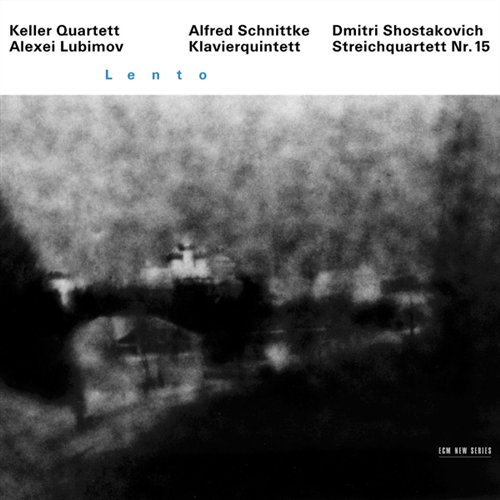
Alfred Schnittke/Dmitri Shostakovich: Lento (ECM New Series 1755)

Lento

Keller Quartett
András Keller violin
János Pilz violin
Zoltán Gál viola
Judit Szabó violoncello
Alexei Lubimov piano
Recorded June 2000
Engineer: Peter Laenger
Produced by Manfred Eicher

The Piano Quintet of Alfred Schnittke (1934-1998) begins where many chamber works might end: with the closing of eyes. It is behind these lids, the shadowy backdrops of which form the projection screen of our deepest mortalities, that the music remains. Even the Waltz of the second movement is a doppelgänger, its higher strings haunting the periphery like an epidemic. Such profound banalities are what make this a harrowing, if somnambulate, work. The piano’s role is very much subdued, providing regularity where there is none to be had. Rarely proclamatory, it reveals its deepest secrets when, at the end of the Andante, the sustain pedal is depressed merely for its metronomic effect in want of note value. The album takes its title from the fourth movement, a viscous, writhing creature that never shows its face. After enduring so many scars, the final Moderato tiptoes ever so gracefully around the fallen shards, gathering from each a snatch of light—just enough for a handful.

Schnittke very much admired the late works of Dmitri Shostakovich (1906-1975), of which the String Quartet No. 15, op. 144 cuts deepest. Completed in 1974, two years before Schnittke’s quintet, Shostakovich’s last quartet of a planned 24 consists of six almost seamless Adagios. At 37 minutes, it is the longest of his quartets, if not also the most ponderous. A few shocks interrupt us, as the forced pizzicati of the Serenade, but otherwise we are lulled in the deepening shade of a wilted tree that sways as it ever did at the hands of an unseen breeze. Ironically, the Nocturne provides the earliest intimations of sunrise, throughout which the cello smiles through its tears. A bitter smile, to be sure, but an unforgettable change of expression in the music’s otherwise tense features. We are allowed a single breath before the Funeral March that follows. A tough lyricism pervades, as in cello’s repeat soliloquies, all of which primes us for the cathartic Epilogue, in which is to be had a forgotten treasure, a time capsule buried in childhood and only now unearthed.

Although this is an album drawn in morbidity—Schnittke’s quintet finds its genesis in the death of the composer’s mother, while Shostakovich’s quartet premiered months before his own—it is supremely life-affirming, each work a breathing testament to indomitable creativities. The Keller Quartett, joined by Alexei Lubimov for the Schnittke, lay themselves bare at every turn, wrenching out by far the most selfless performances thus far recorded of this complementary pair.

<< Kim Kashkashian: Hayren (ECM 1754 NS)
>> Joseph Haydn: The Seven Words (
ECM 1756 NS)

John Holloway: Unarum fidium (ECM New Series 1668)

John Holloway
Unarum fidium

John Holloway baroque violin
Aloysia Assenbaum organ
Lars Ulrik Mortensen harpsichord
Recorded December 1997, Kloster Fischingen, Switzerland
Engineer: Markus Heiland
Produced by Manfred Eicher

“And if you require proof of faith, I’ll show you not fidelity but my fiddle.”
–Johann Heinrich Schmelzer

On Unarum fidium, violinist John Holloway has put together a robust program of Baroque delights and an even more robust assembly of musicians to make them sparkle. For his ECM debut, Holloway wanted to do something special, it seems, and opts for a unique basso continuo of harpsichord and organ, respectively played by Lars Ulrik Mortensen and Aloysia Assenbaum. The two work in tandem—the result of arduous experimentation—to form a breathtaking stage for three demanding technical dramas. The choice is far from arbitrary and has legitimate historical precedent as a later 17th-century configuration. Remarks Holloway, “One of our ambitions with this recording is to demonstrate a case for this extraordinarily rich sound in instrumental music of this style.” Whatever the ambition, this innovative trio synergizes like no other.

The Verona-born Antonio Bertali (1605-1669) was a composer of the Viennese Imperial Court whose posthumous reputation hardly matches that which he enjoyed in his lifetime. The Chiacone on offer is reason enough to restore it. Any doubts about the continuo are immediately quelled as its lush bifurcation spreads warmth throughout every phrase. As for the music itself, it is effervescent and exhilarating. Like a theatrical production that masks all the dramaturgical grunt work with sublime costuming and dance, it enchants not without great effort. Holloway commits himself to a melodic line that is all the fierier for its restraint.

Succeeded perhaps only by Biber’s Mystery Sonatas in complexity and content, the Sonatae unarum fidium of Johann Schmelzer (1620-1680) shine as exemplars of the form. Schmelzer, who may very well have studied with Bertali in Vienna, was a master on another level, as evidenced in his fondness for playful contrasts. Where the First Sonata is languid, almost provincial, the Second Sonata leaps into more spirited reveries. Despite all the flourishes demanded of the soloist, the music remains fairly stationary. The Third Sonata makes use of an enchanting echo technique and allows the organ its broadest strokes, which eventually blend into the arpeggio that opens the Fourth Sonata. And as the violin slowly works its way into the architecture at large, it approaches percussive identities in the faster variations. The Fifth and Sixth Sonatas are markedly different in that they work with negative space, describing the branches of a tree not by the leaves they sprout but by the snatches of sky they delineate.

Holloway closes with an anonymous Sonata for scordatura violin and basso continuo. Found in the same library among the preceding works, its stylistics places it squarely within the Biberian matrix. It may be the shortest piece on the album, but the present company only enlivens its archival significance as a fitting finish.

The music on this disc is refined, but also more contemplative than that of Holloway’s other ECM outings. What it lacks in flair for the programmatic contortions of Biber or the eccentricities of Veracini, it makes up for in directness of heart. This is melodically linear music that leaves an unmistakable crumb trail for us to follow. What he drops is so delectable that we end up eating our way to the destination without hope of return. The beauty of it is that, by the end, we are happy to stay right where we are.

<< Schönberg/Schubert: Klavierstücke (ECM 1667 NS)
>> Giya Kancheli: Magnum Ignotum (ECM 1669 NS
)

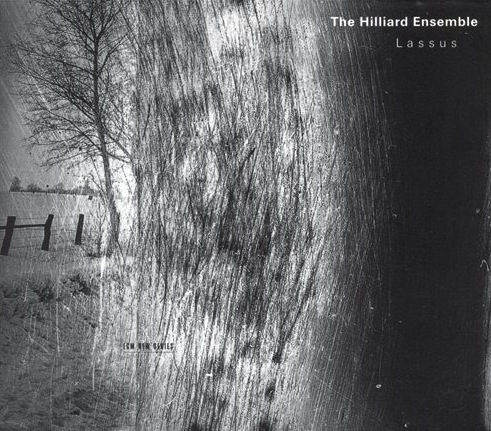
The Hilliard Ensemble: Lassus (ECM New Series 1658)

The Hilliard Ensemble
Lassus

The Hilliard Ensemble
David James countertenor
Rogers Covey-Crump tenor
John Potter tenor
Gordon Jones baritone
Recorded November 1993, Boxgrove Priory, Chichester
Engineer: Peter Laenger
Produced by Manfred Eicher

Of the more than 2000 works written by the Franco-Flemsih composer Orlande de Lassus (1532-1594), this benchmark recording by the Hilliard Ensemble encompasses two of his most significant. The plainchant that opens our hearts to the Missa Pro Defunctis provides a level foundation from which to rise slowly into vocal awareness. Like all great polyphonists, Lassus treats the word as flesh, stretching it over the skeleton of a life animated by divine breath. Yet within the godly body beats a heart of silence, and within that silence thrives the core faith through which this music is “visibly” recirculated. It proceeds from, and is written in honor of, the same font. Throughout every moment of the Mass’s conception, we are draped in a veil of obscurity, so that by the Agnus Dei we have shielded ourselves enough to handle a glimpse at the face of our Creator. The closing plainchant not only completes the circle, but spins it like a coin that never stops.

The Prophetiae Sibyllarum is Lassus’s ode to chromaticism, and introduces a unique set of textual and tonal colors that he would never visit again. Unexpected harmonic shifts draw straight lines amid a field of curves. At its densest moments, the Prophecies reach the profundity of Gesualdo, as in the inescapably gorgeous Sybilla Phrygia. These are decidedly secular pieces, constructed as they are around Pagan-influenced texts. Never content in staying in one territory for too long, they are constantly shifting between moods and colors, so that by the end one is left with a fractal of musical effect.

It seems that every new Hilliard Ensemble recording outdoes the last, and this is certainly no exception. Gordon Jones truly stands out here, as he brings a distinct airiness to his lines. The interplay between him and Rogers Covey-Crump in the Graduale of the Mass is astonishing, while David James shines through every turn of the Prophetiae. The music of Lassus would be a puzzle, were it not for the solutions etched upon its surface, as if it were glass and one need only turn it to catch the light the right way to see those inscriptions glowing in a litany of scars across the visage of time. Its meanings are the Alpha and Omega of creation, and duly so for the music created in their name.

<< Peter Erskine Trio: JUNI (ECM 1657)
>> Hans Otte: Das Buch der Klänge (ECM 1659 NS
)

Giya Kancheli: Lament (ECM New Series 1656)

Giya Kancheli
Lament

Gidon Kremer violin
Maacha Deubner soprano
Tbilisi Symphony Orchestra
Jansug Kakhidze conductor
Recorded March 1998, Centre for Music and Culture, Tbilisi
Engineer: Mikhail Kilosanidze
Produced by Manfred Eicher

ECM offers some of Giya Kancheli’s most compelling music in Lament (Music of Mourning in Memory of Luigi Nono). This 1994 outpouring for violin, soprano, and orchestra is a requiem, a postlude, a concerto, and homage. It is also more than these, spreading its heavy wings wide across an ever-changing landscape. Kancheli revisits the words of Hans Sahl, whose verses appeared upon the same lips in EXIL, this time through his poem “Stanzas.”

I go slowly hence from the world
Into a domain beyond all distance,

Gidon Kremer’s violin seems to arise from a shadow within a shadow. Soon joined by flute, which acts like a hooded guide through the wilderness, Kremer flirts with his surroundings. The orchestra responds provocatively to these agitations, only to blend back into the woodwork from which its sounds are born. As strings wander toward the horizon, every bowed step seems only to bring them closer to me, as if I were but a projection of a faraway self.

And what I was and am and shall remain
Goes with me hasteless and forbearing
Into a country ’til yet untrod

The wind continues its gentle flight, weaving through orchestral punctuations like a suture through flesh. These satoric bursts never last. Their clarity is brief, their catharsis even briefer. Kremer brings a raw, rustic tone, and with it a certain terrestrial quality to this otherwise stratospheric music. Unfamiliar skies and the mud-stained roads beneath them temper any possible thrill of discovery. And yet, the closer I walk to death, the brighter my surroundings seem to become.

I go slowly hence from time
Into a future beyond the stars,

Kremer’s lilting highs mesh beautifully with Maacha Deubner’s own as both pull the orchestra to a high summit. I leap without hesitation, floating ever so gently back to solid ground. Deubner seems to sing from somewhere not of this world. Her voice becomes a memory, something heard when I let down my mental guard. Kremer gets an equally magical sound from his instrument, leading the orchestra with utter determination.

And what I was and am and ever shall remain
Goes with me hasteless and forbearing,

Deubner sets aloft a high-pitched violin before oboe and orchestra spin their own guiding light out of ether. Familiar material works its way into my mental window: a rare comfort in these tattered vestiges, far enough removed from Kancheli’s motivic staples while also weeping in their shadows. I can only sit on the edge of music like this, never knowing whether to lie back or lean forward. And so I am resigned to the margin, left to wander

As though I’d not, or scarcely, ever been.

<< Arvo Pärt: Kanon pokajanen (ECM 1654/55 NS)
>> Peter Erskine Trio: JUNI (ECM 1657
)

Arvo Pärt: Kanon pokajanen (ECM New Series 1654/55)


Arvo Pärt
Kanon pokajanen

Estonian Philharmonic Chamber Choir
Tõnu Kaljuste conductor
Recorded June 1997 at Niguliste Church, Tallinn
Engineer: Teije van Geest
Produced by Manfred Eicher

I have lived my life wantonly on earth and have delivered my soul to darkness. But now I implore Thee, O merciful Lord, free me from this work of the enemy and give me the knowledge to do Thy will.

Of all the music to have graced the digital grooves of ECM’s ongoing relationship with Arvo Pärt, these settings of the Russian Orthodox Canon of Repentance to Our Lord Jesus Christ in its entirety stand out as the pinnacle of his craft. On second thought, perhaps “stand out” is the wrong analogy, for if anything the music of Kanon pokajanen comports itself through kneeling and supplication. Completed in 1997 in commemoration of the 750th anniversary of Cologne Cathedral, it was premiered the following year by its dedicatees, Tõnu Kaljuste conducting the Estonian Philharmonic Chamber Choir, who also perform it here to humble perfection. Sung entirely in Church Slavonic, the Kanon is structured as follows:

Ode I
Ode III
Sedalen
Ode IV
Ode V
Ode VI
Kontakion
Ikos
Ode VII
Ode VIII
Ode IX
Prayer after the Canon

Ode II has no text and drops out as the silent number. The remaining Odes are introduced by an irmos, which acts as a link between word blocks, followed by four troparia, or hymnal stanzas, of which the last is always the Theotokion, or Hymn to Mary. The “intermezzo hymns” between Odes III/IV and VI/VII provide a summary function, not unlike a recap episode in a long-running series, except that here they are full-fledged episodes in and of themselves, each its own hue in the emerging aural ikon. The Kontakion and its Ikos are deeply rooted in the act of reading, as in the ways in which these hymns would normally be chanted, while the final prayer serves to close the circle in preparation for Communion. The lifeblood of the text is its refrain of “Have mercy on me, O God, have mercy on me,” which circulates like an involuntary reflex of the spiritual body.

If there is a more heart-stopping, transportive moment in all of choral literature than the opening proclamation, I have yet to hear it. Sung with such passion in every single voice and rising in a collective exhalation of Godly energies, it never fails to halve me to my core. On the whole, the sound palette of the Kanon varies from barely harmonized periodic elements to full-blown organic compounds. Antiphonal glue holds the most fragile texts together in preparation for glorious leaps of faith, such as the passage in Ode III during which tenors and altos soar over a beautifully sustained drone. Ode VI is another notable moment, featuring cosmic ambulation between women’s voices over a deep cantus firmus. It is a vital motif, rocking between Heaven and Earth with baptismal impact. And one will be hard pressed to forget the doubling male soloists of the Ikos, which always haunts me long after its brief traversal. The tearfully arranged Prayer after the Canon distills the thematic energy even further, drawing with its pigments an image of such careful self-immolation that only silence can offer itself as palimpsest.

The Estonian Philharmonic Chamber Choir is as much a treasure as the one who has provided them such bounty. They handle every note as the holy relic that it is, passed down through the ages and translated in song so that others may touch it without degrading its surface. The altos in particular emit an outstanding richness of tone. The recording space is potently reverberant, drawing out every pause like a comet’s tail. Listening to this music, one comes to appreciate the choral qualities of Pärt’s instrumental pieces as well. And while those have received plenty of deserved attention, Kanon pokajanen is a must-listen for anyone wishing to hear the Estonian visionary in his most enlightened state of grace. The music is almost too powerful, such that listening to the entire album in one sitting can be a draining experience, faced as we are with the prospect of returning to a secular world once its last ghost leaves our ears.

If language is, as the composer himself professes, for him a constant “point of departure,” then nowhere is it so intensely communicative than in the Kanon. Anyone who fears that Pärt’s music was a passing fad in an era craving spiritually minded music for the weary masses need look no further than this heavenly spool from which a thread has tied itself around us before we even press PLAY. You may just find something new that has resided in your soul all along.

<< The Hilliard Ensemble: In Paradisum (ECM 1653 NS)
>> Giya Kancheli: Lament (ECM 1656 NS
)

András Schiff/Peter Serkin: Music for Two Pianos (ECM New Series 1676/77)

András Schiff
Peter Serkin
Music for Two Pianos

András Schiff piano
Peter Serkin piano
Recorded November 1997 at the American Academy of Arts and Letters, New York
Engineer: Tom Lazarus
Produced by Philip Traugott, Peter Serkin, and Manfred Eicher

In his liner notes, Klaus Schweizer describes a unique meeting of minds when pianists András Schiff and Peter Serkin appeared on stage together for a November 1997 concert held at New York’s Metropolitan Museum of Art. Rather than join forces, these two “protagonists” rubbed those forces together to see what kind of electricity could be produced, so that “the audience had the pleasure of enjoying a contest of temperaments…and may have come away with the impression that such ‘contrapuntal’ music-making can be more stimulating than the harmony of two kindred souls.” The spontaneity of said performance and all its glorious vices have made their way into this subsequent studio recording, for which we are treated to the same sounds that graced the eyes and ears of all who were there for this rare event. As Schweizer so keenly sees it, this is a program of fugal magnificence, each work drawing from Bach’s highest art its own vivid line of continuity.

Wolfgang Amadeus Mozart (1756-1791):
Fugue in C Minor for Two Pianos, K. 426
Mozart’s fugue may be without commission or context, but we can safely assume it was more than an honorary exercise. As its grinding voices quickly resolve themselves into harmonious contrapuntal weaves, we feel a transformation in every resolution. Through a delightful, if slightly cloudy, game of trills and trade-offs, the musicians pull off a garden-fresh take on this engaging opener.

Max Reger (1873-1916):
Variations and Fugue on a Theme of Beethoven for Two Pianos, op. 86
These variations on a Beethoven bagatelle (op. 119) are like a spindle from which is cast a veritable maypole of permutations. The opening Andante, quoted almost verbatim, brightens with every revolution. With moods ranging from rapture (Agitato) and majesty (Appassionato; Allegro pomposo) to exuberance (both Vivaces) and tearful remembrance (Sostenuto), these colorful miniatures feed like a rainbow into the glowing waterfall of the final Fugue.

Ferruccio Busoni (1866-1924):
Fantasia contrappuntistica for Two Pianos,Busoni-Verzeichnis 256b
What began as an ambitious attempt to complete the unfinished final movement of Bach’s almighty Die Kunst der Fuge turned into Busoni’s crowning achievement. Every gesture of this massive organism is rendered with the utmost artistry and given its full breadth in the exponential possibilities of a keyboard squared. The 10-minute introductory movement alone carries the weight of the whole. A series of fugues and variations “drops” like blocks in a Jacob’s ladder toy, of which the third Fugue and the Intermezzo stand out, the former for its overwhelming heights and the latter for its solemnity.

Mozart:
Sonata in D Major for Two Pianos, K. 448/375a
Far removed yet of the same passionate spirit is Mozart’s only sonata for two pianos, which receives here as lively a performance as one could ever hope for. Two no less than thrilling Allegros bookend a scintillating Andante, combining to form one of the composer’s most widely recognized pieces and closing this cohesive double album with a thick wax seal.

Since this release, Schiff has continued a longstanding relationship with ECM. Listen and find out where it all began.

<< Keith Jarrett: The Melody At Night, With You (ECM 1675)
>> Maneri/Phillips/Maneri: Tales of Rohnlief (ECM 1678
)