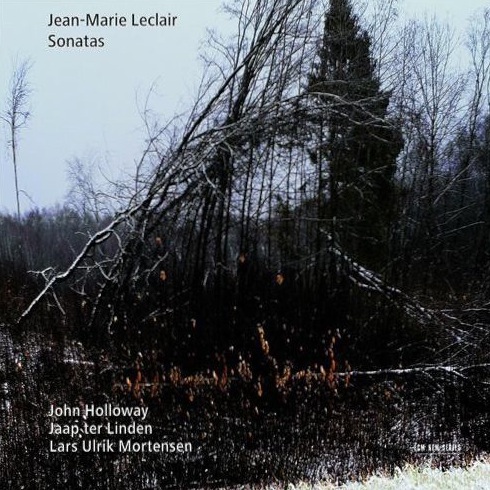
Jean-Marie Leclair: Sonatas – Holloway (ECM New Series 2009)

Jean-Marie Leclair
Leclair Sonatas

John Holloway violin
Jaap ter Linden violoncello
Lars Ulrik Mortensen harpsichord
Recorded November 2006 at Propstei St. Gerold
Engineer: Stephan Schellmann
Executive producer: Manfred Eicher

The biographies of composers can sometimes outweigh the notoriety of their music. Jean-Marie Leclair (1697-1764) is one such case. Born 1697 in Lyon, he left the city in his mid-twenties for Turin, where he sharpened his eye (and ear) for theatre and ballet and returned to Paris in 1723 to make a name for himself as a composer. Within a decade he was one of the most exciting violinists of his time, a pioneer in the French school of his instrument. By 1758 he had fallen on hard times. After leaving his wife, Leclair rejected the offers of his patron, the Duke de Gramont, to instead take lodgings unbefitting of his station in an unreputable part of the city. Six years later, a gardener would discover the composer stabbed to death in his vestibule. The gardener himself and Leclair’s nephew emerged as primary suspects, but no conclusive evidence was ever brought upon either (the most recent scholarship fingers the latter). One might think, in the wake of this tragedy, that the fruits of his endeavors would have bounded of their own accord into the public eye. This was not to be, and it is only with the advent of recording that his chamber works have grown into the recognition they deserve beyond musicological interest.

In a conversation included in the CD booklet, John Holloway is quick to place Leclair alongside the great violinist-composers under the bow of his acclaimed earlier ECM recordings: Biber, Muffat, Schmelzer, and Veracini. With cellist Jaap ter Linden and harpsichordist Lars Ulrik Mortensen, the British violinist takes on five selections from the opus 5 of 1734. Among the composer’s finest, the set yields a surplus of charm and virtuosity. While Holloway’s Leclair reads more conservatively than the fiery licks of his Biber, these sonatas are more about consistency than drama. To achieve this is no small feat, and requires fluid concentration of the musicians. That being said, the uniformity of dynamic patterning and phrasing will tire some listeners, who may feel it better suited as a light soundtrack to their activity. All the more reason to give it a deep listen the first time around.

Leclair’s time in Italy clearly rubbed off—not only because he follows the four-movement model of his predecessor, Arcangelo Corelli (in Turin, Leclair studied with Giovanni Battista Somis, himself a pupil of Corelli), but also because his deft blend of the Rococo and the Baroque sets him apart from the Parisian pack and speaks of a continental (known then as the gouts réunis, or “mixed taste”) perrsonality. The sonatas chosen here boast some of his subtlest inflections, and nowhere more so than the whimsical opening of the Sonata VIII in D major. This gives way to spirited color changes as the harpsichord continuo drops out for the tender Aria, only to make its triumphant return in the stately Andante before bristling with sprightly atmospherics in the dancing Allegro. Those wanting stronger excitements need look no further. This theatrical edge continues in the Sonata VII in a minor, in which a straightforward beginning yields two winged Allegros. Captivating harmonies between violin and harpsichord add to the airborne feel and give extra shine to Holloway’s trills.

One hears Italian pigments seeping through the opening Adagio of the Sonata I in A Major, the Aria of which weaves the more sensitive writing on this disc, as do the Largo and Aria of the Sonata III in e minor. The Sonata IV in B-flat Major carries this tender mission further in its Adagio, which sparks a fuse of complex proportions in an exhilarating Chaconna, a sonata unto itself.

This may not be as thrilling as Holloway’s previous recordings for ECM, and not one the newcomer may wish to start with, but Leclair’s music lives by its own rules of contrast. The intuitiveness of his harmonization and counterpoint, Holloway notes, begs for that same attentiveness in the performing. This becomes more obvious with each new listen, enfolding us in the depths of a music that breathes as it sings.

Paul Griffiths: let me tell you

Paul Griffiths
let me tell you
Hastings, East Sussex: Reality Street Editions, 2008

She is like the rest of us; we all have no more than the words that come to us in the play. We go on with these words. We have to.

So the king prefaces let me tell you, an ode to Ophelia, whose limited vocabulary as Shakespeare allots her in Hamlet—481 distinct words—forms the toolkit for Paul Griffiths’s autobiographical exercise. Avid ECM listeners will have caught a glimpse of this language via there is still time, wherein his own recitations of similarly restricted poetry are the moon to cellist Frances-Marie Uitti’s sun and prove that the conceit is not a restriction at all, but rather a microscope’s mirror throwing light on that which might otherwise be left to inference. Ophelia’s brother, Laertes, and her father, Polonius, are the main specimens on her slide, and Shakespeare himself the dye that imparts context.

1
The story begins with a concession to concessions. Ophelia speaks, and speaks of speaking. Her call to speech is musical: like music, an act in the fullest sense, moving to rhythm of grass and herb.

This is like being one of my own observers, but with no powers over what is observed.

She remembers her birth, but muses upon the art of memory as gift bestown over keep earned. She sees, or rather hears, her father in the cadence of his anticipation, connecting sole to stone as amniotic darkness readies itself to break light around her.

False memory may speak, I find, as well as true. I have to know the difference.

The sounds are immaterial, as true in origin as lies. Father’s feet fade into alliteration, his face alive with death. As it is, we come to realize that it is not her birth after all, but her brother’s—pulled from in to out by the dimples of Achilles. The maid sings of tears and roses, equates tears and roses with glass, and frets them to the consistency of wet paper. The maid sounds herself only through singing. Otherwise,

She would look down at us and say nothing—say nothing but look and look, harsh with love.

The face as medium: it knows of love beyond the bounds of her charge, carries it through the yeast of her other half, percolating through the dough of secret passion until it crackles like a finely browned crust that all but burns eager hands. She is a character of vocal shadows. The young siblings take this challenge as a game, and spin from it a fiber they can only hope will survive the distance she puts between herself and them as she follows her nose to a kitchen beyond the mountain.

2
The flowers come and go, but leave a trail of their scent. With the mark of a pansy, the pollen and blood of it smeared across the hands, it changes from solid to liquid in the blink of a written eye. The iris materializes on her arm, a curiosity in relief, a sisterly longing temporarily branded.

And there is the sun, and there is the mountain: all where we are is in an ecstasy of expectation.

From this fragile experience, the winds of which linger in curls from a photo tinter’s brush, she knows the value of intimacy within bounds, the buzz of the almost-was. And in fact, beauty is never an indulgence here. It flits in and out of touch, floats in musings on music, and comports itself loosely in the presence of bodies and minds.

Here all is still, still as night. We do not have the joy of music.

Thus the melody of language, inherent as crickets to midnight, also reveals a dream: the wish for something to give up, for the choice to do so. The father looms, bearded but not, lavishing brother and sister with warm breath. In them pools reflect the stories of his travels, and they too tremble and distort those memories with every telling. Words come verily, jumping gaps shallow and deep. It is the battler’s tale, wrapped in water and set adrift, farther to sea than any memory might have been.

3
Here is an Ophelia whose childhood resembles a stained glass window. Each section is its own color. Some are uniform and almost transparent, others milky and swirled, but they cohere at once-molten boundaries. Anxieties surround the maid who spent so much of her time with the siblings. Her absence is fraught. She is home, lost to the whim of another relationship in an empty life. But the maid returns with something dour, her actions choreographed to royal step. In them are mirrors for the end-aware glance of a sick girl.

But do I long for death and not know it? Is this what my words tell me?

A play within a play, performance at Polonius’s beck and call. Behind its curtain stretches the actor of death, the rise and fall of death. Ophelia questions her remembrance of the stage, but in the asking answers the conundrum that is the root of her. She knows quietude equals harmony.

The after reads into the before. This she admits. Drawing a name from the play and the fortress, she twists a mock fiber of reality from the shavings of fiction and holds to her bosom the flowers that will end her.

4
We discover her need for flowers, a trip over the mountain by a path startlingly seen. She meets the maid’s daughter, whose animosities are at once vague and clear. This daughter becomes an anti-Ophelia, a mirror-Ophelia, an other-Ophelia in one. She glares and resists, pushes the girl into our capture, from which the only escape is a dip.

It’s cold. My eyes weep.

Those same eyes see profundity incarnate, wrapped in glass and splashed through the atlas of openness that is her heart. A visitation, a spark and a candle, fearful and awed. Her memory unfolds one morpheme at a time, a hand-game shielded by paper pyramids and children’s scrawl. Her memory looks back to the shadows. It pulls the oxcart of the present, heavier with distance and jangling with a litany of bells.

5
She grows into an awareness that constricts her, even as it opens those eyes beyond where light may reach. Hers is the desire for visions and valences. The unkempt window, cobwebbed and secure, frames it all in quadrants. Music waits like fatality, a game played only once and which leaves a trail of mimics until the temptation to lose overcomes. Strategies are windows of a different sort. They facilitate emotional insight, forming bonds that would never have been without competition.

With music, thank God, you cannot speak.

Behind the façade of affection beats the drum of fate, and Laertes follows his along a divergent path. This, Ophelia would seem to know—if not then, then ever more. She was the one who let go of his hand, that it might transcend the arras of his brokenness. It is written on her skin.

6
I wish he had been well more of the time, says Ophelia of her father, whose letters adhere to her. She remembers the words as if they were her own (as of course they are). Not only are his eyes weak, but also his denials. Yet she remembers his time in uniform during a time that was not uniform. Since then his speech has become his synecdoche. I do not know what I would do without him.

7
Her mother: the italicized she. Notorious indifference and depravity of the one who neither listens nor reads, yet has no compunctions in letting the children know what goes on in her chambers. Mother shares these details, imposes them upon daughter, to ensure that power and separation are one and the same. And the suitors don’t stop there. They have eyes for the younger.

She had made it so that I could not believe my own memory.

Sharing is a double-edged blade: one side run with the blood of the unavoidable turn, the other licked clean by bedroom trysts. She must hide these things. Her father cannot know, though his eyes implore. In his absence, mother calls her close and opens the floodgates of illogic. The vessel of that deluge is as quiet as her motive, and sands away the grit of intangible things.

She was a length of hell.

But then she is gone. The sister bids good riddance. The brother inquires.

8
Hamlet appears pronominally, as nature and nurture wrapped into one. His presence has long since faded, though abstractly it flickers in and out of sense. Ophelia fishes his limpid brain, but comes up short every time. Into her chamber the boy steals and, along with her brother, ganders what he cannot ever have. There is a lack of affection in Hamlet’s past that speaks to the dwindling nature of her own. The cloak of yearning frays at last when Hamlet takes an education. Words hang from his tongue like raindrops at the tips of leaves.

Without music it means nothing. Without music it could make me fear.

Polonius wanders into the background, but ties a string to Ophelia’s finger ere exeunt. In light of this, she hopes the hearts of both men will see her silhouette and marvel. And when the young man swoons as if in the plays he attends, she closes the light around herself and wonders what brought her here.

9
The play is not still: it becomes something.

She is aware of the theater. Loves the theater, insofar as she knows her lines. And so we jump into a mise-en-abyme…only it’s not, for we have the ending already in grasp. The trio—father and children—takes a comedic bow.

10
Praying to a God she knows to be absent, she supplicates a mountain away from the kingdom, calculates in her heart the mathematics of foretelling. How can she not doubt the music of life, when all it amounts to is silence?

Now there is no eye on us, and the night goes on without end.

11
Yet silence can be an act of kindness, of a love so deep it cannot be defined—as when Laertes throws himself into manhood at the arm of a pretty young thing or two. Unlike their mother, he locks his tingling away from the girl, who wonders still about what is over. When she confronts him on it, the answer is morbid, final.

There is a change in the brother. His person shines.

In this erotic turn, speech becomes excitement, contact, and self-realization.

In my heart as in yours there is no doubt:
What reason then, my love, not to come out?

12
Night,
A letter to the curtain, behind which the body thrums. A time when mouths open—not to speak but to sing.
day:
Sun burns away the flesh of pretense, leaving skeletons of passion to rest on the hills. Glass weeps with light.
there is no difference for me.
The difference is love: they make the night as the night makes them. Togetherness blossoms like those pansies by the path, now overgrown beyond recognition. The weeds are quills in the playwright’s hand, flung one after another until the inkwell runs dry. The hand will open, say nothing, and drop. It cracks a door to tragedy.

13
Last night I made up my mind: I must go.

The young lord has left her to the darkness. Death is no longer the correct term. If only there was remembrance to tell her father and brother what they cannot know, they might respond. Their tears will tell enough.

Ophelia in the castle, hands on knotted ore, seeks the king and in him lays the infant of her choice.

There’ll be no remembrance of you here. It will be as if you had never been. The effect of O.

14
“O” is all that I am. Through the portal, a ring on a finger left in the forge’s keep. The knob turns at my touch. For as long as the snow powders the earth like the face of another, I will linger here, a trace and a scent. If crowds should gather and resurrect me a million times, only to throw me and my vocabulary into the abyss of plot development, so be it. I have said my piece, and the piece has said me.

If there is anything to be found in these images, it is a version of ourselves. The pathos of life is clearest when the means are limited. They express changes in light. The text begins to take on an anatomy: shoulders, hearts, tongues, and arms all fit together in changing combinations. Quotidian essentials like food and children’s games become a linguistic game to best capture the essence of nonexistent fare. Words become names, and names objects. The color green is at once generative, sinful, and divine.

To be sure, these parameters are fascinating but in the end imply something greater than the sum, if not also the subtraction, of their parts. Just as we can forever impose shapes on the water vapor we call “cloud,” also infinite is the potential of the graph we call “letter.”

By the time we have read this Ophelia, she has already read us.

Your opinions on reviewing

To my readers, old and new alike:

Working on this project as I have been for almost three years, I try to be as attentive to my own writing as to what I’m writing about. In an effort not to sound repetitive, I try to adapt my writing style to the nature of the album I’m reviewing. Obviously, this works more successfully some times than others. I am curious to know your opinion about what works best for you as readers. Do you prefer the more abstract, impressionistic reviews (see, for example, my recent thoughts on Angles of Repose), the more straightforward ones, or do both work in their own way? Through the former, I try to convey the feeling of the music, because anyone can look up an album to know what it is. I’m more interested in how it is. What do you think?

Maneri/Phillips/Maneri: Angles of Repose (ECM 1862)

Angles of Repose

Joe Maneri alto and tenor saxophones, clarinet
Barre Phillips double-bass
Mat Maneri viola
Recorded May 2002, Chapelle Sainte Philomèe, Puget-Ville
Engineer: Gérard de Haro
Produced by Barre Phillips and Steve Lake

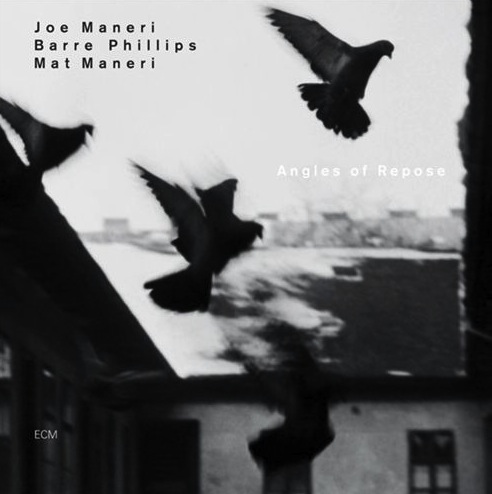
When Joe and Mat Maneri and Barre Phillips materialized in the studio to record Tales of Rohnlief, the result was a magical recipe of microtonal blues and other off-the-beaten-path catharses. The session begged for a sequel, and its name is Angles of Repose. This time around, our synergistic trio throws rules into the air like pigeon feed for the small frame of life that is the cover photograph (incidentally, my favorite ECM sleeve/title combination in the entire catalogue) in the name of integrity.

Number One
Phillips is a grounding force in this opener, adding as much as he takes away and saving the sawdust, so to speak, from his whittling. Joe snakes his prophetic way through vocal and instrumental languages in a veritable feast of biological rumination, tempered by analysis in the immediacy of discovery.

Number Two
The internal machine may be vast, but its weak spot is infinitesimal. Father and son patty-cake the earth into submission. You can skitter and flitter all you want, but you’ll never find the path unless it finds you, whether gelled by time or fragmented by the violence of discovery.

Number Three
Joe cracks the fountain with faith and signs his nameless art with dots and dashes. If he seems winded, it’s only because he is the wind. Ameliorated by the corona of experience, he tempers his weapons with air, that they might never pierce the skin of any mortal fear, along which flounders the death of discovery.

Number Four
Twisting between thumb and fingers, the night rolls the city into a cigarette and smokes it until it sleeps. Every noteless space only makes it stronger. Butterflies and rhinoceri now share the same breath, fraught with the wonder of discovery.

Number Five
A duet for strings of spacious mind channels the wastes of contradiction and melts them into a mold. As the sculpture cools, it becomes a shadow. Its visage weeps invisibility. The hands of passersby inadvertently float through it, so that all they are left with is the fallacy of discovery.

Number Six
The cup has tipped, its contents spreading in a partially eclipsed circle. In this pool where broken mirrors float, we see the multiplicity of our genetic code’s sonority. Harmonics are the edges of fingernails on glass, and further the edge of that glass on sky. Resonant beauty briefly surfaces—a dolphin’s back—before plunging into the brine of discovery.

Number Seven
Blood begets blood begets the onlooker, whose wayfarer soul quivers with the loss of discovery.

Number Eight
The metamorphosis has occurred, not from man to insect but from insect to man, still carrying the language of its forbearers, dribbling into the cupped hands of discovery.

Number Nine
Birdsong becomes liquid mercury in the room-temperature stare of indifference. It is here where music is born, shedding truth for its simulacrum in the hopes that it will be consumed more quickly and forgotten on the way to the core. When our ears spread their wings, they need only lift one talon to leave their carrion. All the screeching and scratching accomplishes one thing: activation. We can feel in the air a vibrant disturbance, which brings its own instructions, blank as October sky. There is a beginning in every end, the anode to galactic circuits in search of a name. And if you lean in close enough, it may just whisper it to you, for it is the breath of discovery.

Number Ten
The whale scratched by Ahab’s spear swims for a song. Its balanced lyric of play guides the sonar true. It wakes you up just to tell you to go to sleep. This is the dream of discovery.

Three lines make not a braid, but a single unbreakable filament plugged directly into the kundalini of any listener willing to close the mind and open the body to the possibility of its activation. Yes, the album has its highlights (Numbers Five and Nine, I’d say, if you asked me), and contains Joe’s most heart-wrenching playing on record, but its lowlights are just as expertly realized, for in this sound-world there is no hierarchy, only the contemplating line that wraps around us as it goes along its way. If pinnacles have restless dreams, these are their soundtracks.

OM: Kirikuki (JAPO 60012)

OM
Kirikuki

Urs Leimgruber soprano and tenor saxophones, percussion
Christy Doran guitar
Bobby Buri bass
Fredy Studer drums, percussion
Recorded October 1 and 2, 1975, at Tonstudio Bauer, Ludwigsburg
Engineer: Martin Wieland
Produced by OM

Like its contemporary, the Everyman Band, the Lucerne-based quartet known as OM succeeded in blending rock and free improv idioms to gnarled perfection. Composed of guitarist Christy Doran (Dublin-born but Swiss-raised) and fellow countrymen Urs Leimgruber (reeds), Bobby Burri (bass), and Fredy Studer (drums), the group was an espresso shot in all four careers. ECM has, of course, given just dues with a 2006 retrospective. Still, there’s no better place to get acquainted with OM than through the four complete albums for sister label JAPO, of which this is the first (the fourth, Cerberus, survives fully intact on said retrospective).

Doran is the compositional heart and soul of the set. The only track not penned by him is “Lips” (Leimgruber/Burri), which stands out for its inspired flute playing. Leimgruber sings into the instrument for a bit of polyphonic panache against a gorgeously primal backing, Doran providing industrial touches throughout. Yet it is “Holly” which introduces the album’s distinctly nocturnal sound. Leimgruber’s talents abound here, casting him in the melodic lead from the start. Smoky atmospheres are blown into rings at his lips through a pure, oboe-like soprano. His gorgeous, full highs, complemented by Doran’s crunch, make for an energizing sound and bring their smoothness to the burnished field that is “Sykia.” The buoyant drumming makes this an enchanting epilogue. The color wheel of “Karpfenteich” begins with reedless trio action before launching us horizonward in a lob of flame. More propulsive action from the rhythm section here backs some artful crosstalk between reed and guitar. Yet it is the “Hommage à Mme. Stirnmaa” that takes this cake and bakes another one in its place. From the lovely solo by Duran that starts, it builds to a slightly burnt frenzy, out of which arises a bass of flesh and wires. The tenor solo is like a coda, rough and unleashed, and opens into a percussion solo from Studer, this but the carpet for a grand underwater raga. A masterstroke, and proof enough to seek out OM’s dates in full.

There is something strangely melancholic about the river of Kirikuki. The sunshine is in its sediments.

Of Tears, Of Privilege: Adam’s Lament at Lincoln Center

Adam’s Lament
Latvian Radio Choir
Sinfonietta Rīga
Tõnu Kaljuste conductor
Alice Tully Hall, Starr Theater
Lincoln Center for the Performing Arts
November 17, 2012
7:30pm

Of Tears…
It would be easy to paint the maturation of Arvo Pärt in the shape of a funnel. The Estonian composer was trained in the language of modernism but came to consolidate his musical foci into so-called “holy minimalism”—a catchall term that, while descriptive enough, ultimately defeats itself. In Pärt’s vision, minimalism seems better represented as pinpoints of light, stars that would be nothing without their limpid sky. Such mutual dependency is what makes the music sacred. We do better, then, to twin the funnel into an hourglass, endlessly turned by the hands and mouths of whoever bestows its truths to those fortunate enough to hear them. So we are when the Latvian Radio Choir and Sinfonietta Rīga, under the masterful guidance of Tõnu Kaljuste, present an all-Pärt program as part of Lincoln Center’s annual White Light Festival. Anticipation is high and met when the first strains of the Berliner Messe (1990-91, rev. 2002) touch our cortices. Composed on commission after Pärt’s emigration to Berlin, this setting of the Ordinary possesses a remarkable permeability. Around the standard texts and interjected Allelujas, strings sketch the thunder of conversion. Their pulse is elemental, hidden. Suspension awaits in Pärt’s setting of the Te Deum (1984-85, rev. 1992), the work that introduced me to its composer and which has since lived inside me. It develops motives like a book: knowledge that came before feeds into that which follows. A digitally sampled wind harp unfurls a constant and godly breath, piano dipping into the font of reason and stirring double basses to higher registers. Every crescendo equals stillness. We feel it in the soles of our feet, in the palms of our hands, in the stigmata of our collective memory.

Intermission brings about the surreal din of interpretation, snatches of recreated melody and soloists praised for the sake of proving knowledge.

Trisagion (1992, rev. 1994) begins the second half. Written in celebration of the 500th anniversary of a small Finnish parish, its title comes from the Greek for “Thrice Holy” and makes reference to Orthodox prayer and to the piece’s three core pitches. It is an overturned cup, spilling unspoken words. It is the beat of mortality. It is crystal, tarnished and restored. Also restored are the writings of ascetic Silouan of Athos (1866-1938), something of a touchstone of Pärt’s work and the red thread of Adam’s Lament (2009), the landscape of which resonates with suffering. Tears feed its soil as sunlight feeds the flora that grow from it. The mountains shiver, fauna likewise in their dreamless slumber. All the more appropriate that the musicians encore with Estonian Lullaby (2002, rev. 2006), bringing with it needed repose in an age so restless that only a child’s mind can contain its temper.

Of Privilege…
Nestled in the orchestra section of Alice Tully Hall, and in the most prayerful music I have experienced firsthand in years, I become uncomfortably aware of the allowances that brought us together. In the suffering of Silouan’s Adam lies the root of strife. How can Pärt not have this in mind when he has suffused his reading with the pain of the mortal body, its skeleton at once fractured and bonded by immeasurable sorrow? On this note, I must respectfully disagree with Zachary Woolfe, who in his November 19 New York Times review characterizes Pärt as having “defined a seductive vision of modern spiritual music, one that seeks to escape our world…rather than to embrace it.” I wonder if we are listening to the same music, for it is anything but escapist. Rather, it reminds me that I am experiencing an $80-per-ticket luxury even as innocents continue to die for nothing at the hands of self-interested regimes. Its surplus of beauty only serves to emphasize the rarity thereof. In spite of venue and context, the intimacy of the musicianship heightens my awareness of these realities. That their charge transcends the commercial trappings of the festival speaks to precisely the love that went into its creation, even if it does nothing to obscure the tightrope I walk in balancing appreciation with the hypocrisy of my inaction. I feel this acutely as, in the wake of a standing ovation, concertgoers debate the technical ups and downs of what they have just heard. With such effect still whirring inside us, what difference do a few glitches in the first half make?

In the toy chest of temptation, there is a kaleidoscope of shadow. Through it, one sees that the world has become sick with perlocution. Turning it in the hands only darkens its glory. It blinds us to those in need. Awareness, this music tells us, is not enough. One must also know the vitality of experience. Grace is not something to be won back through good deeds or mere contemplation, but felt when one no longer seeks it. When I seek Mr. Kaljuste instead and inform him that I will be writing this review, he humbly wishes me good luck. Yet I read a deeper truth into the statement. Without luck, I would not have been here. May I never forget that.

Let me know Thy touch,
that I may know of life.
Let me know Thy touchlessness,
that I may know the path.

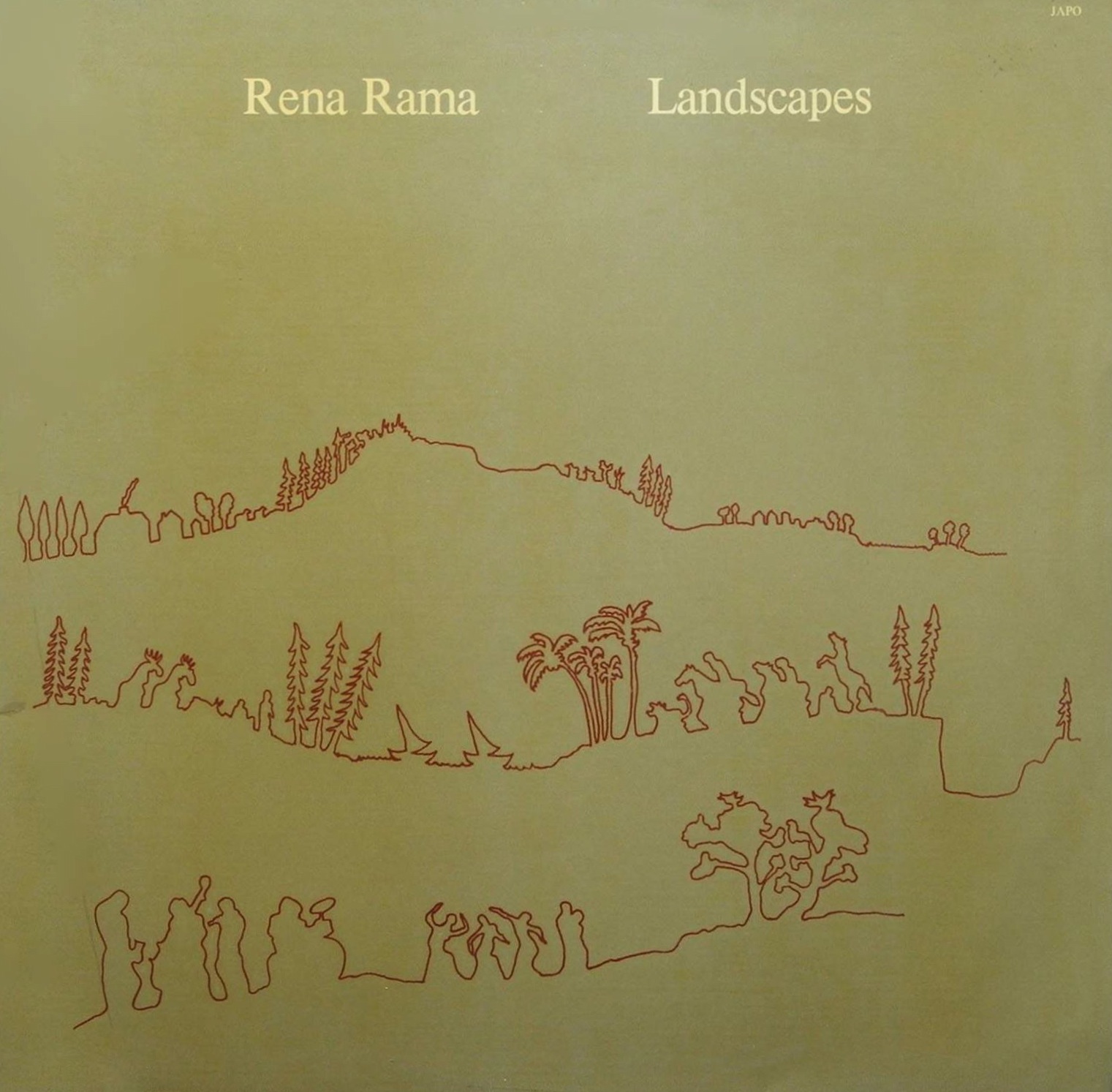
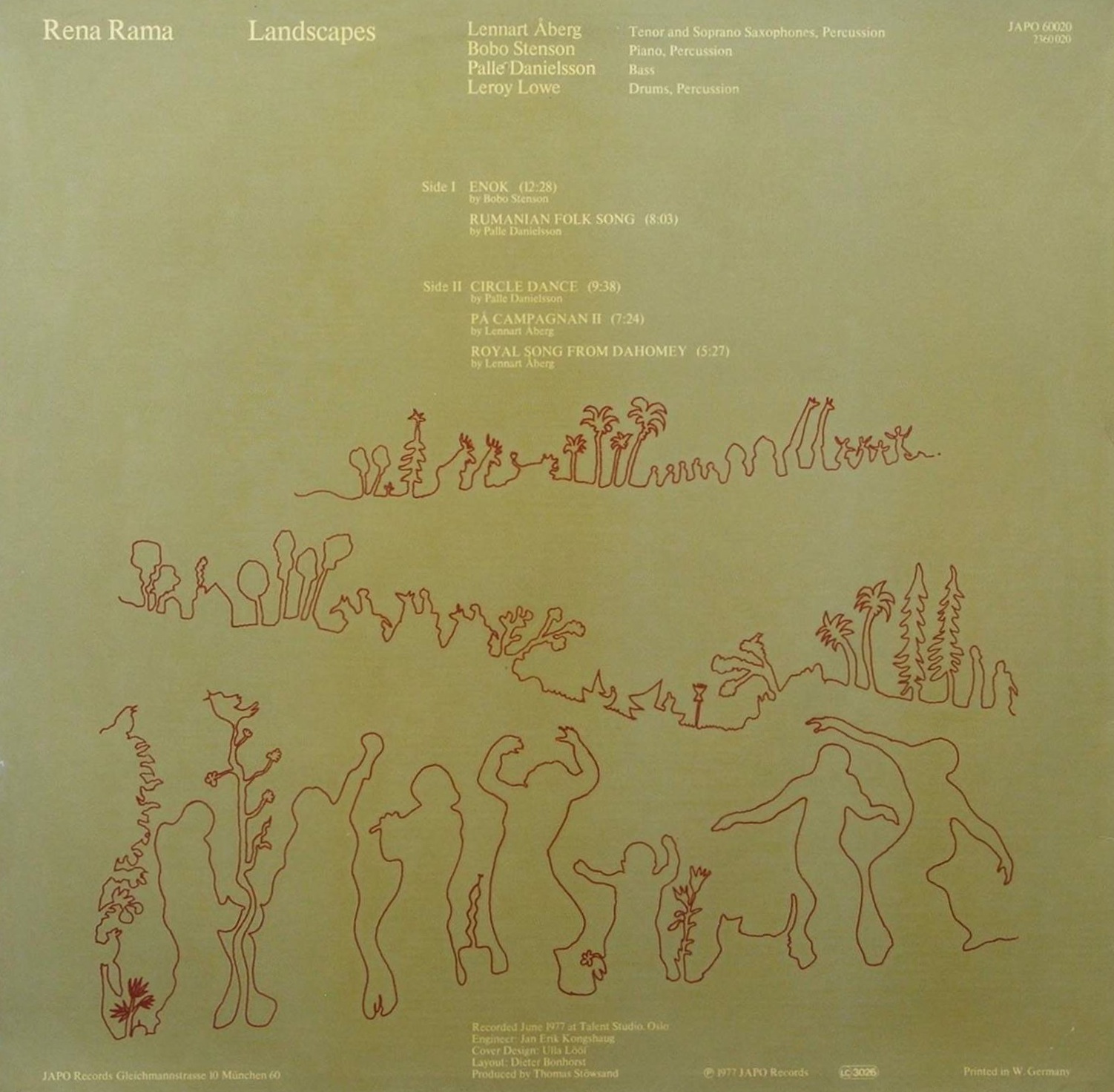
Rena Rama: Landscapes (JAPO 60020)

Rena Rama
Landscapes

Lennart Åberg tenor and soprano saxophones, percussion
Bobo Stenson piano, percussion
Palle Danielsson bass
Leroy Lowe drums, percussion
Recorded June 1977 at Talent Studio, Oslo
Engineer Jan Erik Kongshaug
Produced by Thomas Stöwsand

Saxophonist, flutist, and composer Lennart Åberg is among ECM’s sleeper talents. Having graced the label only as sideman to 1994’s Dona Nostra, his brilliance was saved instead for the limited JAPO imprint. On this record he is joined by fellow Swedes Bobo Stenson (piano) and Palle Danielsson (bass), both familiar to ECM listeners. Perhaps not is American drummer Leroy Lowe, who rounds out this incarnation of the quartet known as Rena Rama and played with the group from 1975 to 1983. Born 1944 on a Pittsburg farm, Lowe began playing drums in his high school marching band and later befriended such greats as Billy Hart in his quest for a personal voice. After a two-year period of study at the Berklee School of Music, he joined Otis Redding’s Big Band on tour. The rigorousness of this experience led him to renounce the lifestyle that came with it. In need of recovery, he randomly picked Oslo as a holiday destination and, after some shuffling around, ended up in Sweden, where he sadly died of cancer in 1999…but not before leaving behind a legacy spanning 30+ years. I note Lowe’s background not only because it’s worth telling, but also because it seems indicative of Rena Rama’s aesthetic: it spins a globe and plays whatever its finger lands on.

From the drum solo that opens the Stenson-penned “Enok,” it’s clear that Lowe was a moving force in this outfit. Colorful as an ice cream shop’s selection of toppings, he opens a spacious sound together with Stenson’s entrance, to say nothing of Thomas Stöwsand’s engineering, while Danielsson adds good vibes to the growing message. With this skyward energy behind him, Åberg need only open his wings and let the wind do the talking. That powerful tenor sheds its earthly weight in favor of a boisterous key that with its dancing unlocks gurgling leaps of intuition from Stenson. Danielsson offers two tunes. The composer’s darkly melodic intro in “Rumanian Folk Song” kicks into a light groove with Lowe along for the ride—the bed of the quartet’s energy. Stenson again scales the z-axis, landing only to relay his altitude to Åberg’s soprano. The latter, soft and sure, casts a gray spell. Throughout, the contours of the rhythm section are much like patterned cloth, wispy yet boldly imprinted. Stenson gives us the alphabet of “Circle Dance” before Åberg’s tenor puzzles it out into words and sentences. He is happy to wander far afield, knowing the band’s footprints will always catch up. A veritable tributary of invention. The reedman closes out with two compositions of his own. First is the soprano-infused “På Campagnan II,” which threads galleries of needles in single strokes of intuition. The pianism’s frenzied beauty and hip contributions from the rhythm section are surpassed only by Åberg himself. Those same infections spread in “Royal Song From Dahomey.” This caravan of purposeful melodizing is at once cold and warm and rains percussion on us as if in a desert without oasis.

Like most JAPO releases, this is another elusive jewel, but well worth the digging.


Sleeve back

Veljo Tormis: Litany To Thunder (ECM New Series 1687)

Veljo Tormis
Litany To Thunder

Veljo Tormis
Estonian Philharmonic Chamber Choir
Tõnu Kaljuste conductor
Recorded August 1998, Estonian Concert Hall, Tallinn
Engineer: Teije van Geest
Produced by Manfred Eicher

“I do not use folk song. It is folk music that uses me.”
–Veljo Tormis

Since the 1992 release of Forgotten Peoples, the first major survey of Veljo Tormis to be released outside of Russia, ECM has paved an international appreciation of the Estonian composer, whose choral output exceeds 500 pieces. More than number, it is the melodic and textual content of those pieces that asks of the listener attention to source, meaning, and atmosphere. Although so much of Tormis’s work is drawn from Baltic folk traditions, his project is more one of expression than of preservation. He paints a distinct amalgam of texts and motifs, so that what we are left with is a sonic trajectory that moves ever forward. There is no group more qualified to follow that trajectory than the Estonian Philharmonic Chamber Choir. Under the direction of Tõnu Kaljuste, these intensely talented singers breathe the music on Litany To Thunder as if it were their own.

dear girls dear maidens
where shall we go before the night sets in

How Can I Recognize My Home begins the program with a runo-song. This form finds its charge in the pre-Christian beliefs of the Baltic Finnic region, linking stanzas in a two-part round. On the surface a paean to nostalgia, it is more deeply a cartography of origins in which the voice becomes the thread that grows thinner with life and snaps only in death. Between the fatigue of travel and the cold springs that gurgle in wait of parched throats, the moon shines through it all like a maternal eye.

When the boys sang on the ship,
the girls thought it was an organ playing.
They could not imagine that the boys of their village
could sing so well.

Singing Aboard Ship (1983) is an Ingrian-Finnish folk song that features a call-and-response framework welded tight by the contralto of Karin Salumäe. The EPCC’s restraint is in full flower here, lapping at vessel’s edge with the reverence of lips pursed to a holy relic. It is an important setting, for it proves the power of song to be a guiding light through adversity. That the Finnic peoples exiled by the Soviet regime in the wake of World War II managed to preserve this tale is testament to that very fact.

You are earth-born, I am earth-born,
we are both black boil.

The Kalevala-inspired Curse Upon Iron (1972) showcases Tormis’s uncanny ability to soak us in a feeling. With its shamanic drum and tense use of silence, it peers into the heart of elemental forces and further into the human condition, which too often seeks to render those forces into tools of harm. The words reduce iron to its blood, to the evil that is its parasite. They even draw a line of affiliation to modern warfare, to the bane of technology. The furnace becomes a symbol of hatred fueled by temptation. Tenor Mati Turi and bass Allan Vurma bellow its fires, sustaining themselves through (if not on) sirens and shrieks of indignation.

And I, the child, then learned and learned,
I, little one, picked up the words.

In the wake of this aural forge, The Singer’s Childhood (1966) emerges as one of the most ethereal choral compositions to ever grace the ear. It is not only that its relative beauties are gentle enough to break apart from a sigh, but also because its appeal to nature as a source of art pulls our eyes from the upward swing of industrial and social progress and returns them to the wealth of activity and inspiration we have yet to regard on the ground.

The sea has fed us, the sea has watered us,
the sea has taken away many men from us.

Songs Of The Ancient Sea (1979) is overtly programmatic. Its technical admixture of whistling winds, cackling seagulls, and calling of shipmates lure the imagination from land. This piece is akin to performance storytelling, whereby the listener is not only engaged but also implicated in the action. A particularly moving section comes halfway through, when the tenor soloist laments a brother’s loss to the waves.

A hundred swordless men,
a thousand sworded men,
all the men from under a hill,
from the black earth.

The Bishop And The Pagan (1992/95) tells of Bishop Henry, whose death by the hands of a Finnish pagan farmer in 1158 is told from both sides. On the one hand is the memorial feast in Henry’s honor; on the other, an alliance with the victor. History changes places like shuffled cards, each obeisance a faltering shadow of reconciliation. In its careful balance of monastic solemnity and outright vilification, the vocal weave grows more resilient the more it is pulled.

Pour, Thunder, pour

The 1974 title composition for male choir shares similar touch points of battle, turning them into emblems of sacrifice. The meadows, overrun with chaos, funnel like sand through an hourglass, leaving a perfectly formed mountain of time.

I stepped into the house
a chair was brought to me
made of the bones of my geese

The Lost Geese is the forlorn tale of a maiden who must look after the geese on her family’s farm. The task proves more difficult than she imagined, however, when her geese are chased by demons into a spooky manor, where she is offered a meal of her charge. She throws their blood to the earth, where grows a tree populated with wildlife. This and How Can I Recognize My Home comprise the Two Estonian Runo-Songs, composed between 1973 and 1974. Sung as purely as the words are crystalline by sopranos Eve Härma and Kadri Ratt to the unobtrusive commentary of Marrit Gerretz-Traksmann at the piano, they wander without pause.

Tormis’s vitality and aesthetic properties connect the peoples of this music as the shore connects land and sea, establishing a fluid relationship between fields of geography and tradition. Images transcend linguistic barriers. In so being heard, they live anew.

<< Jan Garbarek: RITES (ECM 1685/86)
>> Heiner Goebbels: Surrogate Cities (ECM 1688/89 NS
)