

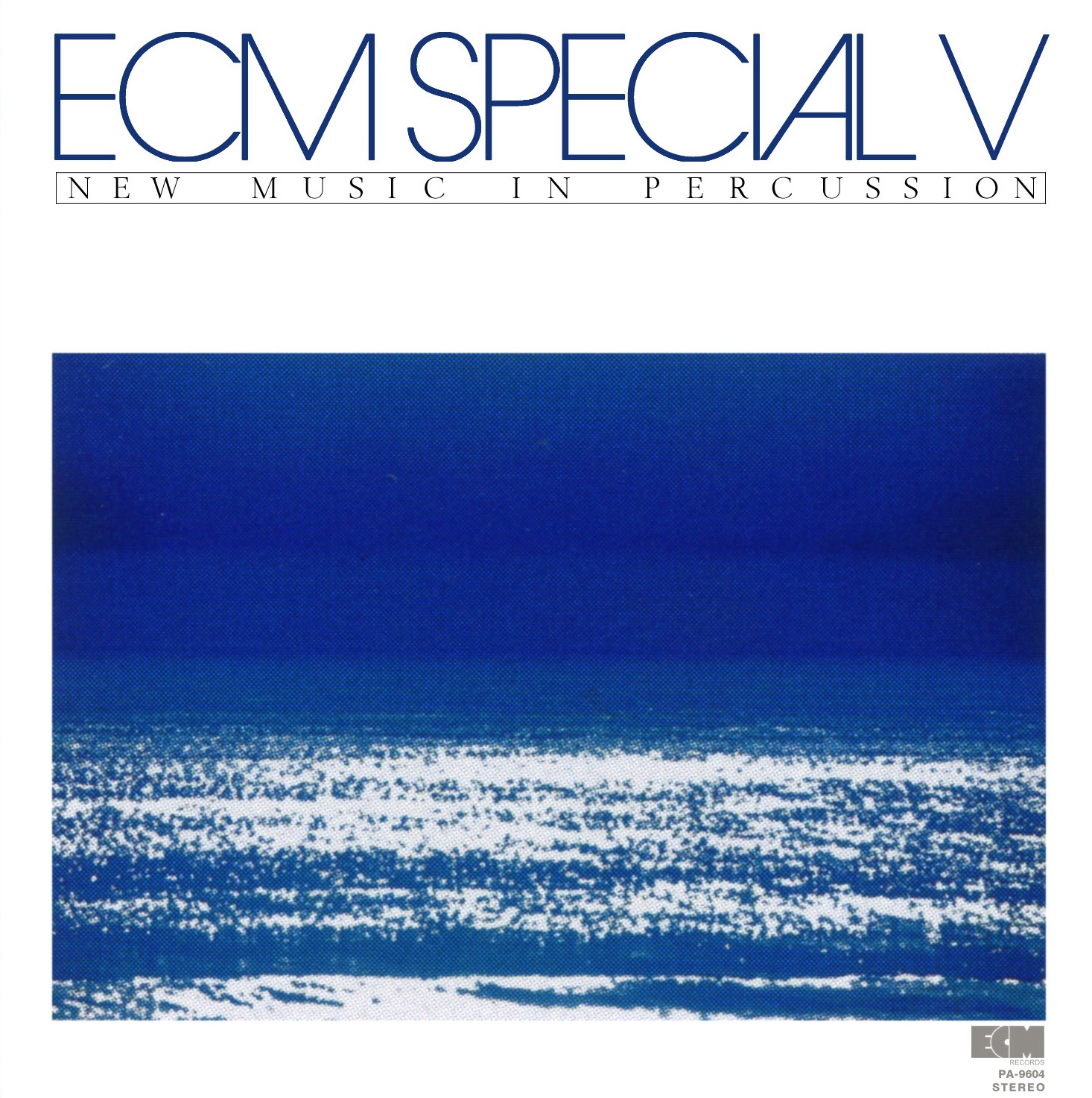
Percussion, in the ECM imagination, rarely behaves as ornament or engine alone. On ECM Special V: New Music in Percussion, rhythm functions as a conduit for revelation, each struck surface opening into an interior geography where hands and skins communicate in infinity signs. The compilation gathers music that feels carved from threshold states, hovering between human gesture and some older grammar of vibration. Its deepest theme may be contact: the instant when one body addresses another through resonance and receives, in return, a message immediately felt in the beat of the moment.
“Scimitar” is the first of two selections from gone-too-soon multi-instrumentalist Colin Walcott’s Cloud Dance, and it opens this world with a blade of astonishing finesse. Walcott’s tabla and John Abercrombie’s electric guitar do not merely accompany one another, nor do they settle into polite dialogue. They graze and refract, skating across modal waters with fiery verses on their tongues. The title feels exact, not because the music cuts with aggression, but because its arc is curved, gleaming, and ceremonial. Abercrombie’s lines seem to wander through electrified calligraphy, while Walcott’s hands compose a nervous scripture beneath them. The result is an engagingly articulated treasure, a fragment of bronze retrieved from some submerged republic of sound. “Prancing” deepens the album’s first inquiry by replacing Abercrombie with Dave Holland, whose bass brings a darker grain to the duo format. Holland gives the music a second shadow, a pliant undertow that lets Walcott’s rhythmic intelligence breathe with greater dramatic consequence. Beneath the tactile play runs an enlivening melodic current, subtle but persistent, turning the piece into a small kinetic body with secret chambers.
“Call from the Sea” arrives from what was then a JAPO-only release, Nan Madol, and still sounds as though Edward Vesala discovered a percussion language inside a ruin without a country. His beguiling masterpiece speaks in tongues that only the heart understands, though even that statement feels insufficient before its strange density. Crashing cymbals and bowed edges gather around field recordings of Alpine herding calls, producing a sound world that feels genetic rather than composed, as though memory itself had been spliced with copper and mist. As vast in implication as it is brief in duration, the piece foreshadows Vesala’s “Ballad for San,” which appears near the end of this compilation by way of Satu. There, the music expands into a macrocosmic answer to big band, a celestial mechanism with brass for bone and percussion for blood. Palle Mikkelborg’s trumpet already carries the glint of another altitude, and Vesala’s conception moves with a flare that feels both cosmic and bodily.
Jack DeJohnette’s “Picture 3,” from Pictures, shifts the compilation toward a more corporeal electricity, joined again by Abercrombie’s guitar, in which groove becomes a corridor of distortion. The listener wanders its funhouse turns and finds each reflection slightly delayed, each angle revealing a facet of the self that had been waiting behind the ear. DeJohnette’s drumming is propulsive without becoming blunt, full of muscular intelligence and angled grace, while Abercrombie’s circular phrases trace luminous traps in the air. Their combination produces a delectable effect, though “delectable” hardly captures the uncanny appetite of the piece. It eats expectation and leaves rhythm’s skeleton polished clean. The track also clarifies the compilation’s larger design: percussion here never sits beneath melody but bends the space in which melody becomes possible.
“Algeria,” from Ruta And Daitya, carries Keith Jarrett into a more cryptic register, singing into a flute while DeJohnette shapes the ground with hand drums. The sound moves through multiphonic shades of emotional depth, tactile and haunted, with a quasi-tribalistic charge that feels less ethnographic than psychic. This is one of the most mysterious duo records in the ECM back catalog, and the excerpt included here preserves that enigma with admirable restraint. Jarrett’s breath seems to fracture into ghost syllables, while DeJohnette’s touch turns percussion into a listening organ. The selection pairs beautifully with “American Indian: Song Of Sitting Bull,” from Paul Motian’s masterful Conception Vessel, where Jarrett’s flute meets Motian’s percussion in a related spiritual register. This second terrain feels somehow closer to home, rooted in an inward ceremony rather than distant projection. Motian’s presence has the quiet authority of someone drawing a circle on the floor and knowing precisely which spirits will enter via unfinished address.
“Malibu Reggae” changes the angle entirely, revealing yet another facet of DeJohnette’s art. Drawn from Untitled, one of the label’s unusual early gems, the track brings in an interesting band with Alex Foster taking the saxophonic lead. Its uplift is immediate, but the music avoids mere brightness. There is intelligence in its buoyancy, a rhythmic grin with hidden circuitry. Foster’s line moves with conversational ease, while DeJohnette shapes the tune from within, letting its surface radiance conceal a sophisticated internal clock. After the compilation’s more ritualized passages, “Malibu Reggae” feels almost shockingly open. It reminds us that percussion can let the body smile while the mind keeps discovering new doors in the floor.
“Jewel Ornament” brings us full circle by drawing from the well of Walcott’s Grazing Dreams. Abercrombie returns, and this time Don Cherry’s wooden flute widens the frame with an arid, singing tenderness. Walcott’s tabla glows at the center, a jeweled pulse whose articulations seem painted.
ECM Special V does something quietly radical by asking us to hear percussion as a philosophy of contact. Every stroke becomes an argument against isolation. Every vibration insists that nothing touched remains singular. The drumhead remembers the hand, the cymbal remembers the room, and the listener becomes the last resonating chamber in a chain whose origin cannot be found.

