

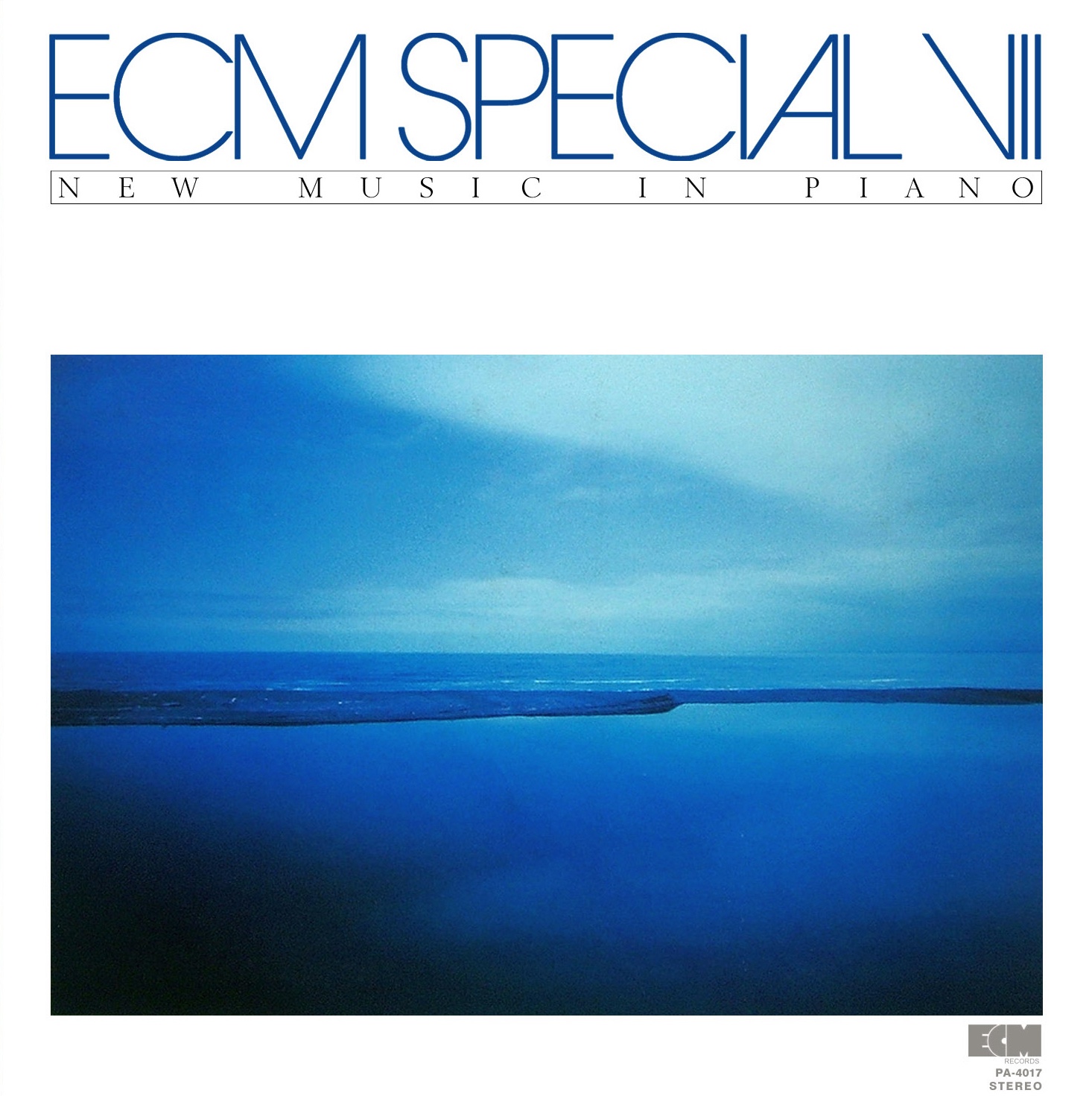
For its seventh installment in the Japan-only ECM Special series, Trio Records finally dedicated a compilation to “New Music in Piano.” The expected constellation is present. Keith Jarrett and Paul Bley occupy familiar zones of gravity, while Steve Kuhn moves nearby with his own restless voltage. Yet the album’s first door opens in a particularly inspired direction: Stanley Cowell’s Illusion Suite, represented by the luminous “Ibn Mukhtarr Mustapha.” Cowell moves between acoustic and electric pianos, then lets the kalimba flicker through, while Stanley Clarke and Jimmy Hopps keep the tune airborne. The result is righteously engaging, a gallery of moving pigments in which groove becomes geometry and melody keeps turning corners the ear did not know were there. The track gives the compilation a thesis without announcing one too loudly: the piano here is an instrument of passage, a set of thresholds through which jazz walks into dream logic while keeping one hand on the body.
That sense of liminality deepens with Art Lande’s Rubisa Patrol, whose “A Monk in His Simple Room” serves as one of the set’s most quietly devastating inclusions. Despite the title’s hidden chamber, the performance refuses miniature domesticity; Lande’s touch opens small windows inside the phrase, and Mark Isham, who made several crucial appearances in ECM’s first decade, turns the trumpet into a filament of interior light. Richard Beirach’s “Seeing You,” drawn from Eon, works in a different shade of nocturnal intelligence. With Frank Tusa and Jeff Williams beside him, Beirach seems to smooth the wrinkles in the night, laying out a gorgeously articulated swath of trio jazz with the faint metallic scent of revelation threaded underneath.
Jarrett appears twice, each instance offering a distinct version of ascent. “Staircase Part III” (Staircase), is brief and beautiful, a self-contained solo fragment improvised into abundance. “Spiral Dance” (Belonging), answers with ecstatic lift, propelled by the mind-melded precision of Jarrett’s European quartet. Jan Garbarek leads the charge with incisive charm, while Palle Danielsson and Jon Christensen make the ground seem elastic beneath him. Christensen in particular plays with that rare intuition that can tighten the music’s screws while giving it more oxygen. He and Danielsson also appear on Garbarek’s Witchi-Tai-To, represented here by its title track. With Bobo Stenson at the piano, the piece remains a classic of the highest order, building a monumental tower of atmosphere from a small box of abstract tools. Garbarek’s playing reaches one of its most soulful recorded peaks, a sound that bends toward song without surrendering its mystery.
The remaining selections widen the map without dissolving the central spell. “Harlem,” from Paul Bley’s Open, to love, is brief yet emotionally saturated, a blues reduced to its psychic skeleton and then touched back into flesh. “Sirens’ Song,” by way of Azimuth’s self-titled debut, enters a more vaporous chamber. John Taylor’s piano and synthesizer move with playful modal intelligence. Around him, Norma Winstone’s wordless voice hovers at the edge of language, while Kenny Wheeler’s horn swells with soft lunar tact. The two Steve Kuhn selections make a more curious case. Trance is certainly one of the seminal ECM albums of the 1970s, although “The Sandhouse” may not be its strongest ambassador, favoring a wandering study in sound color over the record’s deeper structural magnetism. “Places I’ve Never Been,” from Motility, is another matter entirely: a locomotive masterstroke written by Harvie Swartz, whose bass work gives the piece a muscular inner spring. Kuhn’s soloing is prime. Steve Slagle’s flute cuts a bright oblique path through the arrangement, and Michael Smith tears into the kit with exhilarating force. The track also offers a vivid reminder of Martin Wieland’s engineering prowess and the spacious acoustics of Tonstudio Bauer.
What finally makes ECM Special VII so rewarding is its refusal to treat its subtitle as a tidy category. The phrase becomes stranger the longer one sits with it. Is newness located in the harmonic idea or in the room that records it? Does it belong to the player’s body, or to the listener’s willingness to let form become a portal? In that sense, this object feels less archival than oracular, gathering musicians under the banner of discovery within discovery.
 Between Sound and Space: ECM Records and Beyond
This series of compilations is fascinating to me. They seem so nicely procured.
I dislike the comparison, but I wonder to myself if William Ackerman took the idea when he released the “Sampler” series on Windham Hill in the 80s.
Nicely procured indeed. The great Kenny Inaoka had a lot to do with selecting the tracks for this series, so the ears were certainly there. The question of samplers is interesting, especially since they date back to the 1950s, so Ackerman’s inspiration could have come from any number of sources. But still, it’s hard to imagine him not being intimately familiar with ECM by then!