

somewhere i have never travelled, gladly beyond
E. E. Cummings
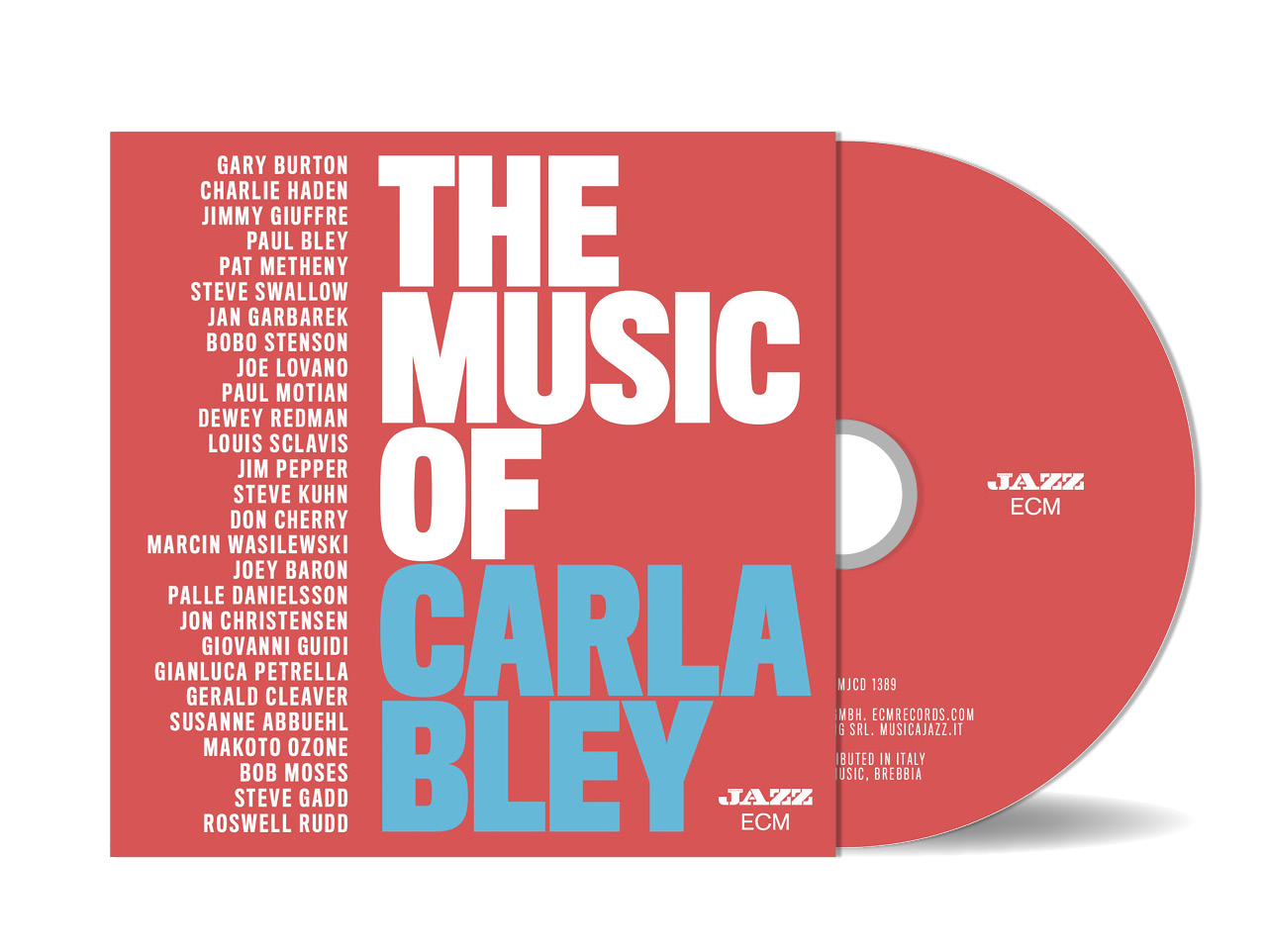
Released with the December 2021 issue of Musica Jazz, this compilation traces Carla Bley’s compositions and arrangements across the ECM and WATT universes. Some performances feature Bley herself; others entrust her music to artists who understood her impact. Her pieces migrate between ensembles and disclose chambers hidden within their original forms. The album becomes a study of transmission, following one imagination through generations of musicians.
Bley’s contribution cannot be reduced to composition in any ordinary sense. Her melodies could be tender without surrendering irony, while her harmonies bent solemnity until it exposed some hidden absurdity. She made complexity conversational and gave humor a metaphysical edge. Even when interpreted by others, a Bley composition retains the sensation of a mind turning around inside itself, inspecting its machinery with curiosity and suspicion.
“Introduction to People,” one of two pieces Bley contributed to Charlie Haden’s The Ballad of the Fallen (ECM 1248), establishes this quality immediately. The music unfolds across a broad field, enlarged by her rolling pianism and Haden’s pellucid bass. Beneath its stately motion lies a quieter drama of human arrival. Bley’s chords lift trapdoors beneath the ensemble, exposing safes where tenderness has been storing its contraband.
That gift assumes another shape in “Jesus Maria,” from Jimmy Giuffre 3, 1961 (ECM 1438/39). The piece could still the heart of a demon, perhaps long enough for it to remember the first thing it loved. Giuffre himself opens the melody from within, revealing a pale interior where each note seems to have waited centuries for speech. “Ictus,” from the same recording, moves with freer contours and sharper angles, confirming that Bley’s identity was never confined to one emotional register.
The Steve Kuhn Trio’s Wisteria (ECM 2257) yields “Permanent Wave,” saturated with the authority of an invented memory. Its nostalgia feels older than the listener, though no precise past can be assigned to it. The tune enters the mind carrying the trace of a space that may never have existed. Bley understood that longing can belong to an experience that never occurred yet continues to ache with historical confidence.
Gary Burton’s recordings reveal another side of her influence. On “Syndrome,” from Real Life Hits (ECM 1293), the music becomes an intricate mechanism, fiery yet immaculately articulated. Steve Swallow shifts the center before the ear can locate it. Bley gives the musicians a system whose rules generate elegant disobedience, capturing the tension between design and escape at the center of modern jazz.
Her imagination expands in “A.I.R. (All India Radio),” heard on Jan Garbarek’s Witchi-Tai-To (ECM 1041). Ceremonial bass initiates the piece before Garbarek’s saxophone rises into pentatonic radiance. His sound discovers altitude as an ethical condition, where freedom must choose between liberation and vertigo. Bobo Stenson drives the music onward at the piano, after which Garbarek’s soprano returns to inscribe its bright grammar upon emptiness.
On The New Quartet (ECM 1030), Burton’s interpretation of “Olhos de Gato” pursues a nocturnal logic. A seedy undercurrent passes beneath the polished surface, while the melody prowls along the margins of visibility. Every phrase appears to know something it refuses to confess. The harmonies can seem gracious from one angle, then expose a hidden tooth when turned slightly toward the ear.
Paul Bley’s Open, to love (ECM 1023) brings us “Closer,” a solitary piano reading shaped by restraint and private uncertainty. The melody searches through its memories for loose change, arranging forgotten tender according to a logic known only to loss. Their former marriage adds resonance, though the music refuses the vulgarity of explanation. Whatever passed between them has been transmuted into hesitation and the fragile mathematics of spacing.
“Ida Lupino,” performed on Giovanni Guidi’s album of the same name (ECM 2462), carries a dedicatory depth appropriate to a recording made for Bley’s 80th birthday. Gianluca Petrella’s trombone and Louis Sclavis’s bass clarinet tunnel beneath the melody, searching for its buried biography. The piece reflects an attraction to figures who refuse prepared roles.
“Vashkar” has accumulated decades of interpretation. On Arctic Riff (ECM 2678), the Marcin Wasilewski Trio and Joe Lovano approach it twice, acknowledging that the composition cannot be exhausted by one passage through its terrain. Its roots have been strengthened by reinvention rather than preserved through fidelity, proof that Bley’s works have a way of remaining themselves while becoming otherwise.
The Wasilewski Trio’s reading of “King Korn,” from January (ECM 2019), turns Bley’s angular intelligence into a puzzle of kinetic surfaces. The pianist’s lines scramble their geometry until a temporary order appears. Yet resolution never restores innocence.
Returning to the Gary Burton Quintet’s Dreams So Real (ECM 1072), “Vox Humana” stands among Bley’s crowning statements. The title invokes the human voice, though the composition reaches toward a sound formed before the mouth divided the world into names. Burton and his ensemble preserve its beauty without polishing away its strangeness.
Perhaps the compilation’s most radical interpretation comes from Susanne Abbuehl. On “Seven,” drawn from April (ECM 1766), she places words by E. E. Cummings upon the inward altar of Bley’s composition. Syllables hover inside the music as fragments of consciousness, each carrying a small lantern through the corridors of syntax. Cummings and Bley share an instinct for dismantling familiar forms without compromising their tenderness.
“Ad Infinitum,” from Dinner Music (WATT/6), closes the collection with a large-scale romp powered by Bley’s fiery organ changes. The title promises endless continuation, though the music pursues infinity with a grin that complicates every claim to transcendence. Bley understood that the sublime may arrive carrying a life-altering theorem and a rubber chicken in opposite pockets. Her humor protects seriousness from vanity, puncturing the membrane through which profundity mistakes itself for importance.
Across these recordings, Carla Bley emerges as one of modern jazz’s great engineers of productive instability. Her compositions preserve the intelligence of written music while granting improvisation the right to revise reality. Every melody contains a hidden hinge; every harmony suspects another world folded behind it. What endures is a method of consciousness, a way of hearing order become curious about its own disappearance.


Thanks for making me aware of this excellent compilation. Here’s a Spotify playlist: https://open.spotify.com/playlist/3Q0xEL0lq4vDG9npC2bnRZ?si=bba2d1c0ab304633
This is perfect, thank you!