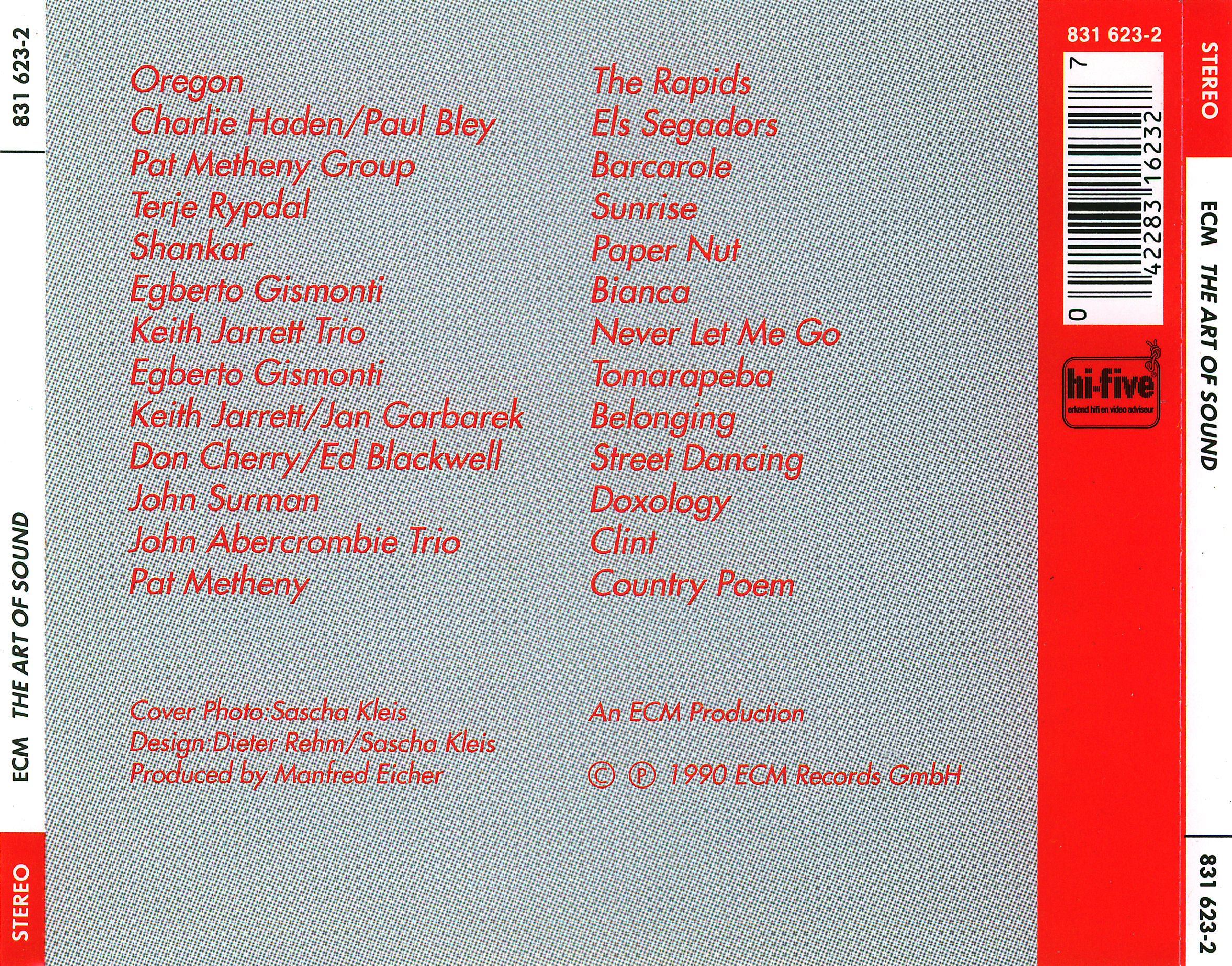
“Sit down and give this a proper listen!” So proclaims the booklet accompanying this obscure compilation from the Netherlands. Released in 1990 by ECM Records in collaboration with Hi-Five, its purpose is to draw from the label’s catalogue to gauge the quality of home system loudspeakers and amplifiers. The resulting “test CD” pays tribute to producer Manfred Eicher’s penchant for classically captured jazz and atmospheric veracity. Combining ADD and DDD recordings, it allows audiophiles to expose vibrating cabinet doors or buzzing speaker grilles while tweaking their systems toward perfection. It is also a great sampler in its own right.
Oregon’s self-titled ECM debut (ECM 1258) yields “The Rapids,” whose opening chords render compositionally minded passages with unusual dimensional force. Rays of light shoot from Paul McCandless’s soprano, yet the percussive colors of Collin Walcott hold the tightest grip on the ear, clearing a wide berth for Martin Wieland’s engineering virtuosity.
From small ensemble to large, the compilation enters the politically charged terrain of Charlie Haden’s The Ballad Of The Fallen (ECM 1248), where Wieland’s prowess is again evident. “Els Segadors” (The Reapers) is a song of revolt from the Spanish Civil War that would later become an anthem for the Catalan Republic. This rendition begins with a somber elegy for brass, flowering with the introduction of a funereal snare and glockenspiel. Haden’s lone voice then carries the weight of all that came before toward those who have yet to arrive.
Next come the smooth yet precisely honed sounds of the Pat Metheny Group, whose “Barcarole” introduces perhaps ECM’s greatest engineer, Jan Erik Kongshaug. Normally a fixture at Oslo’s Rainbow Studio, he works here in New York’s Power Station, where the classic Offramp (ECM 1216) was laid down in October 1981. His handling of Metheny’s Synclavier-enhanced guitar against the band’s mellower textures remains among the most remarkable balancing acts at the mixing board ever documented on ECM. Metheny’s tender “Country Poem,” from his solo effort New Chautauqua (ECM 1131), also appears, opening a quieter chamber in this imaginary heart.
Kongshaug’s reign continues on the self-titled trio record from Terje Rypdal, Miroslav Vitous, and Jack DeJohnette (ECM 1125). “Sunrise” floats in on DeJohnette’s scurrying drums, spurred by the air currents of Rypdal’s Fender Rhodes. Suspended plucking from the bass burns against grittier monologues, while overdubs balance the spacious surroundings with fallow echoes. The guitar dominates, its trembling accents grabbing clouds by their collars and shaking them until melodies fall out in broken illuminations. Rypdal scrapes his pick along the strings, tearing apertures in the fabric of space-time. Through those openings, one hears the machinery of distance turning upon itself.
“Paper Nut” from Shankar’s Song For Everyone (ECM 1286) is another standout for its enmeshment of starkly contrasting sound colors, embodied by the biting soprano of Jan Garbarek and the fluid undercurrents of Shankar’s 10-string double violin. The latter’s arpeggios coil through the former’s repartee, producing an argument whose logic keeps changing its alphabet. Their exchange challenges even the most calibrated speaker system to keep pace with the revolving dialogue.
Egberto Gismonti and Nana Vasconcelos’s Duas Vozes (ECM 1279) gifts us the wonders of “Bianca.” Named after Gismonti’s daughter, its handclaps and unusual guitar treatments create a space at once intimate and unbounded, demanding careful articulation in the recording and the listening. From the same album comes “Tomarapeba,” which moves further into chant-inflected ceremony, where voice and percussion generate their own sacred conditions. Gismonti and Vasconcelos remain unmistakably themselves even as they permit something older than authorship to pass through. Both tracks demonstrate ECM’s ability to make two musicians exceed the dimensions of any music hall, while an entire ensemble elsewhere may seem born for an intimate chamber of regard.
That philosophy remains alive in “Street Dancing,” performed by another one-of-a-kind duo, Don Cherry and Ed Blackwell, whose El Corazón (ECM 1230) endures as a shining example of what made ECM so innovative in its approach to recorded sound. Its musical audacity, deftly combining organ and drums, is inseparable from its treatment of physical spaces as instruments in themselves. The studio becomes a third performer whose contribution cannot be parsed from the notes.
No such compilation would be complete without Keith Jarrett, and here we receive two helpings. One charts the waters of his European Quartet in the titular ballad from Belonging (ECM 1050); the other enters his trio’s rendition of “Never Let Me Go,” heard on Standards, Vol. 2 (ECM 1289). Both tunes evoke a past from which one cannot escape, or perhaps the deeper inescapability of one’s roots in place and time. Jarrett’s phrasing seems to remember before the listener does. Each cadence opens a hidden drawer in the mind, though whatever lies inside has already begun revising the person who reached for it.
Another trio, led by John Abercrombie on the guitarist’s Current Events (ECM 1311), finds him in full sparkle mode alongside bassist Marc Johnson and drummer Peter Erskine. Such light could only arrive through Kongshaug’s mastery at the end of the rainbow, where precision and mystery sign the same ledger. Filling the final gap is John Surman’s “Doxology,” from Withholding Pattern (ECM 1295). The 1985 solo album plows a vast melodic field with taste and care, while his favored sequencer gives a glittering edge to the ashen interior of this particular plot.
Taken together, these selections reveal a label concerned with far more than sonic cleanliness. ECM’s art lies in making fidelity personal. And, somewhere between the paradox of production’s eternity and entropy, the studio recognizes that it, too, has been recorded.