

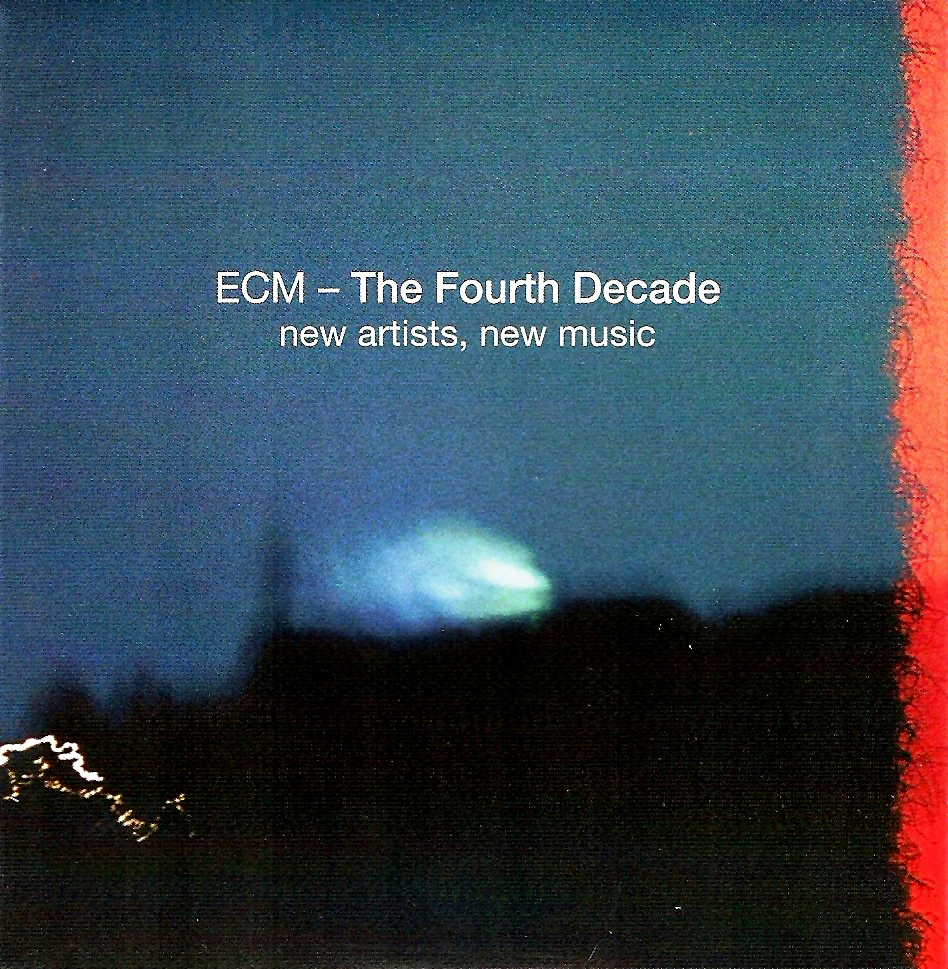
This rare ECM sampler from 2008 gathers selections from the label’s fourth decade of existence, yet the sequence feels less retrospective than prophetic. Its selections cross successive thresholds, revealing musicians at the moment when technique blurs into vision. Producer Manfred Eicher’s gift has often involved recognizing those latent selves, then constructing the acoustic conditions in which they can emerge. The subtitle, “new artists, new music,” names more than a marketing premise. These artists sound new because the music has recalibrated the coordinates by which they understand themselves.
The passage begins with the Wolfert Brederode Quartet’s Currents (ECM 2004), the Dutch pianist’s ECM debut as leader. “Common Fields” introduces both that album and this collection, serving as invocation and orientation. Brederode’s piano arpeggios curl at the edges, pale crests gathering above an invisible depth. Claudio Puntin’s clarinet wanders ashore as a vessel emptied of passengers, though memory still drags its chains through the hull. Mats Eilertsen’s bass leaves dark impressions in the sediment. As Samuel Rohrer’s rhythmic language grows more pronounced, pathos hardens into disturbance, then folds inward again, returning chaos to tenderness.
Anat Fort’s A Long Story (ECM 1994) welcomed the Israeli-born pianist into the label by way of Paul Motian’s introduction. His presence is revelatory on “Just Now,” where his drumming behaves as peripheral thought, alert to everything the central consciousness has missed. Fort’s pianism carries devotional precision. Her phrases absorb drought and return oasis fragrance, drawing nourishment from the absence they appear to lament.
From Fort’s inward radiance, the collection moves toward Jacob Young. His Evening Falls was one of ECM’s most lauded welcomes, but the selection here is “Time Rebel,” from his sophomore effort, Sideways (ECM 1997). Young’s electric guitar loosens the screws in the clock face until duration begins leaking through. Around him, the ensemble flexes with austere suppleness, especially Mathias Eick, whose trumpet liquefies the scaffolding from within. “Still There,” meanwhile, comes from the Tord Gustavsen Trio’s Being There (ECM 2017), their third label appearance. One of the trio’s most anthemic pieces, it discovers grandeur inside restraint, allowing each note to reveal the silence beneath it.
Susanne Abbuehl’s Compass (ECM 1906), her second ECM outing, contributes “Don’t Set Sail,” among the singer’s most cohesive creations. Its words, by the late Ming dynasty poet Feng Menglong, suspend a love poem between longing and prohibition. Abbuehl emotes from within that paradox, while Brederode’s piano discloses the body of water hidden inside the text. Each chord opens an interior sea, and every silence permits the shore to recede.
Holon (ECM 2049), by Nik Bärtsch’s Ronin, is another sophomore album from a singular configuration. “Modul 45” enchants in an ancient sense. Its rhythmic strata accumulate with ceremonial patience, anchored by rubbery bass and polished through exchanges between piano and saxophone. Repetition becomes molecular revision. A figure returns carrying one altered atom, then another, until the structure has migrated while appearing motionless. The piece slows into concentrated transcendence, opening onto a desert interior. A yodeling reed cleaves the darkness with ebony fissures, while Bärtsch’s solo epilogue exposes the nervous system beneath the music’s engineered skin.
Stefano Bollani’s Piano Solo (ECM 1964) yields a fully improvised romp of rough edges and polished verve. The performance belongs to a lineage reaching back through formative ECM releases, including Paul Bley’s Open, to love. Bollani carries that history without flaunting it. He enters the instrument through a contraband staircase beneath the keys, descending toward rooms where wit and virtuosity conduct illicit negotiations. A phrase may begin in mischief, fracture into abstraction, then return with the solemnity of an object recovered from a dream.
Another Italian pianist, Stefano Battaglia, appears through “Canzone di Laura Betti” from Re: Pasolini (ECM 1998/99). Joined by a group of committed musicians, he spins an orchestral web of delicate tensile strength. The piece is a love song to actress and filmmaker Laura Betti, though affection here has been exposed to cinema and remembrance. A jazz trio forms the central chamber, around which trumpet and cello circulate as interpreters between incompatible worlds. Compact in scale, the music contains a black star hidden inside a locket.
Mathias Eick’s The Door (ECM 2059) is the Norwegian trumpeter’s ECM debut, and “Williamsburg” serves as its ambassador. Eick’s horn unravels clock parts and rearranges them into a new anatomy. Time circulates through the horn’s valves before settling into the ensemble’s soft machinery.
The Marcin Wasilewski Trio enters through “Diamonds and Pearls,” from January (ECM 2019). The Prince song is a particularly soaring one in this iteration while retaining its human vulnerability. The trio understands melody as a landscape with moral dimensions, requiring decisions about illumination and concealment. Familiar harmony passes through their collective intelligence until recognition becomes unstable and memory begins exchanging masks with sound.
The final act belongs to three singular Norwegian voices. Christian Wallumrød’s ensemble offers the brooding, sun-kissed “Nash Lontano” from The Zoo Is Far (ECM 2005). Fragments of chamber music drift through a room whose dimensions change whenever the listener tries to measure them. Accordionist Frode Haltli follows with “Vals,” from Passing Images (ECM 1913), a hallucinatory passage in which gestures melt into drains of progression while preserving the residue of dance. The accordion inhales an architecture and exhales its ruins, recalling a social ritual after society itself has disappeared.
Finally comes Trygve Seim’s “Beginning an Ending,” from Sangam (ECM 1797). Its title contains the compilation’s governing secret. Every entrance has already begun to close, while each conclusion shelters an unopened chamber. Trumpeter Arve Henriksen provides the melodic lead, etching a runway for the soul across the ensemble’s dark material. Morten Hannisdal’s cello draws a line of sight through the arrangement, its bow leaving a smoke trail that thins into bluest skin. Flight seems imminent, but the destination remains beyond the jurisdiction of maps.
ECM – The Fourth Decade ultimately becomes a catalogue of cellular membranes through which identity passes and returns altered. Eicher’s sequencing converts separate revelations into a continuous philosophical question, one door opening into another without any visible answer connecting them. The collection leaves behind an unsettling proposition: perhaps music does not preserve moments but releases them from the obligation to have occurred.


