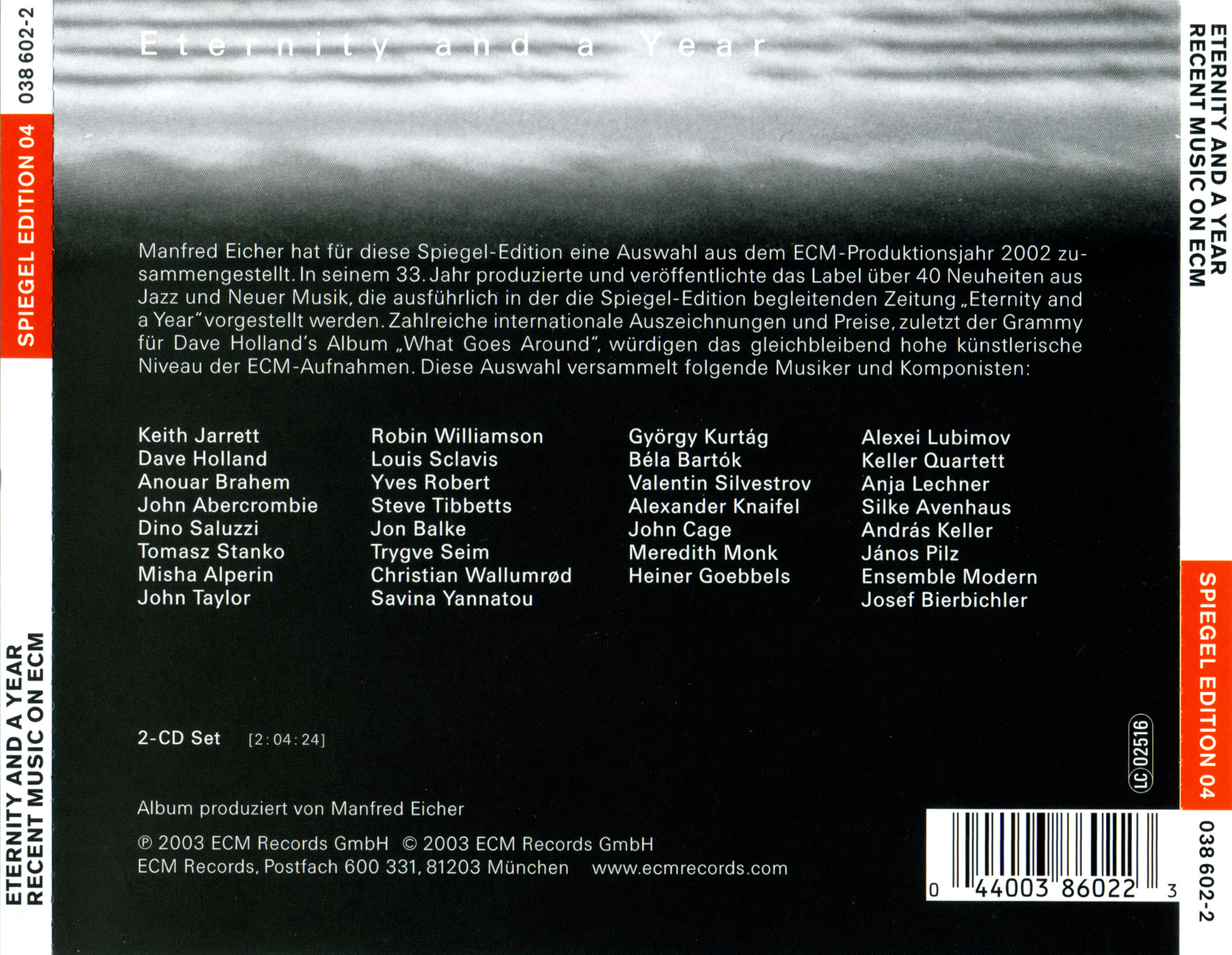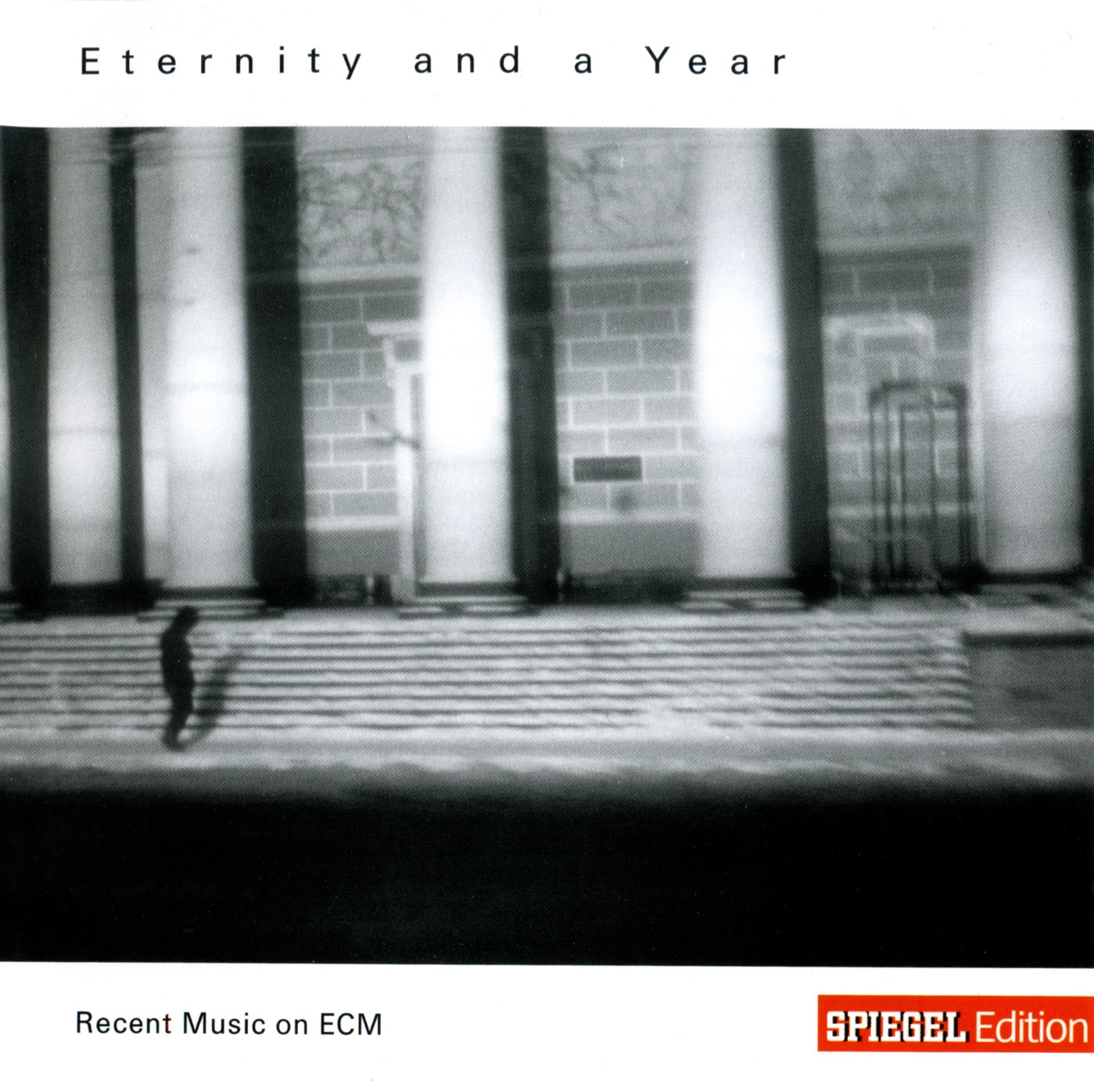
Eternity and a Year gathers music from ECM’s 2002 production year, the label’s 33rd, when more than 40 recordings appeared. The double album forms a two-way mirror. Disc 1 returns the listener’s altered image; Disc 2 stands behind the glass, observing that reflection and discovering its afterlife. Jazz and classical music become opposed memories: one improvises its ancestry, while the other remembers futures that never arrived.
Disc 1: The Silvered Face
On Kyanos (ECM 1822), Jon Balke & Magnetic North Orchestra continue the journey begun on Further, uniting Per Jørgensen, Arve Henriksen, Anders Jormin, and Audun Kleive. In “Mutatio,” piano gestures rise and the ensemble answers with soft interruptions. “Sarabande Nouvelle,” the emotional hinge of Christian Wallumrød Ensemble’s Sofienberg Variations (ECM 1809), bears a similar patina. Its sorrow seems inherited from an unnamed century. Horns and rubato swells give it ceremonial stature, while its composure trembles like someone holding a cracked vessel upright.
That vessel becomes sacred in Alexander Knaifel’s “An Autumn Evening,” the second movement of In Air Clear and Unseen on Svete Tikhiy (ECM New Series 1763), performed by Keller Quartett. Tyutchev’s poetry hovers behind the notes. Knaifel’s “chain breathing” makes the quartet one organism, erasing the border between death and renewal. Candles multiply from one flame, and a dreamed ribbon remains clenched in the waking hand.
The current darkens in “Über den Selbstmord” from Heiner Goebbels’s Eislermaterial (ECM New Series 1779). Hanns Eisler’s pensive song brings a sensitive topic under the microscope as a moral pressure. A student of the Schönberg school and an exile alongside Bertolt Brecht, Eisler thinks against annihilation while naming it, turning exile into conscience.
The Kalymnos song “With the Moon I’m Walking” opens Savina Yannatou & Primavera en Salonico’s Terra Nostra (ECM 1856) with mournful violin, posing a nocturnal question across centuries. Anouar Brahem’s Le pas du chat noir (ECM 1792) answers through “Pique-nique à Nagpur,” where Brahem and Jean-Louis Matinier hover between sleep and vigilance. On Responsorium (ECM 1816), Dino Saluzzi’s “A mi hermano Celso,” dedicated to his brother and fellow bandoneonist, bends affection through unexpected turns, as though blood had learned counterpoint.
In Yves Robert’s “Let’s lay down,” from In Touch (ECM 1787), muted trombone builds a room from breath, answered by Vincent Courtois’s cello and Cyril Atef’s percussion. “Soundtrack” from John Abercrombie’s Cat ’n’ Mouse (ECM 1770) creates a neighboring chamber, where Marc Johnson’s pulse and Mark Feldman’s emotion suggest romance as life’s self-revising syntax.
Folk memory supplies another structure in Bartók’s “Erdély Tánc” and “Rumanian Song,” played by András Keller and János Pilz on 44 Duos for Two Violins (ECM New Series 1729), while György Kurtág’s Ligatura – Message to Frances-Marie op. 31b from the same recording extends it toward a vanishing point, an orchestral voice arriving after its imagined body has dissolved.
On Always Let Me Go (ECM 1800/01), Keith Jarrett tilts the rearview mirror during “The River” until past and present mingle. Glassine chords and trailing chromatics create wordless tenderness. Meredith Monk’s mercy (ECM New Series 1829) withdraws language through “core chant.” The music precedes the grammar needed to contain it, and its abrupt ending reveals incompletion as the form’s hidden organ. Thus, humility becomes the disc’s final reflective substance.
Disc 2: Behind the Glass
Disc 2 enters the chamber that observed the first. Anja Lechner and Silke Avenhaus begin with Valentin Silvestrov’s Postludium No. 3 from leggiero, pesante (ECM New Series 1776), unraveling charm into afterthought. Cello and piano brighten the edge of obscurity with light borrowed from something already departing.
In Touch returns in altered form, reducing its title piece to Robert and Courtois. Their duet pins down lepidopteran sound as low animations carry secrets through breath. Alexei Lubimov makes concealment playful in John Cage’s In a Landscape, recorded for Der Bote (ECM New Series 1771). His quicker undulations differ from Herbert Henck’s ECM reading but lose no depth. Cage’s melodic humility embodies a radical hospitality, allowing the smallest figure to occupy an immeasurable lodging.
Orientation becomes archaeology on Robin Williamson’s Skirting the River Road (ECM 1785). “The Four Points Are Thus Beheld” opens the cardinal directions into improvisatory petroglyphs: Paul Dunmall’s tenor saxophone incises the walls while Ale Möller’s hammered dulcimer threads silver overhead. Steve Tibbetts somehow answers with “Glass Everywhere” from A Man About A Horse (ECM 1814), where the mirror shatters inward. Music turns damage into an offering; the raw passes into the cooked where explanation loses jurisdiction.
Misha Alperin’s “Dark Drops” on Night (ECM 1769), performed with Lechner and Hans-Kristian Kjos Sørensen, miniaturizes that catastrophe. Percussion flickers while piano and cello preserve alert quiet. Louis Sclavis gives labor a cinematic body in “Le travail” from Dans la nuit (ECM 1805). Clarinet moves among Dominique Pifarély’s violin and Courtois’s cello, while François Merville’s percussion joins Matinier’s accordion. The textures recall Philip Glass’s silent film scores, even as Sclavis treats description as action’s lingering imprint.
The final constellation converts concealment into propulsion. The Dave Holland Big Band’s “Upswing,” from What Goes Around (ECM 1777), joins baritone weight, Duane Eubanks’s crisp trumpet, and bright vibraphone. On The Source and Different Cikadas (ECM 1764), Trygve Seim, Øyvind Brække, and Per Oddvar Johansen gather brushed drums and horns in “Mmball,” like closing credits for characters still speaking behind the screen. Unity arrives through Kenny Wheeler’s “Ma Bel,” realized by John Taylor, Marc Johnson, and Joey Baron on Rosslyn (ECM 1751). It flowers through restraint, beautiful because it leaves radiance unspent.
Soul of Things (ECM 1788) brings the chamber to its deepest point with Tomasz Stanko Quartet’s “Soul of Things, Var. I.” Marcin Wasilewski’s piano clears a space where Stanko’s trumpet can hear itself, while Sławomir Kurkiewicz and Michał Miśkiewicz shape restraint into supporting pressure.
Eternity and a Year proposes that memory may be the organ by which the future studies its own ruins. And if we recognize ourselves in anything, it is because the concealed observer is another reflection, and the opaque surface has been looking back through us all along.