

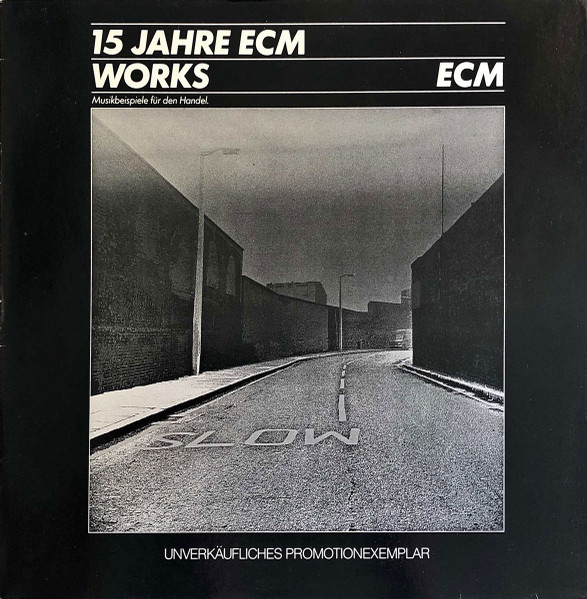
Released by ECM in 1984, 15 Jahre ECM Works has become a largely forgotten branch of the “Works” series, whose better-known volumes offered compact portraits of individual artists. This compilation widens the aperture across the label’s first 15 years, arranging nine recordings into an oblique self-portrait.
Keith Jarrett opens with “Country,” housed on My Song (ECM 1115). His piano and Jan Garbarek’s tenor saxophone establish the theme with lucid conviction, while bassist Palle Danielsson and drummer Jon Christensen circulate beside the melody instead of supporting it from below. Jarrett grounds the performance without fastening it to the earth. The harmony folds inward as the melody opens its arms, and Garbarek carries the pale brilliance of something remembered before it has happened. Joy already understands loss here, though sadness gains no authority over it. Egberto Gismonti’s “Raga” shifts this suspension toward personal ritual. On Sol Do Meio Dia (ECM 1116), his custom 8-string guitar remains resolutely beat-driven, yet rhythm behaves as an opening rather than a boundary. Collin Walcott’s tabla turns repetition into a revolving passageway. A kalimba surfaces from beneath their exchange; shrill fluting tears a ribbon through the air. Technique burns away its passport and speaks in the grammar of an unnamed country.
A more guarded chamber appears in Gary Burton’s “Olhos De Gato.” Within The New Quartet (ECM 1030), Carla Bley’s melody pursues a nocturnal logic, prowling the margins of visibility while a seedy current moves beneath the polish. Burton’s vibraphone provides an immaculate exterior, but each note leaves a faint fingerprint upon the next. Mick Goodrick’s guitar loosens the arrangement’s joints without disturbing its elegant stealth. That secrecy combusts when Gateway (ECM 1061) supplies Jack DeJohnette’s “Unshielded Desire.” John Abercrombie tears a fissure through the music’s floor, while DeJohnette reorganizes each eruption into kinetic exegesis. Desire assumes physical properties and changes skins. Their exchange discovers a form of thought beyond language, provided the body is willing to become the sentence.
Pat Metheny’s “(Cross The) Heartland” carries another conception of motion. By the time of American Garage (ECM 1155), the Pat Metheny Group had forged its identity through years of touring, with Metheny and Lyle Mays’s work alongside Joni Mitchell further sharpening their partnership. The tune carries that knowledge without displaying the labor behind it. Metheny moves with bright purpose while Mays opens harmonic distances around each melodic turn, and the ensemble makes precision breathe. The heartland becomes a method of traversal, an interior expanse transformed through return. Chick Corea approaches discipline from another direction in “Addendum,” the buoyant conclusion to Children’s Songs (ECM 1267). Cellist Fred Sherry and violinist Ida Kavafian cast backward glances to reveal previously invisible chambers, while sudden turns keep the equilibrium at hand pleasantly endangered.
Questions of origin grow more elusive in Jan Garbarek’s “Folk Song,” which opens Folk Songs (ECM 1170). Garbarek joins Egberto Gismonti and Charlie Haden in winding the traditional melody into a helix of tender consideration. His saxophone carries the grain of a human voice stripped of words; Gismonti places luminous fragments beneath it, and Haden lets the bass become nostalgia’s dark handwriting. Eberhard Weber’s “Touch” extends this idea through ensemble contact. At the entrance to Yellow Fields (ECM 1066), piano and bass begin a groove-oriented exchange before synthesized strings enlarge the field. Charlie Mariano’s soprano carries a bright current as Jon Christensen supplies a flexible spine. Weber governs through the room he grants the others, turning touch into distributed authorship. The quick fade feels deliberate, as though the groove has wandered beyond the microphone’s jurisdiction.
That distant horizon becomes tangible in “Waves,” the title piece of Terje Rypdal’s Waves (ECM 1110). Rypdal suspends guitar and synthesizer above Sveinung Hovensjø’s six-string electric bass while Christensen’s drums redraw the lower boundary. Palle Mikkelborg sends his fluegelhorn through a ring modulator until brass enters a mineral state, gleaming with intelligence evolved under enormous pressure. Each line acquires temporary gravity before entering another orbit. Rypdal’s phrases burn routes through the ensemble’s coordinates, and every sustained tone contains the possibility of becoming a horizon.
Together, these recordings transform an anniversary into a question about duration. Fifteen years becomes the interval required for sound to loosen its attachment to creation and enter communal memory. Each selection opens a passage that the next refuses to close, preserving ECM’s identity as a disciplined approach to the edge where vocabulary fails. Every performance carries decisions made by absent hands, then deposits a question inside future bodies: what will you do with the freedom someone else learned how to hear? Attention, practiced intensely enough, changes the moral anatomy of a person. A promotional sampler can therefore conceal a private revolution, revealing consciousness as borrowed acoustics, an instrument briefly entrusted to whoever happens to be awake.

