

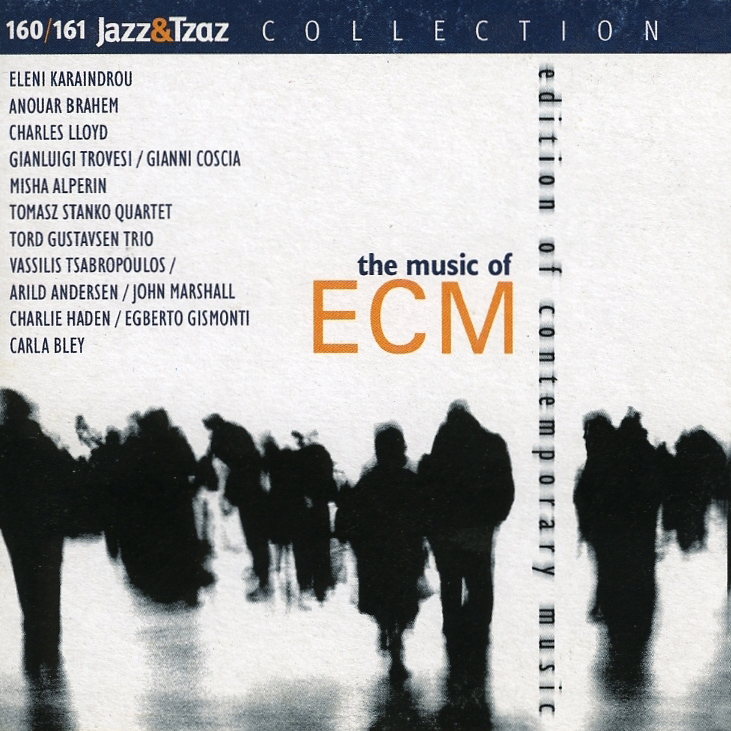
Jazz & Τζαζ, the prominent Greek monthly founded by Giorgos Charonitis in 1993, chronicled the Greek and international jazz scenes for 245 issues before ending in July 2013. Each issue carried a compilation CD, turning the magazine into both document and doorway. Released in 2006 with Issue #160/61, The Music of ECM gathers 10 recordings from a catalogue whose silences have always seemed as consequential as its fills. Heard together, these pieces form a folded atlas of interior territories.
Migration and Moral Light
Eleni Karaindrou treats the events of The Weeping Meadow as births, nurturing them until they acquire new flesh and political consciousness. Issued as ECM New Series 1885, the soundtrack sends its eponymous theme down a river-run exposition whose source seems older than the story containing it. History enters quietly in the guise of an accordion, wearing the face of desire. Charles Lloyd approaches another history on Lift Every Voice (ECM 1832/33), where his reading of “What’s Going On” permits Marvin Gaye to flicker between realms in an arrangement radiant with earthly consequence. Lloyd loosens the song’s familiar coordinates without diluting its moral urgency; protest deepens into meditation while retaining its teeth. His saxophone draws out the ache inside the title until its question addresses both society and the portion of the soul that remains awake before suffering.
Countries Made of Breath
The title piece of Khomsa (ECM 1561) places the oud of Anouar Brahem amid accordionist Richard Galliano, pianist François Couturier, bassist Palle Danielsson, and drummer Jon Christensen, with Jean-Marc Larché’s fluid soprano saxophone casting a long shadow across the ensemble. Every musician seems to occupy a private cell of the same silence, slowly opening small doors through which the others may pass. The passage narrows further when Night (ECM 1769) reaches its slow-motion dream sequence, as inhabited by Misha Alpherin and cellist Anja Lechner. Their tender duet absorbs breath in lieu of exhale. Each vanished note leaves a vacancy that continues vibrating, as though revising the object it had sworn to preserve.
Shadow Theaters
The Tomasz Stanko Quartet opens the first variation within Soul of Things (ECM 1788) by entering through a film-noir aperture. One can almost hear raindrops ticking against gabardine as Stanko’s protagonist steps from the first curl of fog, his trumpet bearing the scorched elegance of someone who knows the answer but remains loyal to the question. Slawomir Kurkiewicz attends to the scene with extraordinary patience, finding fertile ground in Marcin Wasilewski’s pianism while Michal Miskiewicz marks the perimeter with faint points of contact. ECM 1703, In Cerca Di Cibo, gives Gianluigi Trovesi and Gianni Coscia a more mischievous theater in John Lewis’s “Django (Donadona).” Mourning discovers frivolity hidden inside its coat. Clarinet and accordion preside over a tiny kingdom where sorrow repeatedly misplaces its crown, yet darkness remains attached to every bright gesture. Their narrative arc teaches grief a more intricate form of movement.
Matter, Pressure, and Dream
Changing Places (ECM 1834) turns gentleness into a material state through the Tord Gustavsen Trio’s “Melted Matter.” Its melody imposes itself with the quiet force of grass bent beneath wind, while solos surface so naturally that their crocodilian eyes are visible before the submerged bodies can be sensed. Gustavsen gives each phrase room to acquire a private afterlife; Harald Johnsen and Jarle Vespestad shape pulse and depth behind closed eyes. A denser transformation takes shape within Achirana (ECM 1728) as Vassilis Tsabropoulos joins Arild Andersen and John Marshall for “Diamond Cut Diamond.” Tsabropoulos begins with whispered clusters that conjure a ribbon loosening at the nape and a thought suspended between memory and premonition. Andersen’s heavy quavers become immense arrows in darkness, their shafts hewn from fallen trees and feathered with itinerant dreams. Marshall tests the structure’s hidden joints while preserving its buoyancy. Under such pressure, the gem becomes consciousness sharpened against itself.
The Ethics of Intimacy
The concert preserved on In Montreal (ECM 1746) returns Charlie Haden and Egberto Gismonti to the Magico songbook through “Palhaço,” a Gismonti trio staple in which Gismonti’s astonishing pianism balances florid biospheres against ponderous asides, cultivating whole ecologies before following a single root into darkness. Haden drafts the terms of endearment by which every page turns. His bass places ancestral weight beneath airborne flourishes. Their intimacy depends upon mutual permission, the freedom to become briefly impossible within a world built for that impossibility. Carla Bley brings this movement to completion through “Utviklingssang,” which 4X4 (WATT/30) entrusts to Andy Sheppard’s whispering tenor in what may be the finest arrangement of the beloved tune. Bley’s simple line turns once and exposes an unsuspected dimension; Sheppard enters it without claiming ownership. The collection’s hidden geography has been ethical all along, a province created whenever one consciousness makes room for another. ECM’s deepest proposition may concern attention as shelter: music decides what within the world will be permitted to keep real.
 Between Sound and Space: ECM Records and Beyond