

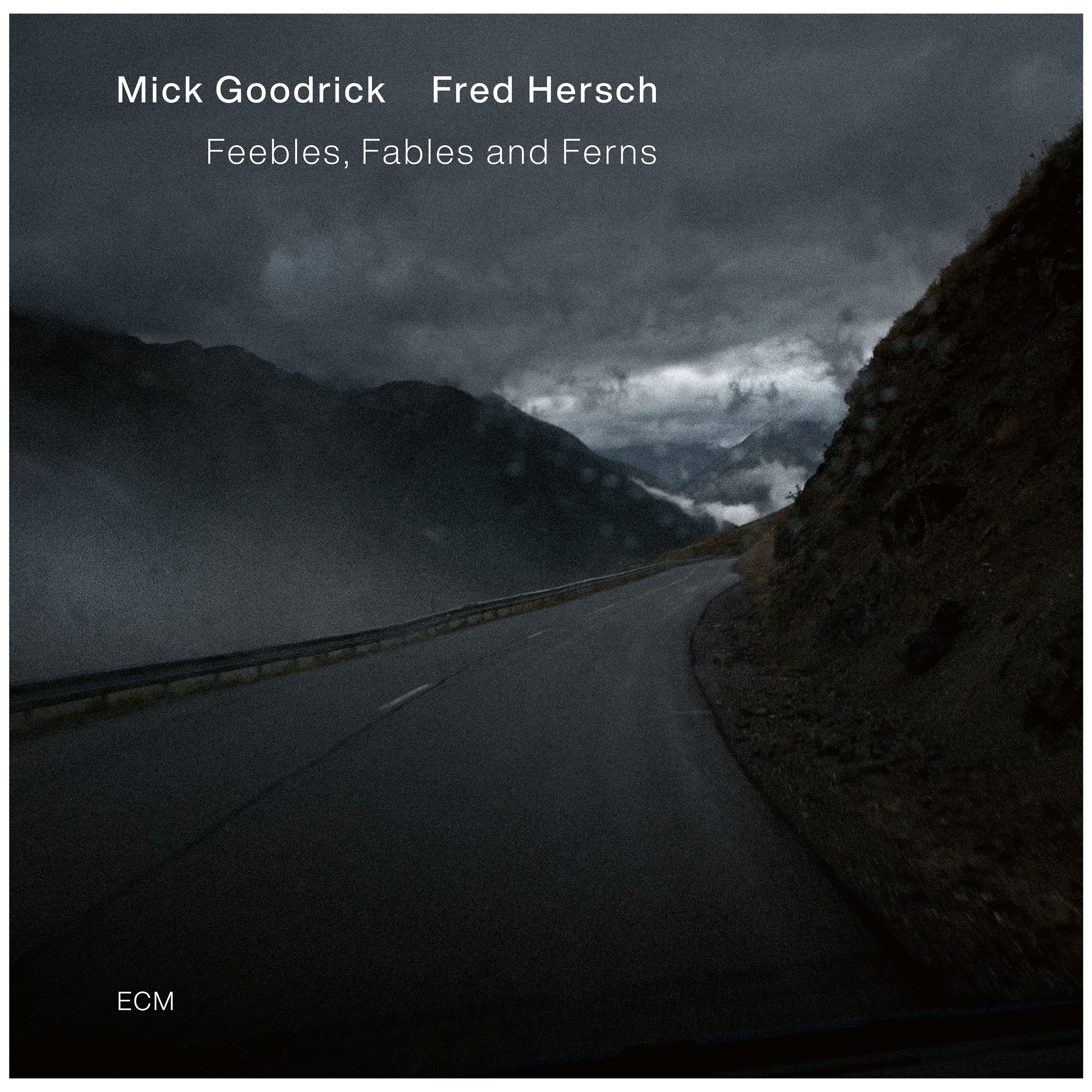
Mick Goodrick/Fred Hersch
Feebles, Fables and Ferns
Mick Goodrick guitar
Fred Hersch piano
Recorded August 1988 at Classic Sound Studio, NYC
Engineer: A. T. Michael MacDonald
Remixed 2025 by Chris Allen
Original recording produced by Fred Hersch
Cover photo: Jean-Guy Lathuilière
An ECM Production
Release date: June 19, 2026
Recorded at Fred Hersch’s New York studio in August 1988, Feebles, Fables and Ferns documents the only recorded meeting between Hersch and guitarist Mick Goodrick, then fellow fixtures of Boston’s jazz community. Historical circumstance provides the frame, yet the deeper distinction resides in the remarkable ease of their exchange. The session carries almost none of the dust normally associated with an archival recovery. Its present tense remains intact, sealed within every pause and sudden melodic turn. Both musicians develop ideas in real time without crowding the music or steering it toward predetermined conclusions. Their attentiveness suggests a shared space in which each voice can enter fully while leaving the other unclaimed. Goodrick, an influential teacher whose sparse discography never adequately reflected his stature, is especially compelling. His quietly inventive improvising reveals why Julian Lage, Pat Metheny, Wolfgang Muthspiel, and so many other guitarists have regarded him so highly. He seems able to bend a phrase around the interior of a thought, decorating its walls without obscuring their mystery.
That rapport animates a lively program of originals, standards, and one open improvisation. Goodrick’s title composition, first heard on 1979’s In Pas(s)ing, emerges here as a compact study in interlocking lines. Hersch and Goodrick’s melodic phrases remain tight yet fluid, while rhythmically astute changes seem to discover their destination only upon reaching it.
“Falling Grace,” one of two Steve Swallow tunes in the set, brings a livelier angle to that exchange. Retaining its composer’s crooked smile, it folds playfulness into sardonic self-awareness while maintaining considerable lyrical poise. Hersch answers that wit with buoyant precision, while Goodrick phrases across it from oblique vantage points, tugging at the seams without tearing the fabric. Swallow’s “Amazing” later enters through Goodrick’s “Away 10,” moving through dimly illuminated memories that appear to recognize us before we recognize them. What was laid down casually in a studio nearly four decades ago has acquired meanings unavailable to its creators, proving that music can continue thinking after its makers have left the room. Time has not merely preserved these performances but has collaborated with them.
Within that expanding temporal space, “Five Excursions” unfolds as a surreal yet welcoming chain of improvisations. Its tentative beginnings resemble a constellation being plotted by instruments uncertain of the sky behind them. A few pinpointed tones establish provisional coordinates, after which the music opens into interlocking geometries. Hersch and Goodrick appear to reverse-engineer causes for effects already hovering in the air. Silence becomes a working material rather than an interruption, allowing each idea to cast a longer shadow.
As Johnny Green’s “Out of Nowhere” blossoms into the foreground, the album enters a region of crystalline wit evocative of Chick Corea’s ECM classics. Clever syncopation and deft motivic interchange make the performance feel perpetually on the verge of levitation. Hersch rearranges the tune’s internal gravity while Goodrick sends bright phrases skimming along its altered surface, each musician alert to the comic potential inside sophistication.
Hersch’s “Heartsong” draws the session toward a more openly radiant center. The composition pumps richness through its chambers, yet its emotional amplitude remains governed by a profound introversion. Goodrick understands how much the tune contains and resists the temptation to excavate everything at once. Even during his fastest lines, every note retains a private place in the larger design. Hersch, for his part, stays within reach, grounding uplift in touch and harmonic clarity.
Mal Waldron’s “Soul Eyes,” originally written with John Coltrane’s sound in mind, offers a final field of inquiry for instruments far removed from that conception. Guitar and piano open from within, allowing secrets to emerge as subtle alterations of perspective. Goodrick homes in on details that another improviser might treat as mere filler. Minute changes in the harmonic terrain acquire enormous consequence beneath his attention, with a bent inflection or delayed resolution suddenly becoming the axis around which the piece turns. Hersch’s lyricism operates simultaneously inside the drama and beyond its frame. He inhabits the melody while quietly altering the conditions under which it can be understood.
Feebles, Fables and Ferns stands as an unusually intimate portrait of two restless musical minds meeting on equal terms. Its archival unearthing offers more than access to a lost session; it returns a form of attention that now feels almost radical. Hersch and Goodrick listen without attempting to absorb one another, preserving difference as the very substance of communion. Their duetting gradually becomes a demonstration that freedom can deepen when another consciousness is fully present.

