

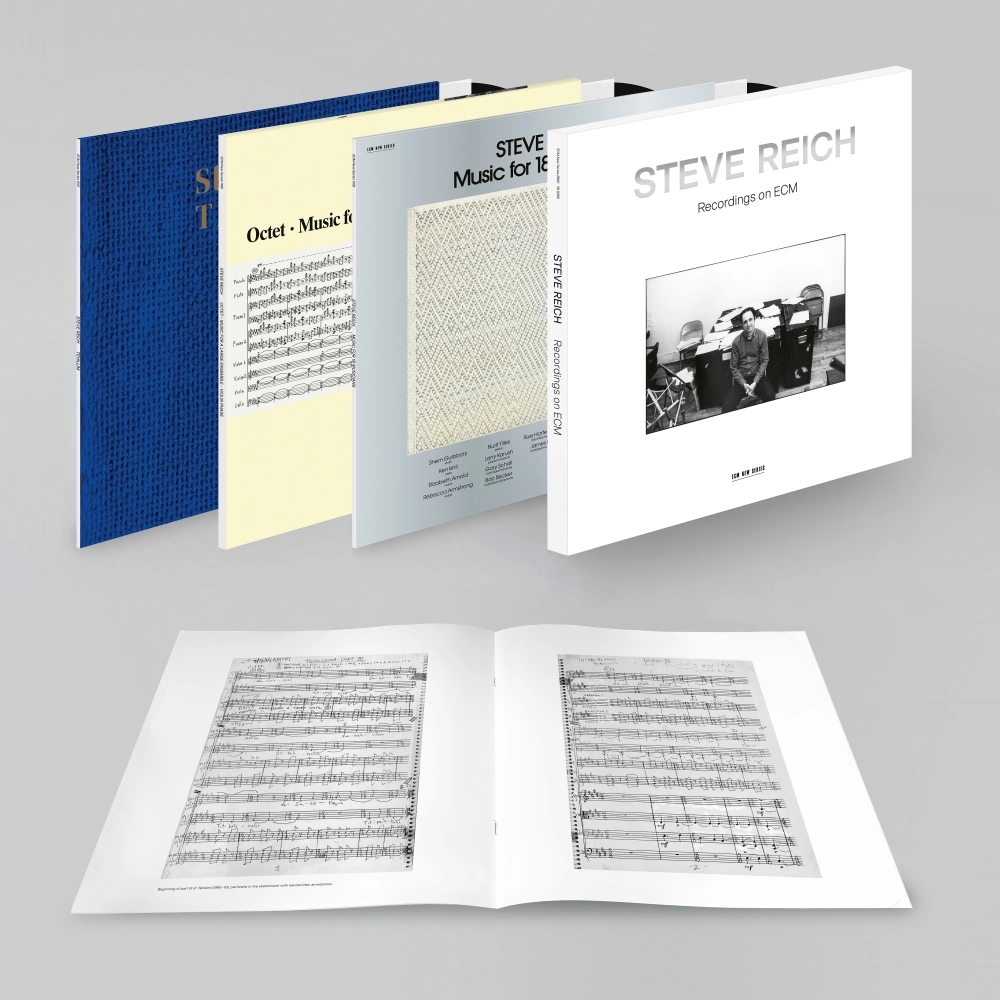
In Steve Reich’s music, repetition is a method of survival. A phrase returns carrying the microscopic damage of having been heard, while attention acquires an unfamiliar capacity for desire. Recordings on ECM brings that reciprocal transformation back to vinyl, gathering the three albums ECM released between 1978 and 1982. Revisiting the collection issued on CD in 2016, this three-LP edition arrives on October 2, 2026, one day shy of the composer’s 90th birthday. Sourced from the original analogue master tapes, the records reproduce their original sleeves; archival photographs accompany Paul Griffiths’s liner notes. Inside the music, strict procedures open improbable apertures, and counting becomes a form of surrender.
The history behind these recordings retains its own dissonance. Reich had developed an unmistakable musical language before the recording industry found a durable place for it. Manfred Eicher brought Music for 18 Musicians, recorded for Deutsche Grammophon but left unreleased, into circulation through ECM in 1978. His intervention gave a public address to an imagination exceeding the available categories. Across the collection, gestures migrate between works, acquiring unfamiliar consequences in changed surroundings. What initially registers as an insistent surface gradually admits depth, until the ear discovers a staircase folded into a single step.
Music for 18 Musicians establishes this permeability with extraordinary clarity. Its opening cycle of eleven chords provides the harmonic material that subsequent sections expand, and the eventual return closes an immense parenthesis. Pianos and mallet instruments sustain a continuous pulse while voices and winds measure phrases through the limits of breath. The mechanical subdivision of time meets the lung’s finite generosity, allowing rigor to develop a vulnerable interior. Wordless singing moves through the instrumental fabric with translucent tenderness; clarinets continue its contours until the boundary between body and instrument becomes difficult to locate. The ensemble’s collective alertness supplies much of the recording’s emotional force. A shifting accent redirects a passage without disturbing its pulse, while the vibraphone’s cues turn communication into audible structure. Individual timbres retain their grain within a beautifully concentrated field. During the work’s nearly hour-long span, our sense of succession loosens. The clock has entered its own reflection and found soil there to grow roots.
The next album changes the proportions of this experience. Music for a Large Ensemble distributes its activity across a broader instrumental field, maintaining remarkable buoyancy amid the layered motion. Strings contribute a vibrating tension; trumpet chords open luminous pockets above the pulse. The vibraphone’s resonance gives the surrounding activity a polished edge without draining its tactile life. Apparent abundance rests on meticulous relationships, allowing the smallest adjustment to alter the lung capacity of the whole. Every entrance renews the agreement holding this intricate structure together, making consistency an active expression of shared musical purpose.
Violin Phase concentrates the inquiry into a more abrasive intimacy. Its repeated figure slips out of alignment with its doubles, generating patterns through the resulting weave. Shem Guibbory’s bow retains a palpable friction, giving the process an embodied urgency. Reiteration rubs the phrase against itself until hidden contours become audible; an interval opens its mouth, and another melody steps through. Where attention lands determines the shape of the encounter. Octet introduces a delicacy of articulation that feels newly spacious. The flute illuminates the texture from within, while clarinet lines give its motion a supple underside. Its abrupt ending leaves the ear suspended, still furnishing a room from which the walls have vanished.
With Tehillim, the voice assumes the authority of language. Reich’s engagement with his Jewish heritage places Hebrew psalm texts at the composition’s center, allowing their rhythms to determine melodic movement. Meaning inhabits the pulse as an ancestral presence. The opening interplay of singing and percussion has a searching energy, and the unfolding canons give that energy increasingly intricate dimensions. Through the work’s four parts, exhilaration gathers a contemplative gravity; the slower third part suspends the forward impulse without extinguishing its inner motion. The performance gives each carefully shaped phrase an edge of discovery. In the closing hallelujahs, praise becomes bodily expenditure, a word passing through the throat until its syllables seem capable of bearing the singer aloft.
Returning to these performances, I continue to hear excess within the supposedly minimal. Reich makes limited materials sustain an astonishing density of experience, and his musicians give that density a human scale. This vinyl edition offers a renewed occasion to inhabit their concentration. Even the necessary interruptions sharpen awareness of what persists after the sound stops. The mind follows a process until following becomes participation; the body answers before interpretation has finished assembling its credentials. Eventually, a pulse reaches some unlit interior of the listener and finds that it has been expected. Within the groove, the future rehearses its first breath.

