

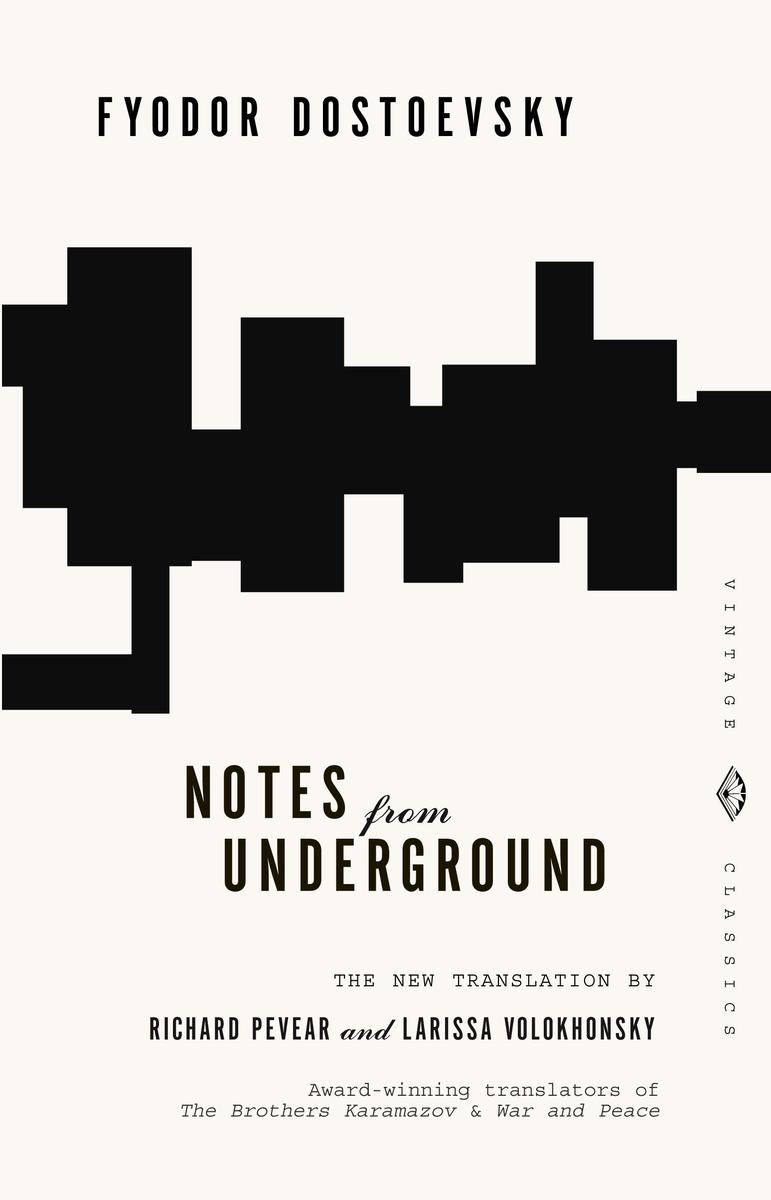
Published in 1864, Notes from Underground enters the nineteenth century through a wound in its confidence. Russia’s arguments over human emancipation had become arguments over the human creature itself, over whether an enlightened understanding of self-interest could make goodness inevitable. Dostoevsky places a solitary voice inside that promise and allows it to gnaw through the floor. The result anticipates the estrangement of later modernist fiction and the problems existentialism would make its own, yet its historical force remains inseparable from its peculiar intimacy. The novel makes consciousness a place where the future can be refused before it arrives. Its speaker possesses enough intelligence to expose the arrogance of a system and enough vanity to turn that exposure into an excuse for tormenting others. These capacities occupy the same cramped body. Their coexistence gives the book its terrible vitality.
Even its chronology refuses the reassurance of a straight line. The first part presents the underground man at forty, elaborating the convictions with which he has upholstered his seclusion. The second, “Apropos of the Wet Snow,” returns to his life at twenty-four. We encounter the philosophy before the experiences against which it has hardened, then discover how much flesh has been concealed inside its abstractions. This reversal changes the meaning of what we have already read. Arguments that initially resemble a defense of human freedom acquire the odor of an alibi, while episodes of humiliation expose the needs that theory has learned to disguise. His earlier life never becomes a simple explanation of his later consciousness, since the older man retains control of the telling and continues to dispute his own evidence. Memory enters stage left under escort. The book’s two halves form a struggle over interpretation in which a life keeps escaping the conclusions imposed upon it. The philosopher has delivered his speech. Now someone must pay for it.
“I am a sick man…I am a wicked man.” Between those declarations, the narrative opens its cynical caesura. Sickness might solicit care, whereas wickedness seems to forbid it, and the speaker cannot resist arranging both possibilities before us. Translators Richard Pevear and Larissa Volokhonsky preserve the nervous immediacy of a voice that has scarcely announced itself before beginning to revise the announcement. The man believes his liver is diseased, although he admits uncertainty about what ails him. His refusal to consult a doctor becomes an act of spite whose only injured party is himself. Already the comedy has begun its patient work upon our sympathy. Who is supposed to suffer from this magnificent refusal? The doctors will survive it. He knows this and insists upon it anyway, extracting sovereignty from the prospect of getting worse. His body becomes the hostage of an argument addressed to nobody who needs to answer. In that opening hesitation, a whole existence curls around the pleasure of making its own misery ungovernable.
Pevear’s introduction cautions against mistaking the narrator’s proximity for a direct statement of Dostoevsky’s beliefs. The caution matters because this man knows how to recruit a reader. His “gentlemen” are an imagined audience whose objections he can supply before they arrive, a tribunal assembled from the educated assumptions he despises and the approval he cannot stop desiring. They often embody the rationalist confidence associated with Nikolai Gavrilovich Chernyshevsky and his followers, although their function exceeds any single historical party. The reader who laughs becomes another occupant of that audience, while withholding laughter merely invites speculation about the motive for our refusal. Whatever we do, he has already begun discussing us with himself. We are invited into his consciousness under conditions that make every response available for confiscation, and his apparent candor gives the confiscation its charm. He courts attention through declarations of indifference, finding in our resistance another reason to continue.
Chernyshevsky’s What Is to Be Done?, published in 1863, supplied the radical imagination with a utopian fiction that became a formative text for revolutionary readers. Its rational egoism proposed that a proper understanding of self-interest could bring individual benefit into harmony with the common good. Notes from Underground attacks that assurance and parodies the confidence that human life can be reorganized according to a comprehensible plan. A proverbial crystal palace condenses the promise into an architecture of perfected satisfaction. From the underground man’s corner, its transparency looks suffocating. The danger he identifies concerns the reduction of lived existence to a calculable mechanism, an arrangement in which human flesh remains present while its freedom has been explained away. Yet the rival he installs beneath this edifice is hardly a trustworthy liberator. A grievance has seized the emergency exit and declared itself the guardian of the soul.
His strongest objection begins with the possibility that a person might knowingly choose injury. If human conduct follows enlightened advantage, what becomes of the pleasure of refusing advantage itself? “What makes you conclude that man’s wanting so necessarily needs to be corrected?” he asks in kind. The question pierces the benevolence that appoints itself curator of someone else’s desire. Wanting may embrace reason, but it can also insist upon a satisfaction that reason has no wish to recognize. To preserve this troublesome remainder, the underground man will defend even a ruinous caprice, musing to himself, if not also about himself, “I even think the best definition of man is: a being that goes on two legs and is ungrateful.” The sentence is wonderfully indecent. Gratitude would acknowledge that the world has given us something worth accepting, and his creature reserves the right to spit upon the gift. Such ingratitude can expose coercion decoratively wrapped in generosity. It can also become the reflex by which every offered kindness is ruined before it has the chance to make a claim upon us. His defense of freedom carries both possibilities in its mouth.
Arithmetic therefore acquires a menace disproportionate to its innocence. Two times two is four, and the underground man hears in that result the shutting of a door. The equation becomes intolerable when its certainty is promoted into a model of existence, when the unresolved human creature is treated as a problem awaiting its final solution. A completed life would have no room left in which to want. “And though our life in this manifestation often turns out to be a bit of trash,” he goes on to say, “still it is life and not just the extraction of a square root.” Destruction consequently offers the strange consolation of reopening what completion has sealed. He suspects that people may overturn a perfectly furnished happiness simply to feel their own hands at work upon it. Here his argument finds an unsettling strength, for increased knowledge supplies no automatic moral improvement. A civilization can condemn bloodshed while becoming more accomplished at committing it. Reason may sharpen an instrument whose purpose remains atrocious. But the very force of this insight tempts him toward a disastrous privilege, allowing the refusal of reason to appear honorable regardless of what that refusal does. Freedom begins to resemble a house whose owner burns each room to prove that the keys are his.
Within that house, consciousness proliferates until movement becomes nearly impossible. Every intention produces a witness against itself. Revenge requires an injury that can be believed in long enough to justify acting upon it, yet analysis keeps dissolving the belief. A motive reveals another motive beneath it, and the excavation continues until the ground has vanished. His intelligence discovers contingency everywhere, then awards itself a distinction for being unable to stand. The “characterless being” he calls morally obligatory becomes a person whose capacity to imagine alternatives has swallowed the possibility of choosing among them. There is real anguish here, as well as a peculiar snobbery. He cannot become an insect, but even this failure can be made into evidence of exceptional depth. The confession keeps returning a dividend to the vanity that financed it. Each admission of worthlessness is quietly stamped with the assurance that an ordinary man could never understand such worthlessness so well.
The stone wall of natural necessity provides a further occasion for this divided pleasure. A direct person can accept a limit and proceed within it. The underground man continues to suffer against the wall even after conceding that he cannot break through. Acceptance would deprive him of the quarrel through which he feels himself existing. His “voluptuous standstill in inertia” is filled with imaginary reprisals, many of them exquisitely revised and none capable of exhausting the offense. Action would expose revenge to the indifference of an actual world. In fantasy, the grievance retains an obedient audience and a limitless duration. Even suffering becomes theatrical, as his reflections on toothache suggest. A cultivated sufferer can make a moan accuse everyone within hearing, turning pain into a demand that others should be inconvenienced by its existence. Dostoevsky lets us laugh at the grotesque ingenuity of this arrangement. The laughter catches unpleasantly in the throat when we recognize how easily the wish to be understood becomes a wish to punish those who have failed to understand us.
Dreams offer the apparent escape. There he can inhabit the “beautiful and lofty” without submitting his grandeur to the humiliating conditions of an encounter. His imagined heroism excuses his degradation, and the degradation gives his heroism something sufficiently immense to redeem. Ordinary decency would spoil the arrangement by asking for an action too small to furnish an epic. The dreamer needs humanity at a distance, where love can expand without meeting another person’s inconvenient will. This is one reason the novel’s collision of the sentimental aspirations of the 1840s with the rationalist programs of the 1860s feels so corrosive. Both provide languages through which a person can substitute an ideal for an encounter. The underground man inhabits their incompatibility, dressing his hunger in whichever vocabulary will make it appear most impressive.
That condition has a disquieting contemporary echo. The imagined “gentlemen” anticipate the audience before whom a person can spend an entire life preparing reactions to reactions. Social media gives such anticipation a visible apparatus, but Dostoevsky locates the deeper machinery in the desire to secure recognition while retaining control over what recognition may reveal. His protagonist rehearses exposure until it becomes another means of concealment. He can confess to vanity with such conspicuous intelligence that the confession begins to demand admiration. His contradictions draw us into a relation where we enjoy detecting the trap and continue supplying it with victims. To call him simply unreliable hardly reaches the problem. We often perceive his evasions correctly and remain susceptible to their pleasure. Reading becomes an experiment in how far insight can coexist with complicity. The man keeps asking whether we are laughing because laughter gives him both the wound he expects and the contact he requires.
Pevear and Volokhonsky make this entanglement audible through an English that permits the voice its awkward insistence. The repeated language of “profit” gives desire a commercial shadow, allowing the attack on rational self-interest to remain entangled with the terms of its opponent. “Wanting” preserves an ordinary bodily pressure that a more elevated vocabulary could too easily dignify. Even the phrase “little debauch” carries the faint absurdity of a speaker attempting to manage his disgrace through scale. These choices matter because the book’s thinking takes place inside speech that keeps slipping out of its speaker’s control. Sudden qualifications interfere with an assertion before it can settle into authority. A joke exposes an intention the narrator immediately tries to reinterpret. The intellectual violence depends upon these abrasions. In this translation, his voice retains the feeling of a thought catching on its own teeth, producing an eloquence whose injuries remain visible.
When the second part returns to the young clerk, those verbal injuries acquire a social history. “I was then already bearing the underground in my soul,” he admits. Office life makes his body a surface upon which he imagines everyone else reading contempt. Another person’s face can seem an intolerable judgment before a word has been spoken. The encounter with an officer who physically moves him aside crystallizes the misery of being treated as an obstacle without the dignity of an antagonist. His elaborate preparations to collide with the officer on equal terms make a small contact of shoulders bear the weight of an entire metaphysics of recognition. He longs to establish that his body occupies space with the same right as the body of a man whose rank makes room for it. The humor is agonizing because the desired equality has been reduced to a gesture that may scarcely register with its recipient.
His reunion with former schoolmates enlarges this collision into a social catastrophe. At Simonov’s rooms, he insists upon joining a farewell dinner for Zverkov, a man whose easy confidence he resents with the intimacy of an old scar. He needs these men to acknowledge his superiority and cannot bear to leave them to their indifference. When the dinner’s changed hour is not communicated to him, an hour of waiting becomes proof of the insignificant place he occupies in their lives. Their eventual arrival briefly relieves the loneliness that his pride has been preparing to denounce. As the evening deteriorates, he drinks and attempts to force the gathering into the drama he has rehearsed. His insulting toast brings ridicule, while his prolonged pacing gives the room a miserable pendulum. Everyone else possesses the terrible freedom to stop thinking about him. He remains, making his refusal to leave an exhibition of the dependence he wishes to conceal. Dostoevsky’s wit here works through duration. We feel how long it takes a man to discover that humiliation can continue after the spectators have become bored.
He follows them to a brothel with revenge still furnishing imaginary scenes, and there he encounters Liza, a young woman whose vulnerability offers him an audience he can command. His conversation with her borrows the moral intensity of sentimental literature. He evokes the tenderness of a family and confronts her with a future of abandonment, making himself the apparent bearer of a knowledge that might save her. Some of the feeling is sincere, which deepens the harm. A person can speak truthfully about another’s suffering while using that truth to establish power over her. He needs Liza’s tears to compensate for the contempt he has just endured, and his borrowed eloquence supplies the instrument. The human body he has defended against rational calculation is now being reorganized under the pressure of his own design. Her destination seems so clear to him that the use of fear to drive her toward it can pass for benevolence. His account of freedom has found a listener whose freedom it can temporarily forget.
Liza’s observation that he speaks from a book touches the apparatus at its most vulnerable point. She has heard the borrowed cadence beneath the apparent revelation. He resents the exposure because his authority depends upon the illusion that these words come directly from a depth inaccessible to other people. Literature has supplied him with a personality he can perform, and her remark briefly separates the performance from the person. Nevertheless, he gives her his address, extending the scene into the prospect of an actual relation. An address is a dangerous thing to offer when one’s grandeur exists mainly in speech. It translates a promise into a place where the promising person can be found. The underground man begins to dread the arrival that his own rhetoric has invited. Liza may come expecting the man who spoke to her, and encounter the room in which that man has never managed to live.
Her visit finds him in the midst of a degrading struggle with his servant Apollon, whose composure has become another provocation to his vanity. The ragged dressing gown completes an exposure that the narrator had anticipated with feverish precision. His fear of being seen as poor mixes with the more intimate fear of being seen as helpless. The rescuer has been discovered in need of rescue, and Liza responds to that need. She recognizes his unhappiness and embraces him. For a moment, something enters the scene that his rehearsal could neither produce nor prevent. Her compassion changes the relation between them without asking him to become impressive first. He sobs, then begins to perceive this reversal as another humiliation. The possibility of being loved in his misery threatens the superiority through which he has imagined love becoming bearable. Care reaches him at the very point where his elaborate defenses have made care seem an insult. To accept it would require allowing another person’s understanding to exist beyond his authority.
He answers by asserting mastery through their intimacy, then presses money into her hand in a final attempt to degrade what she has offered. The gesture tries to assign her a familiar price and restore a hierarchy in which he can remain the purchaser. Here the first part’s language of profit returns with an appalling material exactness. Having defended the human creature against every formula that would fix its value, he attempts to reduce Liza to a transaction the instant her tenderness exceeds his calculations. Her refusal of the money leaves his arithmetic stranded on the table. The banknote has become an object his interpretation cannot successfully spend. We should resist turning this refusal into a tidy victory, since the injury has already occurred and her future remains unknown. Yet it interrupts his dominion over the meaning of the encounter. He cannot make the gift into a purchase merely by deciding that it shall be one. Another will has answered him, and the answer survives without the argumentative extravagance he requires to make his own refusals feel alive.
The episode changes the philosophical stakes of the novel. A defense of unrestricted wanting has met the wanting of someone else, exposing the ease with which liberty can be made into a private license. The underground man can identify the coercion hidden in a utopian scheme while practicing an intimate version of that coercion himself. His failure complicates the defense of freedom without canceling it. Liza’s refusal gives that freedom a form he cannot bear to recognize. The later Crime and Punishment permits a path toward repentance to appear in its epilogue. Here remorse keeps getting recruited into the narrator’s performance, granting him the agitation of a conscience without requiring its obedience. Dostoevsky’s Christianity makes the encounter especially charged. In a March 1864 letter to his brother Mikhail, he complained that the censors had removed material in which he derived “the necessity of faith and Christ.” The surviving text leaves that stated intention without a fully preserved expression. Liza’s compassion nevertheless permits a Christian reading of the encounter, offering an answer to the self’s enclosure that the narrator cannot accept. Love would place him in a relation whose value depends upon neither his triumph nor his abasement. He continues to translate that possibility into a contest, then punishes the person who momentarily made the contest unnecessary.
The closing reflections on embodied life bring this failure into a stranger register. “We’re stillborn, and have long ceased to be born of living fathers,” he writes, extending his condition into an accusation against a humanity ashamed of possessing its own bodies. His “omni-men” pursue an existence purified of the vulnerability through which an actual person can be reached. Such a creature could possess every possibility while never enduring the irreversible smallness of one life. The underground man’s continual revisions enact the seduction of that fantasy. Each version of himself can be exchanged for another. But Liza has entered the record with a body he can hurt, and this body prevents his plurality from remaining an innocent intellectual abundance. His freedom of interpretation cannot travel backward into her experience and undo it. Time has preserved something his rhetoric would prefer to keep negotiable. A life has consequences even when its author refuses to settle upon a character.
Perhaps this is where the novel’s deepest unease passes beyond its humble cast of characters. His final wish to speak for everyone gives us reason to look toward the person he has struggled to make into an explanation of himself. Liza’s departure opens a space he cannot fill without further invention. We know almost nothing of the life that might await her, and the temptation to furnish it with a redemptive destiny would repeat his assumption that her existence owes us a useful meaning. Her suffering need not educate him in order to matter. Neither must she remain forever at the point where his cruelty left her. The thought becomes difficult precisely where it becomes generous, asking us to imagine a future while surrendering possession of its contents. Somewhere in that unclaimed possibility, the stillborn argument loosens its hold upon the living. There may be a room in which his voice has never sounded, where no sentence requires her to become the heroine of his unhappiness. We can grant her that room without furnishing it. The door remains hers.

