

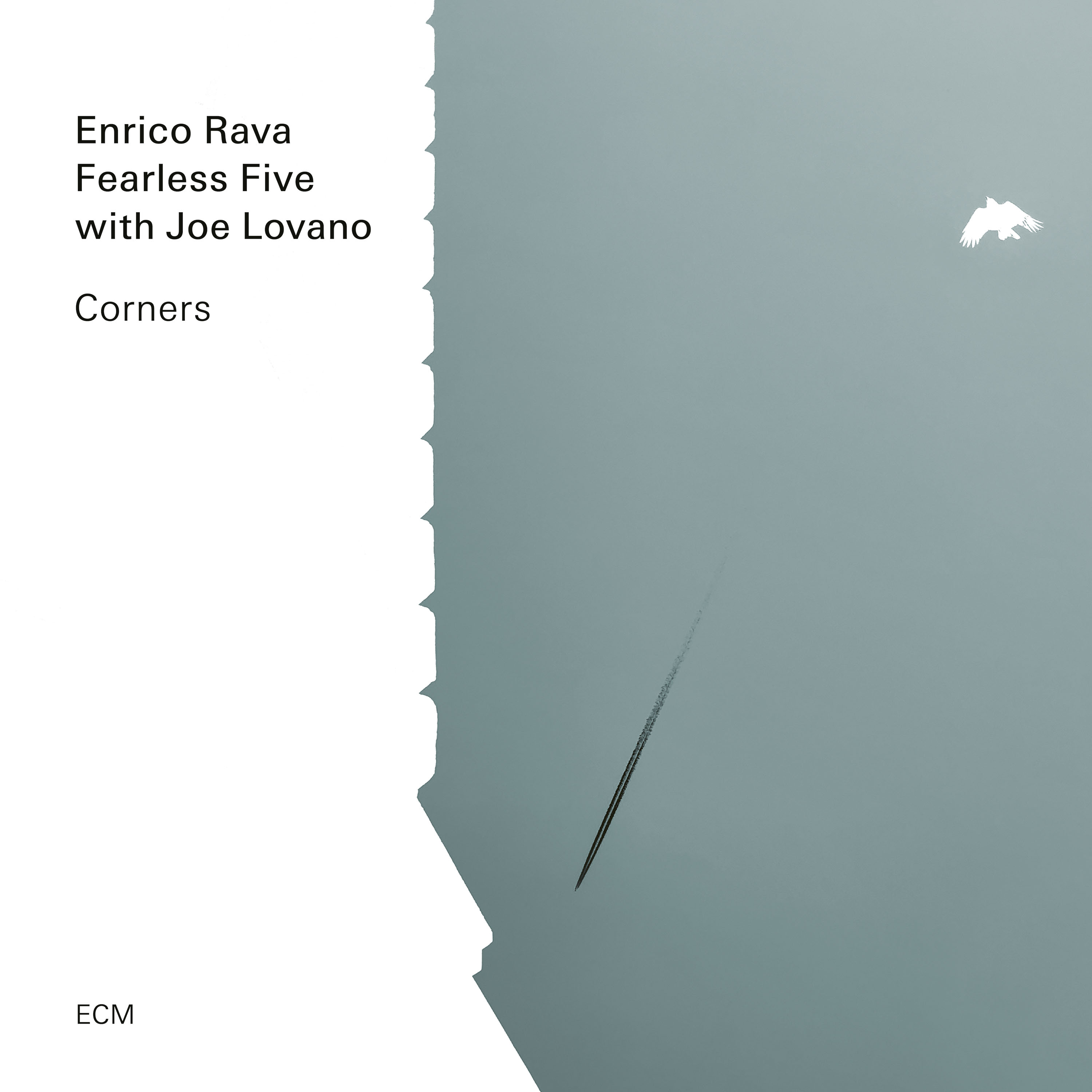
Enrico Rava
Fearless Five
with Joe Lovano
Corners
Enrico Rava trumpet, flugelhorn
Joe Lovano tenor saxophone, tarogato
Matteo Paggi trombone
Francesco Diodati guitar
Francesco Ponticelli double bass
Evita Polidoro drums, vocals
Recorded July 2025
Auditorium Parco della Musica
Ennio Morricone, Rome
Recording engineers: Angelo Mincuzzi, Massimiliano Cervini,
and Roberto Catucci (supervision)
Mixing engineer: Stefano Amerio
October 2025, Udine
Cover photo: Max Franosch
Album produced by Manfred Eicher
Release date: October 16, 2026
On Corners, Enrico Rava’s lyricism acquires fresh contours in the collective imagination of his Fearless Five. Melody enters a studio whose occupants can move the walls, and the trumpeter’s familiar eloquence discovers unfamiliar dimensions within its own breath. Formed after an impromptu concert outside Rome in 2022, the quintet takes its name from a composition on his 1978 Enrico Rava Quartet. Guitarist Francesco Diodati, trombonist Matteo Paggi, bassist Francesco Ponticelli, and drummer Evita Polidoro bring distinct compositional identities to the ensemble’s ECM debut, joined by guest saxophonist Joe Lovano, whose partnership with Rava yielded Roma in 2019. Diodati alone had worked with Rava in other groups; their intuitive rapport helps make freedom a practical condition of the music. Recorded at Rome’s Auditorium Parco della Musica on July 21–23, 2025, and produced by Manfred Eicher, the album gathers contributions from every participant. Shared authorship becomes an invitation to alter the terms of belonging. Rava’s language passes between generations, acquiring shadows with anatomies of their own.
His flugelhorn introduces “Certi angoli segreti” with a supple assurance that lets the melody reveal itself by degrees. There is something clandestine in its poise, a private staircase descending through the center of a public gesture. Diodati’s delicate marbling deepens the rhythm section’s contours, giving Lovano ample space to carve airborne trajectories without losing the grain of his sound. The tenor’s robust delicacy holds ascent and gravity in the same phrase. Around Rava’s unraveling lines, the ensemble adjusts its proportions, allowing a melodic turn to become an opening through which the whole group can pass. Paggi’s solo burns through that space with exhilarating conviction, its lower register lending physical force to the gathering intensity. Diodati, too, pursues distortion, summoning a brilliance reminiscent of Terje Rypdal: the guitar’s radiance has teeth. Across nearly 12 minutes, the piece establishes how freely this ensemble can change direction while keeping each player’s presence sharply audible. Even the most fugitive line leaves a pressure mark.
That expansiveness makes the intimacy of Diodati’s “Sin peso” especially arresting. Its cinematic sensibility allows the open distances of a western to fold into noir’s troubled interiors. Rava’s muted trumpet moves with the composure of a figure carrying an undisclosed past; each phrase seems to know which door would be dangerous to open. The guitar supplies a landscape whose horizon has been confiscated, leaving the melody to negotiate distance through touch. Polidoro’s “Le mie gambe” draws that inward movement closer to the body. Sung by its composer, it is one of the album’s most affecting performances, her voice finding a passage through the instruments that seems scarcely wide enough for speech. Slinking guitar and tender bass give the song a palpable warmth, while the horns bring its emotional implications forward through their intimate harmonies. Feeling becomes audible at the point where the individual timbres begin to soften into one another. The voice inhabits that threshold, lending the ensemble’s abstraction a pulse beneath the skin.
Lovano’s “Sun Rava” unsettles the ground again. Its abstract blues opens onto freer exchanges, with momentum repeatedly finding and relinquishing its footing. The tenor’s conversation with drums and bass is particularly enthralling: Polidoro and Ponticelli make motion responsive enough to accommodate Lovano’s changing inflections, so that each rhythmic decision has consequences for the next breath. Freedom here involves the vertigo of being heard with such precision that an impulse can alter the entire group’s direction. Rava’s “Hitchcock at the Beach” concentrates its drama into a much shorter span, Polidoro’s vocals adding a silver sheen to its nostalgic atmosphere. Lovano’s melancholy points toward tragedy with remarkable restraint, leaving grief suspended at the threshold of articulation. The ache resides in that withheld disclosure. On “Tone, Shape and Colours,” a collective improvisation sparked by a Lovano motif, the tarogato gives contemplation a reedier edge. Bells and gongs float across the surface as tensions gather beneath them. Their eventual surrender to rest feels almost anatomical, a clenched hand discovering the space inside its palm.
Ponticelli’s brief “Ça va sans dire” distills these roaming impulses into a melodic aphorism. Its nocturnal wanderings leave Diodati a generous surface on which to work, the guitar giving depth to a statement whose brevity invites close attention. Rava’s “Bowery Dance” then turns toward the remembered streets of his New York years. Guitar fuzz and pliant bass introduce an abstract opening before a harder groove assembles itself, interrupted by stops and starts that keep its momentum alert. Lovano and Rava exchange phrases with lived experience in their jaws, allowing memory to find fresh musculature in the present tense. Their ease carries the knowledge of musicians who can recognize an opening before it has fully formed. Paggi’s “Mamma” brings this restless company into a tender close. Its gentleness gives the ensemble’s responsiveness an unexpectedly vulnerable meaning, reaching beyond the bandstand toward the strange beginnings of personhood. A child enters a language already in progress, addressed long before it can answer. Someone lends significance to a cry; a sound acquires a place in another person’s life. The musicians’ mutual attention gives that ancient transaction an adult complexity, their experience deepening the risk of allowing a phrase to need an answer. Fearlessness becomes unexpectedly fragile here, entrusted to another pair of hands. Rava’s lyricism, so articulate throughout Corners, approaches the obscure tenderness from which articulation first emerges. The first person begins in the second.

