
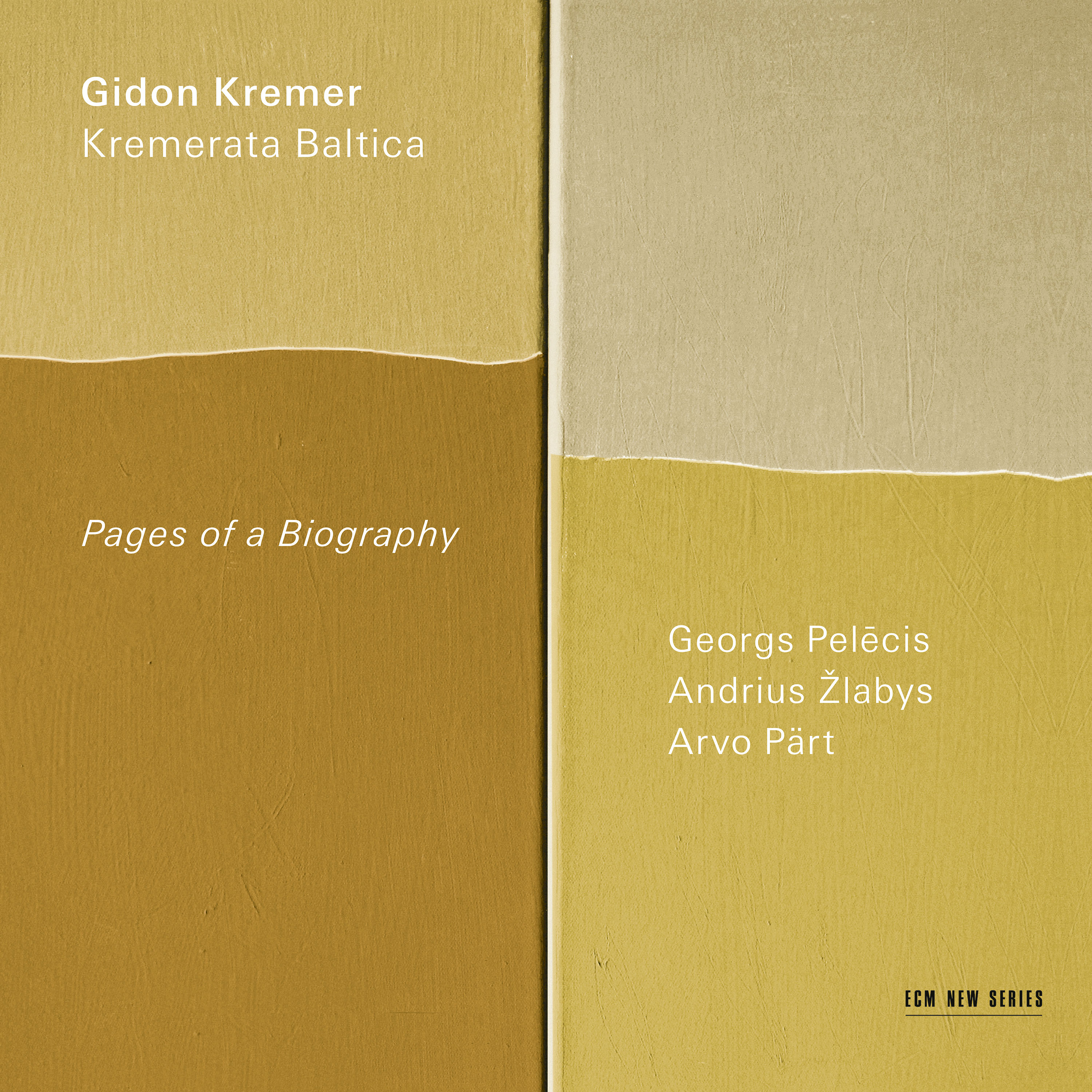
Gidon Kremer
Kremerata Baltica
Pages of a Biography
Gidon Kremer violin
Geneva Lewis violin
Andrew Pushkarev vibraphone, tubular bell
Kremerata Baltica
Pages of a Biography, Passacaglia, Darf ich…
recorded January 2024
Studio Residence Paliesius, Ignalina
Engineers: Vilius Keras, Aleksandra Kerienė
Kaleidoscope of Lost Time
recorded September 2020
at the Reformation Church, Riga
Recording engineer: Varis Kurmiņš
Cover: Fidel Sclavo
Executive producer: Manfred Eicher
Release date: October 30, 2026
Gidon Kremer and Kremerata Baltica continue their long association with ECM’s New Series on Pages of a Biography, a recording in which the violinist’s history passes through the hands of those who have helped to shape it. Georgs Pelēcis and Andrius Žlabys contribute works conceived for Kremer, while Arvo Pärt’s presence reaches back to Tabula Rasa, the 1984 release that inaugurated the imprint. With Kremer approaching his 80th birthday in 2027 and the ensemble its 30th anniversary, the program opens a space in which the commemorative impulse can become strangely permeable. A life told through music acquires entrances its subject could never have built alone. Founded in 1997 to bring young musicians from the Baltic states into a shared artistic undertaking, Kremerata Baltica gives this understanding a collective body.
Pärt’s Passacaglia, heard in the orchestral version prepared in 2007 for Kremer’s 60th birthday, establishes this relationship through the simplest of circular motions. Kremer and Geneva Lewis draw their violin harmonies over the strings with a delicacy whose slightly abraded edges give the music a spirited skin. Andrei Pushkarev’s vibraphone places metallic footprints across a frozen lake, each tone opening a small chamber of depth beneath the surface. There is something almost Vivaldian in the suppleness of the textures, though the lower strings carry a dramatic undertow that gathers its force slowly. Pizzicato figures bring that development inward, registering as minute disturbances in the body’s private machinery. Above them, the violin lines entwine and separate with an ease that leaves room for friction. The recurring harmonic pattern gives each change a place to return to, even as its emotional coordinates shift. Within the circle, belief is allowed to wander; repetition discovers the difference between coming back to a place and becoming available to it.
Pelēcis’s title concerto, written for Kremer in 2007, gives that wandering a more personal geography. Their friendship began during their school years in Riga and continued in the shared quarters of the Moscow Conservatory, where Pelēcis witnessed the preparation through which public achievements slowly acquired their private framework. His score draws on the violin concertos that became decisive points in Kremer’s early career. Brahms and Elgar enter alongside recollections of competition performances; Sibelius and Beethoven provide further points of contact with the interpreter’s developing identity. Yet the quotations remain answerable to the person who once lived inside them. Set among more dramatic episodes, they emerge from the uncertain border between musical inheritance and remembered experience. Pelēcis’s description of the solo monologues as “intimate pages from a personal diary” becomes especially telling here. The diary has been written by someone else, and its subject must read himself into being through a voice that already knows him.
The opening solo feels its way into this territory with the vulnerability of childhood. Kremer gives the line an existence prior to explanation, finding in its exposed grain the authority of something alive. Buoyant orchestral gestures begin to court it, and their exchanges admit dissonance at the margins. Pelēcis lets passages of flowing beauty encounter the abrupt editing cuts of recall, as the pastoral turns its pockets inside out, spilling dark coins into the grass. Throughout the piece’s nearly thirty uninterrupted minutes, the violin speaks from within that complexity, drawing the insistent rhythms of the strings into its own work of discovery. Kremerata Baltica responds with an alertness that gives the broader episodes their cinematic scope while preserving the intimacy of the solo voice. The relationship between them becomes a sustained act of thinking in sound, capable of admitting doubt without surrendering its momentum. Near the close, the vibraphone distils the preceding expansiveness into a peculiarly bare utterance. The violin threads itself through that resonance, a silver filament drawn from a sentence whose meaning has become too familiar for speech.
With Žlabys’s Kaleidoscope of Lost Time, composed between 2014 and 2020 for Kremer and his ensemble, that inward scrutiny enters a more fractured consciousness. The composer envisioned Kremer’s sound in his earliest sketches, and the violin writing carries the imprint of a particular touch even at its most abstract. Žlabys speaks of giving the sensation of time’s disappearance a more durable form through music, so that beauty and sadness can be visited again. Across the work’s five movements, such revisitation becomes a problem of perception: every return alters the eye through which the past is apprehended. The opening Prelude sets this process in motion through dramatic undulations, its folk inflections carrying something dreamt into the firmness of the pulse. The dance occasionally appears to have misplaced its dancers, leaving their gestures suspended in the strings. Kremer inhabits those absences with a searching intensity, giving the music’s surreal spaces enough physical resistance to be felt. Time acquires joints here, and we hear the strain of their bending.
Scherzacaglia carries its mixed ancestry in its name, inviting musical forms to loosen their claims to separate identities. Along the way, neoclassical poise meets a rhythmic insistence suggestive of Shostakovich. Dissonant hymnody opens fissures in the devotional surface. The performers give each shift a distinct pressure, sustaining the sense of movement through different states as Dissonance gives way to Quarter=87. In Perpetuum, the violin’s flowing beauty opens an expanse so luminous that earlier agitations seem briefly to have been cast by its light. The double basses stir beneath that radiance, pulling its apparent weightlessness toward the body, until the opening dance reenters with the altered gravity of something that has survived its own telling. Žlabys makes this return both irresistible and disturbing.
Pärt’s Darf ich … (1999) gathers these questions into a more intimate register, with Lewis taking the solo violin part beside Pushkarev’s tubular bell in C sharp. The violin has a declamatory force that feels inseparable from its prayerfulness: its address is bold because the act of addressing remains vulnerable. Against the strings, the bell gives that vulnerability a vertical dimension, opening a heavenward passage through the music’s spare physical means. A requiem appears to have been dismantled and its fragments reassembled as a psalm, the weight of mourning redistributed through the possibility of praise. Kremer calls the work “almost a prayer,” understanding it as a reminder that musicians serve a cause beyond themselves. Lewis gives that conviction a voice of her own, making the album’s generational relationship audible in the place where it becomes most exposed. Her final high note is exquisitely breathy, a slender fold in the air holding open the title’s unfinished question. Permission itself acquires a barely material form.
That question quietly rearranges the premises of a recording devoted to one musician’s life. On an album named for Kremer’s biography, the closing solo belongs to another person, and his history finds one of its deepest expressions in her freedom to speak. The friendship encoded in Pelēcis’s concerto and the evanescence Žlabys seeks to preserve have brought us to an ethic of hospitality. Whatever these relationships transmit may become unrecognizable to the giver. Biography begins to touch the obscure responsibilities of parenthood, where a future is nurtured without its face being prescribed. Somewhere an eyelid is forming in darkness, protecting a gaze the past cannot rehearse. To have lived well may be to have made room for that gaze, including everything in it that will never turn toward us.

