Dub is smoke without mirrors, a realm in which a single beat, bass line, or keyboard riff might jettison you in the orbit of another planet. It is an axis of spirit and tactic, a philosophy shaped through strategic distribution of energies. In the context of Bill Laswell’s Method of Defiance, the parameters of dub take on new valences of initiation, and throughout this album, refashioned from the project’s first two appearances on its namesake label, their pressures equalize across a raw spectrum of possibility.
The Scientist, a remixer of exacting standards and enmeshed execution, conducts three laboratory experiments. At the outer rims are his “One World Dub” and “One World Disorder Dub,” each a head nodding across the mind’s eye, of which every bloodshot vein is a river. Rooted in groove, even as they groove into roots, their magickal patterns serve us a steaming bowl of get into it. If one is a body, the other is its soul. On the exhale, that same body basks in the smoke of “Herb 4” with enough justification to fill a book of harmony.
Sonic pedagogue extraordinaire Mad Professor gives us the first of two takes on “Elijah’s Lament.” While his is a mirrored consciousness that plays with time like Legos, the other, by MRC Riddims (a.k.a. Oktopus and MRC) is a love letter to Krooklyn that fills our legs like sun the Hudson. It is a world unto itself, one where phantom selves dance until they sweat themselves out of their minds and back into our own. Sub Code, who hails from Morocco, gives us a rarefied, immediate version of “Do or Die.” It is a breath given meaning through faith in the evergreen conflict of populations. These last two are among a handful of one-way communiques, the others being Perdurabo 6’s “One World First Claim Version” (a necklace strung with plaster footprints and hung around a lion’s neck) and “Encode Armour Feed” by the isosceles Prefuse 73, whose embrace of Laswell’s prime currents is a match made in outer space and brought to earth for an all-too-brief visitation.
Dr. Israel is a master oarsman in these waters, rowing as he does with entire trees in his hands. His plunges into “Taykeovah” and “No Salvation” remind us that exploration kills in the name of self. Where one is melodic glass shattered and re-glued for strength, the other is a spider’s web unchained and repurposed for flight.
At the topographic endpoint, meditating on a mountaintop, is Laswell’s binary star. “Quantum Echo Apparition” renders his bass an elliptical entity, by whose hands the heart of dub is massaged to tenderness, while an “Entombment Dub” of the same cut frames darkness as a stroke that gives life without need for validation but the listener’s undivided attention.
The first release from the namesake project of bassist Bill Laswell’s M.O.D. Technologies label, Jahbulon introduces a collective freed by evolving membership yet united by a common prayer: to move. In this incarnation, Laswell island-hops with fellow travelers Dr. Israel and (Garrison) Hawk on vocals, Bernie Worrell on keys, and Guy Licata on the percussive front line. Yet the beacon of this record is Hawk himself, who, true to name, soars above every soundscape with sharp vision and dives for the kill at the slightest hint of escape.
In this respect, “Patterns of War” speaks less of outward aggressions than inner protections. Its opening whistle, reminiscent of a bomb in freefall, sends up a shock of hip-hop particles, shot through with reggae afterburn. The latter bronzes the words, each a fist against oppression that turns mass destruction on its head until weapons fall out of its pockets in two equidistant piles. In the shadow of this difficult introduction, the little flame of “Salvation” flickers into a full-fledged conflagration of brotherhood. God is not only in the details, it seems to say, but also born from them. This is glory in Creation, a circulation of nature as father, mother, and child in one.
Singularity further prevails in “One World,” a central, affirmative palette. Its vocal fingerprints litter the canvas until portraits of a city, a borough, and its denizens take discernible form. In their hands, a book of knowledge reads: Whenever you are disillusioned by what happens downhere, know that reality never ceases upthere. Such is the message of “Do or Die,” the halting beats of which serve to emphasize its corporate surgery before retexturing into smoother down midway through.
Whether spiraling through the tightness of “Revolution” or sending listeners on missions of the heart in “No Justice,” splashing the inner ache of “Taykeovah” or looking beyond skin into the stealth groove of “Elijah’s Lament,” each song blasts its refusal to be held down, translating technology of the rich into aid for the destitute. A testing of faith by the genocide of global interests. A scriptural circle in which judgment is swift only for those unworthy to wield it.
Each of these urban zones acts as a reflection of the body and its genetic recitations—rituals forged in breath and semantics. Even the illustrative affirmations of “Herb is Burnin’” and “Diss Never” breed a certain invincibility of purpose. Worrell’s sparkle and shine are particularly salient at expressing the changes of tomorrows, even as they nibble on leftovers at the table of survival. No soul should have to fend for sustenance on a planet united against its own iniquities. But this is exactly what’s going on, and why we need to open our ears like the pages of a book. We must rise above the power of difference not between each other but within ourselves before we can recognize what we all share.
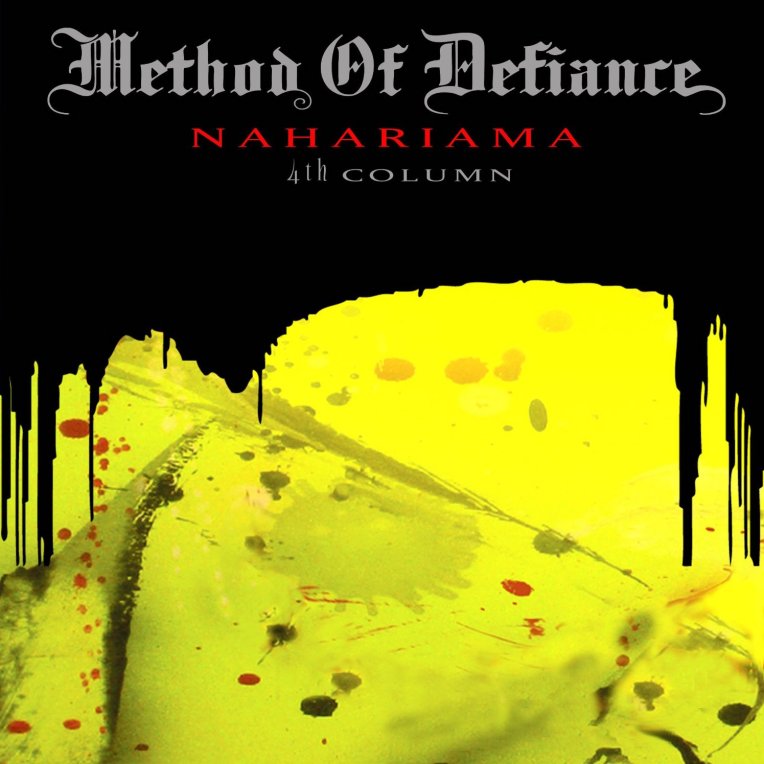
The silver mouths of Method of Defiance inhale the first settings of Nahariama, exhaling the golden acid of “Anachronizer Reloded” as if it were an incantation for the artificially intelligent: a transmission of subterranean vibrations made palatable for aboveground receptors. The arms of this music squeeze visions of apocalypse so tightly of their judgment that by the end only light is left.
In these beginnings flutters a list, inscribed as if on papyrus. It is a roster of and for the ages: Bill Laswell on bass, DJ Krush, Bernie Worrell and Robert Burger on keyboards, Toshinori Kondo on trumpet, Graham Haynes (son of drummer Roy) on cornet, Guy Licata (purveyor of real-time drum ‘n’ bass) on drums, and master Senegalese percussionist Aiyb Dieng. Names and vocations are penned in accordance to their stations, solidifying the place of each in a universal unfolding of sonority. The rhythms thereof draw sweat even from heatwaves, gifting the knowledge of history made present as if it were a drop of night powering a thousand bodies.
The dub vibrations of “Unearthed” sail a river of lava, guided by the oar calls of a melodica. It’s all in the details of the vision: the sacred crotales, the snaking bass-speak, the keyboard riffs and reveries. All of these combine in one stable vessel, opening pores to the nourishment of uncertainty. The sun must set even as it rises, leaving the shed skin of some nominal mission to choke in moonlight. The volcano continues to complain, and the musicians can only hope you will hear it even when closing your eyes to what the day has brought back to life.
In the wake of this slumber, “Anathema” comes as a fluid shock to the senses, to which Kondo’s trumpet is a ghost summoning its own body before cremation. It turns sediment into wine of experience, inviting the shaman for a sip before the slip. In this act of transference, it’s as if the very sky were being wounded, leaking the cloudy plasma of “Dark Rain,” in which organ-breath and dub-tears fuse in a spiral of mutual interest. The mirage is as real as the groove pouring from its open veins, a conduit between flesh and earth that ignores the sky as the illusion it has always been.
Within the context of these downright mystical cymatics, it’s all the more sobering to be reminded of human folly by the remnants of “Fukushima.” Here the listening, being spun from molecular awareness, is as thick as a shroud of mourning. Laswell is the primary voice, a serpent whose skin wears the aftermath like a scar in ways the dead cannot. It has no wall of terminology to scale, no labyrinth of choice to solve. It has only internal radar and a desire to recalibrate its disturbances.
Hence, the resurrection of “Abyssos,” which shakes off the sadness like water from canine pelt and moves toward a healing world. Knowing that emptiness has always been its greatest threat, it smiles as the galaxy opens wide for a swallow of hope. Licata’s drumming keeps the iconography three dimensional, if only that we might better understand its ambient dispersion.
This leaves “Quantum Clash” to unleash the fullest groove of these all. Drilling into the ground for want of home, it proceeds at full tilt, keyboards and bass allowing the surrounding frictions plenty of singing room. This is catharsis as anti-catharsis, winking at its own reflection to demonstrate the whimsy of infinity.
It’s no giant leap, then, to surmise that album’s title comes from The Book of the Sacred Magic of Abramelin the Mage, a Kabbalistic grimoire dating back to the 15th century. The word nahariama means “river of waters,” and describes the concepts of art occurring herein with far more veracity than the hundreds of other words in which I have cushioned it. Either way, its currents will flow, with or without us. Of that you can be sure.
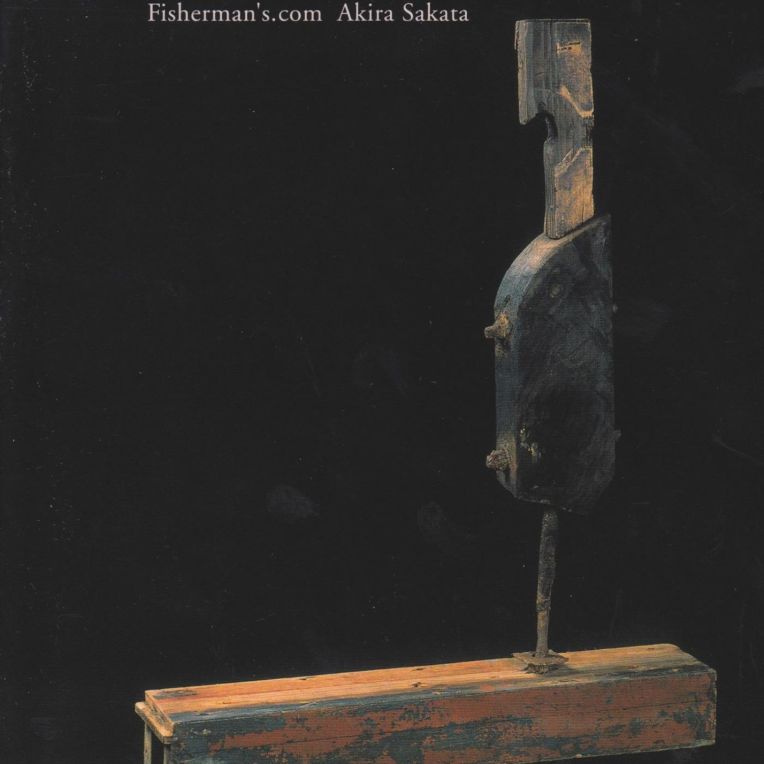
Originally released in 2001, Fisherman’s.com is Japanese free-jazz stalwart Akira Sakata’s ode to folksongs of the sea, reimagined and repurposed as seeds for avant distortions. Featuring Sakata on alto saxophone and vocals, Bill Laswell on bass, Pete Cosey on guitar, and Hamid Drake on drums, it’s an intensely personal statement on the fluidity of tradition.
“Kaigarabushi” opens with a fisherman’s song from the region of Tottori in western Japan. Sakata’s singing of it has a mineral quality that will taste familiar to admirers of Mikami Kan. Like a blind minstrel who feeds only the ears of ghosts longing to relive their exploits, he touches listeners from temporal distances. The band at his side sets up a row of large beakers, each filled to brimming with funk. Yet while Laswell and Drake are precisely measured, Cosey stirs up an amorphous mixture of colors through the flange of his talking guitar. His sound bleeds out the smallest facets of Sakata’s singing, and finds in their reimbursement an alluring style of damage. So, too, does the bandleader’s reed work pour on strange beauty.
“Ondo no funauta” sets out on more troubled waters before bass and drums drop an anchor of groove, while Cosey’s fins move in more mysterious ways below depths. By no coincidence, the song tells of boatmen handling a particularly treacherous strait in Hiroshima Prefecture, though one might never know those challenges for the skill with which the band navigates them. Neither does Sakata’s saxophone betray one wave of that treachery, as it emotes without fear, and blasts the surety of their experience beyond the ultimate fallibility of their technology.
“Saitarabushi” (incorrectly Romanized as “Saitarobushi”), another fishing song, also made an appearance on Sakata’s 1997 trio album, Dō deshō?! (How’s That?!). Here is the fruit of dangerous labors, the celebration a big catch with due ceremony. Sakata is soulful as ever over the band’s shoreline backdrop, even as Cosey portals in some modal ghost signatures of those who drowned long so. Laswell is thick and thin by turns, imprinting the sand but flying off with a harmonic in the same breath.
“Wakare no ippon sugi,” a ballad from the 1950s that clinched singer Hachirō Kasuga’s status as a pioneer of the Japanese enka form, is barely recognizable through Sakata’s filter—no small feat for such a famous tune. The forlorn lyrics tell of love lost under a cedar tree, a parting so sad that even the birds cry in the mountains. Not that a non-Japanese speaker would know this, given the upbeat presentation. All of which makes Sakata’s cries through the reed, and the guttural exhale with which he ends the album, that much more cathartic and emotionally relevant.
From this archival trove comes Bill Laswell’s remix of “Kaigarabushi,” which holds fast to its original drone but pencils in hues of Mongolian throat singing and faraway percussion. Cosey’s guitar is reborn as a long stare into the sun, while Sakata’s voice reaches for even farther stars, his saxophone strangling them until they gasp for darkness. The funk returns intermittently, only to fall into the earthly ooze from which it sprang.
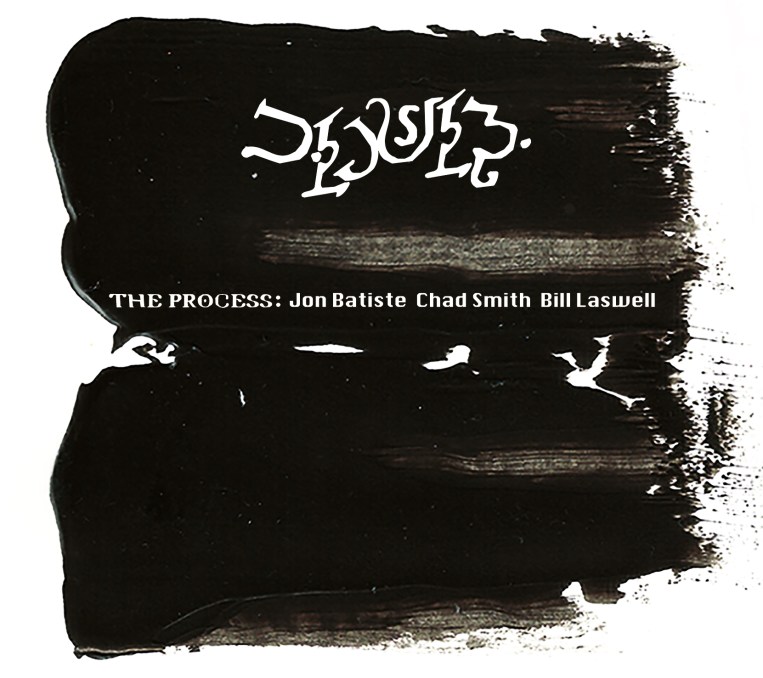
Keyboardist Jon Batiste (Stay Human), drummer Chad Smith (Red Hot Chili Peppers), and bassist Bill Laswell (the whole damn musical universe): three master musicians meeting for the first time in a studio to score a film that would never be made. Or so the EPK would have you believe. This is, however, something of a misrepresentation, one which assumes sounds exist strung like beads along continua of time. But a deeper listen reveals these men were already linked through the kinship of their sonic pursuits: different religions, if you will, offering sacrifice to the same gods. As for the unmade film, it too is a product of imagination that requires the screen of a listener’s mind on which to project itself before any semblance of narrative can occur.
At the molten core of this project is Batiste himself, who spins three original pillars of support at key intervals. Their titles—“B1,” “B2,” and “B3,”—read like the display of an elevator descending into some psychological archive, where the aisles between stacks are meant for kneeling in deference to those things unknown even to the self. Awash with suspension and slippage in equal measure, each digs deeper into the mind’s eye to pull out a retinal shift from axis to praxis.
Moving to the surface of this cross-section pulls us by the ears onto the igneous glyphs of trifecta minerals. “Timeline” feels like an extension of its surroundings, holding feet to flame until they crackle with the blisters of a million journeys. Batiste rocks the Hammond organ like a machete through vine, while in “Spiral” (best described as a dance party inside a giant didgeridoo) he adds harpsichord and strings in service of some parallel, cinematic reality. “Black Arc” is more radiant and composes its speech through Laswell’s harmonious eclipse.
From the album’s guest contributions, messages emerge weighted and secure. “Drop Away” features TV on the Radio’s Tunde Adebimpe on vocals, for a vibe that puts one in mind of Peter Gabriel at his worldliest. A solid groove beneath it all, courtesy of an especially lucid rhythm section, urges Adebimpe’s voice through a netting of enhancements and inside-outing: a method of disappearance, whereby the self becomes something of an idol to its own destruction.
Killah Priest and Garrison Hawk pen a letter to interplanetary communication in “Turn on the Light/Ascent,” for which the Wu-Tang Clan rapper and Jamaican singer respectively harness the beat as a means of flooding channels beyond this marbled terrarium we call home. From heavy beat-drops arises a phoenix of celestial pianism, tenor sax (courtesy of Peter Apfelbaum), and liquid bass. Trumpeter Toshinori Kondo is no less vocal on “Haunted,” wherein structures contract and expand much like the air in his lungs. This one runs a knife blade along its own gums until they bleed. Guitarist Dominic James adds crunch to “Time Falls,” bringing about an urgent metamorphosis from bling to bang, as if in denial of the jazzy nocturnus that is “The Drift.”
Whereas the filaments of life burn slowly until the body swells with endings, the landscape of death is sustainable and verdant. And this is, perhaps, what the titular process is all about: understanding that everything is a transition into the next, without end.
Anat Fort piano Gary Wang bass Roland Schneider drums Gianluigi Trovesi alto clarinet
Recorded November 2013, Auditorio Stelio Molo RSI, Lugano
Engineer: Stefano Amerio
Produced by Manfred Eicher
U.S. release date: April 8, 2016
On Birdwatching, Anat Fort’s third album for ECM, the Israeli pianist and composer proves once again that music is a journey without repetition. I trace this axiom back to her label debut, 2007’s A Long Story, from which “Something ’Bout Camels” carried over into the 2010 follow-up, And If. This time around, another tune from that same record—“Not The Perfect Storm”—makes a reappearance, now re-cloaked by the melodic overlay of Italian reedman Gianluigi Trovesi, who joins her trio with bassist Gary Wang and drummer Roland Schneider for her farthest-reaching record to date. The rumbling pianism of that latter track speaks at once to Fort’s illustrative prowess and willingness to sidestep its clichés. Indeed, beyond the thunder implied in the lower register of her keyboard, the broad wingspan of Trovesi’s alto clarinet speaks of clearer skies. The forces at work are greater than the sum of their parts, which over the course of six and a half minutes emit more light than they absorb.
Moved by this collaboration, I opened a recent interview with Fort by asking about Trovesi’s involvement—a partnership perhaps as inevitable as it was unexpected.
“Unlike with Paul Motian, I was never intimidated by working with Gianluigi. I really loved his work, which I’d known through ECM, and fate brought us together on stage for a jazz festival in Novara, Italy in 2013. A few months later, he joined my trio in Israel. He’s such a gentle and beautiful human being, so there was never any conflict. The only thing that gets in the way is the language barrier, but at any rate we communicate through the music.”
Case in point: “Earth Talks,” which finds them conversing as a duo. Like Fort herself, Trovesi seems to attract entire planetary systems into orbit than be gravitationally pulled into others. His chromatic inflections are the blood flow of her ebony and ivory veins, which pulse with solitude even as they drink in joyful praises. Trovesi walks over, never through, Fort’s articulate themes, so as not to disturb their archaeological integrity. Even when he joins the full trio, as in “Jumpin’ In” or “Murmuration,” his sinewy topography feels like grass in love with the soil. In other words: an affirmation of roots.
Neither does the trio engage with blatant exhibitionism, but finds unity—and utility—in the negative spaces that frame each intimate spectacle. Such alignment to the inner workings of faith gives the quartet all the oil it needs to burn through the collectively improvised “Inner Voices.” Though delicate and exploratory, it never breaks its stare. Such disparate elements reach deepest convergence in two variations of “Song Of The Phoenix,” in which the trio clears a path for Trovesi’s transformation from roaming to mourning. His rougher bending of pitch enhances the emotional gravity at hand. Wang and Schneider reveal themselves to be so much more than a rhythm section, but a listening organ attuned to every gradation. Which is not to say their individual talents are not forthcoming. In the trio-only “It’s Your Song,” Schneider’s drumming is remarkably fluent, moving with the insouciance of an Olympic ice-skater, while Wang’s kinetic solo lends the scene some much-needed heat.
It’s impossible for me to experience such gestures without reading biographical impulses behind each tune. The beauty of this record, as with all of them, is that Fort allows more than enough space for individual interpretation:
“I think that’s how I usually treat my music, or how my music treats me, I should say. It’s a very personal thing. I could even call it a private universe, which of course I’m trying to share by playing and putting out there. This recording is different for having so many short pieces, which wasn’t something we planned to do. But as [producer] Manfred [Eicher] and I started mixing it together, we did more editing than I’ve ever done. It clearly needed to be a story of vignettes. That was a surprise for me, and something that the music initiated, and which we answered collaboratively. As I say in the promo video, the music will convey its own story if you let it.”
Listening to what the music was saying led to Fort to add two improvised piano solos: “First Rays” and “Sun.” Added at the last minute, these became the first and last tracks of the final mix. Within this frame, the album is better able to balance color and monochrome.
On that note of production, Birdwatching marks the first time Fort has worked with Stefano Amerio at the Auditorio Stelio Molo RSI studio in Lugano, Switzerland, thus completing her unintended tour of ECM’s heavyweight engineers, rounded out by Jan Erik Kongshaug in Oslo (And If) and James Farber in New York (A Long Story).
“Each of these experiences has been great,” Fort admits, “and Stefano has a great ear. It was very special to record at the RSI studio, because you record live, setting up on a stage in a very small auditorium without headphones or dividers. It’s really unique to do it that way, and he knows how to record so that it feels live but also clean enough to be crafted.”
One can hear this especially in “Meditation For A New Year,” which boasts some of Fort’s most soulful playing on record, but keeps its expansiveness within reason in search of a major chord. Like “Milarepa,” of which only the first of three parts appears on this album, it indicates a new phase of self-expression, a turning of the ear toward the self to know what may become of love.
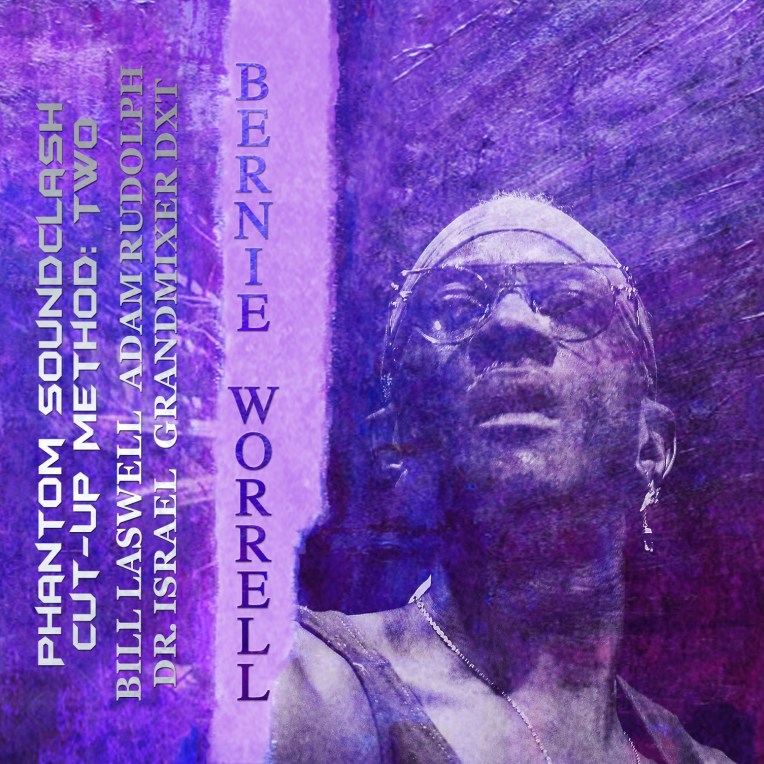
The single track of master keyboardist Bernie Worrell’s entry into the Phantom Soundclash multiverse carries the title “Purple World.” Bassist-producer Bill Laswell, percussionist Adam Rudolph, beat scientist Dr. Israel, and pioneering DJ Grandmixer DXT are Worrell’s transient crew—all of them suited to withstand a wide range of emotional impacts. Only here, they are interested less in the effects than causes of said impacts.
Worrell’s art is a wonder to behold, not least of all because on record he plays for us alone. Every detail rendered audible through his art is a treasure, from which unfolds the lotus of a gracious spirit. Touched by the light of more distant suns than ours, he lobs funk over galaxies in that brotherly way of his, seeking a universal blues. Yet there is something reverential and earthly, as internal as it is eternal, to his musical body, of which each gesture is more decipherable than the last. Worrell preserves these behaviors for future generations who might scour their contours with instruments no longer resembling the ones that produced them.
Laswell’s fluid bassing arises in womb-song, its umbilical cord shooting nebulae at the blade of conceptual silence. As these heavenly bodies comingle, they draw one another into a tantric lore spoken by the prophecy of technology. (The organ is inorganic because it can only exhale, but nevertheless speaks truths as only a machine can.) Through the vale of this nexus runs a river of beats, whose current glides across the bedrock of a thousand ages until it becomes a simulacrum, a world of worlds.
The underlying groove is likewise something more than itself—not merely an invitation to nod along but fully environmental attunement. Metals in the rhythm-sphere indicate an elemental core, which as the transmissions distort bleeds dark matter. Notes grow less pronounced, flashes of memory like so many solar flares as the bass fragments into override.
A rare color in nature, purple visualizes a living resonance as intimate as the copulation of time and space. It is the inherency of the groove incarnate, a cosmic wound healed through listening. And as this journey winds down into subterranean dream fronds, Worrell once again proves that music is something from which we were born…not the other way around.
Wu Man is a peerless virtuoso of the pipa, a Chinese lute-like instrument rarely heard stateside in close quarters, much less in the hands of its greatest living master. On 10 April 2016, the Shanghai Quartet paired it with classical strings, closing out the Cornell Concert Series with an adventurous program. The results, however, were inconsistent and, at times, baffling.
The Shanghai headliners began with three Chinese folksongs — “Yao Dance,” “Shepherd’s Song” and “Harvest Celebration” — beautifully arranged by the quartet’s second violinist Yi-Wen Jiang. The last two songs in particular, both from the southwestern province of Yunnan, varnished the grain of their arranger’s relationship with the music of his homeland, further showcasing the superb technique, dynamic control and finesse that have earned the quartet high regard. Sparingly applied techniques, including percussive tapping of the cello, lent delightful tactility. At the opposite end of the spectrum was the concert’s concluding “Concerto” for string quartet and pipa by renowned composer Tan Dun. In this version, reduced from an orchestral original, the pipa felt out of place. It was, rather, the backbone of a piece which, despite colorful shouting and extended approaches from the string players, proved Wu Man as the focal point of the evening. She commanded the hall so much that the Concerto was better read as a robust adventure for the pipa soloist, to which the addition of strings seemed an afterthought.
Thankfully, Wu Man’s incredible talents grabbed some deserved spotlight in a traditional solo known as “Xi yang xiao gu,” or “Flute and drum music at sunset.” Shed of the modern contrivances that flanked it, its colors shone all the brighter. Wu Man’s artistry was best expressed in the subtle changes — bending pitches and such — which she applied to notes after they were plucked, thereby evoking so much of the landscape and texture the music was meant to describe. Here were rhythms of nature recreated in an instrument born from it: a perfect cycle.
All of which made Zhao Lin’s “Red Lantern” suite all the more incomprehensible for its inclusion. The piece itself has a formidable heritage. Zhao Lin is the son of China’s great film composer, Zhao Jiping, whose soundtrack for Zhang Yimou’s 1991 Raise the Red Lantern stands among his finest. Its assembly of voices and traditional instruments enhanced the film’s tragic social critique of the courtyard house (sanheyuan) system still prevalent in 1920s China. The film’s long takes and thorny emotional unfolding, emblematic of its director’s “Fifth Generation” politics, caused the film to be initially banned in China. As someone intimately familiar with both the film and score, I was confused by Zhao Lin’s reduction of his father’s work, and by the multimedia presentation of which it was one component. On the latter point, the performance was accompanied by video shot in a modern Chinese courtyard, presumably to echo the setting of the film. In her introduction to the piece, Wu Man bizarrely asked us to imagine drinking tea in such a space while listening to the music. But all I could imagine was Yan’er, one of the characters in Raise the Red Lantern, freezing to the point of collapsing in the central courtyard, for all a martyr of the story’s patriarchal injuries.
Even without the source material in mind, the newer video was an incongruous series of shots, replete with modern skyscrapers visible in the background and exit signage appended to doorframes, all of which ruined the atmosphere. Why not show a montage of the film itself, or at least something more appropriate that didn’t look like the test footage of a tourism video? In any case, the music alone was a watered-down version of the original that obscured the film’s tragic subtext. Zhao Lin’s skills fall far from the paternal tree, and hearing these pedantic arrangements of familiar motifs made even less sense with the invasion of new imagery. The whole thing smacked of nothing more than a compositional favor to exploit this rare combination of instruments.
The penultimate piece of the program, Zhou Long’s Song of the Ch’in, was more successful. A fluid piece of cohesive character meant to evoke the sounds of the titular ch’in, a traditional seven-stringed zither, it had a messy, organic feel that allowed us greater access to an emotional world in which diverging styles of music melded together seamlessly. But by then the unpleasant ring left in my ear, and my heart, by the historical and creative revisionism of Zhao Lin’s technical exercise was too deafening to ignore
(See this article as it originally appeared in The Cornell Daily Sunhere.)
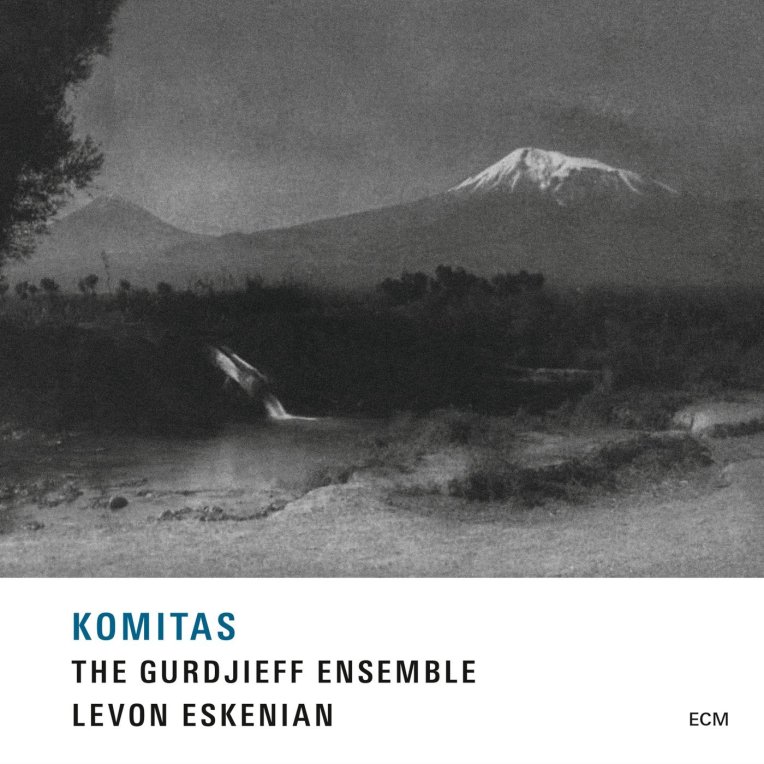
As part of a recent feature on the new ECM album by the Gurdjieff Ensemble, featuring the music of Komitas, for RootsWorld online magazine, I had the fortune of interviewing the ensemble’s director, Levon Eskenian. The article also includes a review of the album by Erik Keilholtz. My own review of the album, soon to appear on this site, will feature others parts of that same interview not included for being more specifically related to ECM. In the meantime, click the cover below to read on.







 Between Sound and Space: ECM Records and Beyond