Vijay Iyer Trio: Break Stuff (ECM 2420)

2420 X

Vijay Iyer Trio
Break Stuff

Vijay Iyer piano
Stephan Crump double bass
Marcus Gilmore drums
Recorded June 2014 at Avatar Studios, New York
Engineer: James A. Farber
Assistant: Akihiro Nishimura
Produced by Manfred Eicher

“He often said that he would sit down at a piano someday and show me how jazz worked, and that when I finally understood blue notes and swung notes, the heavens would part and my life would be transformed.”
–Teju Cole, Open City

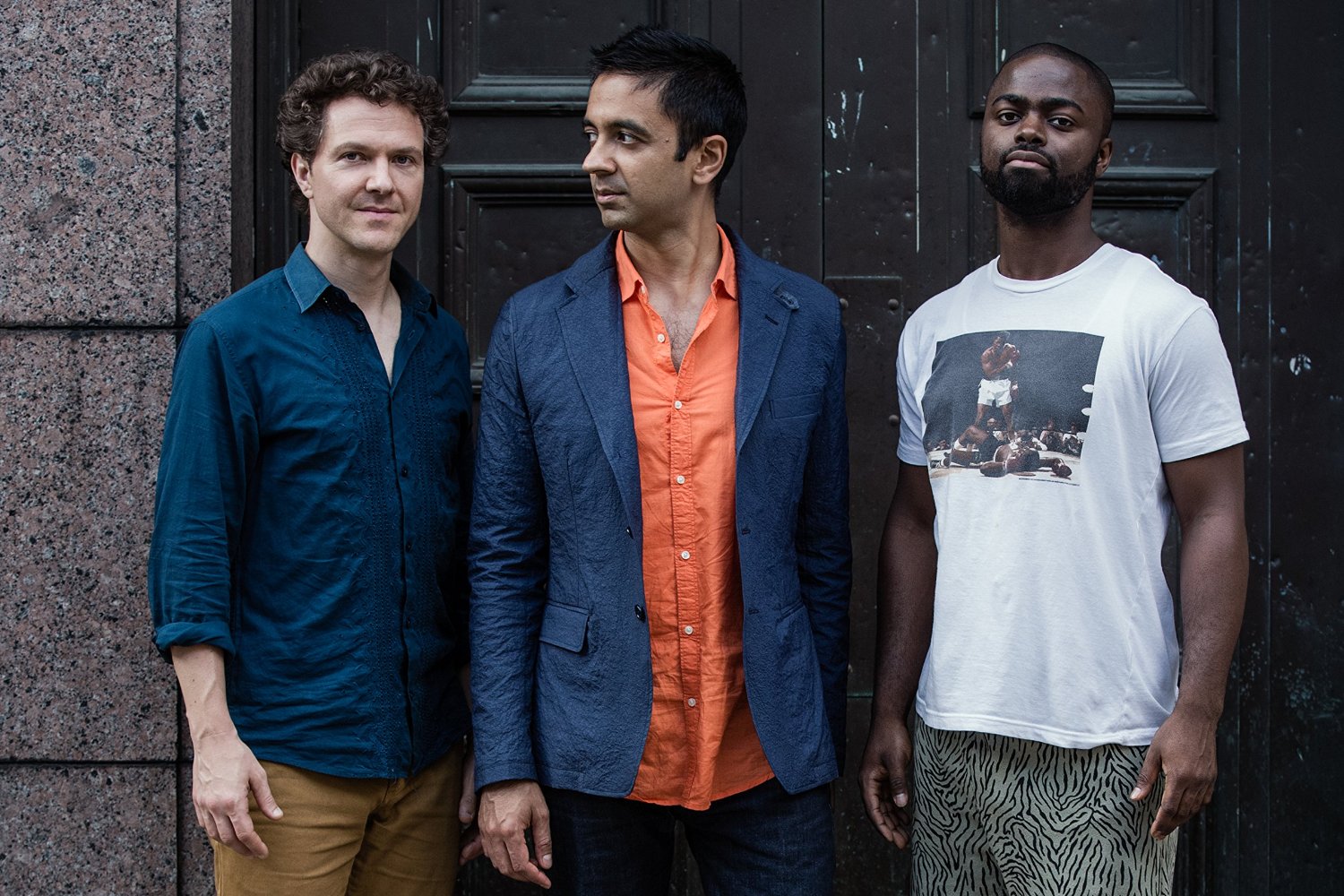
After his imaginative ECM debut, pianist Vijay Iyer returns to the label with bassist Stephan Crump and drummer Marcus Gilmore. Although in operation for over a decade, the trio still finds room to grow, and rarely in such giant leaps as those documented on Break Stuff. The title is Iyer’s mission statement: rupture as rapture. The music hanging from its rafters is theory in practice.

Iyer has been blessed with a peerless tonal command of his instrument. Like the greats that inspire him daily, his artistry is summed up in the word touch. His composing reveals another distinguishing characteristic: a penchant for tempering beauty with something obfuscated. This allows us to appreciate the role of either toward the consummation of the musical experience. Not everything, he seems to say, can be sunshine and roses. We also need moonlight and thorns.
VIT

The atmospheres of Iyer’s trio are remarkable for using such minimal means, and nowhere so evocatively than in the three avian-themed tracks peppered throughout. The well-rounded “Starlings” introduces us to this album’s freshly baked sounds. Already, two things are noticeable. First is that Iyer’s descriptive prowess is as formidable as it is organic. Second is that listeners are invited to bring whatever associations they might have to the music without judgment. What sounds like a flock overhead to one may to another feel like the city streets to another. “Geese,” in fact, proves to be as much about nature as nurture as it morphs from harmonic rumination into urban sprawl. Even the evocatively titled “Wrens,” which ends the album, reaches back with arms bangled in classical chord progressions toward sublime narrative origins. Between the latter two tracks is nestled one of the album’s heartfelt tributes. “Countdown” pays deference to John Coltrane, starting off small but playing big in some of the trio’s densest texturing on record. Gilmore reads between the lines like no one’s business and adds further grounding to other classics by Thelonious Monk (“Work”) and, in a Gershwin-flavored piano solo, Billy Strayhorn (“Blood Count”). In these one can hear the nakedness of Iyer’s creative process, all its trials and errors that occur in the name of seeking. His nod to DJ Robert Hood is likewise into its own negative spaces, laying microtonal harmonies over consonant foundations.

“Taking Flight” is another portrait of the musician’s world. Here, too, balance reigns, weighing on one pan constant travel and dislocation, but on the other the connections achievable only through performing. As indicated by its mixture of reggae and impressionistic touches in the higher register, this tune embraces whatever life has in store. Such openness imbues the remaining tracks with like spirit. Whether in the amethyst “Chorale” or the more ornamental “Diptych,” in both of which Iyer’s rhythm section makes subtle sweeps of brilliance, the trio rounds every angle to jigsaw fit. Yet none of the above is so confident as the title track, the sway of which recalls the opening scene of Spike Lee’s Malcolm X, in which the director and Denzel Washington own the streets, clipped and shined.

Iyer is making the most effective music of his career, and there could be no better place for it to flourish than ECM. Like the missing note in the arpeggio of “Mystery Woman,” the affiliation has opened a gap of opportunity, thereby revealing experience as the most important form of improvisation there is.

(To hear samples of Break Stuff, you may watch the EPK above or click here.)

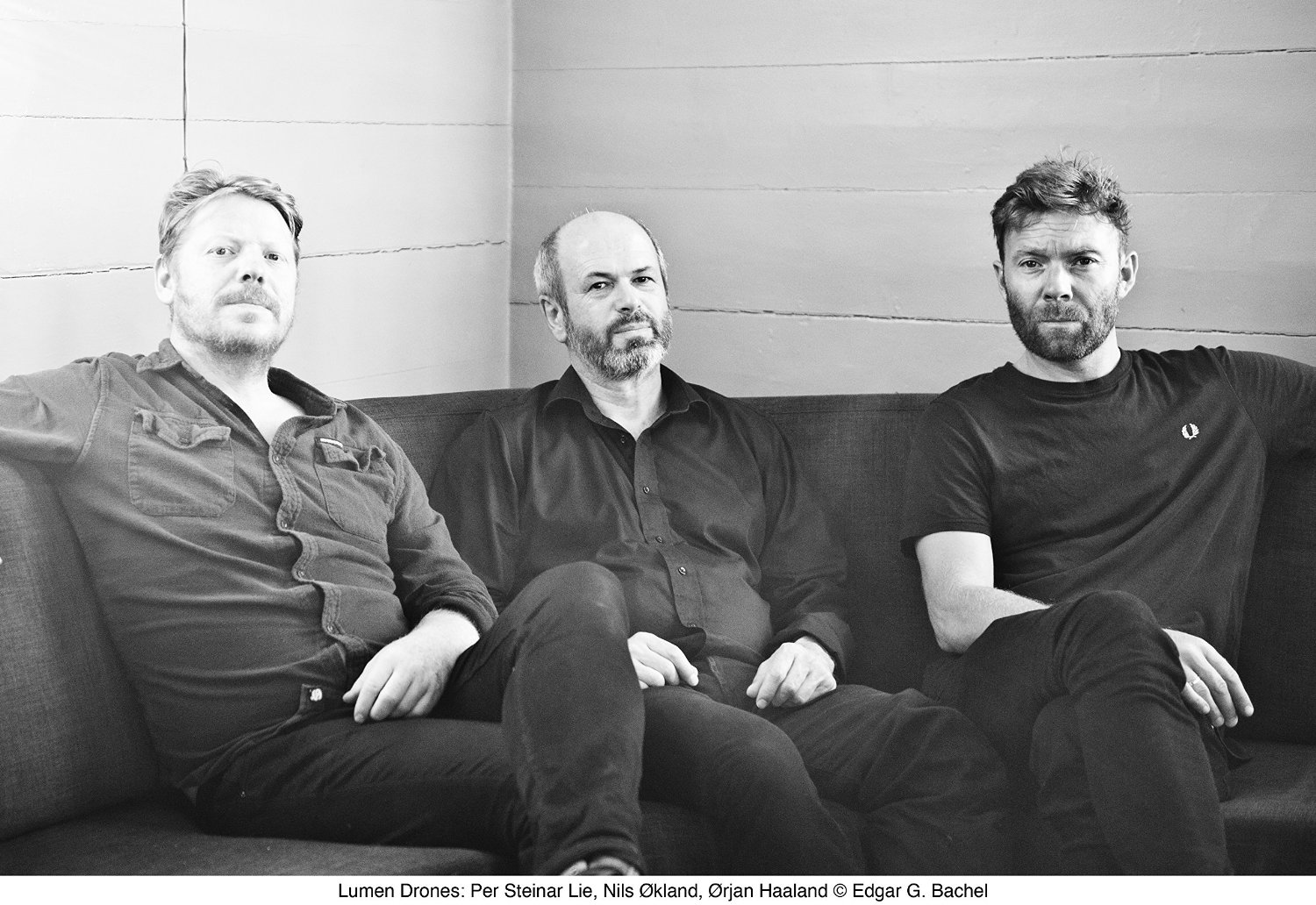
Lumen Drones: s/t (ECM 2434)

Lumen Drones

Lumen Drones

Nils Økland fiddles
Per Steinar Lie guitars
Ørjan Haaland drums
Recorded November 2011, ABC Studio, Etne, Norway
Recording and mixing engineer: Kjetil Ulland
Mastering: Christoph Stickel and Manfred Eicher
An ECM Production

Since his first ECM appearance on the Christian Wallumrød Ensemble’s Sofienberg Variations in 2003, and even more so on his 2009 solo effort Monograph, Nils Økland has served as a conduit between the then and the now. His latest project, Lumen Drones, finds the Norwegian Hardanger fiddle virtuoso in the company of guitarist Per Steinar and drummer Ørjan Haaland. Økland had previously collaborated with Steinar and Haaland, both members of the post-rock group The Low Frequency in Stereo, for a track on the latter’s 2009 album Futuro. That track was called “Solar System,” which best indicates the cosmic reach of this new trio. In ways similar to the band Mono, Lumen Drones cultures its motifs like bacteria in Petri dishes until they reach dizzying proportions.

LD

Chalk it up to ECM’s penchant for balance that often the most obscure, indefinable album covers sleeve the most clearly defined music, while here we have a rare animal encounter for music that is amorphous as the sun’s corona. Aside from two pieces—Lie’s webbed “Lux” and Økland’s ponderous “Keelwater”—this self-titled debut is comprised of collectively burnished hardwoods. “Dark Sea” comes to life without warning, as if startled from a dream, and draws us into a world of brushed drums, guitar, and fiddle. In wave after wave of memory, this unique combination sets a ghostly precedent. Even at its most enigmatic, however, the music that follows is so intensely visual that it’s near impossible not to accompany it with your own mental cinema. “Ira Furore,” for instance, unspools a single thread of cymbal from a tangle of heat-distorted guitar, while the fiddle pours its tenderness in a vain attempt to staunch the flames. The smoldering atmosphere recalls David Lynch’s Lost Highway in both its spatial and psychological desolations, tempered but never transcended by Økland’s soaring grammar. Further distortions abound in “Anemone,” which from deepest roots projects a bouquet of amplified thistles and burns by means of water. Yet the strongest inertia is to be found in the melodic progressions and folkish qualities of “Echo Plexus.” And with so much retrograde to appreciate, it’s no wonder we’re given some room to breathe in “Husky,” a brief and flowing duet between Lie and Økland. From here, it’s only a hop to “Svartaskjær.” Joining a free improv already in progress, it finishes with a jam band sensitivity stripped of all ornament. It breathes, cackles, and swivels its way into a 1970s bonfire, spreading ash all over its Technicolor skin.

Some make mountains of out molehills; Lumen Drones makes molehills out of mountains.

(To hear samples of Lumen Drones, click here.)

Tim Berne’s Snakeoil: You’ve Been Watching Me (ECM 2443)

You've Been Watching Me

Tim Berne’s Snakeoil
You’ve Been Watching Me

Tim Berne alto saxophone
Oscar Noriega clarinet, bass clarinet
Matt Mitchell piano and electronics
Ryan Ferreira electric and acoustic guitars
Ches Smith drums, vibraphone, percussion, timpani
Recorded December 2014 at “The Clubhouse” in Rhinebeck, NY
Engineer: D. James Goodwin
Assistant: Bella Blasko
Mastering at MSM Studios by Christoph Stickel
Produced by David Torn

Alto saxophonist Tim Berne and his Snakeoil outfit stand poised and ready to strike on their third ECM excursion. You’ve Been Watching Me might just as well be titled “You’ve Been Listening To Me,” because it’s impossible to have wandered into Berne’s unmistakable ghost towns and not swear you’ve heard every poker game that went down in their saloons. As if the band weren’t tetrahedral enough, Berne welcomes guitarist Ryan Ferreira to his honed nexus of clarinetist Oscar Noriega, pianist Matt Mitchell (who also provides electronics), and drummer-percussionist extraordinaire Ches Smith. In this album’s press release, Berne speaks of Ferreira’s presence as “subtraction by addition,” and these musicians’ ability to open their sound by virtue of greater number speaks to the intuitiveness of this apparent contradiction. Producer David Torn, known to ECM fans for his own incendiary trips, further notes the role of space in the band’s improvisational purview.

TBS

In the latter vein, “Small World In A Small Town” opens Snakeoil’s postmodern borders to the possibility of transcendence. The late-night balladry of Berne and Mitchell forms a double helix that is equal parts playoff and championship before vibraphone and electric guitar place their thematic bets. Yet what begins in typical Berne territory soon veers skyward as verdant cymbals and sustained pianism ride a wave of panning satellite transmissions. Noriega’s clarinet pulls weeds as if from below, leaving room for Berne to sprout in their place some of his most beautiful playing on record. In return, Noriega draws a bow from klezmer strands and nocks an arrow of river water before letting it fly in slow motion into an originary cushion. The band rises like a golem, overrunning its cup with maxed-out levels of intensity.

Before taking that space walk, we start out with the recognizably jagged cohesions of “Lost In Redding.” Ferreira’s firewall of distortion is noticeable from the outset and gives the other instruments an indelible point of reference. Guitar and bass clarinet find each other in the swarm just as the band leaves them hanging like solars in desperate absence of systems. Multi-phonic squeals from the two reedmen and Ferreira’s crisp unraveling send a newborn piano out on its stumbling legs, gaining uprightness like a foal on the outside. Berne and Noriega find tenderness in the poignant “Embraceable Me,” which opens a direct line of communication between the listener and the listened. This irons itself out into a resonant space of timpani, piano, and edge-worn clarinet, while Ferreira goes splashing through martial orbits.

Much of what follows is fragmentary or, as one title would have it, “Semi-Self Detached.” The latter tune’s hazy flotation marries alto to echo until Ferreira unsolders the seams of time, thus unleashing Berne’s anti-tirade like the electricity from King Humpty Dumpty’s cracked sun. The compact yet strangely gradual “Angles” is the yolk within, just at the brink of rupture, while the title track, a through-composed refraction for solo acoustic guitar, diffuses the white around it. At the end of the tunnel we find the roller-coaster ladders and cinematic desiderata of “False Impressions,” another prime space for Ferreira seen through the darker glasses of vibraphone and alto.

One may speak of great jazzmen as evolving before our very ears with each successive release, but Berne’s case is a living example of an artist involving with age: not scaling an impossible mountain of ideals but boring through it to see how people live on the other side. What he returns with is something like jazz times ten, an advancement of such integral proportions that it might set your cells to stun. A phenomenal album, and Snakeoil’s highest proof mash so far.

(To hear samples of You’ve Been Watching Me, click here.)

Trio Mediaeval: Aquilonis (ECM New Series 2416)

Aquilonis

Trio Mediaeval
Aquilonis

Anna Maria Friman voice, Hardanger fiddle, melody chimes
Linn Andrea Fuglseth voice, portable organ, melody chimes
Berit Opheim voice, melody chimes
Recorded June 2014 at Propstei St. Gerold
Engineer: Peter Laenger
Recording supervision: John Potter
An ECM Production

Trio Mediaeval are Anna Maria Friman, Linn Andrea Fuglseth, and, making her ECM debut, Berit Opheim (who in 2014 replaced Torunn Østrem Ossum). In their sixth New Series program, the Scandinavian songstresses bring a characteristically thoughtful cohesion to their selections and the themes under which they live again. The album’s title means “North Wind,” but as recording supervisor John Potter explains in his album note, the metaphor is as much temporal as geographical, emphasizing as it does the Trio’s centuries-long reach.

TM

Furthest from the present are two Italian sacred songs from the 12th century. “Benedicti e llaudati” (Sacred and blessed apostles…) and “Fammi cantar l’amor” (Let me sing of the love…) contrast radiant harmonies spun around a core of chant with monophonic lines of flight. The drone also figures as a natural extension of three Norwegian folk songs, which find the singers accompanying themselves for the first time on instruments (the enriching percussion heard on 2007’s Folk Songs was courtesy of Birger Mistereggen). The Hardanger fiddle, played by Friman, is both heart and lungs of “Ingen vinner frem til den evige ro” (Eternal rest is the reward of…), and its ghost whispers in the air of the vocal solo “Gud unde oss her at leve så” (God gave us grace to live), a string of beauty untying itself in righteousness.

A step closer brings us to 14th-century Iceland and the vespers of the Office of St. Thorlak, beautifully unpacked from their plainchant rudiments into braids of censer smoke. The masterful arrangements enchant with their folkish brogue, sounding at times more like songs of the Irish plains than prayerful nights. Now it’s Fuglseth on the portable organ who gleans a droning undercurrent from the score and copies its DNA until it breathes. Yet another step lands us in the more pronounced polyphony of three 15th-century English carols, of which “Ecce quod natura mutat sua jura” (Behold, nature changes her laws) and “Alleluia: A newë work” are sublime highlights. The latter was the first piece the original Trio ever sung and makes its glowing presence known to a wider audience at last.

In the realm of the living, English composer Andrew Smith contributes three symbiotic pieces to the Trio’s repertoire. Of these, “Ioseph fili David” (Joseph, son of David) is the crowning jewel of the program, while “Ave regina caelorum” (Hail, Queen of heaven) breaks glass with its light. Swedish composer Anders Jormin, better known to ECM fans as a jazz bassist with a classical heart, solely offers “Ama.” Based on a poem by Virgil, it is a miniature of overlaid shapes, transparent and turned askew until they form new harmonies in search of the old. The singers themselves compose three pieces, each a vital organ to the program’s functioning body, planets without satellites whose clouds welcome all suns. And American composer William Brooks yields the somber yet tender “Vale, dulcis amice” (Farewell, sweet friend) on which the program ends.

The combination of self-accompaniment and new music secures the women of Trio Mediaeval as the reigning torchbearers of the now-defunct Hilliard Ensemble, of whom they are superlative protégés. Like their legendary mentors, they are able to move from one coil of existence to the next without slightest loss of form. Here’s hoping they continue to do so for decades to come.

(To hear samples of Aquilonis, click here.)

The Hilliard Ensemble: Transeamus (ECM New Series 2408)

Transeamus

The Hilliard Ensemble
Transeamus

David James countertenor
Rogers Covey-Crump tenor
Steven Harrold tenor
Gordon Jones baritone
Recorded November 2012, Propstei St. Gerold
Engineer: Peter Laenger
Executive producer: Manfred Eicher

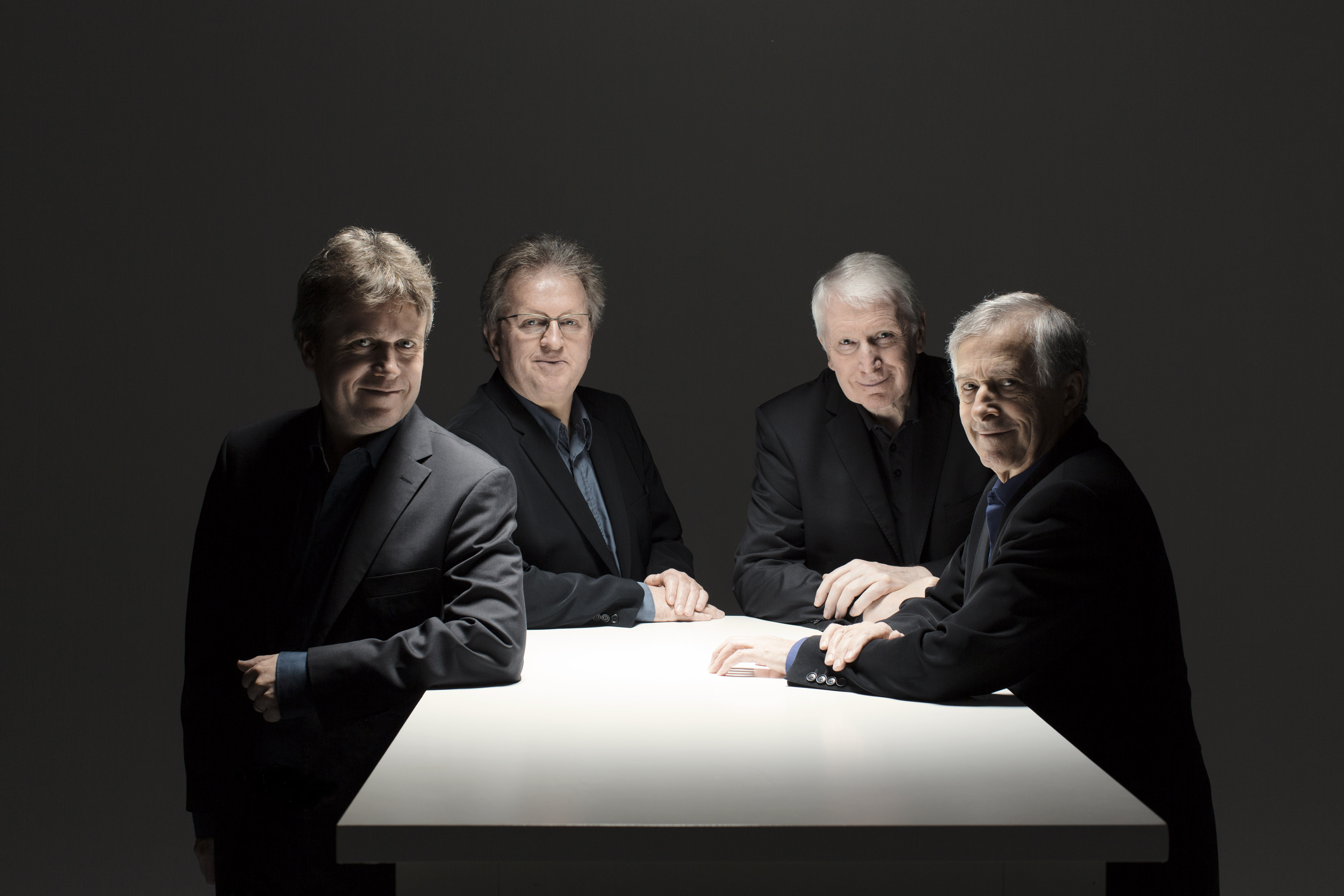
The illustrious Hilliard Ensemble ends its decades-long tenure with ECM, and with the world of performance, in a program of 15th-century English carols and motets for two, three, and four voices. Since debuting on the label with 1989’s Perotin, countertenor David James, tenors Rogers Covey-Crump and John Potter, and baritone Gordon Jones have enchanted with their peerless blend of timbres, equal interest in contemporary and early music, and scholarly sheen. In 1998 Steven Harrold filled the venerable shoes of Potter, who would go on to strengthen his leadership of the Dowland Project (see, for example, Night Sessions) and pursue alluringly off-the-map endeavors such as Being Dufay. Harrold joined ECM’s venerable ranks in a traversal of motets by Guillaume de Machaut, one of many landmark recordings by the newly minted ensemble.


(Photo credit: Marco Borggreve)

Whereas other vocal groups might have bowed out with a flourish, the Hilliards have chosen a contemplative return to roots, drawing from a repertoire ingrained in their individual beings long before becoming a part of their collective one. Many of the composers whose work is represented herein are anonymous, yet their music, notes David James in his affectionate liner note, is anything but. Included among the sélections sans auteur is some of the Hilliards’ most incisive singing on disc, which illuminates the verily bookended pages of “Clangat tuba” in purest gold and imbues “Lullay, I saw” with baby’s-breath. Also remarkable are the more intimate combinations, especially those pairing James with one or both of the tenors. The Codex Speciálník has long been one of my most beloved Hilliard albums, in large part because of its occasional duets, and Transeamus may just share that position for its own. “There is no rose,” one of the program’s three carols, is one such instance of skeletal beauty.

John Plummer (1410-1483) is one of four known composers represented. His “Anna mater” is an astonishing creation. Through watery sustains, over which the higher voices bend like willow branches, it reveals a consummate approach between image and reflection. The “Stella Caeli” by Walter Lambe (1450/51-a.1499) threads one of the program’s most angelic looms with a continually changing color scheme. “Ave Maria, Mater Dei” by William Cornysh (c.1468-1523) is as lovely as it is luminescent, and is all the more moving for Gordon Jones’s spinal tap. Lastly, Sheryngham’s “Ah, gentle Jesu” secures the Hilliard Ensemble legacy with a piece of such descriptive power that it turns the immaterial into a tangible piece of faithful proportion, if not also proportional faith. Like the windows of Propstei St. Gerold, the Austrian monastery where so much of their brilliance was captured for posterity, these unrivaled singers allow light to shine both ways.

This album’s title may be Latin for “we travel on,” but we the listeners can be sure that just as much of the Hilliards will be left behind in our hearts as they will carry forward in their own.

(To hear samples of Transeamus, click here.)

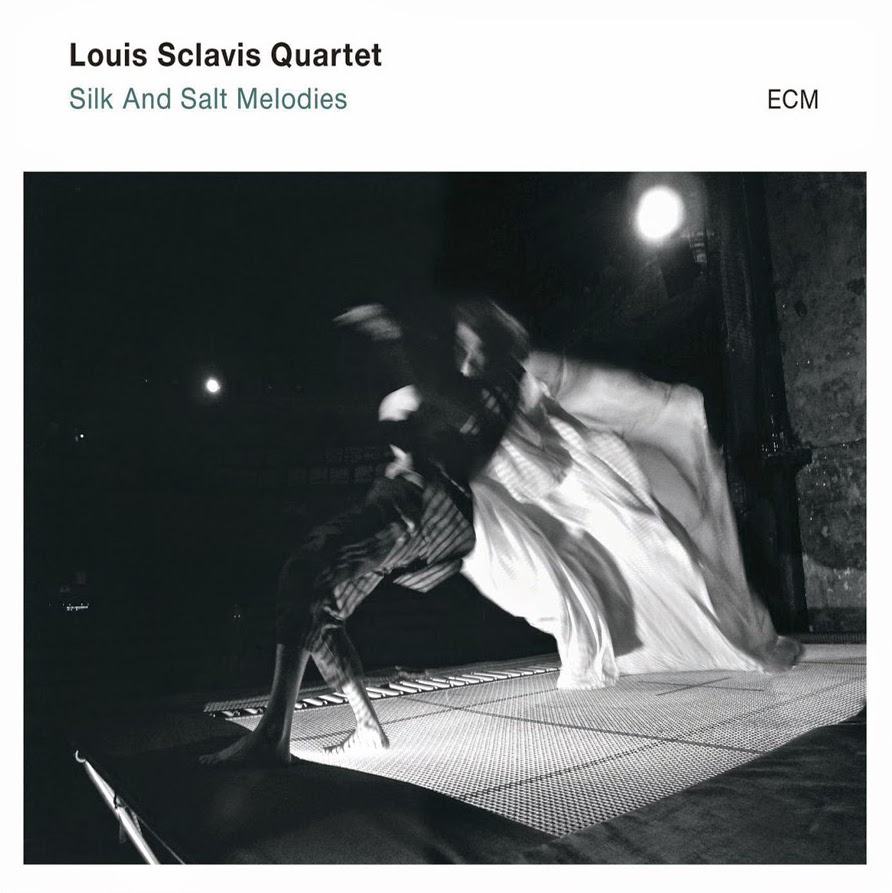
Louis Sclavis Quartet: Silk And Salt Melodies (ECM 2402)

Silk And Salt Melodies

Louis Sclavis Quartet
Silk And Salt Melodies

Louis Sclavis clarinet
Gilles Coronado guitar
Benjamin Moussay piano, keyboard
Keyvan Chemirani percussion
Recorded March 2014, Studios La Buissonne, Pernes-les-Fontaines
Engineers: Gérard de Haro and Romain Castera
Produced by Manfred Eicher

Silk And Salt Melodies draws on the well of Louis Sclavis’s Sources. The latter trio album showed the French multi-reedist and composer channeling the spirit of invention with guitarist Gilles Coronado and keyboardist Benjamin Moussay. To that band he now welcomes Iranian-French percussionist and goblet drum master Keyvan Chemirani in a characteristically recalibrated project of musical nomadism. Sclavis’s writing, of which this album is entirely composed, is obviously enlivened by the reinvention.

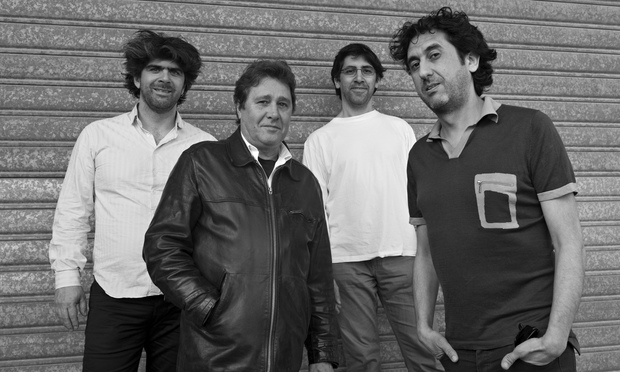
Louis Sclavis Quartet
(Photo credit: Olivier Degen)

The year 2014, when this album was released, was something of a golden one for the electric guitar on ECM, which found ambassadorship in the artistries of Wolfgang Muthspiel, Jacob Young, and Per Steinar Lie of Lumen Drones. Coronado is no exception, and adds his gold-leaf appliqué with more aplomb than ever. Like each of this band’s musicians, he cares less for soloing than solitude and accordingly explores the methods by which one can travel alone while still being in the company of others. The modal harmonies Coronado shares with Sclavis’s bass clarinet in “L’homme sud,” for example, would seem to indicate a total fusion of interests but, like a deck of cards fanned in anticipation of a spectator’s selection, his guitar waits for just the right moment to be plucked. Then there is his knife-edged interjection into “L’autre rive,” by which he pares a pianistic reverie down to a bite-sized blues. And one must also remark on Coronado’s geometric approach to “Cortège,” in which he takes his playing to a third dimension along a percussive z-axis.

And speaking of percussive axes, Chemirani draws them wherever he happens to be. His opening duet with Coronado in “Dance For Horses” shows a natural virtuoso at work and establishes the pulse by which piano and bass clarinet must reach their apex at the precise moment of abandonment. Chemirani connects his biggest constellations in “Dust And Dogs,” making it the album’s highlight for its ripple effect. From the groovy electric piano, twanging guitar, and beautiful reed work, one can sense a new door opening by the end of its 10 venerable minutes.

Sclavis, for his part, gives back that same inspiration with interest in “Sel et soie.” In his hands, the bass clarinet becomes an emotional portal, and it is all we can do not to get sucked in. Moussay is a suitable partner for that darker reed, as in the duo track “Des feux lointains,” which like a Jenga tower at the hands of skillful players maintains its structural integrity no matter how many pieces are removed. This same combination opens the album’s introductory “Le parfum de l’éxil” before giving way to the full quartet in all of its distorted integrity. From the beginning we jump to “Prato plage,” which caps off the album with a brief, minute-long field recording of amphibious night that suddenly leaves us suspended, grasping for the melodies that brought us here.

Louis Sclavis is like a sun that whips planetary bodies into harmonious dances of orbits. Or, better yet, a moon that draws melodies from the waves at any hour. Over the years he has narrowed his focus, unpacking the multifaceted implications of liner melodies rather than the linear implications of multifaceted arrangements. Leaning toward the former with experience and age has made his music at once edgier and more accessible. Because the improvising among these musicians is so well matured, the material along this Silk Road feels arranged right out of the box and awaits the manipulation of our listening to make it so.

(To hear samples of Silk And Salt Melodies, click here.)

Michael Mantler: The Jazz Composer’s Orchestra Update (ECM 2391)

Mantler Update

Michael Mantler
The Jazz Composer’s Orchestra Update

Nouvelle Cuisine Big Band
Christoph Cech conductor
Michael Mantler trumpet
Harry Sokal tenor saxophone
Bjarne Roupé guitar
Wolfgang Puschnig alto saxophone
David Helbock piano
radio.string.quartet.vienna
Bernie Mallinger violin
Igmar Jenner violin
Cynthia Liao viola
Asja Valcic cello
Recorded live August 30/31 and September 1, 2013 at Porgy & Bess, Vienna, Austria
Engineer: Martin Vetters
Mixed and mastered October and December 2013 at Studios La Buissonne, Pernes_les_Fontaines, France
Engineers: Gérard de Haro and Nicolas Baillard
Produced by Michael Mantler
An ECM Production in collaboration with Porgy & Bess, Vienna

Trumpeter and composer Michael Mantler began the Jazz Composer’s Orchestra in the mid-1960s with Carla Bley as a larger outlet for radical jazz interventions. Having just arrived in New York City as a young man from Vienna, Mantler was raring to float his ideas among musicians—Pharoah Sanders, Cecil Taylor, and Don Cherry among them—who cared. In an interview with Steve Lake printed in this album’s booklet, he stresses the tightly knit community of free jazz at the time. The scene was small, he recalls, “and most everybody knew and worked with each other, having formed a kind of bond through necessity, since we were involved in a music that was commercially totally unviable and often even quite disliked by the mainstream audience and critics alike.” While digitizing old JCO scores in 2012, he saw a chance at renewal and The Jazz Composer’s Orchestra Update was born. The new pieces—penned 1963-69 and revised in 2013—are sheep in wolves’ clothing, each precisely notated but with room to spin wool of improvisation.

MM

Mantler has always been one for forthright atmospherics, and these pieces are no exception to that tendency. If anything, they embody it to the fullest. Aiding in the reshuffling are guitarist Bjarne Roupé (last heard on Mantler’s For Two), altoist Wolfgang Puschnig, tenorist Harry Sokal, pianist David Helbock, the radio.string.quartet.vienna, the Nouvelle Cuisine Big Band under the direction of Christoph Cech, and the composer himself on trumpet. Mantler is, in fact, the featured soloist of Update One, which introduces a slightly dissonant and reactive world of sound. Because the big band cuts such a complex figure in the studio, muscling its way through a chain of through-composed cells, each “Update” may be distinguished by its soloist(s). While all the musicians here are well suited for the job, Roupé is a natural-born Mantler interpreter. His gestures cut like a razor across Updates Eleven and Part 1 of Twelve, both of them bursting with roots in a gnarled sort of grandeur.

The main reedmen are likewise exceptional. Sokal’s tenor flips a coin of thunder and soul in Update Eight, landing once on each side in the name of night. Puschnig’s alto, rides a wave somewhere beyond even those extremes in Update Ten, crashing on a vacant shore and leaving only a tender solo from bassist Manuel Mayr to show for having been there. Update Five lodges both saxophones in a briar patch of architectural impulses as the brass section blasts its messages with faith. The radio.string.quartet.vienna adds a dab of brooding to the palette in Update Nine. Violent expectorations, flowering pizzicati, tinkling cymbals, bright piano, clarion trumpet, and dim sonorities from the horns all enhance the strings’ flexibility as spider-web anchors bowing in the wind. Update Six, meanwhile, boasts crepuscular descriptions from Helbock at the keys, while Mantler returns in his barnacled shell.

The last two tracks form an unspoken diptych, with “Update Twelve Pt. 2 (Preview)” going all in with its round of spotlights, and “Update Twelve Pt. 3” taking the opposite route in a skeletal motif, ending where it might also have began: with a thesis statement. It’s an enjoyable reminder that Mantler’s pieces, while consummate in execution, are forever malleable in form, markers along a trail like no other on ECM grounds.

(To hear samples of The Jazz Composer’s Orchestra Update, click here.)

The Jazz Composer's Orchestra Update

Kenny Wheeler: Songs for Quintet (ECM 2388)

Songs for Quintet

Kenny Wheeler
Songs for Quintet

Kenny Wheeler flugelhorn
Stan Sulzmann tenor saxophone
John Parricelli guitar
Chris Laurence double bass
Martin France drums
Recorded December 2013 and mixed September 2014 at Abbey Road Studios, London
Engineer: Andrew Dudman
Assistant: Toby Hulbert
Mastering: Frank Arkwright
Produced by Manfred Eicher and Steve Lake

The late trumpet/flugelhorn virtuoso and composer Kenny Wheeler was one of jazz’s most beloved musicians and every album he recorded for ECM was an event to be savored—and now more than ever with Songs for Quintet. Wheeler’s last recording nestles some classics in mostly newer material and is a departure for the label in being recorded at London’s legendary Abbey Road Studios, where he is joined by longtime friends tenor saxophonist Stan Sulzmann, guitarist John Parricelli, bassist Chris Laurence, and drummer Martin France.

KW

Given the way that “Seventy-Six” eases its way into the heart, you can be sure this is a Wheeler record. Like “The Long Waiting” later in the set, it rests on a foundation of bass and guitar, on which the band builds its togetherness. Within this mesh, Parricelli slings his guitar solo like a comfortable leather bag that conforms to the body from years of regular use. In both tracks, Sulzmann’s tenor is another remarkable voice, shadowing Wheeler’s own lyrical fronting without stepping on their toes. In fact, he and the rest are in obvious deference to their leader’s coolness.

Two blasts from the past, buffed to a reflective shine, enrich the album with their inclusion. “Old Time,” last heard as “How It Was Then” on the 1995 Azimuth album of the same name, is among the groovier numbers. Sulzmann and Wheeler share soaring harmonies over some prime rhythm sectionining: France an ambassador of finesse and Laurence of nimble eccentricities. And one of ECM’s finest jazz albums of all time, Angel Song, gets a nod in “Nonetheless,” a deserving self-tribute now shed of its shadows in the presence of brighter cymbals and guitar. Sulzmann’s wings catch thermal after thermal in a space that Wheeler might once have claimed on Gnu High. The saxophonist’s true standout track, though, is “Sly Eyes,” a luscious tango that is all the wiser for its bassing. “Pretty Liddle Waltz” is another robust dance.

The cryptically titled “1076” is champagne in a bottle, by which is christened a scuttling vessel. Like “Jigsaw,” its elements interlock seamlessly. The latter tune is slick in that distinctly Wheelerian way and spotlights a musician with a lot on his mind. By his gentle yet forthright tone, Wheeler serves no pretense but the down-home profundity of his vision. Even as his younger sidemen paint sunbursts overhead, he is content to strip his cottage and repaint its walls in variations of that same comfortable shade. In keeping with the rural theme, “Canter No. 1” begins with a relaxed bass solo, from which Wheeler spins an enchanting story. Each chord change becomes a rope swing in his hands as he suspends his peerless language over childhood rivers toward fuller throttle.

Not only is this as fine a swan song as one could hope for; it’s also fantastic album in and of itself. Were one to approach it not knowing the personnel involved, it would sound just as poignant, for its strength lies first and foremost in the writing: a mark of greatness, if ever there was one.

(To hear samples of Songs for Quintet, click here.)

Chris Potter & Underground Orchestra: Imaginary Cities (ECM 2387)

Imaginary Cities

Chris Potter
Underground Orchestra
Imaginary Cities

Chris Potter tenor and soprano saxophones, bass clarinet
Adam Rogers guitars
Craig Taborn piano
Steve Nelson vibraphone, marimba
Fima Ephron bass guitar
Scott Colley double bass
Nate Smith drums
Mark Feldman violin
Joyce Hammann violin
Lois Martin viola
Dave Eggar cello
Recorded December 2013 at Avatar Studios, New York
Engineer: James A. Farber
Assistant: Tim Marchiafava
Mixed October 2014 by Manfred Eicher, Chris Potter and James A. Farber
Produced by Manfred Eicher

Chris Potter has been deservedly recognized as a superlative musician and soloist, but he will just as likely go down in history as one of the great jazz composers of his time. Having already proven himself in that capacity with The Sirens, Potter continues his relationship with the only label with vision deep enough to realize his own. The title of Imaginary Cities evokes Italo Calvino’s invisible ones, and like the Italian magical realist’s vignettes depicts the same space from different angles of time and perspective. Bringing life to this masterpiece are the musicians of his Underground Orchestra. Essentially an expansion of his Underground quartet with guitarist Adam Rogers, pianist Craig Taborn, and drummer Nate Smith, the current project adds to that nexus bassists Fima Ephron (on electric) and Scott Colley (on upright), vibraphonist and Dave Holland Quintet colleague Steve Nelson, and a string quartet headed by violinist Mark Feldman.

The album’s torso is the title suite in four parts. Beginning with the sparkle of “Compassion,” moving through the propulsive “Dualities” and “Disintegration,” and ending with “Rebuilding,” Potter applies pigment to a formidable cityscape indeed, beyond which the bandleader’s sidemen and -women unroll ocean until an entire globe’s worth of water is given a chance to reflect it. Strokes of brilliance to listen for are Rogers’s constellatory riffs (especially in the far-reaching Part 4) and the string quartet writing of Part 2 (in which Nelson’s marimba also makes a multifaceted splash within a pizzicato frame). Through it all, Potter’s saxophones carve lines in the water like the fins of benevolent sharks. He unpacks his solos with the intuition of an experienced traveler and, especially by the sopranism of Part 3, emotes in an honest, straightforward tone.

The peripheral yet no-less-integral outliers of the program beget some of Potter’s most advanced playing on record. Of these, “Lament” is a most worthy introduction. Colley’s contributions on bass to the same are duly expressive and feed off arco strings without draining their atmosphere, from which emerges Potter’s tenor only after a lush prologue. His patient reveal is genius and thwarts our over-allegiance to the man at stage center. Between the angular “Firefly” (remarkable for Ephron’s bass guitar solo) and the Bartók-inspired “Shadow Self” (marked by Feldman’s unmistakable violin and Potter’s bass clarinet), exist lips locked in a smile, and which in the concluding “Sky” leave their kiss marks on the clouds.

Potter practices a trifecta approach, meaning that he eases into his themes and that, no matter how far his fingers travel in improvising around them, he always keeps home base in plain sight. His is a music of the here and now. It needs only you to guide it into the future.

(To hear samples of Imaginary Cities, you may watch the EPK above or click here.)