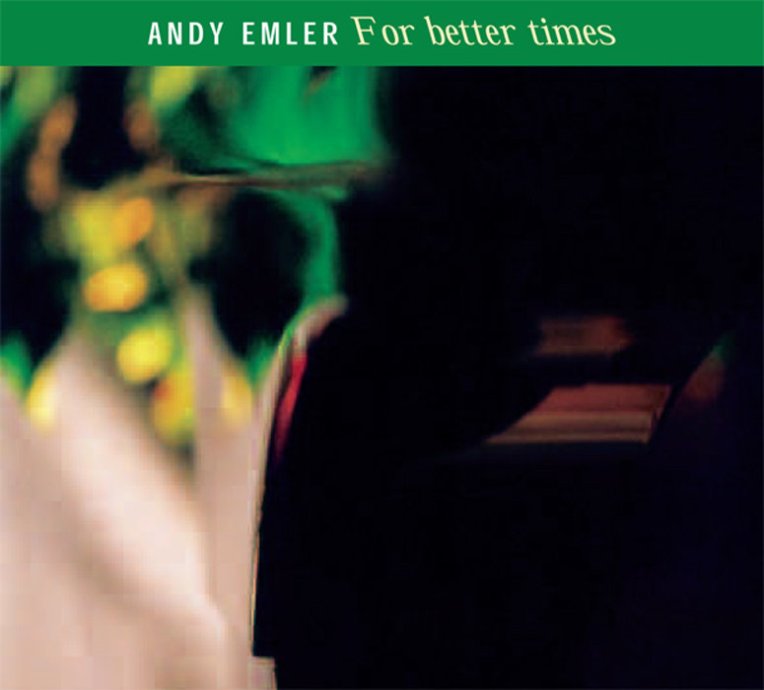
Andy Emler: For better times (RJAL 397007)

Cover

Andy Emler
For better times

Andy Emler piano
Recorded and mixed August 2008 at Studios La Buissonne by Nicolas Baillard and Gérard de Haro
Mastered by Nicolas Baillard at Studios La Buissonne
Steinway prepared and tuned by Alain Massonneau
Produced by Andy Emler and Gérard de Haro
Release date: November 6, 2008

The La Buissonne debut of pianist Andy Emler is the result of a 15-year friendship with the studio and label director Gérard de Haro, whose encouragement to make a solo album resulted in For better times. It’s a brave and personal session brimming with ideas. Having said that, the result is not a solo album per se. Despite coming from the hands and mind of one performer, multitracking fleshes out Emler’s flexible compositional backbone with well-toned muscles and spontaneous movements. In the opening “There is only one piano left in this world,” we find his instrument taking on the role of drum, backing, and lead, wound like a clock spring and set to mark the passage of time with deep regularity. On top of that he spins a wealth of chimes to titillate the heart and mind. It’s also a meta-statement on the nature of ideas and the tragedy of their erasure. The piano plays on, crying to be heard when silencing threatens to become the norm. In “Fear no more, suffer no more,” he delineates a philosophy of interaction, and in the next two tracks—“Crouch, touch, engage” and “Father and son”—explores the darkest and brightest corners of human relationships. His physical approach gives us a sense of weight and armor, and bids us to strengthen our capacity for love. From the intimate to the grandiose, “Speak up! Tribute for better times” acts out conflict on a global scale, treating the inner strings like a palimpsest for failed arguments. Finally, he leaves on a high note with the dialogic “Let’s create together.” Thus, the ruthlessness of time and those who ignore its lessons is laid out like a meal we fear eating, for to do so would mean admitting our complicity in its creation to begin with. And so, we sing along with Emler, hoping for change, for harmony, and yes, for better times.

Jean-Sébastien Simonoviez: Crossing life and strings (RJAL 397006)

Cover

Jean-Sébastien Simonoviez
Crossing life and strings

Jean-Sébastien Simonoviez piano
Jean-Jacques Avenel double bass
Riccardo Del Fra double bass
Barre Phillips double bass
Steve Swallow electric bass
Quatuor Opus 33
Marie Lesage
violin
Anne-Céline Paloyan violin
Marie-Anne Hovasse viola
Nesrine Belmokh violoncello
Recorded on May 21 and 24, June 8, August 3/4 and mixed on September 6/7, 2007 at Studios La Buissonne by Nicolas Baillard and Gérard de Haro
Mastered by Nicolas Baillard at Studios La Buissonne
Steinway prepared and tuned by Alain Massonneau
Coordination: Manuela Vincendeau
Produced by Gérard de Haro and RJAL for La Buissonne
Release date: February 21, 2008

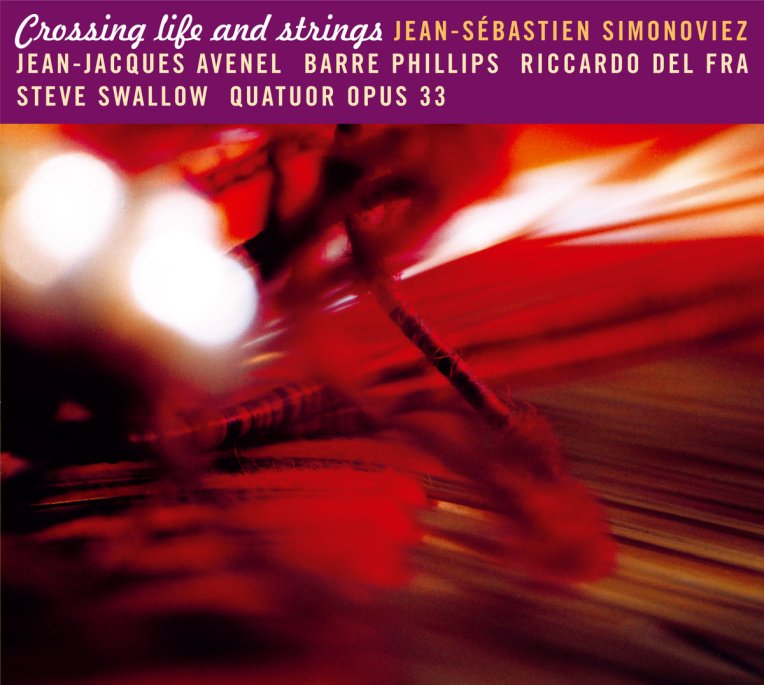
Following the atmospheric integrity of his La Buissonne debut, pianist and composer Jean-Sébastien Simonoviez teams up with producer Gérard de Haro, conceiver of this new project involving three double bassists (Jean-Jacques Avenel, Riccardo Del Fra, and Barre Phillips), Steve Swallow on electric bass, and the Opus 33 string quartet. Simonoviez pairs with each bassist in duo settings throughout, with occasional support by strings, before finishing with a tripartite suite for the roster in full.

The ache of Phillips’s bow is impossible to mistake for that of anyone else. Whether squealing unaccompanied into flowering strings in “Om #2” or fashioning a veritable Rorschach test in Stanley Myers’s “Cavatina,” he renders underwater songs for landlocked souls. His deftest passage is a balanced reading of John Coltrane’s “Welcome,” in which loving gestures and rougher interpretations swap stories.

Del Fra intersects with an equally diverse set of tunes, from the honeymoon feel of “Leonor Theme” to the poise of “My Ship” (Ira Gershwin/Kurt Weill). The only slight misstep is his soloing on Keith Jarrett’s “The Prayer,” which starts off tenderly before dipping into some derivative playing, even if it does emphasize the integrity of its surroundings. Some of his best playing is on “Om #1,” for which he unravels a colorful introduction into tasteful pulsing.

Swallow dialogues with Simonoviez on two occasions. Where “It Changes (The World)” finds both musicians tilling mineral-rich soil, touching the harmonic core of things as easily as breathing, Léo Ferré’s “A Une Passante” lays its balladry on thick: the sonic equivalent of a sommelier-poured glass of wine.

For me, however, Avenel is the star among them. The resonance of his arco arpeggios in “Leonard” glide across a river that flows in full assurance of its melodic destiny. And in “Diaguily Song,” his buoyancy and percussive flavor show us a player in total control of his instrument.

All of these idiosyncrasies come together in “Le Cosmos.” This sonic depiction of order from chaos actualizes a shift in time for all to hear, and remember, the origins we all share.

Keith Jarrett @ 75

In celebration of Keith Jarrett’s 75th birthday, ECM has gifted listeners with two very special albums. The first is a teaser encore from the upcoming Live from Budapest album, slated for a Fall 2020 release. In anticipation of what is sure to be a worthy live document, we encounter the beautiful suspensions of “Answer Me,” in which Jarrett molds the piano in loving clay.

front-answer-me-keith-jarrett

Despite being recorded not too long ago (July 3, 2016 to be precise), it sings to us from a distance, held up to the ear like a conch shell in which the past of another has been sheltered from the ravages of time. And yet, the more we listen back on these memories, the more they become folded into our own, as if they had been living inside us all along. This is what Jarrett at his best can achieve: whether spontaneously improvising or digging deep into the tried and true, he makes it all feel so inevitable. The music has always been there, waiting to be drawn out by the right pair of hands. And whose hands could be more effective than his to articulate a melody in the language of sunlight through breeze-shaken leaves.

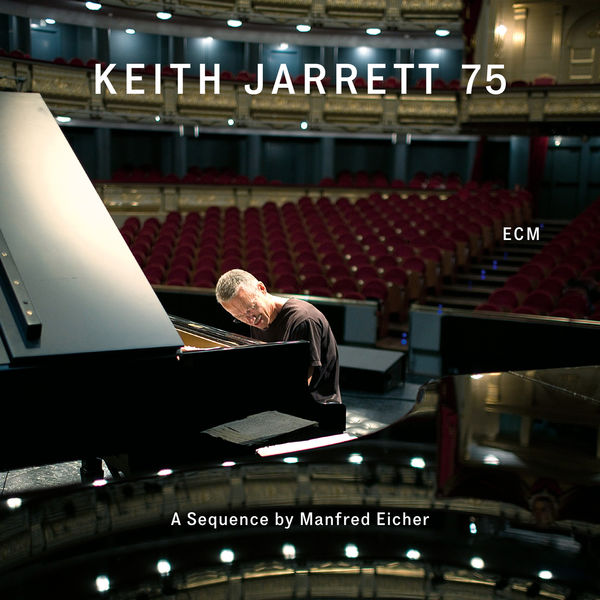
The second, and more substantial, present is Keith Jarrett 75, a sequence of five tracks curated by producer Manfred Eicher himself. Opening with the churned butter of “Never Let Me Go” (Standards, Vol. 2), it flows in stride with the passage of time. Perennial partners Gary Peacock and Jack DeJohnette are more than a rhythm section, but organs of the same body returning home after a long sojourn. In Jarrett’s vocalizations we hear the ache of it all, pooling like rain in cupped flowers, flung into the air by Peacock’s organic solo. And speaking of solo, we transition into that very territory with Part VII of Creation. In this rolling wave of spirit, sentient waters and thoughtless continents meet to share their silences.

ME Sequence

Another jump in time and mood warps us to Jarrett’s European quartet with saxophonist Jan Garbarek, bassist Palle Danielsson, and drummer Jon Christensen. Together, they unpack the largest cargo from the oceanic vessel that is “Personal Mountains.” A prototypical example of forward motion in music, it sustains inspiration from start to finish, Garbarek gilding the edges of Jarrett’s eyes, themselves closed in surrender. A shuffle of the deck brings us to the landmark duo record Jasmine with bassist Charlie Haden for a gently swinging take on “No Moon At All.” As sweet as it is sincere, it touches the soul with inspiration. Last but not least is “Flying Pt. 1” from Changes. A glorious soar through skies where wingtips catch clouds and leave melodic trails in their wake, it opens Jarrett’s inimitable trio like a book of truisms and waits for us to catch up with the confirmation of experience. The more exciting the music gets, the more we understand the power of harmony at altitudes beyond the audible.

Foltz/Oliva/Chevillon: Soffio di Scelsi (RJAL 397005)

Cover

Soffio di Scelsi

Jean-Marc Foltz clarinets, percussion
Stéphan Oliva piano, percussion
Bruno Chevillon double bass, percussion, vocals
Recorded April 28/29, 2004 at Studios La Buissonne by Gérard de Haro
Mixed December 2006 at Studios La Buissonne
Mastered by Nicolas Baillard
Steinway prepared and tuned by Alain Massonneau
Coordination: Manuela Vincendeau
Produced by Gerard de Haro and RJAL, Jean-Marc Foltz, Stephan Oliva and Bruno Chevillon for La Buissonne
Release date: June 1, 2007

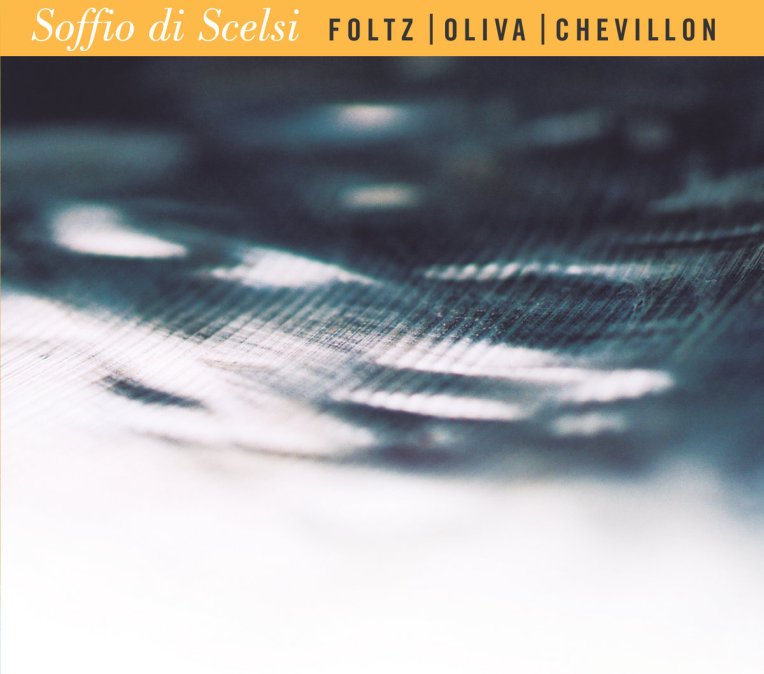
Inspired by the mind and music of Giacinto Scelsi (1905-1988), this set of 14 freely improvised pieces, each of which deepens an encounter with the Italian composer that could never be, merges the shoe impressions of clarinetist Jean-marc Foltz, pianist Stéphan Oliva, and bassist Bruno Chevillon in the same wondrous mud.

The droning qualities of the opening put me in mind of Scelsi’s onetime confinement in a psychiatric hospital, where he incessantly played an A-flat on the piano until his personal style emerged. In parallel, the music compresses itself until outer edges crack to reveal an encroachment. Such borders between inner and outer realms are what make this listening experience so self-aware. All the musicians play percussion as well, adding splashes of surprise, tactile drama, and color to an otherwise monochromatic landscape. If anything, we are made privy to a sound in which the details of our lives transform from solid to liquid to gas, and in that process wish themselves out of existence.

Contrasts abound in this intensely focused session: between a prayer bowl and an arco double bass at its most growling register, between a piano and the abandoned home throughout which it seems to echo, between the regularity of a spontaneous motif and the uncertainty of its denouement. But at the center of their wingspans beats a heart that unifies them by blood and call to flight. Other organs of this metaphorical body make their functions known. Chevillon’s bow has the quiver of a compromised lung, Oliva’s piano the struggle of an aging brain, Foltz’s reed the contraction of a throat too parched to speak. In the midst of such guttural ciphers, it is all we can do to piece together messages from whatever shreds of gloom are afforded us.

The sounding of drums is a wakeup call to every conductor to have ever lifted a baton in a dream, only to find that the orchestra plays not as expected, instead moving at a snail’s pace toward consonance. And as the curtain falls at half-speed, as if in morose accompaniment, the weight of time becomes apparent. The effect is so lulling that when a voice breaks from its cage in the penultimate vision, it can only signal a breaking dawn. Or so we think as the moon, setting again, leaves us stranded on the leaky vessels of our own expectation, paddling with tired hands.

Thus, Scelsi’s spirit lives on in a most tangible way, as if trickling through the fingers of musicians intent on catching as much inspiration as they can before it seeps into the dank earth, never to be touched anew.

Stéphan Oliva: Coïncidences (RJA 397004)

Cover

Stéphan Oliva
Coïncidences

Stéphan Oliva piano, Fender Rhodes
Bruno Chevillon double bass, typewriter
Recorded on April 4/5 and mixed on June 16, 2005 at Studios La Buissonne by Gérard de Haro
Mastered by Nicolas Baillard at Studios La Buissonne
Produced by Gérard de Haro and RJA for La Buissonne
Release date: November 10, 2005

“I had jumped off the edge, and then, at the very last moment, something reached out and caught me in midair. That something is what I define as love. It is the one thing that can stop a man from falling, powerful enough to negate the laws of gravity.”
–Paul Auster, Moon Palace

Where most albums of such beauty as this would be considered gifts to listeners, in Coïncidences pianist Stéphan Oliva offers something for readers. Indeed, this largely solo program of self-styled “book music” takes its inspiration from the writing of Paul Auster, whose clear-cut prose draws Oliva’s responses beyond the delineation of a mere soundtrack, constituting instead their own form of textual appreciation.

The album is framed by an arco sketch, via guest bassist Bruno Chevillon, of Jerome Kern’s “Smoke Gets In Your Eyes,” replete with the sound of a typewriter. The writer’s classical instrument makes further appearances in “Olympia’s Lullaby,” which evokes reading under lamplight, and an aphoristic improvisation called “Fuite–Poursuite–Suite.” In both we find ourselves awakening within as the world without falls asleep.

With the exception of a few appearances by Fender Rhodes (e.g., the nocturnally inclined “Levitation”), the album opens the piano itself like a book. The physical properties of literature are keenly explored across its keys. Given the studio in which he was recorded, Oliva takes full advantage of the space afforded him, wherein intimacy can be cultivated like a vocabulary. In “La Traversée,” which makes two appearances, we nearly expect a voice to sing, but the only words available to us are implied by movement over speech, melody over meaning. Such lyrical extensions of the printed word swirl around us in “En Aparte” and “Ghosts Of The Stereoscope.” Like a face turning to glance at something that would otherwise be forgotten, each is willing to let the details of another scene creep into the foreground.

Such actions, reading not only between the lines but also underneath them, are the musical equivalent of writing notes in the margins of a favorite book and looking back upon them years later with fondness, only now with a different color of pen in hand. Even the more dissonant tracks, like “Portee Disparue” and “Sachs March,” cling to us with their own static electricity, as if born from the pleasure of riffling pages at one’s fingertips.

Jean-François Jenny-Clark: Solo (RJA 397002)

Cover

Jean-François Jenny-Clark
Solo

Jean-François Jenny-Clark double bass
Recorded live on August 9, 1994 at Theâtre des Halles, Avignon (Festival Bass 94)
Sound recording: Gérard de Haro
Mastering: Gilles Olivesi at Studios La Buissonne
Coordination: Manuela Vincendeau
Produced by Gérard de Haro and RJA for La Buissonne
Release date: August 9, 1994

Solo documents a live performance from 1994 by Jean-François Jenny-Clark (1944-1998), one of the most talented bassists of his generation, who eagle-eyed ECM listeners will recognize from Paul Motian’s Le Voyage and Kenny Wheeler’s around 6, among others. Consisting only of two tracks, this archival treasure closes the irises of our ears around an intimate exposition of his artistry. Well-versed across idioms, Jenny-Clark was just as comfortable playing the music of Pierre Boulez as he was backing Don Cherry or Keith Jarrett, and his eclectic influences seep from every pore.

The lion’s share of the album is taken up by the pragmatically titled “Concert.” Throughout its 38 minutes of unwavering invention, Jenny-Clark crochets a chain of interconnected scenes at the soul level. His approach to the double bass is always from the inside out, as if diving into its waters to places where light normally doesn’t reach and emerging with unknown creatures of the deep. And while his willingness to surrender to whatever impulse taps his shoulder was always apparent, on this recording it is particularly foregrounded. He is cohesive at his most abstract, unchained at his grooviest, pliant and sincere against the unaccompanied backdrop that gives him contrast. Breathing in an elliptical atmosphere of regard, his body seems to fold into itself with every change of direction. Traction is never far away: there is always a sense of purpose and of having traveled somewhere. Even when digging into more percussive textures, we know that melodic denouements are close ahead, and that we are privileged to stand in one place as he unrolls a spontaneous scroll for our regard. Following this is a 5-minute epilogue called “Rappel” (Reminder). A chain of association in its own right, it is a quiet cultivation of whispering tides, each the supply to its own heart, beating onto shore.

A masterful swan song from one of Europe’s late greats that oozes with personality and muscular lyricism. We are there.

Jean-Sébastien Simonoviez: Vents & marées (RJA 397001)

Cover

Jean-Sébastien Simonoviez
Vents & marées

Jean-Sébastien Simonoviez piano
Recorded on February 22, 2000 and January 9, 2003 at Studios La Buissonne by Gérard de Haro
Mastered by Gilles Olivesi and Thomas Verdeaux at Studios La Buissonne
Release date: May 30, 2003

Vents & marées (Winds & tides) is the flagship release from the La Buissonne label, named for the studio of Gérard de Haro, famed engineer of many recent ECM productions and a soulful seeker of sound (ECM now distributes the label on its website). Appropriate, then, that de Haro should begin with the quintessential studio instrument: the solo piano. At the hands of Jean-Sébastien Simonoviez, its keys glisten like photographs just old enough to show patina but fresh enough to reflect the light just so under the lamp of interpretation.

The program shuffles together four distinctly different decks in a stack of magical proportions. A selection of standards stands out for its poise. An air of suspension permeates every molecule of “I Wish I Knew,” which Simonoviez plays as if unbound to time or place. “My Favorite Things” comes across with especial tenderness, and finds him enhancing the subtle balance of melancholy and joy that make the song so coniferous. And the way he shifts from reverie to glorious reality and back again throughout the course of “If I Should Lose You” is nothing short of exquisite.

Two John Coltrane tunes, “Naïma” and “Lonnie’s Lament,” showcase not only fearlessly self-reflective playing but also soulful engineering. Two dips into Bernard Herrmann’s film score to Fahrenheit 451, “The Bedroom” and “The Road,” are equally visual and flow with the precision of method actors who embody the power of every moment.

But the most substantive deck of all is comprised of Simonoviez’s own writing, which spans geographies and climates in a most organic way. The personal vibes of “Lumières (Pour Duke)” put in mind a bird flying for no other reason than to enjoy the sensation. The high clusters of “Tacha” fall like snow into happy memories, while “See” brings gentle urgency to the fore. “Winds & Tides” is the thesis statement and drips like candlewax into the abyss of time. Its gestures are palpable. Finally, “Paix” embraces us with thick harmonies and rolling waves.

As can be expected by anyone who has kept tabs on de Haro’s behind-the-scenes presence at ECM, the sound quality is impeccable—spacious without whelming, distant yet close enough to touch, and emotional without ever feeling ungenuine. Let this new journey begin, continue, and leave its mark.

Carla Bley/Paul Haines: Escalator Over The Hill (JCOA 2)

EOTH Cover

Carla Bley
Paul Haines
Escalator Over The Hill

Jack Bruce voice
Linda Ronstadt voice
Viva voice
Jeanne Lee voice
Paul Jones voice
Carla Bley voice
Don Preston voice
Sheila Jordan voice
The Jazz Composer’s Orchestra
Gato Barbieri, Dewey Redman saxophones
Don Cherry, Michael Mantler, Enrico Rava trumpets
Roswell Rudd trombone
Perry Robinson clarinet
John McLaughlin guitar
Leroy Jenkins violin
Charlie Haden double bass
Paul Motian drums
Recorded November 1968 at RCA Recording Studios, New York (engineer: Paul Goodman), November 1970-June 1971 at RCA Recording Studios, New York (engineers: Ray Hill, Jim Crotty, Pat Martin, Dick Baxter, Gus Mossler, and Tom Brown), March 1971 at Empirical Sound, at the Cinematheque, New York (courtesy Jonas Mekas and Richard Foreman; engineer: Dave Jones), and June 1971 at Butterfly Mobile Sound Van, at the Public Theatre, New York (courtesy Joseph Papp and Bernard Gersten; engineers: Karl Sjodahl, Bob Fries, Nelson Weber, and Wes Wickemeyer)
Editing: Carla Bley
Mixing: Carla Bley, Michael Mantler, Karl Sjodahl, and Ray Hall
Production and coordination: Michael Mantler

Escalator Over The Hill is widely considered to be the magnum opus of Carla Bley. And while the pianist, composer, and arranger went on to have a flourishing career in all of those capacities, there’s something to be said for EOTH’s cult status in the annals of jazz (and her own) history. Referred to by Bley, and the increasingly massive crew required to produce it, as an “opera” for shorthand, it is officially billed as a “chronotransduction.” The term comes from the mind of Sheridan (“Sherry”) Speeth, a scientist befriended by EOTH’s librettist, Paul Haines. Given the slipstream nature of what any new listener poised over the PLAY button is ill-prepared to expect, Speeth’s neologism bears the brunt of describing these goings on. More on that below.

Haines, we know from Bley’s own account, sent her a poem in early 1967. At the time, she was working on a piece called “Detective Writer Daughter,” soon to become the seed for the EOTH forest. Shortly thereafter, Haines moved to India, and from his new home sent more texts over the next three years. Even before the piece took shape as such in Bley’s mind, she knew exactly who to train her creative telescope on—namely, the Jazz Composer’s Orchestra and its satellite talents—in search of worthy interpreters. Their orbits were as complementary as the sonic solar system that defined them was organic. What she lacked, however, was an asteroid belt of singers. Notes Bley, as quoted in The Penguin Jazz Guide: “I used every musician I knew for the cast. I even used some people I didn’t know; all they had to do was ask to be in it and I said: “Of course you can.’ At one point I needed some extra chorus voices quickly so I went out on the street in front of the studio and enlisted passers-by.” Her then-husband Michael Mantler recruited Jack Bruce, but it fell upon Bley to seek out the rest. Her search led her early on to actress Viva (one of Andy Warhol’s “superstars”) and later to Steve Ferguson (NRBQ), Paul Jones (Manfred Mann), and Don Preston (Mothers of Invention). Even as forces were gathering, finances were dwindling, as were her relationships with the record company originally slated to back the project, when Sherry and Sue Speeth donated a whopping $15,000 to unclog the drain. This act of generosity (combined with other funding sources) allowed them to move forward with total independence, and even access to RCA Recording Studios. Due to the sizable cast and conflicting schedules, it was nearly impossible to get everyone in the same room, meaning that some had to be recorded separately and fused on the laboratory table of the mixing board. Seventy-five reels of tape later, and after much barrel scraping and knuckle busting (as Bley furiously wrote out every part by hand), she still did not have her Ginger, a politically central figure among EOTH’s dramatis personae. Paul Motian floated the idea of Linda Ronstadt, “who said she had never been confronted with music so difficult,” Bley recalls. Once Ronstadt sent in her tapes by mail to New York from Los Angeles, the final piece of the vocal puzzle fell into place.

With that, let us return to the chronotransduction.

Chrono: Latin root from the Greek khronos, meaning “time.” At once vague and specific. To be sure, everything we encounter along this eclectic train ride—as big band impulses fight for bench space with Kurt Weil dinner theater, Indian classical forms, and progressive rock—has much to do with distortions and questionings of time. Even before a single voice throws a pitch, the windup of Hotel Overture delineates a space where nature and technology engage in melodic congress. The overture itself has a time marking—13 minutes and 11 seconds, to be precise—but the strokes of those numerals feel more like the wrought-iron cars of a prison than the window thrown open by the hands of their inscriber. From this parthenogenetic wellspring echo horns of regression. Just as the gloom is about to turn into doom, Roger Dawson’s conga and Paul Motian’s drums flip on a stage light so that the clarinet of Perry Robinson can rip into the foreground of this carnivalesque nightmare in stark relief. Gato Barbieri’s tenor saxophone likewise unleashes a guttural catharsis for the ages, one that must be heard with every fiber of its being. The preparation of all this is such that when a droning choir of voices overlays our brokenness in This Is Here… we feel it like a swarm of fireflies rent for all humanity.

Cecil Clark’s Old Hotel deepens our impression of time through the matter-of-fact worldview of the Doctor (Don Preston), who has the honor of introducing the album’s title, a metaphor of complicity in the violence of capitalist production. A four-year-old Karen Mantler (daughter of Carla and Michael) utter the comment du jour: “Riding uneasily.” Thus do the men of EOTH’s world proceed to travel, their pulses determining the flow of life until they cease to beat. Barbieri pushes through the pomp and circumstance, calling out to a soul that doesn’t wish to be found. Bley bids everyone to stay awake, as if we might fall prey to a global concussion. The loudspeaker cuts her off, as naysayers often do. But she presses on with dialogic fortitude. Sheila Jordan, singing as the “Used Woman,” further understands the folly of fleshly burdens. In the wake of these disturbances, we are treated to a brief performance by the hotel lobby band in “Song To Anything That Moves.”

The march of the present proceeds to take us Off Premises, as Jack Bruce shouts his corporate angst across the airwaves of his traveling band (John McLaughlin on electric guitar, Bley on organ, Bruce on electric bass, and Motian on drums). Ronstadt lends her crystalline voice to “Why,” which feels like a country tune staged as a farce of climactic achievement. As Ginger, she battles the vagaries of a world that no longer regards itself in the mirror. Beyond the door of Cecil Clark’s, Bruce guides us to the piece that started it all, “Detective Writer Daughter.” This thinly veiled analysis of a broken citizenry looking for leadership while the blood of assassination still stings their eyes sets up “Doctor Why,” in which Bruce’s banter with Ronstadt cracks faces open like diaries better left unread. After the brooding “Slow Dance (Transductory Music),” we get the “Smalltown Agonist,” in which explosions of lies and truth comingle until neither is distinguishable from the other.

Thus have we entered the realm of the transduction. The word describes the process by which energies or messages are converted from one form into another. Whether In The Meadow Or In Hotels, in which Bley sings as the laboratorial Mutant, or in “Over Her Head,” in which she mourns a fallen nationhood, each utterance becomes thought. Amid this unsettling mix of whimsy and self-protection, Charlie Haden’s bass line mocks beneath McLaughlin’s acoustic, as if to express the impossibility of change from what was known before.

In Flux opens with “Oh Say Can You Do,” a duet between Bley on calliope and Bill Leonard as Calliope Bill, sharing the inevitability of misdirection in our lives. This is followed by “Holiday In Risk,” which I can only describe as Meredith Monk doing cabaret. The obligatory nod across the pond comes in the form of “A.I.R. (All India Radio),” which launches Don Cherry’s trumpet over arid terrain, replete with dumbek (played by Souren Baronian) and Motian on glittering percussion. All is but a preview of the nearly 13-minute “Rawalpindi Blues.” McLaughlin’s electric dialogues in the flames of Bruce’s bass, while Motian beats the air into submission, transitioning into Cherry’s desert caravan. Cherry also sings as the Sand Shepherd, carrying us over into “End Of Rawalpindi,” with Jeanne Lee as Ginger II in a passionate helix of description with Bruce. Those same two ensembles blister in a fusion-esque universe that would seem to parallel John Abercrombie’s Timeless.

Because all music must come to an end, Over The Hill reads like an obituary. After the doctor’s final prescription in “End Of Animals,” we encounter the 27-minute masterpiece of “…And It’s Again.” Barring some cryptic lyrics (e.g., “The hectic silhouettes of chins”), the mood is lucid, especially in the horns (among them Michael Mantler on trumpet and Roswell Rudd on trombone), backed by Haden and Motian, before ending on a long hum, made possible by a lock groove in the original vinyl. Of that almighty drone, we get 20 minutes before the curtain closes.

Perhaps it’s the pall of pandemic and social distancing that hangs over me as I write this, but I cannot help hear EOTH as a meta-statement about suffering. Not only for the persecution of those who stand up for their beliefs, but for those who never got the chance. It’s more than a relic of its time. It’s a relic about time and its infinite transductions from concept to physical reality. And Bley has all the scars to prove it.


EOTH Back

The Jazz Composer’s Orchestra: s/t (JCOA 1)

WATT-1801-front

Jazz Composer’s Orchestra

Don Cherry cornet
Gato Barbieri tenor saxophone
Larry Coryell guitar
Roswell Rudd trombone
Pharoah Sanders tenor saxophone
Cecil Taylor piano
The Jazz Composer’s Orchestra
Michael Mantler
conductor
Recorded on 3M 8-track tape recorders in RCA Victor’s Studio B, New York City
Recording engineer: Paul Goodman
Produced by Michael Mantler

It has been 52 years since the Jazz Composer’s Orchestra dropped its weighty stone into the pond of music history. And yet, its ripples are still rocking the boats of listeners today. Count me among them. Despite having first gotten to know Michael Mantler through his intersections with ECM Records (a personal favorite being The School of Understanding), and having been given a taste of this watershed double LP on Review, I was humbled by the intensity herein. The vital link to that latter compilation is “Preview” (recorded May 8, 1968), which compresses the album’s full magnitude into 3-1/2 minutes via a gut-wrenching solo from Pharoah Sanders on tenor. Over a punctuated ensemble, he gives us much to ponder on the altar of our listening, as if it were the living amalgamation of many deaths before it (if not the dying amalgamation of many lives before it). Not out of any grand level of abstraction or concept but only through a sheer embodiment of execution does it succeed to carry a charge.

While soloists tend to dominate the foreground at any given moment throughout this project, the orchestra itself isn’t something to bat a flaccid eyelash at, either. Sheltering such greats as Steve Lacy, Randy Brecker, Carla Bley, Charlie Haden, Andrew Cyrille, Ron Carter, and Eddie Gomez, it blisters to the touch, and perhaps nowhere no more so than on “Communications #8” (recorded January 24, 1968). Hitting us where it counts with a solar flare, it lights the continents of Don Cherry’s cornet and Gato Barbieri’s tenor with killer instinct. Theirs is a power to be reckoned with. Every breath matters. “Communications #9” (recorded May 8, 1968) is an ember by contrast. But Larry Coryell ensures that the air itself is flammable, and that his guitar is the only logical path toward its combustion. Beneath it all, Bley’s piano chops away at the spine to make way for nerve impulses while droning reeds and five bassists level the earth. Coryell twists his strings until they adhere to inner turmoil. “Communications #10” (recorded May 8, 1968) features a rare introduction from Steve Swallow on upright bass, abstract yet flexible, and for that reason alone lends it archival vitality. So begins a morose and strangely unbreakable chain of inward glances. Trombonist Roswell Rudd is the extroverted soloist moving through viscous oceans before reaching a deserted island where, in dialogue with drummer Beaver Harris, he unravels the stuff of fantasy as if it were his only viable companion. The orchestra swoops in until there’s nothing left but smoke to show for their existence.

All of this leads to the massive diptych “Communications #11.” Spanning nearly 34 minutes, it’s another unrelenting communique. Pianist Cecil Taylor solos the you-know-what out of it like someone on fire in frantic in search for water. His interactions with Cyrille’s percussive details is worth the dive in and of itself. If Part 1 is the freefall, then Part 2 illustrates the landing in gruesome detail. Cyrille and Taylor continue their banter, turning starlight knives, each intent on drawing blood. The energy of their flight is sustained so steadfastly as to bring a tear to the eye, only to dry it with a punch in the cheek. This is where insanity goes for respite. Let it keep you sane.