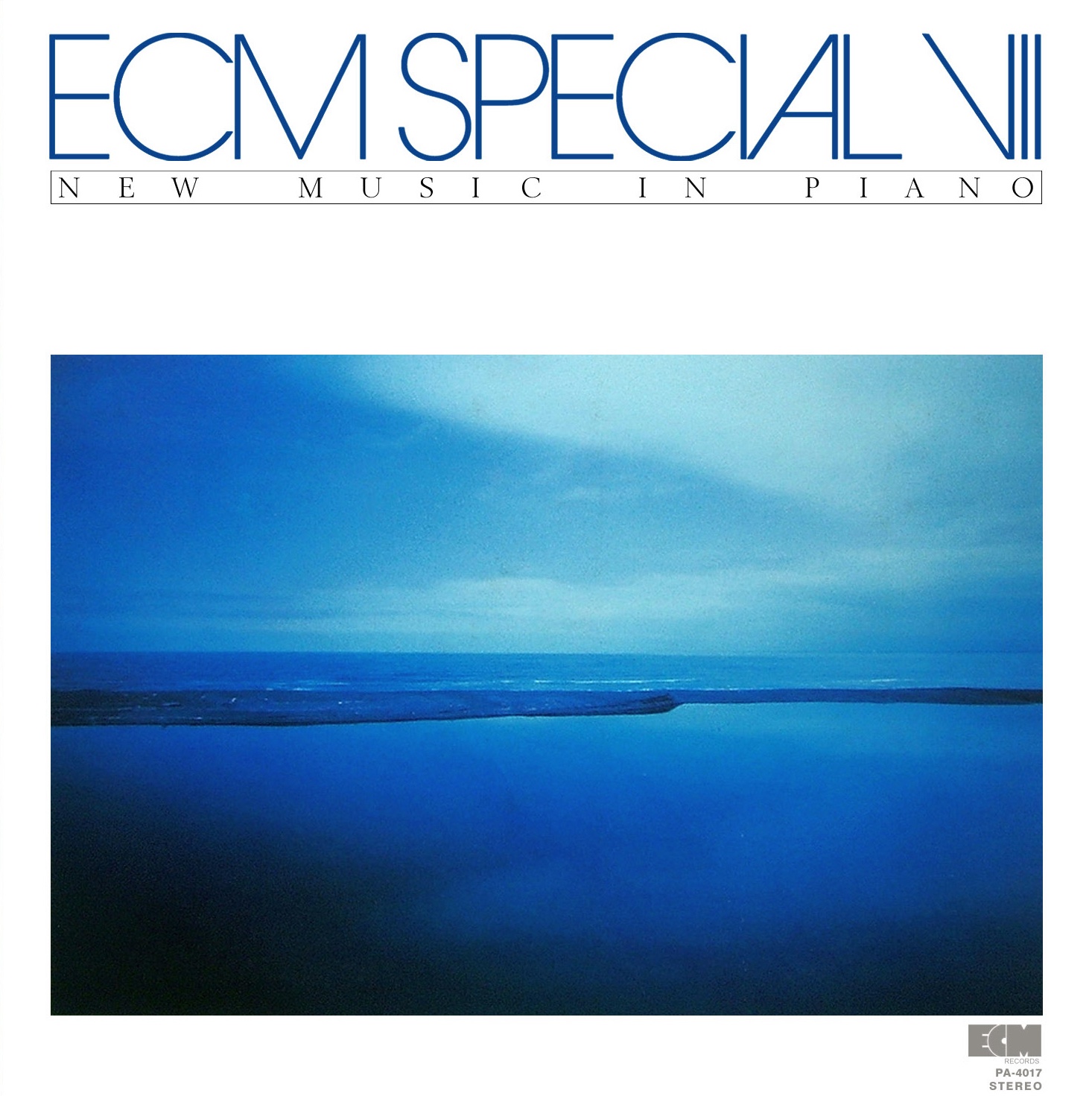
For its seventh installment in the Japan-only ECM Special series, Trio Records finally dedicated a compilation to “New Music in Piano.” The expected constellation is present. Keith Jarrett and Paul Bley occupy familiar zones of gravity, while Steve Kuhn moves nearby with his own restless voltage. Yet the album’s first door opens in a particularly inspired direction: Stanley Cowell’s Illusion Suite, represented by the luminous “Ibn Mukhtarr Mustapha.” Cowell moves between acoustic and electric pianos, then lets the kalimba flicker through, while Stanley Clarke and Jimmy Hopps keep the tune airborne. The result is righteously engaging, a gallery of moving pigments in which groove becomes geometry and melody keeps turning corners the ear did not know were there. The track gives the compilation a thesis without announcing one too loudly: the piano here is an instrument of passage, a set of thresholds through which jazz walks into dream logic while keeping one hand on the body.
That sense of liminality deepens with Art Lande’s Rubisa Patrol, whose “A Monk in His Simple Room” serves as one of the set’s most quietly devastating inclusions. Despite the title’s hidden chamber, the performance refuses miniature domesticity; Lande’s touch opens small windows inside the phrase, and Mark Isham, who made several crucial appearances in ECM’s first decade, turns the trumpet into a filament of interior light. Richard Beirach’s “Seeing You,” drawn from Eon, works in a different shade of nocturnal intelligence. With Frank Tusa and Jeff Williams beside him, Beirach seems to smooth the wrinkles in the night, laying out a gorgeously articulated swath of trio jazz with the faint metallic scent of revelation threaded underneath.
Jarrett appears twice, each instance offering a distinct version of ascent. “Staircase Part III” (Staircase), is brief and beautiful, a self-contained solo fragment improvised into abundance. “Spiral Dance” (Belonging), answers with ecstatic lift, propelled by the mind-melded precision of Jarrett’s European quartet. Jan Garbarek leads the charge with incisive charm, while Palle Danielsson and Jon Christensen make the ground seem elastic beneath him. Christensen in particular plays with that rare intuition that can tighten the music’s screws while giving it more oxygen. He and Danielsson also appear on Garbarek’s Witchi-Tai-To, represented here by its title track. With Bobo Stenson at the piano, the piece remains a classic of the highest order, building a monumental tower of atmosphere from a small box of abstract tools. Garbarek’s playing reaches one of its most soulful recorded peaks, a sound that bends toward song without surrendering its mystery.
The remaining selections widen the map without dissolving the central spell. “Harlem,” from Paul Bley’s Open, to love, is brief yet emotionally saturated, a blues reduced to its psychic skeleton and then touched back into flesh. “Sirens’ Song,” by way of Azimuth’s self-titled debut, enters a more vaporous chamber. John Taylor’s piano and synthesizer move with playful modal intelligence. Around him, Norma Winstone’s wordless voice hovers at the edge of language, while Kenny Wheeler’s horn swells with soft lunar tact. The two Steve Kuhn selections make a more curious case. Trance is certainly one of the seminal ECM albums of the 1970s, although “The Sandhouse” may not be its strongest ambassador, favoring a wandering study in sound color over the record’s deeper structural magnetism. “Places I’ve Never Been,” from Motility, is another matter entirely: a locomotive masterstroke written by Harvie Swartz, whose bass work gives the piece a muscular inner spring. Kuhn’s soloing is prime. Steve Slagle’s flute cuts a bright oblique path through the arrangement, and Michael Smith tears into the kit with exhilarating force. The track also offers a vivid reminder of Martin Wieland’s engineering prowess and the spacious acoustics of Tonstudio Bauer.
What finally makes ECM Special VII so rewarding is its refusal to treat its subtitle as a tidy category. The phrase becomes stranger the longer one sits with it. Is newness located in the harmonic idea or in the room that records it? Does it belong to the player’s body, or to the listener’s willingness to let form become a portal? In that sense, this object feels less archival than oracular, gathering musicians under the banner of discovery within discovery.
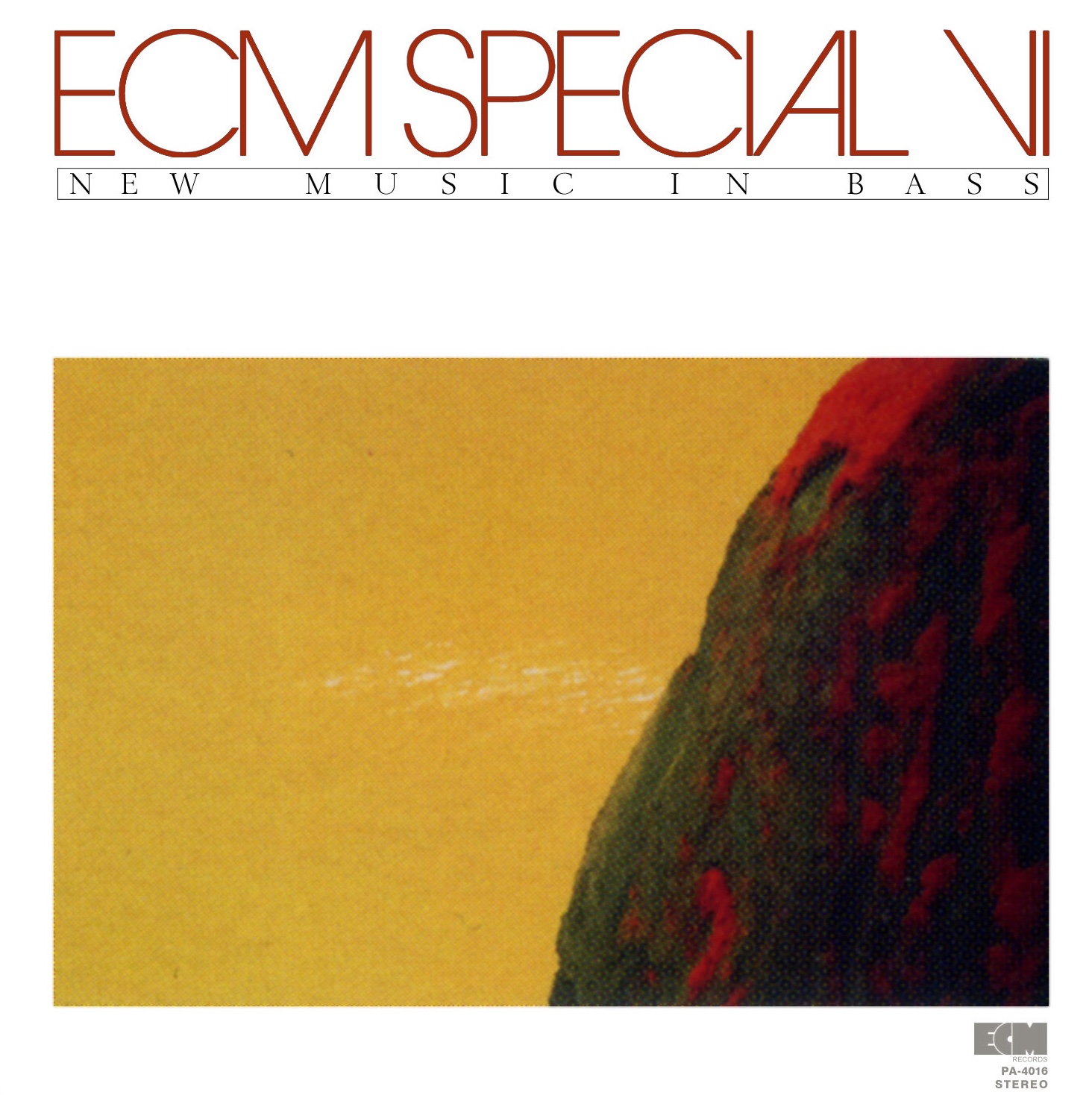
ECM Special VI continues the journey through this rare 1970s compilation series from the Japanese Trio Records imprint, gathering a deepening philosophy of resonance. Across its seven selections, the instrument becomes a hidden intelligence moving through the floorboards, where melody becomes sediment and rhythm grows roots in the dark.
“Re: Person I Knew” features Ralph Towner on 12-string guitar and piano alongside Glen Moore on bass in a crystalline selection from Trios/Solos. The Bill Evans tune shines in this lively rendition, its familiar contours given a freshly polished interior. Moore moves with a buoyant radiance, carrying joy with a shadow tucked inside it, that secret bruise at the center of lyricism. The combination of instruments and the raw presence of the recording create a classic sound, as though the tune had been waiting inside the grain of the room for someone to touch the right string.
“Conference Of The Birds,” from the Dave Holland classic of the same name, shifts into a more detailed register. The bassing here is central to the tune’s structural integrity, acting as the trunk from which the winds of Anthony Braxton and Sam Rivers take their intricate departures, while Barry Altschul’s marimba knots the wood with character. Its strength lies in subtleties that grow more evident in this surrounding company. The lilting melody and delicate interplay never fracture their sway, even as the piece seems to think in suspended calculations.
“Hotel Hello,” another title track, comes from the duo album by Gary Burton and Steve Swallow. This electric bass-forward tune is richly textured, with Swallow doubling on piano while Burton moves among marimba, vibraphone, and organ. Its playfulness has a dissonant edge, a kind of smiling unease, charming because it refuses to resolve into innocence. The tension builds without surrendering to release, turning the piece into a haunting foray into multitracked nostalgia.
“Mountainscape V” offers a wonderfully synth-infused example of Barre Phillips’s artistry, future-seeking yet unmistakably marked by its era. Although the bass is partially absorbed by the overall assemblage, veneered by John Surman’s soprano saxophone and animated by Stu Martin’s drumming, it remains the primary artery, slightly distorted inside its electronic wrapping. Its distance is answered by the tender intimacies of Arild Andersen’s “Wood Song,” a gorgeous improvisation from Shimri with pianist Lars Jansson, Pål Thowsen on percussion, and Juhani Aaltonen on wooden flute. Here the bass treads a circular path and learns that arrival is only another form of departure. Hints of other horizons lure the soul with delicate promises of return through a door one has never seen before.
Eberhard Weber’s The Following Morning brings us “Moana II,” a swath of atmospheric imaginings with haunting arco calls amid Rainer Brüninghaus’s glass-cold piano. Its changes are elastic, yet its emotional integrity never slackens. Weber’s sound seems comfortable vacillating between body and apparition, making for a luminous contradiction in which weight is transformed into dream-geometry, stepping aside to let some long-lost emotion cut to the front of the line.
The compilation closes with “Trilogy III” from Gary Peacock’s Tales Of Another, an early germination of the Keith Jarrett Trio with Jack DeJohnette. After Peacock’s introspective introduction, the band gathers speed and carries the listener toward a horizon that keeps receding under the force of its own invitation. Jarrett is in fine form, his soloing erudite without becoming ornate, while DeJohnette and Peacock hold the structure with total concentration. Thus, ECM Special VI turns the bass into a metaphysical instrument. Perhaps all listening begins there, in the low frequencies that support language, where the self exists in the state of constant rearrangement.
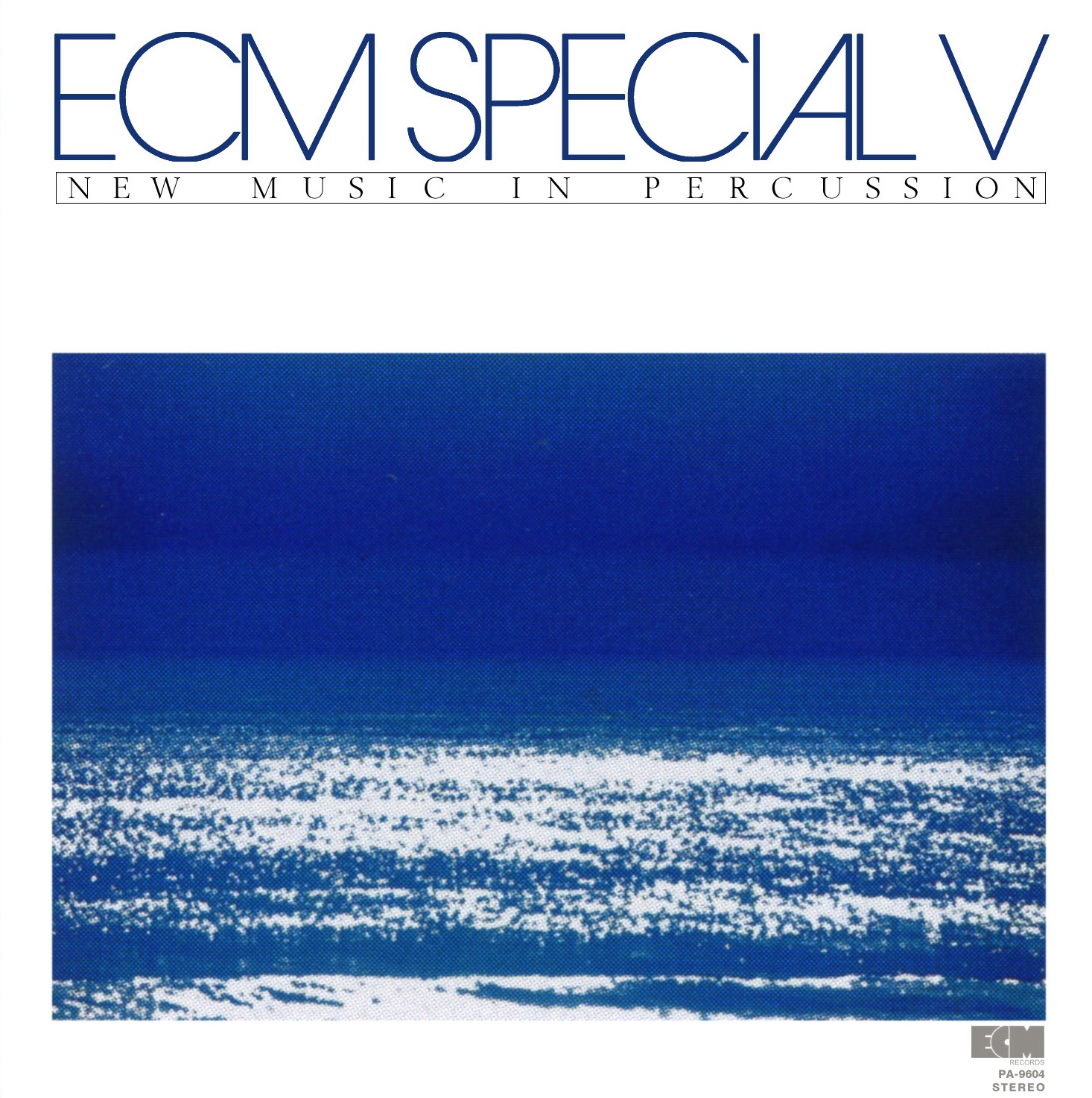
Percussion, in the ECM imagination, rarely behaves as ornament or engine alone. On ECM Special V: New Music in Percussion, rhythm functions as a conduit for revelation, each struck surface opening into an interior geography where hands and skins communicate in infinity signs. The compilation gathers music that feels carved from threshold states, hovering between human gesture and some older grammar of vibration. Its deepest theme may be contact: the instant when one body addresses another through resonance and receives, in return, a message immediately felt in the beat of the moment.
“Scimitar” is the first of two selections from gone-too-soon multi-instrumentalist Colin Walcott’s Cloud Dance, and it opens this world with a blade of astonishing finesse. Walcott’s tabla and John Abercrombie’s electric guitar do not merely accompany one another, nor do they settle into polite dialogue. They graze and refract, skating across modal waters with fiery verses on their tongues. The title feels exact, not because the music cuts with aggression, but because its arc is curved, gleaming, and ceremonial. Abercrombie’s lines seem to wander through electrified calligraphy, while Walcott’s hands compose a nervous scripture beneath them. The result is an engagingly articulated treasure, a fragment of bronze retrieved from some submerged republic of sound. “Prancing” deepens the album’s first inquiry by replacing Abercrombie with Dave Holland, whose bass brings a darker grain to the duo format. Holland gives the music a second shadow, a pliant undertow that lets Walcott’s rhythmic intelligence breathe with greater dramatic consequence. Beneath the tactile play runs an enlivening melodic current, subtle but persistent, turning the piece into a small kinetic body with secret chambers.
“Call from the Sea” arrives from what was then a JAPO-only release, Nan Madol, and still sounds as though Edward Vesala discovered a percussion language inside a ruin without a country. His beguiling masterpiece speaks in tongues that only the heart understands, though even that statement feels insufficient before its strange density. Crashing cymbals and bowed edges gather around field recordings of Alpine herding calls, producing a sound world that feels genetic rather than composed, as though memory itself had been spliced with copper and mist. As vast in implication as it is brief in duration, the piece foreshadows Vesala’s “Ballad for San,” which appears near the end of this compilation by way of Satu. There, the music expands into a macrocosmic answer to big band, a celestial mechanism with brass for bone and percussion for blood. Palle Mikkelborg’s trumpet already carries the glint of another altitude, and Vesala’s conception moves with a flare that feels both cosmic and bodily.
Jack DeJohnette’s “Picture 3,” from Pictures, shifts the compilation toward a more corporeal electricity, joined again by Abercrombie’s guitar, in which groove becomes a corridor of distortion. The listener wanders its funhouse turns and finds each reflection slightly delayed, each angle revealing a facet of the self that had been waiting behind the ear. DeJohnette’s drumming is propulsive without becoming blunt, full of muscular intelligence and angled grace, while Abercrombie’s circular phrases trace luminous traps in the air. Their combination produces a delectable effect, though “delectable” hardly captures the uncanny appetite of the piece. It eats expectation and leaves rhythm’s skeleton polished clean. The track also clarifies the compilation’s larger design: percussion here never sits beneath melody but bends the space in which melody becomes possible.
“Algeria,” from Ruta And Daitya, carries Keith Jarrett into a more cryptic register, singing into a flute while DeJohnette shapes the ground with hand drums. The sound moves through multiphonic shades of emotional depth, tactile and haunted, with a quasi-tribalistic charge that feels less ethnographic than psychic. This is one of the most mysterious duo records in the ECM back catalog, and the excerpt included here preserves that enigma with admirable restraint. Jarrett’s breath seems to fracture into ghost syllables, while DeJohnette’s touch turns percussion into a listening organ. The selection pairs beautifully with “American Indian: Song Of Sitting Bull,” from Paul Motian’s masterful Conception Vessel, where Jarrett’s flute meets Motian’s percussion in a related spiritual register. This second terrain feels somehow closer to home, rooted in an inward ceremony rather than distant projection. Motian’s presence has the quiet authority of someone drawing a circle on the floor and knowing precisely which spirits will enter via unfinished address.
“Malibu Reggae” changes the angle entirely, revealing yet another facet of DeJohnette’s art. Drawn from Untitled, one of the label’s unusual early gems, the track brings in an interesting band with Alex Foster taking the saxophonic lead. Its uplift is immediate, but the music avoids mere brightness. There is intelligence in its buoyancy, a rhythmic grin with hidden circuitry. Foster’s line moves with conversational ease, while DeJohnette shapes the tune from within, letting its surface radiance conceal a sophisticated internal clock. After the compilation’s more ritualized passages, “Malibu Reggae” feels almost shockingly open. It reminds us that percussion can let the body smile while the mind keeps discovering new doors in the floor.
“Jewel Ornament” brings us full circle by drawing from the well of Walcott’s Grazing Dreams. Abercrombie returns, and this time Don Cherry’s wooden flute widens the frame with an arid, singing tenderness. Walcott’s tabla glows at the center, a jeweled pulse whose articulations seem painted.
ECM Special V does something quietly radical by asking us to hear percussion as a philosophy of contact. Every stroke becomes an argument against isolation. Every vibration insists that nothing touched remains singular. The drumhead remembers the hand, the cymbal remembers the room, and the listener becomes the last resonating chamber in a chain whose origin cannot be found.
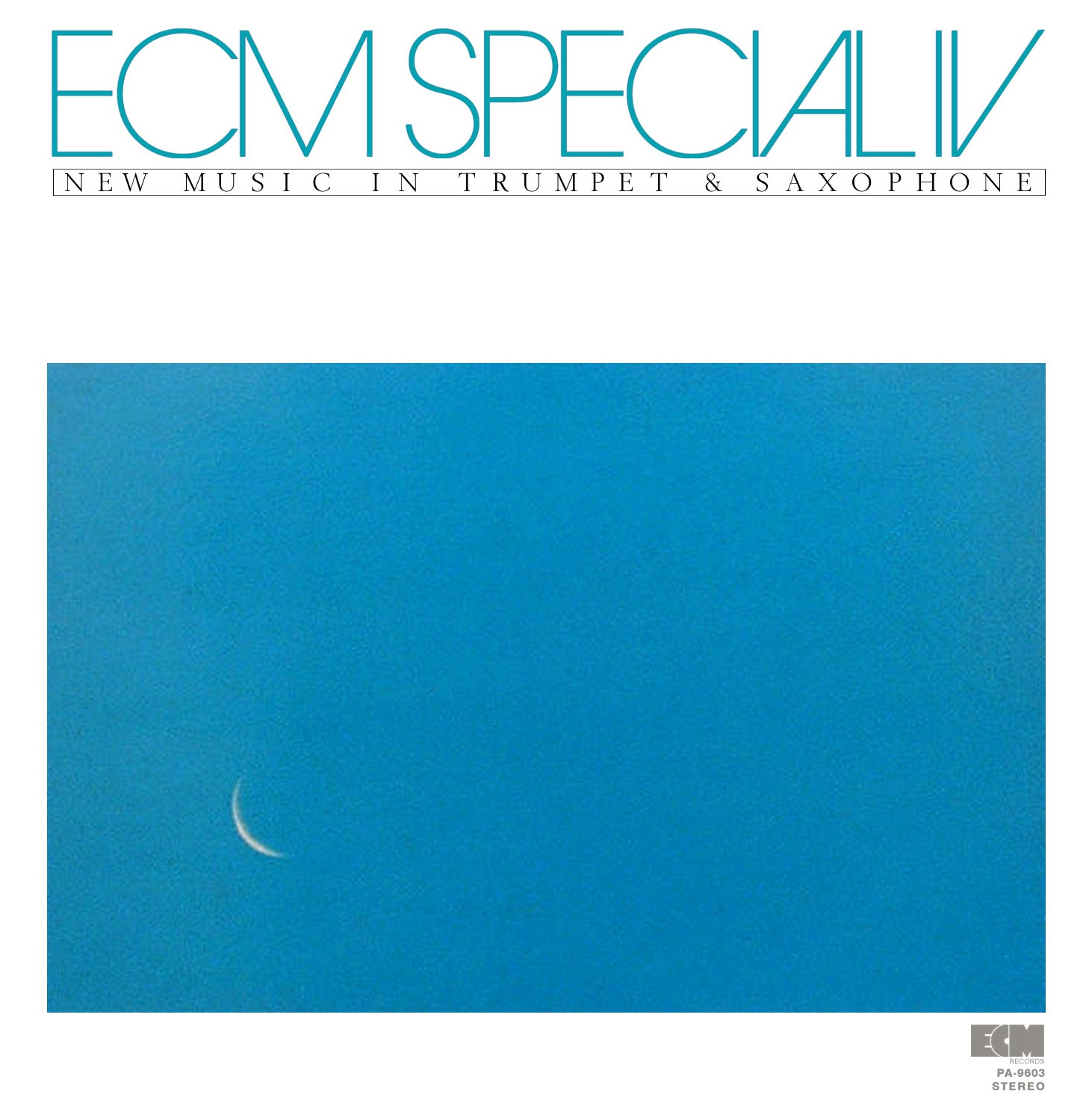
For the fourth volume in the Japan-only ECM Special series, we turn to a selection of tracks devoted to trumpet and saxophone, though the premise soon feels less taxonomic than metaphysical. Across the album, horn and reed serve as emissaries of the instant once melody slips free of intention. “Viddene” opens that passage with a descent into the font of Dis, the legendary duo album between saxophonist Jan Garbarek and guitarist Ralph Towner. Beneath them, a field recording of a wind harp stretches its drone into an almost mineral patience. Garbarek’s soprano, piercing yet hospitable, does not merely climb above the mountaintops but renders altitude a place where yearning can thin itself into radiance. Towner’s 12-string answers with wholesome grain and resonant wood, giving the saxophone’s aerial hunger a body to return to. The result is a soundscape of deep order, moving from abstraction toward groove.
In the wake of this dense conversation, “Tale” enters from Tomasz Stanko’s Balladyna, where the trumpeter speaks into the tensile architecture built by Dave Holland and Edward Vesala. The piece has a robust sense of motion, lumbering forward without losing balance, its gait full of alleyway intelligence and nocturnal cartilage. Stanko’s horn seems to carry a private flame cupped inside brass, illuminating only what it needs to continue. Nothing here explains itself, which is precisely why it convinces. The music fades while still in possession of secrets, leaving the listener with the sensation of having overheard a confession through a wall of smoke. “Svevende” returns us to Garbarek’s sound-world by way of Dansere, where his throaty reed cries with genuine emotional register in a setting only this band could have conjured. Bobo Stenson gathers the harmonic field around him, while Palle Danielsson and Jon Christensen give the rhythm a nervous, breathing intelligence. What begins in fragmentation gradually gathers into a more progressive pulse, around which Stenson and Danielsson inscribe their own Fibonacci sequence of lore.
Enrico Rava’s “By the Sea,” despite retaining the same rhythm section, changes the mood considerably, smoothing the surface until the music seems to stretch horizontally across an enormous inner screen. Taken from one of the trumpeter’s finest albums, The Pilgrim And The Stars, it sparkles all the more through John Abercrombie’s electric guitar, whose presence adds a filament of electricity to the surrounding calm. Rava’s melody moves with slick assurance, skating forward without needing to open its eyes, trusting the contours beneath it with almost dangerous grace. For listeners in 1977, the sound must have felt newly minted, a silver organism arriving from some studio out of time. Rava also closes the album in identical company with “Tribe,” from The Plot, and there the body returns with more visible muscle. A propulsive bass line is doubled by guitar, the cymbals flicker with chromatic wit, and Rava’s tone stays rounded yet incisive, peaking without snapping even the smallest twig in its surroundings. The groove has earth under its nails, but its mind is elsewhere, busy drawing constellations on the inside of the skull.
Between those two Rava signposts, Dave Liebman’s “The Call,” from Drum Ode, widens the album’s ritual dimension. One of only two ECM albums Liebman made as leader, Drum Ode remains a singular document, and this excerpt distills an ecstatic logic. His echoing tenor leaps joyfully amid a gathering of percussionists, a figure absorbed into a larger ceremony of impact and resonance. The title feels exact. This is a call, though not a summons, toward any ordinary destination. It is a signal sent backward through the body, toward the ancient percussive alphabet beating beneath thought. The energy is enormous, yet the recording never collapses into mere heat. ECM’s characteristic spaciousness gives even the densest passages a lucid edge, making the performance feel both historic and strangely unborn, a document whose ink has not yet dried in time.
Garbarek returns once again in “Belonging,” from Keith Jarrett’s timeless record of the same name. The duet opens in pianistic reverie before Garbarek’s soulful tenor walks into frame. Such seamless balladry grows rarer in an age increasingly trained to mistake synthesis for soul, yet here it stands, towering and alive, carrying its vulnerability without theatrical varnish. Then comes “’Smatter,” a gem among gems from Kenny Wheeler’s inimitable Gnu High. The bandleader’s flugelhorn converses with Jarrett’s unstable radiance while Holland and Jack DeJohnette keep the ground elastic beneath them. The piece lifts the spirits without sacrificing complexity, and Wheeler’s richness seems to come from a chamber deeper than technique. To hear this music now is to recognize that joy, when properly documented, becomes a difficult proof.
ECM Special IV is an evergreen meditation on breath under pressure, and its performances preserve the sensation of musicians listening so intensely that sound appears to enter the world through them rather than from them. The album’s profundity lies in its refusal to treat music as expression alone. This music suggests something stranger: that the self may be an instrument briefly borrowed by breath, a rented room through which larger silences pass on their way to becoming audible.
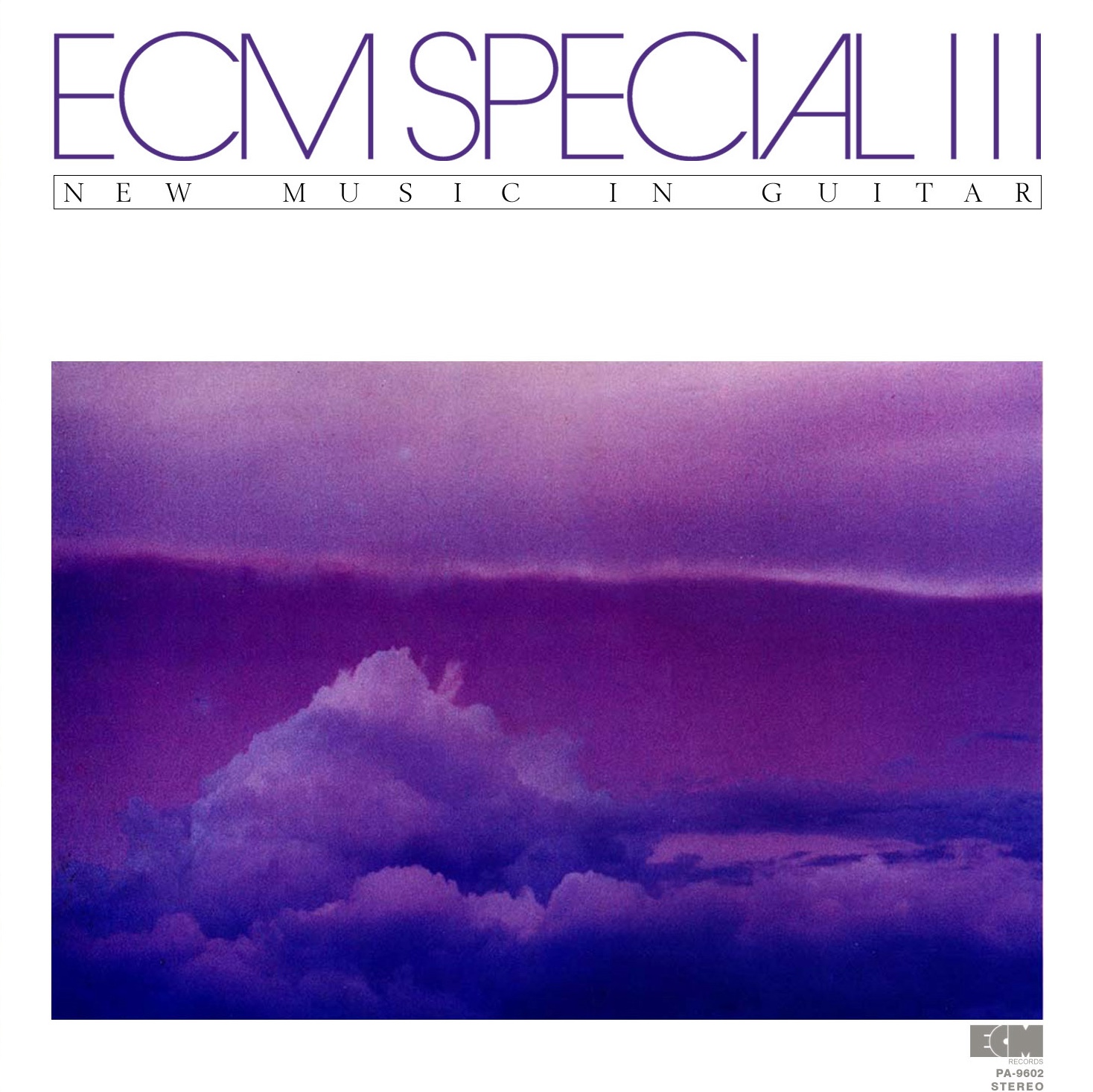
Following the first two ECM Special albums from the Japanese Trio Records imprint, this subsequent volume is the series’ first proper compilation, drawing finished tracks from a handful of canonical albums in the label’s history under the subtitle New Music in Guitar. That phrase is already a small philosophical disturbance. Not new music for guitar, as one might expect, but in guitar, as though the instrument were an interior world all to itself. Across these selections, the guitar becomes a threshold between the solitude of the hand and the vastness that opens when strings agree to tremble.
The journey begins with “Love Song” from John Abercrombie’s Timeless. On acoustic guitar, Abercrombie is joined by Jan Hammer on piano for a reverie that seems to hover in the afterglow of an otherwise phenomenally kinetic listening experience. The melody is tender and circular, a moonflower in fullest bloom of night. Interestingly, although drummer Jack DeJohnette is billed on the album, he does not appear on this duo track. Yet DeJohnette emerges alongside Abercrombie in the next selection, “Unshielded Desire,” taken from the first Gateway session, and the contrast is electrifying. This improvised powerhouse awakens the nervous system to the inspiring forces of these late greats, as Abercrombie’s guitar opens a fissure in the floor of the music, revealing a furnace underneath.
Next comes “Sad Hero” from Bill Connors’ enchanting Theme To The Gaurdian. Although Connors made only a handful of appearances on ECM, none were as intimately crafted as this. The present selection is a multitracked wonder in which different moths seem to gather around a single hidden lamp, each one casting a separate shadow from the same source. Connors plays with heartfelt attention to detail, yet the result never feels polished into sterility. The music carries the ache of an inward epic compressed into a few minutes of glowing filament. This track feels strangely inevitable beside Terje Rypdal’s “Like a Child, Like a Song,” the concluding piece from After The Rain. Another superior example of a single musician creating an entire world from scratch, it is characteristically fluid and dreambound in its quiet intensity. Amplified strings and piano are the primary voices, for all an elegiac vapor that erases the wall between composition and dream inscription.
No such sequence would be complete without Pat Metheny, and here we receive two prime examples of his early ECM language. “Watercolors,” from the album of the same name, threads his seamless lines through the fine needles of Dan Gottlieb’s drums and Eberhard Weber’s bass, giving the music a buoyancy both relaxed and exacting. Metheny’s phrasing already has that unmistakable sensation of forward motion carried by inner light, each note advancing with the composure of a traveler who knows the road because he has invented it beneath his own feet. “Missouri Uncompromised,” from Bright Size Life, shifts the terrain with Bob Moses and Jaco Pastorius at his side. The track veers into more twisted paths of improvisational continuity, its angles brighter, its logic more elastic. Metheny’s unwavering commitment to notecraft remains intact, but here the music refuses the straight corridor, choosing instead a route through mirrored stairwells and sideways doors.
“Matchbook” brings together Ralph Towner and vibraphonist Gary Burton, and the title track of their first duo record holds up beautifully for its shining atmosphere and fluid morphology. Towner’s guitar finds an ideal counterpart in Burton’s luminous attack, and together they construct a miniature habitat of suspended lines in which every tone has a tensile purpose. Last is “Elbow Room” from Sargasso Sea, which carries Towner forward with Abercrombie, bringing the compilation full circle. Its combination of electric and 12-string signatures continues to sparkle through an inventive exchange that feels conversational without lapsing into casualness.
Listening to this album now, one can only imagine what it must have felt like for Japanese audiences encountering these sounds at the time, gathered under careful curation. What a treasure, certainly, but the treasure may not reside only in the tracks themselves. Perhaps it lies in the act of transmission, in the record as a vessel crossing languages without translating anything, carrying the grain of fingers, circuits, wood, and breath into another listening culture. In that sense, ECM Special III is a small ceremony of distance overcome. The guitar, held close to the body, becomes a machine for imagining elsewhere. And somewhere in that elsewhere, the listener discovers that music’s deepest intimacy may be its refusal to belong entirely to the one who made it.
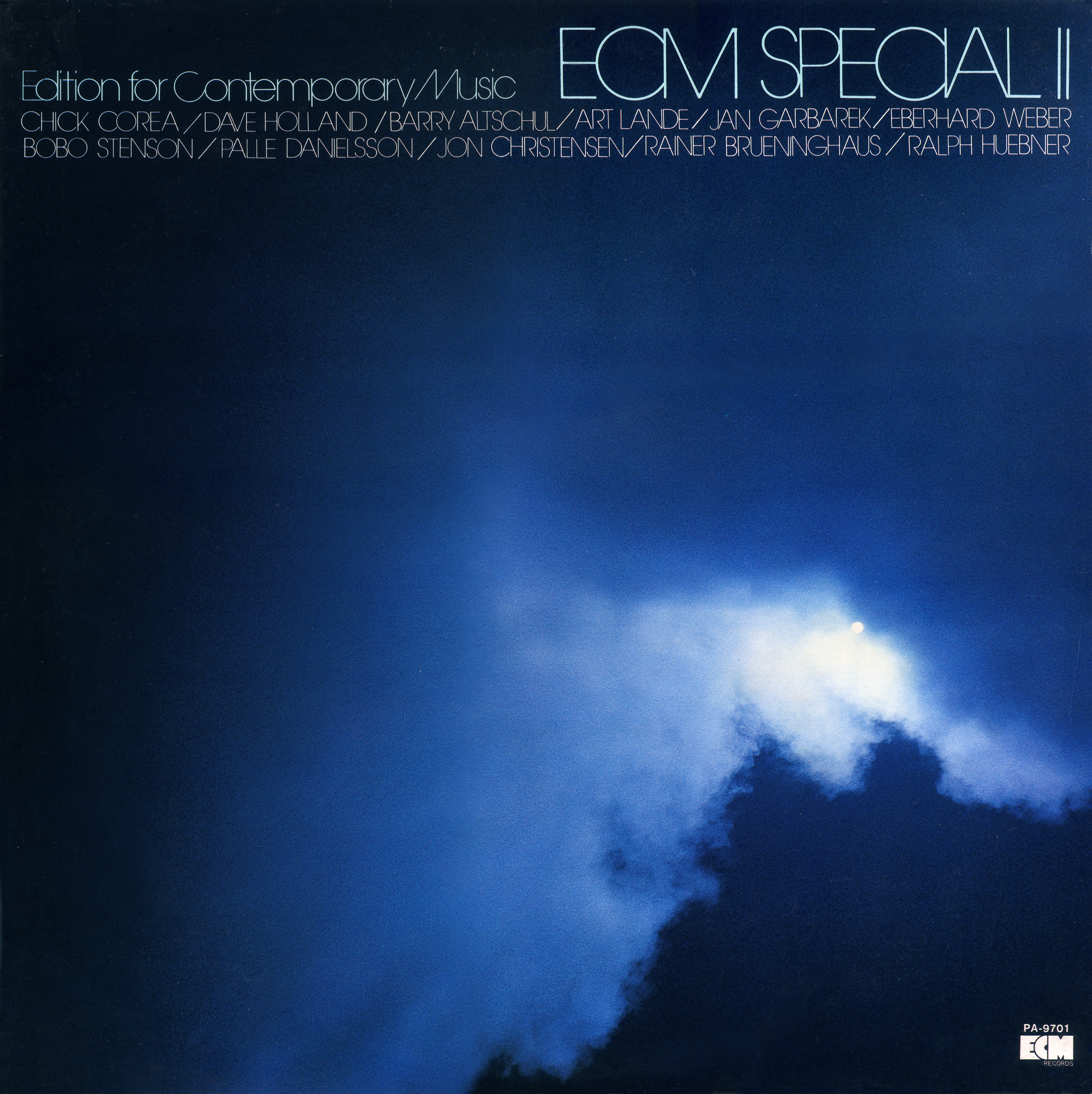
Returning to ECM’s formative years can feel like entering a chamber where the future has been stored in mineral form. The label’s early catalog still radiates that paradoxical condition of sounding both newly born and long remembered, and in the context of this rare Japanese compilation series, the effect deepens into something almost ceremonial. Following its 1973 predecessor, ECM Special II gathers fragments from separate iterations of the same dream, arranging them not as a set of nested thresholds. Taken as a concentric circle, the album moves from exploratory outskirts toward a luminous core, asking us to hear outtakes and canonical statements as parts of one larger organism, a spiral of unfinished thoughts becoming articulate in the dark.
At the outer rim are two outtakes from the classic album A.R.C., with Chick Corea at the piano and Dave Holland on bass, while Barry Altschul’s percussion scatters sparks across the floorboards. Holland opens “Country Song” with a line that seems to hitch itself to some imaginary caravan, sturdy yet strangely weightless, giving the track its momentum. Altschul adds a granular shimmer, while Corea moves between muted-string color and full-throated pianism with an Americana feeling that never settles into nostalgia. The foot-stomping vamp has charm, certainly, but its deeper value lies in the sense of musicians testing the tensile limits of a shared intuition. Holland’s soloing is robustly delightful, his amplified twang stretching across flat plains and invisible roads until the music begins to smudge at the edges. Corea’s atmospherics gradually loosen the frame, and what might first appear to be a minor archival curiosity begins to glow as a document of cognition in motion. “Vadana II” pulls the circle outward into more abstract terrain, where the trio’s passion seems almost too volatile for the vessel meant to contain it. The thread loosens, vanishes, returns with a changed face. Structures rise and collapse into their own scaffolding. What remains is a sonic kaleidoscope whose beauty comes from the audible heat of refinement.
One ring inward brings us to two pieces from Red Lanta, the singular collaboration between Arte Lande and Jan Garbarek, one of the most quietly enchanted productions of ECM’s first decade. Their pairing possesses a delicacy that never becomes fragile, a pastoral intelligence sharpened by inward pressure. Garbarek’s flute enters with a lilting candor, while Lande’s pianism opens corridors inside the harmony. In “Miss Fortune,” the duo cultivates a bucolic edge without turning picturesque, breathing through a faintly impossible geometry of sunlight combed over fields. “Cherifen Dream of Renate” leans further toward folk inflection, yet its dream logic resists any simple earthbound reading. The piece seems to remember a village that may never have existed, a place built from half-sung names and the amber residue of sleep. Together, these tracks deepen the compilation’s circular design, translating the restless inquiry of A.R.C. into a more inward grammar of tenderness.
At the album’s center stands “Kukka,” from Garbarek’s seminal Witchi-Tai-To, where his tenor assumes the foreground with a calm intensity. Bobo Stenson’s piano keeps opening new surfaces beneath him, Palle Danielsson’s bass crests with lyrical force, and Jon Christensen’s drumming seems to occupy every corner of the room without crowding it. Though it is among the more laid-back selections from an often kinetic album, “Kukka” is no less dizzying for its abundance of internal motion. Stenson’s soloing has that rare quality of sounding inevitable only after it happens, while Christensen transforms time into a field of hidden hinges. Danielsson’s lines rise with a singing patience, giving the performance one of its most quietly magical moments. What makes the piece endure is its refusal to announce its profundity. It simply unfolds, and in unfolding reveals that restraint can be a form of velocity.
And then there is “The Colours of Chloë,” from Eberhard Weber’s album of the same name, a masterpiece whose presence here serves as a subterranean engine. With Rainer Brüninghaus on keyboards and Ralph Hübner on drums, Weber shapes a sound that remains unmistakable even when stripped of context, intimate yet vast in its truth. Against the rolling tide of synthesizer, images of the past flicker with cinematic charge, allowing the ears to remember what the eyes never witnessed. That whistling threadline comes alive with possibility, opening a path for Weber’s elastic bass and Brüninghaus’s photoreal sense of color to shine forth. Few artists have ever assembled atmospheric and melodic architecture with such uncanny poise. Weber’s sound world found its perfect complement in Manfred Eicher’s production sensitivity, which here feels like a form of listening made visible.
ECM Special II embodies a small philosophy of adjacency, a record of how music migrates from margin to center and back again without losing its ambient temperature. The outtake, the duo miniature, the iconic statement, the remembered masterpiece: each occupies its place in a mandala that turns archival miscellany into metaphysical cartography. These tracks arrive from the past without behaving as relics, each bearing questions that have not finished asking themselves.
Perhaps that is the unexpected gift of this album. It does not merely remind us that ECM’s early years were fertile; it suggests that listening is a form of archaeology practiced on the unborn. We lower the needle and discover not what was, but what still waits inside what was.
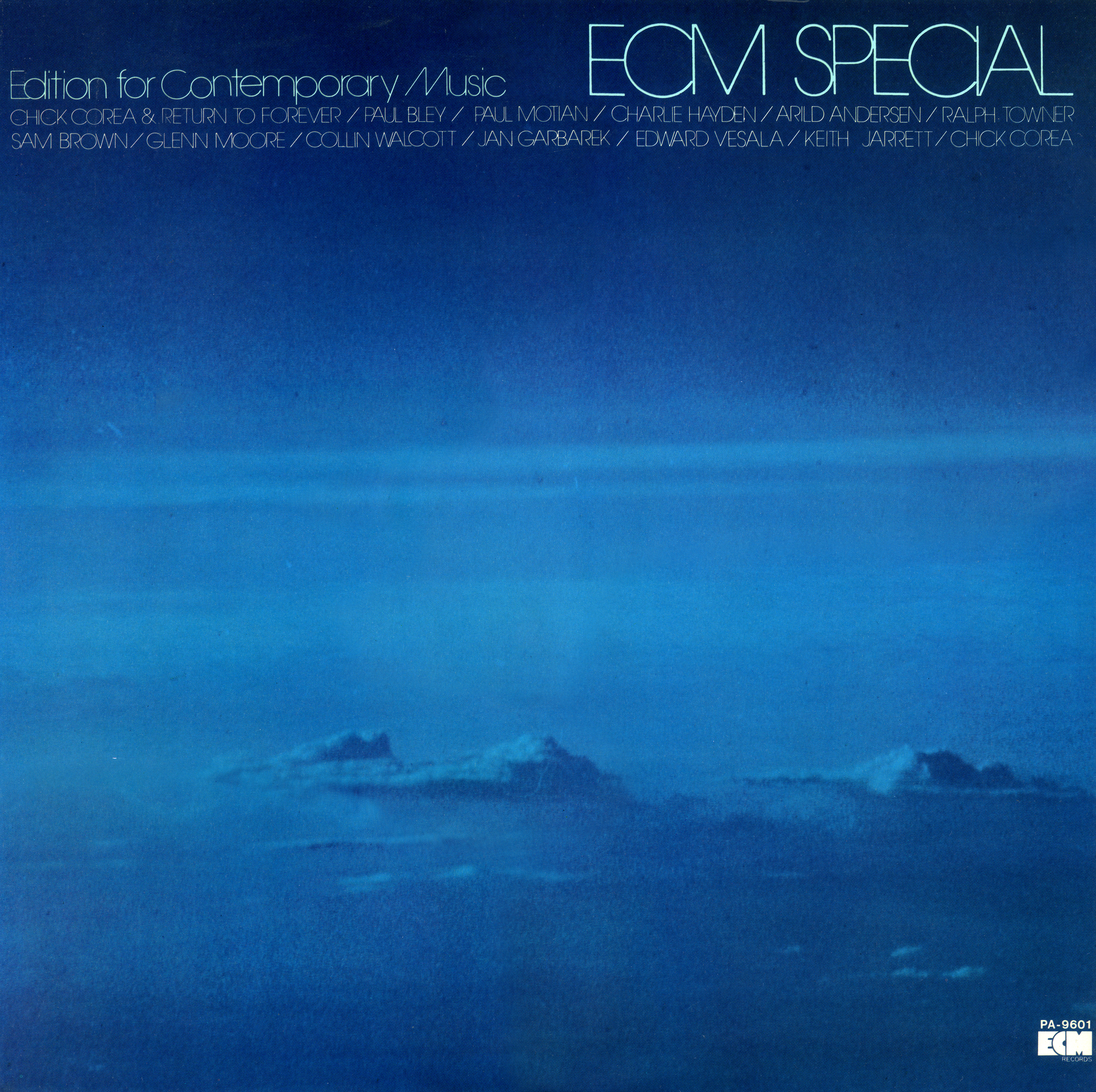
Among the many rarities I’ve come across in this journey to review all things ECM,few are as intriguing as the 10-part “ECM Special” series released in Japan on Trio Records throughout the 1970s. The tracks on this inaugural album, all recorded in the earliest part of that decade, exude the energy of an unlocked room. The compilation gathers music from a formative stretch in ECM’s history, but its deeper fascination lies in the way it catches artists at the edges of statements they were still learning how to make. These are not simply leftovers, alternates, or marginalia, but apertures into manners of completion. Thus, the album offers a small constellation of provisional illuminations, each track carrying the charge of musicians moving through the half-lit corridor between impulse and form.
The Japanese liner notes deepen the sense of this release as both a historical document and a carefully considered act of transmission. Manfred Eicher contributes a brief but telling note of thanks to Trio, giving the label his blessing not only for preserving ECM’s commitment to sound quality but also for helping introduce its artists to Japanese listeners with the seriousness and care their music deserved. Hisamatsu Noguchi’s accompanying history of the label situates the compilation at an especially early stage in ECM’s development: his note that ECM had released only about 20 LPs by that point reminds us how close this music still was to the label’s origins. “Over the last three years or so,” he writes, “the musically rich jazz records released by ECM have, in no small measure, also served as a warning to existing jazz records that have become bogged down in commercialism.” In that formulation, ECM emerges not simply as a new label with a distinctive aesthetic but as a corrective pressure within the broader jazz marketplace, insisting on space, intention, and fidelity at a time when such values could feel imperiled. Noguchi extends that idea in his praise of Eicher for providing his musicians with “a concert-like setting […] in which to realize their pure intentions and musical plans.”
And yet, the first track on the album is not an “ECM” track at all, though it comes with a relevant provenance in tow. In February 1972, Chick Corea formed the first iteration of Return to Forever with Stanley Clarke, Joe Farrell, Airto Moreira, and Flora Purim, recording the band’s eponymous ECM debut under the production of Manfred Eicher. During this same period, Corea and Clarke were also working with Stan Getz in a group that included Tony Williams, and on March 3, 1972, that ensemble recorded Captain Marvel for Columbia. The album included several Corea compositions, among them “Captain Marvel” and “500 Miles High.” Because of label entanglements, with Return to Forever associated with ECM in Europe and the Getz/Corea project issued by Columbia in the United States, later reissues and compilations sometimes drew these worlds into partial alignment. On ECM Special I, this music carries the feeling of a border crossing, jazz history folding its passport into a paper crane and sending it over several oceans at once.
Featuring Corea on electric piano, Farrell on flute, Clarke on electric bass, and Moreira on percussion, “Captain Marvel” bursts forward with radiant, forthright energy. The Return to Forever identity is unmistakable. Clarke’s bass does not merely propel the tune. It persuades it, shoulders it, gives it a muscular itinerary and a gleaming set of wheels. Everything interlocks with rare confidence, the groove sustained by an internal combustion that never clots or dims. Farrell’s flute surveys the whole journey from a height of untroubled clarity, while Corea’s solo reaches outward with quicksilver assurance, threading brightness through the piece’s open frame. The result is evangelically kinetic, a song with its windows flung open to the luxurious irresponsibility of motion.
In light of all this extroverted velocity, “Seven II,” an unreleased take from Paul Bley’s Open, to love. This version offers a more compact reading of the Carla Bley tune, turning toward realms of infolding affection. Bley’s touch seems to ask questions that the piano answers only in fragments, with the gravity of a mind reluctant to flatten feeling into explanation. Dissonant turns open small fissures in the lyric surface. Improvisational asides appear and disappear with the delicacy of thoughts glimpsed in profile. Moments of friction and concentrated resistance somehow grant the music its most lucid affirmations. By the final bluesy flourish, the piece has bowed to its own interior turbulence.
“Georgian Bay,” from Conception Vessel, features bandleader Paul Motian on drums, Charlie Haden on bass, and Sam Brown on guitar. It is a richly flowing track that surrenders itself to fluctuations of astonishing clarity. The music feels hyper-real in its depiction of time and place, yet the longer one listens, the more unreachable its world becomes. Brown’s arpeggios ripple with patient luminosity, Motian’s cymbals and percussion scatter points of mineral brightness, and Haden’s bass moves through the piece with lyrical sinew and grave freedom. The track evokes a landscape without illustrating it, which is always the harder and more mysterious achievement. Its minimal means generate an immense field of suggestion. Nothing is overdrawn, yet everything seems haunted by a fullness just outside the frame.
“Strings” is an unusual track, with Chick Corea improvising on the internal strings of the piano. Brief, kinetic, molecular, and intricate, it feels torn from the instrument’s hidden nervous system. The piano becomes a cabinet of bones and metallic dreams from which Corea coaxes a dense concentration of gesture and possibility. Drawn from the archives of the Piano Improvisations duology, the piece has the quality of a private experiment that accidentally opens onto metaphysics. In less than a handful of minutes, it suggests that an instrument is never singular. It is a society of concealed mechanisms waiting for a sufficiently curious intelligence to disturb its sleep.
“Brujo II,” from the vicinity of Trios/Solos, brings together Ralph Towner on 12-string guitar, Glen Moore on bass, and Colin Walcott on tabla. The track begins with sparkling guitar, then Walcott’s tabla gives the music traction while Moore’s arco bass draws its shapes into audible being. The chemistry is sometimes looser than what ultimately made it onto the album, yet that looseness has its own revealing quality, a sense of musicians finding the floor as they walk across it. Towner’s guitar glints with prismatic discipline, Walcott supplies an earthy centrifugal pull, and Moore’s lines turn the surrounding space into a darkened planetarium. The piece feels exploratory in the truest sense, testing how much unknown territory an ensemble’s shared breath can hold.
“Counterphonymic,” a track that fell by the wayside of Facing You, is a brief improvised piece with a twisted, jazzy flavor that refuses to stand still. Its rhythms falter yet lurch onward with a strange uprightness, producing an anxious but satisfying momentum. One might call it drunken, were it not for the crystal-clear intentionality beneath the surface. Keith Jarrett’s phrasing keeps slipping through trapdoors of its own devising, yet every stumble becomes a decision retroactively revealed as necessary. The piece is full of crooked intelligence, a miniature theater of imbalance in which poise is achieved by declining all conventional forms of poise.
“Bruremarsj,” with Jan Garbarek on tenor saxophone, Arild Andersen on bass, and Edward Vesala on drums, comes from Triptykon. A traditional tune, it works beautifully through proudly air-filled lungs, carrying a heartfelt and playful quality. Garbarek’s tone has a rural austerity that does not exclude tenderness. Andersen’s bass grounds the piece with quiet conviction, while Vesala’s drums complicate the path without disturbing its communal spirit. The track feels unified in a way that does not require polish. Its open grain is the point.
“Noon Song II,” an outtake from Piano Improvisations Vol. 1, shifts between lyrical reverie and upbeat dance with an almost mercurial sense of character. Corea moves between inwardness and buoyancy without making either feel stable for long. The piece keeps discovering new rooms inside itself, some intimate, some vividly animated, each entered with the fluency of an artist for whom improvisation is not wandering but instantaneous architecture. Its beauty lies in the way tenderness can suddenly acquire a pulse and motion can suddenly turn reflective. Corea lets moods infiltrate one another until the distinction between them begins to blur.
Taken as a whole, ECM Special I offers a timely glimpse into the recorded and performing process during a foundational period in ECM’s history. Yet its value extends beyond historical curiosity. The album reveals that the periphery of a catalog can contain some of its most charged material, precisely because these performances have not been embalmed by canonical expectation. They show musicians shaping sound at the edge of decision, making art before art has fully recognized itself in the mirror.
The deepest pleasure of this collection is that it refuses the museum logic of secondary material. Rather than asking us to treat these pieces as supplements to more authoritative albums, it invites us to imagine creation itself as an incomplete archive, a series of rooms opening behind the rooms we thought were barred from entry. In that sense, ECM Special I teaches that music’s most profound revelations may not arrive as monuments. Sometimes they appear as side doors, pencil marks, fragments saved by accident, faint signals from the workshop of becoming. And perhaps the life we call finished is also only another take, preserved on some impossible label, waiting for an unknown listener to lower the needle and hear, beneath all our official versions, the trembling master we never knew we had recorded.
My latest review for All About Jazz documents my thoughts on this phenomenal new album by Wolfgang Muthspiel’s “Chamber Trio,” featuring trumpeter Mario Rom and pianist Colin Vallon alongside the guitarist. Drummerless jazz of the highest order that fans of Muthspiel’s work on ECM won’t want to miss. Click the cover below to read more.
Caminante, no hay puentes, se hace puentes al andar. –Gloria Anzaldúa
Echoes from the Borderlands is a collective comprised of Valeria Luiselli, Ricardo Giraldo, and Leo Heiblum. It also names the 24-hour sound piece that explores and gives voice to areas of interstate violence along the U.S.-Mexico border. At the core of this sonic experience is a living canvas of sorts, a vibrational palimpsest built from binaural and quadraphonic recordings. Into this are woven archival recordings and other voices, authored by Luiselli, which move through the piece as necessary witness and disturbance. The result is a constellation of counternarratives to the official stories that pervade our newscycle, allowing Indigenous, brown, and black perspectives to keep pace with the conventional histories that ignore or kill them. The land itself serves neither as an abstraction nor as a mere foil for sociopolitical musings. It is a witness whose testimony has been buried under weary curricula and the administrative trance of empire. In this way, the project upsets the schema that dominates our lives in standard parochial models, not by refuting them point by point, but by placing beside them a deeper grammar of residue and return.
The present chapbook is the first study in this hallway, a narrow, illuminated passage that provides insight into the project’s core values and perspectives. Subtitled “Call You When I Get Home,” it exceeds the categories of reading and auditory experience, even as readers can scan a QR code to access its accompanying audio file. It is interactive in the most imperative sense. The pages are divided into three columns of text: the left representing the voices of imagined personas, which the reader is encouraged to read aloud during the allotted timestamps; the right containing interviews and archival materials; the middle holding field recordings taken during the authors’ travels across California, Arizona, New Mexico, and Texas. Over the course of 71 minutes, the reader becomes an implicative subject who must regard their own life experiences and histories as braided into those of maiming and erasure. To listen is to enter a chamber in which history does not sit behind glass but presses its mouth to the present tense.
The sounds open with a clear recording of humpback whales off the Pacific Coast, bringing us into dialogue with nature, a realm in which the cares of human self-interest have no throne. Yet this solace is short-lived because the first voice we hear questions why, in creation myths, the earth and sky are always “cloven asunder.” Must everything be broken to be told? Then again, such is the nature of trauma: we must be fragmented before we can be made whole. And our tormenters know and exploit this intimately. Stories get stolen, butchered, and consumed until they turn into the feces of time, buried along with the rest of our detritus in the middens of the forgotten. In this opening movement, the piece establishes one of its fiercest claims: that creation and destruction have too often been forced into the same orality, and that origin stories carry their own hidden instruments of cutting. Every atom is narrated by those who learn to split it.
The border, then, is the “margin of a page,” a place where the real commentary begins and where the thoughts we hold dear can manifest beyond what is published, printed, and codified. One voice, for example, tells us about the many iterations of the border wall since President Truman erected the first in 1945, just after World War II. Not coincidentally, those initial chain-link fences were dug from the very desert where Japanese Americans were interned before being trucked to the border. “Each president,” we are reminded, “has since potlucked his bit of iron, steel, cement, mesh, and wire.” Despite what legacy media would have us believe, no one in recent history is guiltless of this charge. Everyone has that dust and ballast on their hands. In light of this, the border does not emerge here as a fixed line but as an accumulating technology of dread, a ceremonial scar renewed by the ritual polishing of fear on a national level. Its materials migrate across history with obscene efficiency. What once enclosed the demonized now repels the displaced. The same metal keeps changing uniforms.
Many of the archival voices concern how true love gets trampled by systemic pressures of citizenship, feeling lost and found by the enemy. We hear the sounds of people crossing the border, their bodies reduced to mechanical baggage that reflects time in constant reversal. Desire itself is subject to inspection, while kinship must answer to paperwork. The body, in transit, is converted into a problem of storage, the metaphysical insult of being processed by a system that cannot recognize the sacred velocity of arrival.
An unheard story then emerges: voices of detention center inhabitants whose lives have been confined to shells of their former selves. Children are taken from their parents and kept “in their place.” Woven into their testimony are histories of early-20th-century racial eugenics in the U.S., which, let it not be forgotten, would become the model for Nazi Germany. The haunting audio of a promo film about the lushness of revitalized land, using water to bring newness to the desert, arrives at the expense of forced sterilization. Both involve the severing of channels. The parallel is vastly intentional, the female reproductive cycle and anatomy mapped not over but under the land, out of sight and out of mind, so that the infrastructural powers that be need not acknowledge the effects of their own actions. The fantasy of improvement conceals a theater of extraction. The project asks us to hear irrigation as incision, settlement as anesthesia, and fertility as a field administered by those who confuse conquest with care. But the land cannot be settled, for it is constantly in motion. Those who kill try to force the illusion of its stillness, yet entropy always wins. The only certainty is possibility.
“And which story do you believe in?” we are asked. Only then do we realize the luxury of not answering, of turning both the physical and metaphorical page, tuning the radar dishes of our ears to off-planet signals while terrestrial cries go unheard. Speech acts are life acts, birthing newness and assertion that someone was here. They are the vibrational footprints most easily ignored. Yet they can also be recovered and repurposed. What is the point of fear when it is manufactured as a drug to be taken by mouth? The question hangs in the auditory field with almost pharmacological force. Fear circulates through public life as the prescription of a patriotic supplement, whereupon it is metabolized and mistaken for instinct. Against this, Echoes from the Borderlands offers listening as detoxification, not in the shallow language of purity, but as an intellectual and bodily refusal to let terror do all the thinking.
Still, all of this casts doubt on our ability to know what has been shielded from us, for how can we begin to document what is no longer there? And yet, perhaps there is no need to document in the ordinary sense but rather to make space for the old and forgotten paths. Just because one gentrifies the land does not mean the veins running beneath it are bloodless. The heart of the earth is still beating. Knowledge does not exist to be extracted but to be lived and passed on to those with private power, those who inherit not domination but obligation. Therefore, the proverbial question is not whether a tree that falls alone in a forest makes a sound, but whether the death cry of the one falling at the hands of its destroyer is ever acknowledged. We are returned to this ethical threshold time and again, reminded that sound is never merely sound. It is a demand placed upon the living by that which has been made absent, if only by being declared administratively unreal.
And the more we learn of the history of pleasure, and how women’s access to it continues to be medically inhibited, the less room remains for any excuse. The ores of the world are the building blocks of their oppression; that is what we so often forget. Without the materiality of that harm, there might not be so much destruction. From the copper mines that find their way into IUDs to the sand and rock that hide the bodies of victims, they are the disease and the artificial cure, the problem, reaction, and solution, all rolled into one. Because the more you dig into the earth, the more of an excuse you have to kill for what you find. Extraction becomes a philosophy before it becomes an industry. It trains the eye to regard depth as inventory. In the chapbook’s most unsettling passages, body and sediment are coextensive archives of intrusion. What is done to one is rehearsed upon the other, and the wound learns to speak in minerality.
By the time we encounter the long, wordless passage of a Union Pacific train at the 49’40” mark, we must face our own complicities in the contents of its cargo. Where are all of those materials going? Whose financial and political interests will they serve? By the time we wonder, it is already too late, for the objects of our scrutiny are already on their way to destinations we can only imagine. Not the trainyards and depots written on delivery logs, but the bodies in which they will eventually find a host to parasitically take over slowly, year after year, until their role in the deaths of the Other is obscured beyond recognition. The sound of a military plane flying overhead, too, reminds us that the long arm of surveillance reaches into homes and orifices while we sleep. Because no one can hear you from that high up. Aerial power converts people into smudges of movement beneath an indifferent machine sky. It is the same script of altitude as moral evasion.
One might feel inclined to pore through these recollections in search of secrets that may enlighten us about their hidden meanings, but such an approach amounts to an uncut key at best. In this case, we do better to see the act of recording as a living practice, a ritual of attendance in which capture does not mean possession. And while it is tempting to read Echoes from the Borderlands as an index of disorientation or a manual for wandering through the ruins of state-sponsored sense, we must see in its rhythms and framings an affirmative orientation, not so much an act of alienation as an alienation of action. The project estranges the habits that render violence ordinary. It asks the listener to inhabit the interval before conclusion, the charged hollow between hearing and response, where responsibility first begins to condense.
“The ear,” wrote Pauline Oliveros, “is a faithful collector of all sounds that can be gathered within its limits of frequency and amplitude. Sounds beyond the limits of the ear may be gathered by other sensory systems of the body.” Might we, then, read the microphone as an ear of expanded intimacy or even radical hospitality that gathers what the sanctioned ear has been trained to discard in anticipation of the real? Then again, the English word anticipate has its roots in the Latin ante and capere, giving us a portmanteau that means “before taking.” A painful reminder that we arrive after the seizure and before the reckoning, in that spectral jurisdiction where every footstep is both evidence and plea.
The timely charge of Echoes from the Borderlands lies in its refusal to convert suffering into a discernible shape. It does not “cleanse” the archive or turn the border into a metaphor tidy enough to be carried away unharmed. Instead, it leaves us with the difficult splendor of relation: the knowledge that every silence contains a confiscated name. To listen here is to accept that the connection from soul to soul is not waiting somewhere ahead, already engineered by grace, but must be made through the unbearable patience of continuing.
Voyager, there are no bridges, one builds them as one walks.