András Schiff: Franz Schubert – Sonatas & Impromptus (ECM New Series 2535)

Schubert Sonatas and Impromptus

András Schiff
Franz Schubert: Sonatas & Impromptus

András Schiff fortepiano
Recorded July 2016, Kammermusiksaal H. J. Abs, Beethoven-Haus, Bonn
Engineer: Stephan Schellmann
Tuning and technical assistance: Georg F. Senn
Executive producer: Manfred Eicher
Release date: April 12, 2019

“Secretly, I hope to be able to make something of myself, but who can do anything after Beethoven?”

In these words, Franz Schubert (1797-1828) at once shadowed himself against his light of inspiration and added to its fiery glow. But because artists of any type are often their worst bêtes noires, the humble interpreter would better judge his place in history, for while this music exuded from the body of its composer, it infuses every sinew and synapse of its performer. In András Schiff, Schubert finds an amplifier both in and out of time. “Schubert’s music,” notes the Hungarian-born pianist, “is the most human that I know,” and only a musician of such humanity could hold true to that doctrine.

In his own day, Schubert was filed prematurely under “recondite,” and so after the publication of his first two early sonatas he dove headlong into his crowning Winterreise, producing also in that period the Moments musicaux (see ECM New Series 2425/26) and the first Impromptus D 899. The latter were never meant to be concert pieces. “And even if we play them in a large hall today,” Schiff insists, “we have to transform that space into an intimate space.” Schiff does that, and more, in his renderings of these mosaics. From the light-footed highs to the surface-level lows and the heavenly mids between them, Schiff achieves a striking balance and dynamic spread on the Franz Brodmann fortepiano, built in Vienna circa 1820, which makes its recording debut here. In the first impromptu especially, one hears a mind thinking aloud in words that can only be captured in their absence. In place of letters, Schubert writes with feelings—not impressions, but fully formed emotional landscapes. As lines diverge, Schiff handles their individuality with surgical care. In both the second and third impromptus, he carries across a sense of water running through a forest, while in the last enhancing the modesty reflected in the epigraph above.

The Sonata in c minor D 958 was written in 1828, just two months before Schubert’s death. Its Allegro plunges us into a world all its own, crafted as much by shadow as by light. Schiff’s rhythmic sensitivity is righteously attuned and reveals a difference of reiteration rarely matched. The mournful Adagio finds its promise fulfilled by asking for no promise to be fulfilled. Its eternal spiral of questioning and answering becomes a private dialogue for composer and performer alike. A Menuett gives us respite from the weight of darkness, turning to a memory as a rift in the fabric of time that cannot be brought closer no matter how far we reach. The final Allegro, which Schiff calls a “dance of death,” is a mad, desperate rush into turbulent night. At any given moment, it threatens to unchain itself, but manages to hold its integrity, even as it unspools to a thread of its former glory.

The Three Piano Pieces D 946, essentially impromptus by another name, are among Schubert’s most adroit. The first of these, in e-flat minor, appeared at Schiff’s fingers previously on ECM in his Encores After Beethoven, and enthralls even more in the present rendition. This piece has it all: drama and introspection, virtuosity and humility, life and death. The second is an inversion of the first, achieving some of its densest textures in the middle between a head and tail of airy resolution, while the final impromptu jumps through one thematic hoop after another until it sticks its landing perfectly.

Schiff is keen to observe that Schubert, even in his brief life, wrote more than 600 lieder for piano and voice, and that even when writing for solo piano “the human voice and the song are always present.” His magnum opus, the Sonata in A Major D 959, is proof positive of this effect and is alone worth the price of admission. Its gargantuan opening is the science of poetry incarnate. At nearly 16 minutes, it floats two images for each one it sinks, and leaves us tenderized for the lachrymose Andantino that follows. If any single movement can be exhibited as proof of the fortepiano’s capabilities, this would be it. From whispers to thunder, it encompasses the full gamut with breadth of mind, and Schiff understands its mechanical heart as his own. The mood is so intense that the Scherzo opens a portal from one end of life to the other, bleeding into the concluding Rondo as if time itself were a physical substance to be waded through on the way to eternity.

As Misha Donat writes in his liner essay, “In the beauty of his material and the magical effects of elliptical key change…it must be said that Schubert actually surpassed his model.” But perhaps their relationship isn’t so much temporal as spatial, for while Schubert had himself buried close to Beethoven, the two would seem to converse from atop distant mountains even as performers of their music try to hang-glide along the currents between them without falling. And while it’s tempting to imagine what Schubert might have written had he lived beyond the tragic age of 31, that his flame caught hold of its worldly wick for as long as it did should be enough to validate the gift of its light.
Marco Ambrosini/Ensemble Supersonus: Resonances (ECM 2497)

2497 X

Marco Ambrosini
Ensemble Supersonus
Resonances

Marco Ambrosini nyckelharpa
Anna-Liisa Eller kannel
Anna-Maria Hefele overtone singing, harp
Wolf Janscha Jew’s harp
Eva-Maria Rusche harpsichord, square piano
Recorded November 2015, Auditorio Stelio Molo RSI, Lugano
Engineer: Lara Persia
Album produced by Manfred Eicher
Release date: June 21, 2019

Nyckelharpa virtuoso Marco Ambrosini returns to ECM with a project as successful as it is ambitious. In Ensemble Supersonus, he has forged a far-reaching prism through which to shine the light of his neglected forte, and by its rainbow effects a wealth of reimagined material. For Resonances, he is joined by Anna-Liisa Eller on kannel, overtone singer Anna-Maria Hefele, Wolf Janscha on Jew’s harp, and harpsichordist Eva-Maria Rusche.

The album opens with Ambrosini’s unaccompanied “Fuga Xylocopae.” As the keystone to the geometry that follows, it renders an entire world of possibilities, and from that panoply frames eleven further scenes, each more painterly than the last. In its wake, Heinrich Iganz Franz Biber’s “Rosary” Sonata No. 1 gets a chemical peel, touched by Hefele’s blinding inner-space and Rusche’s sparkling plectra. Through it all, Ambrosini’s abilities delight, touching off minutiae that one would never have guessed to be lurking in Biber’s psyche. Music by Johann Jakob Froberger (an e-minor Toccata played on square piano) and Girolamo Frescobaldi (a Prelude and Toccata with added nyckelharpa) flesh out the Biberian zeitgeist.

Although released in 2019, this album was recorded in 2015, one year after the ensemble’s present lineup cohered in a mutual search for ancient and modern music with such Baroque modes as their fulcrum. From the Medieval mysticism of Hildegard von Bingen’s O Antiqui Sancti, made manifest by Hefele’s liminal voicing, to the starkly visual writing within the group, nothing in the program is out of place. In the latter vein, Janscha contributes three compositions: Ananda Rasa, Fjordene, and Ritus. The first and last are statues come to life, actors moving across a silver screen, while the second is a Jew’s harp solo of deepening soul. Rusche adds her own: the kinetic and vivacious Erimal Nopu, a buoyant polyphony of spirits that seems inspired as much by 17th-century harmonies as by Manuel de Falla. As does Hefele, whose 2 Four 8 is a forest of overtones through which a full moon shines.

The traditional Swedish “Polska” widens the ensemble’s meeting ground like antique machinery oiled to renewal. Ambrosini sighs and sings, treating laments as messages in a bottle cracked open only in dreams. Another standout in this fantastical regard is “Hicaz Hümâyan Saz Semâisi” by Veli Dede, whose music has intersected with ECM before via Anouar Brahem’s Conte de l’incroyable amour. Its modal beauties are familiar and forever searching, thus proving that, for all its backward glances, Ensemble Supersonus is looking resolutely forward, as I hope we can to a follow-up in the future.

Thomas Demenga: J. S. Bach – Suiten für Violoncello (ECM New Series 2530/31)

Demenga Bach

Thomas Demenga
J. S. Bach: Suiten für Violoncello

Thomas Demenga violoncello
Recorded February 2014, Hans Huber-Saal, Basel
Engineer: Laurentius Bonitz
Executive producer: Manfred Eicher
Release date: October 27, 2017

The Cello Suites of Johann Sebastian Bach, like his Sonatas and Partitas for solo violin, are touchstones for listeners and performers alike. In the latter sense, Thomas Demenga approaches them through an ECM lens for the second time here. Having first fragmented his traversal between 1986 and 2002 through a series of pairings with contemporary works, thereby suggesting exciting new relationships, here he uncovers intra- rather than interrelationships, moving from fundament to firmament and back again with mind and hands sculpted by experience into something unmissable.

Where some interpretations might seek to add something new, Demenga’s embrace something old, always there but too often crucified on the scoreboard of modernism. Here we encounter a return to form, if not also a form of return, in the deepest interest of music that springs eternal from Creator to creator. Referred to in Thomas Meyer’s liner essay as “every cellist’s gospel,” the Cello Suites do more than encourage rereading; they demand it. Having played these masterpieces for more than 50 years, Demenga understands that no one is ever “done” with them and that we’re all born and expire in its swaddling echoes.

In the First Suite, he carries an antique sensibility from first inhale of Prélude to last exhale of Gigue, working shadows into familiar nooks and crannies as if they constituted a physical substance. That same feeling of breath, more than metaphorical, whispers, rasps, and soliloquizes through the Second Suite’s philosophical journey. Its Prélude liquifies the heart and feeds it to another in a cycle of life that cannot be qualified by any other means than the gut strings and baroque bow with which Demenga has chosen to articulate every stroke. The Courante is strangely beautiful in its jagged denouement, while the Sarabande that follows it speaks with haunting urgency and the concluding Gigue with three-dimensional tactility.

The lithe stirrings of the Third Suite’s Prélude and Allemande form a dyad of such emotional integrity as to occupy a realm all their own. As in the famous Bourrée I & II, he dives inward for pearls of wisdom, unpolished and offered in their own shells, glorious specimens of nature whose perfection communicates in the language of imperfection. Demenga’s trills and glissandi are as surprising as they are organic, and flow of their own volition.

Says Demenga of Bach, “His music is detached from personal feelings and dramas or other events to which many composers give expression in their music. That is why his music is so pure and why it possesses, we might say, something divine.” In interest of that expression, this performance is made all the more solitary for its attention to dance-informed structures. This is especially evident in the program’s second half, which through the prism of the Fourth Suite shines a light striated with as much solemnity as exuberance. From the throaty Prélude unspools a narrative of timeless impulses. In the Allemande and Courante that follow, one can feel the soul of a viola da gamba squeezing through the strings, as if the latter were portals of mastery to which our ears must seem as eyes hungry for vistas beyond the known. And in the footwork of the final Gigue, the press of flesh into soil is vivid and alive.

From that sunlit scene Bach pivots into the twilight of the Fifth Suite. Here the modesty of its inception tangles in moral debate with its fleshly Courante—made all the more carnal for Demenga’s intuitive bowing—before finding solace in the blushing Gigue.

This leaves the Sixth Suite to stand as its own Book of Revelation, a scriptural culmination of all that came before it, a fulfillment of prophesies as old as they are indisputable, and which spread the good news of salvation not through words but actions.

As the opening movements—not least of all in the dizzying Prélude—suggest, we must find our own way into this music not by way of deciphering but in the knowledge of receiving a gift in and of faith. And if the finality of its Gigue is any indication, we must treat farewell as the opening of a deeper relationship with life itself, personified in every tremble of the waiting ear and reciprocated whenever we need to be reminded of purpose.

Dénes Várjon: De la nuit (ECM New Series 2521)

De la nuit.jpg

Dénes Várjon
De la nuit

Dénes Várjon piano
Recorded April 2016, Auditorio Stelio Molo RSI, Lugano
Engineer: Markus Heiland
Produced by Manfred Eicher
Release date: August 31, 2018

He searched under the bed, around the fireplace,
in the chest: but he found no one.
And he could not understand how the spirit had crept in—
and how he had escaped again.
–E.T.A. Hoffmann, Night Pieces

Hungarian pianist Dénes Várjon, who last regaled ECM listeners on 2012’s Precipitando, returns with another program of three culturally disparate composers united by the immaterial. Although the blood running through the veins of Robert Schumann (1810-1856), Maurice Ravel (1875-1937), and Béla Bartók (1881-1945) may be genetically dissimilar, in each we find arbitrations of music that, according to the booklet essay by Jürg Stenzl, “far transcended the confines of their time.” The untethered quality of these compositions, each chosen with utmost attention to detail, by virtue of their literary angles interlock in organic conversation. And in rendering them, ECM has found an unparalleled interpreter.

Schumann’s Fantasiestücke, op. 12 of 1837 are comprised of transfixing poetry. In these “character pieces,” linked explicitly to the writings of E.T.A. Hoffmann and Jean Paul, Schumann eschews sonata form in favor of an emotional mosaic that abides by its own logic. Its foundations support a lighthouse for listeners lost at sea. From the dramatic (Aufschwung and In der Nacht) and tenderly inquisitive (Warum?) to the mythic (Fabel) and dreamlike (Traumes Wirren), Schumann shines his light through one incredible prism after another until, coming to rest after the robust Ende vom Lied, Várjon, too, breathes the sigh of a journeyman closing his eyes with success.

Ravel’s Gaspard de la nuit (1908), inspired by a prose-poetry collection of the same name by Aloysius Bertrand, spins those latter impulses into a web of vivid imagery. The lambent Ondine evokes the water sprite of the same name, whose attempts at seduction follow fountain-like trajectories before rejection sends her reeling into the background. Le Gibet (Gallows) is meant to illustrate the body of a hanged man. Morbid yet beautiful, its suspensions take on new meaning. Scarbo returns to folklore in its depiction of the eponymous dwarf, said to haunt nightmares. The sensation of running desperately through a forest of which every tree is a hand tearing at our clothes makes this one of the most astonishing renditions I’ve ever heard of this piece.

The title of Bartók’sSzabadban(1926) means “Out of Doors,” and provides respite in the pastoral truths of its canvas. Some of its many influences include folk songs in the darkly percussive first movement and the harpsichord music of Couperin in the third. Throughout, a sense of comfort is always one step removed, locked in step with the march of a history that has all but left these jewels behind. Like the final movement, each scene is totally committed to its own unfolding, until we’re ready to work it back into shape as a promise to return.

Trio Mediaeval & Arve Henriksen: Rímur (ECM 2520)

Rímur

Trio Mediaeval & Arve Henriksen
Rímur

Anna Maria Friman voice, Hardanger fiddle
Linn Andrea Fuglseth voice, shruti box
Berit Opheim voice
Arve Henriksen trumpet
Recorded February 2016, Himmelfahrtskirche, München
Engineer: Peter Laenger
Produced by Manfred Eicher
Release date: March 3, 2017

If fate would send me around the world
far away from you,
I would yet, with tears, send you a sigh
that belongs to you.

The title of Rímur, Trio Mediaeval’s seventh album for ECM, takes its name from a longstanding tradition of Icelandic rhyming verses, passed down orally from generation to generation until reaching their present incarnations in a program that meshes three distinct voices with a fourth: that of trumpeter Arve Henriksen. In this artful sequence of chants, hymns, and folk songs drawn from Scandinavian sources, the quartet reimagines music as it might have swept across northern landscapes during bygone ages whose histories are renewed in these melodic survivors.

Because improvisation has always been a vital component of Nordic folk tunes, the leaps of intuition required of their interpretation are in-built into the music. And while saxophonist Jan Garbarek’s collaboration with the Hilliard Ensemble will draw obvious comparison—and, to be sure, fans of that project will want to own this one as well—it’s very much its own world, tracing a continental fringe that runs crosswise to that ECM classic.

The Icelandic material yields the most ghostly effects—not only because of a certain transparency, but more importantly because of Henriksen’s ability to see in it what few others might. Whether rising like the stream of a quiet fountain in “O Jesu dulcissime,” a highpoint of the disc for its vocal blending and Hardanger fiddle accents, or unraveling inner spirit in “Morgunstjarna,” a hymn to God’s only begotten Son in confirmation of grace, Henriksen reveals unforced harmonies, by turns balladic and martial. Other highlights include the original “Krummi,” the traditional Swedish shanty “Du är den första,” and the anonymous chant “Alma Redemptoris Mater.” In each of these, he extends the wingspan of expectation while yet cooling us in a familiar shade. In his absence, Friman, Fuglseth, and Opheim are spotlighted by a handful of vocal pieces, including some especially evocative material from Norway. Of these, the wedding tune “Brureslått” features some of the most stillness-inducing singing the trio has ever recorded.

At the heart of this recording are substantial hymns to Saints Birgitta (Sweden), Magnus (Orkney), and Sunniva (Norway). The first, by 14th-century Swedish composer Nils Hermansson, epitomizes the dynamics that make Trio Mediaeval such a unique ensemble. The way in which they spin from a single voice a sonority beyond triplicate measure is exquisite, even as Henriksen adds a voice of his own, at first in lockstep then in untethered flight. In the other hymns, they sail equally selfless waters. Would that we were able to turn their metaphorical vessel into a reality, docked far beyond the world’s storehouse of hatred by a braid of divine inspiration.

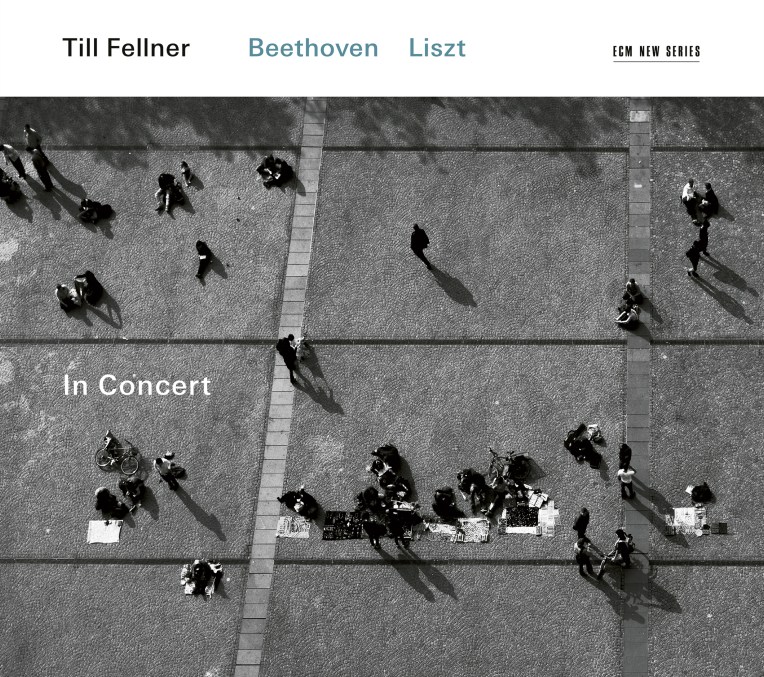
Till Fellner: In Concert – Beethoven/Liszt (ECM New Series 2511)

2511 X

Till Fellner
In Concert: Beethoven/Liszt

Till Fellner piano
Années de pèlerinage
Concert recording, June 2002
Wien, Musikverein, Großer Saal
Tonmeister: Gottfried Zawichowski
Engineer: Andreas Karlberger
An ORF Recording (Austrian Broadcasting Corporation/Radio Österreich 1)
Sonata No. 32
Concert recording, October 2010
Middlebury College Performing Arts Series
Mahaney Center for the Arts, Robison Hall
Tonmeister: Mark Christensen
Mastering: Markus Heiland
An ECM Production
Release date: November 2, 2018

But where of ye, O tempests! is the goal?
Are ye like those within the human breast?
Or do ye find, at length, like eagles, some high nest?
–Lord Byron, Childe Harold’s Pilgrimage

After a mosaic of recordings spanning the gamut from J. S. Bach to Thomas Larcher, Till Fellner returns to ECM with a pastiche of live recordings from 2002 and 2010. The first presents the Austrian pianist in his home capital for year one of Franz Liszt’s Années de pèlerinage. Inspired by the composer’s trip to Switzerland from 1835 to 1836 but unpublished until 1855, this aural scrapbook is alive with alpine imagery and motifs, encompassing firsthand memories, friendships, and even political views. It’s on the latter note that the collection begins with La Chapelle de Guillaume Tell. This stately introduction to an otherwise flowing work sets a precedent of architectural soundness that infuses all to follow. Contrast this with the watery beauties of Au lac de Wallenstadt and Au bord d’une source, and you already have a sense of the variety to which Liszt had eloquent access, rendered by Fellner with dynamic temperament.

While many sections, such as the sunlit Pastorale and Eglogue (the latter riffing on a shepherd’s song), are built around fleeting impressions, each nevertheless feels complete. This may be due to the fact nearly all of the music is revised from earlier material, an exception being the tempestuous Orage. No matter the duration, emotional integrity is the primary ingredient, so that the descriptions of Vallée d’Obermann’s thirteen precious minutes feel just as thick as Le mal du pays. Both seem to find the composer yearning for home when away from it, if not also for distant travels when in it, lending themselves to a score that only serves to nourish Fellner’s radiance. All the above shades of meaning cohere in Les cloches de Genève, by which the pianist elicits rich yet subtle sonorities.

If Liszt is a photographer, then Ludwig van Beethoven is a filmmaker whose magnum opus is surely the Sonata No. 32 in c minor. His Opus 111 shares its key signature with the Fifth Symphony and other monumental works, and provides a fitting end to his sonata cycle. As suggested in William Kinderman’s deeply considered liner essay, “The pair of movements of this sonata interact as a contrasting duality suggesting strife and fulfillment, evoking qualities which have stimulated much discussion, reminding commentators of the ‘here’ and the ‘beyond,’ or ‘samsara’ and ‘nirvana.’” Such spiritual language is no mere hyperbole, but an activation point of Beethoven’s grander concerns over the effects of art on the soul. As The Art of Fugue was to Bach, so is the Sonata No. 32 to Beethoven with regard to variation.

To be sure, Fellner touches upon those grander narratives, but more importantly keeps his ears attuned to the details. In the opening movement, for example, his arpeggios feel like quills on paper. Balancing stream-of-consciousness impulses with deeply articulated control, he links an unbreakable chain of progression. The second and final movement begins almost timidly, as if sifting through old notes for fear of what one might find, only to be surprised by a joy one never knew was waiting for rediscovery. Urgency compels the left hand while trills in the right signal a transformation of flesh into glory. “The transformational power of this closing music,” says Kinderman, “acts like a utopian symbol, which seeks to neutralize if not dispel the tragic reality embodied in the weighty opening movement of the work.” And perhaps weight is the most appropriate physical property by which to analyze what’s happening here, for regardless of size and scope, the relationship of every note to gravity is meticulously examined, its potential for flight believed in like a prayer.

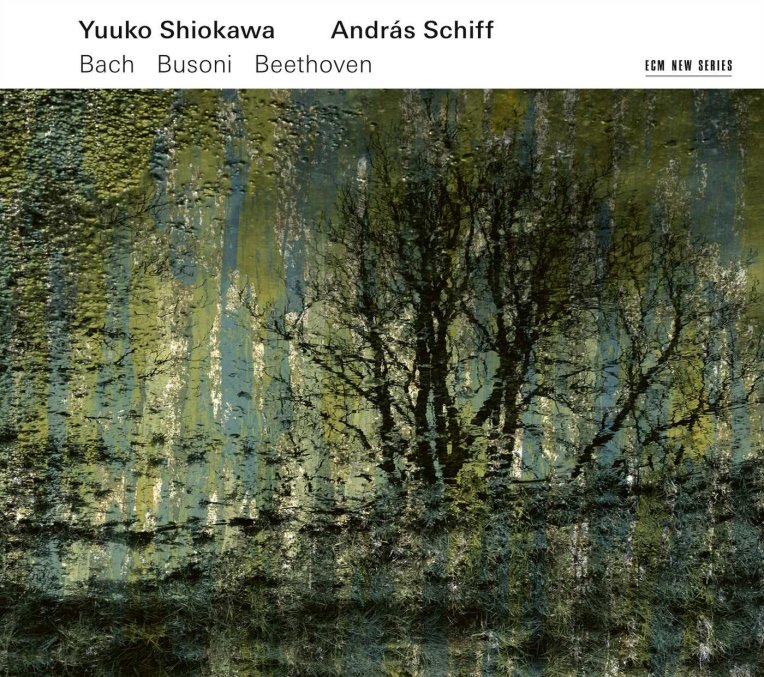
Yuuko Shiokawa/András Schiff: Bach/Busoni/Beethoven (ECM New Series 2510)

Bach Busoni Beethoven

Yuuko Shiokawa
András Schiff
Bach/Busoni/Beethoven

Yuuko Shiokawa violin
András Schiff piano
Recorded December 2016, Auditorio Stelio Molo RSI, Lugano
Engineer: Stephan Schellmann
Produced by Manfred Eicher
Release date: October 27, 2017

Seventeen years separate the first appearance of Yuuko Shiokawa and pianist András Schiff on ECM’s New Series and this long-awaited follow-up. Here they bring their intimate knowledge and experience to bear on sonatas by Johann Sebastian Bach (1685-1750), Ferruccio Busoni (1866-1924), and Ludwig van Beethoven (1770-1827). Through its sequence and execution, the program reveals as much richness of ideas within the pieces as between them.

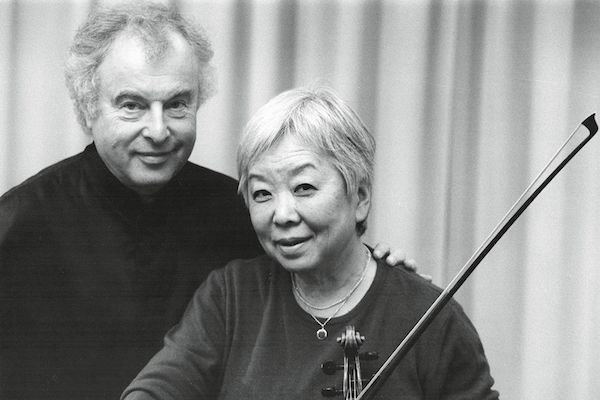
Shiokawa Schiff
(Photo credit: Barbara Klemm)

Bach’s Sonata No. 3 in E Major, BWV 1016, dating to his 1717-23 tenure as Kapellmeister at Köthen, is emblematic of a then-nascent genre, and finds both composer and interpreters ordering lines of many shapes and sizes. Schiff’s role at the keyboard is a challenging one, each hand operating independently yet with deep awareness of the other, while Shiokawa must paint with an actorly brush from first note to last. The vulnerability she brings to the opening Adagio is but one example of her ability to take something so lilting, so fragile, and render it impervious to the trampling feet of time. From there she takes us on a journey of inward focus, and by an interactive cartography traces bubbling streams to destinations of delight.

Although Busoni was more steeped in Bach than perhaps any composer before or since, one would be hard-pressed to find Baroque affinity in the first movement of his Sonata No. 2 in e minor, Op. 36a. Towering over a decidedly Beethovenian landscape, it leans toward and away from its historical precedents with fervor. Whereas single movements in the Bach were facets of a larger mosaic, each of Busoni’s sections is a sonata unto itself. The gargantuan final movement, however, is a theme and variations on the Bach chorale “Wie wohl ist mir, o Freund der Seelen, wenn ich in deiner Liebe ruh,” as it appears in wife Anna Magdalena’s Clavier-Büchlein of 1725. Busoni’s 17-minute exegesis goes from funereal to exuberant and back again. Between those worthy bookends stand two slim, insightful volumes. Where the Presto is playful yet adhesive, the somber Andante treads over shifting terrain.

In light of these fantastic excursions, Beethoven’s Sonata No. 10 in G Major comes across as non-fiction. As the composer’s last violin sonata, it holds a status all its own, and its details are organically suited to the duo. Where the trills and harmonies of its Allegro yield an enchanting ripple effect, the Adagio holds us suspended as if in need of nothing more than a confirmation of breath. A brief Scherzo scales the highest peak before trekking down into an Allegretto with a joy given life through musicians who care genuinely for everything they touch. It’s therefore difficult to listen to this recording without reminding oneself that Shiokawa and Schiff are partners in both music and life. Not only because they play so lovingly, but also because they listen to each other with rapt attention, inspiring nothing short of the same.

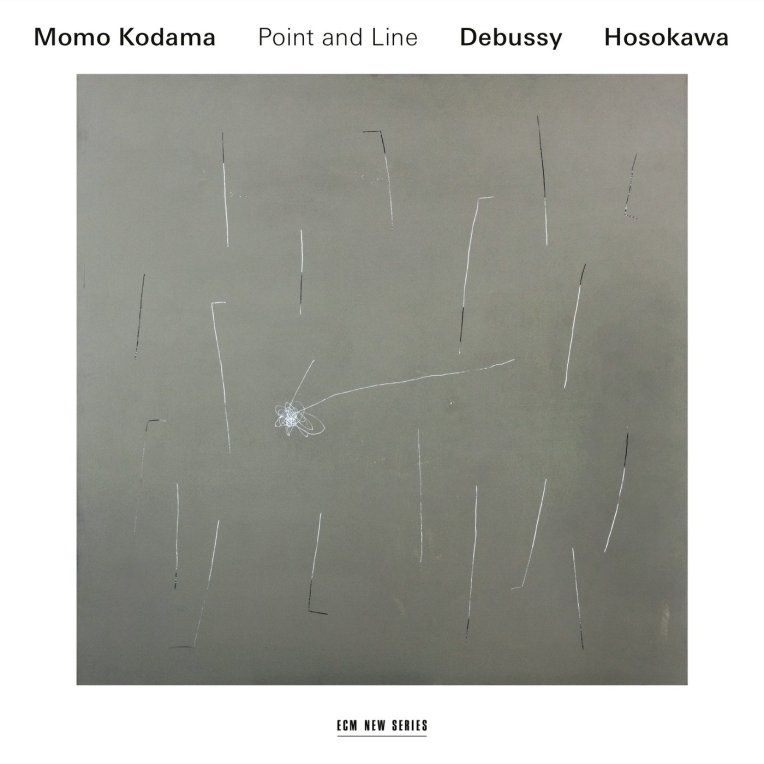
Momo Kodama: Point and Line (ECM New Series 2509)

Point and Line

Momo Kodama
Point and Line

Momo Kodamapiano
Recorded January 2016, Historischer Reitstadel, Neumarkt
Engineer: Stephan Schellmann
Produced by Manfred Eicher
Release date: January 27, 2017

Four years after making her ECM New Series debut with La vallée des cloches, pianist Momo Kodama returns with a program that is equally adventurous in expectation and inevitable in hindsight, this time shuffling the Études pour piano, L 136 (1915) of Claude Debussy (1862-1918) and Etude I-VI for piano, SJ 1180 (2011-13) of Toshio Hosokawa (b. 1955) into an integrated experience. Having performed both cycles separately, here Kodama imagines them in dialogue with each other. “A number of elements in Hosokawa’s music,” she writes in her liner note, “make me sense a proximity to Debussy. One is the freedom of its formal design; another is its interplay and layering of colors. What I fins especially remarkable in both is a capacity for poetic utterance and ranges widely between lyricism and drama, between meditation and virtuosic display.” As in acts of translation between languages, what separates is also what binds, and Kodama is a masterful interpreter in that regard, fluent as she is in every dialectical nuance at hand.

“Hand” is indeed the operative word, as Kodama’s parallel communicators ride over the intimate cascades of Debussy’s Etude XI before swirling the waters below in defiance of prettiness. Thus, whatever conversational approach we might attribute to process isn’t necessarily between two (or more) people, but rather between different shades of the same musical self. Kodama’s rendering thereof illuminates a cohesive identity, and she, as surely the composers themselves, revels in disruptions, treating each as an opportunity for productive change.

Hosokawa’s Etude II, from which this album get its name, takes its descriptive heading with beautiful literalness, contrasting sustained notes and dotted clusters, the latter as sprays of baby’s breath in a wider bouquet. A spirit of favorable conflict prevails, as also in Debussy’s Etude III, wherein points and lines are converted into poetry. Not that what follows is a series of impressionistic vignettes, but a space in which every utterance counts. As dynamics lob from soft to loud and back again, we are primed for the versification of Hosokawa’s “Calligraphy, Haiku, 1 Line” (Etude III), of which dramatic outbursts amid resonant silences become organic allies.

As the composers continue to seesaw between foreground and background, something surprising begins to happen: we begin to lose track of who wrote what. For while the reveries of Etudes IV and VIII have an obviously Debussean flavor, we might also read distinctly Hosokawan associations into the second and first etudes. And while the tail-chasing details of Hosokawa’s first and fourth etudes reveal a childlike dedication to play (the latter’s subtitle, “Ayatori, Magic by 2 Hands, 3 Lines,” makes reference to the cat’s cradle game), his respect for Debussy peeks from behind the curtains of “Lied, Melody” (Etude VI), a high point that pushes darkness and light through lattices of memory.

Retrospection seems equally vital to sustaining Debussy’s mocking Etude I and Hosokawa’s visceral “Anger” (Etude V), and by the emotional clarity of those expressions turns anticipation into reflection. Like Debussy’s Etude VII, they draw a compass between our ears, for while the notes may go up and down, the hands travel right and left, leaving us with a navigational instrument to cherish as we leave this land behind into uncharted waters.

Tigran Mansurian: Requiem (ECM New Series 2508)

2508 X

Tigran Mansurian
Requiem

Anja Petersen soprano
Andrew Redmond bass
RIAS Kammerchor
Münchener Kammerorchester

Alexander Liebreich conductor
Recorded January 2016, Jesus-Christus-Kirche Dahlem, Berlin
Engineers: Peter Laenger and Stephan Schellmann
Produced by Manfred Eicher
Release date: March 17, 2017

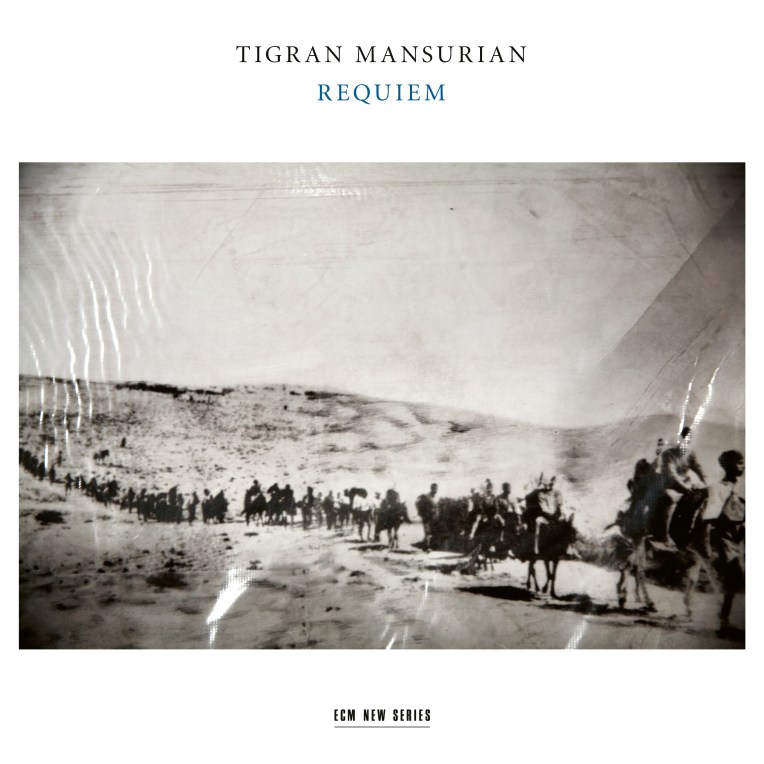
ECM’s sixth album dedicated to Tigran Mansurian is a reference recording of his Requiem. Dedicated to victims of the Armenian genocide in Turkey that killed approximately one million people between 1915 and 1917, and composed a century later, it blends Continental and Orthodox traditions in a manner that is as unexpected as it is creatable by no other author. “The essence of the problem,” notes Mansurian of his process this time around, “was the existence of certain differences in the readings of religious texts between the Armenian Church and, say, the Roman Catholic Church. The psychology of a believer who represents a nation that has long been without an independent state differs sharply from the psychology of a believer at whose back stands a powerful religious community and centuries of independent statehood.” In this respect, he isn’t simply composing in a liminal space but also inviting the listener to light a candle in that space and pray in its glow.

A requiem challenges anyone wishing to write one, and for some has been a rite of passage. Mansurian struggled with the form for years, writing a handful of distinct attempts before abandoning them in favor of the one gifted to us here. Although scored for soprano, baritone, mixed chorus and string orchestra, its collective spirit renders those solo roles—filled with emotional veracity by Anja Petersen and Andrew Redmond, respectively—in the “Tuba mirum” and “Domine Jesu Christe” as something more than representational; rather, they are two rays in a sun’s worth of individual voices. In humbler terms, their relationship to the larger assembly is as leaves to a tree, crying for acknowledgment with what little water they have left before their severed roots catch up with them. Such acts of violence, themselves stemming from a dark place, nevertheless confirm God’s grace to pull tortured souls from a tragic world into one that never trembles in fear of mortal sin.

Before we tread too deeply into these forests of mirrors, we begin with an airier “Requiem aeternam,” in which unrequited lives hold their hearts in their hands. Strings shift eerily from foreground to background in metaphysical exchange, presaging their playful relationship to choral motives in the “Kyrie.” Dances are brief and unsustainable, flowing like two separate rivers joining to cascade over the cliff of the “Dies irae.” Their urgency is jagged yet interlocking: a puzzle of mortality putting itself together despite our best attempts to upset it. The suspended animation of the “Lacrimosa” is echoed in the meditative “Agnus Dei,” and between them an insistent “Sanctus” which creates its own call and response of spirit, flesh, and remembrance.

Listening to Mansurian’s Requiem is like watching a film that weaves archival footage into freshly choreographed scenes of historical reckoning. It’s as if the cover image, depicting Armenian deportees trekking through the desert toward Aleppo, Syria, were coming to life, every figure contributing to the prescience of the whole, shaking their heads at what we have become.