Alexander Knaifel: Svete Tikhiy (ECM New Series 1763)

Svete Tikhiy

Alexander Knaifel
Svete Tikhiy

Keller Quartett
András Keller
 violin
János Pilz violin
Zoltán Gál viola
Judit Szabó cello
Oleg Malov piano
Tatiana Melentieva soprano
Andrei Siegle sampler
In Air Clear and Unseen recorded October 2000 at Radio Studio DRS, Zürich
Engineer: Peter Laenger
Svete Tikhiy recorded1994/95 at Film Studio Lenfilm and 1997 at St. Petersburg Recording Studio
Engineers: Mikhail Shemarov, Victor Dinov, and Andrei Siegle
Produced by Manfred Eicher

Nature is not as you imagine her:
She’s not a mold, nor yet a soulless mask—
She is made up of soul and freedom
She is made up of love and speech…
–Fyodor Ivanovich Tyutchev (1803-1873)

For its first conspectus of St. Petersburg-based composer Alexander Knaifel, ECM presents  Svete Tikhiy (O Gladsome Light). Side by the side, the program’s two works—each a triptych—seem vastly different in scope. And perhaps they are on the surface. But they are also part of an ongoing braid of interest on the part of the composer in what is lifted from the score and held in the spirit of the performers to whom he entrusts interpretation: in essence, the reading of the word. For this recording, the word comes to us both lower- and uppercased.

The former flexes its waking hour throughout In Air Clear and Unseen (1994) for piano and string quartet, peeking from behind the Orthodox veil through which Knaifel’s music is often so diffused. Steeped in the poetry of Fyodor Tyutchev, each tableau reads through gestures of slowly measured time. “In Some Exhausted Reverie” begins in Silvestrov-like fashion: with a piano postlude. It touches the ether with a delicacy so organic it almost falls away by merely being gazed upon. Its stillness may be illusory, but the potential emotional connection it makes with the listener flows into the ribcage and finds room to conform.

If encouraged to compare, one could cite Pärt’s Alina as an analogous atmosphere, if only for its breathing room. Distinct here is the feeling of something titanic, as if an entire history were being grappled with in a single note. All of which makes the opposite point: that there is never just one note, for each is a combination of many more, and those of still others. The air is unseen, yes, but it can be felt. It is a field of touch. Hence the tactility of Knaifel’s performers, whose own lives are filtered through their contact with the music. Instructed as they are to intone that which is ultimately “unvoiced,” the instrumentalists embrace each living moment with their entire being, itself a resounding instrument of warmth and illumination.

The central section, “An Autumn Evening” (for string quartet), finds a more distant analogue to the music of Tavener, whose The Last Sleep of the Virgin is also of Byzantine cast (and, coincidentally enough, composed the same year as the accompanying work on this disc). The lucidities of both shimmer in slow motion. Unique to Knaifel’s aesthetic is the unity of the assembly: the quartet is one flesh, a portrait of humanity drawn through what he calls “chain breathing.” The combination becomes something of a filter through which death renews life. It is the dreamed-of ribbon still in hand upon waking. The final section marries these two impulses, pulling childhood memories like a hood against blasphemy and lighting many candles from a single, originary flame.
The title composition, Song of the Most Holy Theotokos, is composed for soprano Tatiana Melentieva and sequencer. The eponymous hymn, which appears only at the end of the piece, is among the oldest Christian hymns, a folding of light into Christ and both into the world. It is force of life, but also agency of solace. Here the self-reflexivity of the replenished soul is expressed in the electronic manipulations and multi-tracking of Melentieva’s voice. The result is a ponderous, overtly crafted chorus of the self, giving way to echoing caverns of implosion. These, in turn, impart life to the openness of God. From mantra-like quivers and resonant tongues to the rounded grace of the central unaffected voice, it turns lullabies into dust and dust into starlight. And as the final fragments blur skyward, worship becomes a shroud for the ears.

On the whole, Svete Tikhiy is also a master class in engineering. Were the content not afforded the spaciousness it deserves, its inner voices might never reach us. This is not to say that technology adds something not already there, only that it brings out inherent tendencies toward infinite expression. The echo becomes a primary signifier of its referent, but also something more: a reference in and of itself to yet another echo, ad infinitum.

<< Anders Jormin: Xieyi (ECM 1762)
>> Seim/Brække/Johansen: The Source and Different Cikadas (
ECM 1764)

Eberhard Weber: Endless Days (ECM 1748)

Endless Days

Eberhard Weber
Endless Days

Eberhard Weber bass
Paul McCandless oboe, english horn, bass clarinet, soprano saxophone
Rainer Brüninghaus piano, keyboards
Michael DiPasqua drums, percussion
Recorded April 2000 at Rainbow Studio, Oslo
Engineer: Jan Erik Kongshaug
Produced by Manfred Eicher

Electric bassist Eberhard Weber, one of the most recognizable depth-sounders of European improvisation, with Endless Days continues the journey charted so boldly across ECM’s fertile map. True to form, he breaks the jazz mold that searches him, instead making use of orchestral sweeps and precisely notated forms. Solos, per se, are few and far between. The only exceptions are “A Walk In The Garrigue” and “Solo For Bass,” the latter of which presages Weber’s sure-to-be-seminal Résumé. With liquid touch, he dances, turns on a molecule, and settles into warmth.

The instrumentation of Endless Days is as intimate as its sound is expansive. Multi-reedist Paul McCandless, keyboardist Rainer Brüninghaus, and percussionist Michael DiPasqua—all longtime allies—comprise a quartet of unveiled lyricism. The seesawing keys of “Concerto For Bass” fade in on a lush vista as only Weber can articulate. Skittering percussion hurtles us across a tessellation of water and land as an oboe cranes its neck, birdlike, in anticipation of a storm. A soft keyboard drone provides ample soil for Weber’s pliant germinations, which in characteristic fashion build majestic tidal waves from mere ripples in “French Diary.” Here DiPasqua and McCandless flank an itinerant piano to the rhythm of an internal clock before ending in a pinprick of light, adding a new star to the shadows of “Nuit Blanche.” This cinematic piece emotes through a sepia veneer of whisky and unrequited love, dripping like a tree after rain. “Concerto For Piano” brings the band up to full speed. Playful touching of the keys adds unexpected angles. The title track has the makings of a folk song unfolding in real time, fashioning from its cellular vocabulary set a full-bodied text. This program of otherwise new material ends with a throwback to Weber’s Little Movements, reworking from that 1980 album its opening composition, “The Last Stage Of A Long Journey.” Flowing arpeggios float the leaves of Brüninghaus’s pianism along an unbroken river and find their angelic alter ego in McCandless, whose soprano saxophone draws a thread from heart to ritual.

Eternally refreshing in Weber’s work is the comfort that titles are immaterial—so evocative is his sound-world that it tells us a different story every time, a story so familiar it seems to emanate from the listener. All that’s left to ask: What stories will it convey to you?

<< Thomas Larcher: Naunz (ECM 1747 NS)
>> Claudio Puntin/Gerður Gunnarsdóttir: Ýlir (
ECM 1749)

Thomas Larcher: Naunz (ECM New Series 1747)

Naunz

Thomas Larcher
Naunz

Thomas Larcher piano
Thomas Demenga cello
Erich Höbarth violin
Recorded November 1999, Europahaus Mayrhofen, Austria
Engineer: Stephan Schellmann
Executive producer: Manfred Eicher

Austrian pianist Thomas Larcher, previously known to ECM New Series aficionados as a tactful interpreter of contemporary music, with Naunz shows his colors as a composer of the same. That Larcher is a close associate of Heinz Holliger, another musician-composer of immense talent, should come as no surprise: both compose as if through a microscope. Yet while Holliger tends to languish in protracted gazes at what lies beneath his cover slides, Larcher is more interested in compressions and calms before storms—in the message of the medium. The laser-precise title piece, written 1989 for piano, evokes a particular brain chemistry and cellular dysfunction…yet also a fractured, spatial sort of harmony. Its thirteen-and-a-half-minute duration holds a broad technical spectrum on the tongue: metallurgical hammerings, bright pops, and bluesy accents trade places in carousel fashion. Every note drips like a love-sworn face, open-mouthed, a scabbard without a sword.

Thomas Demenga pushes these images deeper into the fire in Vier Seiten (1998), throwing himself into jaggedly brushed scenery. Larcher’s trust in Demenga is obvious, for even the most challenging passages flow effortlessly at the cellist’s virtuosic touch. Ley lines crack in a symphony of such intimate proportions that the piece stabilizes, settling into meditative fog curls, a muscle torn to infinity. Further bowings are put on hold for the duration of two more piano pieces. The fractured yet resonant Noodivihik (1992) works at an even more cellular level. With scientific attention, Larcher expounds its polyphony in monosyllables while moments of clarity rub up against those of murky discomfort. Not every piece, however, is so overtly disjointed, for in such a piece as Klavierstück 1986 (the collection’s earliest composition) there is overt color-bleeding, punctuated by moments of insistence that fade into bodiless reflections.

Larcher

The autobiographically inflected Kraken (1994-1997), a fascinating trio, revives Demenga and adds the violin of Erich Höbarth. In the latter’s playing is an Ysaÿe-like exuberance told yet in a language Larcher’s own, distinct for its obsessions. The entrance of piano after Höbarth’s pliant introduction lends a morose, titanic feeling of sunkenness. Violin lines evoke ghostly strangers from the wreckage, cleaving water and sky in kind. As a unit the trio forms a methodical braid, ponytail of a slumbering warrior. Larcher brings a percussive sound to his part, treading water in a marriage of staccato and legato impulses. The Holliger connection deepens as Demenga and Höbarth embark on a journey eerily reminiscent of his Duo for Violin and Cello before fragility and gnarled woodwork bring closure. Also bringing closure is the concluding Antennen-Requiem für H. (1999), an elusive piano piece that flirts with audibility by way of various extended techniques. Hands on the strings turn the instrument into a fast-forwarded film. It is a diegesis, an awakening, a genetic table setting loosed from its horizontal plane.

Larcher’s music is the equivalent of a postmortem. With a meticulousness that can only come out of self-discipline, he scours every body for clues of its demise. In so doing, he creates new life. Every helix begins a story.

<< Charlie Haden/Egberto Gismonti: In Montreal (ECM 1746)
>> Eberhard Weber: Endless Days (
ECM 1748)

Heino Eller: Neenia (ECM New Series 1745)

Neenia

Heino Eller
Neenia

Tallinn Chamber Orchestra
Tõnu Kaljuste conductor
Recorded August 1999, Estonia Concert Hall, Tallinn
Engineer: Teije van Geest
Produced by Manfred Eicher

The word “trauma” comes from the Greek, meaning “wound.” The derivation seems apt: a wound leaves one prone to infection from invisible forces, while from it exudes the very stuff that keeps us alive. According to classical Freudian psychoanalysis, a healthy Ego redirects traumatic influence, thereby protecting us from overstimulation. Otherwise, the trauma festers within. Either way, the subject is spared the pain of being consciously aware of the affliction in question. Music, however, inflects this view somewhat differently. In that of Estonian composer Heino Eller (1887-1970), a distinctly autobiographical impulse floods us neither with catharsis nor with a working-through. It is, rather, a fullness of life that sees death not as non-existence but as one of many equal facets.

Eller’s stamp on Estonian concert music cannot be overstated: his was the spark that set a revolution aflame. His influence pulses on in the work of his many students. Arvo Pärt, for one, fondly remembers his composition teacher as a noble human being who nurtured an open and personal approach, as the founder of Estonia’s professional music scene, and above all as a musician of “strict logic.” Yet Eller’s personal life was also indelibly marked by a strictly illogical act: the murder of his wife, Anna, at the hands of occupying Nazis. It was during this period that his Lüüriline Süit (Lyric Suite, 1945), originally composed for piano but heard here in an orchestral reworking, came to fruition. The heartrending physicality of its mortal undercurrents breathes with the ache of living—a sound as only the Tallinn Chamber Orchestra under Tõnu Kaljuste’s direction could elicit without need for the background sketched above. Each of its six movements is corporeally minded, a ballet of actors on a sociopolitical stage. In the final movement especially one notices the rhythmic sensibilities inherited by such progenitors as Erkki-Sven Tüür, only here they pick at a scab that will never heal. The depth of landscape is masterful, its contrasts of texture and time, of heaven and hell, indicative of all that follows.

The 1928 title composition is a memorial to friend Johannes Arro (1865-1928). A tone poem of majestic emotional depth, it undergoes constant color changes, each continuing the gloomy dramaturgy of the opening suite. The Five Pieces for String Orchestra (1953)—of which “Homeland Song,” says Pärt, is the Estonian equivalent of Sibelius’s Finlandia—unfolds in a more fragmentary, though no less organic, sense of architecture. Like that of Antonio Gaudi, straight lines are rare and there is a beginning at every end. Densities also vary: a solo violin draws a silver thread through the occasional needle, pocking the clouds with patches of sky. From lively dances to saturnine dips, the overall effect is stirring and reminds us that home is never far away, so long as one can find a song to share.

The concluding works of the program embrace the spectrum of Eller’s craft. The Sümfonietta (Sinfonietta, 1965-67), his last major composition, speaks in a language of catch and release. Every time it seems to tip, something swoops in to steady it. Agitations in the lower strings draw a screen as translucent as rice paper yet as impenetrable as an iron fortress as we are moved through a vast unraveling into the final dance, the spirit alive and forthcoming with its light. The promise of that light is realized in Eleegia (Elegy, 1931) for string orchestra and harp. Written in memory of another musical friend, Peeter Ramul (1881-1931), its lachrymose reflections turn into titanic hope, drifting through joyful memories to get there. All of which brings us full circle to the knowledge with which we began: namely, that something of our lives, whether given or taken away, persists beyond the measure of all the grief in the world.

The listener will be hard-pressed to locate a single abrasive maneuver in Eller’s compositions. Each is a coherent entity. There is feeling that the music will go on without ever resolving itself, but that in that lack of closure time becomes its own mirror. We may never understand the persistence of violence, but at least it may be temporarily diluted by the draw of a bow.

<< Trygve Seim: Different Rivers (ECM 1744)
>> Charlie Haden/Egberto Gismonti: In Montreal (
ECM 1746)

Iva Bittová: s/t (ECM 2275)

Iva Bittová

Iva Bittová

Iva Bittová voilin, voice, kalimba
Recorded February 2012, Auditorio Radiotelevisione svizzera, Lugano
Engineer: Stefano Amerio
Produced by Manfred Eicher

Characterizing the music of Iva Bittová as resistant to definition both describes it perfectly and does it a disservice. The former, because her minimal tools of violin and voice elicit a museum’s worth of colors, moods, and brushstrokes. The latter, because every listener will emerge from that museum with a unique image in mind that is anything but indefinable. Despite her many creative personalities—which encompass acting, performing, and composing—she has achieved notoriety by no small feats of expression. Still, don’t be mistaken: this is no “avant-garde” artist. She’s not upsetting paradigms, but deepening their self-awareness.

“The violin accompanies me all the time,” says Bittová of an instrument that has centered her musical life since the early 1980s. “It is a mirror reflecting my dreams and imagination.” Yet she is, above all, a singer. Whether through vocal folds, bow, or physical gesture, her voice strikes flint to stone and blows a tangle of weed until it glows. So potent is said voice that it inspired fellow Czech composer Vladimír Godár’s Mater (documented most recently in a 2007 release for ECM New Series), a multilayered cantata on women-centered texts of which Bittová is both sun and satellite.

Iva

This self-titled solo album finds Bittová in her element in a series of 12 numbered “Fragments,” and because fragments imply a whole, it makes sense to speak of the album as such. Like a work of masterful anamorphosis, its image emerges only by submitting oneself to its perspective. Twelve is, of course, a mystical number. It defines the modern clock, marks the end of childhood, numbers the Bibical apostles, and zodiacally divides the heavens. Here it is a riddle that harbors many more.

The album begins and ends with her voice slaloming through the delicate signposts of a kalimba. Here and throughout there is harmony and tension, starlight and soil. At one moment, her voice and bow may unify. At another, her feet go their separate ways, divorced from body and destination. Pizzicato gestures seem to pluck hairs from the scalp of the night, while arco gestures get lost in mazes even as Bittová draws them. Sometimes: her voice alone, spoken and then sung, so that incantation becomes chant becomes lullaby in one fluid swing. Sometimes: the violin alone, crossing every bridge without ever touching feet to plank. Sometimes: a river’s flow through black forest, hints of love and travel.

To be sure, ghosts of a Slovakian heritage breach the fabric of time that veils her, but the freshness of her storytelling makes it all feel uncharted. For while she does adapt the music of Joaquín Rodrigo in Fragment VI and sings texts by Gertrude Stein and, notably, Chris Cutler in others (III and VII, respectively), she renders these sources personal and organic through her crafting. Words like “gypsy,” “folk,” and “tradition,” then, might as well be gusts of air, so intangible are they in her sound-world. That being said, her art is certainly rooted in a worldly sense of time and plays with that notion as would a hummingbird flirt with a backyard feeder. Her sound is resilient to climatic damage, for it has already absorbed so much of the oxidation that gives it character, and her tone is never brittle, even at its thinnest. In fact, the album’s strongest moments are to be found in her unaccompanied singing. From gentle cuckoo to shaman’s possession, her voice cycles through many (after)lives and makes this world of social details begin to feel other-cultural.

Here is an artist whose sense of architecture is wholly translucent, whose persona is her crucible, and whose music is an embodied practice, a mimesis personified to the point of healing.

(To hear samples of Iva Bittová, click here. See this review as it originally appeared in RootsWorld magazine.)

Michael Mantler: Hide and Seek (ECM 1738)

Hide and Seek

Michael Mantler
Hide and Seek

Robert Wyatt voice
Susi Hyldgaard voice, accordion
Roger Jannotta flute, oboe, clarinets
Michael Mantler trumpets
Martin Cholewa French horn
Vincent Nilsson trombone
Bjarne Roupé guitars
Tineke Noordhoek vibraphone, marimba
Per Salo piano
Marianne Sørensen violins
Mette Winther violas
Helle Sørensen cellos
Recorded and mixed February-Septemer 2000 at Danish Radio Studios, Copenhagen
Engineer: Lars Palsig
Vocals recorded April 2000 at Gallery Studios, London
Engineer: Jamie Johnson
Electronic percussion programmed by Michael Mantler, sounds realized at Subzonique
Produced by Michael Mantler

Michael Mantler is a force: not to be reckoned with, per se, but of reckoning itself. He is an artist of voices, one who, as the title of this operatic jewel attests, seeks them out from hiding. One of those, Robert Wyatt (long since found), is a singer with whom this album furthers a 25-year collaboration. Another is Susi Hyldgaard (also an accomplished accordionist), who first rose from within the Mantler fold in his masterwork The School of Understanding. Accompanying them is an expanded version of the composer’s loosely termed Chamber Music and Songs Ensemble, which opens its wings to include, on winds, Roger Jannotta (of Tom van der Geld’s elusive Children At Play) and Danish pianist Per Salo. Also (omni)present is Bjarne Roupé, a guitarist who has become an integral player in Mantler’s soundings. The most vital instrument of all, however, is the text by Paul Auster, an author on Mantler’s mind for years and whose eponymous short play lends itself starkly to the composer’s unmistakable brand of telepathy. The result is no mere setting, as Mantler takes his scissors (with the author’s approval) to its language with surgical care.

Holograms are constructed in such a way that if you cut them into pieces, each retains the entire image on a smaller scale. Such is the dynamic of Hide and Seek’s seventeen miniatures. Not one is fragmentary but rather contains elements of the whole. The purely instrumental “Unsaid” dots the program in six parts, the first of which opens. In them one encounters swarms of commentary, some more modest than others, around the guitar’s queen bee. In them are the agitations into which the play’s two characters are so reluctant to give. The balance is meticulous. It allows Wyatt and Hyldgaard to dance in their circles of comfort, breaking even in their seesawing between resignation and martyrdom even as the strings paint cracks in the glass above. Unsaid, yes, but not un-voiced.

“What did you say?”

These words introduce us to a drama of elliptical conversational elements. They cradle in their hands steaming plates of indecision, miscommunication, and vulnerability, which take the piece’s full duration to consume. Voices get caught up in their own vices, and in that process also take advantage of a few loopholes. Statements become facing mirrors lost in a mise-en-abyme of their own making. In their net the accordion occupies stage center, emotes without semantic limitations, while Mantler’s trumpet drips with guidance.

“What do you see?”
“Absolutely nothing”

Question and answer. Cloud and rain. Strings and footsteps. These comprise the core of Hide and Seek, their refrain a powerful marker of identity, or lack thereof, in which all traction is gilded, amplified. The tangled web of “What can we do?” features Mantler’s electronically programmed drums in a whirl of self-realization. It also poses the album’s most pertinent question, for which it has no answer but the melody of its asking.

“It all has to end sometime”

Closure by conjuring. An impending doom, so dark it is beautiful. In its shadows Wyatt and Hyldgaard make an emotionally foiled pair, especially in the final leg. They braid acceptance, parrying and thrusting their way toward the simple resolution of “I’m glad you’re glad.”

All of which culminates in two of Mantler’s most perfect shapes. The circling electric guitar of “Do you think we’ll ever find it?” marks a standout denouement, while “It makes no difference to me” sets speech atop a fulcrum of rocking strings. A return to the game, the accordion’s song passes through the door and on to the next chapter, as yet unwritten.

<< Vassilis Tsabropoulos: Akroasis (ECM 1737)
>> Ensemble Belcanto: Come un’ombra di luna (
ECM 1739 NS)

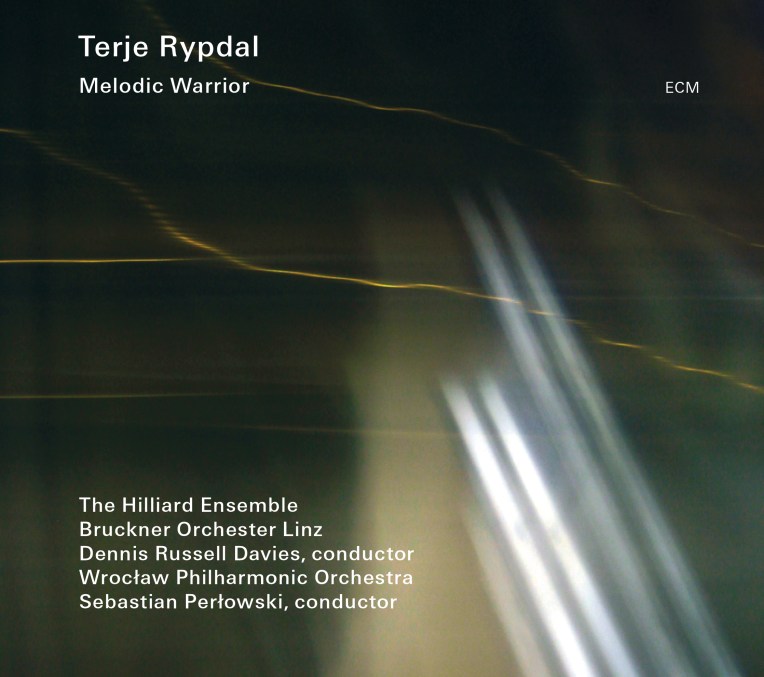
Terje Rypdal: Melodic Warrior (ECM 2006)

2006 X

Terje Rypdal
Melodic Warrior

Terje Rypdal guitar
The Hilliard Ensemble
Bruckner Orchester Linz
Dennis Russell Davies conductor
Wroclaw Philharmonic Orchestra
Sebastian Perloswski conductor
Melodic Warrior recorded December 2003 at Brucknerhaus, Linz (ORF)
Recording engineer: Alice Ertlbauer-Camerer
Engineer: Alois Hummer
And The Sky Was Coloured… recorded November 2009 at Jazztopad Festival, Wrocław
Recording engineer: Maurycy Kin
Mixed at Rainbow Studio, Oslo by Jan Erik Kongshaug, Manfred Eicher and Terje Rypdal
Album produced by Manfred Eicher

…from the house made of mirage…
…the rainbow rose up with me…
…the rainbow returned with me…
…to the entrance of my house…
…from the house made of mirage…
–excerpted from a Navajo Night Chant

How does one review an album for which one has also written liner notes? This is the challenge I set before myself in the instance of Terje Rypdal’s astonishing Melodic Warrior. Pairing the gargantuan title piece with a younger sibling, it reveals yet another facet of the Norwegian guitarist’s compositional profile, one that has given us such wondrous reflective surfaces as Undisonus and his Lux Aeterna. Where those two works examined sonic temperatures across relatively expansive climates, here the lens cracks in an implosion of voices.

Of those voices we get four prominent stewards in the Hilliard Ensemble, who also commissioned Melodic Warrior from the very ether. Their singing burgeons in a selection of Native American poetry chosen by Rypdal, along with a sprinkle of original words. To the touch-and-go listener it may seem an outlying choice for the Hilliards, unless of course one considers their likeminded reworking of Quechua and Passamaquoddy sources with saxophonist Jan Garbarek on, respectively, Mnemosyne and Officium Novum—in which case the fit could hardly be more intuitive. These are poetries rooted in that which roots us, pouring mercury into the primacy of oral over written expression: the lived knowledge that eternal regeneration is impossible without the fleeting rain.

The instrumental makeup alone chains this magnum opus to an immovable classical altar, surrounding the Hilliards with a full orchestra under the ever-erudite guidance of Dennis Russell Davies. It further bears the scars of Rypdal’s many-hued pools of influence, for his electric guitar bleeds through its movements like fire through lit steel wool, cupping a prog-rock relic or two in its satchel. In light of this, Melodic Warrior would seem to bring together many of his earlier threads into unified fruition—from his supergroup The Dream and on through the defining ECM years (Odyssey, Chasers, and especially Skywards) to the large-scale compositions mentioned above. The end effect is a snake coiled and poised to strike. Yet rather than deploy its secrets as weaponry (the melodic warrior sustains injury in place of others), it holds venom in mind and makes it palatable to the tongue and to the ear. Rypdal’s baying leads are unmistakable in this regard, stringing us as they do along a necklace of vocal cells, each writ large within the itinerant body. That we can at last experience the journey of that body on disc (prior to release, it had been maturing in ECM’s vaults for nearly a decade) is a gift for the soul.

Rypdal’s Opus 79 finds company in his Opus 97, And The Sky Was Coloured With Waterfalls And Angels. Whether coincidental or not, the numerical reversal suggests a kinship. And indeed, despite its wordless topography, the second piece would seem to drink from the same ocean, albeit on a different coast. Fronting now another orchestra and without the company of (human) voices, Rypdal paints bruises of a different kind: these the bursting flowers of a fireworks display. Although not overtly programmatic, those eruptions do materialize in periodic squints, carrying us out on a breath of awe.

It was an honor and a dream come true to contribute liner notes to this release. In solidarity with listeners (and because digital downloads deprive us of the pleasure of holding a booklet), I offer said notes in full below, with ECM’s kind permission.

… . …

Contrapunctus naturalis: Rypdal’s Warriors and Angels

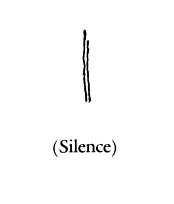
The Chippewa tell a form of picture-story in which silence takes the form of two lines, close but never touching. As the asymptote of all existence, they do more than represent. They enshrine. Surrounding them is a need for self-questioning, for acknowledging the power of the beating drum.

River, nature, vision: these are the tools of the warrior whose flesh stands firm against the tide. Like the stag hanging from a tree—last touched by chipped stone and hunter’s eye, now drained by gravity and sun’s transit—it has an illusory stillness. Somewhere, in another time, the warrior’s legs still run. Terje Rypdal’s warrior is consequently melodic. Protagonist of his magnum opus, he activates a landscape by contact of lyric and pen. Its composer is a river; the voices of the Hilliard Ensemble its fauna; the writhing Bruckner Orchestra Linz, under the baton of Dennis Russell Davies, its flora. Davies adds depth through an abiding passion for living works. He gives voice to the margins, here doubly so, guiding Rypdal’s assembly through a 45-minute epic drawn from Chippewa, Navajo, Pima, and Papago sources. The words came to Rypdal by way of stage director and musician Carl Jørgen Kiønig, who lent him a book of Native American poetry. “Its closeness to nature mirrored my own,” he says, and thus the seeds were planted. Since its 2003 Austrian premiere, this Hilliard commission has taken on a soul that consolidates Rypdal’s many paths.

From his early ECM leader dates onward, including the self-titled 1971 debut and 1974’s Whenever I Seem To Be Far Away, Rypdal has had a hand in multiple idioms. He grew up in a classical home (his father was also a composer) and trained formatively in that sphere before taking to the guitar in his teens. If we can paint anything with these biographical colors, it is not the portrait of a fusion artist, but rather one who walks along dissolving borders. Whether in the chamber music aesthetics of Q.E.D. or the wayfaring 5th Symphony, in the droning lyricism of Undisonus or the flowing textures of Lux Aeterna, through it all persists a consistency of vision.

And what of Melodic Warrior? “The title came to me almost as a vision,” Rypdal recalls. “It felt as if I had planned something like this all my life.” Given the strength of this conviction, one might expect a ruder “Awakening” than what transpires in the eponymous prologue. The first of nine movements, it opens its eyes in high-pitched stasis, an abyss where the fray of human awareness hums above the earth’s surface. The ensuing plunge is cinematic to the core, traveling from cosmos to land, from breath to heart. In it we find the glitter of coastal waters, a veritable Bering land bridge rooted in sea floor and spreading its fingers toward wounded sky. To tread here is to embrace daylight, to feast on it, as the crow takes to carrion.

Storm, leaf, soil: the constellations Rypdal’s electric guitar lives by, echoes from a mythic past, garments donned by our four unmistakable voices when twilight falls around them. Their welcome blessing reveals an organic body, splitting and fusing like water’s flow. As one, they fly. In isolation, they soar. During solos their spirits thread disparate needles, sometimes flirting with call and response, but always with unity in sight. A storm is nothing without its droplets.

Rypdal remains the omniscient lurker, resurfacing across the suspenseful pages of “The Secret File” with script aflame. He envisions this dramatic intermezzo—having used it before in a hard-rock context—as a nod to Western film soundtracks, thereby bearing relevance on the contradictions of the Native American theme. Not until “Song Of Thunder” does he ride lightning into the roiling ash. He weaves stealthily, finding in the curve of a whale’s back, in the sweep of a honeybee’s pollen comb, the natural counterpoint that haunts his oeuvre at large.

The strings of Linz mark the face of this music with laugh lines. Profound shifts in light reveal rivulets and isles of possibility. In “Magician Song” countertenor David James evokes a leaf on that water, the tremble of the branch before its descent, the seed from which that tree burgeoned. Ancestors become stories, backgrounds become foregrounds, as they would in dreams, and close the circle by way of opening another in the light of a morning star.

The flair of Melodic Warrior brings to mind another ECM-represented composer, Erkki-Sven Tüür, whose background in progressive rock buoys a mind meld of fortitude and color. And if we can draw further lines of contact to the work of such 20th-century stalwarts as Górecki, Ligeti, Penderecki, and even a hint of Glass, it is only because Rypdal has mixed and baked his clay from the mineral-rich soil of deep listening.

All of this comprises a challenge to purveyors of modern music who rest on atmospheric crutches in lieu of compelling linear themes. Rypdal points to early conversations in this regard with label mate Ketil Bjørnstad: “We used to talk about how melody in contemporary music was looked down upon. I knew right from the start of my composing that I had to bring back melody…and beauty in general.” His forte embodies the uphill battle of this realization, beholds the world as new parents behold themselves, at once without and within. The polarity makes sense, for what is the guitar if not a bringer of visceral melody? It is a fortuitous compositional tool in the hands of one who wields it properly.

Sky, journey, reflection: the shaman’s initiations. As technician of the sacred, the shaman dismantles mortal designs. He abstains from taste of dust for that of haze. He casts bones through skin, passes mind through matter, and returns with timely prophecy. He visualizes decay, the withering of boundaries. He casts one eye down and the other up. Thus undone, the earth overflows.

And The Sky Was Coloured With Waterfalls And Angels is the receptacle of that excess. More than a landscape, it is another link in the chain of being. The live recording presented here opens a curtain on Wrocław, Poland, where the 2009 Jazztopad Festival (artistic director: Piotr Turkiewicz) is about to set forth on this purely instrumental journey. It is under these auspices that, with Sebastian Perłowski leading the Wrocław Philharmonic and Rypdal poised before six foreshortening strings, the music bubbles with the freshness of its premiere.

The piece was inspired by the 2008 International Fireworks Festival in Cannes and assumes a denser structure than its sibling. It brings to evidence the din of human commerce, technology, and construction, even as it links those rosettes high beyond mundane concern. The violin scratches an itch it cannot quell, unfurls banners of melancholia between explosions. Even a surge of harp brings little hope or heavenliness. It is caked with time, unshaken. Somehow all of this finds peace, such that the sky becomes the cell of another body, and that body the cell of another.

Mirror, vessel, silence: the totems of a composer seeking nectar. Once found, it drips from waterskin, emphasizes imperfections. This music holds a mirror to land, turning every arch into a ring. The counterpoint is more than natural. It is the all-encompassing sight of things created and destroyed. Every instrument sheds a skin.

The horns in particular take on a quasi-Wagnerian role throughout the program, signaling themes and atmospheres as they become intertwined with locations and avatars. At one moment the song of bestial life, swaying the next in bowed waters, they cast crimson lines of intention into a darkening sea. This is the trick of Rypdal’s notecraft: he digs into continental influences with an archaeologist’s eye, persevering where many have quit until that single common vessel is revealed, petrified yet singing.

Tyran Grillo

Silence

Michael Mantler: Songs and One Symphony (ECM 1721)

Songs and One Symphony

Michael Mantler
Songs and One Symphony

Mona Larsen voice
Michael Mantler trumpet
Bjarne Roupé guitar
Marianne Sørensen violin
Mette Winther viola
Gunnar Lychou viola
Helle Sørensen cello
Kim Kristensen piano, synthesizers
Radio Symphony Orchestra Frankfurt
Peter Rundel conductor
Songs recorded October 11, 1993, Danish Radio, Copenhagen
Recording engineer: Ronald Skovdal
Mixing engineer: Lars Palsig
One Symphony recorded November 13/14, 1998, Hessischer Rundfunk, Frankfurt
Recording engineer: Thomas Eschler
Mixing engineer: Rainer Schwarz
Album produced by Michael Mantler

I don’t know
anything darker
than the light.

Whatever your spiritual inclinations, you can be thankful that people like Michael Mantler have walked this earth and left behind a sonic trail so intuitively drawn it almost hurts. The Austrian-born composer delivers a subtle yet nonetheless smashing twofer in Songs and One Symphony, pairing his settings of poems by Ernst Meister with the titular symphony.

Songs is performed by the Chamber Music and Songs Ensemble, a group Mantler formed in 1993. Last heard in his masterpiece The School of Understanding, its instrumental signatures are uniquely Mantlerian, including the composer himself on trumpet, Bjarne Roupé on guitar, Kim Kristensen on keyboards, and a string quartet. For the present recording singer Mona Larsen assumes the throne, her wrapping of words the perfect disguise for Meister’s bare bones. Mantler’s ability to draw out melodies from the texts as if they’d always been there is uncanny. The cycle’s smoothness of execution is uniquely moving in this regard, finding traction in every negative space on the page. The connective tissue between “For ever” and “Nothing more,” for example, breathes in the fumes of just-sung sentiments and exhales the fearless drug of circumstantial evidence. Indeed, each slide on the projector roulette bears its own exhibition letter, submitted to the scrutiny of an invisible jury. Their shifting and murmuring implies conclusions but them lets them go in the interlude “How Long Are Our Nights,” from which the cello espouses lachrymose verdicts in kind. Larsen slips through words like a snake through the knotholes of an abandoned shed, carrying in her mouth the minimal shadows required to bleed warmth and misery. She embodies Meister’s “stir of solitude” so unpretentiously that one need know nothing of her pop music roots. Rather, she unearths her art for the first time with every stanza.

One Symphony is the result of a German radio commission. It takes the concept of a symphony in its most rudimentary form—which is to say, as a large meeting of musicians—and represents Mantler’s mounting interest in explicitly notated material. Consisting of four numbered movements, it finds its voice early on with the establishment of a characteristic flow. The harp flirts with the water’s surface like a sunlit dragonfly in Part 1, sucking inkblots from paper as if water from a glass. The shifting rhythms and textures achieve perfect kilter in the final origami fold, looking deeply into the mirror where its cinematic fantasy moves on. Part 2 opens poised before an oncoming train: it hears the signals but heeds them not in the widening funnel of light. The clouds offer little solace, dark and gnarled as their manner is. The feeling of locomotion never completely recedes. It touches the piano keys, flicks its hair in the wind, and swings from brass branches. The honeycombed Part 3 unloads a relatively mechanical shipment of dots and dashes, leaving the aftermath to spawn life of its own will in Part 4. This self-tending garden sustains some of the symphony’s darkest wounds and presses its palm to a cold window until an ephemeral handprint is all that’s left of its ever having been here.

<< Karl Amadeus Hartmann: Funèbre (ECM 1720 NS)
>> Nils Petter Molvær: Solid Ether (
ECM 1722)

Eleni Karaindrou: Trojan Women (ECM New Series 1810)

Trojan Women

Eleni Karaindrou
Trojan Women

Socratis Sinopoulos Constantinople lyra, laouto
Christos Tsiamoulis ney, suling, outi
Panos Dimitrakopoulos kanonaki
Andreas Katsiyiannis santouri
Maria Bildea harp
Andreas Papas bendir, daouli
Veronika Iliopoulou soprano
Eleni Karaindrou
Antonis Kontogeorgiou chorus director
Recorded July 2001 at Studio Polysound, Athens
Engineer: Yiorgos Karyotis
Produced by Manfred Eicher

No human heart is set so hard
that hearing the grave music of your dirge,
your keening, would not bring tears.

The distinct approach of Greek composer Eleni Karaindrou to film sound-tracking, through ECM’s rigorous documentation of her partnership with director Theo Angelopoulos, has imbued her music with a life of its own among international audiences. All the while, Karaindrou had been nurturing an equally prolific association at home with the theatre. Her Angelopoulos in that craft has been director Antonis Antypas, with whom she has collaborated on over 20 productions for the Aplo Theatro. This album documents her incidental music for a new staging of the Euripides tragedy Trojan Women, which received its premiere at the Ancient Theatre of Epidaurus on August 31 and September 1, 2001.

First performed in 415 B.C., the play was a vitriolic critique of the Athenians’ then-recent attack on the island of Melos, where countless violently perished and women were sold into bondage in the name of conquering Sparta (in this the Athenians did not succeed). It is perhaps no coincidence that the word melos also means song, for singing constitutes the very flesh of this album’s limestone skeleton. Karaindrou kneads into these politics the idea that less is more. With the barest use of folk instruments—such as the Constantinople lyra, ney, santouri, and bendir—she implies a battered panorama of immense emotional congruity. Producer Manfred Eicher has lent further sanctity through his arrangement and editing of the material into its present form.

A profoundly comported scenography of touching (which is to say, tangible) melodic beauty finds particular expression through the lyra’s grasshopper song. It is a mournful, unforgettable sound, dry as a reed in summer. The harp also figures notably in the music’s rolling waves, overcoming the barrenness evoked by titles like “Terra Deserta” with oceanic depth. Its vibrations are transformations of landscape itself, silenced by their own resonance.

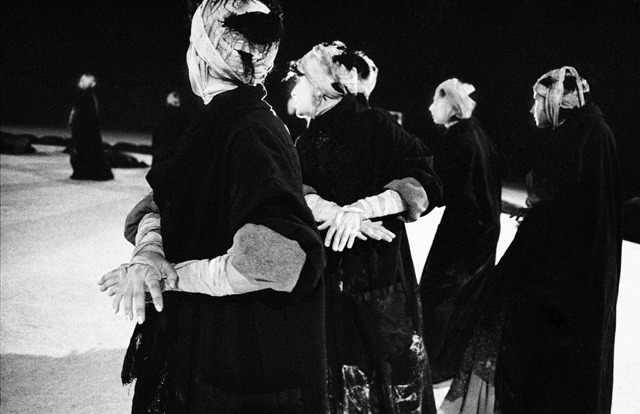
Trojan Stage

Much of the material on Trojan Women will sound familiar to regular Karaindrou listeners. The themes, although nominally character-specific, are melodically uniform, changing their instrumental clothing from visage to visage, thereby sounding a fluidity of purpose and choice. Unusual, and perhaps a point of contrast to nevertheless persistent indications of barrenness, is the presence of choir and a soprano soloist who only occasionally poises her lips above the waterline to spout names of the deep. Of central importance in this regard are the three stasimons (choral odes), each a vertebra of both story and music, a refraction of the rest. In them voices grow bolder, reaching epiphany in “An Ode Of Tears” and “In Vain The Sacrifices,” the latter a ring to which the former’s gaping clasp holds true. These voices do more than the traditional Greek chorus. They burgeon at stage center, relegated not to the wings but to the head and body of a flightless bird. Without wings, they think themselves into freedom, casting their minds from horizon to horizon, faster than the sun. They do not create the stars but make them brighter.

As a matter of course, the pieces are generally short (only one surpasses four minutes). In their sublime chemical suspensions of tears, blood, and determination swims a pair of eyes—one directed at us, the other elsewhere. Consequently, there is a feeling of stepping out of time in order to better understand its circumscription. Vast harmonic networks slumber in the underlying empty spaces, never stirring except in the most funerary moments. Despite the mythic sheen, the music of Trojan Women finds deeper mystery in the earth’s living subjects, which in isolation reveal the mystery of creation, both divine and mortal, far more acutely: in order to attain permanence one must be open to the fallacies of agreement.

Alternate Trojan
Alternate cover